99
우리나라 야생화에서 분리한 효모의 항산화 활성과 Xanthine Oxidase 및 Tyrosinase 저해활성
한상민
1·현세희
1·김나미
2·이종수
1*
1배재대학교 바이오·의생명공학과, 2한국인삼공사 글로벌제품연구소
Antioxidant Activity and Inhibitory Activities of Xanthine Oxidase and Tyrosinase of Yeasts from Wild Flowers in Korea
Sang-Min Han
1, Se-Hee Hyun
1, Na-Mi Kim
2and Jong-Soo Lee
1*
1Department of Biomedicinal Science and Biotechnology Paichai University, Daejeon 302-735, Korea
2Global Products Research Institute, Korea Ginseng Corp., Daejeon 305-805, Korea
ABSTRACT : We prepared supernatants and cell-free extracts of yeasts isolated from wild flowers in Korea, and their antioxidant activity and inhibitory activities of xanthine oxidase and tyrosinase were investigated. Among them, cell-free extracts of Kuraishia capsulata UL40-2 and Sporobolomyces ruberrimus 121-Z-3 showed significantly high xanthine oxidase inhibitory activity of 46.4%
and 48.3%, respectively. Starmerella bombicola 80-J-1 also showed tyrosinase inhibitory activity of 36.2% in the cell-free extract.
Other antioxidant activities and tyrosinase inhibitory activities were not detected or were below 20%. Maximal production of the xanthine oxidase inhibitors were observed when Kuraishia capsulate UL40-2 and Sporobolomyces ruberrimus 121-Z-3 were cultured in the yeast extract-peptone-dextrose media at 30oC for 24 hour, respectively.
KEYWORDS : Antioxidant activity, Tyrosinase inhibitory activity, Wild flower, Xanthine oxidase inhibitory activity, Yeasts
서 론
주로 자낭균류, 담자균류(유포자 효모)와 일부 불완전균 류(무포자 효모)에 분포하고 있는 효모는 Cryptococcus속 균 등 몇 종을 제외한 대부분이 비병원성 균들로서 오래 전부터 주류 등의 전통 발효 식품 제조 등에 이용되어 오
고 있고[1] 근래에 진핵세포를 가진 고등 미생물로서 분자 유전학 등의 연구재료로 이용되고 있다. 또한 효모는 다른 미생물에 비하여 빠른 생육과 배양이 용이한 이점 등이 있 어 최근에 항고혈압성 안지오텐신 전환효소 저해물질[2, 3], 항치매성 β-secretase저해물질[4], acetylcholinesterase 저해물질[5], 혈관신생억제물질[6], 미백성 tyrosinase 저해 물질[7], 혈전용해 활성물질[8] 등 다양한 의약활성물질이 나 생리기능성물질들 개발이 보고되고 있다.
저자들은 근래 우리나라 야생화들에 분포하고 있는 효 모들을 분리하여 국내외 미기록 효모들의 발굴과 함께 효 모 종 다양성을 확립하고자 전보[9-11]에서는 제주도, 울릉 도, 욕지도 등 우리나라 주요 섬들과 오서산, 백암산, 계족 산 등 주요 산들의 야생화들에서 효모들을 분리 동정하였 다. 본 연구에서는 이들의 항산화 활성과 xanthine oxidase 저해활성 및 tyrosinase 저해활성 등을 측정하여 항통풍성 xanthine oxidase 저해활성이 높은 효모들을 선별하였다.
또한 선발된 우수효모들을 이용한 xanthine oxidase 저해 물질 생산 조건을 조사하였다.
*Corresponding author E-mail: [email protected] Received June 9, 2015 Revised June 15, 2015 Accepted June 17, 2015
This is an Open Access article distributed under the terms of the Creative Commons Attribution Non-Commercial License (http://
creativecommons.org/licenses/by-nc/3.0/) which permits unrestricted non-commercial use, distribution, and reproduction in any medium, provided the original work is properly cited.
Kor. J. Mycol. 2015 June, 43(2): 99-103 http://dx.doi.org/10.4489/KJM.2015.43.2.99 pISSN 0253-651X • eISSN 2383-5249
© The Korean Society of Mycology
재료 및 방법
효모와 시약
제주도와 울릉도, 통영 앞바다의 욕지도 등의 우리나라 섬들과 충남 홍성의 오서산, 대전의 계족산, 전북 정읍의 백암산 등의 야생화들에서 분리 동정한 효모들을[9-11] 실 험에 사용하였다.
Xanthine oxidase와 tyrosinase, 1,1-diphenyl-2-picryl- hydrazyl (DPPH)는 Sigma-Aldrich (St. Louis, MO, USA) 제품을 사용하였고, 기타 시약들은 분석용 특급을 사용하 였다.
배양 상등액과 무세포 추출물의 제조
분리 효모들을 yeast extract peptone dextrose (YPD) 배 지에 접종하여 30oC에서 24시간 배양한 후 8,000 rpm으로 20분간 원심 분리하여 상등액과 세포배양물을 각각 얻었 다[12]. 세포배양물은 다시 0.1 M Tris-HCl 완충용액(pH 8.3)에 현탁시킨 후 초음파 균체파쇄기(Vibra cell; SONICS
& Materials, Newtown, CT, U.S.A.)로 파쇄하고 12,000 rpm으로 20분간 원심 분리하여 무세포추출물을 얻었다.
이들 상등액과 무세포추출물들을 동결건조시킨 후 이들을 0.1 M potassium phosphate 완충용액(pH 7.5)에 10 mg/
mL로 용해시켜 생리기능성 측정용 시료로 사용하였다[12].
생리 기능성 측정
지금까지 효모를 대상으로 연구가 많이 실시되지 않은 생리기능성 가운데 노화억제에 관련된 항산화활성과 xan- thine oxidase 저해활성 및 tyrosinase 저해활성 등을 실시 측정하였다. 항산화활성(전자공여능)은 DPPH를 이용하여 다음과 같이 측정하였다. 시료 60 µL에 DPPH 12.5 mg을 에탄올 100 mL에 용해시킨 DPPH 용액 240 µL를 첨가한 후 10분간 반응시킨 다음 525 nm에서 흡광도를 측정하여 대조구의 값과 비교하여 활성을 계산하였다[13, 14].
미백성 tyrosinase 저해활성은 시료 25 µL에 5 mM L- DOPA 50 µL, 0.1 M potassium phosphate 완충용액(pH 6.8)을 혼합한 후 tyrosinase 40 U을 첨가하여 37oC에서 10 분간 반응시켜 475 nm에서 흡광도를 측정한 후 대조구의 값과 비교하여 활성을 계산하였고 3반복의 평균값으로 표 시하였다[8].
Xanthine oxidase (XOD) 저해활성은 시료 100 µL를 1 mM xanthine 용액 200 µL와 0.05 U xanthine oxidase 100 µL에 혼합하고 0.1 M potassium phosphate buffer (pH 7.5) 600 µL 첨가하여 1 mL로 정용한 후 37oC에서 5분간 각각 반응시켰다. 1 N HCl 200 µL를 가하여 반응을 정지 시키고 12,000 rpm으로 10분간 원심 분리하여 침전된 단 백질을 제거하였다. 배양상등액과 무세포추출물 중에 함 유되어 있는 uric acid 함량을 분광분석기(UV-1601; Shi-
정량한 후 다음과 같이 각각의 xanthine oxidase 저해활성 을 계산하였고[15], 위와 같이 얻은 저해활성 결과들을 3 반복의 평균값으로 표시하였다.
Xanthine oxidase 저해활성(%) =
[1 − {A(시료구) − B(시료구 blank) / C(대조구)}] × 100
결과 및 고찰
야생화에서 분리한 효모의 항산화활성과 xanthine oxidase 및 tyrosinase 저해활성
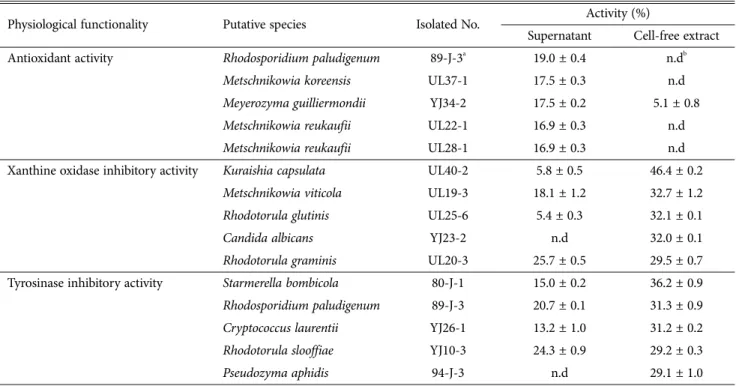
제주도와 욕지도 및 울릉도 등 우리나라 주요 섬들의 야 생화들에서 분리 동정한[9, 11] 50종 141 효모 균주들의 생 리기능성들을 배양상등액과 무세포추출물로 구분하여 측 정한 후 생리기능성별로 활성이 우수한 효모들을 5개씩 선 별한 결과는 Table 1과 같다. 항산화 활성은 제주도 성산 일출봉 야생화에서 분리한 Rhodosporidium paludigenum 89-J-3의 배양상등액이 19.0%로 가장 높았고 무세포추출 물들은 대부분 활성을 보이지 않았다. 항통풍성 XOD 저 해활성은 울릉도 나리분지의 야생화에서 분리한 Kuraishia capsulata UL40-2의 무세포추출물에서 46.4%로 비교적 높 은 활성을 보였으나 배양상등액에서는 Rhodotorula gram- inis UL20-3이 25.7%를 보였을 뿐 대체로 20% 미만으로 미 약하였다. 또한 미백성 tyrosinase 저해활성은 제주도 서귀 포 시내 야생화에서 분리한 Starmerella bombicola 80-J-1 의 무세포추출물에서 36.2%의 활성을 보였고 대부분 배양 상등액 보다는 무세포추출물에서 비교적 활성이 높았다.
이 결과들은 Hyun 등[12]이 전라북도 고군산열도의 선 유도 일대에서 2014년 4월 중순에 개화한 꽃들로부터 분리 한 효모들 중 Metschnikowia reukaufii SY44-6의 배양상등 액이 각각 49.6%의 XOD 저해활성과 38.4%의 tyrosinase 저해활성을 보였고 Cryptococcus aureus SY40-1의 무세포 추출물이 46.5%의 XOD 저해활성을 보였다는 결과와 유 사하였다. 그러나 서울 구로동의 야생화에서 분리한 Pseu- dozyma hubeiensis 228-S-1의 무세포추출물의 XOD 저해 활성(19.6%)[9]과 Han 등[17]이 덕유산 야생화에서 분리 한 Sporobolomyces phaffii JS00583의 40.4% 보다는 높은 결과였다.
한편 계족산과 오서산 및 백암산 등 우리나라 산에 서식 하는 야생화들에서 분리 동정한[10] 32종 66균주 효모들의 무세포추출물과 배양상등액들의 생리기능성을 측정한 후 위와 같이 생리기능성별로 우수효모들을 선별한 결과는 Table 2와 같다. 항통풍성 XOD 저해 활성은 Sporobolomyces ruberrimus 121-Z-3의 무세포추출물이 48.3%로 가장 높았 고 Pseudozyma antarctica 123-Z-4와 Rhodotorula glutinis 115-Z-1의 무세포추출물들도 각각 46.3%와 45.3%로 비교 적 높았으며 Filobasidium floriforme 396-JB-1의 배양상등
poridium fluviale 399-JB-1의 배양상등액에서 22.0%를 보 였을 뿐 대체로 낮았고 tyrosinase 저해활성도 5균주들의 배양상등액에서 28.6~29.9%를 보였으나 무세포추출물에 서는 20% 미만으로 미약하였다.
이 결과들은 Han 등[17]이 2014년 7월에 개화한 덕유산 일대 야생화에서 분리한 Sporobolomyces phaffii JS00583 배 양상등액의 XOD 저해활성(40.4%)보다는 높았으나 Cryp- tococcus magnus JS00570의 배양상등액의 미백성 tyrosi- Table 1. Physiological functionalities of five potent species from total 141 yeast strains of wild flowers collected in Yokjido, Ulleungdo, Jeju-do, Korea
Physiological functionality Putative species Isolated No. Activity (%)
Supernatant Cell-free extract
Antioxidant activity Rhodosporidium paludigenum 89-J-3a 19.0 ± 0.4 n.db
Metschnikowia koreensis UL37-1 17.5 ± 0.3 n.d
Meyerozyma guilliermondii YJ34-2 17.5 ± 0.2 5.1 ± 0.8
Metschnikowia reukaufii UL22-1 16.9 ± 0.3 n.d
Metschnikowia reukaufii UL28-1 16.9 ± 0.3 n.d
Xanthine oxidase inhibitory activity Kuraishia capsulata UL40-2 5.8 ± 0.5 46.4 ± 0.2
Metschnikowia viticola UL19-3 18.1 ± 1.2 32.7 ± 1.2
Rhodotorula glutinis UL25-6 5.4 ± 0.3 32.1 ± 0.1
Candida albicans YJ23-2 n.d 32.0 ± 0.1
Rhodotorula graminis UL20-3 25.7 ± 0.5 29.5 ± 0.7
Tyrosinase inhibitory activity Starmerella bombicola 80-J-1 15.0 ± 0.2 36.2 ± 0.9
Rhodosporidium paludigenum 89-J-3 20.7 ± 0.1 31.3 ± 0.9
Cryptococcus laurentii YJ26-1 13.2 ± 1.0 31.2 ± 0.2
Rhodotorula slooffiae YJ10-3 24.3 ± 0.9 29.2 ± 0.3
Pseudozyma aphidis 94-J-3 n.d 29.1 ± 1.0
aSource of description [9, 18]; bn.d, not detected or < 5%.
Table 2. Physiological functionalities of five potent yeast species from total 66 yeast strains of wild flowers collected in Mt.
Gyejok, Mt. Oseo and Mt. Baekam, Korea
Physiological functionality Putative species Isolated No. Activity (%)
Supernatant Cell-free extract
Antioxidant activity Rhodosporidium fluviale 399-JB-1a 22.0 ± 0.7 n.db
Candida sp. 383-CO-1 15.3 ± 0.8 n.d
Sporobolomyces ruberrimus 121-Z-1 14.4 ± 0.4 n.d
Cryptococcus flavescens 387-JB-2 13.5 ± 0.7 n.d
Rhodotorula glutinis 115-Z-4 12.6 ± 0.3 6.0 ± 0.6
Xanthine oxidase inhibitory activity Sporobolomyces ruberrimus 121-Z-3 7.8 ± 0.6 48.3 ± 0.7
Pseudozyma antarctica 123-Z-4 10.3 ± 0.6 46.3 ± 0.2
Rhodotorula glutinis 9-Z-1 n.d 45.3 ± 0.9
Rhodotorula mucilaginosa 380-CO-3 43.0 ± 0.4 17.9 ± 0.5
Filobasidium floriforme 396-JB-1 41.8 ± 0.3 17.8 ± 0.4
Tyrosinase inhibitory activity Auriculibuller fuscus 393-JB-1 29.9 ± 0.9 19.7 ± 0.9
Cryptococcus flavescens 373-CO-1 29.5 ± 0.6 22.7 ± 0.5
Filobasidium floriforme 396-JB-1 28.8 ± 0.9 8.5 ± 0.4
Rhodotorula nothofagi 376-CO-2 28.7 ± 0.8 15.8 ± 0.9
Cryptococcus flavescens 371-CO-2 28.6 ± 0.1 23.5 ± 0.7
aSource of description [9, 18]; bn.d, not detected or < 5%.
nase 저해활성(36.1%)보다는 낮은 결과였다.
항통풍성 xanthine oxidase 저해물질의 최적 생산 조건 위와 같이 섬과 산 지역 야생화들에서 분리한 효모들의 생리기능성 중에서 항통풍성 xanthine oxidase 저해활성이 가장 우수하였던 Kuraishia capsulate UL40-2와 Sporobol- omyces ruberrimus 121-Z-3를 최종 선정하였다. 이들을 이 용한 XOD 저해물질 생산 조건을 조사한 결과 Fig. 1과 같 이 Kuraishia capsulate UL40-2와 Sporobolomyces ruberri- mus 121-Z-3 각각을 YPD 배지에 접종하여 30oC에서 배 양하였을 때 배양시간이 경과함에 따라 XOD 저해활성이 증가하여 배양 24시간 후 얻은 무세포추출물이 47.2%와 49.5%로 가장 높은 XOD 저해활성을 보였다.
또한 yeast extract malt extract (YM), Luria bertani (LB), YPD, tryptic soy broth (TSB)와 potato dextrose broth (PDB) 배지 등을 이용하여 두 효모들의 XOD 저해물질 생 산에 미치는 배지의 영향을 검토한 결과 Kuraishia capsu- lata UL 40-2는 YPD와 YM 배지에서 각각 47.9%와 46.5%
를 보였고 PDB 배지와 TSB 배지에서는 30% 미만의 낮은 활성을 보였다(자료 미제시). Sporobolomyces ruberimus 121-Z-3 역시 YM 배지와 YPD 배지에서 배양하였을 때 가장 높은 저해활성(49.8%, 49.0%)을 보여 두 균주 모두 YPD 배지나 YM 배지가 XOD 저해물질 생산에 적당한 것 으로 생각된다.
이 결과는 Hyun 등[9]이 서울 구로동 일대에서 2012년 개화한 꽃에서 분리한 Pseudozyma hubeiensis 228-S-1을 YPD 배지에 접종하여 30oC에서 48시간 배양하여 얻은 무 세포추출물의 XOD 저해활성(19.6%)보다는 배양시간이 짧았고 더 높은 활성이었다. 그러나 Jang 등[17]의 느타리
이었다.
Xanthine oxidase는 핵산관련물질인 xanthine을 산화시 켜 요산을 생합성하는데 관여하는 rate-limiting 효소로서 이러한 요산이 관절부위에 축적되어 통풍을 유발시킨다[9].
통풍은 최근 발병이 급속히 증가하고 있는 만성 소모성 질 환의 일종이며 아직까지 효능이 우수하면서 부작용이 적은 항통풍성 건강 소재 개발은 매우 미진한 실정이다[9]. 따 라서 본 연구 결과들은 비록 느타리버섯 자실체의 물추출 물보다 활성이 낮지만 버섯 자실체의 배양기간(3~4주) 등 을 감안하였을 때 배양이 용이하고 배양시간이 짧은 이점 이 있는 효모에서의 생산은 경제적 측면에서 더 유리할 것 이고 새로운 항통풍성 건강 소재의 산업화에 기초자료로 활용할 수 있을 것이다.
적 요
제주도, 울릉도, 욕지도 등 우리나라 섬들과 계족산, 오 서산, 백암산 등의 산에서 서식하는 야생화들에서 분리한 207 효모 균주들을 YPD 배지에 24시간 배양하여 각각의 무세포추출물과 배양상등액을 제조한 후 이들의 항산화활 성과 Xanthine oxidase 저해활성 및 tyrosinase 저해활성을 측정하였다. 섬 지역 야생화들에서 분리한 Kuraishia cap- sulata UL40-2와 산 지역 야생화에서 분리한 Sporobolo- myces ruberrimus 121-Z-3의 무세포추출물이 각각 46.4%
와 48.3%의 비교적 높은 항통풍성 xanthine oxidase 저해 활성을 보였다. 또한 Starmerella bombicola 80-J-1의 무세 포추출물 역시 36.2%의 미백성 tyrosinase 저해활성을 보였 다. 그 밖의 항산화활성과 tyrosinase 저해활성은 모든 분리 효모들에서 없거나 30% 미만으로 미약하였다. 이들 가운데 Fig. 1. Effect of cultural times of Kuraishia capsulata UL40-2( ) and Sporobolomyces ruberimus 121-Z-3( ) on the production of xanthine oxidase inhibitor.
late UL40-2와 Sporobolomyces ruberrimus 121-Z-3의 xan- thine oxidase 저해제의 최적 생산 조건을 검토한 결과 두 효모 각각을 YPD에 접종하여 30oC에서 24시간 배양하여 얻은 무세포추출물이 47.2%와 49.5%의 높은 xanthine oxi- dase 저해활성을 보였다.
Acknowledgements
This work was supported by a grant from the National Institute of Biological Resources (NIBR), funded by the Ministry of Enviroment (MOE) of the Republic of Korea.
REFERENCES
1. Kim JH, Kim NM, Lee JS. Physiological characteristics and ethanol fermentation of thermotolerant yeast Saccharomyces cerevisiae OE-16 from traditional Meju. Kor J Food Nutr 1999;12:490-5.
2. Jeong SC, Kim JH, Kim NM, Lee JS. Production of anti- hypertensive angiotensin I-converting enzyme inhibitor from Malassezia pachydermatis G-14. Mycobiology 2005;33:142-6.
3. Kim JH, Lee DH, Jeong SC, Chung KS, Lee JS. Characteri- zation of antihypertensive angiotensin I-converting enzyme inhibitor from Saccharomyces cerevisiae. J Microbiol Biotech- nol 2004;14:1318-23.
4. Lee DH, Lee DH, Lee JS. Characterization of a new antide- mentia β-secretase inhibitory peptide from Saccharomyces cerevisiae. Enzyme Microb Technol 2007;42:83-8.
5. Lee DH, Lee JS, Yi SH, Lee JS. Production of the acetylcho- linesterase inhibitor from Yarrowia lipolytica S-3. Mycobiology 2008;36:102-5.
6. Jeong SC, Lee DH, Lee JS. Production and characterization of an anti-angiogenic agent from Saccharomyces cerevisiae K-7. J Micriobiol Biotechnol 2006;16:1904-11.
7. Jang IT, Kim YH, Yi SH, Lim SI, Lee JS. Screening of a new fibrinolytic substances-producing yeast. Kor J Mycol 2011;39:
227-8.
8. Jang IT, Kim YH, Kang MG, Yi SH, Lim SI, Lee JS. Produc- tion of tyrosinase inhibitor from Saccharomyces cerevisiae.
Kor J Mycol 2012;40:60-4.
9. Hyun SH, Mun HY, Lee HB, Kim HK, Lee JS. Isolation of yeasts from wild flowers in Gyonggi-do province and Jeju island in Korea and the production of anti-gout xanthine oxidase inhibitor. Kor J Microbiol Biotechnol 2013;41:383-90.
10. Min JH, Ryu JJ, Kim HK, Lee JS. Isolation and identification of yeasts from wild flowers in Gyejoksan, Oseosan and Beak- amsan of Korea. Kor J Mycol 2013;41:47-51.
11. Hyun SH, Min JH, Lee HB, Kim HK, Lee JS. Isolation and diversity of yeasts from wild flowers in Ulleungdo and Yok- jido, Korea. Kor J Mycol 2014;42:28-33.
12. Hyun SH, Han SM, Lee JS. Isolation and physiological func- tionality of yeasts from wild flowers in Seonyudo of Gogun- sanyeoldo, Jeollabuk-do, Korea. Kor J Mycol 2014;42:201-6.
13. Hyun SH, Han SM, Lee JS. Characteristics and physiological functionalities of unrecorded yeasts from wild flowers of Seonyudo in Jeollabukdo, Korea. Kor J Microbiol Biotechnol 2014;42:402-6.
14. Kim HK, Lee EN, Geum JW, Lee JS. Nutritional characteri- stics and physiological functionality of polyplant extracts from some vegetables and medicinal plants. Kor J Food Nutr 2008;
21:410-5.
15. Hyun SH, Lee JS. Microbiological characteristics and physio- logical functionality of new records of yeasts from wild flo- wers in Yokjido, Korea. Mycobiology 2014;42:198-202.
16. Han SM, Hyun SH, Lee JS. Isolation and identification of yeasts from wild flowers in Deogyu mountain and their phy- siological functionalities. Kor J Mycol 2015;43:47-52.
17. Jang IT, Hyun SH, Shin JW, Lee YH, Ji JH, Lee JS. Charac- terization of an anti-gout xanthine oxidase inhibitor from Pleurotus ostreatus. Mycobiology 2014;42:296-300.
18. Hyun SH. Isolation and identification of yeasts from wild flowers in several islands and mountains of Korea and deter- mination of their functionality [dissertation]. Daejeon (Korea):
University of Paichai; 2015.