64
한 국 균 학 회 지
The Korean Journal of Mycology
각종 곡류들로부터 야생 효모의 분리 및 종 다양성
한상민
1·박원종
2·이종수
1*
1배재대학교 바이오·의생명공학과, 2공주대학교 식품공학과
Isolation and Diversity of Wild Yeasts from Some Cereals
Sang-Min Han
1, Won-Jong Park
2and Jong-Soo Lee
1*
1Department of Biomedicinal Science and Biotechnology, Paichai University, Daejeon 302-735, Korea
2Department of Food Technology, Kongju National University, Yesan 314-701, Korea
ABSTRACT : Several kinds of wild yeasts were isolated and identified from some cereals. A total of twenty six yeast strains were isolated from eleven kinds of cereals. Among twenty six yeast strains, Saccharomyces cerevisiae were five strains and Pseudozyma antarctica were four strains. Five species of Cryptococcus including Cryptococcus magnus were also isolated. Pseudizyma aphidis were isolated from black bean, and Saccharomyces cerevisiae, Cryptococcus flavescens, Cryptococcus magnus and Hannaella zeae were also isolated from glutinous millet.
KEYWORDS : Cereals, Diversity, Identification, Isolation, Wild yeasts
지금까지 대부분의 효모들은 장류 등의 전통 발효식품 등에서 분리되어 각종 발효 식품 제조에 많이 이용되어 왔 고[1] 근래에 효모로부터 항통풍성 물질[2], 미백활성 물질 [3], 혈전용해 물질[4], 항고혈압성 물질[5, 6], 혈관신생(암 전이)억제 물질[7], 항치매 물질[8, 9] 등 각종 생리활성 물 질 생산 자원으로도 이용되고 있다.
그러나 자연환경에 분포하고 있는 야생효모들의 다양성 과 이들의 산업적 응용 연구는 많이 실시되지 않았다. 하지 만 최근 우리나라 주요 산들[10]과 제주도 등의 주요 섬들 [11-16]의 야생화들에서 효모들을 분리하여 산업적 응용을 위한 생리기능성 등을 조사하여 보고한 연구들이 늘어나고 있다. 본 연구에서는 대전의 전통 재래시장 일대에서 2014 년 10월에 수집한 각종 곡류들에서 효모들을 분리 동정하
여 이들의 분포 특성을 조사하였다.
야생효모들의 분리 및 동정은 먼저 재래시장 등에서 수 집한 곡류들에 멸균수를 넣고 1시간 동안 진탕시킨 후 이 들 현탁액을 streptomycin(50 µg/mL)과 ampicillin(50 ug/
mL)을 함유한 YPD(10 g/L yeast extract, 20 g/L dextrose, 20 g/L pepton, 15 g/L agar) 한천배지에 20 µL 도말하여 30oC 에서 2일 동안 배양한 후 생육한 효모들을 분리하였다[10].
또한 분리 효모들의 동정을 위해 전보[10]와 같이 분리 효모들의 26S rDNA의 D1/D2 부위를 polymerase chain reaction (PCR)으로 증폭시켜 염기서열을 분석하였고, 이들 염기서열들의 상동성을 BLAST (NCBI) 프로그램[17]을 사용하여 확인 비교하여 최종 동정하였다[18].
곡류들로부터 야생 효모의 분리 및 동정
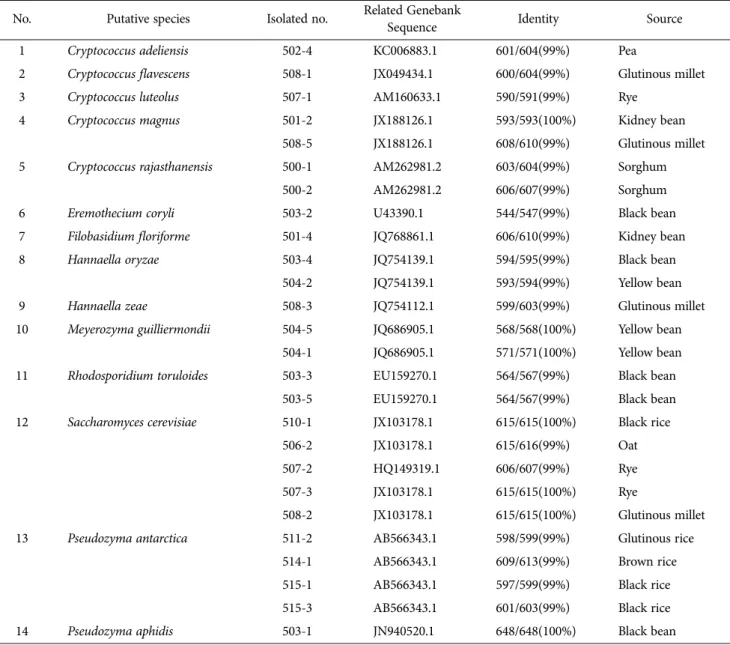
완두콩 등 11종의 곡류들로부터 모두 14종 26균주의 효 모들을 분리 동정하였다(Table 1). 이들 가운데 Saccharo- myces cerevisiae가 5균주로 단일 종으로는 가장 많이 분리 되었고 Pseudozyma antarctica가 4균주 분리되었다. 또한 Cryptococcus magnus를 포함하는 Cryptococcus속 균들이 7주 분리되었고 mold-like 효모인 Eremothecium coryli와 곡류에서 특징적으로 분리되는 Hannaella oryzae와 Han- naella zeae 등도 분리되었다.
분리 효모들의 다양성
위와 같이 곡류들로부터 분리 동정한 14종 26균주 효모
Research Note
*Corresponding author E-mail: [email protected] Received February 27, 2015 Revised March 4, 2015 Accepted March 9, 2015
This is an Open Access article distributed under the terms of the Creative Commons Attribution Non-Commercial License (http://
creativecommons.org/licenses/by-nc/3.0/) which permits unrestricted non-commercial use, distribution, and reproduction in any medium, provided the original work is properly cited.
Kor. J. Mycol. 2015 March, 43(1): 64-67 http://dx.doi.org/10.4489/KJM.2015.43.1.64 pISSN 0253-651X • eISSN 2383-5249
© The Korean Society of Mycology
각종 곡류들로부터 야생 효모의 분리 및 종 다양성
65
들의 종 다양성을 조사한 결과 서리태에서는 Pseudozyma aphidis 등의 4종의 효모들이 분리되었고 차조 역시 Saccha- romyces cerevisiae 등 4종의 효모들이 분리되어 시료 곡류 중에서 가장 많은 효모들이 분리되었다(Fig. 1). 그 밖에도 호밀, 햇백태, 흑미, 강낭콩 등에서는 2종의 효모들이 각각 분리 되었고 수수, 완두콩, 찹쌀, 귀리, 현미 등에서는 각각 1종의 효모들이 분리되었다(Fig. 1).
이상의 결과들을 종합하였을 때 각종 곡류들에는 다양 한 효모종이 분포하고 있고 공통적으로 S. cerevisiae가 많 이 분리된 것은 분리원인 곡류들이 비교적 풍부한 탄수화 물 외에도 효모의 생육에 필요한 미네랄 등의 다양한 물질 들을 함유하고 있기 때문인 것으로 생각된다. 이 결과는 전 통발효식품이나 이들의 부원료에는 S. cerevisiae가 많이 분 포하고 있다는 보고[1, 7, 8]와 유사한 경향을 나타냈다. 그 러나 하천, 연못가, 야산 등지[19]와 울릉도와 욕지도[13]
등의 야생화에서 Cryptococcus속 균이 많이 분리된 것과는 다른 분포 특성으로 자연환경에 분포하는 야생효모들은 환 경에 따라 특정한 효모들만이 독립적으로 분포하는 것이 아니고 다양한 종 분포 특성을 보이는 것으로 추정된다.
적 요
전통 재래시장 등에서 수집한 곡류 11점에서 효모 14종 26균주들을 분리 동정하였다. 이들 균주 중에서 Saccharo- myces cerevisiae가 5균주로 단일 종으로는 가장 많이 분리 되었고 Pseudozyma antarctica도 4균주가 분리되었으며 Cryptococcus magnus를 포함하는 Cryptococcus도 5종이 분 리되었다. 또한 서리태와 차조에서 각각 4종의 비교적 많은 야생 효모들이 분리되었다.
Table 1. Yeast species from several kinds of cereals in Korea
No. Putative species Isolated no. Related Genebank
Sequence Identity Source
1 Cryptococcus adeliensis 502-4 KC006883.1 601/604(99%) Pea
2 Cryptococcus flavescens 508-1 JX049434.1 600/604(99%) Glutinous millet
3 Cryptococcus luteolus 507-1 AM160633.1 590/591(99%) Rye
4 Cryptococcus magnus 501-2 JX188126.1 593/593(100%) Kidney bean
508-5 JX188126.1 608/610(99%) Glutinous millet
5 Cryptococcus rajasthanensis 500-1 AM262981.2 603/604(99%) Sorghum
500-2 AM262981.2 606/607(99%) Sorghum
6 Eremothecium coryli 503-2 U43390.1 544/547(99%) Black bean
7 Filobasidium floriforme 501-4 JQ768861.1 606/610(99%) Kidney bean
8 Hannaella oryzae 503-4 JQ754139.1 594/595(99%) Black bean
504-2 JQ754139.1 593/594(99%) Yellow bean
9 Hannaella zeae 508-3 JQ754112.1 599/603(99%) Glutinous millet
10 Meyerozyma guilliermondii 504-5 JQ686905.1 568/568(100%) Yellow bean
504-1 JQ686905.1 571/571(100%) Yellow bean
11 Rhodosporidium toruloides 503-3 EU159270.1 564/567(99%) Black bean
503-5 EU159270.1 564/567(99%) Black bean
12 Saccharomyces cerevisiae 510-1 JX103178.1 615/615(100%) Black rice
506-2 JX103178.1 615/616(99%) Oat
507-2 HQ149319.1 606/607(99%) Rye
507-3 JX103178.1 615/615(100%) Rye
508-2 JX103178.1 615/615(100%) Glutinous millet
13 Pseudozyma antarctica 511-2 AB566343.1 598/599(99%) Glutinous rice
514-1 AB566343.1 609/613(99%) Brown rice
515-1 AB566343.1 597/599(99%) Black rice
515-3 AB566343.1 601/603(99%) Black rice
14 Pseudozyma aphidis 503-1 JN940520.1 648/648(100%) Black bean
66
한상민·박원종·이종수Acknowledgements
This work was supported by a grant from the National Institute of Biological Resources (NIBR), funded by the Ministry of Environment (MOE) of the Republic of Korea (NIBR No. 2013-02-001).
REFERENCES
1. Kim JH, Kim NM, Lee JS. Physiological characteristics and ethanol fermentation of thermotolerant yeast Saccharomyces cerevisiae OE-16 from traditional Meju. Korean J Food Nutr 1999;12:490-5.
2. Hyun SH, Mun HY, Lee HB, Kim HK, Lee JS. Isolation of yeasts from wild flowers in Gyonggi-do province and Jeju island in Korea and the production of anti-gout xanthine oxidase inhibitor. Korean J Microbiol Biotechnol 2013;41:383- 90.
3. Jang IT, Kim YH, Kang MG, Yi SH, Lim SI, Lee JS. Produc- tion of tyrosinase inhibitor from Saccharomyces cerevisiae.
Kor J Mycol 2012;40:60-4.
4. Jang IT, Kim YH, Yi SH, Lim SI, Lee JS. Screening of a new
fibrinolytic substances-producing yeast. Kor J Mycol 2011;39:
227-8.
5. Jeong SC, Kim JH, Kim NM, Lee JS. Production of antihyper- tensive angiotensin I-converting enzyme inhibitor from Mal- assezia pachydermatis G-14. Mycobiology 2005;33:142-6.
6. Kim JH, Lee DH, Jeong SC, Chung KS, Lee JS. Characteriza- tion of antihypertensive angiotensin I-converting enzyme in- hibitor from Saccharomyces cerevisiae. J Micriobiol Biotechnol 2004;14:1318-23.
7. Jeong SC, Lee DH, Lee JS. Production and characterization of an anti-angiogenic agent from Saccharomyces cerevisiae K-7. J Micriobiol Biotechnol 2006;16:1904-11.
8. Lee DH, Lee DH, Lee JS. Characterization of a new antidem- entia β-secretase inhibitory peptide from Saccharomyces cere- visiae. Enzyme Microb Technol 2007;42:83-8.
9. Lee DH, Lee JS, Yi SH, Lee JS. Production of the acetycholi- nesterase inhibitor from Yarrowia lipolytica S-3. Mycobiology 2008;36:102-5.
10. Min JH, Ryu JJ, Kim HK, Lee JS. Isolation and identification of yeasts from wild flowers in Gyejoksan, Oseosan and Beak- amsan of Korea. Kor J Mycol 2013;41:47-51.
11. Hyun SH, Mun HY, Lee HB, Kim HK, Lee JS. Isolation of yeasts from wild flowers in Gyonggi-do province and Jeju island in Korea and the production of anti-gout xanthine Fig. 1. Diversity of yeast from cereals.
각종 곡류들로부터 야생 효모의 분리 및 종 다양성
67
oxidase inhibitor. Korean J Microbiol Biotechnol 2013:41:383- 90.
12. Hyun SH, Min JH, Lee HB, Kim HK, Lee JS. Characteristics of two unrecorded yeasts from wild flowers in Ulleungdo, Korea. Kor J Mycol 2014;42:170-3.
13. Hyun SH, Min JH, Lee HB, Kim HK, Lee JS. Isolation and diversity of yeasts from wild flowers in Ulleungdo and Yok- jido, Korea. Kor J Mycol 2014;42:28-33.
14. Hyun SH, Lee JS. Microbiological characteristics and physio- logical functionality of new records of yeasts from wild flo- wers in Yokjido, Korea. Mycobiology 2014;42:198-202.
15. Hyun SH, Han SM, Lee JS. Characteristics and physiological functionalities of unrecorded yeasts from wild flowers of Seon- yudo in Jeollabukdo, Korea. Korean J Microbiol Biotechnol.
2014;42:402-6.
16. Hyun SH, Han SM, Lee JS. Isolation and physiological func- tionality of yeasts from wild flowers in Seonyudo of Gogun- sanyeoldo, Jeollabuk-do, Korea. Kor J Mycol 2014;42:201-6.
17. Altschul SF, Madden TL, Schäffer AA, Zhang J, Zhang Z, Miller W, Lipman DJ. Gapped BLAST and PSI-BLAST: a new generation of protein database search programs. Nucleic Acids Res 1997;25:3389-402.
18. Kurtzman CP, Robnett CJ. Identification and phylogeny of ascomycetous yeasts from analysis of nuclear large subunit (26S) ribosomal DNA partial sequences. Antonie Van Lee- uwenhoek 1998;73:331-71.
19. Min JH, Hyun SH, Kang MG, Lee HB, Kim CM, Kim HK, Lee JS. Isolation and identification of yeasts from wild flo- wers of Daejeon city and Chungcheongnam-do in Korea. Kor J Mycol 2012;40:141-4.