This is an Open Access article
© 2020 THE KOREAN SOCIETY OF MYCOLOGY.
Accepted: November 30, 2020 Revised: November 19, 2020 Received: October 30, 2020 https://doi.org/10.4489/KJM.20200045 Kor. J. Mycol. 2020 December, 48(4): 475-484
OPEN ACCESS pISSN : 0253-651X eISSN : 2383-5249
RESEARCH ARTICLE
국내에 서식하는 꽃에서 분리한 야생 효모 분포 및 종 다양성
김정선1,2, 이미란1, 김재윤1, 허준1, 권순우1, 윤봉식2, 김수진1,*
1국립농업과학원 농업미생물과, 2전북대학교 환경생명자원대학 생명공학부
Distribution and Species Diversity of Wild Yeasts Isolated from Flowers in Korea
Jeong-Seon Kim1,2, Miran Lee1, Jae Yoon Kim1, jun Heo1, Soon-Wo Kwon1, Bong Sik Yun2, Soo-Jin Kim1,*
1Agricultural Microbiology Division. National Institute of Agricultural Science, RDA, Wanju 55365, Korea.
2Division of Biotechnology and Advanced institute of Environmental and Bioscience, College of Environmental and Bioresource Sciences, Chonbuk National University, Chonbuk 54596, Korea.
*Corresponding author: [email protected]
ABSTRACT
Various indigenous yeasts were isolated and obtained from flowers in the Republic of Korea, and their distribution and species diversity were studied. Seventy-seven flowers were collected from 25 areas in Korea, and 502 yeast strains were isolated from these flowers.
A total of 50 species were identified by comparing large subunit rDNA gene sequence homology with the type strains of yeasts. The analysis of yeast distribution showed that the dominant yeast species were Aureobasidium pullulans, A. leucospermi, and Filobasidium magnum in each region and flower samples. Except for the above three yeast species, no species of yeasts showed any meaningful distribution among the habitat regions and sources. In conclusion, 50 species of indigenous yeasts were obtained from flowers that can be used as industrial resources, and the data could be used for further research on yeast diversity and interactions between yeast and its host.
Keywords: Diversity, Flowers, Identification, Yeast
서론
효모는 다양한 서식지에서 다양하게 분포한다고 알려져 있다[1]. 토양과 수생환경에서의 효모 서식에 관한 연구는 많이 이루어지고 있지만 식물과 관련된 효모 군집(community)의 다양성과 그
하다고 보고되고 있다[8-9]. 꽃은 다양한 효모의 서식지로 알려질 뿐 아니라 꽃의 꿀 농도에 효모 가 직접적으로 영향을 주며 서로 간에 연관성을 증명하려는 연구 또한 다각도로 진행되고 있다 [10].
본 연구는 국내에 분포하는 꽃을 분리원으로 하여 지역별, 분리원별 효모의 다양성과 분포 특 성에 관한 기초 자료를 확보하고, 국내에서 서식하고 있는 다양한 토착 효모 종을 수집하고자 하 였다.
재료 및 방법
국내 지역별 꽃 채집 및 효모 순수 분리
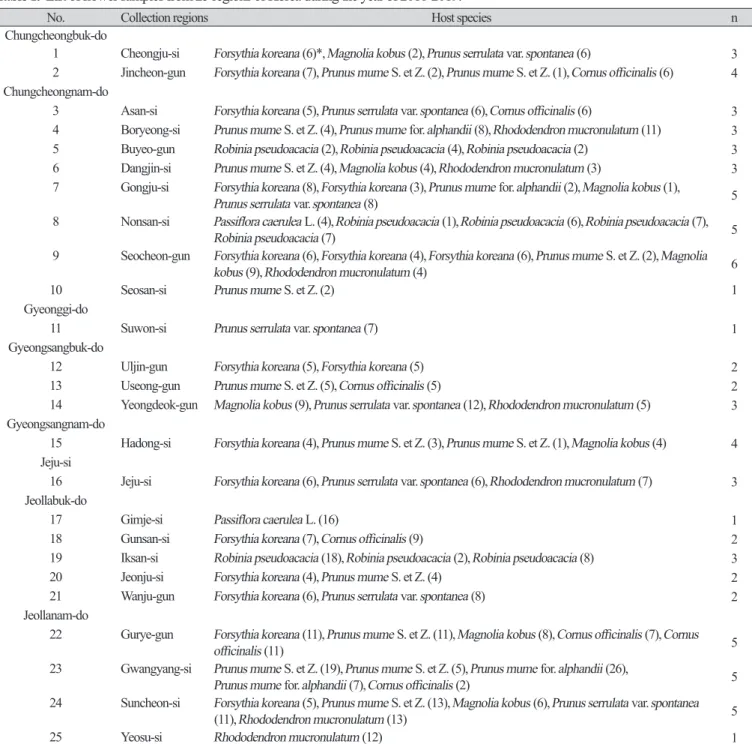
2018년에서 2019년까지 경기도 수원, 충청북도 청주, 진천, 충청남도 아산, 보령, 부여, 당진, 공 주, 논산, 서천, 서산, 전라북도 김제, 군산, 익산, 전주, 완주, 전라남도 구례, 광양, 순천, 여수, 경상 북도 울진, 의성, 영덕, 경상남도 하동, 제주도, 25지역에서 꽃 9종(n=77)을 채취하였다. 9종의 꽃 은 개나리(Forsythia koreana) 17개체, 매화(Prunus mume S. et Z.) 14개체, 홍매화(Prunus mume for.
alphandii) 3개체, 황매화(Passiflora caerulea L.) 2개체, 벚꽃(Prunus serrulata var. spontanea) 8개체, 아 카시아(Robinia pseudoacacia) 9개체, 진달래(Rhododendron mucronulatum) 7개체, 산수유(Cornus officinalis) 7개체, 목련(Magnolia kobus) 8개체가 각각의 지역에서 채집되었다(Table 1).
채취된 꽃은 멸균된 0.85% sodium chloride buffer에 희석하여 항생제(chloramphenicol 17 mg/L과 propionic acid 1.25 g/L)가 첨가된 5종 배지; MEA (malt extract agar), DG18 (dichloran-glycerol agar), DRBC (dichloran rose bengal chloramphenicol agar), YMA(yeast malt extract agar), GPYA(glucose- peptone-yeast extract agar)에 각각 희석평판하고 3차 계대배양을 실시하여 효모 균주를 순수분리 하였다.
효모 염기서열 분석 및 분자계통학적 분석
분리된 효모의 large-subunit (LSU) rDNA gene의 D1/D2 영역 염기서열은 ㈜마크로젠(Macrogen, Seoul, Korea)의 염기서열 분석 의뢰를 통해 확보하였다. 프라이머는 NL1 (5�-GCATATCAATAAG CGGAGGAAAAG-3'), NL4 (5�-GGTCCGTGTTTCAAGACGG-3′)을 사용하여 양방향 분석하였다.
염기서열 분석 및 계통수 제작을 위한 프로그램은 MEGA ver. 7.0 software를 사용하였다[11]. 분 석은 maximum likelihood statistical method (ML)과 bootstrap method (n=1,000)을 설정값으로 수행하 였다. 표준균주 염기서열은 NCBI blast (https://blast.ncbi.nlm.nihg.gov/Blast.cgi)의 데이터베이스를 참고하였고, 상동성 비교는 DNAMAN 7.0 (Lynnon Co., Quebec, Canada) software로 수행하였다.
결과 및 고찰
국내에 서식하는 꽃에서 유래한 야생 효모의 분리 및 동정
국내 25개 시·군(경기 1, 충북 2, 충남 8, 전북 5, 전남 4, 경북 3, 경남 1, 제주 1)에서 2018년부터 2 년간 꽃 9종(n=77)을 채집하여 효모 502균주를 분리하였다. 분리된 효모의 LSU rDNA gene D1/D2 영역 염기서열을 분석하여 기존에 알려진 효모 표준균주 염기서열과 상동성을 비교하여 동정하 였다. 그 결과 자낭균으로는 363균주(strain)가 3목(order), 9과(family), 26종(species)으로, 담자균으 로는 139균주가 5목, 8과, 24종으로 동정되었다(Table 1, 2).
Table 1. List of flower samples from 25 regions of Korea during the year of 2018-2019.
No. Collection regions Host species n
Chungcheongbuk-do
1 Cheongju-si Forsythia koreana (6)*, Magnolia kobus (2), Prunus serrulata var. spontanea (6) 3 2 Jincheon-gun Forsythia koreana (7), Prunus mume S. et Z. (2), Prunus mume S. et Z. (1), Cornus officinalis (6) 4 Chungcheongnam-do
3 Asan-si Forsythia koreana (5), Prunus serrulata var. spontanea (6), Cornus officinalis (6) 3 4 Boryeong-si Prunus mume S. et Z. (4), Prunus mume for. alphandii (8), Rhododendron mucronulatum (11) 3 5 Buyeo-gun Robinia pseudoacacia (2), Robinia pseudoacacia (4), Robinia pseudoacacia (2) 3 6 Dangjin-si Prunus mume S. et Z. (4), Magnolia kobus (4), Rhododendron mucronulatum (3) 3 7 Gongju-si Forsythia koreana (8), Forsythia koreana (3), Prunus mume for. alphandii (2), Magnolia kobus (1),
Prunus serrulata var. spontanea (8) 5
8 Nonsan-si Passiflora caerulea L. (4), Robinia pseudoacacia (1), Robinia pseudoacacia (6), Robinia pseudoacacia (7),
Robinia pseudoacacia (7) 5
9 Seocheon-gun Forsythia koreana (6), Forsythia koreana (4), Forsythia koreana (6), Prunus mume S. et Z. (2), Magnolia
kobus (9), Rhododendron mucronulatum (4) 6
10 Seosan-si Prunus mume S. et Z. (2) 1
Gyeonggi-do
11 Suwon-si Prunus serrulata var. spontanea (7) 1
Gyeongsangbuk-do
12 Uljin-gun Forsythia koreana (5), Forsythia koreana (5) 2
13 Useong-gun Prunus mume S. et Z. (5), Cornus officinalis (5) 2
14 Yeongdeok-gun Magnolia kobus (9), Prunus serrulata var. spontanea (12), Rhododendron mucronulatum (5) 3 Gyeongsangnam-do
15 Hadong-si Forsythia koreana (4), Prunus mume S. et Z. (3), Prunus mume S. et Z. (1), Magnolia kobus (4) 4 Jeju-si
16 Jeju-si Forsythia koreana (6), Prunus serrulata var. spontanea (6), Rhododendron mucronulatum (7) 3 Jeollabuk-do
17 Gimje-si Passiflora caerulea L. (16) 1
18 Gunsan-si Forsythia koreana (7), Cornus officinalis (9) 2
19 Iksan-si Robinia pseudoacacia (18), Robinia pseudoacacia (2), Robinia pseudoacacia (8) 3
20 Jeonju-si Forsythia koreana (4), Prunus mume S. et Z. (4) 2
21 Wanju-gun Forsythia koreana (6), Prunus serrulata var. spontanea (8) 2
Jeollanam-do
Table 2. Flower-living yeasts isolated from 25 regions of Korea during the year of 2018-2019. (to be continued)
Species of yeasts No. of Strain Equivalent strain designation Related GenBank sequence Identity (%) Ascomycotaa-Capnodialesb-Cladosporiaceaec
Cladosporium endophytica 2 MFLUCC17-0599T MG646949.1 576/577 (99.83%)
Ascomycotaa-Dothidealesb-Saccotheciaceaec
Aureobasidium leucospermi Group C1 4 CBS 130593T NG058566.1 585/586 (99.83%)
Aureobasidium leucospermi Group C4 4 CBS 130593T NG058566.1 581/586 (99.15%)
Aureobasidium leucospermi Group C6 78 CBS 130593T NG058566.1 581/585 (99.32%)
Aureobasidium melanogenum Group B2 7 CBS 105.22T FJ150926.1 583/583 (100%)
Aureobasidium namibiae Group D1 7 CBS 147.97T FJ150937.1 581/585 (99.32%)
Aureobasidium namibiae Group D8 1 CBS 147.97T FJ150937.1 580/582 (99.31%)
Aureobasidium pulluans Group A11 167 CBS 584.75T NG055734.1 582/582 (100%)
Aureobasidium pulluans Group A2 2 CBS 584.75T NG055734.1 580/581 (99.83%)
Aureobasidium pulluans Group A6 1 CBS 584.75T NG055734.1 584/585 (99.83%)
Aureobasidium pulluans Group A7 1 CBS 584.75T NG055734.1 578/579 (99.83%)
Aureobasidium pulluans Group A9 2 CBS 584.75T NG055734.1 586/587 (99.83%)
Ascomycotaa-Saccharomycetalesb-Debaryomycetaceaec
Candida boleticola 6 CBS 6420T KY106351.1 537/537 (100%)
Candida saitoana 2 CBS 940T KY106730.1 552/553 (99.82%)
Debaryomyces nepalensis 1 CBS 5921T KY107578.1 559/561 (99.64%)
Debaryomyces prosopidis 5 JCM 9913T NG055701.1 584/584 (100%)
Meyerozyma caribbica 1 NRRL-Y-27274T EU348786.1 567/570 (99.47%)
Meyerozyma guilliermondii 16 NRRL-Y-2075T JQ689047.1 573/574 (99.83%)
Ascomycotaa-Saccharomycetalesb-Dipodascaceaec
Yarrowia deformans 1 CBS 2071T EF405984.1 480/480 (100%)
Yarrowia lipolytica 1 CBS 6124T AM268450.1 483/484 (99.79%)
Ascomycotaa-Saccharomycetalesb-Metschnikowiaceaec
Metschnikowia rancensis 2 CBS 8174T AJ508580.1 505/509 (99.21%)
Metschnikowia reukaufii 11 CBS 5834T KY108499.1 518/522 (99.23%)
Ascomycotaa-Saccharomycetalesb-Phaffomycetaceaec
Candida vartiovaarae 6 CBS 4289T KY106862.1 555/555 (100%)
Cyberlindnera fabianii 2 NRRL-Y-1871T EF550321.1 577/577 (100%)
Wickerhamomyces anomalus 9 NRRL-Y-366T NG057174.1 554/555 (99.82%)
Wickerhamomyces arborarius 3 CBS 12941T KY110107.1 459/460 (99.78%)
Ascomycotaa-Saccharomycetalesb-Pichiaceaec
Nakazawaea siamensis 1 DMKU RK467T NG060235.1 555/556 (99.82%)
Pichia membranifaciens 1 CBS 107T KY108878.1 575/578 (99.48%)
Ascomycotaa-Saccharomycetalesb-Saccharomycetaceaec
Lachancea thermotolerans 7 NRRL-Y-8284T NG042626.1 575/575 (100%)
Ascomycotaa-Saccharomycetalesb-Saccharomycetales incertae sedisc
Candida argentea 1 CBS 12358T KY106304.1 540/540 (100%)
Candida bombi 2 Y-17081T U45706.1 480/483 (99.38%)
Candida sake 3 CBS 159T KY106745.1 556/556 (100%)
Candida temnochilae 6 CBS 9938T AY242344.1 529/531 (99.68%)
Ascomycota-Filobasidialesb-Filobasidiaceaec
Cryptococcus albidus var. kuetzingii 1 CBS 1926T KY106960.1 570/570 (100%)
Filobasidium magnum 36 CBS 140T KY107722.1 617/618 (99.84%)
Naganishia adeliensis 11 CBS 8351T KY108601.1 597/598 (99.82%)
Naganishia albida 4 CBS 142T NG055717.1 598/598 (100%)
Naganishia diffluens 2 CBS 160T KY108608.1 565/565 (100%)
Naganishia friedmannii 11 CBS 7160T KY108613.1 613/614 (99.84%)
Naganishia uzbekistanensis 1 CBS 8683T KY108618.1 553/554 (99.82%)
Table 2. Flower-living yeasts isolated from 25 regions of Korea during the year of 2018-2019.
Species of yeasts No. of Strain Equivalent strain designation Related GenBank sequence Identity (%) Basidiomycotaa-Microbotryomycetes incertae sedisb-Microbotryomycetes incertae sedisc
Curvibasidium pallidicorallinum 23 CBS 9091T KY107299.1 555/555 (100%)
Basidiomycotaa-Sporidiobolalesb-Sporidiobolaceaec
Rhodotorula dairenensis 3 CBS 4406T KY108996.1 575/575 (100%)
Rhodotorula graminis 17 CBS 2826T AF070431.1 593/593 (100%)
Rhodotorula mucilaginosa 4 CBS 316T NG055716.1 591/591 (100%)
Rhodotorula taiwanensis 2 CBS 11729T KY109163.1 579/580 (99.83%)
Sporobolomyces phaffii 6 CBS 9129T KY109760.1 590/593 (99.49%)
Basidiomycotaa-Tremellalesb-Bulleraceaec
Bullera alba 1 CBS 500T NG042387.1 613/613 (100%)
Basidiomycotaa-Tremellalesb-Bulleribasidiaceaec
Hannaella kunmingensis 1 JCM 11006T NG042317.1 617/617 (100%)
Hannaella luteola 1 CBS 943T AJ555466.1 614/614 (100%)
Hannaella oryzae 1 CBS 7194T NG042351.1 611/612 (99.84%)
Basidiomycotaa-Tremellalesb-Cryptococcaceaec
Kwoniella pini 1 VKM-Y-2958T NG042453.1 611/611 (100%)
Kwoniella shandongensis 1 Y13-1T JN160602.1 610/610 (99.51%)
Basidiomycotaa-Tremellalesb-Rhynchogastremataceaec
Papiliotrema aurea 5 CBS 318T KY108728.1 597/600 (99.50%)
Papiliotrema pseudoalba 1 CBS 7227T NG058276.1 606/607 (99.84%)
Papiliotrema rajasthanensis 1 CBS 10406T KY108743.1 574/575 (99.83%)
Basidiomycotaa-Trichosporonalesb-Trichosporonaceaec
Cutaneotrichosporon moniliiforme 3 CBS 2467T KY107333.1 607/617 (98.38%)
Trichosporon aquatile 2 CBS 5973T NG058417.1 608/608 (100%)
Total number of strains 502
a Phylum; b Order; c Family; taxonomy of yeasts from those phylum level to family level
꽃 유래 야생 효모의 지역별 및 분리원별 다양성
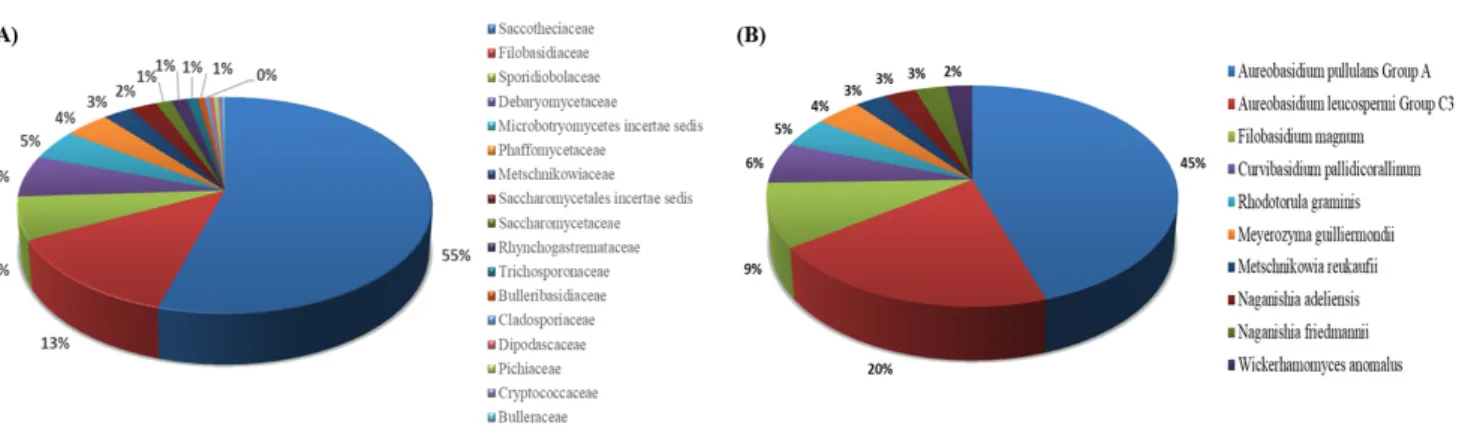
총 502균주의 효모 중에서 자낭균 Saccotheciaceae family에 속하는 Aureobasidium pullulans (173균주)과 A. leucospermi (86균주)가 가장 많이 분리되었고, 담자균 Filobasidiaceae family 의 Filobasidium magnum (36균주)이 다음 순위로 분리되었다(Fig. 1). 가장 발생 빈도가 높은 A.
pullulans는 주로 식물 표면에 부착하여 서식하는 종으로 보고되었고, 5% 미만의 빈도로 분리 된 Rhodotorula, Cryptococcus, Sporobolomyces 속 등의 담자균류도 식물 잎에서의 분포가 보고 된 바 있다[12-13]. 국내 주요 산과 섬, 논밭과 과수원, 수목원, 하천 등지의 야생화로부터 선행 된 발생 보고에 의하면 Cryptococcus 속, Pseudozygoma 속, Rhodotorula 속, Sporobolomyces 속, Metschnikowia 속 등이 주로 분리되었다[14-18]. 스페인 남부지역의 다양한 꽃의 꿀에서 효모의 다양성에 관한 연구에서는 꽃의 당 농도 및 온도를 조절하거나 곤충 행동이나 식물의 활력에 미 친다고 알려있는 Metschnikowia reukaufii와 M. gruessii 종이 꽃의 꿀에 가장 많이 분포하고 그다음 빈도로 A. pullulans가 분포한다고 보고한 바 있다[5,8]. 이는 본 연구에서 보여준 효모 종의 분포와
Fig. 1. Distribution and classification of yeasts isolated from flowers in Korea during the year of 2018-2019. (A) Classification of yeasts at
family-level (B) Classification of yeasts at species-level; In (B), only the top 10 species of yeasts were shown.채집 지역에 따라 효모의 분포 특성을 살펴보면, 꽃이 많이 채집된 지역인 충청남도와 전라남 도 지역에서 각각 24종 139균주와 24종 167균주가 분리되었다. 모든 지역에서 A. pullulans와 A.
leucospermi가 분리되었으며, F. magnum은 꽃이 적게 채집된 경기도와 제주도를 제외하고 모든 지역에서 분리되었다. 효모 3종 A. pullulans, A. leucospermi, F. magnum의 경우 여러 지역에서 골고 루 분포하는 것으로 보아 국내에 분포하는 많은 꽃이 위의 주요한 효모 3종의 서식지로써 적합한 환경을 제공하는 것으로 보인다(Fig. 2).
효모의 분포는 지역적으로 유의미한 차이는 보이지 않았지만, 다양한 지역에서 분리된 효모는 앞선 연구에서와같이 샘플링 단위 수가 증가할수록 효모의 다양성이 증가함을 확인할 수 있었다
[10].
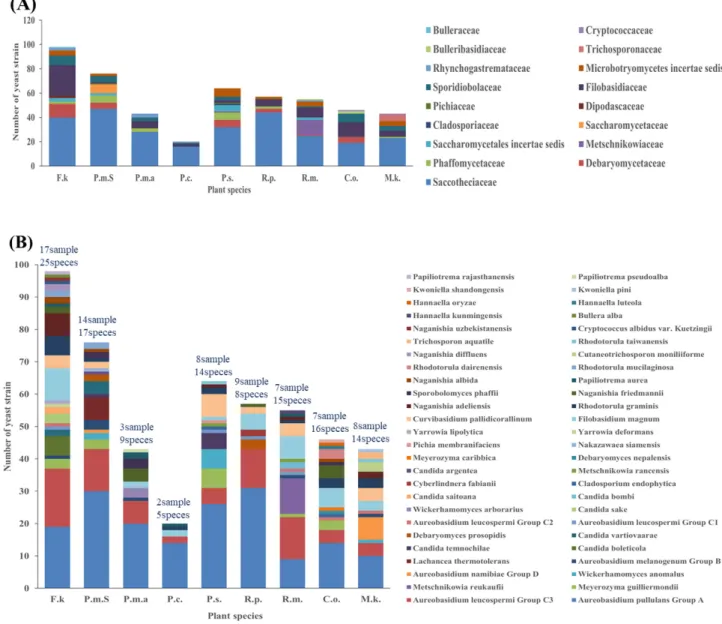
꽃 종류에 따른 효모 종(species)의 분포를 살펴보면, 분리원으로 사용된 모든 꽃에서 효모가 분 리되었고 꽃 1종에서 효모는 최대 6종까지 분리할 수 있었다. 17시료로 가장 많이 채집된 개나리 (Forsythia koreana)로 부터 25종의 효모를 분리할 수 있었고, 지역적 분포에서 나타난 결과와 같이 모든 시료에서 A. pullulans, A. leucospermi, F. magnum가 분리되었고 채집된 시료가 다양할수록 다 양한 효모를 확보할 수 있었다(Fig. 3). 주요한 3종 효모를 제외하고는 분리원에 따라 효모 종은 각 기 다른 분포를 보였고, 대부분의 경우 꽃에 따른 효모 종 분포 유의성은 확인할 수 없었고 추후 연구를 통해 더 많은 샘플링과 더 많은 지역에서의 연구가 필요한 것으로 사료된다. 하지만 세계 여러 지역에서의 꽃과 효모의 광범위적 지역 분포 특성과 같은 많은 데이터베이스가 요구되는 연구를 위한 기초 자료로써 활용될 수 있을 것으로 기대한다[5].
본 연구에서는 국내에 서식하는 꽃에 A. pullulans, A. leucospermi, F. magnum 효모 3종이 우점하 는 것을 확인하였고, 다양한 효모 종의 지역별 및 분리원별 차이를 살펴봄으로써 효모와 기주 간 의 상호작용이나 효모 다양성 연구에 기초 자료로 구축하였다. 또한 국내 토착 효모 50종을 확보 함으로써 효모의 산업적 응용 분야를 위한 귀중한 자원으로 활용하고자 한다.
적요
국내에 서식하는 꽃에서 다양한 토착 효모를 분리 및 확보하고 효모의 분포 특성과 종 다양성에 관해 연구하였다. 국내 25지역에서 꽃 9종 77개체를 채집한 후 효모를 순수분리하였다. 효모 502 균주의 large-subunit (LSU) rDNA 염기서열을 분석 및 상동성 비교로 각 효모의 종을 동정하였다. 분 리된 효모는 총 50종으로 동정 되었고, 모든 꽃 시료로부터 Aureobasidium pullulans, A. leucospermi, Filobasidium magnum이 분리되었다. 꽃에 우점한 효모 3종을 제외하고, 효모 균주 수가 적게 분리된 종은 지역과 분리원에 따른 유의성을 확인할 수는 없었다. 본 연구를 통해 꽃으로부터 확보한 국내 토착 효모 50종은 산업적 활용을 위한 자원으로써 역할을 기대할 수 있고, 추후 효모와 기주 간의 상호작용이나 효모 다양성 연구의 기초 자료로써 활용될 수 있을 것이다.
Fig. 3. Distribution of yeasts isolated from various flowers collected in Korea. (A) Classification of yeasts at family-level. (B) Classification of
yeasts at species-level. Scientific names of flowers: F.k., Forsythia koreana; P.m.S, Prunus mume S. et Z.; P.m.a., Prunus mume for. alphandii;P.c., Passiflora caerulea L; P.s., Prunus serrulata var. spontanea; R.p., Robinia pseudoacacia; R.m., Rhododendron mucronulatum; C.o., Cornus officinalis; M.k., Magnolia kobus.
ACKNOWLEDGEMENTS
This work was supported by a grant National Institute of Agricultural Science, Rural Development Administration (Project No. PJ01354906) in Korea.
REFERENCES
1. Kurtzman PC, Fell WJ. Amsterdam, the yeasts, a taxonomic study, fifth edition. London:
Elsevier; 2011; p. 65.
2. Han SM, Hyun SH, Lee HB, Lee HW, Kim HK, Lee JS. Isolation and identification of wild yeasts from soils of paddy fields in Daejeon metropolitan city and Chungcheongnam-do, Korea. Kor J Mycol 2016;44:1-7.
3. Han SM, Lee JS. Isolation and identificationof wild yeasts from soils of an herb park in Seoul metropolitan city and characteristics of unrecorded yeasts. Kor J Mycol 2016;44:108-12.
4. Han SM, Kim HK, Lee HB, Lee JS. Isolation and identification of wild yeasts from freshwaters and soils of Nakdong and Yeongsan river, Korea, with characterization of two unrecorded yeasts. Kor J Mycol 2016;44:350-4.
5. de Vega C, Albaladejo RG, Guzmán B, Steenhuisen SL, Johnson DS, Herrera MC, Lachance MA. Flowers as a reservoir of yeast diversity: description of Wickerhamiella nectarea f.a. sp.
nov., and Wickerhamiella natalensis f.a. sp. nov. from South African flowers and pollinators, and transfer of related Candida species to the genus Wickerhamiella as new combinations.
FEMS Yeast Res 2017;17:1-11.
6. Lachance AM, Bowles MJ, Starmer TW, Barker SJ. Kodamaea kakaduensis and Candida tolerans, two new ascomycetous yeast species from Australian Hibiscus flowers. Can J Microbiol 1999;45:172-77.
7. Hong SG, Chun JS, Oh HW, Bae KS. Metschnikowia koreensis sp. nov., a novel yeast species isolated from flowers in Korea. Int J Syst Evol Microbiol 2001;51:1927-31.
8. Pozo IM, Herrera MC, Bazaga P. Species richness of yeast communities in floral nectar of southern Spanish plants. Microb Ecol 2011;61:82-91.
9. Mittelbach M, Yurkow MA, Nocentini D, Nepi M, Weigend M, Begerow D. Nectar sugars and bird visitation define a floral niche for basidiomycetous yeast on the canary islands. BMC Ecol 2015;15:1-13.
10. Canto A, Herrera MC, Rodriguez R. Nectar-living yeasts of a tropical host plant community:
Diversity and effects on community-wide floral nectar traits. PeerJ 2017;5:e3517.
11. Kumar S, Stercher G, Tamura K. MEGA7: Molecular evolutionary genetics analysis version 7.0 for bigger datasets. Mol Biol Evol 2016;33:1870-4.
12. Fonseca Á, Inácio J. Phylloplane yeasts. The yeasts handbook. Biodiversity and ecophysiology of yeasts. In: Rosa CA, Peter G. Berlin: Springer-Verlag; 2006. pp. 263-302.
13. Vadkertiová R, Molnárová J, Vránová D, Sláviková E. Yeasts and yeast-like organisms associated with fruits and blossoms of different fruit trees. Can J Microbiol 2012;58;1344-52.
14. Hyun SH, Mun HY, Lee HB, Kim HK, Lee JS. Isolation of yeasts from wild flowers in
16. Hyun SH, Min JH, Lee HB, Kim HK, Lee JS. Isolation and diversity of yeasts from wild flowers in Ulleungdo and Yokjido, Korea. Kor J Mycol 2014;42:28-33.
17. Hyun SH, Han SM, Lee JS. Isolation and physiological functionality of yeasts from wild flowers in Seonyudo of Gogunsanyeoldo, Jeollabuk-do, Korea. Kor J Mycol 2014;42:201-6.
18. Hyun SH, Lee JG, Park WJ, Kim HK, Lee JS. Isolation and diversity of yeasts from fruits and flowers of orchard in Sinam-myeon of Yesan-gun, Chungcheongnam-do, Korea. Kor J Mycol 2014;42:21-7.