201
전라북도 고군산열도의 선유도 일대 야생화들로부터 효모 의 분리 및 생리기능성
현세희·한상민·이종수*
배재대학교 바이오·의생명공학과
Isolation and Physiological Functionality of Yeasts from Wild Flowers in Seonyudo of Gogunsanyeoldo, Jeollabuk-do, Korea
Se-Hee Hyun, Sang-Min Han and Jong-Soo Lee*
Department of Biomedicinal Science and Bioechnology, Paichai University, Daejeon, 302-735, Korea
ABSTRACT : Sixty one yeast strains of 21 species were isolated from wild flowers in Gogunsanyeoldo, including Seonyudo of Jeollabuk-do, Korea, and identified by comparison of nucleotide sequences for PCR-amplified D1/D2 region of 26S rDNA using BLAST. Among them, Cryptococcus sp. including C. aureus SY1-4 were found to be dominant, and Metschnikowia sp. including M. reukaufii SY20-1 and Rhodotnula sp. such as R. ingeniosa SY1-1 were also abundantly isolated. Some physiological functio- nalities of the culture broth and cell-free extracts from 61 yeast strains were determined. Supernatant from Metschnilowia reuk- aufii SY44-6 showed anti-gout xanthine oxidase inhibitory activity of 49.6% and whitening tyrosinase inhibitory activity of 38.4%, respectively.
KEYWORDS : Flowers, Gogunsanyeoldo, Isolation, Physiological functioinality, Yeasts
서 론
섬 지역은 일반적으로 산이나 평야 등의 내륙지역과 다 른 온도와 습도 등 자연환경을 갖고 있으므로 효모를 포함 한 미생물들의 다양한 종 특성을 보여준다. 지금까지의 효 모 분리는 주로 발효식품이나 이들의 주, 부원료 등에서 실시되어 많은 균주들이 보고되었고 일부가 산업화되었다 [1-4]. 그러나 꽃과 과일, 곡식, 토양등 자연환경에 서식하
는 효모들의 분리, 동정과 이들의 산업적 응용연구는 거의 실시되지 않았다.
따라서 필자 등은 대전지역 주택가와 공단부근[5, 6], 대 전의 계족산, 충남 홍성의 오서산, 전북 정읍 백암산[7], 동 해와 대천 등의 해안지대[8]와, 경기도와 제주도 등지의 야생화들[9]로부터 효모들을 분리하여, 보고하였고, 일부 국내 미기록 효모 균주들을 선별하여 특성을 보고하였다 [6]. 또한, 울릉도와 남해안의 욕지도 야생화들로부터 효모 들을 분리하고 이들의 다양성을 조사하여 보고하였고[10], 최근 충남 예산군 신암면 일대의 과수원의 과일 및 꽃들 [11]과 대전 한밭수목원의 꽃과 과일들로부터 효모들을 분 리, 동정하여 보고하였다[12]. 위와 같은 연구를 통하여 전 통 발효식품이나 당 함유 식품들로부터 분리, 보고된 Sac- charomyces속 균 중심의 효모 다양성과 전혀 다른 Crypto- coccus속 균과 Metschnikowia속 균 등이 야생화들에 많이 분포하고 있음을 확인하였다.
본 연구에서는 우리나라 서쪽에 위치한 전라북도 고군 산열도의 선유도 일대 야생화들로부터 효모들을 분리하여 동정하여 필자 등에 의하여 최근 보고된 울릉도와 제주도 지역 야생화들로부터 분리된 효모들과 종 다양성을 비교
*Corresponding author E-mail: [email protected] Received September 4, 2014 Revised September 18, 2014 Accepted September 22, 2014
This is an Open Access article distributed under the terms of the Creative Commons Attribution Non-Commercial License (http://
creativecommons.org/licenses/by-nc/3.0/) which permits unrestricted non-commercial use, distribution, and reproduction in any medium, provided the original work is properly cited.
Kor. J. Mycol. 2014 September, 42(3): 201-206 http://dx.doi.org/10.4489/KJM.2014.42.3.201 pISSN 0253-651X • eISSN 2383-5249
© The Korean Society of Mycology
하였다. 또한 이들의 산업적 응용성을 검토하기 위하여 분 리 균주들의 배양상등액과 무세포추출물들을 제조한 후 주요 생리기능성들을 조사하였다.
재료 및 방법
효모균주의 분리 및 동정
전라북도 고군산열도의 선유도 일대(Fig. 1)에서 2014년 4월 초순에 개화한 꽃들을 각각 멸균튜브에 채취한 후, 5 mL의 멸균수를 넣고 1시간 동안 진탕하여 현탁액을 얻었 다. 현탁액 일부를 스트렙토마이신(50 µg/mL)과 앰피실린 (50µg/mL)이 들어 있는 Yeast extract-peptone dextrose (YPD) 한천배지에 도말하고 30oC에서 48시간 배양한 후 생육된 효모 집락들을 분리하였다[5].
이들 분리효모의 동정은 26S rDNA의 D1/D2 부위의 염 기서열을 전보[8]와 같이 확인한 후 얻은 염기서열들을 NCBI의 BLAST를 사용하여 데이터베이스에 등록되어 있 는 효모들과의 분자생물학적 상동성을 확인하여 최종 동 정하였다.
배양상등액과 무세포추출물의 제조 및 생리기능성 분리 효모 균주들을 YPD배지에 접종하여 30oC에서 24 시간 배양한 후 8000×g 로 20분간 원심분리하여 상등액과 세포배양물을 각각 얻었다. 세포배양물은 다시 0.1 M Tris- HCl 완충용액(pH 8.3)에 현탁시킨 후 초음파균체파쇄기로 파쇄하고 다시 12000×g로 20분간 원심 분리하여 무세포추 출물을 얻었다. 이들 상등액과 무세포추출물의 생리기능성 들을 아래와 같이 측정하였다.
항산화활성(전자공여능)은 1,1-dipenyl-2-picrylhydrazyl (DPPH)을 이용하는 Blois의 방법[13]으로 측정하였다. 시 료 60 µL에 DPPH 용액(DPPH 12.5 mg을 EtOH 100 mL에
용해) 240 µL를 가한 후 10분간 반응시키고 525 nm에서 흡광도를 측정하여 시료 무첨가 대조구의 값과 비교하여 활성을 계산하였다[14].
미백성 Tyrosinase 저해활성은 시료 25 µL에 5 mM L- DOPA 50µL, 0.1 M potassium phosphate 완충용액(pH 6.8)를 혼합한 후 tyrosinase 40 U을 첨가하여 37oC에서 10 분간 반응시킨 다음 475 nm에서 흡광도를 측정하여 시료 액 무첨가 대조구의 값과 비교하여 활성을 계산하였다[15].
Xanthine oxidase (XOD) 저해활성 측정은 먼저 0.1 M potassium phosphate buffer (pH 7.5)에 10 mg/mL로 용해 하였다. 이들 시료 100 µL를 1 mM Xanthine 용액 200 µL 와 0.05 U xanthine oxidase 100 µL에 혼합하고 0.1 M po- tassium phosphate buffer (pH 7.5) 600µL 첨가하여 1 mL 로 정용한 후 37oC에서 5분간 각각 반응시켰다. 1 N HCl 200µL를 가하여 반응을 정지시킨 후 12,000 rpm으로 10분 간 원심 분리하여 단백질을 제거한 다음 생성된 uric acid 함량을 분광분석기(UV-1601, SHIMADZU)로 292 nm에서 흡광도를 측정하여 정량한 후 아래와 같이 배양 상등액과 무세포 추출물의 Xanthine oxidase 저해활성을 계산하였고 3반복의 평균값으로 표시하였다[16].
Xanthine oxidase 저해활성(%) = [1 − {A(시료구) − B(시 료구 Blank)/C(대조구)}] × 100
결과 및 고찰
선유도 일대 야생화들로부터 효모의 분리 및 동정
전라북도 고군산열도의 선유도 본 섬과 망주봉, 옥돌해 변, 선유 3구의 뒷장불, 무녀도, 장자도와 대장도리 장자봉 등에서 2014년 4월에 개화한 산자고 등 51점의 야생화로들 로부터 효모들을 분리, 동정한 결과는 Table 1과 같다.
모두 21종의 효모들을 61균주 분리하였고, 이들 중 Cryp- tococcus 속 균이 6종, 30균주로 가장 많이 분리되었으며, 특히 Cryptococcus aureus가 11균주, Cryptococcus magnus 가 9균주로 대부분을 차지하였다. 또한 Metschnikowia reu- kaufii 도 11균주가 분리되었고, Rhodotorula속 균도 7균주 가 분리되었다. 우점균으로 분리된 Cryptococcus속 균들은 대체로 점성의 협막을 갖고 있고 발효능이 없으며 공기 중 에 많이 존재하면서 Cryptococcus neoformans처럼 사람이 나 가축에 감염하여 cryptococcosis를 일으키는 병원균들이 많은 것으로 알려져 있다[17]. 또한 M. reukaufii는 D-ara- bitol 생산이 보고[18]되어있고 Rhodotorula속 균은 카로티 노이드 색소 등을 생산하는 침채류 등의 오염균과 지방생 산 효모균 등이 알려져 있다[19].
이들 우점균들은 필자 등[10]이 울릉도와 욕지도, 제주도 등 다른 섬 지역에서 많이 분리되었던 균주들과 동일한 균 주들이었으나 Occultifur externus와 Yarrowia lipolytica 등 은 선유도 야생화에서만 분리된 균주들이었다. 본 연구의 Fig. 1. Sampling sites (★) of Gogunsanyeoldo, Jeollabuk-do,
Korea.
선유도 야생화 시료 채취 시 기온은 15oC 내외, 상대습도는 약 73%이었던 반면에 기보고된 욕지도 야생화들의 효모 다양성 연구[10]와 제주도 야생화 효모 다양성 연구[9]의 시료 채취 시의 기온은 각각 15.8oC와 24.8oC, 상대습도는 각각 66.4%와 80.0%이었다. 이와 같이 각각의 섬들은 위치 에 따라 온도, 바람, 습도, 일조량 등의 차이가 있고 따라서 섬 지역 야생화들의 개화시기와 꽃 자체의 영양성분 등이 다르기 때문에 각각의 섬들간에 야생화들의 효모 종 다양 성에서 차이가 나는 것으로 추정된다.
분리 효모균주들의 배양 상등액과 무세포 추출물들의 생리 기능성
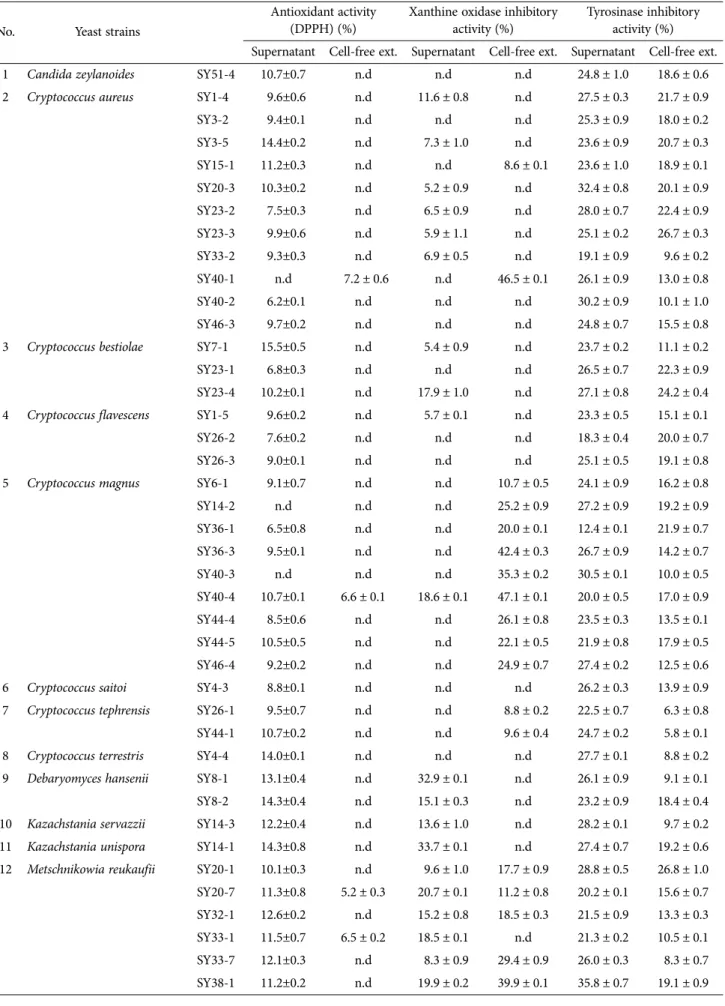
분리, 동정한 61 효모균주들에 대하여 위와 같이 이들 각 각의 배양상등액과 무세포추출물을 제조한 후 이들의 XOD 저해활성과 Tyrosinase 저해활성 등을 측정한 결과는 Table 2와 같다.
먼저 Xanthine에서 요산을 생성하여 통풍을 유발시키는 데 rate-limiting enzyme으로 관여하는 Xanthine oxidase를 저해하는 활성을 측정한 결과, 가장 많이 분리된 M. reuk- Table 1. Yeasts species isolated from wild flowers in Gogunsanyeoldo, Jeollabuk-do, Korea
No. Putative species
Related Genbank sequence
Identity (%) No. Putative species
Related Genbank sequence
Identity (%)
1 Candida zeylanoides SY51-4 JX441602.1 575/581(99) 8 Cryptococcus terrestris SY4-4 KC006603.1 595/600(99) 2 Cryptococcus aureus SY1-4 EU304246.1 598/602(99) 9 Debaryomyces hansenii SY8-1 KC261981.1 575/577(99)
SY3-2 EU304246.1 587/590(99) SY8-2 KJ095639.1 567/568(99)
SY3-5 EU304246.1 589/591(99) 10 Kazachstania servazzii SY14-3 JQ808006.1 559/559(100) SY15-1 EU304246.1 594/598(99) 11 Kazachstania unispora SY14-1 HM627101.1 577/582(99) SY20-3 EU304246.1 578/578(100) 12 Metschnikowia reukaufii SY20-1 JX067756.1 507/513(99)
SY23-2 EU304246.1 596/601(99) SY20-7 JX067756.1 516/520(99)
SY23-3 EU304246.1 599/605(99) SY32-1 JX067756.1 514/517(99)
SY33-2 EU304246.1 593/598(99) SY33-1 JX067756.1 519/525(99)
SY40-1 EU304246.1 593/593(100) SY33-7 JX067756.1 513/517(99)
SY40-2 EU304246.1 584/585(99) SY38-1 JX067756.1 519/523(99)
SY46-3 EU304246.1 597/600(99) SY38-2 JX067756.1 517/523(99)
3 Cryptococcus bestiolae SY7-1 FJ534903.1 594/597(99) SY44-6 JX067756.1 514/517(99)
SY23-1 FJ534903.1 594/597(99) SY44-7 JX067756.1 516/518(99)
SY23-4 FJ534903.1 584/588(99) SY46-5 FJ455114.1 510/520(98)
4 Cryptococcus flavescens SY1-5 JX049434.1 598/602(99) SY46-7 JX067756.1 506/509(99) SY26-2 FJ743610.1 603/607(99) 13 Occultifur externus SY5-2 AY745723.1 586/601(98) SY26-3 AB698750.1 590/591(99) 14 Pichia holstii SY20-2 AY761150.1 562/574(98) 5 Cryptococcus magnus SY6-1 JX188126.1 604/607(99) 15 Pichia scolyti SY3-1 HE612109.1 534/540(99)
SY14-2 JX188126.1 607/610(99) SY3-4 HE612109.1 528/535(99)
SY36-1 JX188126.1 605/607(99) 16 Rhodosporidium
diobovatum SY4-2 JX068686.1 567/569(99)
SY36-3 JX188126.1 607/609(99) SY4-5 JX068686.1 567/569(99)
SY40-3 JX188126.1 608/609(99) 17 Rhodotorula ingeniosa SY1-1 AJ749834.1 580/593(98) SY40-4 JX188126.1 608/609(99) 18 Rhodotorula minuta SY47-2 FR870029.1 588/593(99)
SY44-4 JX188126.1 607/609(99) SY47-4 FR870029.1 596/601(99)
SY44-5 JX188126.1 597/597(100) 19 Rhodotorula
mucilaginosa SY7-3 FN428899.1 573/575(99) SY46-4 JX188126.1 594/594(100) 20 Rhodotorula slooffiae SY34-2 AB566328.1 596/600(99)
6 Cryptococcus saitoi SY4-3 JX188127.1 588/590(99) SY34-4 AB566328.1 595/596(99)
7 Cryptococcus tephrensis SY26-1 JX188134.1 588/590(99) SY42-4 AB052212.1 595/597(99) SY44-1 JX188134.1 605/611(99) 21 Yarrowia lipolytica SY51-1 HF545672.1 510/511(99) SY51-3 HF545658.1 510/512(99)
Table 2. Physiological functionalities of the yeasts from wild flowers of Gogunsanyeoldo, Jeollabuk-do, Korea No. Yeast strains
Antioxidant activity (DPPH) (%)
Xanthine oxidase inhibitory activity (%)
Tyrosinase inhibitory activity (%) Supernatant Cell-free ext. Supernatant Cell-free ext. Supernatant Cell-free ext.
1 Candida zeylanoides SY51-4 10.7±0.7 n.d n.d n.d 24.8 ± 1.0 18.6 ± 0.6
2 Cryptococcus aureus SY1-4 09.6±0.6 n.d 11.6 ± 0.8 n.d 27.5 ± 0.3 21.7 ± 0.9
SY3-2 09.4±0.1 n.d n.d n.d 25.3 ± 0.9 18.0 ± 0.2
SY3-5 14.4±0.2 n.d 07.3 ± 1.0 n.d 23.6 ± 0.9 20.7 ± 0.3
SY15-1 11.2±0.3 n.d n.d 08.6 ± 0.1 23.6 ± 1.0 18.9 ± 0.1
SY20-3 10.3±0.2 n.d 05.2 ± 0.9 n.d 32.4 ± 0.8 20.1 ± 0.9
SY23-2 07.5±0.3 n.d 06.5 ± 0.9 n.d 28.0 ± 0.7 22.4 ± 0.9
SY23-3 09.9±0.6 n.d 05.9 ± 1.1 n.d 25.1 ± 0.2 26.7 ± 0.3
SY33-2 09.3±0.3 n.d 06.9 ± 0.5 n.d 19.1 ± 0.9 09.6 ± 0.2
SY40-1 n.d 07.2 ± 0.6 n.d 46.5 ± 0.1 26.1 ± 0.9 13.0 ± 0.8
SY40-2 06.2±0.1 n.d n.d n.d 30.2 ± 0.9 10.1 ± 1.0
SY46-3 09.7±0.2 n.d n.d n.d 24.8 ± 0.7 15.5 ± 0.8
3 Cryptococcus bestiolae SY7-1 15.5±0.5 n.d 05.4 ± 0.9 n.d 23.7 ± 0.2 11.1 ± 0.2
SY23-1 06.8±0.3 n.d n.d n.d 26.5 ± 0.7 22.3 ± 0.9
SY23-4 10.2±0.1 n.d 17.9 ± 1.0 n.d 27.1 ± 0.8 24.2 ± 0.4
4 Cryptococcus flavescens SY1-5 09.6±0.2 n.d 05.7 ± 0.1 n.d 23.3 ± 0.5 15.1 ± 0.1
SY26-2 07.6±0.2 n.d n.d n.d 18.3 ± 0.4 20.0 ± 0.7
SY26-3 09.0±0.1 n.d n.d n.d 25.1 ± 0.5 19.1 ± 0.8
5 Cryptococcus magnus SY6-1 09.1±0.7 n.d n.d 10.7 ± 0.5 24.1 ± 0.9 16.2 ± 0.8
SY14-2 n.d n.d n.d 25.2 ± 0.9 27.2 ± 0.9 19.2 ± 0.9
SY36-1 06.5±0.8 n.d n.d 20.0 ± 0.1 12.4 ± 0.1 21.9 ± 0.7
SY36-3 09.5±0.1 n.d n.d 42.4 ± 0.3 26.7 ± 0.9 14.2 ± 0.7
SY40-3 n.d n.d n.d 35.3 ± 0.2 30.5 ± 0.1 10.0 ± 0.5
SY40-4 10.7±0.1 6.6 ± 0.1 18.6 ± 0.1 47.1 ± 0.1 20.0 ± 0.5 17.0 ± 0.9
SY44-4 08.5±0.6 n.d n.d 26.1 ± 0.8 23.5 ± 0.3 13.5 ± 0.1
SY44-5 10.5±0.5 n.d n.d 22.1 ± 0.5 21.9 ± 0.8 17.9 ± 0.5
SY46-4 09.2±0.2 n.d n.d 24.9 ± 0.7 27.4 ± 0.2 12.5 ± 0.6
6 Cryptococcus saitoi SY4-3 08.8±0.1 n.d n.d n.d 26.2 ± 0.3 13.9 ± 0.9
7 Cryptococcus tephrensis SY26-1 09.5±0.7 n.d n.d 08.8 ± 0.2 22.5 ± 0.7 06.3 ± 0.8
SY44-1 10.7±0.2 n.d n.d 09.6 ± 0.4 24.7 ± 0.2 05.8 ± 0.1
8 Cryptococcus terrestris SY4-4 14.0±0.1 n.d n.d n.d 27.7 ± 0.1 08.8 ± 0.2
9 Debaryomyces hansenii SY8-1 13.1±0.4 n.d 32.9 ± 0.1 n.d 26.1 ± 0.9 09.1 ± 0.1
SY8-2 14.3±0.4 n.d 15.1 ± 0.3 n.d 23.2 ± 0.9 18.4 ± 0.4
10 Kazachstania servazzii SY14-3 12.2±0.4 n.d 13.6 ± 1.0 n.d 28.2 ± 0.1 09.7 ± 0.2
11 Kazachstania unispora SY14-1 14.3±0.8 n.d 33.7 ± 0.1 n.d 27.4 ± 0.7 19.2 ± 0.6
12 Metschnikowia reukaufii SY20-1 10.1±0.3 n.d 09.6 ± 1.0 17.7 ± 0.9 28.8 ± 0.5 26.8 ± 1.0 SY20-7 11.3±0.8 5.2 ± 0.3 20.7 ± 0.1 11.2 ± 0.8 20.2 ± 0.1 15.6 ± 0.7 SY32-1 12.6±0.2 n.d 15.2 ± 0.8 18.5 ± 0.3 21.5 ± 0.9 13.3 ± 0.3 SY33-1 11.5±0.7 6.5 ± 0.2 18.5 ± 0.1 n.d 21.3 ± 0.2 10.5 ± 0.1 SY33-7 12.1±0.3 n.d 08.3 ± 0.9 29.4 ± 0.9 26.0 ± 0.3 08.3 ± 0.7 SY38-1 11.2±0.2 n.d 19.9 ± 0.2 39.9 ± 0.1 35.8 ± 0.7 19.1 ± 0.9
aufii의 SY44-6의 배양상등액이 49.6%로 가장 높았고, 무 세포추출물에서는 C. aureus SY40-1이 46.5%를 보였다.
또한, 멜라닌 합성을 저해하여 미백을 증진시키는 생리 기능성인 Tyrosinase 저해활성을 조사한 결과 다른 항산화 활성이나 XOD 저해활성보다 대체로 높았고, 특히 M. reu- kaufii SY44-6의 배양상등액이 38.4%, M. reukaufii SY38- 2의 무세포추출물에서는 37.0%로 XOD 저해활성에서처럼 높은 활성을 보였다(Table 2).
항산화활성은 Pichia scolyti SY3-4의 배양상등액에서 16.4%을 보였을 뿐 대체로 낮았고, 무세포추출물에서는 거 의 모든 균주들에서 이들 활성이 없거나 매우 미약하였다.
항산화물질은 필자 등[16]의 연구에서와 같이 대부분이 채 소나 과일, 약용식물 등에 많이 함유되어있는 페놀 화합물 들이고 이들의 환원력이 클수록 전자공여능이 높았다는 보 고[20,21]로 미루어 볼 때 효모나 세균 등의 미생물 배양물 에서는 이들 함량이 낮기 때문에 항산화활성이 낮은 것으 로 사료된다.
이상의 생리기능성측정 결과들을 요약해보면 전라북도 고군산열도 선유도 일대 야생화에서 분리한 효모 61 균주 들 중 M. reukaufii SY44-6의 배양상등액이 각각 49.6%의 XOD 저해활성과 38.4%의 Tyrosinase 저해활성을 보였고
따라서 이 효모 균주는 앞으로 항통풍성 물질과 미백 증진 물질 생산에 매우 유용하게 응용될 수 있는 우수한 균주로 사료되어 현재 배양시간 등 이들의 최적 생산 조건 검토가 진행되고 있다.
위와 같이 건강소재 개발 자원으로도 효모 균주들이 매 우 유용할 것으로 사료되어 필자등이 환경부 국립 생물자 원관 지원으로 현재 분리, 보관중인 1000여주의 다른 효모 균주들에 대해 항산화활성을 포함한 주요 생리기능성 측 정이 현재 진행되고 있다.
적 요
전라북도 고군산열도 선유도 일대에서 2014년 4월에 개 화한 야생화들로부터 효모들을 분리한 후 이들의 26S rDNA의 D1/D2 부위의 염기서열을 결정한 다음 NCBI의 BLAST database에 등록되어 있는 효모들과의 상동성을 비 교 분석하여 동정하였다. 야생화 51점에서 21종의 효모들 을 61 균주 분리하였고, 이들 중 Cryptococcus aureus SY1- 4 등의 Cryptococcus 속 균들이 가장 많았고, Metschnikowia reukaufii SY20-1등 Metschnikowia 속 균과 Rhodotorula ingeniosa SY1-1등 Rhodotorula 속 균들도 비교적 많이 분 Table 2. Physiological functionalities of the yeasts from wild flowers of Gogunsanyeoldo, Jeollabuk-do, Korea (continued)
No. Yeast strains
Antioxidant activity (DPPH) (%)
Xanthine oxidase inhibitory activity (%)
Tyrosinase inhibitory activity (%) Supernatant Cell-free ext. Supernatant Cell-free ext. Supernatant Cell-free ext.
12 Metschnikowia reukaufii SY38-2 17.3 ± 0.1 n.d 33.6 ± 0.1 n.d 26.9 ± 0.7 37.0 ± 0.8 SY44-6 09.3 ± 0.1 5.2 ± 0.1 49.6 ± 0.3 n.d 38.4 ± 0.3 14.7 ± 0.3 SY44-7 10.5 ± 0.9 7.7 ± 0.4 21.9 ± 0.7 n.d 23.5 ± 0.2 12.7 ± 0.1
SY46-5 n.d 6.3 ± 0.7 n.d 36.5 ± 0.2 18.2 ± 0.4 34.3 ± 0.1
SY46-7 09.7 ± 0.2 n.d 20.5 ± 0.3 31.5 ± 0.2 21.5 ± 0.7 11.6 ± 0.4
13 Occultifur externus SY5-2 11.5 ± 0.3 n.d 07.3 ± 0.6 n.d 22.7 ± 0.3 09.3 ± 0.1
14 Pichia holstii SY20-2 07.9 ± 0.5 n.d 11.6 ± 1.0 19.8 ± 1.0 27.7 ± 0.1 31.1 ± 0.4
15 Pichia scolyti SY3-1 n.d n.d 11.2 ± 0.4 17.9 ± 1.0 25.1 ± 0.3 16.9 ± 0.9
SY3-4 16.4 ± 0.2 n.d 07.9 ± 1.0 19.8 ± 0.5 26.9 ± 0.1 14.3 ± 0.4 16 Rhodosporidium diobovatum SY4-2 n.d n.d 08.8 ± 0.8 18.7 ± 1.1 22.0 ± 0.1 13.0 ± 0.9
SY4-5 14.6 ± 0.1 n.d 08.3 ± 0.9 n.d 20.1 ± 0.2 19.4 ± 0.8
17 Rhodotorula ingeniosa SY1-1 12.5 ± 0.1 5.2 ± 0.7 07.5 ± 0.6 12.2 ± 0.4 21.5 ± 0.3 17.6 ± 0.8
18 Rhodotorula minuta SY47-2 11.2 ± 0.2 8.3 ± 0.3 n.d n.d 10.2 ± 0.1 27.9 ± 0.9
SY47-4 06.9 ± 0.1 n.d n.d n.d 20.6 ± 1.0 17.8 ± 0.6
19 Rhodotorula mucilaginosa SY7-3 10.7 ± 0.2 n.d 07.2 ± 0.9 n.d 20.0 ± 0.6 12.5 ± 0.5
20 Rhodotorula slooffiae SY34-2 09.33 ± 0.1 n.d n.d n.d 24.0 ± 0.9 19.8 ± 0.8
SY34-4 08.5 ± 0.3 n.d n.d n.d 15.4 ± 0.6 11.5 ± 0.7
SY42-4 10.2 ± 0.1 n.d n.d n.d 26.4±0.9 21.2 ± 0.5
21 Yarrowia lipolytica SY51-1 06.0 ± 0.1 n.d 08.2 ± 0.5 n.d 26.0±0.1 22.5 ± 0.7
SY51-3 13.1 ± 0.4 n.d 05.3 ± 0.7 n.d 21.6±0.1 20.9 ± 0.9
n.d, not detected or <5%.
리되었다. 이들 61 균주들의 배양상등액과 무세포추출물을 제조한 후 생리기능성을 측정한 결과 M. reukaufii SY44-6 의 배양상등액이 각각 49.6%의 XOD 저해활성과 38.4%의 미백성 Tyrosinase 저해활성을 보여 우수하였다.
감사의 글
본 논문은 환경부 국립생물자원관의 지원을 받아 수행된 연구결과입니다.
REFERENCES
1. Kwon SC, Jeon TW, Park JS, Kwak JS, Kim TY. Inhibitory effect on tyrosinase, ACE and xanthine oxidase, and nitrite scavenging activities of Jubak (Alcohol filter cake) extracts. J Kor Soc Food Sci Nutr 2012;41:1191-6.
2. Min JH, Kim YH, Kim JH, Choi SY, Lee JS, Kim HK. Com- parison of microbial diversity of Korean commercial Mak- geolli showing high β-glucan content and high antihyperten- sive activity, respectively. Mycobiology 2012;40:138-41.
3. Lee DH, Lee DH, Lee JS. Characterization of a new antide- mentia β-secretase inhibitory peptide from Saccharomyces cerevisiae. Enzyme Mucrib Tech 2007;42:83-8.
4. Lee JS, Yi SH, Kwon SJ, Ahn C, Yoo JY. Isolation identifica- tion and cultural conditions of yeasts from traditional meju.
Kor J Appl Microbiol Biotechnol 1997;25:435-41.
5. Min JH, Hyun SH, Kang MG, Lee HB, Kim CM, Kim HK, Lee JS. Isolation and identification of yeasts from wild flowers of Daejeon city and Chungcheongnam-do in Korea. Kor J Mycol 2012;40:141-4.
6. Kang MG, Hyun SH, Ryu JJ, Min JH, Kim HK, Lee JS. Note on newly isolated yeasts from wild flowers in Daejeon city, Korea. Kor J Mycol 2012;40:174-6.
7. Min JH, Ryu JJ, Kim HK, Lee JS. Isolation and identification of yeasts from wild flowers in Gyejoksan, Oseosan and Beak- amsan of Korea. Kor J Mycol 2013;41:47-51.
8. Min JH, Lee HB, Lee JS, Kim HK. Identification of yeasts iso- lated from wild flowers collected in coast areas of Korea based on the 26S rDNA sequences. Kor J Mycol 2013;41:185-91.
9. Hyun SH, Mun HY, Lee HB, Kim HK, Lee JS. Isolation of
yeasts from wild flowers in Gyonggi-do and Jeju island of Korea and production of anti-gout xanthine oxidase inhibitor.
J Microbiol Biotechnol 2013;41:383-90.
10. Hyun SH, Min JH, Lee HB, Kim HK, Lee JS. Isolation and diversity of yeasts from wild flowers in Ulleungdo and Yokji- do, Korea. Kor J Mycol 2014;42:28-33.
11. Hyun SH, Lee JG, Park WJ, Kim HK, Lee JS. Isolation and diversity of yeasts from fruits and flowers of orchard in Sinam-myeon of Yesan-gun, Chungcheongnam-do, Korea.
Kor J Mycol 2014;42:21-7.
12. Hyun SH, Min JH, Kim SA, Kim HK, Lee JS. Yeasts asso- ciated with fruits and blossoms collected from Hanbat arbo- retum, Daejeon, Korea. Kor J Mycol 2014;42:178-82.
13. Blois MS. Antioxidant determination by the use of stable free radical. Nature 1958;181:1199-200.
14. Kim HK, Lee EN, Geum JH, Lee JS. Nutritional characteri- stics and physiological functionality of ployplant extracts from some vegetables and medicinal plants. Kor J Food Nutr 2008;
21:410-5.
15. Jang IT, Kim YH, Kang MG, Lee SH, Lim SI, Lee JS. Produc- tion of tyrosinase inhibitor from Saccharomyces cerevisiae.
Kor J Mycol 2012;40:60-4.
16. Hyun KW, Kim JH, Song KJ, Lee JB, Jang JH, Kim YS, Lee JS. Physiological functionality in Geumsan perilla leaves from greenhouse and field cultivation. Kor J Food Sci Technol 2003;35:975-9.
17. Chan M, Lye D, Win MK, Chow A, Barkham T. Clinical and microbiological characteristics of cryptococcosis in Singapore:
predominance of Cryptococcus neoformans compared with Cryptococcus gattii. Int J Infect Dis 2014;26:110-5.
18. Nozaki H, Suzuki S, Tsuyoshi N, Yokozeki K. Production of D-arabitol by Metschnikowia reukaufii AJ14787. Biosci Biote- chnol Biochem 2003;67:1923-9.
19. Zhang Z, Zhang X, Tan T. Lipid and carotenoid production by Rhodotorula glutinis under irradiation/high-temperature and dark/low-temperature cultivation. Bioresour Technol 2014;
157:149-53.
20. Seo GW, Cho JY, Kuk JH, Wee JH, Moon JH, Kim SH, Park KH. Identification of antioxidative substances in Allium fistu- losum L. by GC-MS. Kor J Food Sci Technol 2003;35:988-93.
21. Kang YH, Park YK, Oh SR, Moon KD. Studies on the physi- ological functionality of fine needle and mugwort extracts.
Kor J Food Sci Technol 1995;27:978-84.