*Corresponding author: Jong-Shik Kim Phone: +82-54-780-3451; Fax: +82‐054-780-3469;
E-mail: [email protected]
Korean J Environ Agric. 2015;34(3):238-243. Korean Online ISSN: 2233-4173
Published online 2015 July 5. http://dx.doi.org/10.5338/KJEA.2015.34.3.24 Print ISSN: 1225-3537
Yeasts in the Flowers of Wild Fleabane [ Erigeron annus (L.) Pers.]
Jong-Shik Kim
1*, Dae-Shin Kim
21
Gyeongbuk Institute for Marine Bio-Industry, Uljin 36314, Korea
2
World Heritage and Mt. Hallasan Research Institute, Jeju Special Self-Governing Provincial Government, Jeju 63122, Korea
Received: 14 May 2015 / Revised: 8 June 2015 / Accepted: 29 June 2015 Copyright ⓒ 2015 The Korean Society of Environmental Agriculture
This is an Open-Access article distributed under the terms of the Creative Commons Attribution Non-Commercial License (http://creativecommons.org/licenses/by-nc/3.0) which permits unrestricted non-commercial use, distribution, and reproduction in any medium, provided the original work is properly cited.
238
Abstract
BACKGROUND: Yeasts associated with fleabane flowers were identified using isolation methods previously applied in yeast biotechnology. A culture-based approach was required for isolation of many yeast strains associated with fleabane.
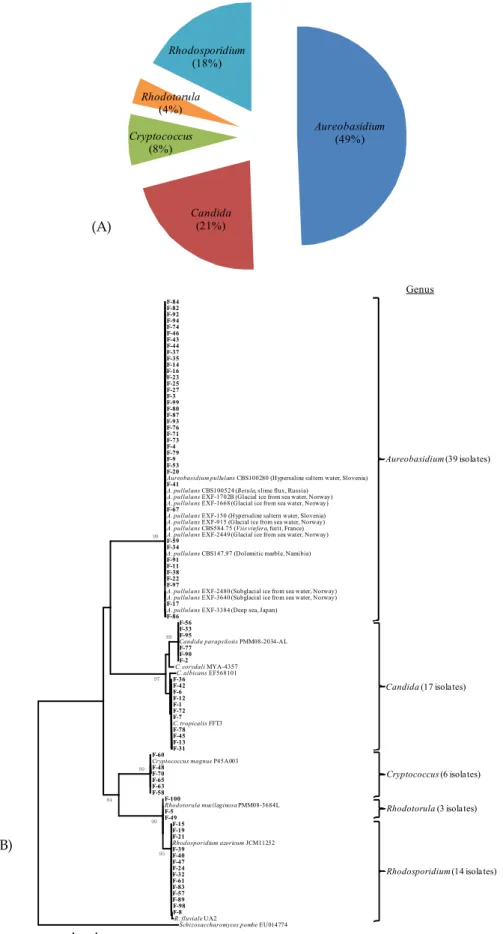
METHODS AND RESULTS: We spread homogenized fleabane flowers onto GPY medium containing chloramphenicol, streptomycin, Triton X-100, and L- sorbose. We isolated 79 yeast strains from the flowers of wild fleabane, and identified the yeasts via phylogenetic analysis of isolates from agar plates. The yeast species included 39 isolates of Aureobasidium pullulans, 17 of the genus Candida, 14 of the genus Rhodosporidium, 6 of the genus Cryptococcus, and 3 of the genus Rhodotorula.
CONCLUSION: Yeast isolates associated with fleabane flowers included A. pullulans (39 isolates) and other yeast species (40 isolates). Such yeast isolates may have biotechnological potential.
Key words: Fleabane, Erigeron annus (L.) Pers., ITS gene, Wild yeast
Introduction
Erigeron annus (L.) Pers. is an annual or biennial
herb of the Compositae, and is a North America native pioneer species that often colonizes disturbed areas such as pastures, vacant fields, roadsides, railways, and waste areas; the herb was introduced to Korea in 1910 (Park, 2009). Flowering occurs in June and July, cephalization is white, the ligulate flower is pistillate, and the tubular flower is yellow with a long pappus (Korea National Arboretum, 2012). The leaves are edible and are commonly used in folk medicine to treat indigestion, stomach ache, diarrhea caused by enteric pathogens, and hypoglycemia (Lee, 1996; Lee, 2003; Yoo, et al ., 2008). Little is known, however, about the ecological roles of plant yeasts.
Yeasts play roles in many complex processes of various ecosystems such as plant tissues (stems, flowers, and fruits); insects; soils; aquatic environments;
and extreme environments (Fonseca and Inácio, 2006;
Raspor and Zupan, 2006; Botha, 2011). Industrial attributes of yeasts include the primary roles they play in many food fermentations yielding beers, ciders, wines, sake, distilled spirits, bakery products, industrial enzymes, and agricultural products (Deak, 2009; Tamang and Fleet, 2009).
In this study, we characterized the yeast species associated with fleabane flowers. Previous studies have attempted to do the same, but their sampling strategies were casual or insufficient. Moreover, only minimal phylogenetic analyses of cultural yeast isolates have been performed in the past (Halloran et al ., 2013); therefore, our results provide a basis for
Research Article Open Access
Materials and Methods
Yeast isolation
Erigeron annus (L.) Pers. samples were aseptically collected from a residential area in Uljin with the aid of autoclaved scissors and forceps, and placed in clean plastic bags. Flower samples were stored in a cooler during transfer to the laboratory (in Uljin) and processed the same day. Each sample was washed three times with 10 mM potassium phosphate buffer and stored in an autoclaved container. Several washed flower samples were placed in tubes (Falcon Plastics, Los Angeles, CA, USA) filled to 10 mL with 10 mM potassium phosphate buffer and homogenized using an autoclavable hand homogenizer (T10 Basis;
IKA, Staufen, Germany). Homogenized samples (1 mL) were placed on sterile solid media, plated using a glass spreader, and incubated at 25°
oC for 2-5 days.
Yeast colonies that grew on large plates (Nunc Bio- assay dishes, 245 × 245 × 25 mm, Thermo Scientific, Roskilde, Denmark) were selected with autoclaved toothpicks and inoculated into 96-deep-well plates (Assay Block, 2 mL/well, 96 well square v-bottom;
Costar, Cambridge, MA, USA) prior to liquid culture at 25°C at 800 rpm for 48 hours (Choi et al ., 2013).
The media used for screening included (all % values are w/w): dichloran-glycerol 18% (DG18) agar (MB Cell, Seoul, Korea); dropout base (DOB) with complete amino acid supplement mixture (CSM) agar (MP Bio, Santa Ana, CA, USA); GPY agar (4%
glucose, 0.5% peptone, 0.5% yeast extract, and 1.5%
agar); and Sabouraud chloramphenicol gentamicin (SCG) agar (MB Cell). Antibiotics (100 mg/L of both chloramphenicol and streptomycin) were added to each medium to repress bacterial growth, and 0.1%
(v/v) Triton X-100 and 0.4% (w/v) L-sorbose were added to repress fungal growth. Yeasts were cultured on DG18, DOB with CSM, GPY, and SCG agar media in square plates (245 × 245 × 25 mm). All colonies from plates yielding multiple colonies were picked and cultured separately. In total, 79 individual isolates were transferred to fresh plates three times and then processed for sequencing of the internal transcribed spacer (ITS) genes.
Sequencing and phylogenetic analysis
The detailed methodology of sequencing and phylogenetic analysis has been previously published
described ITS1 (5′-TCCGTAGGTGAACCTGCG-3′) and ITS4 (5′-TCCTCCGCTTATTGATATGC-3′) primers (White et al ., 1990). For polymerase chain reaction (PCR), DNA was extracted from yeast colonies growing on agar plates using the Instagene Matrix method, according to the manufacturer’s protocol (Bio-Rad Laboratories, Hercules, CA, USA).
PCR was performed with 20 ng genomic DNA as template in a 30-μL reaction volume containing EF- Taq DNA polymerase (Solgent, Daejeon, Korea).
The PCR program included the following steps: 95
oC for 5 minutes; followed by 35 cycles of 95
oC for 2 minutes, 55
oC for 60 s, and 72
oC for 60 seconds; and a final extension step for 10 min at 72
oC. Amplification products were purified using a multiscreen filter plate (Millipore Corp., Bedford, MA, USA). Sequencing was performed using a PRISM BigDye Terminator v3.1 Cycle Sequencing Kit (Applied Biosystems, Foster City, CA, USA). Hi-Di formamide (Applied Biosystems) was added to DNA samples containing the extension products. The mixtures were incubated at 95
oC for 5 minutes followed by 5 minutes on ice, and analyzed on an ABI Prism 3730XL DNA Analyzer (Applied Biosystems). DNA sequencing was performed by Macrogen Inc. (Seoul, Korea). Nucleotide sequences for the 79 isolates reported in this paper were deposited in DDBJ(DNA Data Bank of Japan)/
GenBank under the following accession numbers:
LC018741-LC018819.
Phylogenetic analysis of Aureobasidium pullulans interspecies
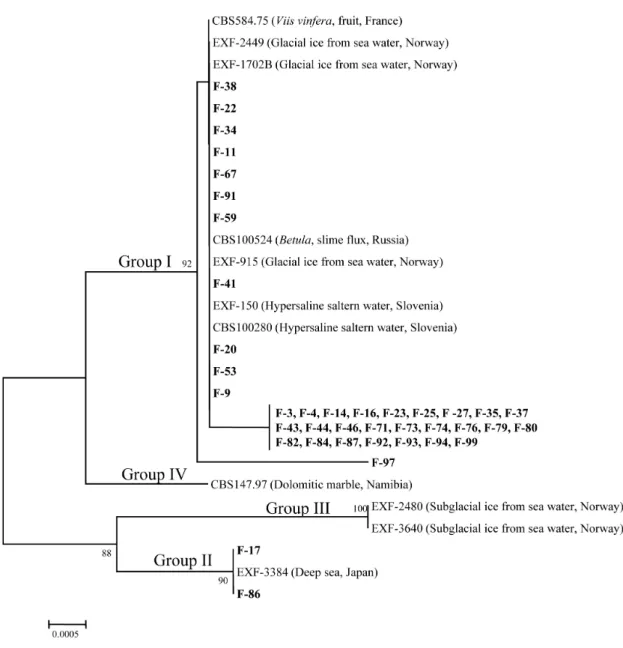
The nucleotide sequences of the ITS genes were aligned using the ClustalW2 program of the EMBL-EBI website. A BLAST search was used to identify the GenBank sequences most closely related to those of the yeast isolates. Phylogenetic trees were constructed using the neighbor-joining method, using MEGA5 for Windows (Tamura et al ., 2011), and featured bootstrap analyses of 1,000 samples. Evolutionary distances were calculated using the Kimura two-parameter method (Saitou and Nei, 1987).
Results and Discussion
Here, yeast isolates colonizing fleabane flowers
were isolated and phylogenetically analyzed. Seventy-
nine strains from whole yeast isolates were identified
(A)
Aureobasidium (49%)
Candida (21%) Cryptococcus
(8%) Rhodotorula
(4%)
Rhodosporidium (18%)
(B)
F-84F-82 F-92F-94 F-74F-46 F-43 F-44F-37 F-35 F-14F-16 F-23F-25 F-27F-3 F-99 F-80F-87 F-93 F-76F-71 F-73F-4 F-79F-9 F-53
F-20Aureobasidium pullulans CBS100280 (Hypersaline saltern water, Slovenia) F-41
A. pullulans CBS100524 (Betula, slime flux, Russia) A. pullulans EXF-1702B (Glacial ice from sea water, Norway) A. pullulans EXF-1668 (Glacial ice from sea water, Norway) F-67
A. pullulans EXF-150 (Hypersaline saltern water, Slovenia) A. pullulans EXF-915 (Glacial ice from sea water, Norway) A. pullulans CBS584.75 (Viis vinfera, furit, France) A. pullulans EXF-2449 (Glacial ice from sea water, Norway) F-59F-34
A. pullulans CBS147.97 (Dolomitic marble, Namibia) F-91F-11
F-38 F-22F-97
A. pullulans EXF-2480 (Subglacial ice from sea water, Norway) A. pullulans EXF-3640 (Subglacial ice from sea water, Norway) F-17A. pullulans EXF-3384 (Deep sea, Japan)
F-86F-56 F-33F-95
Candida parapsilosis PMM08-2034-AL F-77F-90
C. corydali MYA-4357F-2 C. albicans EF568101 F-36F-42
F-6F-12 F-1F-72 F-7 C. tropicalis FFT3 F-78F-45 F-13F-31
F-60Cryptococcus magnus P45A003 F-48F-70
F-65 F-63F-58
F-100
Rhodotorula mucilaginosa PMM08-3684L F-5F-49
F-15 F-19F-21
Rhodosporidium azoricum JCM11252 F-39F-40
F-47 F-24F-32 F-61 F-83F-57 F-89F-98 F-8R. fluviale UA2
Schizosaccharomyces pombe EU014774 95
99 99
89
97
84 99
0.5
Aureobasidium (39 isolates)
Candida (17 isolates)
Cryptococcus (6 isolates)
Rhodotorula (3 isolates)
Rhodosporidium (14 isolates) Genus
Fig. 1. (A) Pi chart, and (B) a phylogenetic tree of yeast isolates from flowers of the wild fleabane
Erigeron annus
(L.) Pers., based on internal transcribed spacer sequences. Strains described in the present study are in bold font. The numerals are the confidence levels derived from 1,000 replicate bootstrap samplings.Fig. 2.