1 This is an Open-Access article distributed under the terms of the Creative Commons Attribution Non-Commercial License (http://
creativecommons.org/licenses/by-nc/3.0) which permits unrestricted non-commercial use, distribution, and reproduction in any medium, provided the original work is properly cited.
J. Mushrooms 2014 March, 12(1):1-7 http://dx.doi.org/10.14480/JM.2014.12.1.1 Print ISSN 1738-0294, Online ISSN 2288-8853
© The Korean Society of Mushroom Science
*Corresponding author E-mail : [email protected]
Tel : +82-32-835-4619, Fax : +82-32-835-0763 Received March 14, 2014
Revised April 1, 2014 Accepted April 2, 2014
Antioxidant, anti-acetylcholinesterase and xanthine oxidase inhibitory activities of three extracts from Phellinus igniarius
Ga-Heon Jin, Min Woong Lee1, Kyung Hoan Im2 and Tae Soo Lee2*
Department of Ophthalmic Optics, Shinheung University 95 Hoam-ro, Uijeongbu, Gyeongggi 480-701, Korea
1Department of Life Sciences, Dongguk University, 30, Pildong-ro, Seoul, 100-175, Korea
2Division of Life Sciences, Incheon National University,(Songdo-dong) 119 Academy-ro, Yeonsu-gu, Incheon, Korea
ABSTRACT: This study was initiated to investigate antioxidant, anti-acetylcholinesterase, and xanthine oxidase inhibitory activities and properties of fruiting bodies, mycelia, and fermentation culture filtrates from Phellinus igniarius. The contents of total phenols and flavonoid of fruit bodies, mycelia, and culture filtrate were 15.35-1.36 mg/g, 10.35-7.85 mg/g, and 8.25-5.36 mg/g. The 1,1- diphenyl-1-picrylhydrazyl (DPPH) radical scavenging abilities of the extracts from the fruiting bodies, mycelia, and culture filtrates were 90.25-95.60%, 78.82-85.24%, and 76.32-82.50% at 50-400µg/mL, respectively. The chelating ability of fruiting body extract on ferrous ions was higher than those of mycelia and culture filtrates tested. The anti-acetylcholinesterase inhibitory activity of the fruiting body extract at 400µg/mg exhibited 91.10% on AChE, which is lower than that of positive control, galanthamine (94.82%). The xanthine oxidase inhibitory activities of the fruiting bodies, mycelia, and culture extract were 85.47%, 78.13%, and 72.49% at 400µg/mL, respectively. Overall, the fruiting body extract has better anti-acetylcholinesterase, antioxidant and xanthine oxidase inhibitory activities than those from mycelia and culture filtrate.
KEYWORDS: Anti-acetylcholinesterase, Antioxidant, Phellinus igniarius, Xanthine oxidase inhibition
Introduction
In many living organisms, oxidation is an essential process for producing energy to fuel biological processes.
However, free radicals and other reactive oxygen species that are produced within the body caused cell death and tissue damage. The cell and tissue damages caused by free radicals and reactive oxygen species may be related to diseases such as atherosclerosis, autoimmune disease, cancer, diabetes, inflammation, and Parkinson’s diseases (Halliwell and Gutteridge 1984). Soholm (1998) reported that the oxidative stress caused by free radical species
also contributed ageing and neuronal damage including Alzheimer’s disease, which is a progressive neurological degeneration characterized by cognitive impairment and abnormal behavior of the patient. Xanthine oxidase (XO) is an enzyme that generates reactive oxygen species and catalyze the oxidation of hypoxanthine to xanthine and can further catalyze the oxidation of xanthine to uric acid. These enzymes play an important role in the catabolism of purine in humans. The excess amount of XO in the serum, it may cause gout. Gout is characterized by recurrent attacks of acute inflammatory arthritis in the joint. It is caused by elevated levels of uric acid in the blood. Then, the uric acid crystallizes, and the crystals deposit in joints and caused gout. Thus, it is necessary to use antioxidant for protecting the human body from free radicals and reactive oxygen species. However, the use of synthetic antioxidant such as butylated hydroxyanisole (BHA), butylated hydroxytoluene (BHT) has been restricted in the food industry because of suspicion of causing liver damage and carcinogenesis (Grice 1988). Therefore, natural sources possessing antioxidant capacities are being screened. Therefore, the screening, development, and utilization of potent natural antioxidant and anti-
cholinesterase compounds are necessary.
Phellinus igniarius belongs to the family Hymenochaetaceae and order Hymenochaetales and used for medicinal purposes in oriental countries for long period of time (Dai and Togor, 2007). Mushrooms have been known to produce various physiologically beneficial compounds and can be used for functional foods for human health (Wasser and Weis, 1999). Several different species belong to Phellinus were widely applied for the treatment of antioxidant, anticancer, inflammation, anti-obesity and also protect body from viral, bacterial, and fungal infection. The Phellinus also have been known to boost heart health, lower the risk of hypercholesterolemia and help balance blood sugar levels, detoxification process of body, and lessening allergic reactions (Ajith and Janardhanan, 2003).
The antioxidant properties present in mushrooms are good sources to protect the human body from oxidative damage without any interference. The phenolics from mushrooms have been found to be an excellent antioxidant. The bioactivity of phenolics may be related to their ability to scavenging free radicals, chelate metals, inhibit lipoxygenase (Mizno, 2002). The well known species belong to Phellinus are P. linteus, P. baumii, P.
pini, P. igniarius, and P. gilvus. Among these species, biologically active secondary metabolites such as phenolic compounds, polyketides, terpenes, and steroids production were produced from P. linteus, P. pini and P.
baumii (Chang and Wasser, 2012). So far, there is no artificial cultivation method was available in P. igniarius and only a few articles were published on physiologically beneficial activities of this mushroom. In this work, we reported that extracts form fruiting bodies, mycelia, and fermentation culture filtrate of P. igniarius displayed antioxidant activities in a series of in vitro tests including DPPH scavenging activity on free radicals, scavenging activity on ferrous ions, determination of total phenolics and flavonoid contents. In addition to this, anti- acetylcholinesterase and xanthine oxidase inhibitory activities also investigated.
Materials and Methods
Specimens and fungal isolate
Dried fruiting bodies of Phellinus igniarius were obtained from Professor Yankofsky of Mendel University in Brno, Czech Republic and the mycelial culture of the mushroom was obtained from ‘‘Culture Collection of Mushrooms’’ of Incheon National University, Incheon, Korea.
Preparation of the Extracts
Fruiting body extract
Fresh fruiting bodies of P. igniarius were hot air dried at 45oC for 48 h and finely pulverized. To obtain the crude fruiting body extract, 30 g of powdered sample was extracted with 300 mL of 70% ethanol with stirring at 150 rpm for 24 h at 25oC. The mixture was filtered through two layers of Whatman No. 1 filter paper. The residues were then extracted with two additional 300 mL aliquots of ethanol as described above. The combined extracts were evaporated with a rotary evaporator at 40oC and the remaining solvent was removed with a freeze- drier (Operon, Gimpo, Korea). The dried fruiting body extracts were stored at −80oC deep freezer until used.
Mycelia extract
Mycelia of P. igniarius were cultured in liquid media (powdered soybean cake 30 g, sucrose 300 g, KH2PO4 5 g, MgSO4·7H2O 5 g, cooking oil 10 mL, distilled water 1,000 mL) for 20 days in a bottle container at 25oC. After 20 days incubation, the liquid cultures were filtered through 2 layers of Whatman No. 1 filter paper. Then, the filtered mycelia were washed 3 times with distilled water and dried with hot air incubator at 45oC for 48 h.
To obtain the extract from the mycelia, 10 g of dried mycelial biomass were mixed with 100 mL of 70%
ethanol with stirring at 150 rpm for 24 h at 25oC. The extraction method from mycelia was the same as extraction from the fruiting bodies.
Culture filtrate
The culture filtrate was prepared with remaining solution after filtration of liquid culture containing mycelia with two layers of Whatman No.1 filter paper. Filtered culture extract was collected in a bottle and condensed at 45oC with rotary evaporator (Eyela, Saitama, Japan). The remaining water within culture extract was removed with a freeze-drier (Operon, Gimpo, Korea).
Assay for total phenolics
Total polyphenol contents of the three extracts were analyzed by the method described by Sarikurkcu et al.
(2008) involving Folin-Ciocalteu reagent. Briefly, one mL of extract solution containing 2000µg extract was added to a flask. Forty five mL of distilled water and 1 mL Folin- Ciocalteu reagent was added and flask was shaken vigorously. After 3 min, 3 mL of 2% Na2CO3 solution was
added and the flask was kept in dark and allowed to stand for 2 h by intermittent shaking. Absorbance was measured at 760 nm with UV-vis spectrophotometer (Optizen 2121 UV, Korea). The concentrations of phenolic compounds were calculated by standard gallic acid graph:
Absorbance =
0.00304 gallic acid (µg) + 0.00340 (R2:0:9993)
Assay for total flavonoid
Total flavonoid content was determined by the method described by Sarikurkcu et al. (2008). Briefly, 1 mL of 2%
aluminium trichloride (AlCl3) in methanol was mixed with the same volume of the methanol extracts. Absorption readings at 415 nm with UV-vis spectrophotometer were taken after 10 min against a blank sample consisting of a 1 mL extract solution with 1 mL methanol without AlCl3. The concentrations of flavonoid compounds were calculated by stand quercetin graph:
Absorbance = 0.0338 quercetin (µg)−0.0002 (R2: 0:9969)
Scavenging effect on DPPH radicals
The hydrogen atoms or electron donation ability of the extracts and some pure compounds were measured as bleaching of the purple colored DPPH methanol solution (Cuendet et al., 1997). Four mL of various concentrations (50−400 µg/mL) of the extracts in methanol was added to 1 mL of DPPH radical solution in methanol (final DPPH concentration, 0.2 mM). The mixture was shaken vigorously and allowed to stand for 30 min, and the absorbance of the solution was measured at 517 nm using a UV-vis spectrophotometer. % Inhibition of the DPPH free radical scavenging activity (I%) was calculated as following formula:
I % = [(Acontrol−Asample)/Acontrol] × 100,
where Acontrol is the absorbance of the control reaction (containing all reagents except the test compound), and
Asample is the absorbance of the test compound. BHT was
used as a reference compound.
Chelating effect on ferrous ions
The chelating effect was determined according to the method of Dinis et al. (1994). Briefly, 2 mL of various concentrations (50-400µg/mL) of the extracts in methanol was added to a solution of 2 mM FeCl2 (0.05 mL). The reaction was initiated by adding 5 mM ferrozine (0.2 mL). Total volume was adjusted to 5 mL
with methanol, and the mixture was shaken vigorously and left at room temperature for 10 min. The absorbance of the solution was measured by using a UV-vis spectrophotometer at 562 nm. The inhibition percentage of the ferrozine-Fe2+complex formation was calculated by using the following formula:
Metal chelating effect (%) = [(Acontrol−Asample)/Acontrol] × 100,
where Acontrol is the absorbance of the control (control contained FeCl2 and ferrozine; complex formation molecules), and Asample is the absorbance of the test compound. BHT was used as reference compound.
Xanthine oxidase inhibitory activity
Xanthine oxidase inhibitory activity of various extracts from the P. igniarius was assayed using spectrophotometer under aerobic conditions using xanthine as the substrate (Costantino et al, 1992). The assay mixture consisted of 1 mL extract of the different concentrations (50-400µg/
mL), 2.9 mL of phosphate buffer (pH 7.5), and 0.1 mL of xanthine oxidase enzyme solution (0.1 units/mL in phosphate buffer, pH 7.5), which was prepared immediately before use. After pre incubation at 25oC for 15 min, the reaction was initiated by the addition of 2 mL of the substrate solution (150µM xanthine in the same buffer). The assay mixture was incubated at 25oC for 30 min. The reaction was then stopped by the addition of 1 mL of 1N hydrochloric acid and the absorbance was measured at 290 nm by using a spectrophotometer. Different concentrations of the extracts were dissolved in DMSO and the final concentration of DMSO was 5%. Allopurinol (50-400µg/
mL), a known inhibitor of XO, was used as reference compound. One unit of XO is defined as the amount of enzyme required to produce 1 mmol of uric acid/min at 25oC. Xanthine oxidase inhibitory activity was expressed as the percentage inhibition of XO in the above assay system calculated as:
Inhibition (%) = [(A−B) (C −D)/(A −B)] ×100,
where A is the activity of the enzyme without the extraction, B is the control of A without the extraction and enzyme; C and D are the activities of the extraction with and without XO, respectively.
Acetylcholinesterase inhibitory activity
Acetylcholinesterase inhibitory activity was measured
by slightly modifying the method developed by Ellman et al. (1961). Electric eel AChE (Type-VI-S, EC 3.1.1.7, Sigma, USA) was used as a enzyme, while acetylthiocholine iodide was employed as substrate of the reaction. DTNB (5,5’-dithio-bis(2-nitrobenzoic)acid) was used for the measurement of the cholinesterase activity. Ethanol was used as a solvent to dissolve test compound and the control. Briefly, 150µL of 100 mM sodium phosphate buffer (pH 8.0), 10µL of sample solution dissolved in ethanol at different concentrations and 20µL AChE (5.32
× 10-3 U) solution was mixed and incubated for 15 min at 25oC, and 10µL of 0.5 mM DTNB was added. The reaction was then initiated by the addition of 10µL of acetylthiocholine iodide (0.71 mM). The hydrolysis of the substrate was measured at a wavelength of 412 nm by using microplate reader (SpectraMax PC340, Molecular Devices, USA). The percentage of inhibition of AChE was determined by comparison of reaction rates of samples relative to blank sample (ethanol in phosphate buffer, pH 8) using the following formula:
% inhibition of AChE = (ES)/E × 100,
where E is the activity of enzyme without test sample,
and S is the activity of enzyme with test sample. The experiments were performed in triplicate. Galantamine was used as a positive control.
Results and Discussions
Total phenolics and flavonoid
Phenolic and flavonoid compounds are the major naturally occurring antioxidant components. The phenolic compounds found in the fruiting bodies, mycelia fermentation culture filtrates were 15.35-10.36 mg/g, 10.35- 7.85 mg/g, and 8.25-5.36 mg/g, respectively. The highest amount of total phenolics and flavonoid found in fruiting bodies might explain their better effectiveness in antioxidant properties. Therefore, it is concluded that the higher antioxidant, anti-acetylcholinesterase, and xanthine oxidase activities of fruiting bodies of P. igniarius might be due to the highest contents of total phenolics and flavonoid.
DPPH scavenging effect on free radicals
The scavenging effects of the various extracts of P.
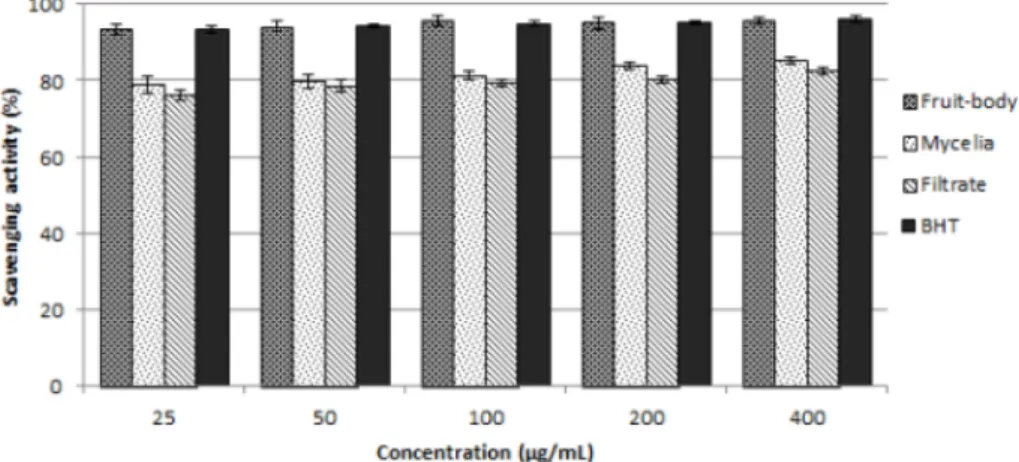
igninarius on DPPH radicals increased with increasing concentration. At 25-400µg/mL, the scavenging abilities of the fruiting body, mycelia and culture filtrate on the DPPH radicals ranged from 93.25-95.60%, 78.82-85.24%, and 76.32-82.50%, respectively (Fig. 1). These results indicate that the fruiting body extract possessed good activity, whereas the mycelia extract and culture filtrate showed moderate and poor activities, respectively at the concentrations tested. However, at 25-400µg/mL, BHT also showed good scavenging abilities of 93.96-95.94%.
Methanol extracts of H. marmoreus, A. bisporus, and Pleurotus citrinopileatus fruiting bodies scavenged DPPH radicals by 46.6-68.4% at 5,000µg/mL (Lee et al., 2007).
Table 1. Total phenolics and Flavonoid contents of 3 extracts of Phellinus igniarius
Sample Phenolics content Flavonoids content (µg GAEs/mg extract) (µg QEs/mg extract) Fruiting body 15.35±0.13 10.36±0.87
Mycelia 10.35±0.54 7.85±0.72
Culture filtrate 8.25±0.35 5.36±0.15 Values are expressed as means±SD (n=3).
GAEs, gallic acid equivalent/mg extract; QEs, quercetin equivalent/
mg extract.
Fig. 1.DPPH scavenging activity of various extracts of Phellinus igniarius. The values expressed as means±SEM (n=3).
It is found that the scavenging activity of various extracts from P. igniarius were more effective than those mentioned. The good DPPH scavenging activity of various extracts from P. igniarius might be due to high concentrations of phenolic and flavonoid compounds within fruiting body, mycelia and culture filtrate.
Chelating effects on ferrous ions
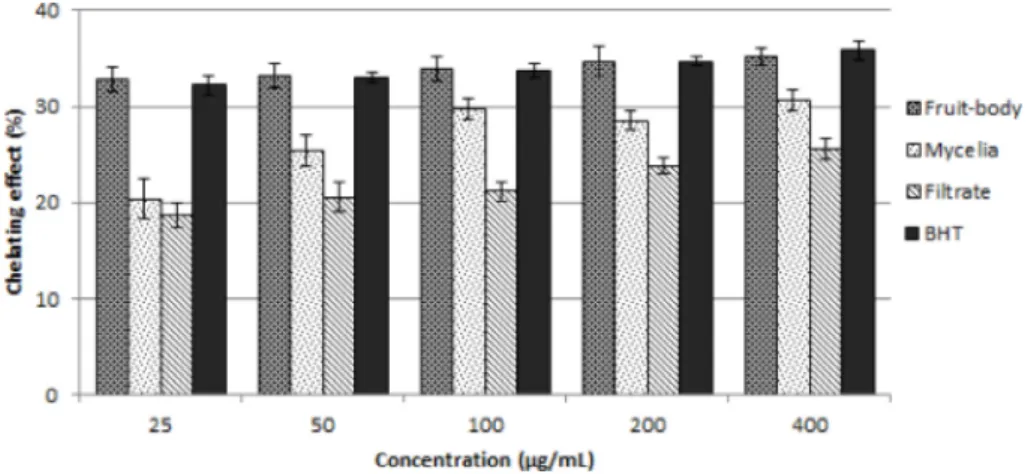
The chelating activity of the extracts from fruiting bodies, mycelia and culture filtrate at five different concentrations (25, 50, 100, 200 and 400µg/mL) from P.
igniarius toward ferrous ions was investigated. BHT was used as a positive control for ferrous ions. As shown in Fig. 2, the chelating capacity of the extracts increased with increasing extract concentration. The strongest chelating effect (35.15%) was obtained from the fruiting body extract at 400µg/mL. At this concentration, the lowest chelating effect was exhibited by the culture filtrate (25.59%). The hot water extracts of 2,000µg/mL
from Ganoderma tsugae and Agrocybe cylindracea chelated ferrous ions by 42.6 and 45.8%, respectively (Mau et al., 2004; Tsai et al., 2006). The chelating abilities of H. marmoreus and P. citrinopileatus at 1-5 mg/mL were 75.6-92.6% (Lee et al., 2007). Therefore, the high ferrous-ion chelating abilities of the various extracts from the fruiting bodies of P. igniarius would be beneficial.
Xanthine oxidase inhibitory activity
Xanthine oxidase inhibitory activities of various extracts of P. igniarius increased with increasing concentration. At 50-400µg/mL, the xanthine oxidase inhibition of fruiting body, mycelia, and culture filtrate ranged from 75.23-85.7%, 65.15-78.13%, and 60.26- 72.49%, respectively. However, at the same concentrations, allopurinol, the reference compound showed excellent xanthine oxidase inhibitory activity ranged from 85.52- 94.15% (Fig. 4). The results indicated that the fruiting Fig. 2.Chelating effect of various extracts from Phellinus igniarius. The values expressed as mean±SEM (n=3).
Fig. 3.Xanthine oxidase inhibitory activity of various extracts from Phellinus igniarius. The values expressed as mean ±SEM (n=3).
body extract showed good inhibitory activity, while the mycelia extract and culture filtrate showed moderate and moderately poor activities, respectively at the concentration tested. However, at higher extraction doses, xanthine oxidase would be significantly inhibited.
Flavonoids belong to a group of polyphenolic compounds have been known to possess a good xanthine oxidase inhibitory activity (Costantino et al., 1992). Therefore, high contents of phenolic and flavonoid contents in the various extracts of P. igniarius would contribute to xanthine oxidase inhibitory activity.
Acetylcholinesterase inhibitory activity
AChE inhibitory activities of the three extracts of the mushroom compared with those of galantamine used as a reference drug for the treatment of early stage of Alzheimer’s disease. Against AChE enzyme at 25- 400µg/mL concentration, the AChE inhibitory abilities of the fruiting body, mycelia and culture filtrate ranged from 60.45-90.12, 29.36-72.27, and 22.82-60.76%, respectively (Fig. 3). However, the inhibitory activity of the reference compound, allopurinol were 85.52-94.15% at the same concentration. Orhan and Ustun (2011) reported that the AChE inhibitory activities of mushrooms such as Trametes versicola, Polporus pinicola and Polyporus sulphureus showed 28.35, 31.44, and 37.61% inhibition on AChE at the concenetration of 500µg/mL, respectively which are lower than that of P. igniarius.
These results indicated that the fruiting body extract have lower xanthine oxidase inhibitory activity compared with the positive control, allopurinol. Therefore, it is concluded that the fruiting body possessed good inhibitory activity, whereas the mycelia extract and
culture filtrate showed moderate and poor inhibitory activities, respectively at the concentration tested.
Therefore, the high inhibitory activity of the fruiting body extract of P. igniarius on AChE was related to high phenolic and flavonoid contents, and good antioxidant activities.
Acknowledgement
This study was partly supported by a research grant from Shinheung college for sabbatical leave of the first author in 2012.
References
Halliwell B, Gutteridge JMC. 1984. Oxygen toxicity, oxygen radicals, transition metals and disease. Biochem J. 219:1-4.
Soholm B. 1998. Clinical improvement of memory and other cognitive functions by Ginkgo biloba: review of relevant literature. Adv Ther. 15:54-65.
Dai YC, Tolgor B. 2007. Illustrations of edible and medicinal fungi in northeastern China. Science Press, Beijing, China.
Wasser SP, Weis AL. 1999. Medicinal properties of substances occurring in higher basidiomycetes mushrooms: current perspectives (review). Int J Med Mushrooms. 1:31-62.
Ajith TA, Janardhanan KK. 2003. Cytotoxic and antitumor activities of polypore macrofungus, Phellinus rimosus (Berk) Pilat. J Ethnopharmacol. 84:157-162.
Mizuno T. 2002. Medicinal properties and clinical effects of culinary-medicinal mushroom Agaricus blazei Murrill (Agaricomycetideae). Int J Med Mushrooms. 4:299-312.
Chang ST, Wasser SP. 2012. The role of culminary-medicinal mushrooms on human welfare with a pyramid model for human health. Int J Med Mushrooms. 14(2):95-134.
Sarikurkcu C, Tepe B, Yamac M. 2008. Evaluation of the antioxidant activity of four edible mushrooms from the Central Anatolia, Eskisehir - Turkey: Lactarius deterrimus, Fig. 4.Acetylcholinesterase inhibitory activity of various extracts from Phellinus igniarius. The values expressed as mean±SEM (n=3).
Suillus collitinus, Boletus edulis, Xerocomus chrysenteron.
Biores. Technol. 99:6651-6655.
Cuendet M, Hostettmann K, Potterat O, Dyatmiko W. 1997.
Iridoid glucosides with free radical scavenging properties from Fagraea blumei. Helvetica Chimica Acta. 80:1144-1152.
Dinis TC, Madeira VM Almeida LM. 1994. Action of phenolic derivatives (acetaminophen, salicylate, and 5-amino salicylate) as inhibitors of membrane lipid peroxidation and as peroxyl radical scavengers. Arch Biochem Biophys. 315:161-169.
Costantino L, Albasini A, Rastelli G, Benvenuti S. 1992. Activity of polyphenolic crude extracts as scavengers of superoxide radicals and inhibitors of xanthine oxidase. Planta Med. 58:
342-344.
Lee YL, Yen MT, Mau JL, 2007. Antioxidant properties of various extracts from Hypsizigus marmoreus. Food Chemistry, 104:1-9.
Mau JL, Chang CN, Huang SJ, Chen CC. 2004. Antioxidant properties of methanolic extracts from Grifola frondosa, Morchella esculenta, and Termitomyces albuminosus mycelia.
Food Chem. 87:111-118.
Tsai SY, Huang SJ, Mau JL. 2006. Antioxidant properties of hot water extracts from Agrocybe cylindracea. Food Chem. 98:
670-677.
Costantino L, Albasini A, Rastelli G, Benvenuti S. 1992. Activity of polyphenolic crude extracts as scavengers of superoxide radicals and inhibitors of xanthine oxidase. Planta Med. 58 342-344.
Orhan I, Ustun O. 2011. Determination of total phenol content, antioxidant activity and acetylcholinesterase inhibition in selected mushrooms from Turkey. J Food Composition and Anal. 24:386-390.