170
한 국 균 학 회 지
The Korean Journal of Mycology
Characteristics of Two Unrecorded Yeasts from Wild Flowers in Ulleungdo, Korea
Se-Hee Hyun
1, Jin-Hong Min
1, Hyang Burm Lee
2, Ha-Kun Kim
1and Jong-Soo Lee
1*
1Department of Biomedicinal Science and Biotechnology, Paichai University, Daejeon 302-735, Korea
2Division of Applied Bioscience and Biotechnology, Chonnam National University, Gwangju 500-757, Korea
ABSTRACT : Two unrecorded yeasts, Meyerozyma caribbica UL5-1 and Pichia silvicola UL6-1 were screened from 58 yeasts which were isolated from wild flowers in Ulleungdo in Gyeongsangbuk-do, Korea. The morphological and cultural characteristics of these unrecorded yeasts were investigated. Both yeasts were oval in shape and formed pseudomycelia. P. silvicola UL6-1 formed ascospore, but M. UL5-1 did not. P. silvicola UL6-1 and M. caribbica UL5-1 also grew in vitamin-free medium and 5% NaCl- containing yeast extract-peptone-dextrose medium. The two unrecorded yeasts assimilated glucose, galactose, xylose, cellobiose, trehalose, glycerol and sorbitol, and also fermented glucose, fructose and mannose. The supernatant of both M. caribbica UL5-1 and P. silvicola UL6-1 showed high antihypertensive angiotensin I-converting enzyme inhibitory activity of 84.2% and 82.6%, respectively. Cell-free extract of P. silvicola UL6-1 also showed very high anti-diabetic α-glucosidase inhibitory activity (85.8%).
KEYWORDS : Characteristics, Ulleungdo, Unrecorded yeasts, Wild flowers
Yeast produce various bioactive agents [1-4] including an antihypertensive angiotensin I-converting enzyme inhi- bitor [5]. Most of the yeasts that produce these com- pounds have been isolated from fermented foods or their raw materials [3,4,6]. Recently, we isolated and identi- fied various yeasts, including unrecorded yeasts, from wild flowers growing in cities [7,8], mountains [9], inland and coastal areas [10,11], and, islands, such as Jeju Island, Korea [12,13].
In a previous paper [13], we reported the diversity of yeasts present on wild flowers in Ulleungdo and Yokjido, Korea; we also reported other characteristics of the unre- corded yeasts isolated from Yokjido [14]. Here, we describe the mycological characteristics of the unrecorded yeasts isolated from Ulleungdo, Korea.
We investigated the morphological characteristics of the unrecorded yeasts using previously described methods [13].
The physiological functions of the yeasts were determined as follows. The selected unrecorded yeasts were cultured in yeast extract-peptone-dextrose (YPD) medium at 30°C for 2 d. After centrifugation at 10,000 × g for 15 min, su- pernatants and cells were obtained. The cells were dis- rupted by vortexing with sonication and then centrifuged at 12,000 × g for 20 min. Cell-free extract was obtained and the supernatant was used to determine the physiolo- gical functionalities of the yeasts.
Antihypertensive angiotensin I-converting enzyme (ACE) inhibitory activity was assayed using the method publi- shed by Cushman and Cheung [15]. Antioxidant activity was assayed using the method of Lee et al. [4] using anti- oxidant activity (DPPH) as a substrate. Tyrosinase inhibi- tory activity was assayed by the method of Kim et al.
[16]. Xanthine oxidase inhibitory activity and superoxide dismutase (SOD)-like activity were determined using a modification of a previously described method [9]. α- Glucosidase inhibitory activity was assayed using the me- thod described Kang et al. [17] using ρ-nitrophenyl-β-D- glucophylanoside (PNPG) as a substrate.
The unrecorded yeasts were screened from 58 yeasts isolated in Ulleungdo by searching Keris, PubMed and other fungal taxonomy databases. The previously unre- corded yeasts were identified as Meyerozyma caribbica UL
Research Note
*Corresponding author E-mail: [email protected] Received June 9, 2014 Revised June 10, 2014 Accepted June 17, 2014
This is an Open Access article distributed under the terms of the Creative Commons Attribution Non-Commercial License (http://
creativecommons.org/licenses/by-nc/3.0/) which permits unrestricted non-commercial use, distribution, and reproduction in any medium, provided the original work is properly cited.
Kor. J. Mycol. 2014 June, 42(2): 170-173 http://dx.doi.org/10.4489/KJM.2014.42.2.170 pISSN 0253-651X • eISSN 2383-5249
© The Korean Society of Mycology
Unrecorded Yeasts from Ulleungdo, Korea
171
5-1 and Pichia silvicola UL6-1; they were isolated from Duchesnea chrysantha and Rubia akane in Ulleungdo.
Mycological characteristics of the unrecorded yeasts The morphological and cultural characteristics of the two unrecorded yeasts are summarized in Table 1 and Fig. 1. The two unrecorded yeasts were both oval in shape Table 1. Microbiological and cultural characteristics of the
newly reporting yeasts from wild flowers of Ulleungdo, Korea
Meyerozyma caribbica
UL5-1
Pichia silvicola
UL6-1 Morphological characteristics
Shape O1) O
Vegetalle reproduction B2) B
Size (µm) 2.6×2 3.4×2.6
Ascospore - +
Pseudomycelium + +
Cultural and physiological characteristics
Growth on YM ++ +++
Growth on YPD +++ +++
Growth on PD ++ +++
Color on YPD W3) W
Growth on Vitamin-free medium ++ ++
Growth in 50% Glucose-YPD + -
Growth in 5% NaCl-YPD ++ +
Growth in 20% NaCl-YPD + -
Groth in temp. / pH range 25-37oC /
4-5 20-30oC / 4-8
Urease activity - -
1)O, Oval 2)B, Budding 3)W, White
Fig. 1. Morphological characterization of Meyerozyma caribbica UL5-1 (A,C) and Pichia silvicola UL6-1 (B,D). A and B, Opti- cal microscope (scale bar-1µm); C and D, Scanning electron microscope (scale bars=5µm).
Table 2. Comparison of carbon sources assimilaion between Meyerozyma caribbica UL5-1 and Pichia silvicola UL6-1
Meyerozyma caribbica
UL5-1
Pichia silvicola
UL6-1
D-glucose +* +
D-galactose + +
L-arabinose + -
D-xylose + +
D-cellobiose + +
D-lactose - -
D-saccharose + -
D-trehalose + +
D-maltose + -
N-acetyl-glucosamine + -
D-melezitose + -
D-raffinose + -
Methyl-α-D-glucopyranoside + -
2-keto-D-gluconate + -
Glycerol + +
Adonitol + +
Inositol - -
D-sorbitol + +
Xylitol - -
*+; Growth(assimilation), -; No growth(no assimilation)
Table 3. Comparison of carbon sources fermentation between Meyerozyma caribbica UL5-1 and Pichia silvicola UL6-1
Carbon sources Meyerozyma caribbica UL5-1
Pichia silvicola UL6-1
D-glucose +* +
Fructose + +
Mannose + +
Maltose - -
D-galactoes + -
Sucrose + -
Lactose - -
Raffinose + -
Starch - -
Sorbitol - -
Cellobiose - +
*+; Fermentable, -; not fermentable
172
Se-Hee Hyun, Jin-Hong Min, Hyang Burm Lee, Ha-Kun Kim and Jong-Soo Leedid not form ascospores and pseudomycelia. Both grew well in YPD, yeast extract-malt extract (YM) and potato- dextrose (PD) broth and also grew in vitamin-free me- dium. M. caribbica UL5-1 was found to be halophilic and thermotolerant, and grew well in 20% NaCl-YPD broth at 37oC. Both yeasts were negative for urease activity.
We previously reported about a thermotolerant yeast isolated from wild flowers [14], traditional meju [6], and halotolerant yeasts from Korean fermented soy sauce, Doenjang and Gochujang [18].
We investigated the assimilation and fermentation of the two unrecorded yeasts on various carbon sources, using previously described methods [18] (Table 2 and 3). M.
caribbica UL5-1 utilized several types of hexose, pentose and sugar alcohol such as D-glucose, D-galactose, D-mal- tose, D-saccharose, D-trehalose, D-melezitose, D-raffinose, D-cellobiose, D-xylose, L-arabinose, glycerol, 2-keto-D-glu- conate, D-sorbitol, methyl-α-D-glucopyranoside and N- acetyl-glucosamine. However, it was not able to utilize D- lactose, xylitol, or inositol. Pichia silvicola UL6-1 utilized only D-glucose, D-galactose, D-trehalose, D-cellobiose, glycerol and D-sorbitol. Furthermore, M. caribbica UL5-1 fermented D-glucose, fructose, mannose, D-galactose, su- crose and raffinose, whereas P. silvicola UL6-1 fermented only D-glucose, fructose, mannose and cellobiose.
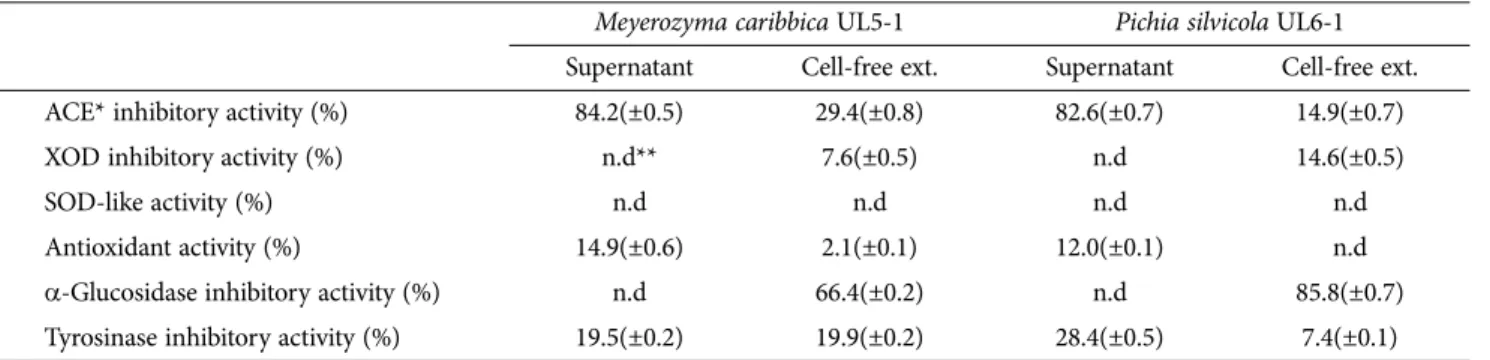
Physiological functionalities of the unrecorded yeasts The physiological functionalities of the supernatants and cell-free extracts from the unrecorded yeasts were inve- stigated (Table 4). The antihypertensive ACE inhibitory activities of supernatants from M. caribbica UL5-1 and Pichia silvicola UL6-1 were 84.2% and 82.6%, respective- ly, approximately 50% higher than those of their cell-free extracts.
These results were higher than those of Saccharomyces
cerevisiae KCTC 7904 (42.1%)[13], Pichia anomala (31.0%), Pichia anomala KCCM 11473 (72.0%)[19], or Pleurotus cornucopiae (78.0%)[20].
The anti-obesity α-glucosidase inhibitory activity of cell- free extract from Pichia silvicola UL6-1 was also very high 85.8%. These results were higher than those of Aspergillus oryzae N157-1 (48.3%)[17] or Pichia burtonii (90.9%)[3]
isolated from Korean traditional fermented foods. Tyrosi- nase inhibitory activity and the other functionalities were either not detected or were very weak (15%).
Acknowledgements
This study was funded by the project on survey and excavation of Korean indigenous species of NIBR under the Ministry of Environment, Republic of Korea.
REFERENCES
1. Jang IT, Kang MG, Na KC, Lee JS. Growth characteristics and physiological functionality of yeasts in pear marc extracts.
Kor J Mycol 2011;39:170-3.
2. Jeong SC, Lee DH, Lee JS. Production and characterization of an anti-angiogenic agent from Saccharomyces cerevisiae K-7. J Microbiol Biotechnol 2006;16:1904-11.
3. Kim YH. Production and in-vivo anti-diabetic activity of α- glucosidase inhibitor from Pichia burtonii Y257-7 [disserta- tion]. Daejeon (Korea): University of Paichai; 2013.
4. Lee JS, Yi SH, Kown SJ, Ahn C, Yoo JY. Enzyme activities and physiological functionality of yeasts from traditional Meju.
Kor J Appl Microbiol Biotechnol 1997;25:448-53.
5. Kim JH, Lee DH, Jeong SC, Chung KS, Lee JS. Characteriza- tion of antihypertensive angiotensin I-converting enzyme in- hibitor from Saccharomyces cerevisiae. J Microbiol Biotechnol 2004;14:1318-23.
6. Kim JH, Kim NM, Lee JS. Physiological characteristics and ethanol fermentation of thermotolerant yeast Saccharomyces cerevisiae OE-16 from traditional meju. Kor J Food Nutr 1999;
12:490-5.
Table 4. Physiological functionalities of unrecorded yeasts from Ulleungdo, Korea
Meyerozyma caribbica UL5-1 Pichia silvicola UL6-1 Supernatant Cell-free ext. Supernatant Cell-free ext.
ACE* inhibitory activity (%) 84.2(±0.5) 29.4(±0.8) 82.6(±0.7) 14.9(±0.7)
XOD inhibitory activity (%) n.d** 7.6(±0.5) n.d 14.6(±0.5)
SOD-like activity (%) n.d n.d n.d n.d
Antioxidant activity (%) 14.9(±0.6) 2.1(±0.1) 12.0(±0.1) n.d
α-Glucosidase inhibitory activity (%) n.d 66.4(±0.2) n.d 85.8(±0.7)
Tyrosinase inhibitory activity (%) 19.5(±0.2) 19.9(±0.2) 28.4(±0.5) 7.4(±0.1)
*ACE, Angiotensin I-converting enzyme; XOD, Xanthine oxidase; SOD, Superoxide dismutase.
**n.d; not detected.
Unrecorded Yeasts from Ulleungdo, Korea
173
7. Kang MG, Hyun SH, Ryu JJ, Min JH, Kim HK, Lee JS. Note on newly isolated yeasts from wild flowers in Daejeon city, Korea. Kor J Mycol 2012;40:174-6.
8. Min JH, Hyun SH, Kang MG, Lee HB, Kim CM, Kim HK, Lee JS. Isolation and identification of yeasts from wild flowers of Daejeon city and Chungcheongnam-do in Korea. Kor J Mycol 2012;40:141-4.
9. Min JH, Ryu JJ, Kim HK, Lee JS. Isolation and identification of yeasts from wild flowers in Gyejoksan, Oseosan and Beak- amsan of Korea. Kor J Mycol 2013;41:47-51.
10. Hyun SH, Lee HB, Kim CM, Lee JS. New records of yeasts from wild flowers in coast near areas and inland areas, Korea.
Kor J Mycol 2013;41:74-80.
11. Min JH, Lee HB, Lee JS, Kim HK. Identification of yeasts isolated from wild flowers collected in coast areas of Korea based on the 26S rDNA sequences. Kor J Mycol 2013;41:185- 91.
12. Hyun SH, Mun HY, Lee HB, Kim HK, Lee JS. Isolation of yeasts from wild flowers in Gyonggi-do and Jeju island of Korea and production of anti-gout xanthine oxidase inhibitor.
J Microbiol Biotechnol 2013;41:383-90.
13. Hyun SH, Min JH, Kim AR, Kim HK, Lee JS. Isolation and diversity of yeasts from wild flowers in Ulleungdo and Yokjido, Korea. Kor J Mycol 2014;42:28-33.
14. Hyun SH, Lee HB, Lee JS. Characteristics of unrecorded
yeasts, Rhodosporidium fluviale, Rhodosporidium paludigenum, Candida sp. 80-J-3 and Kluyveromyces thermotolerans isolated from wild flowers in Korea. Kor J Mycol 2014;41:181-4.
15. Cushman DW, Cheung HS. Spectrophotometric assay and properties of the angiotensin-converting enzyme of rabbit lung. Biochem Pharmacol 1971;20:1637-48.
16. Kim JK, Cha WS, Park JH, Oh SL, Cho YJ, Chun SS, Choi C.
Inhibition effect against tyrosinase of condensed tannins from Korean green tea. Kor J Food Sci Technol 1997; 29:173-7.
17. Kang MG, Yi SH and Lee JS. Production and characterization of a new α-glucosidase inhibitory peptide from Aspergillus oryzae N159-1. Mycobiology 2013;41:149-54.
18. Lee JS, Choi YJ, Kwon SJ, Yoo JY, Chung DH. Screening and characterization of osmotolerant and gas-producing yeasts from traditional Doenjang and Kochujang. Food Biotechnol 1996;5:54-8.
19. Kim NM, So SH, Lee SG, Song JE, Seo DS, Lee JS. Physiolo- gical functionality and enzyme activity of biomass from Pichia anomala grown on ginseng-steaming effluent. Myco- biology 2008;36:148-51.
20. Jang JH, Jeong SC, Kim JH, Lee YH, Ju YC, Lee JS. Cha- racterization of a new antihypertensive angiotensin I-conver- ting enzyme inhibitory peptide from Pleurotus cornucopiae.
Food Chem 2011;127:412-8.