
IEG 환경지질연구정보센터
18
0
0
전체 글
(2) 382. Tae-Yoon Park, Jang Won Sohn, and Duck K. Choi. Fig. 1. Location maps. (a) Index map of the Korean Peninsula showing the position of (b) (hatched box). (b) Simplified geologic map of the Taebaeksan Basin showing the distribution of the lower Paleozoic Joseon Supergroup and position of (c) (rectangular box). (c) Geologic map of the study are showing the fossil locality indicated by asterisks (*). Re-illustrated from Sohn and Choi (2007).. ngwol, Yongtan, Pyeongchang, and Mungyeong groups based on their geographic distribution and unique lithologic successions (Kobayashi, 1966; Choi, 1998; Choi and Chough, 2005; Fig. 1.2). The Taebaek Group is located at the eastern part of the Taebaeksan Basin and comprises eleven lithostratigraphic units: i.e., the Jangsan/Myeonsan, Myobong, Daegi, Sesong, Hwajeol, Dongjeom, Dumugol, Makgol, Jigunsan, and Duwibong formations in ascending order (Choi et al., 2004; Fig. 1). The Sesong Formation is mainly composed of nodular shale, siltstone, fine-grained sandstone, and limestone conglomerate. The lower part of the Sesong Formation is characterized by nodular shale with frequent intercalation of limestone conglomerate. The middle part of the formation comprises fine to medium-grained sandstone with a couple. of limestone conglomerate beds. The upper part of the formation consists of siltstone and fine-grained sandstone with occasional intercalation of limestone conglomerate beds. The sandstone within the formation shows laminated and/or crudely stratified structure. The boundary between the Sesong and Hwajeol formations is placed at the base of limestoneshale couplets of the Hwajeol Formation which overlies several-m-thick fine-grained sandstone facies of the uppermost part of the Sesong Formation. The Sesong Formation was originally proposed for the interval of purple to gray slate with fine-grained sandstone and limestone beds in Sesong and Hwajeol areas which contains the typical Kushanian fauna (Kobayashi, 1930, 1966). Kobayashi (1935) established two trilobite biozones, the Stephanocare and Drepanura zones, within the forma-.
(3) Furongian trilobites from the Sesong Formation. tion, which were correlated with the Kushanian Stage of North China (Kobayashi, 1966). On the other hand, Geological Investigation Corps of Taebaeksan Region (GICTR, 1962) and Cheong (1969) regarded the Sesong Formation as the basal member of the overlying Hwajeol Formation. The Hwajeol Formation was also proposed by Kobayashi (1935) for the upper Cambrian strata composed mostly of an alternating succession of limestone and shale beds in which Kobayashi (1935) recognized five upper Cambrian biozones: in ascending order, the Prochuangia, Chuangia, Kaolishania, Dictyites, and Eoorthis zones. Kobayashi (1966) divided the formation into four members: the basal member (ca. 60 m thick) is an alternating sequence of black shale, limestone, sandstone and slate; the lower member (25 m thick) comprises reddish calcareous sandstone and quartzite and contains the Kaolishania fauna; the upper member (ca. 80 m thick) is an alternation of reddish limestone and dark gray. 383. to black marl with occasional thin shale; and the top member (ca. 40 m thick) was described to consist of dark reddish limestone and dark green marl with intercalations of shale and sandstone layers. However, Sohn and Choi (2005) suggested that the lower part of the Hwajeol Formation (sensu Kobayashi, 1966) is lithologically indistinguishable from, and hence should be incorporated into the Sesong Formation. They recognized the Kaolishania Zone on the basis of the recovery of Kaolishania in the uppermost part of the Sesong Formation and the Asioptychaspis Zone in the lowermost part of the Hwajeol Formation. In addition, the columnar description of Park and Choi (2011, Fig. 2) indicates that there is no distinct lithologic change across the interval from the Neodrepanura Zone (the Drepanura Zone of Kobayashi) to the Prochuangia mansuyi Zone to differentiate formations.. Fig. 2. Lithologic column of the upper part of the Sesong Formations in the Sagundari section with stratigraphic occurrences of trilobites of the Kaolishania fauna..
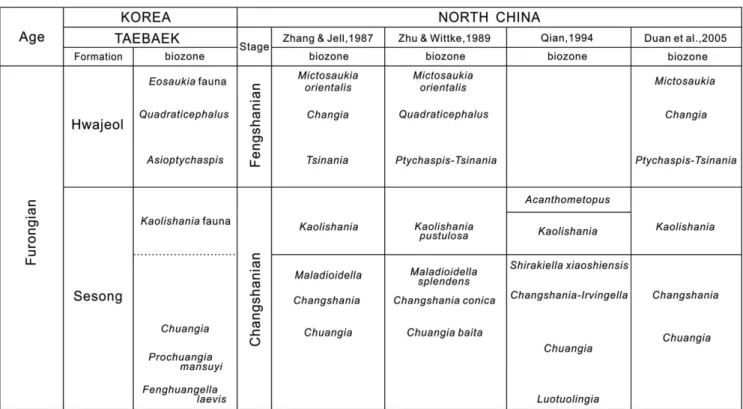
(4) 384. Tae-Yoon Park, Jang Won Sohn, and Duck K. Choi. 3. FOSSIL LOCALITY AND MATERIAL The Sagundari section (129°01'03.4''E, 37°04'57.0''N) is exposed along a road cut, approximately 8 km south of Taebaek City (Fig. 1). The section exposes the interval of ca. 32 m in thickness which is from the upper part of the Sesong Formation up to the lower part of the Hwajeol Formation. The upper part of the Sesong Formation is ca. 19m-thick interval of the section and consists of siltstone and fine-grained sandstone with sporadic intercalations of limestone conglomerate beds which are laterally discontinuous (Fig. 2). The succeeding ca. 13-m-thick interval belongs to the lower part of the Hwajeol Formation and is mainly composed of limestone-shale couplet and limestone conglomerates. The Sesong Formation in the section includes six fossiliferous horizons of limestone conglomerate beds: CS01, CS02, CS04, CS05, CS06, and CS09, in ascending order (Fig. 2). All the fossils recovered from this section are silicified and collected from the residue dissolved out by hydrochloric acid. Some relatively large specimens were found on weathered surface of CS01 horizon. More than 700 trilobite sclerites were recovered for this study. 4. FAUNAL COMPOSISION AND CORRELATION The six fossiliferous horizons of the upper part of the Sesong Formation at the Sagundari section yield thirteen polymerid species: i.e., Shirakiella elongata Kobayashi, 1935,. Shirakiella sp. 1, Taishania? sp. 1, Acanthometopus sp. 1, Pagodia sp. cf. P. spina Qian, 1994, Kaolishania granulosa Kobayashi, 1933, Gumunsoia triangularis gen. et sp. nov., Gumunsoia sp. 1, kaolishaniid gen. et sp. indeterminate, Elaphraella microforma Lu and Qian, 1983, Elaphraella nodus (Qian, 1994), Elaphraella? taebaeksanensis Park and Choi, 2012, and Lingyuanaspis sp. 1, (Fig. 2). Of these, Kaolishania granulosa and Shirakiella elongata were previously reported from the Taebaeksan Basin (Kobayashi, 1935, 1960), and the three shumardiid species, Elaphraella microforma, E. nodus, and E? taebaeksanensis, were recently described by Park and Choi (2012). All the remaining species are documented for the first time in Korea. Kaolishania was originally erected from the Upper Cambrian of Shandong Province, China (Sun, 1924) and subsequently was documented from the Kaolishania Zone of China (Kobayashi, 1933; Sun, 1935; Zhang and Jell, 1987; Zhu and Wittke, 1989; Qian, 1994; Duan et al., 2005) and Korea (Kobayashi, 1935, 1960). The upper part of the Sesong Formation at the Sagundari section may be part of the Kaolishania Zone proposed by Kobayashi (1935), which is presumably equivalent to the Kaolishania Zone of North China. However, Kaolishania was recovered only from the lowermost horizon, CS01 in this study, and it is currently impossible to observe the full stratigraphic range of Kaolishania. Therefore, recognizing the Kaolishania Zone from this interval is not attempted, and this interval is provisionally called the ‘Kaolishania fauna’ herein. Because Kaolishania is not observed in the upper part of the Kaol-. Fig. 3. Correlation of the trilobite biozones of the Taebaek Group with those of North China. Modified from Zhang and Jell (1987), Zhu and Wittke (1989), Qian (1994), Duan et al. (2005), and Park and Choi (2011b)..
(5) Furongian trilobites from the Sesong Formation. ishania fauna, other trilobite taxa than Kaolishania should be used for correlation. The uppermost two horizons, CS06 and CS09, produce Acanthometopus Lu and Qian, 1983, and hence can be correlated to the Acanthometopus Zone of Northeast China, established by Qian (1994), which overlies the Kaolishania Zone (Fig. 3). 5. SYSTEMATIC PALEONTOLOGY The morphological terms generally follow Whittington and Kelly (1997), but the term glabella used herein excludes the occipital ring. Descriptive terms for glabellar furrows and facial sutures are adopted from Henningsmoen (1957). All of the specimens described in this paper are reposited in the paleontological collections of Seoul National University, Korea with registered SNUP numbers. Of the thirteen trilobite species from the fauna, descriptions of the three shumardiid trilobites, Elaphraella? taebaeksanensis Park and Choi, 2012, Elaphraella microforma Lu and Qian, 1983, and Elaphraella nodus (Qian, 1994) were given in detail by Park and Choi (2012), and are not repeated herein. Superfamily Remopleuridioidea Family “Richardsonellidae” Raymond, 1924 Genus Shirakiella Kobayashi, 1935 Type species: Shirakiella elongata Kobayashi, 1935 from the Kaolishania Zone of Taebaeksan Basin, Korea. Remarks: Hupé (1953) established the family Shirakiellidae to which Jell and Adrain (2003) assigned four genera, Neoshirakiella Sun in Sun and Xiang, 1979, Pseudotaishania Qian, 1994, Shirakiella Kobayashi, 1935, and Yantaiella Qian, 1994. The yoked free cheek and relatively large palpebral lobes of Shirakiella is reminiscent of Haniwa quadrata Kobayashi, 1933 which occurs from the Asioptychaspis Zone which overlies the Kaolishania fauna (see Park and Choi, 2011a). Zhu and Wei (1991) suggested that Haniwa is a member of the family “Richardsonellidae” Raymond, 1924. In this study, the family Shirakiellidae is treated as a junior synonym of the “Richardsonellidae”. It should be noted that, however, the Richardsonellidae is rendered paraphyletic by the traditional Remopleurididae (Adrain et al., 2009). We followed the traditional familial concept of the Richardsonellidae herein, but with less confidence. Shirakiella elongata Kobayashi, 1935 Figures 4a–r Shirakiella elongata Kobayashi, 1935, p. 322, pl. 7, figs. 7–13; Lu, 1957, p. 286, pl. 148, fig. 8; Lu et al., 1965, p. 191, pl. 33, figs. 1, 2; Zhu and Wittke, 1989, p. 212, pl. 3, figs. 5, 6, pl. 4, figs. 1–3; Qian, 1994, p. 96, pl. 3, figs. 1–6.. 385. Lectotype: The holotype cranidium (Kobayashi, 1935, pl. 7, fig. 10, PA1235) is missing, and the other cranidium of Kobayashi (1935)’s collection (pl. 7, fig. 7, PA1232) is also missing. The lectotype is designated herein as PA1238 which is a fragmentary external mold of cranidium (Fig. 4r). Diagnosis: A species of Shirakiella with parallel to forwardly-convergent anterior branch of facial suture. Remarks: Kobayashi (1935) reported S. elongata and S. laticonvexa from the Kaolishania Zone of the Sesong Formation (then considered as the Hwajeol Formation). Shirakiella laticonvexa was differentiated from S. elongata in having shorter glabella (Kobayashi, 1935, p.323). The morphology of S. laticonvexa is within the range of morphological variation of S. elongata, and thus S. laticonvexa could be a junior synonym of S. elongata. Material examined: More than 100 cranidia, 64 free cheeks, and 9 pygidia. Occurrence: Kaolishania fauna of the Sesong Formation, Taebaeksan Basin, Korea; CS01–CS09 of the Sagundari section. Also from the Kaolishania Zone of North China (see Qian, 1994). Shirakiella sp. 1 Figures 4s–t Material examined: Two cranidia. Occurrence: Kaolishania fauna of the Sesong Formation, Taebaeksan Basin, Korea; CS02 and CS04 of the Sagundari section. Remarks: Compared to S. elongata, the present cranidia have a more slender glabella, larger palpebral lobes located close to glabella, and narrower fixigenae. Shirakiella xiaoshiensis Lu and Qian, 1983 in Qian (1994) from the Shirakiella xiaoshiensis Zone of Liaoning Province of China is similar to the present specimens in having large palpebral lobes, but S. xiaoshiensis has a broader glabellar and forwardlydivergent anterior branches of facial suture. Genus Taishania Sun, 1935 Type species: Taishania taianensis Sun, 1935 from the Kaolishania Zone of Shandong Province, China. Remarks: Since Taishania was erected in 1935, two subgenera and six species were assigned to the genus from China and Australia: T. platyfrons Shergold, 1980, T. (Weishania) constricta Zhu and Wittke, 1989, T. (Pseudotaishania) yingziensis Qian, 1994, T. (Pseudotaishania) constricta Qian, 1994, and T. jilinensis An and Duan in Duan et al., 2005. However, the generic concept of Taishania is ambiguous. Zhang and Jell (1987) designated a pygidium of Sun (1935) as the lectotype of T. taianensis (Sun, 1935, pl. 3, fig. 25). The largest paratype cranidium has a gently tapering-forward glabella with truncated glabellar front (Sun, 1935, pl. 3, fig. 20). In contrast, all other species assigned to Taishania have.
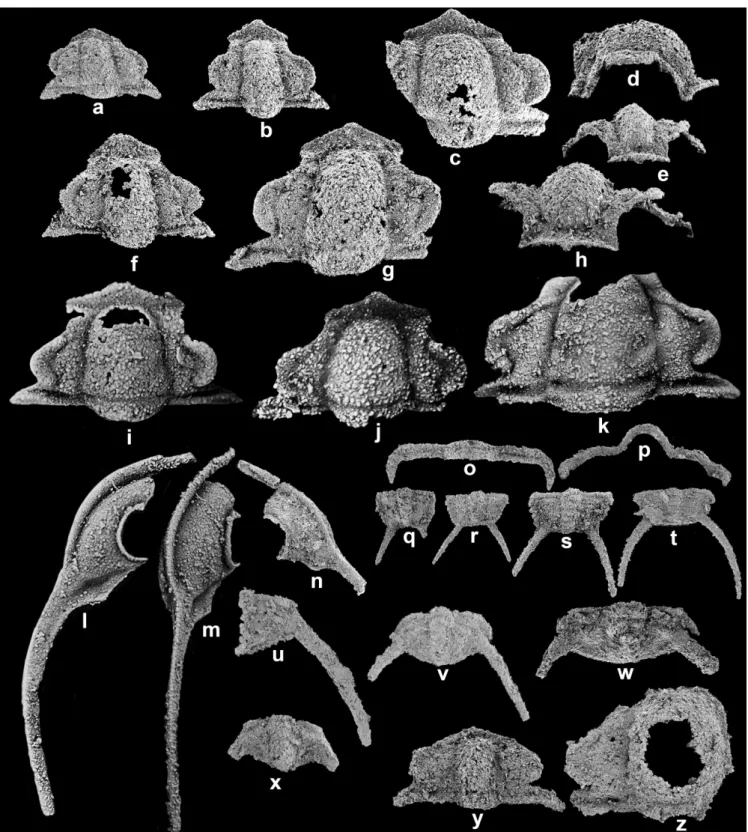
(6) 386. Tae-Yoon Park, Jang Won Sohn, and Duck K. Choi. Fig. 4. (a–q) Shirakiella elongata Kobayashi, 1935 from the Kaolishania fauna of the Sesong Formation in the Sagundari section, Taebaeksan Basin, Korea; (a–f) cranidia, SNUP6133, SNUP6134, SNUP6135, SNUP6136, SNUP6137, and SNUP6138, respectively; (g–k) free cheeks, SNUP6139, SNUP6140, SNUP6141, SNUP6142, and SNUP6143, respectively; (l–q) pygidia; (l–n) SNUP6144, SNUP6145, and SNUP6146, respectively; (o–q) SNUP6147, dorsal, posterior, and lateral views, respectively. All figures ×10.5. (r) external mold, lectotype designated in this study, PA1238, ×1.7. (s, t) Shirakiella sp. 1., SNUP6148 and SNUP6149, respectively, ×10.5.. a parallel-sided to slightly tapering forward glabella with a rounded glabellar front. In addition, the largest paratype cranidium has a divergent forward anterior branch of facial suture, whereas all other species of Taishania, except for Taishania platyfrons from Australia, have a somewhat parallel sided anterior branch of facial suture. More detailed inspection and discussion on the generic concept of Taishania are in need. Taishania? sp. 1 Figure 5 Description: Cranidium rectangular in outline, with smooth surface. Glabella rectangular, weakly tapering forwards, ca. two-thirds of cranidial length, convex; axial furrows deep and narrow; lateral glabellar furrows obsolete; preglabellar furrow deep and narrow. Occipital ring one-fourth of glabellar length, as wide as glabellar width. Occipital furrow simple, transverse, and shallow. Preglabellar field weakly. convex, downsloping forwards, ca. one-fifth of glabellar length. Anterior border broadly curved anteriorly, weakly convex, as long as preglabellar field; anterior border furrow shallow and clearly incised. Palpebral lobes semicircular, ca. one-third of glabellar length, located in glabellar midlength; palpebral furrows absent; eye-ridges absent. Fixigena narrow. Anterior branches of facial suture parallelsided to weakly divergent and then curved inwards along anterior cranidial margin; posterior branches of facial suture strongly divergent. Posterior field short and downsloping abaxially. Posterior border transverse and downsloping abaxially; posterior border furrow shallow and wide. Free cheek yoked together along narrow anterior border and doublure, strongly downsloping peripherally. Genal field weakly convex, separated from narrow lateral border by shallow and narrow border furrow. Eye socle elevated, clearly separated from genal field by change in slope. Doublure as broad as lateral border. Genal spines directed weakly oblique posteriorly, as long as free cheek..
(7) Furongian trilobites from the Sesong Formation. 387. Fig. 5. Taishania? sp. from the Kaolishania fauna of the Sesong Formation in the Sagundari section, Taebaeksan Basin, Korea; (a–f) cranidia; (a) SNUP6150, dorsal view; (b) SNUP6151, dorsal view; (c) SNUP6152, dorsal view; (d, e) SNUP6153, dorsal and oblique anterolateral views;(f) SNUP6154, dorsal view; (g) a fragmentary cephalon, SNUP6155; (h–j) free cheeks, SNUP6156, SNUP6157, and SNUP6158, respectively; (k–m) pygidia; (l–n) a pygidium, SNUP6159, dorsal, posterior, and lateral views, respectively. All figures ×18. (n–p) large cranidia collected from the weathered surface of CS01 horizon; (n) SNUP4018, dorsal view, ×4, refigured from Sohn and Choi (2005); (o) SNUP6160, lateral view, ×5; (p) SNUP6162, dorsal view, ×3.. Material examined: Twenty-one cranidia, 13 free cheeks, and 3 pygidia. Occurrences: Kaolishania fauna of the Sesong Formation, Taebaeksan Basin, Korea; CS01–CS05 of the Sagundari section. Remarks: The large cranidia are comparable to the specimens assigned to Taishania taianensis by Qian (1994, pl. 14, figs. 1–6). However, as the generic concept of Taishania is ambiguous, we leave the specimens in open nomenclature. In the present collection, cranidia represent a range of. ontogenetic development. The small cranidia, ranging from 1 mm to 1.5 mm in length, are characterized by very short anterior cranidial border and large palpebral lobes. With growth, anterior cranidial border and palpebral lobes become relatively longer and smaller, respectively. In the large cranidia, anterior cranidial border is longer than preglabellar field. ?Family “Richardsonellidae” Hupé, 1953 Genus Acanthometopus Lu and Qian, 1983.
(8) 388. Tae-Yoon Park, Jang Won Sohn, and Duck K. Choi. Type species: Acanthometopus obesus Lu and Qian, 1983 from the Acanthometopus Zone, Taizihc Valle, Liaoning Province, Northeast China. Remarks: Lu and Qian (1983) assigned this genus into the family Solenopleuridae Angelin, 1854. Later, Qian (1994) considered it as belonging to the Richardsonellidae Raymond 1924. Jell and Adrain (2003) followed Lu and Qian (1983)’s original assignment to the Solenopleuridae. Acanthometopus is assigned to the Richardsonellidae herein, but with reservation. Acanthometopus sp. 1 Figure 6 Material examined: Twenty-two cranidia, 10 free cheeks, and one pygidium.. Occurrence: the uppermost part of the Kaolishania fauna of the Sesong Formation, Taebaeksan Basin, Korea; CS06 and CS09 of the Sagundari section. Remarks: Qian (1994) provided reconstructions of the cranidium, free cheek, thoracic segment, and pygidium of A. obesus (Qian, 1994, text-fig. 35), in which the glabella possesses nine node-like impressions, and abaxial margin of palpebral lobes are ornamented with three short protuberances. The relatively small specimens of Acanthometopus sp. 1 in this study do not show such features. Lu and Qian (1983) illustrated a yoked free cheek of this A. obesus. Although no complete yoked free cheek of Acanthometopus sp. 1 has been collected, the doublure of the anterior part of free cheek is significantly long (Figs. 6l–p), implying Acanthometopus sp. 1 may also have had a yoked free cheek. The only recovered pygidium of Acanthometopus sp. 1 is. Fig. 6. Acanthometopus sp. 1 from the Kaolishania fauna of the Sesong Formation in the Sagundari section, Taebaeksan Basin, Korea; (a–k) cranidia; (a) SNUP6163, dorsal view; (b) SNUP6164, dorsal view; (c, d) SNUP6165, dorsal and oblique anterolateral views; (e) SNUP6166, dorsal view; (f–h) SNUP6167, dorsal, lateral, and anterior views, respectively; (i–k) SNUP6168, dorsal, lateral, and anterior views, respectively; (l–p) free cheeks, SNUP6169, SNUP6170, SNUP6171, SNUP6172, and SNUP6173, respectively; (q, r) a pygidium attached to the left side of the axis of four thoracic segments, SNUP6174; (q) lateral view of the pygidium; (r) dorsal view of the pygidium. All figures ×19..
(9) Furongian trilobites from the Sesong Formation. attached to the left side of axis of four thoracic segments (Figs. 6q–r). The thoracic segment morphology is readily different from that of Acanthometopus obesus figured by Lu and Qian (1983, p. 3, fig. 3) and Qian (1994, text-fig. 35), and thus is not considered belonging to Acanthometopus sp. 1 in this study. The pygidium is spinose as that of A. obesus illustrated by Qian (1994, pl. 14, fig. 12; text-fig. 35). Superfamily Leiostegioidea Bradley, 1925 Family Pagodiidae Kobayashi, 1935 Genus Pagodia Walcott, 1905 Type species: Pagodia lotos Walcott, 1905 from the Tsinania Zone of Shandong, North China (by original designation). Pagodia sp. cf. P. spina Qian, 1994 Figure 7. 389. Pagodia (Idamea) spina Qian, 1994, p. 118, pl. 22, fig. 5. Material examined: Ten cranidia, three free cheeks and four pygidia. Occurrence: The uppermost part of the Kaolishania fauna of the Sesong Formation, Taebaeksan Basin, Korea; CS06 and CS09 of the Sagundari section. Remarks: Qian (1994, p. 118) established Pagodia spina on the basis of two cranidia from the Kaolishania Zone, and mentioned that this species can be distinguished by the presence of strong occipital spines. The cranidia in this study have somewhat tumid occipital spines, and are assigned to P. spina with reservation. The dorsally directed occipital spine is most prominent in a small cranidium (Figs. 7e–f), but they are relatively short in larger cranidia (Figs. 7h–l). The pygidia assigned to the present species include one large fragmentary pygidium (Fig. 7t) and three small pygidia. The large fragmentary pygidium has a gran-. Fig. 7. Pagodia sp. cf. P. spina from the Kaolishania fauna of the Sesong Formation in the Sagundari section, Taebaeksan Basin, Korea; (a–n) cranidia; (a–d) SNUP6175, dorsal, oblique anterolateral, anterior, and lateral views, respectively; (e–g) SNUP6176, dorsal, anterior, and lateral views, respectively; (h, i) SNUP6177, dorsal and lateral views; (j–l) SNUP6178, dorsal, lateral, and anterior views, respectively; (m–o) SNUP6179, dorsal, lateral, and anterior views, respectively; (p–s) free cheeks; (p, q) SNUP6180, dorsal and lateral views; (r, s) SNUP6181, dorsal and lateral views; (t–aa) pygidia; (t) a fragmentary pygidium, SNUP6182; (u–w) SNUP6183, dorsal, lateral, and posterior views, respectively; (x–z) SNUP6184, dorsal, lateral, and posterior views, respectively; (aa) SNUP6185, dorsal view. All figures ×10.5..
(10) 390. Tae-Yoon Park, Jang Won Sohn, and Duck K. Choi. ulated surface, but the small pygidia do not. The assignment of these small pygidia to this species is less secure. Family Kaolishaniidae Kobayashi, 1935 Genus Kaolishania Sun, 1924 Type species: Kaolishania pustulosa Sun, 1924 from the Chaumitien Formation, Shandong Province, China. Other species: see Hughes et al. (2011). Remarks: Resser and Endo in Endo and Resser (1937) established Paramansuyella granulosa from Liaoning Province of China which was synonymized with Kaolishania granulosa by Kobayashi (1960) and Shergold (1971). However, the specimens of Resser and Endo in Endo and Resser (1937) are too fragmentary to be referred to Kaolishania. Kaolishania granulosa Kobayashi, 1933 Figure 8 Synonym list: See Hughes et al. (2011) for the full synonym list of this species. Added to the synonym list in this study is Kaolishania pustulosa Sun, 1924 reported by Zhu and Wittke (1989, p. 222, pl. 8, figs. 4–6) (see below). Diagnosis: A species of Kaolishania having a pygidium with a semi-elliptical outline, six axial rings including terminal piece, four pleurae directed obliquely backwards, and a pair of obliquely divergent pleural spines. Description: Cranidium trapezoidal in outline, wider than long, sculptured with fine granules. Glabella trapezoidal, tapering forwards, ca. 80% of cranidial length, ca. 50% of cranidial width, strongly convex, downsloping anteriorly. Axial furrows deep and narrow. Three pairs of lateral glabellar furrows; S1 deep, clearly incised, directed oblique backwards; S2 shorter than S1 and directed oblique backwards; S3 short, pit-like and directed forwards. Occipital ring one-fifth of glabellar length, slightly narrower than glabella, convex. Occipital furrow moderately deep abaxially, becoming shallower adaxially. Preglabellar furrow deep and clearly incised. Preglabellar field absent. Anterior border transverse, short, and moderately convex. Anterior border furrow narrow and shallow. Palpebral lobes bean-shaped, elevated abaxially, ca. 30% of glabellar length, located in front of glabellar mid-length; palpebral furrow shallow and clearly incised. Palpebral area elevated abaxially. Eye ridges connecting S3 to palpebral lobes, directed obliquely backwards. Anterior branches of facial suture weakly divergent and then curved inwards along anterior cranidial margin; posterior branches of facial suture divergent convex. Posterior border transverse and curved posteriorly, downsloping abaxially. Hypostome semi-circular in outline, convex; middle body oval; middle furrow moderately incised; anterior lobe semicircular in outline; posterior lobe crescentic, short, one-fifth of hypostomal length. Anterior margin slightly angular;. anterior border narrow. Anterior wing short, with lateral margin pointed, continued to lateral border; lateral border moderately wide, defined by well deeply incised lateral border furrow. Free cheek with broad and convex genal field and stout genal spine; genal field sculptured with fine granules, downsloping outwards; lateral border furrow indicated by change in slope; lateral border of uniform width, convex; genal spine directed posterolaterally. Pygidium semi-elliptical in outline with a pair of pleural spines. Axis tapering backwards, reaching to border furrow, with six axial rings including a semi-circular terminal piece. Anteriormost axial ring ca. one-fourth of pygidial width, strongly convex, with well-defined articulating half ring. Inter-ring furrows deep and narrow; posteriormost inter-ring furrow faintly incised. Axial furrow clearly incised. Pleural region with four pleurae, weakly convex; interpleural furrows obsolete; pleural furrows clearly incised. Posterior band of first pleura and anterior band of second pleura forming pleural spines. Pleural spines as wide as first pleural rib, as long as pygidium, directed obliquely backwards. Border broad and weakly convex. Border furrow deep and clear, but not crossing the first pleural rib. Material examined: Nineteen cranidia, 5 hypostomes, 3 free cheeks, and 9 pygidia. Occurrence: Kaolishania fauna of the Sesong Formation, Taebaeksan Basin, Korea; CS02–CS09 of the Sagundari section. Remark: As pointed out by Hughes et al. (2011), two species, K. pustulosa Sun, 1924 and K. granulosa Kobayashi, 1933 can remain within the genus Kaolishania with confidence. The cranidia show a forwardly tapering glabella and highly elevated palpebral lobes. Overall morphology of cranidium is similar to that of K. pustulosa. However, pygidia of K. granulosa bear six axial rings, four pleurae directed obliquely backwards, and backwardly oblique pleural spines, whereas those of K. pustulosa have seven axial rings, five pleurae directed backwards, and backwardly directed pleural spines. Kaolishania pustulosa reported by Zhu and Wittke (1989) from Tangshan of China has a pygidium bearing four pleurae and divergent pleural spines which are characteristic features of Kaolishania granulosa. The immature cranidia (Figs. 8a–c) have a parallel-sided glabella, the glabella becomes broad-based during growth. The smallest cranidium (Fig. 8a) has a smooth surface. With growth the anterior cranidial border becomes weakly curved rearward (Figs. 8c and e), then it becomes straight (Fig. 8f), and finally, the anterior cranidial border becomes slightly rounded anteriorly (Figs. 8h and k). Immature pygidia were also recovered in this study (Figs. 8t–x). The smallest pygidium (Figs. 8t and u) has yet to develop the pygidial spine. The two smallest pygidia (Figs. 8t–v) have a lateral border-like structure which is reminiscent of that of the immature pygidia of Tsinania canens.
(11) Furongian trilobites from the Sesong Formation. 391. Fig. 8. Kaolishania granulosa Kobayashi, 1933 from the Kaolishania fauna of the Sesong Formation in the Sagundari section, Taebaeksan Basin, Korea; (a–k) cranidia; (a) SNUP6186, dorsal view, ×14; (b) SNUP6187, dorsal view, ×14; (c, d) SNUP6188, dorsal and lateral views, ×14; (e, f) SNUP6189, dorsal and lateral views, ×14; (f, g) SNUP6190, dorsal and lateral views, ×14; (h–j) SNUP6191, dorsal, lateral, and anterior views, respectively, ×10; (k) SNUP6192, dorsal view, ×10. (l–n) hypostomes; (l, m) SNUP6193, ventral and lateral views, ×18; (n) a fragmentary hypostome, SNUP6194, ×9; (o, p) free cheeks; (o) SNUP6195, ×13.5; (p) SNUP6196, ×13.5; (q– s) thoracic segments; (q) SNUP6197, ×14; (r, s) SNUP6198, dorsal and posterior views, ×14; (t–x) meraspid pygidia; (t, u) SNUP6199, dorsal and posterior views, ×17; (v) a fragmentary pygidium, SNUP6200, ×17; (w) a fragmentary pygidium, SNUP6201, ×17; (x) a fragmentary pygidium, SNUP6202, ×17; (y–ad) large specimens collected from the weathered surface of CS01 horizon; (y, z) cranidium, SNUP4017, dorsal (×6) and lateral views (×4); (aa) free cheek, SNUP6203, ×3.5; (ab–ad) pygidia; (ab) SNUP6204, dorsal view, ×4; (ac) SNUP6205, ventral view, ×3; (ad) SNUP6206, ventral view, ×8..
(12) 392. Tae-Yoon Park, Jang Won Sohn, and Duck K. Choi. Walcott, 1905 (see Park and Choi, 2009). This demonstrates a close phylogenetic relationship between kaolishaniids and tsinaniids as suggested by Park and Choi (2009). The relatively large meraspid pygidium bears two segments in front of the pleural spine-bearing segment (Fig. 8x), thus probably belonging to the meraspid degree which is two degrees earlier than holaspid period. Genus Gumunsoia new genus Type species: Gumunsoia triangularis n. sp. from the Kaolishania fauna of the Sesong Formation, Taebaeksan Basin, Korea. Etymology: From the name Gumunso, the natural monument of Korea, no. 417, a large hole made in an outcrop of the Dumugol Formation, penetrated by a stream, near the Sagundari section from which the material was collected. Diagnosis: A genus of the Kaolishaniidae having an anteriorly pointed cranidial border and large palpebral lobes. Remarks: Gumunsoia is characterized in having a triangular anterior cranidial border and large palpebral lobes located away from glabella. The comparable shape of anterior cranidial border is seen in Tingocephalus Sun, 1935. However, Gumunsoia are distinguished from Tingocephalus in possessing large palpebral lobes. Gumunsoia triangularis Figures 9a–x Diagnosis: As for the genus. Etymology: Referring to the triangular anterior cranidial border of the species. Types: Holotype cranidium: SNUP 6207(Fig. 9i) from the Kaolishania fauna of the Sesong Formation, Taebaeksan Basin, Korea. Description: Cranidium sub-triangular in outline, wider than long. Glabella trapezoidal, tapering forwards, ca. 80% of cranidial length, ca. 30% of cranidial width, strongly convex, downsloping anteriorly. Axial furrows clearly incised. Lateral glabellar furrows faint. Occipital ring one-fifth of glabellar length, as wide as glabella, convex; posterior margin curved backward. Occipital furrow clearly incised. Preglabellar field absent. Anterior border triangular, short, flat and weakly downsloping abaxially. Anterior border furrow transverse and shallow. Palpebral lobes large, beanshaped, elevated as palpebral area, ca. 60% of glabellar length, located slightly posterior to glabellar mid-length; palpebral furrow clearly incised and curved outwards. Preocular area narrow and steeply downsloping forwards; palpebral area elevated; posterior area short and transverse, downsloping abaxially. Eye ridges directed obliquely backwards. Facial sutures opisthoparian; anterior branches of facial suture convergent straight and then curved outwards along lateral margins of anterior cranidial border; posterior. branches of facial suture strongly divergent. Posterior border transverse and downsloping abaxially. Free cheek with a convex genal field and a long genal spine; lateral border furrow clearly incised; lateral border convex; eye socle elevated, clearly separated from genal field by eye socle furrow; genal spines directed oblique posteriorly and curved inwards. Pygidium semi-elliptical in outline with a pair of long pleural spines; axis tapering backwards, reaching to posterior margin; anteromost axial ring ca. one-fourth of pygidial width, convex; the long pleural spines directed obliquely backwards. Material examined: Eleven cranidia, four free cheeks, 3 thoracic segments, and 16 pygidia. Occurrence: Kaolishania fauna of the Sesong Formation, Taebeaksan Basin, Korea; CS04 and CS05 of the Sagundari section. Remarks: Immature pygidia (Figs. 9q–s) have an upturned lateral border-like structure which reflects a close phylogenetic relationship with Kaolishania and Tsinania (see Park and Choi, 2009). Gumunsoia sp. 1 Figures 9y–z Material examined: One small cranidium and one fragmentary cranidium. Occurrence: Kaolishania fauna of the Sesong Formation, Taebaeksan Basin, Korea; CS01 of the Sagundari section. Remarks: Compared to the immature cranidium of G. triangularis, the immature cranidium of Gumunsoia sp. 1 is more transverse and has a short and less pointed cranidial border. The large fragmentary cranidium also has a broader glabella compared to G. triangularis. Kaolishaniid genus and species indeterminate Figure 10 Material examined: Five cranidia, one free cheek, and one pygidium Occurrence: Kaolishania fauna of the Sesong Formation, Taebaeksan Basin, Korea; CS02 , CS04, CS05, and CS09 of the Sagundari section Remarks: The poor preservation and paucity of the specimens prevent further identifications. The single pygidium (Fig. 10i) is distinguished from those of Kaolishania granulosa and Gumunsoia triangularis in having pleural spines less divergent backwards. Such less divergent backward pleural spines are seen in the kaolishaniid trilobites such as Kaolishania pustulosa Sun, 1924 and Mansuyia Sun, 1924. Superfamily “Ptychoparioidea” Matthew, 1887 ?Family Solenopleuridae Angelin, 1854 Genus Lingyuanaspis Guo and Duan, 1978.
(13) Furongian trilobites from the Sesong Formation. 393. Fig. 9. (a–x) Gumunsoia triangularis gen. et sp. nov. from the Kaolishania fauna of the Sesong Formation in the Sagundari section, Taebaeksan Basin, Korea; (a–k) cranidia; (a) SNUP6207, dorsal view; (b) SNUP6208, dorsal view; (c–e) SNUP6209, dorsal, lateral, and anterior views, respectively; (f) SNUP6210, dorsal view; (g, h) SNUP6211, dorsal and anterior views view. All figures ×13. (i) SNUP6212, dorsal view, ×10.5; (j) SNUP6213, dorsal view, ×10.5; (k) SNUP6214, dorsal view, ×7; (l–n) free cheeks; (l, m) SNUP6215, dorsal, oblique lateral views, ×6.5; (n) SNUP6216, ×8.5; (o, p) thoracic segment, SNUP6217, dorsal and posterior views, ×17; (q–x) pygidia, SNUP6218, SNUP6219, SNUP6220, SNUP6221, SNUP6222, SNUP6223, SNUP6224, and SNUP6225, respectively, (q–t, v, w) meraspid pygidia, (u, x) holaspid pygidia. All pygidia ×14. (y, z) Gumunsoia sp. 1 the Kaolishania fauna of the Sesong Formation in the Sagundari section, Taebaeksan Basin, Korea; (y) SNUP6226, dorsal view of a small cranidium, ×13; (z) SNUP6227, dorsal view of a fragmentary cranidium, ×13..
(14) 394. Tae-Yoon Park, Jang Won Sohn, and Duck K. Choi. Fig. 10. Kaolishaniid genus and species indeterminate from the Kaolishania fauna of the Sesong Formation in the Sagundari section, Taebaeksan Basin, Korea; (a–e) cranidia; (a) SNUP6228, dorsal view; (b) SNUP6229, dorsal view; (c) SNUP6230, dorsal view. All figures ×11.5; (d–f) SNUP6231, dorsal, anterior, and lateral views, respectively, ×10; (g, h) free cheek, SNUP6232, dorsal and lateral views, ×10; (i) pygidium, SNUP6233, dorsal view, ×19.. Fig. 11. Lingyuanaspis sp. from the Kaolishania fauna of the Sesong Formation in the Sagundari section, Taebaeksan Basin, Korea; (a– e) cranidia; (a) SNUP6234, dorsal view; (b–d) SNUP6235, dorsal, anterior, and oblique anterolateral views, respectively; (e) SNUP6236. All figures ×16; (f–l) free cheeks; SNUP6237, SNUP6238, SNUP6239, SNUP6240, SNUP6241, SNUP6242, and SNUP6243, respectively. (f–j) ×19 (k, l) ×13.5.. Type species: Lingyuanaspis lingyuanensis Guo and Duan, 1978 from the Changshan Formation, Laozhuanghu sec-. tion, Lingyuan County, Liaoning Province, China. Remarks: The generic concept was recently discussed by.
(15) Furongian trilobites from the Sesong Formation. Hughes et al. (2011). The current familial assignment is less secure, because, as pointed out by Hughes et al. (2011), other solenopleurids with similar morphology are middle Cambrian in age. Lingyuanaspis sp. 1 Figure 11 Material examined: Three cranidia and nine free cheeks. Occurrence: Kaolishania fauna of the Sesong Formation, Taebaeksan Basin, Korea; CS02, CS05, CS06 and CS09 of the Sagundari section. Remarks: Although the largest cranidium at hand do not exceed 3 mm in length, it shows morphological features of Lingyuanaspis, such as the somewhat V-shaped anterior cranidial border, and posteriorly curved posterolateral projection of fixed cheek. The free cheeks of Lingyuanaspis are reported for the first time here. The free cheek of Lingyuanaspis has wide and convex genal field, somewhat narrow lateral border defined by well-impressed border furrow, elevated eye socle, and a genal spine as long as two third of cranidial length. Undetermined Trilobite Sclerites Undetermined cranidium 1 Figures 12a–c Material examined: One cranidium Occurrence: Kaolishania fauna of the Sesong Formation, Taebaeksan Basin, Korea; CS04 of the Sagundari section Description: Cranidium weakly convex, subtrapezoidal in outline, wider than long. Glabella broad, slightly tapering forwards, defined by shallow axial furrow and rounded to truncated glabellar front; occipital furrow moderately impressed. Preglabellar field relatively long, ca. 0.30 of cranidial length, flat to weakly convex. Anterior border short, slightly rounded forwards. Palpebral lobes small, located in front of glabellar midpoint, defined by weakly impressed palpebral furrow. Posterior fixigenal field very short; posterior border slightly widening abaxially, delineated by moderately incised posterior border furrow. Anterior branch of facial slightly convergent forward or parallel-sided; posterior branch of facial suture nearly transverse. Undetermined cranidium 2 Figures 12d–e Material examined: One immature cranidium. Occurrence: Kaolishania fauna of the Sesong Formation, Taebaeksan Basin, Korea; CS06 of the Sagundari section. Remarks: This small cranidium has a dorsally directed, tumid occipital spine. Pagodia sp. cf. P. spina has an occipital spine, but this small cranidium is different from the immature cranidium of Pagodia sp. cf. P. spina of similar. 395. size (Fig. 7e) in having a longer cranidial outline, more slender glabella, and relatively long palpebral lobes. Undetermined cranidium 3 Figure 12f Material examined: One fragmentary cranidium Occurrence: Kaolishania fauna of the Sesong Formation, Taebaeksan Basin, Korea; CS06 of the Sagundari section. Remarks: The parallel-sided glabella abutting to the anterior cranidial border may suggest a leiostegioid affinity of this cranidium, but it is too fragmentary to say anything. Undetermined cranidium 4 Figure 12g Material examined: One poorly-preserved immature cranidium. Occurrence: Kaolishania fauna of the Sesong Formation, Taebaeksan Basin, Korea; CS09 of the Sagundari section. Remarks: The trapezoidal outline of this cranidium is reminiscent of the immature cranidial morphology of Tsinania canens (see Park and Choi, 2009), and thus may reflect a close affinity, but its small size and poor preservation do not allow a reliable classification. Undetermined hypostome 1 Figure 12h Material examined: One hypostome. Occurrence: Kaolishania fauna of the Sesong Formation, Taebaeksan Basin, Korea; CS05 of the Sagundari section. Remarks: This single hypostome is characterized by the serrated posterolateral margin. Fortey (1990) mentioned that specialized hypostomal morphology is usually shown from the trilobites with conterminant hypostomal condition. If it is the case, this hypostome might belong to Gumunsoia triangularis, given the associated trilobites from the CS05 horizon. Undetermined hypostome 2 Figure 12i Material examined: Three hypostomes. Occurrence: Kaolishania fauna of the Sesong Formation, Taebaeksan Basin, Korea; CS01 and CS04 of the Sagundari section. Remarks: One of these hypostomes was collected from the CS01, and is morphologically distinguished from the hypostome of Kaolishania granulosa. The shumardiid trilobite, Elaphraella? taebaeksanensis Park and Choi, 2012 also occurs from the CS01 horizon, but the small size of E. taebaeksanensis rules out the possibility of having this hypostome. This hypostome may belong to Shirakiella elongata or Taishania? sp..
(16) 396. Tae-Yoon Park, Jang Won Sohn, and Duck K. Choi. Fig. 12. (a–c) undetermined cranidium 1, SNUP6244, dorsal, anterior, and lateral views, respectively ×15. (d, e) undetermined cranidium 2, SNUP6245, dorsal and lateral views, ×15. (f) undetermined cranidium 3, SNUP6246, dorsal view, ×18. (g) undetermined cranidium 4, SNUP6247, dorsal view, ×18. (h) undetermined hypostome 1, SNUP6248, ventral view, ×12. (i) undetermined hypostome 2, SNUP6249, ventral view, ×12. (j) undetermined hypostome 3, SNUP6250, ventral view, ×20. (k–n) undetermined pygidium 1; (k, l) SNUP6251, dorsal and posterior views, ×14; (m, n) SNUP6252, dorsal and posterior views, ×14. (o–r) undetermined pygidium 2; (o, p) SNUP6253, dorsal and posterior views, ×18; (q, r) SNUP6254, dorsal and posterior views, ×18. (s, t) undetermined thoracopygon 1, SUNP6255, dorsal and oblique posterolateral views, ×20.. Undetermined hypostome 3 Figure 12j Material examined: One hypostome. Occurrence: Kaolishania fauna of the Sesong Formation, Taebaeksan Basin, Korea; CS09 of the Sagundari section. Remarks: This hypostome has a constriction at anterior one-fifth of hypostomal length. Peng et al. (2003) reported a hypostome of the shumardiid trilobite, Akoldinioidia shanjiangensis Peng et al. 2003, which has a constriction, thus similar to this hypostome. If this hypostome has a shumardiid affinity, it may belong to Elaphraella nodus (Qian, 1994) (see Park and Choi, 2012). Undetermined pygidium 1 Figures 12k–n Material examined: Three fragmentary small pygidia. Occurrence: Kaolishania fauna of the Sesong Formation, Taebaeksan Basin, Korea; CS06, and 09 of the Sagundari. section. Remarks: These pygidia are twice as wide as long, moderately convex. Axis is narrow, tapering gently rearwards, nearly reaching to posterior margin, defined by shallow axial furrow. No pygidial border is seen. Undetermined pygidium 2 Figures 12o–r Material examined: Three small pygidia. Occurrence: Kaolishania fauna of the Sesong Formation, Taebaeksan Basin, Korea; CS06, and 09 of the Sagundari section. Remarks: These pygidia are inverted triangular in outline, as wide as long, and highly convex. Considering the small size, they may be immature meraspid pygidia of an associated trilobite species. Undetermined thoracopygon 1 Figures 12s–t.
(17) Furongian trilobites from the Sesong Formation. 397. 2011, Cambrian rocks and faunas of the Balck Mountain Klippe, Material examined: One fragmentary thoracopygon. Bhutan. Geological Magazine, 148, 351–379. Occurrence: Kaolishania fauna of the Sesong Formation, Taebaeksan Basin, Korea; CS09 of the Sagundari section. Hupé, P., 1953, Classification des Trilobites. Annales de Paléontologie, 39, 61–168. Remarks: This incomplete thoracopygon contains more Jell, P.A. and Adrain, J.M., 2003, Available generic names for trilothan five thoracic segments with a pygidium. Although the bites. Memoirs of the Queensland Museum, 48, 331–553. poor preservation hampers clear identification, the pygid- Kobayashi, T., 1930, Cambrian and Ordovician faunas of South ium retained seems the same as the undetermined pygidium 2. Korea and the Bearing of the Tsinling-Keijo Line in Ordovician ACKNOWLEDGMENTS: We are grateful to anonymous reviewers for providing helpful remarks. Ryan Mackenzie and Nigel Hughes kindly gave us advices on some taxa. Financial support for this study has come from the National Research Foundation of Korea (Grant No. 2011-0013162). This paper is a contribution of the BK 21 Project of the School of Earth and Environmental Sciences, Seoul National University.. REFERENCES Adrain, J.M., Peters, S.E., and Westrop, S.R., 2009, The Marjuman trilobite Cedarina Lochman: thoracic morphology, systematics, and new species from western Utah and eastern Nevada, USA. Zootaxa, 2218, 35–58. Angelin, N.P., 1854, Palaeontologia Scandinavica p. i–ix, 21–92 (Academiae Regiae Scentarum Suecanae: Holmiae). Bradley, J.H. Jr., 1925, Trilobites of the Beekmantown in the Philipsburg region of Quebec. Canadian Field Naturalist, 39, 5–9. Cheong, C.H., 1969, Stratigraphy and paleontology of the Samcheog coalfield, Gangweondo, Korea (1). Journal of the Geological Society of Korea, 5, 13–56. Choi, D.K., 1998, The Yongwol Group (Cambrian–Ordovician) redefined: a proposal for the stratigraphic nomenclature of the Choson Supergroup. Geosciences Journal, 2, 220–234. Choi, D.K. and Chough, S.K., 2005, The Cambrian–Ordovician stratigraphy of the Taebaeksan Basin, Korea: a review. Geosciences Journal, 9, 187–214. Choi, D.K., Chough, S.K., Kwon, Y.K., Lee, S.-B., Woo, J., Kang, I., Lee, H.S., Lee, S.M., Sohn, J.W., Shinn, Y.J., and Lee, D.J., 2004, Taebaek group (Cambrian–Ordovician) in the Seokgaejae section, Taebaeksan Basin: a refined lower Paleozoic stratigraphy in Korea. Geosciences Journal, 8, 125–151. Duan, J.-Y., An, S.-L., Liu, P.-J., Peng, X.-D., and Zhang, L.-Q., 2005, The Cambrian Stratigraphy, Fauna and Palaeogeography in Eastern part of North China Plate. Yayuan Publishing Company, Hong Kong, 255 p. (in Chinese) Endo, R. and Resser, C.E., 1937, The Sinian and Cambrian formations and fossils of southern Manchoukuo. Manchurian Science Museum Bulletin, 1, 1–474. Fortey, R.A., 1990, Ontogeny, hypostome attachment and trilobite classification. Palaeontology, 33, 529–576. Geological Investigation Corps of the Taebaeksan Region (GICTR), 1962, Report on the Geology and mineral Resources of the Taebaeksan Region. Geological Society of Korea, Seoul, 89 p. Guo, H.-J. and Duan, J.-Y., 1978, Cambrian and Early Ordovician trilobites from northeastern Hebei and western Liaoning. Acta Palaeontologica Sinica, 17, 445–458. (in Chinese) Henningsmoen, G., 1957, The trilobite family Olenidae; with descriptions of Norwegian material and remarks on the Olenid and Tremadocian Series. Skrifter Utgitt av der Norske VidenskapsAkademi i Oslo, I, Matematisk-Naturvidenskapelig Klasse, 303 p. Hughes, N.C., Myrow, P.M., McKenzie, N.R., Harper, D.A.T., Bhargava, O.N., Tangri, S.K., Ghalley, K.S., and Fanning, C.M.,. palaeogeography. In: Proceedings of the Imperial Academy, 6, 423–426. Kobayashi, T., 1933, Upper Cambrian of the Wuhutsui basin, Liaotung, with special reference to the limit of the Chaumitien (or Upper Cambrian) of eastern Asia and its subdivision. Japanese Journal of Geology and Geography, 11, 55–155. Kobayashi, T., 1935, The Cambro-Ordovician formations and faunas of South Chosen. Paleontology, Part III, Cambrian faunas of South Chosen with a special study on the Cambrian trilobite genera and families. Journal of the Faculty of Science, Imperial University of Tokyo, Section II, 4, 49–344. Kobayashi, T., 1960, The Cambro-Ordovician formations and faunas of South Korea, Part VII, Paleontology VI. Journal of the Faculty of Science, University of Tokyo, Section II, 12, 329–420. Kobayashi, T., 1966, The Cambro-Ordovician formations and faunas of South Korea, Part X, Stratigraphy of the Chosen Group in Korea and South Manchuria and its relation to the CambroOrdovician formations and faunas of other areas, Section A, The Chosen Group of South Korea. Journal of the Faculty of Science, University of Tokyo, Section II, 16, 1–84. Lu, Y.-H, 1957, Trilobita. In: Institute of Palaeontology, Academia Sinica (ed.), Index fossils of China, Invertebrata, Part III: Geological Press, Beijing, p. 249–294. (in Chinese) Lu, Y.-H. and Qian, Y.-Y., 1983, New zonation and correlation of the Upper Cambrian Changshanian Stage in North China. Acta Palaeontologica Sinica, 22, 235–254. Lu, Y.-H., Chang, W.-T., Chu, C.-L., Chien, Y.-Y., and Hsiang, L.-W., 1965, Chinese Fossils of All Group, Trilobites of China. Science Press, Beijing, 766 p. (in Chinese) Matthew, G.F., 1887, Illustrations of the fauna of the St. John Group. 4. Part 1. Description of a new species of Paradoxides (Paradoxides regina). Part 2. The smaller trilobites with eyes (Ptychopariidae and Ellipsocephalidae). Transactions of the Royal Society of Canada, 5, 115–166. Park, T.-Y. and Choi D.K, 2009, Post-embryonic development of the Furongian (late Cambrian) trilobite Tsinania canens: implications for life mode and phylogeny. Evolution & Development, 11, 441–455 Park, T.-Y. and Choi, D.K., 2010, Two middle Cambrian diceratocephalid trilobites, Cyclolorenzella convexa and Diceratocephalus cornutus, from Korea: development and functional morphology. Lethaia, 43, 73–87. Park, T.-Y. and Choi, D.K, 2011a, Ontogeny of the Furongian (late Cambrian) remopleuridioid trilobite Haniwa quadrata Kobayashi, 1933 from Korea: implications for trilobite taxonomy. Geological Magazine, 148, 288–303. Park, T.-Y. and Choi, D.K, 2011b, Trilobite faunal successions across the base of the Furongian Series in the Taebaek Group, Taebaeksan Basin, Korea. Geobios, 44, 481–198. Park, T.-Y. and Choi, D.K., 2012, Middle Furongian (late Cambrian) shumardiids from the Sesong Formation, Taebaek Group, Korea. Journal of Paleontology, 86, 51–59. Park, T.-Y., Han, Z.-Z, Bai, Z.-Q., and Choi, D.K., 2008, Two middle Cambrian trilobite genera, Cyclolorenzella Kobayashi, 1960 and.
(18) 398. Tae-Yoon Park, Jang Won Sohn, and Duck K. Choi. Jiulongshania gen. nov., from Korea and China. Alcheringa, 32, 247–269. Park, T.-Y., Kim, J.-H., and Choi, D.K., 2009, A middle Cambrian trilobite fauna from the lowermost part of the Sesong Formation at Gadeoksan, northern part of Taebaek. Journal of Paleontological Society of Korea, 25, 119–128. (in Korean with English summary) Peng, S.-C., Babcock, L.E., Hughes, N.C., and Lin, H.L., 2003, Upper Cambrian Shumardiids from northwestern Hunan, China. Special Papers in Palaeontology, 70, 197–212. Qian, Y.-Y., 1994, Trilobites from the middle Upper Cambrian (Changshan Stage) of north and northeast China. Palaeontologica Sinica, new series B, 30, 1–176 (in Chinese with English summary). Raymond, P.E., 1924, New Upper Cambrian and Lower Ordovician trilobites from Vermont. Proceedings of the Boston Society of Natural History, 37, 389–466. Shergold, J.H., 1971, Late Upper Cambrian trilobites from the Gola Beds, western Queensland. Bureau of Mineral Resources, Geology and Geophysics, Australia, Bulletin, 112, 127 p. Shergold, J.H., 1980, Late Cambrian trilobites from the Chatsworth Limestone, western Queensland. Bureau of Mineral Resources, Geology and Geophysics, Bulletin, 186, 111 p. Sohn, J.W. and Choi, D.K., 2005, Revision of the Upper Cambrian trilobite biostratigraphy of the Sesong and Hwajeol formations, Taebaek Group, Korea. Journal of the Paleontological Society of Korea, 21, 195–200. (in Korean with English summary) Sohn, J.W. and Choi, D.K., 2007, The Furongian trilobites from the Asioptychaspis and Quadraticephalus zones of the Hwajeol For-. mation, Taebaeksan Basin, Korea. Geosciences Journal, 11, 297– 314. Sun, Y.-C., 1924, Contribution to the Cambrian faunas of China. Palaeontologia Sinica (B), 1, 1–109. Sun, Y.-C., 1935, The Upper Cambrian trilobite faunas of North China. Palaeontologia Sinica (B), 2, 1–69. Sun, Y.-C. and Xiang, L.-W., 1979, Late Upper Cambrian trilobite fauna from western Yunnan. Bulletin Chinese Academy of Geological Sciences, 1, 1–15. (in Chinese) Walcott, C.D., 1905, Cambrian faunas of China. In: Proceedings of the U.S. National Museum, 29, 1–106. Whittington, H.B. and Kelly, S.R.A., 1997, Morphological terms applied to Trilobita. In: Kaesler, R.L. (ed.), Treatise on invertebrate paleontology. Part O, Revised, Arthropoda 1. Trilobita 1. Geological Society of America and University of Kansas Press. Boulder, Colorado and Lawrence, Kansas, p. 313–330. Zhang, W.-T. and Jell, P.A., 1987, Cambrian Trilobites of North China–Chinese trilobites housed in the Smithsonian Institution. Science Press, Beijing, 459 p. Zhu, Z.-L. and Wei, R.-Y, 1991, On taxonomic position of Haniwa Kobayashi (Trilobita). Acta Palaeontologica Sinica, 30, 413–419. (in Chinese with English summary) Zhu, Z.-L. and Wittke, H.W., 1989, Upper Cambrian trilobites from Tangshan, Hebei Province, North China. Palaeontologia Cathayana, 4, 199–259. Manuscript received December 29, 2011 Manuscript accepted September 1, 2012.
(19)
수치



+7




관련 문서
그 외 사회 전반에 적용되는 광의의 플랫폼 - 공용플랫폼/ 디자인 플랫폼/ 브랜드 플랫폼 등. 플랫폼은 공용하고 차량의 스타일 등을 결정하는
■ 인접 플랫폼이나 신규 플랫폼을 상시 모니터링 하여 자사의 플랫폼 전략에 반영할 필요 있음. 외부 환경과 기업 상황에 맞는
2012 12th International Venice Biennale, Silver Lion, ‘Architecture as New Geography’ Exhibition Architectural Association of Ireland, Award, University of Limerick
Szeles P., and Bacsi J., The Sapard Program in Hungary: Problems and Perspectives a Sapard Program Magyarorszagon, Journal of Central European Agriculture,
H, 2011, Development of Cascade Refrigeration System Using R744 and R404A : Analysis on Performance Characteristics, Journal of the Korean Society of Marine Engineering, Vol.
학생의 꿈과 끼를 살리는 융합인재교육 (STEAM) 우리가
학생의 꿈과 끼를 살리는 융합인재교육 (STEAM) 우리가
인형극은 흥미 호기심 자극 강력한 도구 어린이 , 학부모 , 시민 위한 과학문화 확산. 예술은
