• 검색 결과가 없습니다.

Convergence of Acupoint and Electrical Stimulation Therapy for Blood Flow and Pain Threshold

N/A
N/A
Protected

Academic year: 2021

Share "Convergence of Acupoint and Electrical Stimulation Therapy for Blood Flow and Pain Threshold"

Copied!
9
0
0

로드 중.... (전체 텍스트 보기)

전체 글

(1)

*This paper was supported by the fund of Sahmyook University.

*Corresponding Author : JongEun Yim([email protected]) Received April 4, 2019

Accepted June 20, 2019

Revised May 20, 2019 Published June 28, 2019

Convergence of Acupoint and Electrical Stimulation Therapy for Blood Flow and Pain Threshold

Dong-Hyun Yi 1 , Beom-Ryong Kim 1 , Yoon-Jung Hur 1 , Dong-Hoon Kim 1 , Su-Young Shim 1 , Jong-Eun Yim 2*

1

Student, Sahmyook University Graduate School

2

Professor, Department of Physical Therapy, Sahmyook University

혈류량과 통증역치에 대한 경혈과 전기자극치료의 융합연구

이동현 1 , 김범룡 1 , 허윤정 1 , 김동훈 1 , 심수영 1 , 임종은 2*

1
삼육대학교 일반대학원 학생,

2

삼육대학교 물리치료학과 교수

Abstract This study examined how the application of silver spike point (SSP) and acupuncture-like transcutaneous electrical nerve stimulation (A-TENS) on acupoints affects blood flow and pain threshold, using laser Doppler blood fluxes and the Commander algometer. Our study included 32 healthy men and women who were randomly divided into the SSP group (n=18) and the A-TENS group (n=14). The pain threshold and blood flow were measured at the Neiguan (PC6) of the Jueyin Pericardium Meridian of the hand. SSP was performed with a 2.8cm electrode at a fixed frequency of 3 Hz for 15 minutes. The change in blood flow and pain threshold after the intervention significantly differed between the two groups (p<0.05). We found that the application of SSP and A-TENS on an acupoint altered their blood flow and pressure pain threshold, with SSP resulting in significantly greater change than A-TENS. Based on these results, the convergence of acupoint and electrical stimulation therapy can be usefully applied as a method for various patients. Continued development of convergence interventions is necessary.

Key Words : Acupuncture-like transcutaneous electrical nerve stimulation, Silver spike point, Blood flow rate, Pain threshold, Laser Doppler blood flux, Algometry, Convergence

요 약 본 연구는 건강한 성인남녀를 대상으로 경혈지점에 은침전기자극과 침형 경피신경전기자극을 적용하여 혈류량 과 통증 역치에 미치는 효과를 알아보고자 하였다. 성인남녀 32명을 대상으로 SSP group (n=18), A-TENS group (n=14)으로 무작위 배정하여 적용하였다. 혈류량을 측정하기 위해 레이저 도플러 영상을 사용하였고, 통증 역치를 측 정하기 위해 압통측정기를 사용하였다. 집단 내 혈류량의 변화는 두 그룹 사이에서 유의한 차이가 있었고(p<0.05), 압 통 역치의 변화는 SSP group에서만 유의한 차이가 있었다(p<0.05). 중재 후 집단 간 혈류량과 압통 역치의 변화에서 는 SSP group과 TENS group 사이에서 유의한 차이가 있었다(p<0.05). 결과적으로 경혈지점에 SSP와 A-TENS을 적용한 결과 혈류량과 압통 역치의 변화가 있었으며, 특히 SSP을 경혈지점에 적용할 때 더욱 큰 변화를 볼 수 있었다.

이러한 결과를 바탕으로 경혈과 전기자극치료의 융합이 다양한 환자를 위한 방법의 하나로 유용하게 적용할 수 있으며, 지속적인 융합중재개발이 필요하다.

주제어 : 은침전기자극, 침형 경피신경전기자극, 혈류량, 압통역치, 융합

(2)

1. Introduction

Acupuncture is an Eastern medicine practice in which pain and physical ailments are treated by inserting thin needles into certain points in the body to facilitate the flow of qi and achieve balance between the yin and yang[1]. The World Health Organization has stated that acupuncture can treat pain, acute infection and inflammation, functional impairments of the autonomic nervous system, and peripheral and central nervous system diseases. Unlike drugs, acupuncture is easy to administer and quickly produces results with minimal side effects. For this reason, it is used in various medical fields, including internal medicine, surgery, gynecology, pediatrics, neuropsychiatry, dentistry, otorhinolaryngology, anesthesiology, and for the treatment of various palsies. Acupuncture produces superior therapeutic effects by maximizing the body’s endogenous analgesic and anti-inflammatory mechanisms without any significant side effects[2]. It has been particularly used as a treatment for multiple diseases for the purpose of analgesia and anti-inflammation[3].

Analgesia is one of the most definitive effects of acupuncture, and is defined as anesthetic effects caused by acupuncture[4].

Studies report that acupuncture increases peripheral blood flow at the treatment site[5], increases micro blood flow at skin graft sites[6], elevates blood flow rate and cellular metabolism[7], facilitates skin regeneration by promoting proliferation of epithelial cells[8], promotes fibronectin and collagen production in the dermal layer[9], and induces subcutaneous fibroblast activity. The elevated blood flow rate induced by acupuncture promotes skin regeneration and activates immune functions through increased blood supply[10].

In addition, acupuncture activates autonomic sympathetic and parasympathetic regulation, which in turn induces localized axon reflex and vasodilation[11], as well as facilitates the release

of various calcitonin-gene related peptides and neuropeptides that increase local blood supply[12].

Owing to the difficulty in administration of acupuncture by non-specialists, and the invasiveness of the technique, which raises concerns in patients regarding pain and possibility of infection, various alternatives to acupuncture have been developed, such as acupressure and silver spike point (SSP).

Since SSP was first introduced by Masayoshi Hyodo in 1976, it has been useful on older adults and children because it overcame the disadvantages of acupuncture: pain and skin infection caused by needle puncture[13]. SSP is a type of surface acupuncture point stimulation, where low-frequency electric stimulation is delivered through silver spike point electrodes on the skin. It is theoretically rooted in acupuncture, and is often called needleless acupuncture because it generates similar stimulation by applying pressure at the treatment site[14].

Acupuncture-like transcutaneous electrical nerve stimulation (A-TENS or TENS) is commonly used for patients with chronic pain. It is a classic electrotherapy method, critical to clinical physiotherapy, that produces analgesic effects by activating the peripheral nervous tissues through electric signals[15]. TENS is based on the gate control theory, which argues that pain conduction can be blocked by stimulating sensory nerves[16].

Several studies have reported that TENS-induced afferent activity inhibits the relay of harmful stimuli to the spine through pre- and post-synaptic processes, and some studies have also described its effects on blood flow[17].

As shown by the effects of thermotherapy

using heating devices and ultrasound, vasodilation

increases blood flow and the supply of nutrients

and oxygen to tissues, thereby activating immune

cells and facilitating recovery[18]. In addition,

vasodilation promotes pain relief by effectively

and promptly eliminating inflammatory metabolites

(3)

such as prostaglandin, bradykinin, and histamine, and facilitates the therapeutic process[19]. As shown here, elevation of blood flow has a significant clinical implication in pain management and therapy.

Therefore, this study aimed to examine how the application of SSP and TENS on acupoints affects blood flow and pain threshold, using laser Doppler blood fluxes and the Commander algometer.

2. Materials and Methods

2.1 Participants

After providing a detailed explanation about the study, we obtained written consent forms from 32 healthy men and women. The participants were randomly divided into the SSP group (n=18) and A-TENS group (n=14). Participants did not have any circulatory, neurological, or musculoskeletal diseases and abstained from alcohol and other drugs such as analgesics and antidepressants for 24 hours before the study. Individuals with a history of radiation therapy, malignant tumors, and skin disease were excluded from the study.

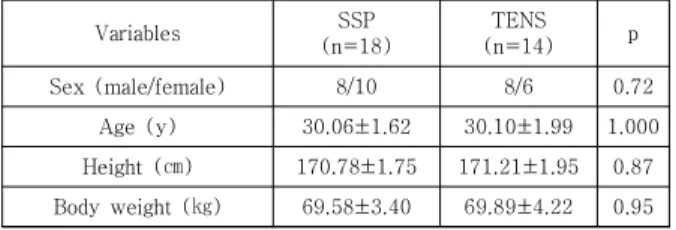
The SSP and A-TENS groups did not significantly differ in their general characteristics Demographic data is shown on Table 1.

Variables SSP

(n=18)

TENS

(n=14) p

Sex (male/female) 8/10 8/6 0.72

Age (y) 30.06±1.62 30.10±1.99 1.000 Height (㎝) 170.78±1.75 171.21±1.95 0.87 Body weight (㎏) 69.58±3.40 69.89±4.22 0.95 Values are presented as mean±standard deviation.

Table 1. General patient characteristics

2.2 Outcome Measurements 2.2.1 Blood flow

Blood flow at the skin surface was measured using noninvasive laser Doppler imaging

equipment (moorLDI2-IR 2013, Wilmington, DE, USA), which is designed to enable monitoring of micro circulation in healthy, disease-affected, or stimulated tissues. Low-power laser light is emitted on the tissues through an optical fiber probe, and the wavelength or frequency of the irradiation is affected by the number or velocity of blood cells in the vessels. This measurement is presented as perfusion units (PU), and there are multiple techniques for accurately analyzing the correlations among measurements. For blood flow measurement, the participant was seated on a chair with their arm on a table, with the medial side of the arm facing upwards; the investigator marked a point on the Neiguan. The arm was scanned with the laser Doppler imaging equipment at 10 ms/pix, and blood flow was analyzed using the printed image (1 cm×1 cm).

2.2.1 Pressure pain threshold

Pressure pain threshold (PPT) was measured using the Commander algometer (JTECH Medical, Midvale, UT, USA), which consists of a probe, handle, and recording device. It enables objective measurement and quantification of local pain through repeated pressure. The probe is attached at the tip of a handle, and surface size is 10 mm×10 mm. Pressure was applied vertically on three sites, 0.5 cm from the mark on the acupoint. The pressure was continued until the participant verbally expressed discomfort or pain. Three measurements were taken, and the average was used for analysis. The unit of pressure was set to pound (lb.). The algometer used has high inter- and intra-rater reliability (r=0.99)[20].

2.3 Intervention and Procedure 2.3.1 Procedure

Participants in both the SSP and A-TENS

groups were administered a questionnaire about

their general characteristics (gender, age, height,

(4)

Experimental (n=18)

Control

(n=14) t (p)

Blood flow Pre 74.4±46.77 76.23±26.45

2.29(0.005)

Post 349.61±206.99 166.18±74.3

Pain threshold Pre 61.4±17.77 57.89±11.89

3.15(0.004)

Post 83.2±18.03 64.67±15.25

Values are presented as mean±standard deviation.

Table 2. Comparison of pain threshold and blood flow between the two groups (n=32)

and weight). For the pre-test, to measure pain threshold and blood flow at the Neiguan (PC6) of the Jueyin Pericardium Meridian of the hand, the participants sat on chairs with their arms on a rail and rested for 5 minutes to relax the muscles.

Next, the test and electric stimulation sites were cleaned. Interventions were administered individually, and the post-test for blood flow and pain threshold was conducted on the same areas[15].

2.3.2 SSP

SSP was performed with the TM-560 (Nihon Medi-Physics Co., Ltd., Tokyo, Japan) with a 2.8-cm electrode at a fixed frequency of 3 Hz for 15 minutes. Intensity was set such that the participants did not perceive pain.

2.3.3 A-TENS

TENS was performed with the TENS machine (Series 3 TENS/EMS Combo - Code: TPN 360, Physio-Med Services Ltd., Glossop, Derbyshire, UK) with two channels. The electrode (2.8 cm in diameter) was attached to the forearm and a stimulation of 3 Hz was applied for 15 minutes.

Intensity was set such that the participants did not perceive pain.

2.4 Statistical analysis

Data were statistically analyzed with the Windows SPSS/PC Statistics 18.0 software (SPSS Inc., Chicago, IL, USA). Participants’ general characteristics were analyzed using the chi-square test. The Shapiro-Wilk test was used

to verify the normality of the data. The changes in blood flow and PPT after intervention in the two groups were compared with the paired t-test. Differences between the SSP and TENS groups were analyzed with the independent t-test. Statistical significance was set at α=0.05.

3. Results

3.1 Changes in blood flow

Both the SSP and TENS groups showed a significant difference in blood flow after the intervention (p<0.05). Additionally, the change in blood flow after the intervention significantly differed between the two groups (p<0.05; Table 2).

3.2 Changes in PPT

The SSP group showed a significant change in PPT after the intervention (p<0.05), whereas the TENS group did not. Moreover, the change in PPT after intervention significantly differed between the two groups (p<0.05; Table 2).

4. Discussion

In general, TENS and its variations are typically

administered for pain management. However, in

TENS, the intensity of electric stimulation has to

be increased continually (within a safe range) as

tolerance develops in patients. SSP is a

noninvasive electrotherapy method that replicates

(5)

the effects of acupuncture, while addressing this specific issue with TENS. SSP is one of the methods that has increased accessibility to acupuncture by comprehensively addressing its shortcomings, such as pain, complexity of technique, difficulty with leaving the needles inserted for long periods, fear of needles, hypersensitivity to needles, and difficulty of administration in children[21]. Furthermore, the electrodes used for SSP are smaller than those for TENS, which enables accurate and repeated stimulation of the acupoint, thereby increasing electric conduction and producing effects similar to magnetic needles[22]. Owing to its acupuncture-like effects, SSP can potentially be used not only for pain management but also for other purposes. In this study, we compared the effects of SSP and A-TENS application on an acupoint.

We divided 32 healthy men and women into the SSP and A-TENS groups to investigate the effects of electric stimulation on blood flow and PPT. The results showed that both blood flow and PPT significantly increased in the SSP group, whereas only blood flow significantly increased in the A-TENS group. The SSP group showed a substantially greater change in local blood flow and PPT compared with the A-TENS group, suggesting that SSP is more effective than A-TENS.

The International Association for the Study of Pain defines pain as “an unpleasant sensory and emotional experience associated with actual or potential tissue damage.” In the present study, we used mechanical pressure pain threshold to objectively measure pain. Pressure threshold refers to the minimum pressure that induces pain or discomfort, and using pressure as a pain threshold lends relatively high objectivity to our method [23].

Previous studies have reported that applying SSP after abdominal surgery significantly decreased pain severity and demands for analgesics, and

that administering SSP along with the use of artificial tears in patients with xerophthalmia produced positive effects[13, 21, 24]. Similar to the results of our study, Lee[25] reported that SSP had a greater effect on threshold compared with TENS in patients with lower back pain. On the other hand, the effect of SSP on pressure threshold did not significantly differ from that of A-TENS in the study by Kim et al.[22]. Our results may have been different because we applied SSP and TENS on a different area of the body, focusing on a particular acupoint.

There are multiple hypotheses regarding the underlying mechanism of SSP, including the gate control theory, descending pain inhibition through the endogenous morphine system in the central nervous system, and elimination of pain-inducing substances due to elevated local blood flow[13]. In a comparison of sensory fibers after SSP and TENS application, Yun[26] stated that SSP does not alter the pain threshold of the C-fiber, arguing that the gate control theory alone cannot explain the underlying pain-controlling mechanism. Lee et al.[27] found that electropuncture stimulation decreased the concentration of P substance, a type of pain-inducing factor in the blood, thereby corroborating the finding of the study by Choi et al.[28] that SSP increases plasma beta endorphin concentration. This finding confirmed that the same mechanism was involved with electropuncture and SSP, suggesting that the therapeutic effects of these techniques could most likely be attributed to descending pain inhibition through the endogenous morphine system.

The low-frequency high-intensity A-TENS used in our study generates analgesic effects by activating the Aδ and C-fibers[29], and it can be compared with SSP because it can stimulate acupoints with high-intensity.

Blood flow refers to the flow of blood in blood

vessels, and it can be modulated by several factors

such as muscular contraction, hemoendothelial

(6)

regulating factors, autonomic nerves, and hormones. Dilated blood vessels facilitate recovery by increasing blood flow circulation and promoting the supply of nutrients. Elevated blood flow promptly removes inflammatory metabolites in the blood vessel such as prostaglandin, bradykinin, and histamine, thereby contributing to healing and pain relief[30]. In our study, blood flow was increased by two different types of electrostimulation, but the change was more substantial in the SSP group. A study reported that electric stimulation with varied frequencies led to irregular changes in blood pressure and heart rate in healthy adults, but it consistently increased blood flow[31], confirming that elevation of blood flow is one of the body’s physiological responses to electric stimulation.

Cramp et al.[32] suggested that the stimulation should be greater than the motor threshold in order to increase subcutaneous blood flow using TENS. Further, they stated that the mechanism underlying the increase of subcutaneous blood flow involves the contraction of muscles, and the phenomenon is localized because it results from muscle activity. Miller et al.[33] reported that muscle contraction caused by TENS is similar to voluntary muscle contraction, with the only difference being the duration of effect. A study that examined physiological changes resulting from the administration of A-TENS on an acupoint found that electric stimulation is not correlated with heart rate, blood pressure, and sensory changes[34], supporting the extent of changes in blood flow caused by A-TENS reported in our study. Applying SSP (3 Hz) on the body inhibited the excitation of sympathetic nerves, increased beta endorphin, and increased vasoactive intestinal peptide (VIP) in Choi’s study[35]. Blood flow is increased as a result of inhibiting sympathetic nervous excitation and increasing VIP release. This can be explained with one of the underlying mechanisms of acupuncture, where axonal reflex is induced by

modulating the autonomic nervous system[11].

Based on these reports, SSP is correlated with blood flow, and SSP and TENS affect blood flow through different mechanisms. SSP leads to greater elevation of blood flow, as increase in blood flow is a secondary effect of autonomic nerve stimulation and vasodilating factors, in contrast to TENS, where blood flow is increased as a result of local muscle contraction. Multiple studies have reported that the elevation of blood flow caused by electropuncture promotes subcutaneous micro blood circulation in the limbs through mechanisms involving increasing capillary permeability, eliminating rigidity of microarteries, altering the liquidity of microcirculation, promoting fibrinolysis, and reducing vascular viscosity and platelet aggregation[36,37].

Notably, our findings have limited generalizability due to the small sample size and the participation of only healthy individuals; the results may differ when the treatments are applied to actual patients experiencing pain.

Although the measurement site was consistent, we did not control for various individual characteristics such as vascular distribution and sensitivity at the measurement site. In the future, a larger sample that also includes patients should be used to elucidate the effects of both treatments, and the use of other instruments to measure pain threshold should be explored to enhance the objectivity of results. Furthermore, a follow-up study should be performed immediately after treatment, to compare the efficacy of different methods of application.

5. Conclusion

This study found that SSP and A-TENS

application on an acupoint in healthy men and

women altered their blood flow and PPT, with a

significantly greater change observed after SSP

treatment. Although the application of SSP and

(7)

TENS on the pain site may be beneficial, treatment on acupoints more effectively alters blood flow and pressure pain threshold.

REFERENCES

[1] X. Cheng, Y. Cheng, X. Huang, W. Jia, S. Li & M. Qiu M. (2009). Chinese acupuncture and moxibustion.

Beijing : Foreign Languages Press Google Scholar.

[2] R. Rossetti, C. Seiler, K. Brathwaite & R. Zurier. (1995).

Effect of Misoprostol on Acute and Chronic Inflammation. American journal of therapeutics, 2, 600-606.

DOI : 10.1097/00045391-199509000-00004

[3] A. Vickers. (1996). Can acupuncture have specific effects on health? A systematic review of acupuncture antiemesis trials. Journal of the Royal Society of Medicine, 89, 303.

[4] S. H. Chung & A. Dickenson. (1980). Pain, enkephalin and acupuncture. Nature, 283, 243.

DOI : 10.1038/283243a0

[5] S. Takayama, T, Seki, M. Watanabe, Y, Monma, S.Y.

Yang & N. Sugita. (2010). Brief effect of acupuncture on the peripheral arterial system of the upper limb and systemic hemodynamics in humans. The Journal of Alternative and Complementary Medicine, 16, 707-713.

DOI : 10.1089/acm.2009.0355

[6] K. H. Kim, S. H. Noh, G. Y. Yang, J. K. Kim, Y. R Kim

& B. R. Lee. (2012). Laser Doppler Analysis of the Effects of Electrocupuncture on Local Blood Flow on Skin Flap: A Case Report. The Journal of Korean Acupuncture & Moxibustion Medicine Society, 29(4), 105-111.

[7] H. K Jung. (2009). The hemodynamic effects of acupuncture on LR3(Taechung) and ST36(Joksamni) in mammary tissues monitored by diffuse optical imaging. Doctoral dissertation. Dongshin University, Na-joo.

[8] S. H. Won, J. S. Owi, E. J. Choi & K. R. Kwon. (2005).

A clinical case study of Acupuncture treatment for burned hand. THE ACUPUNCTURE, 22(1), 13-17 [9] H. J. Chang, B. S. Woo, C. S. Shin, Y. K. Seo, D. J. Paik

& N. S. Kim. (2003). The Effects of Acupuncture on Fibronectin, Collagens and Laminin in the Burn Wound Healing of Rats. Korean Journal of Physical Anthropology, 16, 27-38.

[10] T. Y. Kim. (2013). Trend Analysis of Facial Cosmetic Acupuncture Study based on the Korean Traditional Medicine. Journal of Korean Acupuncture &

Moxibustion Society, 30, 125-137.

DOI : 10.13045/acupunct.2013052

[11] B. Anderson, A. Nielsen, D. McKee, A. Jeffres & B.

Kligler. (2012). Acupuncture and heart rate variability:

a systems level approach to understanding mechanism. The Journal of Science and Healing, 8, 99-106.

DOI : 10.1016/j.explore.2011.12.002

[12] A. White & J. Filshie. (2008). An introduction to western medical acupuncture. Edinburgh : ChurchillLivingstone.

DOI : 10.1016/b978-0-443-07177-5.x0001-3 [13] D. C. Lee. (2008). Using silver spike point needle-free

electro-acupuncture for postoperative pain management. Master dissertation. Victoria University, Melbourne.

[14] K. M. Um. (2018). A Study on the Effects of Silver Spike Point on Functional Constipation Improvement.

Journal of International Academy of Physical Therapy Research, 9(2), 1490-1493

DOI:10.20540/JIAPTR.2018.9.2.1490

[15] J. AminiSaman, S. Mohammadi, H. Karimpour, B.

Hemmatpour, H. Sharifi, R. Kawyannejad. (2018).

Transcutaneous Electrical Nerve Stimulation at the Acupuncture Points to Relieve Pain of Patients Under Mechanical Ventilation: A Randomized Controlled Study. Journal of Acupuncture & Meridian Studies, 11(5), 290-295.

DOI:10.1016/j.jams.2018.06.008

[16] R. Melzack, P. D. Wall. (1965). Pain mechanisms: a new theory. Science, 150(3699), 971-979.

[17] B. Platon, C. Mannheimer, P. Andréll.. (2018). Effects of high-frequency, highintensity transcutaneous electrical nerve stimulation versus intravenous opioids for pain relief after gynecologic laparoscopic surgery:

a randomized controlled study. Korean Journal of Anesthesiology, 71(2), 149-156

DOI:10.4097/kjae.2018.71.2.149

[18] R. Alexander, C. Taylor, N. Cinquemani & J. H.

Kramer. (1970). Use of physical therapy in oral surgical practice. Journal of oral surgery, 28(9), 671-674.

[19] S. C. Jung. (1996). Oral facial pain and temporomandibular disorders. Seoul : Shinheung international.

[20] A. M. Kinser, W. A. Sands & M. H. Stone. (2009).

Reliability and validity of a pressure algometer. The Journal of Strength & Conditioning Research, 23(1), 312-314.

DOI : 10.1519/jsc.0b013e31818f051c

[21] K. S. Lee, Y. H. Kim, K. H. Min, H. K Yoo, Y. H. Hwang

& C. K. Chung. (1985). Clinical Study of the Postperative Pain Management with Silver Spike Point Electro-therapy. Korean Journal of Anesthesiology, 18(1), 63-70.

[22] Y. J. Kim, E. J. Lee, J. S. Cho & C. H. Yi. (1995). Effects

of Acupuncture-Like Transcutaneous Electrical Nerve

Stimulation and Silver Spike Point Therapy on

(8)

Pressure Pain Sensitivity. Physical Therapy Korea, 2(2), 66-72.

[23] A. A. Fischer. (1986). Pressure tolerance over muscles and bones in normal subjects. Archives of physical medicine and rehabilitation, 67(6), 406-409.

[24] K. L Tseng, H. J. Liu, K. Y. Tso, L. C. Woung, Y. C. Su

& J. G. Lin. (2006). A clinical study of acupuncture and SSP (silver spike point) electro-therapy for dry eye syndrome. The American journal of Chinese medicine, 34(02), 197-206.

DOI : 10.1142/s0192415x0600376x

[25] J. W. Lee. (2007). The effect of silver spike point therapy and electrical acupuncture stimulation on lumbar electrical stimulation pain threshold. Master dissertation. Hanseo University, Seo-san.

[26] M. J. Yun & W. H. Lee. (2011). The Effect of Current Perception Threshold and Pain Threshold through Transcutaneous Electrical Nerve Stimulation and Silver Spike Point Therapy. The Journal of Korean Physical Therapy, 23.

[27] H. J. Lee, J .H. Lee, E. O. Lee, H. J. Lee, K. H. Kim &

S. H. Kim. (2009). Substance P and beta-endorphin mediate electro-acupuncture induced analgesia in mouse cancer pain model. Journal of Experimental &

Clinical Cancer Research, 28(1), 102.

DOI : 10.1186/1756-9966-28-137

[28] Y. D. Choi, J. H Lee & J. H. Kim. (2004). Inhibition of Endothelial Cell-dependent Serotonin-induced Contraction of β-endorphin and Increment of Plasma β-endorphin of Silver Spike Point Low Frequency Electrical Stimulation. The journal of Korean society of physical therapy, 16, 499-506.

[29] J. Willer, D. Bouhassira & D. B. Le. (1999).

Neurophysiological bases of the counterirritation phenomenon: diffuse control inhibitors induced by nociceptive stimulation. Clinical neurophysiology, 29(5), 379-400.

[30] H. K. Jeong. (2016). The effect of contrast therapy using infrared and cryotherapy on blood flow, muscle tone and pain. Master dissertation. Sahmyook University, Seoul.

[31] J. E. Tracy, D. P. Currier & A. J. Threlkeld. (1988).

Comparison of selected pulse frequencies from two different electrical stimulators on blood flow in healthy subjects. Physical therapy, 68(10), 1526-1532 DOI : 10.1093/ptj/68.10.1526

[32] F. L. Cramp, G. R. McCullough, A. S. Lowe & D. M.

Walsh. (2002). Transcutaneous electric nerve stimulation: the effect of intensity on local and distal cutaneous blood flow and skin temperature in healthy subjects. Archives of physical medicine and rehabilitation, 83(1), 5-9.

DOI : 10.1053/apmr.2002.27478

[33] B. F. Miller, K. G. Gruben & B. J. Morgan. (2000).

Circulatory responses to voluntary and electrically

induced muscle contractions in humans. Physical therapy, 80(1), 53-60.

DOI : 10.1093/ptj/80.1.53

[34] T. David & A. Y. Jones. (2013). Are physiological changes experienced by healthy subjects during acu-TENS associated with acupuncture point sensations?. Acupuncture in Medicine, 32(1), 28-36 DOI : 10.1136/acupmed-2013-010428

[35] Y. D. Choi. (2002). Effects of electrical stimulation on the level of sympathetic neurotransmitters and VIP the mechanism of VIP induced relaxation. Doctoral dissertation. Kyonggi University, Su-won.

[36] G. Litscher, L. Wang, E. Huber & G. Nilsson. (2002).

Changed skin blood perfusion in the fingertip following acupuncture needle introduction as evaluated by laser Doppler perfusion imaging. Lasers in medical science, 17(1), 19-25.

DOI : 10.1007/s10103-002-8262-9

[37] S. J. Jeong, J. H. Yoo, H. J. Ko, J. C. Shin, M. Kwak &

T. S. Wei. (2018). Efficacy and Patient Satisfaction in Cases of Back Pain Treated Using Either Acupuncture or Chuna: A Comparative Study. The Korean Acupuncture Moxibustion Medicine Society, 35(2), 81-87.

이 동 현(Dong-Hyun Y)i [정회원]

․ 2014년 8월 : 고려대학교 물리치료학 과 (이학사)

․ 2017년 2월 ~ 현재 : 삼육대학교 대 학원 물리치료학과 석박사과정 중

․ 관심분야 : 노인낙상, 전정재활, 이학 적치료

․ E-Mail : [email protected]

김 범 룡(Beom-Ryong Kim) [정회원]

․ 2010년 2월 : 원광대학교 건강관리학 과 (체육학사)

․ 2016년 2월 : 세한대학교 대학원 물 리치료학과 (이학석사)

․ 2017년 2월 ~ 현재 : 삼육대학교 대 학원 물리치료학과 박사과정 중

․ 관심분야 : 운동재활, 근골격계물리치 료, 심장호흡물리치료

․ E-Mail : [email protected]

(9)

저자사진크 기 25*30

허 윤 정(Yoon-Jung Hur) [정회원]

․ 2005년 2월 : 서남대학교 물리치료학 (이학사)

․ 2016년 2월 : 연세대학교 보건대학원 (보건학석사)

․ 2016년 3월 ~ 현재 : 삼육대학교 물 리치료학(박사과정)

․ 2005년 3월 ~ 현재 : 연세의료원 신 촌세브란스 재활병원 물리치료사

․ 관심분야 : 감정노동, 작업장폭력, 물리치료학

․ E-Mail : [email protected]

김 동 훈(Dong-Hoon Kim) [정회원]

․ 2015년 3월 ~ 현재 삼육대학교 물 리치료학과 박사(재)

․ 2014년 4월 ~ 현재 : 분당제생병원 재 활의학과 재활치료실 근무

․ 관심분야 : 신경계 운동치료, 재활치료

․ E-Mail : [email protected]

심 수 영(Su-Young Shim) [정회원]

․ 2016년 8월 : 삼육대학교 물리치료학 과(이학석사)

․ 2016년 9월 ~ 현재 : 삼육대학교 물 리치료학과 박사과정

․ 관심분야 : 물리치료학

․ E-Mail : [email protected]

임 종 은(Jong-Eun Yim) [정회원]

․ 2005년 8월 : 삼육대학교 물리치료 학과 (이학사)

․ 2007년 2월 : 삼육대학교 대학원 물리 치료학과 (이학석사)

․ 2012년 6월 : 로마린다대학교 대학원 물리치료학과 (이학박사)

․ 2012년 9월 ~ 현재 : 삼육대학교 물리 치료학과 교수

․ 관심분야 : 노인낙상, 전정재활, 이학적치료

․ E-Mail : [email protected]

수치

Table  1.  General  patient  characteristics
Table  2.  Comparison  of  pain  threshold  and  blood  flow  between  the  two  groups  (n=32)

참조

관련 문서

Department of Electrical Technology Convergence Engineering, Graduate School of Industry Technology

Complete blood , white blood cell and platelet counts all showed statistically significantly differences (p&lt;0.05), as did. In other tests, PT and aPTT had

With these results, we can suggest the hypothesis that increased cardiac output in the patients who administered ketamine increased muscle blood flow, and this is the

Stop transfusion. Emergency management of anaphylaxis, then test serum of both donor/blood and recipient for quantitative IgA level. Future blood products only

이하선의 실질 속에서 하악경의 후내측에서 나와 하악지의 내측면을 따라 앞으로 간다. (귀밑샘 부위에서 갈라져 나와

지방세포 /blood

적혈구(red blood cell, reticulocyte) 2. 백혈구(white

 물리적 인자치료 - 미세전류신경근육자극(microcurrent electrical neuromuscular stimulation, MENS)..
