- 734 -
반응표면분석법에 의한 메밀(
Fagopyrum esculentum
M.) 새싹 기능성분의 추출 조건 최적화박기재․임정호†․김범근․정진웅․김종찬․이명헌1․조영심․정희용 한국식품연구원, 1한림성심대학 식품영양과
Optimization of Extraction Conditions to Obtain Functional Components from Buckwheat ( Fagopyrum esculentum M.) Sprouts,
using Response Surface Methodology
Kee-Jai Park, Jeong-Ho Lim†, Bum-Keun Kim, Jin-Woong Jeong, Jong-Chan Kim, Myung-Heon Lee1, Young-Sim Cho and Heeyong Jung
Korea Food Research Institute, Seongnam 463-746, Korea
1
Department of Food & Nutrition, Hallym College, Chuncheon 200-711, Korea
Abstract
Response surface methodology (RSM) was used to optimize extraction conditions for functional components of buckwheat (Fagopyrum esculentum). A central composite design was applied to investigate the effects of three independent variables, namelyextraction temperature (X1), extraction time (X2), and ethanol concentration (X3), on responses including extraction yield (Y1), total phenolic content in the extract (Y2), α-glucosidase inhibition activity (Y3), and acetylcholine esterase (ACE) inhibition activity (Y4). Data were analyzed using an expert design strategy and statistical software. The maximum yield was 24.95% (w/w) at 55.75℃ extraction temperature, 8.75 hextraction time, and 15.65% (v/v) ethanol. The maximum total phenolic yield was 222.45 mg/100 g under the conditions of 28.11℃ extraction temperature, 8.65 h extraction time, and 81.72% (v/v) ethanol. The maximum α-glucosidase inhibition activity was 85.38% at 9.62℃, 7.86 h, and 57.58% (v/v) ethanol. The maximum ACE inhibition activity was 86.91% under extraction conditions of 10.12℃, 4.86 h, and 44.44% (v/v) ethanol. Based on superimposition of a four-dimensional RSM with respect to levels of total phenolics, α-glucosidase inhibition activity, and ACE inhibition activity, obtained under various extraction conditions, the optimum ranges of conditions were an extraction temperature of 0-70℃, an extraction time of 2-8 h, and an ethanol concentration of 30-80%
(v/v).
Key words:Fagopyrum esculentum M., extraction, optimization, RSM
서 론
1)
메밀(Fagopyrum esculentum M.)은 마디풀과에 속하는 작물로서 메밀·메물이라고 부르기도 하며 한자어로는 교맥 이라고 부르며, 동아시아 온대 북부의 바이칼호·만주·아무 르강변 등이 원산지로 8세기경부터 국내에 유입되어 널리 이용되어온 작물로 알려져 있다(1). 우리나라에서 메밀은 대중적 기호 식품이자 채소로서 뿐만 아니라 약용 작물로써
†Corresponding author. E-mail:[email protected], Phone:82-31-780-9331, Fax:82-31-780-9333
오래 동안 재배되어 왔다. 메밀 종자는 xylose, mannose, galactose, glucuronic acid, arginine, leucine과 같은 필수 아 미노산과 야채로 이용되는 식물체와 종실에는 rutin을 다량 함유하고 있다(2). 이러한 rutin은 quercetin과 같은 플라보 노이드 계통의 성분으로 모세혈관의 투과성을 향상시키고 당뇨병의 안구압에 관여하는 것으로 알려지고 있으며 동맥 경화 예방이나 혈압강화 및 당뇨병 치료식품으로 인정되고 있어 건강식품으로 개발할 가치가 높은 것으로 알려지고 있다(3,4).
또한, 메밀에는 불포화지방산의 함량이 많고 Ca, Re, K,
로 알려진 것은 2005년 이후로서 새싹채소의 시장 규모는 높은 성장률을 나타내고 있다(10). 새싹으로 재배할 수 있는 식물은 콩, 숙주, 순무, 알파파, 서양배추 등 40여종이 있으 며, 특히, 메밀 새싹은 그 조직이 부드러우며, 독특한 조직감 을 지니고 있을뿐만 아니라 콩나물과 달리 독특한 향을 가지고, 아미노산, 미네랄과 식이섬유가 풍부하다. 이러한 메밀 새싹은 신선한 채소로 생식되거나 seasoning 또는 쥬 스로서 가공되어 사용되거나, 가루로 가공되어 스프, 음료, 차 등의 건강식품의 제조에 있어서 첨가물로서 사용되기도 한다. 또한, 일반적으로 식물종자는 발아가 진행됨에 따라 생리적 활성이 증대되고 성분의 변화가 일어나는 것으로 알려져 있는데, 메밀은 발아 시 특히 rutin의 함량이 크게 증가하는데 메밀종실과 이를 발아한 메밀싹의 rutin 함량은 18∼27배까지 증가하는 것으로 나타나 rutin 공급원으로써 메밀 싹을 섭취하는 것에 대한 관심이 증가하고 있다 (11,12).
따라서, 본 연구에서는 메밀 새싹을 기능성 소재로서 개 발하기 위하여 메밀 새싹의 유용성분의 최적추출을 확립하 고자 하였으며, 이를 위하여 메밀 새싹채소의 총페놀함량, α-glucosidase 저해능, ACE 저해능에 대한 추출특성을 반응 표면분석에 의해 모니터링하고자 하였다.
재료 및 방법
재 료
본 실험에 사용된 메밀은 강원도 봉평에서 2008년에 재 배된 종자를 구입한 것을 사용하였다. 메밀 종자는 4시간 침수 시킨 뒤 건전한 것을 선별한 후 1일 4회 15분간 분주하 도록 설정한 새싹재배기(Mikrofarm, EasyGreen Co., MA, USA)을 이용하여 7일간 18℃에서 성장시켰다. 메밀새싹은 뿌리부분을 제외한 줄기이상의 부분을 절단한 즉시 -70℃
의 온도에서 동결하였다. 동결된 메밀 새싹은 동결건조기 (TD5508 Freeze dryer, Inshin Lab., Co., LTD, Seoul, Korea) 를 이용하여 건조하고 blender(KA-2600, Kaiser, Korea)로
methodology; RSM)을 이용하여 최적 추출조건의 예측과 추출조건에 따른 추출물의 이화학적 특성을 모니터링하였 다. 추출조건의 최적화를 위한 실험계획은 중심합성계획법 에 의하여 설계하였고, 반응표면분석을 위해서는 SAS (statistical analysis system) program(13)을 사용하였다.
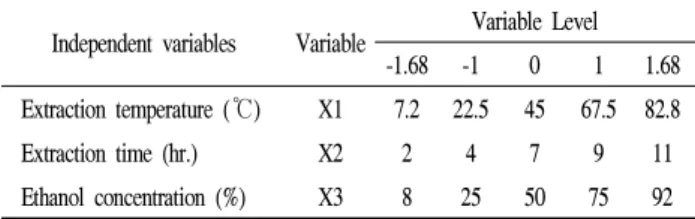
중심합성계획에 의한 독립변수(Xi)의 실험계획은 Table 1과 같이 추출공정에서 중요한 변수로 고려되는 인자, 즉 시료의 추출온도(X1), 추출시간(X2), 증류수에 대한 에탄올 농도(X3)를 -1.68, -1, 0, 1, -1.68의 5단계로 부호화하였다.
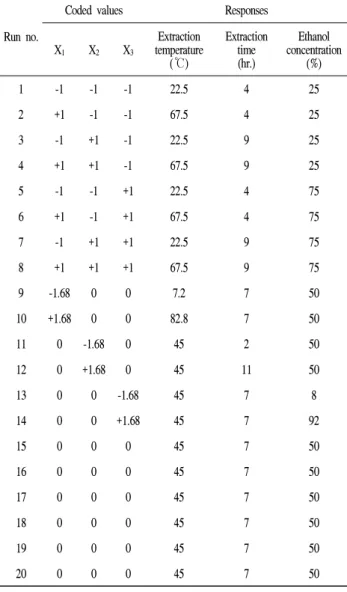
독립변수(Xi)는 중심합성계획에 따라 Table 2와 같이 20구 간으로 설정하여 추출실험을 실시하였다. 또한, 이들 요인 변수에 의한 영향을 받는 종속변수(Yn)는, 추출물의 품질인 자로서 수율(Y1), 총페놀성 화합물 함량(Y2), ACE 저해활성 (Y3) 및 α-glucosidase 저해 활성(Y4)으로 하였으며, 이들은 3회 반복 측정하여 그 평균값을 회귀분석에 사용하였다.
변수들의 추출특성과 그에 상응하는 최적 추출조건은 Mathematica program(14)을 이용하여 4차원 반응표면으로 나타내었다.
Table 1. Experimental range and value of the independent variable in the central composite design for extraction conditions
Independent variables Variable Variable Level
-1.68 -1 0 1 1.68
Extraction temperature (℃) X1 7.2 22.5 45 67.5 82.8
Extraction time (hr.) X2 2 4 7 9 11
Ethanol concentration (%) X3 8 25 50 75 92
최적 추출조건의 예측 및 실증시험
최적 추출조건은 반응변수인 추출물의 특성 즉, 수율, 총페놀성 화합물 함량, α-glucosidase 저해활성 및 ACE 저해 활성의 반응표면을 superimposing했을 때 중복되는 부분의 범위로 예측하였다. 또한 예측된 범위에서 임의의 점을 설 정하여 회귀식에 대입한 후 그 예측된 최적값들에 대하여 검증을 실시하였다.
Fig. 1. Response surface for yield in buckwheat sprout extract at constant value (yield: 20-21-22%) as a function of ethanol ratio, extraction temperature and extraction time.
Table 2. Central composite design matrix of three test variables in coded values, three observed responses of cultivated media
Run no.
Coded values Responses
X1 X2 X3
Extraction temperature
(℃)
Extraction time(hr.)
Ethanol concentration
(%)
1 -1 -1 -1 22.5 4 25
2 +1 -1 -1 67.5 4 25
3 -1 +1 -1 22.5 9 25
4 +1 +1 -1 67.5 9 25
5 -1 -1 +1 22.5 4 75
6 +1 -1 +1 67.5 4 75
7 -1 +1 +1 22.5 9 75
8 +1 +1 +1 67.5 9 75
9 -1.68 0 0 7.2 7 50
10 +1.68 0 0 82.8 7 50
11 0 -1.68 0 45 2 50
12 0 +1.68 0 45 11 50
13 0 0 -1.68 45 7 8
14 0 0 +1.68 45 7 92
15 0 0 0 45 7 50
16 0 0 0 45 7 50
17 0 0 0 45 7 50
18 0 0 0 45 7 50
19 0 0 0 45 7 50
20 0 0 0 45 7 50
Fig. 2. Response surface for total phenolics in buckwheat sprout extract at constant value (phenolics: 100-150-200 mg/100 g) as a function of ethanol ratio, extraction temperature and extraction time.
수율측정
시료의 수율은 항량을 구한 수기에 추출액 10 mL을 취하 여 105℃에서 증발 건고시킨 후 그 무게를 측정하여 추출액 조제에 사용된 원료 양에 대한 백분율(%)로 나타내었다.
총 페놀 함량 측정
시료의 총 페놀 함량은 Folin-Ciocalteu법(15)에 따라 함 량을 측정하였다. 캡튜브에 시료를 0.5 mL 채취하고 1 N Folin-Ciocalteu 시약을 0.5 mL를 첨가하여 정확히 3분 후에 2% sodium carbonate anhydrous 포화용액 10 mL를 첨가한 후 1시간 동안 반응시킨 것을 여과하여 750 nm에서 UV-spectrophotometer(V-570, Jasco Co., Japan)로 흡광도를 측정하여 총 페놀 함량을 구하였다. 표준물질로는 tannic acid(Sigma Co., USA)를 사용하였다.
α-Glucosidase 저해 활성 측정
α-glucosidase 저해활성은 nitrophenol 분석법(16)을 응용 하여 측정하였다. 0.2U/mL α-glucosidase 효소액 50 μL, 2.5 mM ρ-nitrophenyl a-D-glucopyranoside(ρNPG) 100 μL, sample 50 μL 및 50 mM phosphate buffer(pH 6.8) 50 μL와 혼합하여 37℃에서 20분간 preincubation 한 후 0.1 M NaHO 100 μL를 가하여 반응을 정지시키고 405 nm에서 흡광도를 측정하였다.
ACE 저해 활성 측정
Cushman과 Cheung의 방법(17)에 의하여 ACE 저해활성 을 측정하였다. 즉, angiotensin-Ι 전환효소로 rabbit lung acetone powder(Sigma Co., MO, USA)를 0.3 M NaCl을 함유 한 0.1 M sodium borate buffer(pH 8.3)에 1 g/10 mL(w/v)의 농도로 넣고 4℃에서 overnight 교반 추출한 후, 4℃에서
은 3회 반복 실험하였으며, ACE 저해활성도는 아래의 식에 따라 계산하였다.
ACE 저해활성(%) = 1- (C - CB)(S - SB) × 100
S: O.D. of sample SB: O.D. of sample blank C: O.D. of control
CB : O.D. of control blank
결과 및 고찰
추출조건에 따른 추출물의 이화학적 특성
메밀 새싹을 이용한 가공소재로의 활용성을 높이고 기능 성 물질의 최적 추출 조건을 유도하고자 중심합성계획에 의한 20구간의 추출조건에 따라 추출시험을 실시하였다.
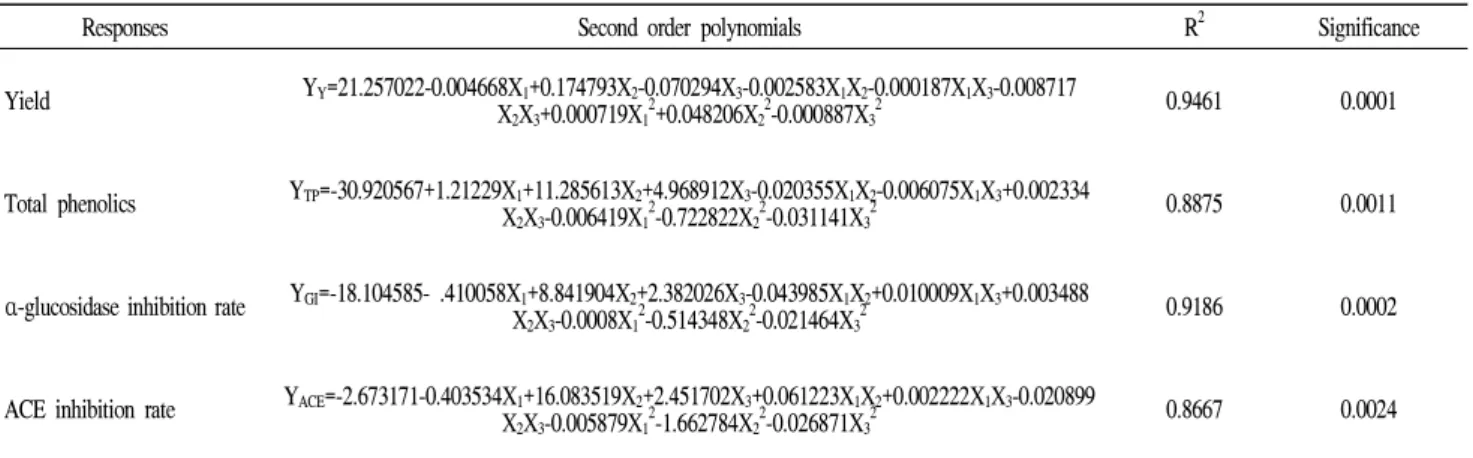
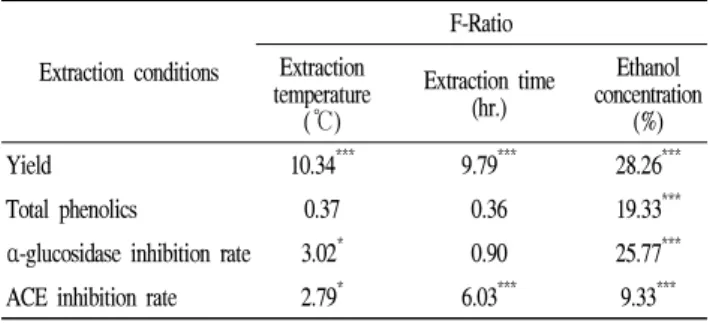
이때 얻어진 각각의 추출물에 대하여 수율, 총페놀성 화합 물 함량, α-glucosidase 저해활성 및 ACE 저해활성을 측정한 결과를 Table 3에 나타내었다. 각각의 결과를 이용하여 최 적 추출조건을 얻고자 반응표면 회귀분석을 실시하여 각 종속변수 즉, 수율, 총페놀성 화합물 함량, α-glucosidase 저해활성 및 ACE 저해활성에 대한 회귀식을 얻었다(Table 4). 또한 변수별 최적 추출조건과 품질특성 값을 예측하여 Table 5에 나타내었으며, 각각의 종속변수에 대한 추출조건 의 영향을 Table 6에 나타내었다. 반응변수들의 4차원 반응 표면은 Mathematica program으로 추출온도(X1), 추출시간 (X2), 에탄올농도(X3)를 독립변수로 하여 Fig. 1∼5에 나타 내었다.
수 율
메밀 새싹의 추출조건에 따른 수율을 측정한 결과는 Table 3과 같이 19.58∼23.65%의 범위로 측정되었으며, 결 과에 대한 반응표면 회귀식의 R2는 0.9461으로 유의성이
7 22.58 135.56 35.51 36.95
8 20.85 210.33 71.04 25.80
9 24.71 134.15 20.29 28.98
10 21.71 219.93 64.49 18.74
11 20.67 202.40 56.05 72.15
12 24.29 108.66 32.00 45.55
13 19.59 225.54 75.94 21.31
14 21.79 206.61 74.08 24.02
15 20.37 214.31 76.49 72.32
16 20.79 196.76 68.04 73.58
17 20.47 215.00 77.85 76.59
18 20.94 202.59 77.52 67.53
19 20.44 205.93 67.59 66.92
20 20.04 197.88 75.46 66.14
Fig. 3. Response surface for α-glucosidase inhibition rate in buckwheat sprout extract at constant value (α-glucosidase inhibition rate: 40-60-80%) as a function of ethanol ratio, extraction temperature and extraction time.
1%이내의 유의수준에서 인정되었다. 예측된 최대값은 추 출온도 55.75℃, 추출시간 8.75 hr 및 에탄올농도 15.65%로 예측되었다. 이것은 반응표면분석으로 예측된 값을 나타낸 것으로 수율은 에탄올농도에 큰 영향을 받고 있었으며, 추 출온도와 시간에 의해서도 영향을 받는 것으로 나타났다.
이러한 결과는 추출온도가 높고 추출시간이 길어지면 팽창 된 고형물의 용해속도 및 용해력이 증가하여 수율이 증가되 는 것으로 볼 수 있으며, Kim 등(18)의 연구에서는 추출온도 및 추출시간이 증가할수록 수율이 증가하는 경향을 보였으 며, Park 등(19)의 산국 에탄올 추출물의 가용성 고형분 함량이 에탄올 농도에 영향을 많이 받고 있다는 보고와 유사한 경향을 나타내었다.
Table 4. Polynomial equations calculated by RSM program for extraction comditin of buckwheat sprouts
Responses Second order polynomials R2 Significance
Yield YY=21.257022-0.004668X1+0.174793X2-0.070294X3-0.002583X1X2-0.000187X1X3-0.008717
X2X3+0.000719X12+0.048206X22-0.000887X32 0.9461 0.0001
Total phenolics YTP=-30.920567+1.21229X1+11.285613X2+4.968912X3-0.020355X1X2-0.006075X1X3+0.002334
X2X3-0.006419X12-0.722822X22-0.031141X32 0.8875 0.0011
α-glucosidase inhibition rate YGI=-18.104585- .410058X1+8.841904X2+2.382026X3-0.043985X1X2+0.010009X1X3+0.003488
X2X3-0.0008X12-0.514348X22-0.021464X32 0.9186 0.0002
ACE inhibition rate YACE=-2.673171-0.403534X1+16.083519X2+2.451702X3+0.061223X1X2+0.002222X1X3-0.020899 X2X3-0.005879X12
-1.662784X22
-0.026871X32 0.8667 0.0024
Fig. 4. Response surface for ACE inhibition rate in buckwheat sprout extract at constant value (ACE inhibition rate: 40-60-80%) as a function of ethanol ratio, extraction temperature and extraction time.
총페놀성 화합물
식물에 널리 분포되어 있는 페놀성 물질은 phenolic hydroxyl 그룹 때문에 단백질 또는 효소단백질, 기타 거대분
자들과 결합하는 성질, 항산화 효과, 2가 금속이온과의 결 합력을 가진다(20). 따라서 본 실험에서는 메밀 새싹에 존재 하는 총 폴리페놀 함량에 대하여 기준물질로 측정 비교하였 다. 중심합성계획에 의한 메밀새싹 추출조건별 총페놀성 화합물 함량은 Table 3에서와 같이 107.01∼225.53 mg/100 g의 범위였으며, 결과에 대한 반응표면 회귀식의 R2는 0.8875으로 유의성이 1%이내의 유의수준에서 인정되었다.
메밀새싹 추출물의 총페놀성 화합물 함량의 예측된 정상점 은 최대점으로 최대값은 추출온도 28.11℃, 추출시간 8.65 hr 및 에탄올농도 81.73%로 예측되었다. 총페놀성 화합물 함량은 에탄올농도에 큰 영향을 받고 있었으며, 추출온도 및 추출시간에 대한 영향은 다소 작은 것으로 나타났다.
퉁퉁마디의 에탄올 추출조건 연구에서 보고한 총페놀성 화합물 함량이 추출온도에 비하여 에탄올 농도가 더 큰 영향을 주고 있다는 보고와 유사한 경향을 나타내었다(21).
또한, Lee 등(22)도 선인장의 총페놀성 화합물 함량에서 추출온도와 추출시간이 증가할수록 높아지는 것으로 보고 하여 본 실험과 유사한 경향을 나타내었다.
Table 5. Predicted levels of optimum conditions for the maximized and minimized responses of variables by the ridge analysis of their response surface
Responses Responses
X1 X2 X3 Estimated
responses Morphology Yield (%) 15.77 3.90 61.04 19.37(min)
minimum 55.75 8.75 15.65 24.95(max)
Total phenolics
(mg/ 100 g) 40.93 6.35 8.26 82.19(min)
maximum 28.11 8.65 81.72 222.45(max)
α-glucosidase
inhibition rate (%) 53.96 6.54 9.20 3.01(min)
saddle point 9.62 7.86 57.58 85.38(max)
inhibition rate (%)ACE 48.27 8.60 86.92 8.58(min)
maximum 10.12 4.86 44.44 86.91(max)
Fig. 5. Superimosed response surface for optimization of total phenolics(150 mg/100 g), α-glucosidase inhibition ratio(60%) and ACE inhibition ratio(80%) of buckwheat sprout extract as a function of ethanol ratio, extraction temperature and extraction time.
α-glucosidase 저해 활성
α-glucosidase는 소장점막의 미세융모막에 존재하는 효 소로서 다당류의 탄수화물을 단당류로 분해하는 탄수화물 의 소화와 흡수에 필수적인 효소이다. 이 효소의 억제는 다당류의 분해를 방해하여 소장에서 glucose의 흡수를 지연 시켜주어 식후 혈당의 급격한 상승을 막는 역할을 한다(23).
메밀새싹에서 α-glucosidase 저해 활성능에 대한 추출조건 별 결과는 Table 3에 나타내었다. 실험 조건에서 α-glucosidase 저해활성능은 20.29∼82.05%로 나타났으며, 이를 바탕으 로 회귀분석을 한 회귀식은 Table 4에 나타내었다. 이러한 α-glucosidase 저해활성능 회귀식의 R2는 0.9186로 나타났 으며, 1%이내의 범위에서 유의성이 인정되는 것으로 나타 났다. 회귀식을 바탕으로 한 α-glucosidase 저해 활성능의 예측된 정상점은 안장점으로 능선분석을 실시하여 본 결 과, 최대값은 85.38%로 예측되었으며, 이때의 추출조건은 추출온도 9.62℃, 추출시간 7.86 hr 및 에탄올농도 57.58%로 예측되었다. α-glucosidase 저해 활성능은 에탄올농도에 큰 영향을 받고 있었으며, 에탄올농도가 증가할수록 저해율이 증가하는 경향을 나타내었고, 추출시간에는 큰 영향을 받 지 않는 것으로 나타났다. α-glucosidase 저해 활성능에 관하 여 감초 세근에 있어서도 에탄올 함량이 저해율에 큰 영향 을 주지 않는 것으로 보고(24)하여 본 실험과 다소 차이를 나타내었으나, 콩나물의 용매별 분리조건에서도 물층에 비 하여 용매층이 우수한 효과를 나타내는 것으로 보고(25)한 것으로 볼 때 시료의 특성에 따른 차이인 것으로 판단된다.
ACE 저해 활성
ACE 저해제는 ACE의 작용을 저해함으로써 angiotensin
Ⅱ의 생성저해, aldosterone 분비감소, 혈관확장제인 bradykinin
에 많은 영향을 받고 있는 것으로 나타났으며, 추출시간에 의해서도 영향을 받는 것으로 나타났으나, 추출온도에 대 해서는 상대적으로 미비한 것을 알 수 있었다. ACE 저해활 성에 관한 메밀의 연구에서(27) 메밀의 ACE 저해활성이 39.39%로 보고하였고, 효소 첨가 가수분해물의 추출물에 서 61.19%로 증가하는 것으로 보고되었다. 버섯의 ACE 저해활성의 경우 추출시간이 감소할수록 ACE 저해활성이 증가하는 형태의 반응 표면이 나타나고, 전체적으로 추출 시간에 영향을 많이 받는 것으로 나타나는 것으로 보고(28) 하고 있어, 본 연구 결과와 유사한 경향을 나타내었다. 또한, 메밀에서 ACE 저해활성을 나타내는 물질은 친수성 peptide 인 것으로 보고되고 있으며, 그 주요성분으로 phenythiolcar- bamoyl 유도체인 것으로 보고(29)하고 있어, 친수성 peptide 의 가용조건과 추출시간에 영향을 많이 받는 것으로 추정되 어진다.
Table 6. Analysis of variables for regression model of physicochemical properties in extraction condition
Extraction conditions
F-Ratio Extraction
temperature (℃)
Extraction time (hr.)
Ethanol concentration
(%)
Yield 10.34*** 9.79*** 28.26***
Total phenolics 0.37 0.36 19.33***
α-glucosidase inhibition rate 3.02* 0.90 25.77***
ACE inhibition rate 2.79* 6.03*** 9.33***
***Significant at 1% level, **Significant at 5% level, *Significant at 10% level.
최적 추출조건 설정 및 최적 추출물의 성분분석
메밀 새싹의 유용성분의 추출조건을 설정하기 위하여 추출조건별 추출물의 수율, 총페놀성 화합물 함량, α -glucosidase 저해활성능 및 ACE 저해활성능에 대한 추출 특성을 조사하였다. 그 결과 메밀 새싹 추출물의 품질특성 을 최대화 할 수 있는 추출조건으로 추출온도 0∼70℃, 추출 시간 2∼8 hr 및 에탄올농도 30∼80%로 나타났으며(Fig
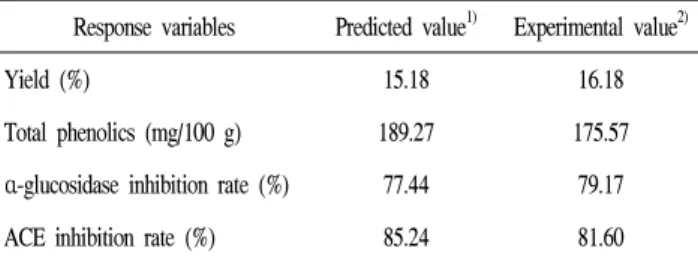
5), 이 범위내의 임의의 조건(추출온도 15℃, 추출시간 5 hr 및 에탄올농도 50%)에서 수율 15.18%, 총페놀성 화합물 함량 189.27 mg/100 g, α-glucosidase 저해효과 77.44% 및 ACE 저해효과 85.24%로 예측되었다(Table 7). 그래서 RSM 기법에 의해 예측된 값과 동일조건에서 실제 실험하여 얻은 실험치를 비교했을 때 수율, α-glucosidase 저해활성능 및 ACE 저해활성능은 예측 범위와 유사한 값을 나타내었고 총 페놀 함량은 조금 낮은 값을 나타내어 도출된 회귀식의 신뢰성을 검증할 수 있었다.
Table 7. Predicted and observed values of the response variables at a given condition within the range of optimum extraction conditions
Response variables Predicted value1) Experimental value2)
Yield (%) 15.18 16.18
Total phenolics (mg/100 g) 189.27 175.57 α-glucosidase inhibition rate (%) 77.44 79.17
ACE inhibition rate (%) 85.24 81.60
1)Calculated using the predicted equations for response variables. Given optimal condition of independent variables : extraction temperature 15℃, extraction time 5 hr, ethanol concentration 50%.
2)Mean values of triplicates determinations
요 약
본 실험은 메밀새싹의 추출조건에 따른 수율, 총 페놀, α-glucosidase 저해활성능, 및 ACE 저해활성능에 대해 반응 표면 분석법을 이용하여 추출조건을 최적화하였다. 중심합 성계획에 따라 추출온도(0∼100 ℃), 추출시간(0∼12 hr) 및 에탄올 농도(0∼100%)를 달리하였을 때 반응 표면 회귀 식의 R2는 수율, 총 페놀, α-glucosidase 저해활성능 및 ACE 저해활성능에서 각각 0.9461(p<0.001), 0.8875(p<0.005), 0.9186(p<0.005) 및 0.8667(p<0.005)로 나타내었으며, 추출 조건별 총 페놀 함량, α-glucosidase 저해활성능 및 ACE 저해활성능에 대한 반응표면을 superimposing하여 얻은 최 적 추출조건 범위는 추출온도 0∼70℃, 추출시간 2∼8 hr 및 에탄올 농도 30∼80%로 나타내었다. 최적 추출조건 범 위내의 임의의 조건인 추출온도 15℃, 추출시간 5 hr 및 에탄올 농도 50 %를 회귀식에 대입하여 얻은 예측값은 수율 15.18%, 총 페놀 함량 189.27 mg/100 g, α-glucosidase 저해활성능 77.44 % 및 ACE 저해활성능 85.24%으로 예측 되었으며, 실제 실험을 통해 얻어진 값은 수율 16.18%, 총 페놀 함량 175.57 mg/100 g, α-glucosidase 저해활성능 79.17% 및 ACE 저해활성능 81.60%으로 매우 유사하게 나타났다.
참고문헌
1. Hao, X., Li, G., Yang, W., Zhou, N., Nin, R. and Zhou, M. (1995) The difference and clasification of light reaction of buckwheat under different treatments of light duration - First report of light reaction difference of buckwheat varieties. International symposium on buckwheat 1995, Current Advances in Buckwheat Research, 541-549
2. Wang, Y., Liu, J. and Qingin, D. (1995) The study on nitrogen and phosphorus content in buckwheat plant and fertilizer application index. International symposium on buckwheat 1995, Current Advances in Buckwheat Research, 593-599
3. Havsteen, B. (1983) Flavonoids a class of natural products of high pharmacological potency. Biochem.
Pham., 32, 1141-1148
4. Lee. J.S., Maeng. Y.S. and Ju, J.S. (1992) The effect of buckwheat supplement on metabolic status of streptozotocin induced diabetic rats, Annual Report of Korea Nutr. Hallym Univ., 9, 21-25
5. Marshall, H.G. and Pomeranz, Y. (1982) Buckwheat description, breeding, production and utilization. In Y.
Pomeranz, ed., Advances in Cereal Science and Technology. Am. Assoc. Cereal Chem., St. Paul, MN.
USA, pp 157-212
6. Choi, Y.S., Ahn, A., Shim, H.H., Choe, M. and Oh, S.Y.
(1992) Effects of instant buckwheat noodle on digestability and lipids profiles liver and serum in rats.
J. Korean Soc. Food Nutr., 21, 478-483
7. Ikeda, K. (1997) Buckwheat: Utilization and recent progress in research. AACC Pacific Rim News, 4-12 8. Mazza, G. and Campbell, C.G. (1985) Influence of water activity and temperarture on dehulling of buckwheat.
Cereal Chem., 62, 31-35
9. Mazza, G. (1988) Lipid content and fatty acid composition of buckwheat seed. Cereal Chem., 65, 122-126 10. Lee, E.H. (2007) Changes in physico-chemical
characteristics during buckwheat germination. Master's degree thesis. Sookmyung Women's University 11. Kim, Y.S., Kim, J.G., Lee, Y.S. and Kang, I.J. (2005)
Comparison of the chemical components of buckwheat seed and sprout. J. Korean Soc. Food Sci. Nutr., 34, 81-86 12. Kim, S.L., Son, Y.K., Hwang, J.J., Kim, S.K. and Hur, H.S. (1998) Development of buckwheat sprout as a functional vegetable. RDA. J. Crop Sci., 40, 191-199 13. SAS Institute, Inc. (1998) SAS/STAT User's Guide,
-fuco- and β-galactopyranosyl-amines, and selected derivatives. Bioorg. Med. Chem., 12, 6569-6579 17. Cushman, D.W. and Cheung, H.S. (1971) Spectrophotometric
assay and properties of the angiotensin converting enzyme of rabbit lung. Biochem. Pharmacol., 20, 1637-1648
18. Kim, N.M., Ko, S.R., Choi, K.J. and Kim, W.J. (1993) Effect of some factors on extraction of effectual components in cinnamon extracts. J. Korean Agric.
Chem. Soc., 36, 17-22
19. Park, N.Y., Lee, G.D., Jeong, Y.J. and Kwon, J.H. (1998) Optimization of extraction conditions for physicochemical properties of ethanol extracts from Chrysanthemum boreale. J. Korean Soc. Food Sci. Nutr., 27, 585-590 20. Lee, T.B. (1979) Illustrated Folra of Korea. Hyangmoon
Publishing Co., Seoul, Korea. pp 511
21. Park, J.W., Kim, H.S., Park, I.B., Shin, G.W., Lee, Y.J.
and Jo, Y.C. (2007) Optimization of ethanol extraction conditions from glasswort(Salicornia herbacea) using response surface methodology. Korean J. Food Preserv., 16, 376-384
22. Lee, G.D., Kim, J.O., Joo, G.J. and Kwon, J.H. (2005) Optimum conditions for the extraction of effective substances from the stem of Opuntia fisccus-indica. Food
effect of the methanol extract of soybean sprout in streptozotocin-induced diabetic rats. J. Korean Soc. Food Sci. Nutr., 32. 921-925
26. Oh, S.J., Kim, S.H., Kim, S.K., Baek, Y.J. and Cho, K.H. (1997) Angiotensin Ⅰ-converting enzyme inhibitory activity of the K-casein fragments hydrolyzated by chymosin, pepsin, and trysin. Fractionation of angiotensin converting enzyme(AEC) inhigitory peptides from soybean paste. Korean J. Food Sci. Technol., 27, 230-234 27. Kayashita, J., Shimaoka, I., Nakajoh, M., Kishida, N.
and Kato, N. (1999) Consumption of a buckwheat protein extract retards 7, 12-dimethylbenz(α)anthracene-induced mammary carcenogenesis in rats. Biosci. Bitechnol.
Biochem., 63, 1837-1839
28. Lee, M.H., Yoon, S.R., Jo, D.K., Kim, H.K. and Lee, G.D. (2007) Optimization of extraction conditions for functional components of roasted Pleurotus eryngii by microwave-assisted extraction. J. Korean Soc. Food Sci.
Nutr., 36, 1062-1069
29. Nakamura, K., Maejima,, Y. and Maejima, S. (2006) Isolation of hydrophilic ACE inhibitory peptides from fermented buckwheat sprout. Peptide Sci., 42, 191-194 (접수 2009년 5월 12일, 채택 2009년 9월 18일)