39(3), 449~454(2010) DOI: 10.3746/jkfn.2010.39.3.449
반응표면분석에 의한 늙은 호박 추출물의 추출조건 최적화
이혜진1․도정룡1․권중호2․김현구1†
1
한국식품연구원
2
경북대학교 식품공학과
Optimization of Extraction Conditions for Extracts from Cucurbita moschata Duch. by Response Surface Methodology
Hye-Jin Lee1, Jeong-Ryong Do1, Joong-Ho Kwon2, and Hyun-Ku Kim1†
1Korea Food Research Institute, Gyeonggi 463-746, Korea
2Dept. of Food Sience and Technology, Kyungpook National University, Daegu 720-701, Korea
Abstract
Extraction characteristics of pumpkin (Cucurbita moschata Duch.) and the functional properties of the corresponding extracts were monitored by the response surface methodology (RSM). The maximum electron donating ability was found as 24.57% at the conditions of 33.13 watt microwave power, 53.67% ethanol concentration and 3.76 min extraction time. The maximum tyrosinase inhibition was 96.59% at 56.21 watt, 68.02%
and 7.97 min. The SOD-like activity was 45.57% at 36.00 watt, 71.51% and 5.28 min. The total polyphenol content was 85.02% at 127.39 watt, 76.18% and 2.68 min. Based on superimposition of four dimensional RSM with respect to electron donating ability, tyrosinase inhibition, SOD-like activity and total polyphenol contents obtained under the various extraction conditions, the optimum ranges of extraction conditions were found to be microwave power of 72~144 watt, ethanol concentration of 0~38% and extraction time of 6~9 min.
Key words: optimization, Cucurbita moschata Duch., response surface methodology, extraction condition
†
Corresponding author. E-mail: [email protected]
†
Phone: 82-31-780-9134, Fax: 82-31-709-9876
서 론
호박(
Cucurbitaspp.)은 박과에 속하는 일년생 덩굴성 초 본으로 동양계 호박(
C. moschataDuch.), 서양계 호박(
C.maxima
Duch.), 페루계 호박(
C. pepoL.)으로 나누어진다 (1). 우리나라에서 재배되는 호박은 동양계 호박으로 애호박 과 늙은 호박을 많이 이용하고 있다. 우리나라 호박은 내건 성이 강하여 유휴지에서도 재배가 가능하고 재배기간 중 농 약을 거의 살포하지 않아도 되는 강점을 지니고 있다(2). 또 한 늙은 호박은 비타민 A, C 및 비타민 전구체인 carotene과 무기물, 식이섬유, 전분, 자당, 포도당 등이 풍부하게 들어있 어 영양학적으로 뛰어나며 이뇨작용과 부종 완화 및 항암효 과, 그 외의 다양한 약리적 효과를 나타낸다(3).
현대사회에 접어들면서 경제성장 및 사회구조의 변화에 따라 생활수준이 향상되었다. 이에 따라 건강에 대한 관심과 기대가 높아지면서 기능성식품에 대한 연구 및 개발이 꾸준 히 이루어지고 있다. 특히 천연 기능성식품으로 늙은 호박의 생리활성, 기능성 및 제품 개발에 대한 연구 또한 활발히 이루어져 왔다. 생리활성 및 기능성에 대한 연구로는 Oh와
Park(4)의 호박즙의 유지 대한 항산화 효과 연구, An 등(5) 의 늙은 호박 추출물의 생리활성 효과 연구 등이 있으며, 제품 개발에 관한 연구로는 호박 잼 개발(6), 호박 음료 제조 (7), 호박 케이크(8) 등이 있다. 그러나 호박의 생리활성 물질 을 이용한 기능성식품 개발에는 최적 추출조건과 추출물의 기능적 특성을 요하는 것이 필요하다.
이에 본 연구에서는 반응표면분석을 이용한 늙은 호박의 기능성 물질의 성분 변화를 살펴보고 최적 추출조건을 설정 하고자 하였다. 이를 위해 마이크로웨이브 에너지, 에탄올 농도, 추출시간에 따른 주요 성분의 추출특성 및 기능적 특 성에 대한 추출조건을 최적화하였다.
재료 및 방법
실험 재료
본 실험에서 사용된 늙은 호박(
Cucurbita moschataDuch.)은 서울 가락시장에서 구입하여 껍질, 과육, 섬유질
및 씨로 분리하여 과육 부분만 사용하였다. 분리한 과육은
동결 건조(FD 5512, Ilshin Lab Co., Ltd., Seoul, Korea)하여
분쇄기(Kaiser, KFN-400S, Kingston Electromotor Co., Ltd., Seoul, Korea)를 사용하여 분쇄 후 분말상태(powder) 의 늙은 호박은 0.2 mm PE film에 밀봉 포장 후 냉동고에 보관하면서 사용하였다.
실험계획
본 실험에서는 추출조건에 대하여 중심합성계획(central composite design)(9)을 사용하여 실험 설계하였고, 추출조 건의 최적화를 위하여 반응표면분석법(response surface methodology, RSM)(10,11)을 사용하였다. 중심합성계획에 서 독립(조건)변수로 마이크로웨이브 에너지(30~150 watt, X
1), 에탄올 농도(0~100%, X
2), 추출시간(1~9분, X
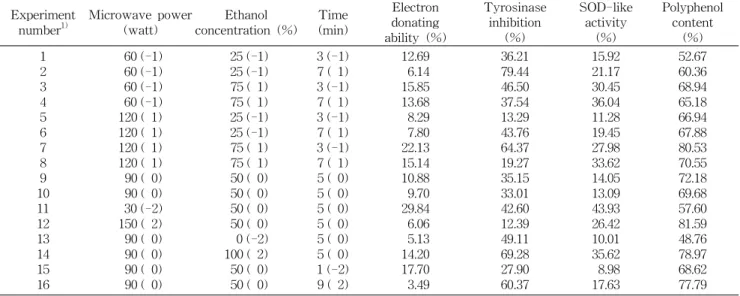
3)을 -2, -1, 0, 1, 2, 5단계로 부호화하여 중심합성계획에 따라 16구간 으로 설정하여 추출하였다(Table 1). 또한 추출물의 품질특 성에 관련된 종속(반응)변수(Y
n)로서 전자공여작용(Y
1), tyrosinase 저해효과(Y
2), SOD 유사활성(Y
3), 폴리페놀 함 량(Y
4)으로 하였으며, 모든 실험은 3반복 측정하여 평균값을 회귀분석에 사용하였다. 회귀분석에 의한 최적조건의 예측 은 statistical analysis system(SAS version 8.0, 2004) pro- gram을 이용하였다.
전자공여작용
추출물의 전자공여작용(electron donating ability, EDA) 은 Kang 등(12)의 방법을 이용하여 각 추출물의 DPPH (1,1-diphenyl-2-picrylhydrazyl)에 대한 전자공여효과로 나타나는 각 시료의 환원력을 측정하였다. 즉, 추출물 0.2 mL에 4×10
-4M DPPH용액(99.9% EtOH에 용해) 0.8 mL와 100% 에탄올 2 mL을 가하여 총액의 부피가 3 mL가 되도록 하였다. 이 반응액을 약 10초간 혼합하고 실온에 10분간 방 치한 후 분광광도계를 사용하여 525 nm에서 흡광도를 측정 하였다. 전자공여효과는 추출물의 첨가 전후의 차이를 백분 율로 나타내었다.
EDA
(%)= ( 1-
AB) × 100
A: 추출물 첨가구의 흡광도 B: 추출물 무 첨가구의 흡광도 Tyrosinase 저해효과
Tyrosinase 활성 저해효과 측정은 Wong 등(13)의 방법 에 따라 측정하였으며, tyrosinase 조효소액은 mushroom tyrosinase(100 units/mL, T7755, Sigma, St. Louis, MO, USA)를 50 mM sodium phosphate buffer(pH 7.0)에 용해하 여 사용하였다. 효소활성의 측정은 추출물 0.1 mL, 10 mM catechol 용액 2.8 mL에 tyrosinase 조효소액 0.2 mL를 가하 고, 대조구에는 tyrosinase 조효소액 대신 50 mM sodium phosphate buffer(pH 7.0)를 가한 후 분광광도계(UV/VIS spectrometer, Jasco, Hachioji, Japan)를 사용하여 420 nm에 서 흡광도 변화를 측정하였다. Tyrosinase에 대한 효소활성
저해효과는 단위시간당 변화된 초기 흡광도의 변화 값을 측 정하여 다음 식과 같이 계산하였다.
N
(%)= ( 1-
A-
B C) × 100
A: 효소액 첨가구의 흡광도 변화값
B: 효소액 대신 buffer 첨가구의 흡광도 변화값 C: 추출물 대신 증류수 첨가구의 흡광도 변화값 Superoxide dismutase(SOD) 유사활성
SOD 유사활성은 superoxide에 의해 산화되는 pyrogallol 의 산화속도를 억제시키는 원리로 Marklund와 Marklund의 방법을 변형한 Kim 등(14)의 방법을 이용하여 실시하였다.
각 추출물 0.2 mL에 pH 8.5로 보정한 tris-HCl buffer(50 mM tris[hydroxymethyl]amino-methane+10 mM EDTA) 3 mL와 7.2 mM pyrogallol 0.2 mL를 가하고 25
oC에서 10분 간 방치한 후 1 N HCl 0.2 mL로 반응을 정지시킨 다음 분광 광도계를 이용하여 420 nm에서의 흡광도를 측정하여 시료 첨가 및 무 첨가구 간의 흡광도 차이를 백분율로 나타내었다.
SOD
(%)= ( 1-
AB) × 100
A: 추출물 첨가구의 흡광도 B: 추출물 무 첨가구의 흡광도
단, A, B는 대조구의 흡광도를 제외한 수치임.
총 폴리페놀 함량
총 폴리페놀의 함량(total polyphenol content)은 Folins- Denis방법(15)에 의해 측정하였다. 시료 0.5 mL에 1 N Folin-Ciocalteu reagent 0.5 mL를 가하여 혼합, 3분간 정치 후 2% Na
2CO
3용액을 10 mL를 첨가하였다. 이 혼합액을 1시 간 동안 반응 후 분광광도계(UV/VIS spectrometer, Jasco) 를 사용하여 750 nm에서 흡광도를 측정하고, 표준물질로 tannic acid를 이용하여 작성한 표준곡선으로부터 총 폴리페 놀 함량(mg%)을 구하였다.
최적 추출조건의 예측
조건별 각 추출물의 최적 추출조건 예측은 전자공여작용, tyrosinase 저해효과, SOD 유사활성, 폴리페놀 함량에 대한 contour map superimposing 하였을 때 중복되는 부분의 범 위에서 최적 추출조건 범위를 예측하였다.
결과 및 고찰
전자공여작용의 변화
전자공여작용은 자유라디칼에 전자를 공여하는 식품의
지방질 산화를 억제하고, 자유라디칼에 의한 노화를 억제시
키는 작용으로 이용되어진다(16). 라디칼 소거작용은 인체
의 질병과 노화를 방지하는데 중요한 역할을 한다. DPPH는
짙은 자색의 비교적 안정한 자유라디칼로서 항산화 활성이
Table 2. Polynomial equations calculated by RSM program for extraction conditions for pumpkin (Cucurbita moschata Duch.)
Response Second order polynomoal equations
1)R
2Significance
Electron donating ability Y
EDA=44.068438-0.571917X
1+0.01935X
2-1.5525X
3+0.002128X
12+0.001747X
1X
2-0.00025X
22+0.002583X
1X
3-0.0053X
2X
3+0.019062X
320.7035 0.2969 Tyrosinase inhibition Y
TI=11.185938+0.050667X
1-0.197300X
2+6.96625X
3+0.00081X
12-0.0028X
1X
2+0.005646X
22-0.091458X
1X
3+0.0231X
2X
3+0.753438X
320.7748 0.1623 SOD-like activity Y
SOD=63.35125-1.219833X
1-0.08575X
2+1.193438X
3+0.006001X
12+0.000245X
1X
2+0.003698X
22+0.006188X
1X
3-0.005475X
2X
3-0.016563X
320.9496 0.0030 Polyphenol content Y
PC=2.718750+0.422792X
1+0.8791X
2+4.219688X
3-0.000371X
12-0.000805X
1X
2-0.002826X
22-0.027021X
1X
3-0.055925X
2X
3+0.142187X
320.9219 0.0104
1)
X
1: microwave power (watt), X
2: ethanol concentration (%), X
3: extraction time (min).
Table 1. Experimental data on electron donating ability, tyrosinase inhibition, SOD-like activity, polyphenol contents Experiment
number
1)Microwave power
(watt) Ethanol
concentration (%) Time (min)
Electron donating ability (%)
Tyrosinase inhibition
(%)
SOD-like activity
(%)
Polyphenol content
(%) 1
2 3 4 5 6 7 8 10 9 11 12 13 14 15 16
60 (-1) 60 (-1) 60 (-1) 60 (-1) 120 ( 1) 120 ( 1) 120 ( 1) 120 ( 1) 90 ( 0) 90 ( 0) 30 (-2) 150 ( 2) 90 ( 0) 90 ( 0) 90 ( 0) 90 ( 0)
25 (-1) 25 (-1) 75 ( 1) 75 ( 1) 25 (-1) 25 (-1) 75 ( 1) 75 ( 1) 50 ( 0) 50 ( 0) 50 ( 0) 50 ( 0) 0 (-2) 100 ( 2) 50 ( 0) 50 ( 0)
3 (-1) 7 ( 1) 3 (-1) 7 ( 1) 3 (-1) 7 ( 1) 3 (-1) 7 ( 1) 5 ( 0) 5 ( 0) 5 ( 0) 5 ( 0) 5 ( 0) 5 ( 0) 1 (-2) 9 ( 2)
12.69 15.85 6.14 13.68 8.29 7.80 22.13 15.14 10.88 29.84 9.70 6.06 5.13 14.20 17.70 3.49
36.21 79.44 46.50 37.54 13.29 43.76 64.37 19.27 35.15 33.01 42.60 12.39 49.11 69.28 27.90 60.37
15.92 21.17 30.45 36.04 11.28 19.45 27.98 33.62 14.05 13.09 43.93 26.42 10.01 35.62 17.63 8.98
52.67 60.36 68.94 65.18 66.94 67.88 80.53 70.55 72.18 69.68 57.60 81.59 48.76 78.97 68.62 77.79
1)
The number of experimental conditions by central composite design.
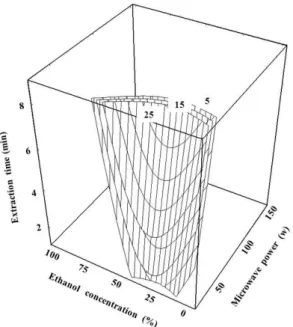
있는 물질과 만나면 라디칼이 소거되어 탈색되어지는데, 이 를 통하여 다양한 천연소재로부터의 항산화물질을 검색하 는데 이용되고 있다. 따라서 전자공여능은 DPPH 라디칼 소 거법에 의해 측정되어진다(17,18). 늙은 호박의 추출조건에 따른 추출물의 전자공여작용 측정 결과는 Table 1에 나타내 었다. 전자공여작용의 변화에 대한 4차원 반응표면은 Fig.
1에 나타나있으며, 반응표면 회귀식은 Table 2와 같다. 회귀 식 R
2의 값은 0.7035로 유의적 차이는 보이지 않았다. Table 3에 나타나 있듯이 늙은 호박 추출물의 분석 결과 추출조건 이 마이크로웨이브 에너지 33.13 watt, 에탄올 농도 53.67%, 추출시간 3.76분일 때 24.57%로 가장 높은 값을 나타냈고, 예측된 정상점은 안장점으로 조건에서 벗어날수록 전자공 여능이 감소하는 경향을 보였다(Fig. 1). 추출조건의 영향은 큰 차이를 보이지 않았으나 그 중 마이크로웨이브 에너지에 더 영향을 받는 것으로 나타났다(Table 4). 이와 같은 결과는 Lee 등(19)의 연구에서 포도씨의 경우 에탄올 농도에서 가장 큰 영향을 받았다는 연구결과와는 상이한 결과를 보였다.
Tyrosinase 저해효과의 변화
Tyrosinase는 tyrosine으로부터 3,4-dihydroxyphenol
Fig. 1. Response surface for electron donating ability in
pumpkin (Cucurbita moschata Duch.) extract at constant
values (electron donating ability: 5-10-15%) according to
ethanol concentration, extraction time and microwave
power.
Table 3. Predicted levels of extraction condition for the maximm responses of variables by the ridge analysis in pumpkin (Cucurbita moschata Duch.)
Response X
11)X
22)X
33)Maximum Morphology
Electron donating ability Tyrosinase inhibition
SOD-like activity Polyphenol content
33.13 56.21 36.00 127.39
53.67 68.02 71.51 76.18
3.76 7.97 5.28 2.68
24.57 96.59 45.57 85.02
saddle point saddle point saddle point saddle point
1)
Microwave power (watt).
2)Ethanol concentration (%).
3)Extraction time (min).
Table 4. Regression analysis for regression model of physiochemical properties in extraction condition of pumpkin (Cucurbita moschata Duch.)
Extraction
conditions F-ratio
Electron donating ability Tyrosinase inhibition SOD-like activity Polyphenol content Microwave power
Ethanol concentration Extraction time
3.74 0.87 0.14
6.32
*0.28 0.28
23.16
**14.45
**0.04
20.21
**1.78 1.62
*
Significant at 10% level,
**significant at 5% level,
***significant at 1% level.
alanine과 DOPA-quinone을 거쳐 흑갈색의 melamin 색소 생성에 관여하는 효소로서 식품의 가공이나 저장 중 효소적 갈변의 원인이며, 피부에 암갈색 색소물질을 침착시키는 원 인이 되기도 한다. 이와 같은 갈변 및 색소침착의 억제를 위한 방법으로 tyrosinase를 저해시키는 방법이 효율적이다 (20,21). 본 실험에서 늙은 호박 추출물의 tyrosinase 저해효 과 측정결과 Table 1과 같이 나타났으며, 이에 대한 반응표 면 분석 결과 회귀식의 R
2은 0.7748로 10% 내에도 미치지 못하여 유의성을 갖지 않았지만 tyrosinase 저해능이 다소 있음을 알 수 있었다. 이에 대한 4차원 반응표면은 Fig. 2에 나타내었다. 예측된 정상점은 안장점으로 추출조건이 마이 크로웨이브 에너지 56.21 watt, 에탄올 농도 68.02%, 추출시
Fig. 2. Response surface for tyrosinase inhibition in pump- kin (Cucurbita moschata Duch.) extract at constant values (tyrosinase inhibition: 5-20-35%) according to ethanol con- centration, extraction time and microwave power.
간 7.97분일 때 최대값이 96.59%로 나타났다(Table 3). 또한 추출조건에 대한 영향은 Table 4에서와 같이 에탄올 농도와 시간의 영향은 거의 없으나 마이크로웨이브 에너지의 영향 을 많이 받고 있음을 알 수 있었다.
SOD 유사활성의 변화
SOD(superoxide dismutase)의 O
2-·는 전과산화수소와 정상상태의 산소로 전환시키는 전자 환원 반응에 반응성이 매우 커서 독성을 일으키며 질병을 유발시키거나 노화를 일 으킨다. SOD(superoxide dismutase) 유사활성 물질은 효소 는 아니지만 SOD와 유사한 역할을 하는 저분자 물질로 주로 pytochemical에 속하며, SOD 유사활성 물질을 통해 인체 내의 superoxide를 제거함으로써 질병예방 및 노화억제의 효과를 기대할 수 있다(22,23). 늙은 호박 추출물의 SOD 유 사활성 변화에 대한 반응표면분석 결과 회귀식이 R
2값이 0.9496으로 1% 수준에서 유의성을 보였다. 반응표면분석을 통한 예측된 정상점은 45.57%로 요인변수가 마이크로웨이 브 에너지 36.00 watt, 에탄올 농도 71.51% 및 반응시간 5.28 분의 추출조건을 나타냈다(Table 3). SOD 유사활성에 대한 반응표면은 Fig. 3에 나타나있다. 추출조건의 영향은 Table 4에서 보는 바와 같이 마이크로웨이브 에너지와 에탄올 농 도에 가장 큰 영향을 받았고 추출시간의 영향은 거의 받지 않음을 알 수 있었다.
폴리페놀 함량의 변화
폴리페놀은 한 분자 내에 2개 이상의 phenolic hydroxyl
(OH)기를 가진 방향족 화합물로서 flavonoid, tannin, an-
thocyanin, stilbene 등이 있다. 이러한 페놀성 화합물은 과산
화기와 탈수소 반응을 일으켜 수소원자를 공유함으로써 라
디칼이 안정한 형태를 형성하여 산화반응의 방지의 역할을
한다(24,25). 늙은 호박 추출물의 추출조건에 따른 폴리페놀
함량을 측정한 결과 Table 1과 같이 나타났다. 이를 토대로
한 반응표면분석 결과 Table 2에 나타난 바와 같이 회귀식의
Fig. 3. Response surface for SOD-like activity in pumpkin (Cucurbita moschata Duch.) extract at constant values (SOD-like activity: 25-30-35%) according to ethanol con- centration, extraction time and microwave power.
Fig. 4. Response surface for polyphenol contents in pumpkin (Cucurbita moschata Duch.) extract at constant values (polyphenol content: 5-15-25%) according to ethanol con- centration, extraction time and microwave power.
R
2이 0.9219로 1% 이내에서의 유의성을 보였다. 예측된 정 상점은 안장점으로 나타났으며 능선분석을 실시한 결과 최 대값은 85.02%였다. 이때의 최적 추출조건이 마이크로웨이 브 에너지 127.39 watt, 에탄올 농도 76.18% 및 추출시간 2.68분으로 나타났다(Table 3). Fig. 4는 폴리페놀 함량에 대 한 반응표면을 나타낸 것이다. Table 4에서 추출조건에 대한 영향을 보면 폴리페놀 함량의 경우 마이크로웨이브 에너지
Fig. 5. Superimposed response surface for optimization of electron donating ability (5%), tyrosinase inhibition (5%), SOD-like activity (25%) and polyphenol content (5%) of ex- tract from pumpkin (Cucurbita moschata Duch.).
Table 5. Optimum extraction condition for maximum re- sponses of electron donating ability, tyrosinase inhibition, SOD-like activity and polyphenol content of pumpkin (Cucurbita moschata Duch.) by superimposing their contour maps
Extraction condition Range of optimum condition Microwave power (watt)
Ethanol concentration (%) Extraction time (min)
72~144 0~38 6~9
가 가장 큰 영향을 주었으며, 에탄올 농도와 추출시간은 거 의 영향을 주지 않는 것으로 나타났다.
최적 추출조건의 예측
늙은 호박 추출물의 최적 추출조건을 설정하기 위하여 에 탄올 농도, 추출시간을 달리한 조건별 추출물의 전자공여작 용, tyrosinase 저해효과, SOD 유사활성 및 총 폴리페놀 함 량에 대한 contour map을 superimposing하여 추출물의 특 성을 모두 만족시켜 주는 추출조건 범위를 중복되는 부분으 로 하여 추출조건을 예측하였다. 그 결과 추출물의 최적화를 위한 추출조건은 Fig. 5의 dark zone과 같이 나타났으며, 늙 은 호박 추출물의 최적 추출조건의 범위는 마이크로웨이브 에너지 77~144 watt, 에탄올 농도 0~38% 및 추출시간 6~
9분으로 예측되었다(Table 5).
요 약
늙은 호박을 최적의 추출조건에서 추출물을 얻고자 반응
표면분석을 이용하여 추출조건을 최적화하였다. 중심합성
계획에 따라 요인변수로 마이크로웨이브 에너지(30~150 watt), 에탄올 농도(0~100%) 및 추출시간(1~9분)을 달리 하고, 전자공여작용, tyrosinase 저해효과, SOD 유사활성 및 총 폴리페놀 함량을 종속변수로 하여 추출하였다. 추출 결과 종속변수에 따라 회귀식의 R
2이 각각 0.7035, 0.7748, 0.9496 및 0.9219로 나타나 SOD 유사활성과 총 폴리페놀 함량의 유의성이 인정되었다. 종속변수인 전자공여작용, tyrosinase 저해효과, SOD 유사활성 및 총 폴리페놀 함량 모두 마이크 로웨이브 에너지의 영향이 가장 큰 것으로 나타났다. 네 가 지 종속변수의 극대값을 얻기 위한 최적 추출조건의 범위는 4차원 반응표면분석을 superimposing하여 얻었다. 그 결과 최적 추출조건이 마이크로웨이브 에너지 72~144 watt, 에 탄올 농도 0~38%, 추출시간 6~9분의 범위를 나타내었다.
문 헌