372 This is an Open-Access article distributed under the terms of the Creative Commons Attribution Non-Commercial License (http://
creativecommons.org/licenses/by-nc/3.0) which permits unrestricted non-commercial use, distribution, and reproduction in any medium, provided the original work is properly cited.
J. Mushrooms 2020 September, 18(4): 372-379 http://dx.doi.org/10.14480/JM.2020.18.4. 372 Print ISSN 1738-0294, Online ISSN 2288-8853
© The Korean Society of Mushroom Science
Min Hong(Assistant Researcher), Da-Hye Choi(Assistant Researcher), Joon-Hee Han(Researcher), Tae-Hyung Kwon(Researcher), Sun-Yeop Lee(Associate Researcher), Yong-Jin Lee(Principal Researcher), Keun-Hyung Yu(Senior Researcher)
*Corresponding author E-mail : [email protected]
Tel : +82-33-258-6991,Fax : +82-33-258-6172 Received July 29, 2020
Revised September 14, 2020 Accepted December 3, 2020
반응표면분석법을 이용한 흰목이버섯의 기능성 성분 추출 조 건 최적화
홍 민 · 최다혜 · 한준희 · 권태형 · 이선엽 · 이용진 · 유근형*
(재)춘천바이오산업진흥원
Optimization of extraction conditions for functional ingredients from Tremella fuciformis Berk. using response surface
methodology
Min Hong, Da-Hye Choi, Joon-Hee Han, Tae-Hyung Kwon, Sun-Yeop Lee, Yong-Jin Lee, and Keun-Hyung Yu*
Department of Research and Development, Chuncheon Bioindustry Foundation, Chuncheon 24232, Korea
ABSTRACT:
Snow fungus (Tremella fuciformis) with functional contents has satisfactory effects on various diseases, including atherosclerosis, high cholesterol, healthy skin, cancer, diabetes, and anti-inflammation. In this study, the extraction yield and functional contents (ergothioneine and β-glucan) of white jelly fungus were compared based on the extraction conditions using response surface methodology. Results revealed the extraction conditions for optimization of the dependent variables to be 60
oC and 4.33 h, when 16.6 mg/mL of sample concentration was used. Under these conditions, the extraction yield was 24.9%, including ergothioneine (66.8 μg/g) and β-glucan (34.9 g/100 g). These results can be useful in understanding the functional ingredients and mass extraction process in mushroom.
KEYWORDS:
Ergothioneine, β-glucan, Response surface methodology, Extraction condition, Central composite design
서 론
버섯은 무기질과 단백질이 풍부하고 비타민 B, D가 많 아 고지혈증, 동맥경화증 등의 성인병을 예방하는 효과가
있어 우리나라에서 흔하게 소비되는 식품 중 하나이다 (Kim, 2012). 항균, 항염증, 항종양, 항세균, 항산화, 면역 조절 등 다양한 기능성에 대한 기술들이 보고되었으며, 버섯 종류마다 다른 생리활성 물질을 가지고 있다(Pyo et al., 2020; Kim, 1998; Lee, 2012). 그중 영지, 표고, 잎새 버섯, 흰목이 등의 버섯에서 보다 다양한 생리 활성이 밝 혀지며 전 세계적으로 그 수요도 꾸준히 증가하고 있다 (Yoo et al., 2016).
흰목이버섯속(Tremella)에 속하는 흰목이버섯(Tremella fuciformis Berk.)은 흰젤리버섯(white jelly fungus) 또는 은이(silver ear)버섯이라고도 불리며, 고부가가치 상품으 로 식품, 화장품, 의약제 등 많은 곳에서 사용되고 있다 (Park et al., 2018). 효능으로는 면역력 증가를 포함하여 항암, 항노화, 항산화 효과 등이 있으며, 수분 보유력이 매우 뛰어나 보습 화장품 소재로 사용되고 있다(Cheng et al., 2002; Li et al., 2014; Chen et al., 2008).
흰목이버섯에는 미네랄 성분인 철분과 칼슘, 인을 다량 함유하고 있고, 풍부한 식이섬유를 포함하고 있다(Yu and Oh, 2016). 또한 흰목이버섯은 항산화 작용으로 과산화와
지방의 증가를 억제하고 동맥경화 및 노화방지에 효과적 이다(Lee et al., 2011). 그리고 식물성 콜라겐도 포함하고 있어 미백 및 주름개선 등 피부유지에 도움이 되며, 꾸준 히 섭취할 경우 기미나 주근깨를 없애는 피부미용 효과도 있다(Lee et al., 2016). 이러한 효능을 나타내는 버섯 특 유의 고분자 다당체인 에르고티오네인(Ergothioneine;
EGT)과 베타-글루칸(β-glucan)은 아미노산 및 다당류로 면역력과 항산화에 관여하는 다양한 생리활성 물질들이 다량 함유되어 있으나 이러한 성분들은 재배방법, 추출용 매, 추출방법 및 건조방법 등에 따라 함량 차이가 큰 것으 로 보고된 바 있다(Lee et al., 2006; An et al., 2019; Lee et al., 2014; Kim et al., 2016; Jang et al., 2014).
독립변수에 대한 각 종속변수들의 영향과 관계를 통계 적인 분석과 변수들의 주효과를 최적화할 수 있는 방법으 로 사용되고 있는 반응표면분석법(Response Surface Methodology; RSM)은 물리학, 식품공학, 사회과학, 생물 학 분야에 사용되고 있다(Heo et al., 2004; Park et al., 2011; Jo et al., 2008; Kim, 2002). 반응표면분석법은 통 계적 유의성이 높아 그 활용도가 높으며, 적은 수의 실험 으로 가장 최적화된 실험계획법을 확인하며 데이터 분석 을 통하여 추정되는 적합한 반응표면의 통계적인 성질을
규명할 수 있다(Nathalie et al., 1992; Hong, 2011; Sim, 2011). 본 연구에서는 반응표면분석 이용하여 흰목이버섯 의 추출조건에 따른 추출특성 모니터링과 추출조건 최적 화를 진행하였으며, 추출조건에 대한 실험계획은 중심합 성계획(Central Composite Design; CCD)을 사용하였으 며, 버섯재배기를 활용하여 흰목이버섯을 재배하고 추출 조건에 따른 성분을 비교하였다.
재료 및 방법
실험재료
본 실험에 사용된 흰목이(Tremella fuciformis Berk)는 버섯재배기 SM-120(Ecoplants, SM-120, Yongin, Korea) 를 이용하여 온도 24oC, 습도 95%, CO2농도 1,000ppm에 서 재배하였으며 400~700 nm 광파장의 가시광선과 320~400 nm 광파장의 UV-A를 조사하였다. 실험 시료는 재배 후 건조한 자실체를 사용하였다.
흰목이버섯의 추출
흰목이버섯을 40oC 조건에서 48시간 열풍건조기(Daedong, Nonsan, Korea)를 이용하여 건조한 뒤 분쇄기(Daesung
Table 1. Experimental Data on Extraction Yield, Ergothioneine and β-glucan of white-jelly-fungus Based on Central Composite
Design by Response Surface MethodExp.
No.
Extraction conditions Experimental data
Temperature
(
oC) Time (h) Sample concentration (mg/mL)
Extraction yield (wt%)
Ergothioneine (ug/g)
b-glucan (g/100 g)
1 60 3 10 27.00 66.35 26.70
2 60 3 30 18.67 68.09 35.87
3 60 4.5 20 20.50 63.92 33.88
4 60 6 10 25.50 64.20 32.75
5 60 6 30 18.83 63.10 27.40
6 75 3 20 20.25 52.78 29.24
7 75 4.5 10 25.50 61.70 20.01
8 75 4.5 20 22.10 64.17 23.25
9 75 4.5 20 23.00 63.75 23.87
10 75 4.5 20 21.10 66.98 23.21
11 75 4.5 20 22.20 64.69 22.98
12 75 4.5 20 21.50 64.60 23.17
13 75 4.5 20 20.70 64.68 22.81
14 75 4.5 30 13.50 65.03 19.50
15 75 6 20 21.50 68.60 16.95
16 90 3 10 23.50 68.13 12.55
17 90 3 30 9.33 68.89 31.03
18 90 4.5 20 21.75 80.21 25.48
19 90 6 10 23.00 85.75 13.38
20 90 6 30 9.33 84.53 9.81
Artlon, DA280-S, Paju, Korea)를 이용하여 80 mesh 사 이즈로 분쇄하고 분말형태로 만들어 사용하였으며, 유효 성분을 추출하기 위해 증류수 100 mL에 분쇄한 흰목이버 섯 자실체를 각각 10, 20, 30 mg/ml의 추출농도로 침지하 여 heating mentle(MTOPs, MS-EAM, Yangju, Korea)에 서 60, 70, 80, 90oC 온도와 3, 4, 5, 6 h 추출시간으로 각 각 가열 후 상온에서 다시 3시간동안 냉각하였다. 각각의 추출조건(추출온도, 추출시간, 추출시료농도)은 Table 1과 같다. 원심분리기(HANIL, SUPRA 22K, Daejeon, Korea) 를 이용하여 15oC에서 4,500 rpm으로 15분간 원심분리하 였으며, 상층액을 감압여과 한 뒤 48시간 동결건조(Ilshin, Korea)하여 분석 시료로 사용하였다.
Ergothioneine 성분 함량 분석
각 분석 시료들을 10 mg/mL의 농도로 3차 증류수에 용 해하고 0.45 um의 syringe filter를 이용하여 filtering한 후 분석에 사용하였다. 분석을 위한 표준물질로는 L-(+)- Ergothioneine (Sigma-Aldrich, St. Louis, MO, USA)를 증류수에 희석하여 사용하였다. Vial tube에 농도 별 희석 된 표준물질과 조건 별 시험용액을 100 uL씩 넣은 후 HPLC (SHIMADZU, LC-20A Prominence, Tokyo, Japan)를 이용하여 측정하였다. 분석에 사용된 컬럼은 순 상(normal phase)컬럼의 일종인 Agilent(USA)의 ZORBAX HILIC Plus(4.6 mm × 100 mm, 3.5 um)를 30oC에서 사용하였고 검출은 UV detector 274 nm에서 이 루어졌다. 이동상은 isocratic mode로 Acetonitrile : water (80:15; v/v)를 1 mL/min Flow로 흘려주었다.
β-glucan 성분 함량 분석
β-glucan 분석은 효소적 방법에 따라 Megazyme β- glucan assay kit (K-YBGL; Megazyme, Ireland)를 사용 하여 측정하였다. 총 glucan 함량을 측정하기 위하여 추 출된 각 시료에 37% HCl 1.5 mL을 넣고 30oC의 water bath에서 45분간 가수분해하였으며, 그 후, 각 시험관에 증류수 10 mL를 넣고 100oC에서 2시간 동안 추가 가수분 해를 실시하였다(An et al., 2019). 2차 가수분해 후 2 M KOH를 10 mL씩 넣고, 200 mM sodium acetate buffer (pH 5.0)를 첨가하여 최종부피를 100 mL로 조정하고
vortexing한 후 상등액 0.1 mL에 200 mM sodium acetate buffer에 녹인 exo-1,3-β-glucanase와 β-glucosidase 혼합 물을 첨가하였다. 이 반응액에 GOPOD(glucose oxidase/
peroxidase, Megazyme) 시약 3 mL을 넣고 고 40oC에서 20분간 반응시킨 후 흡광도를 분광광도계(SpectraMax M5, Molecular Devices, USA)를 이용하여 510 nm에서 측정하여 총 glucan 함량 계산에 사용하였다. α-glucan의 당 함량은 시료 100 mg과 2 M KOH 2 mL씩 첨가하여 20분간 혼합하고 1.2 M sodium acetate buffer 8 mL을 분 주한 후 amyloglucosidase와 invertase 혼합물 0.2 mL을 넣고 40oC water bath에서 30분간 가수분해하였다. 그 후 상등액 0.1 mL에 200 mM sodium acetate buffer 0.1 mL 와 GOPOD(Megazyme) 3 mL를 넣어 40oC에서 20분간 반응시킨 후 510 nm에서 측정하였다. 측정된 total glucan 과 α-glucan의 흡광도는 표준물질 glucose 용액(1 mg/
mL)을 GOPOD 시약과 반응시킨 반응액의 흡광도를 이용 하여 각각 100 g 당 함량(g/100 g) 값으로 계산하였다. β- glucan 함량은 total glucan 함량에서 α-glucan 함량을 빼 준 값으로 계산하였다.
결과 및 고찰
반응표면분석법의 변수설정
흰목이버섯으로부터 ergothionein의 추출조건 최적화를 위해 반응표면분석법을 이용하였다. 본 연구에서는 반응 표면분석법 중 중심합성계획법(central composite design;
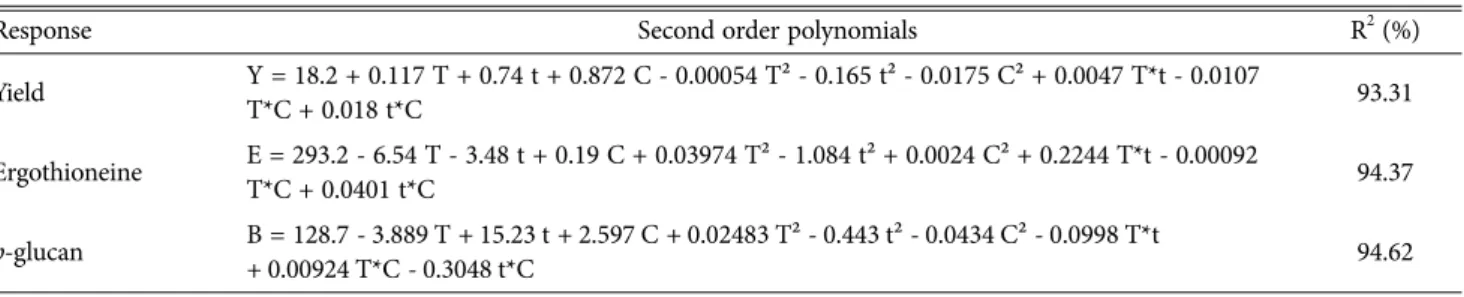
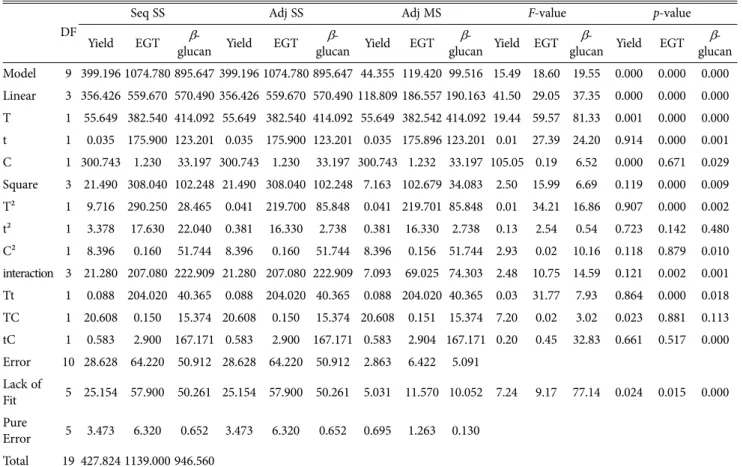
CCD)을 이용하였으며, 추출조건의 독립변수는 기초실험 으로부터 추출시간 3~6 h, 추출온도 60~90oC, 추출시료 농도 10~30 mg/mL로 설정하였다. 또한 독립변수에 영향 을 받는 종속변수는 추출수율, ergothioneine 함량, β- glucan 함량을 측정하여 그 값을 회귀분석에 사용하였으 며, 그 결과값을 Table 1에 나타내었다. Table 2와 같이 종속변수에 대한 독립변수의 회귀방정식이 모두 R²값 0.93 이상으로 1에 가까운 값을 나타내어 반응모형이 신 뢰할 수 있음을 확인하였다. 또한 ANOVA를 수행하였을 때, 종속변수 모두 F-value가 15 이상으로 높고, p-value 는 0.001이하로 낮은 결과 값을 보여 유의성이 있다고 판 단하였다(Table 3). 세 가지 독립변수 중 두 가지 독립변
Table 2. Polynomial equations calculated by RSM program for extraction conditions of white-jelly-fungus
Response Second order polynomials R
2(%)
Yield Y = 18.2 + 0.117 T + 0.74 t + 0.872 C - 0.00054 T² - 0.165 t² - 0.0175 C² + 0.0047 T*t - 0.0107
T*C + 0.018 t*C 93.31
Ergothioneine E = 293.2 - 6.54 T - 3.48 t + 0.19 C + 0.03974 T² - 1.084 t² + 0.0024 C² + 0.2244 T*t - 0.00092
T*C + 0.0401 t*C 94.37
b-glucan B = 128.7 - 3.889 T + 15.23 t + 2.597 C + 0.02483 T² - 0.443 t² - 0.0434 C² - 0.0998 T*t
+ 0.00924 T*C - 0.3048 t*C 94.62
* T: temperature (
oC), t: time (h), C: sample concentration
수에 대한 각 종속변수의 영향을 알아보기 위해 나머지 한 가지 변수를 각각 추출시간 4 h, 추출온도 75oC, 추출 시료농도 20 mg/mL로 고정하여 다음 연구를 수행하였다 (Lee et al., 2017; Jeong et al., 2007; Yun et al., 2014;
Jung et al., 2018).
추출조건별 추출수율
흰목이버섯으로부터 추출시간, 추출온도, 추출시료농도 에 대한 최적 조건을 찾기 위해 중심합성계획법에 따라 설계된 20개의 조건에 맞추어 각 실험을 진행하였다. 흰 목이버섯에서 추출된 추출물의 각 변수에 대한 최적화를 위해 모수 추정에 의한 2차 회귀방정식을 바탕으로 수율
Table 3. Analysis of variance for yield, EGT and β-glucan
DF
Seq SS Adj SS Adj MS F-value p-value
Yield EGT β-
glucan Yield EGT β-
glucan Yield EGT β-
glucan Yield EGT β-
glucan Yield EGT β- glucan Model 9 399.196 1074.780 895.647 399.196 1074.780 895.647 44.355 119.420 99.516 15.49 18.60 19.55 0.000 0.000 0.000 Linear 3 356.426 559.670 570.490 356.426 559.670 570.490 118.809 186.557 190.163 41.50 29.05 37.35 0.000 0.000 0.000 T 1 55.649 382.540 414.092 55.649 382.540 414.092 55.649 382.542 414.092 19.44 59.57 81.33 0.001 0.000 0.000 t 1 0.035 175.900 123.201 0.035 175.900 123.201 0.035 175.896 123.201 0.01 27.39 24.20 0.914 0.000 0.001 C 1 300.743 1.230 33.197 300.743 1.230 33.197 300.743 1.232 33.197 105.05 0.19 6.52 0.000 0.671 0.029 Square 3 21.490 308.040 102.248 21.490 308.040 102.248 7.163 102.679 34.083 2.50 15.99 6.69 0.119 0.000 0.009 T² 1 9.716 290.250 28.465 0.041 219.700 85.848 0.041 219.701 85.848 0.01 34.21 16.86 0.907 0.000 0.002 t² 1 3.378 17.630 22.040 0.381 16.330 2.738 0.381 16.330 2.738 0.13 2.54 0.54 0.723 0.142 0.480 C² 1 8.396 0.160 51.744 8.396 0.160 51.744 8.396 0.156 51.744 2.93 0.02 10.16 0.118 0.879 0.010 interaction 3 21.280 207.080 222.909 21.280 207.080 222.909 7.093 69.025 74.303 2.48 10.75 14.59 0.121 0.002 0.001 Tt 1 0.088 204.020 40.365 0.088 204.020 40.365 0.088 204.020 40.365 0.03 31.77 7.93 0.864 0.000 0.018 TC 1 20.608 0.150 15.374 20.608 0.150 15.374 20.608 0.151 15.374 7.20 0.02 3.02 0.023 0.881 0.113 tC 1 0.583 2.900 167.171 0.583 2.900 167.171 0.583 2.904 167.171 0.20 0.45 32.83 0.661 0.517 0.000 Error 10 28.628 64.220 50.912 28.628 64.220 50.912 2.863 6.422 5.091
Lack of
Fit 5 25.154 57.900 50.261 25.154 57.900 50.261 5.031 11.570 10.052 7.24 9.17 77.14 0.024 0.015 0.000 Pure
Error 5 3.473 6.320 0.652 3.473 6.320 0.652 0.695 1.263 0.130 Total 19 427.824 1139.000 946.560
Fig. 1. Response surface for yield of white-jelly-fungus extraction at constant values as a function of time, sample concentration
and temperature.을 능선분석한 것으로 추출시료농도를 고정한 경우 추출 수율은 추출시간과 추출온도에 큰 영향이 없었다(Fig. 1).
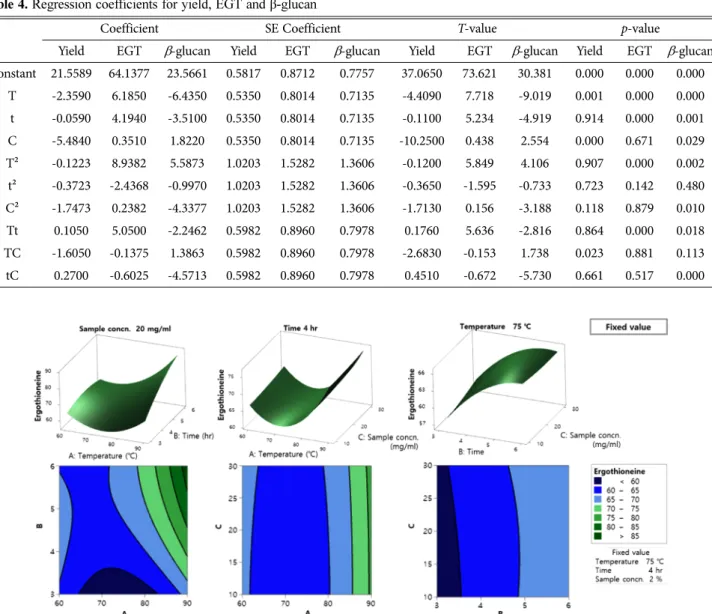
추출시간을 고정하고 추출시료농도와 추출온도의 영향을 살펴본 결과 추출시료 농도가 증가함에 따라 수율은 감소 하였고, 추출온도가 증가함에 따라 다소 감소하는 것으로 나타났다. 추출온도를 고정할 경우 추출수율은 추출시간 에 따른 영향이 없었으며, 추출시료농도에 반비례하는 경 향을 보였다. 가장 많이 영향을 미치는 요인으로는 선형 의 sample concentration(C)로 나타났다(Table 4). Park과 Jeong 등(2006)에 따르면 표고버섯에서 가장 낮은 1:100 의 용매비와 20-40oC의 저온추출에서 고형분 함량과 이 화학적 특성을 가장 높이는 최적 추출조건으로 보고한 바 있다. 본 실험에서도 가장 낮은 10 mg/ml의 농도와 60oC 에서 추출수율이 높았기 때문에 추출수율과 함께 고형분 함량도 많이 얻을 것으로 예상되었다.
Ergothioneine의 함량분석
독립변수인 추출시간, 추출온도, 추출시료 농도에 따른 흰목이버섯에서 추출된 물질의 ergothioneine(EGT) 함량 을 나타내었다(Fig. 2). 추출시간을 4 h으로 고정하고 추 출시료 농도와 추출온도의 영향을 살펴본 결과 EGT 함량 은 추출시료 농도에 따라 큰 영향이 없었으며, 20 mg/ml 추출시료 기준으로 65-80oC 추출온도 구간에서는 EGT함 량이 감소하다가 80oC 이후 다시 증가하는 것으로 나타났 다. 또한 추출온도를 75oC로 고정한 경우 추출물의 EGT 함량은 추출시간이 증가함에 따라 증가하였으며, 추출시 료 농도에 따른 큰 변화는 없는 것으로 나타났다. 추출시 료 농도를 20 mg/ml로 고정한 경우 추출시간이 증가함에 따라 EGT함량은 증가하였으며, 추출온도가 증가함에 따 라 3시간 추출 기준으로 EGT함량은 65-80oC 추출온도 구간에서는 감소하다가 다시 증가하는 것으로 나타났다.
Table 4. Regression coefficients for yield, EGT and β-glucan
Coefficient SE Coefficient T-value p-value
Yield EGT β-glucan Yield EGT β-glucan Yield EGT β-glucan Yield EGT β-glucan Constant 21.5589 64.1377 23.5661 0.5817 0.8712 0.7757 37.0650 73.621 30.381 0.000 0.000 0.000
T -2.3590 6.1850 -6.4350 0.5350 0.8014 0.7135 -4.4090 7.718 -9.019 0.001 0.000 0.000 t -0.0590 4.1940 -3.5100 0.5350 0.8014 0.7135 -0.1100 5.234 -4.919 0.914 0.000 0.001 C -5.4840 0.3510 1.8220 0.5350 0.8014 0.7135 -10.2500 0.438 2.554 0.000 0.671 0.029 T² -0.1223 8.9382 5.5873 1.0203 1.5282 1.3606 -0.1200 5.849 4.106 0.907 0.000 0.002 t² -0.3723 -2.4368 -0.9970 1.0203 1.5282 1.3606 -0.3650 -1.595 -0.733 0.723 0.142 0.480 C² -1.7473 0.2382 -4.3377 1.0203 1.5282 1.3606 -1.7130 0.156 -3.188 0.118 0.879 0.010 Tt 0.1050 5.0500 -2.2462 0.5982 0.8960 0.7978 0.1760 5.636 -2.816 0.864 0.000 0.018 TC -1.6050 -0.1375 1.3863 0.5982 0.8960 0.7978 -2.6830 -0.153 1.738 0.023 0.881 0.113 tC 0.2700 -0.6025 -4.5713 0.5982 0.8960 0.7978 0.4510 -0.672 -5.730 0.661 0.517 0.000
Fig. 2. Response surface for ergothioneine of white-jelly-fungus extraction at constant values as a function of time, sample
concentration and temperature.가장 많이 영향을 미치는 요인으로는 추출시간의 이차항 (t²)으로 나타났다(Table 4).
β-glucan의 함량분석
독립변수인 추출시간, 추출온도, 추출시료농도에 따른 흰목이버섯으로부터 추출된 물질의 β-glucan 함량을 알아 보았다(Fig. 3). 추출시간을 4 h으로 고정하고 추출시료농 도와 추출온도의 영향을 살펴본 결과 추출시료농도가 증 가할수록 β-glucan 함량이 증가하였고 추출온도가 증가함 에 따라 감소하였으며, 추출온도를 75oC로 고정한 경우 시간이 증가함에 따라 증가하였으나, 추출시료농도에 따 라 증가하다가 감소하는 경향을 나타냈다. 추출시료농도 를 20 mg/ml로 고정한 경우 추출시간이 증가함에 따라 β-glucan 함량은 증가하였으며, 추출온도가 증가함에 따 라 β-glucan 함량은 증가하는 경향을 나타내었다. Lee (2005)에 따르면 β-glucan의 점도는 100oC 이후에서 감소 하는 경향이 있는 것으로 보고하였으며, 이는 β-glucan성 분이 추출온도와 반비례 관계임을 추정할 수 있다. 가장 많이 영향을 미치는 요인으로는 선형의 추출온도(T)로 나 타났다(Table 4).
흰목이버섯 추출조건 최적화
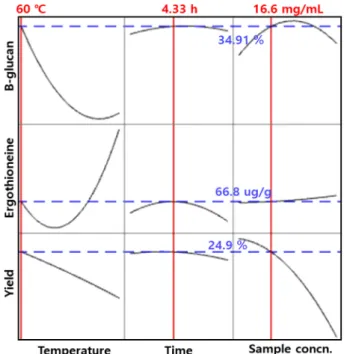
본 연구에서는 세 가지 독립변수(추출시간, 추출온도, 추 출시료농도)와 세 가지 종속변수(추출수율, ergothioneine 함량, β-glucan 함량)를 설정하고, 반응표면분석법에 의해 최적화하여 세 가지 종속변수를 모두 만족하는 추출조건 을 산출하였다. 본 연구에서 흰목이버섯을 40oC 조건에서 48시간 열풍 건조하여 분말화 한 시료로 유효성분을 추출 하였을 때 최적 추출조건은 추출온도 60oC, 추출시간 4.33 h, 추출시료농도 16.6 mg/mL이고, 이 조건에서 예상
되는 반응치는 추출수율 24.9%, ergothioneine 함량 66.8 ug/g, β-glucan 34.9 g/100 g이며 종합만족도는 71.2%로
Fig. 3. Response surface for β-glucan of white-jelly-fungus extraction at constant values as a function of time, sample
concentration and temperature.Table 5. Predicted and experimental values of response
variables for white-jelly-fungus at a given condition within the range of optimum extraction conditionsResponse variables Predicted values Experimental values
Yield (%) 24.9 25.1
Ergothioneine (ug/g) 66.8 66.5
β-glucan (g/100 g) 34.9 34.8
Fig. 4. Optimization graph of response surface for yield,
ergothioneine, and β-glucan of white-jelly-fungus.나타났다(Fig. 4). 추출조건 범위와 모델식을 통하여 예측 된 흰목이버섯의 최적 추출조건을 증명하기 위하여 실제 추출실험하여 값을 측정한 결과, Table 5에서 보는 바와 같이 예상되는 반응치와 유사한 수준으로 나타났다.
적 요
본 연구에서 흰목이버섯의 추출조건별 추출수율과 기능 성 성분의 함량을 비교하여 최적 추출조건을 분석하였으 며, 모든 분석에서 R²이 0.9331~0.9462로 유의성을 보이 는 것을 확인하였다. 각 독립변수에 따른 추출수율과 ergothioneine, β-glucan 성분을 분석한 결과 추출수율은 추출온도와 추출시료농도에 반비례했으며, 추출시간에는 큰 영향이 없었다. Ergothioneine 성분은 온도가 증가할 수록 증가하며, 추출시간은 4.33 h가 가장 높았고 시료량 에 큰 영향이 없었다. β-glucan 성분은 온도가 증가할수록 감소했으며, 추출시간에 큰 영향이 없었고 시료량이 21.2 mg/mL에서 가장 높았다. 모든 종속변수의 최대 독립변 수는 온도 60oC, 추출시간 4.33 h, 추출시료농도 16.6 mg/
mL에서 추출수율 24.9%, ergothioneine 성분함량 66.8 ug/g, β-glucan 성분함량 34.9 g/100 g으로 나타났다.
감사의 글
본 연구는 춘천시 “스마트버섯재배 설치 시범사업 (2018~2020)”으로 수행되었으며, 이에 감사드립니다.
REFERENCES