반응표면분석에 의한 능이버섯 추출물의 추출조건 최적화
이혜진․정성근․도정룡․김현구 한국식품연구원
Optimization of Extraction Conditions of Sarcodon aspratus by Response Surface Methodology
Hye-Jin Lee, Sung-Keun Jung, Jeong-Ryong Do, and Hyun-Ku Kim Korea Food Research Institute
ABSTRACT Response surface methodology (RSM) was used to monitor extraction characteristics of extracts from Sarcodon aspratus. Based on a central composite design, independent variables were microwave power (30∼150 W), ethanol concentration (0∼100%), and extraction time (1∼9 min). Dependent variables were yield, electron-donating ability, total phenol contents, and SOD-like activity. Coefficients of determination (R2) for dependent variables ranged from 0.80 at 0.97. The maximum extraction yield was 50.28% under conditions of 125.1 W microwave power, 18.67%
ethanolic concentration, and 7.06 min extraction time. The maximum extraction electron-donating ability was 22.14%
under conditions of 31.09 W, 45.76%, and 4.32 min. The maximum extraction total polyphenol content was 30.54 mg tannic acid equivalent/g at 122.54 W, 48.05%, and 8.36 min. The maximum extraction SOD-like activity was 33.44% at 121.17 W, 47.42%, and 8.41 min. Based on superimposition of four dimensional RSM with respect to extraction yield, electron-donating ability, total polyphenol content, and SOD-like activity obtained under various ex- traction conditions, optimum ranges of extraction conditions were found to be microwave power of 78∼88 W, ethanol concentration of 39∼57%, and extraction time of 3.5∼9 min.
Key words: Sarcodon aspratus, response surface methodology (RSM), electron donating ability, total polyphenol content
Received 1 December 2014; Accepted 25 February 2015 Corresponding author: Hyun-Ku Kim, Korea Food Research In- stitute, Seongnam, Gyeonggi 463-746, Korea
E-mail: [email protected], Phone: +82-31-780-9134
서 론
버섯은 균류(Fungi) 중 진균류(Eumycetes)에 속하며 대 부분 담자균류(Basidiomycetes)의 일종으로 탄수화물, 단 백질, 지질, 무기질 및 비타민 등의 영양소를 골고루 함유하 고 있다. 또한 독특한 맛과 향기를 지니고 있어 예로부터 식용 및 약용으로 널리 이용돼 왔다(1,2).
능이버섯(Sarcodon aspratus)은 담자균류의 민주름버섯 목(Aphyllophorales) 굴뚝버섯과(Telephoracea Sarco- don)에 속하고 참나무 수종의 뿌리에 공생하는 균근성 버섯 으로 주요 자생지는 한국, 중국, 일본 등지에서 서식하는 것 으로 알려져 있다(3,4). 송이, 표고와 더불어 선호도가 높은 식용 버섯으로 토양이 비옥하고 습한 산림에 자생하고 맛과 향이 뛰어나 향버섯이라고도 불린다. 능이는 대량 생산되는 다른 버섯들과 달리 그 이용도가 매우 제한적이나 단백질 분해 활성이 강하여 예로부터 민간에서는 채취 건조하여 육 류를 먹고 체했을 때 능이버섯의 끓인 물을 복용하여 소화제 로 이용되었다(5-8). 능이버섯의 알려진 주요 성분으로는
유리아미노산 중 글루탐산(glutamic acid)이 가장 많이 함 유되어 있고 그 외 20종의 유리아미노산 성분이 포함되어 있으며, 칼슘, 철, 아연, 마그네슘, 망간 등 무기질을 포함하 고 있다(9). 지금까지 이루어진 능이버섯 다양한 연구를 통 해 항산화 및 항균 효과(10,11), 가수분해효소 함유(12), 혈 중 콜레스테롤 저하 효과 및 항고혈 활성과 항통풍 활성 (6,13-15), 면역조절 효과 및 세포 사멸 유도 활성(16) 등의 능이버섯 효능이 입증되었다.
이처럼 다양한 효능을 갖춘 능이버섯에 대하여 본 연구에 서는 독립변수로 마이크로웨이브 추출법과 유기용매인 에 탄올을 이용하여 다양한 추출조건에서 추출한 능이버섯 추 출물의 가용성 고형분 함량 및 항산화 활성을 측정하고자 하였다. 마이크로웨이브 추출은 환류냉각 추출에 비해 단시 간 고효율의 물질을 추출할 수 있는 것으로 알려져 있다 (17-19). 또한 Turkmen 등(20)에 따르면 식물에서 기능성 물질 추출은 주로 열수 추출법을 이용하고 있으나 추출시간 단축, 추출효율의 증가를 목적으로 유기용매를 이용한 용매 추출이 연구된 바 있어, 이에 본 연구에서 마이크로웨이브를 이용한 추출과 유기용매인 에탄올, 추출시간을 달리하여 최 적의 추출조건을 확립하고자 한다.
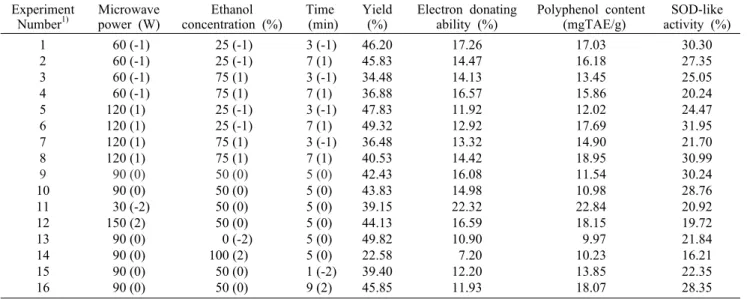
Table 1. Experimental data on yield, electron donating ability, SOD-like activity, polyphenol contents Experiment
Number1) Microwave
power (W) Ethanol
concentration (%) Time
(min) Yield
(%) Electron donating
ability (%) Polyphenol content
(mgTAE/g) SOD-like activity (%) 1
2 3 4 5 6 7 8 9 10 11 12 13 14 15 16
60 (-1) 60 (-1) 60 (-1) 60 (-1) 120 (1) 120 (1) 120 (1) 120 (1) 90 (0) 90 (0) 30 (-2) 150 (2) 90 (0) 90 (0) 90 (0) 90 (0)
25 (-1) 25 (-1) 75 (1) 75 (1) 25 (-1) 25 (-1) 75 (1) 75 (1) 50 (0) 50 (0) 50 (0) 50 (0) 0 (-2) 100 (2) 50 (0) 50 (0)
3 (-1) 7 (1) 3 (-1) 7 (1) 3 (-1) 7 (1) 3 (-1) 7 (1) 5 (0) 5 (0) 5 (0) 5 (0) 5 (0) 5 (0) 1 (-2) 9 (2)
46.20 45.83 34.48 36.88 47.83 49.32 36.48 40.53 42.43 43.83 39.15 44.13 49.82 22.58 39.40 45.85
17.26 14.47 14.13 16.57 11.92 12.92 13.32 14.42 16.08 14.98 22.32 16.59 10.90 7.20 12.20 11.93
17.03 16.18 13.45 15.86 12.02 17.69 14.90 18.95 11.54 10.98 22.84 18.15 9.97 10.23 13.85 18.07
30.30 27.35 25.05 20.24 24.47 31.95 21.70 30.99 30.24 28.76 20.92 19.72 21.84 16.21 22.35 28.35
1)The number of experimental conditions by central composite design.
재료 및 방법
재료
본 연구에 사용된 능이버섯은 강원도에서 채취한 것을 구 입하여 동결건조(MCFD 8508, ilShin Lab Co. Ltd., Dong- ducheon, Korea) 후 믹서기(Hanil Electric Inc., Seoul, Korea)로 분쇄하여 분말화하였다. 능이버섯 분말은 500 μM mesh에 내려 분말 입자를 균일화하여 0.2 mm PE film에 밀봉 포장하여 -20°C에서 보관하며 실험에 사용하였다.
실험계획
본 실험에서는 추출조건에 대하여 중심합성계획(central composite design)(11)을 사용하여 실험 설계하였고, 추출 조건의 최적화를 위하여 반응표면분석법(response surface methodology, RSM)(21,22)을 사용하였다. 중심합성계획 에서 독립(조건)변수로 마이크로웨이브 에너지(30~150 W, X1), 에탄올 농도(0~100%, X2), 추출시간(1~9분, X3)을 -2, -1, 0, 1, 2의 5단계로 부호화하여 중심합성계획에 따라 16 구간으로 설정하여 추출하였다(Table 1). 또한 추출물의 품 질 특성에 관련된 종속(반응)변수(Yn)는 추출수율(Y1), 전자 공여작용(Y2), 폴리페놀 함량(Y3), SOD 유사 활성(Y4)으로 하였으며, 모든 실험은 3반복 측정하여 평균값을 회귀분석 에 사용하였다. 회귀분석에 의한 최적 조건의 예측은 stat- istical analysis system(SAS version 8.0, SAS Institute Inc., Cary, NC, USA) program을 이용하였다.
마이크로웨이브 추출
마이크로웨이브 추출은 마이크로웨이브 추출장치(MAP, Soxwave-100, Prolabo, Paris, France)를 사용하였다. 추 출조건으로 각 시료의 건물중량 2 g에 추출용매 100 mL로 1:50의 비율로 하였으며, 마이크로웨이브 에너지 용량, 추
출용매 및 추출시간은 중심합성계획에 의해 설계된 조건으 로 추출하였다. 추출물은 whatman filter paper No. 2 (Whatman, Clifton, NJ, USA)에 거르고, 회전 감압 증발기 (Rotavapor R-123, Buchi, Flawil, Switzerland)로 감압 농축한 다음 동결건조 하여 함량이 될 때까지 건조한 후 추 출액 조제에 사용하였다.
가용성 고형분 함량
추출물의 수율은 회전 감압 증발기로 감압 농축한 다음 동결건조 하여 함량이 될 때까지 건조한 후 추출액 조제에 사용한 원료 건물량에 대한 고형분 수율(%, d.b.)로 나타내 었다.
DPPH 라디칼 소거작용
추출물의 DPPH 라디칼 소거능은 Blois(23)의 방법에 준 하여 전자공여효과로 나타나는 각 추출물에 대한 환원력을 측정하였다. 즉 능이버섯 추출 분말 1 mg/mL 농도의 시료 0.2 mL에 4×10⁻⁴ M DPPH(1-1-diphenyl-2-picrylhy- drazyl) 0.8 mL와 99.9% 에탄올 2 mL를 가하여 총액의 부피가 3 mL가 되도록 하였다. 이 반응액을 약 10초간 혼합 하고 실온에 10분간 방치한다. 반응액은 분광광도계(Spec- tramax M2, Sunnyvale, CA, USA) Abs525에서 흡광도를 측정하였고 추출물의 첨가구와 첨가하지 않은 무첨가구의 흡광도를 통해 백분율로 나타내었다.
총 폴리페놀 함량
총 폴리페놀 함량은 Folins-Denis(24) 방법에 의해 측정 하였다. 능이버섯 추출 분말 1 mg/mL 농도의 시료 0.5 mL에 1 N Folin-Ciocalteu reagent 0.5 mL를 가하여 혼합, 3분간 정치 후 2% Na2CO3 용액 10 mL를 첨가하였다. 이 혼합액 을 1시간 동안 반응 후 분광광도계(UV/VIS spectrometer,
Table 2. Polynomial equations calculated by RSM program for extraction conditions for Sarcodon aspratus
Response Second order polynomial equations1) R2 Significance Yield YYI=44.55125+0.076708X1-0.0356X2-0.369062X3-0.000414X12+0.000088333X1X2
-0.002772X22+0.007312X1X3+0.013325X2X3-0.031563X32 0.97 0.0007 Electron donating
ability
YEDA=27.935-0.298917X1+0.1298X2+0.015312X3+0.00109X12+0.000322X1X2-
0.002592X22+0.009271X1X3+0.018325X2X3-0.185312X32 0.90 0.0182 Polyphenol
contents
YPC=15.3950312+0.214417X1+0.1318X2+0.000938X3-0.002272X12+0.001272X1X2-
0.00319X22+0.032354X1X3+0.002375X2X3-0.259375X32 0.80 0.6312 SOD-like activity YSOD=22.231562+0.139417X1+0.2218X2-1.342812X3-0.00255X12+0.001438X1X2-
0.00419X22+0.051104X1X3-0.000125X2X3-0.259375X32 0.87 0.0407
1)X1: microwave power (W), X2: ethanol concentration (%), X3: extraction time (min).
Table 3. Predicted levels of extraction condition for the maximum responses of variables by the ridge analysis in Sarcodon aspratus
Response X11) X22) X33) Maximum (%) Morphology
Yield
Electron donating ability Polyphenol contents SOD-like activity
125.10 31.09 122.54 121.17
18.67 45.76 48.05 47.42
7.06 4.32 8.36 8.41
50.28 22.14 30.54 33.44
Saddle point Saddle point Maximum Saddle point
1)Microwave power (W). 2)Ethanol concentration (%). 3)Extraction time (min).
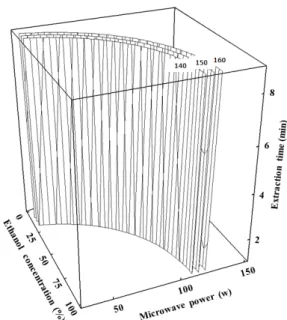
Fig. 1. Response surface for yield in Sarcodon aspratus extract at constant values (yield: 140-150-160%) according to ethanol concentration, extraction time, and microwave power.
Jasco, Hachioji, Japan)를 사용하여 Abs750에서 흡광도를 측정하고, 표준물질 tannic acid를 이용하여 작성한 표준곡 선으로부터 총 폴리페놀 함량(mg tannic acid equivalent (TAE)/g)을 구하였다.
SOD 유사 활성
SOD 유사 활성은 superoxide에 의해 산화되는 py- rogallol의 산화속도를 억제시키는 원리로 Marklund와 Marklund(25)의 방법에 준하여 실시하였다. 능이버섯 추출 분말 1 mg/mL 농도의 시료 0.2 mL에 pH 8.5로 보정한 Tris-HCl buffer(50 mM tris[hydroxymethyl]amino- methane+10 mM EDTA) 3 mL와 7.2 mM pyrogallol 0.2 mL를 가하고 실온에 10분간 방치 후 1 N HCl 0.2 mL로 반응을 정지시킨다. 이 반응액을 분광광도계(Spectramax M2) Abs420에서 흡광도를 측정하여 시료 첨가 및 무첨가구 간의 흡광도 차이를 백분율로 나타냈다.
최적 추출조건의 예측
조건별 각 추출물의 최적 추출조건 예측은 수율, DPPH radical 소거능, 총 폴리페놀 함량, SOD 유사 활성에 대한 contour map superimposing 하였을 때 중복되는 부분의 범위에서 최적 추출조건 범위를 예측하였다.
결과 및 고찰
가용성 고형분 함량의 변화
중심합성계획에 따른 16구간의 추출조건별 능이버섯의 가용성 고형분 함량을 측정한 결과 34.48~49.82%로 Table 1과 같이 나타났다. Table 2에서 보는 바와 같이 회귀식은
YYI=44.55125+0.076708X1-0.0356X2-0.369062X3- 0.000414X12+0.000088333X1X2-0.002772X22+ 0.007312X1X3+0.013325X2X3-0.031563X32이었으며, R2값은 0.97로 상관관계가 높았고 추출조건별 P<0.001 수 준에서 유의성이 인정되었다. 가용성 고형분 함량의 경우 예 측된 정상점은 안장점으로, 마이크로웨이브 에너지 125.10 W, 에탄올 농도 18.67%, 추출시간 7.06분의 조건에서 50.28%의 최대값을 보였다(Table 3). 이들 측정값의 4차원 반응표면 분석 결과는 Fig. 1과 같이 나타났으며, 수율의 경우 마이크로웨이브 에너지의 영향을 가장 많이 받는 것을
Table 4. Regression analysis for regression model of physi- ochemical properties in extraction condition of Sarcodon aspra- tus
Extraction conditions
F-ratio Yield Electron
donating ability
Polyphenol
content SOD-like activity Microwave
power Ethanol
concentration Extraction
time
0.88***
0.09 0.01
0.15 0.07**
0.06
0.18 0.26 0.11
0.22 0.41* 0.25
*Significant at 5% level, **significant at 1% level, ***significant at 0.1% level.
Fig. 2. Response surface for electron donating ability in Sarco- don aspratus extract at constant values (electron donating abil- ity: 150-160-170%) according to ethanol concentration, extraction time, and microwave power.
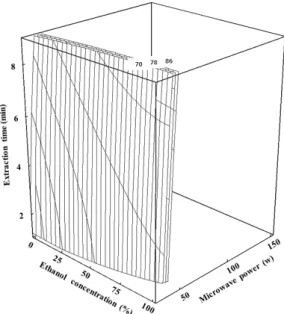
Fig. 3. Response surface for total polyphenol content in Sarco- don aspratus extract at constant values (total polyphenol con- tent: 70-78-86%) according to ethanol concentration, extraction time, and microwave power.
알 수 있었다. Kang 등(26)의 송이버섯 열수 추출물의 고형 분 함량 측정 결과 1% 정도로 능이버섯과 큰 차이를 보였다.
이러한 큰 차이는 추출방법에 따른 것으로 판단된다.
전자공여작용의 변화
각 추출물의 전자공여작용 측정 결과는 Table 1에 나타 냈다. Table 2에서 회귀식은 YEDA=27.935-0.298917X1+ 0.1298X2+0.015312X3+0.00109X12+0.000322X1X2- 0 . 0 0 2 5 9 2 X22+ 0 . 0 0 9 2 7 1 X1X3+ 0 . 0 1 8 3 2 5 X2X3- 0.185312X32이었으며, R2값은 0.90으로 P<0.05 수준에서 유의성이 인정되었다. 반응표면분석을 통해 예측된 정상점 은 안장점의 형태로 마이크로웨이브 에너지 31.09 W, 에탄 올 농도 45.76%, 추출시간 4.32분일 때 최대값이 22.14%
로 예측되었다(Table 3). Table 4에서 보는 바와 같이 전자 공여작용의 경우 에탄올 농도의 영향을 크게 받았고, 4차원
반응표면분석 결과 에탄올 농도와 추출시간이 증가함에 따 라 전자공여능이 증가함을 알 수 있다(Fig. 2). Lee 등(27) 의 연구에 따르면 오디의 경우 에탄올 농도가 증가함에 따라 DPPH 라디칼 소거능이 증가한 결과와 유사하였다.
총 폴리페놀 함량의 변화
총 폴리페놀 함량에 대한 측정값은 Table 1에 나타내었 으며 이에 대한 회귀식은 Table 2에서 보는 바와 같이 YPC=15.3950312+0.214417X1+0.1318X2+0.000938X3
-0.002272X12+0.001272X1X2-0.00319X22+0.032354 X1X3+0.002375X2X3-0.259375X32이었으며, R2값이 0.80 으로 유의적 차이는 나타내지 않았다. 예측된 정상점은 최대 점으로 마이크로웨이브 에너지 122.54 W, 에탄올 농도 48.05%, 추출시간 8.36분일 때 30.54%로 가장 높은 값으 로 측정되었다(Table 3). 총 폴리페놀 함량의 경우 Table 4에서 보는 바와 같이 모든 조건에서 유의적 차이를 보이지 않았으나 마이크로웨이브 에너지와 에탄올 농도가 높을수 록 페놀의 함량이 다소 높은 경향을 보였다(Fig. 3). 이에 따라 낮은 에너지효율과 짧은 추출시간의 조건으로도 페놀 함량이 높은 능이버섯 추출물을 얻을 수 있을 것으로 사료된 다. 한편 노루궁뎅이버섯(28)의 경우 추출용매인 에탄올 농 도가 낮아짐에 따라 반비례적으로 페놀의 함량은 증가하는 것으로 나타나 에탄올 농도가 높아질수록 총 페놀 함량이 비례적으로 증가하는 능이버섯과는 반대의 경향을 보였다.
SOD 유사 활성의 변화
추출조건에 따른 능이버섯 SOD 유사 활성의 변화는 Table 1에 나타냈고, 이에 대한 반응표면분석은 Fig. 4와
Fig. 4. Response surface for superoxide anion radical scavenging activity in Sarcodon aspratus extract at constant values (super- oxide anion radical scavenging activity: 162-182-202%) accord- ing to ethanol concentration, extraction time, and microwave power.
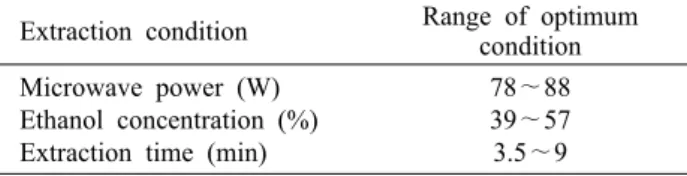
Table 5. Optimum extraction condition for maximum responses of yield, electron donating ability, polyphenol content, and SOD- like activity of Sarcodon aspratus by superimposing their con- tour maps
Extraction condition Range of optimum condition Microwave power (W)
Ethanol concentration (%) Extraction time (min)
78∼88 39∼57 3.5∼9
Fig. 5. Superimposed response surface for optimization of yield (140%), electron donating ability (170%), total polyphenol con- tent (70%), and superoxide anion radical scavenging activity (162%) of extract from Sarcodon aspratus.
같이 나타났다. Fig. 4에서 보는 바와 같이 SOD 유사 활성의 변화는 마이크로웨이브 에너지가 높을수록, 에탄올 농도가 낮을수록 함량이 높은 것을 알 수 있었다. SOD 유사 활성의 회귀식의 결정계수 R2은 0.87의 다소 높은 상관관계를 보였 으며, 5% 이내에서 유의성이 인정되었다(Table 2). Table 3에서 능이버섯의 SOD 유사 활성의 경우 마이크로웨이브 에너지 121.17 W, 에탄올 농도 47.42%, 추출시간 8.41분 일 때 33.44%의 최대값을 보였고, 이때 예측된 정상점은 안장점으로 나타났다. Table 4는 SOD 유사 활성의 추출조 건의 영향을 나타낸 것으로 에탄올 농도의 영향을 가장 많이 받는 것으로 예측되었다(P<0.05).
최적 추출조건의 예측
마이크로웨이브 추출법을 통한 능이버섯의 최적 추출조 건을 설정하기 위해 추출수율, 전자공여작용, 총 폴리페놀 함량, SOD 유사 활성 측정 결과에 대하여 4차원 반응표면을 superimposing 하여 중복되는 범위를 최적 추출조건의 범 위로 예측하였다(Fig. 5). 그 결과 Table 5에서 보는 바와 같이 마이크로웨이브 에너지 78~88 W, 에탄올 농도 39~
57%, 추출시간 3.5~9분에서 능이버섯의 활성이 우수할 것
으로 예측되는 범위로 나타났다. 실험 결과 능이버섯의 경우 에탄올 농도 조건에 따른 활성이 우수한 추출물을 얻을 수 있을 것으로 판단된다.
요 약
능이버섯의 수율과 항산화 활성을 측정하여 효율적 추출조 건을 예측하기 위해 마이크로웨이브 에너지, 에탄올 농도, 추출시간의 요인 변수를 중심합성법에 따라 설정하여 반응 표면분석을 통해 최적화 조건을 설정하였다. 능이버섯 추출 물의 수율, 전자공여작용, 총 폴리페놀 함량, SOD 유사 활성 에 대한 반응표면의 회귀식 R2값이 각각 0.97, 0.90, 0.80 및 0.87로, 수율, 전자공여작용 및 SOD 유사 활성이 각각 P<0.001, P<0.05 및 P<0.05 수준에서 유의성이 인정되었 다. 능이버섯은 요인 변수에 따라 수율은 마이크로웨이브 에너지의 영향을 가장 많이 받았고, 에탄올 농도에 따른 영 향도 있었다. 그 외 종속변수인 전자공여능과 SOD 유사 활 성은 에탄올 농도에 따른 영향을 받는 것으로 나타났다. 추 출물의 각 특성을 모두 만족시키는 최적의 추출조건의 범위 는 superimposing 하여 마이크로웨이브 에너지 78~88 W, 에탄올 농도 39~57%, 추출시간 3.5~9분으로 예측되었다.
REFERENCES
1. Kim GJ, Kim HS, Chung SY. 1992. Effects of varied mush- roomon lipid compositions in dietary hypercholesterolemic rats. J Korean Soc Food Nutr 21: 131-135.
2. Astrup T, Stermdoff I. 1956. The plasminogen activator in animal tissue. Acta Physiol Scand 36: 250-255.
3. Yoo JE, Lee YN. 2009. Optimal culture conditions for MK1
strain isolated from soft-rotten tissue of Neungee mushroom (Sarcodon aspratus) and the physico-chemical properties of the purified exopolysaccharide of MK1. Korean J Microbiol 45: 324-331.
4. Kang TS, Kang MS, Sung JM, Kang AS, Shon HR, Lee SY. 2001. Effect of Pleurotus eryngii on the blood glucose and cholesterol in diabetic rats. Korean J Mycol 29: 86-90.
5. Jeong OJ, Yoon HS, Min YK. 2001. Aroma characteristics of Neungee (Sarcodon aspratus). Korean J Food Sci Technol 33: 307-312.
6. Song JH, Lee HS, Hwang JK, Han JW, Ro JG, Keum DH, Park KM. 2003. Physiological activity of Sarcodon aspratus extracts. Korean J Food Sci Ani Resour 23: 172-179.
7. Lee SA, Song YS, Cho JW, Lee JH, Cho JS. 2001. Effect of the Sarcodon aspratus on the physicochemical and sen- sory properties of cooked beef. J Korean Soc Food Sci Nutr 30: 266-272.
8. Lee JH, Yang JL, Jung CS, Kim HS, Cho JS. 2001. Isolation and purification of fibrinolytic enzyme of edible mushroom, Sarcodon aspratus (Berk.) S. Ito. Korean J Life Sci 11: 561- 567.
9. Nilsson-Ehle P, Garfinkel AS, Schotz MC. 1980. Lipolytic enzymes and plasma lipoprotein metabolism. Annu Rev Bio- chem 49: 667-693.
10. Yoon KY, Lee SH, Shin SR. 2006. Antioxidant and anti- microbial activities of extracts from Sarcodon aspratus. J Korean Soc Food Sci Nutr 35: 967-972.
11. Kim JW, Moon BS, Park YM, Yoo NH, Ryoo IJ, Chinh NT, Yoo ID, Kim JP. 2005. Structures and antioxidant activity of diketopiperazines isolated from the mushroom Sarcodon aspratus. J Korean Soc Appl Biol Chem 48: 93-97.
12. Uhm TB, Ryu KS, Kim MK, Yoo JS, Sohn HS, Lee TK.
1991. Characterization of a serine protease from Neungee [Sarcodon aspratus (Berk.) S. Ito]. J Korean Soc Food Nutr 20: 35-39.
13. Zhang M, Cui SW, Cheung PC, Wang Q. 2007. Antitumor polysaccharides from mushrooms: a review on their isolation process, structural characteristics and antitumor activity.
Trends Food Sci Technol 18: 4-19.
14. Kang HG, Zanabaatar B, Lee JS, Seo GS, Lee JS. 2011.
Antihypertensive activity and anti-gout activity of mush- room Sarcodon aspratus. Korean J Mycol 39: 53-56.
15. Lee KS, Kim JB. 2009. Effects of the Sarcodon aspratus on the high level of blood lipid and obesity induce by high fat-diet in rat. J Life Sci 19: 1265-1270.
16. Mizuno M, Shiomi Y, Minato K, Kawakami S, Ashida H, Tsuchida H. 2000. Fucogalactan isolated from Sarcodon as- pratus elicits release of tumor necrosis factor-alpha and ni-
tric oxide from murine macrophages. Immunopharmacology 46: 113-121.
17. Kwon JH, Bélanger JM, Paré JR. 1992. Optimization of mi- crowave-assisted extraction (MAP) for ginseng components by response surface methodology. J Agric Food Chem 51:
1807-1810.
18. Kwon JH, Bélanger JMR, Paré JRJ, Yaylayan VA. 2003.
Application of microwave-assisted process (MAP) to the fast extraction of ginseng saponins. Food Res Int 36: 491-498.
19. Park EJ, An JJ, Kim JS, Kwon JH. 2013. Antioxidant activ- ities in freeze-dried and hot air-dried Schizandra fruit (Schi- zandra chinensis Baillon) at different microwave-assisted extraction conditions. Korean J Food Sci Technol 45: 667- 674.
20. Turkmen N, Sari F, Sedat Velioglu Y. 2006. Effect of ex- traction solvents on concentration and antioxidant activity of black and black mate tea polyphenols determined by fer- rous tartrate and Folin-Ciocalteu methods. Food Chem 99:
835-841.
21. Jeong JE, Shim SP, Jeong YS, Jung HK, Kim YC, Hong JH. 2011. Optimization of extraction conditions for ethanol extracts from Citrus unshiu peel by response surface meth- odology. Korean J Food Preserv 18: 755-763.
22. Kim DY, Teng H, Choi YH. 2012. Optimization of ultra- sonic-assisted extraction process for Inonotus obliquus us- ing response surface methodology. Current Research on Agriculture and Life Sciences 30: 68-75.
23. Blois MS. 1958. Antioxidant determinations by the use of a stable free radical. Nature 181: 1199-1120.
24. Folin O, Denis W. 1912. On phosphotungastic-phosphomo- lybdic compounds as color reagents. J Biol Chem 12: 239- 249.
25. Marklund S, Marklund G. 1975. Involvement of the super- oxide anion radical in the autoxidation of pyrogallol and a convenient assay for superoxide dismutase. Eur J Biochem 47: 469-474.
26. Kang BH, Lee JM, Kim YK. 2010. Optimization of hot water extraction conditions for Tricholoma matsukake by response surface methodology. J Korean Soc Food Sci Nutr 39: 1206- 1212.
27. Lee JH, Kim Y, Lee SY, Yoo SH. 2014. Conditions for obtaining optimum polyphenol contents and antioxidant ac- tivities of Korean berry and green tea extracts. Korean J Food Sci Technol 46: 410-417.
28. Choi MA, Park NY, Woo SM, Jeong YJ. 2003. Optimization of extraction conditions from Hericium erinaceus by re- sponse surface methodology. Korean J Food Sci Technol 35: 777-782.