반응표면분석에 의한 노랑느타리버섯 추출물의 추출조건 최적화
이혜진․도정룡․정민유․김현구 한국식품연구원
Optimization of Extraction Conditions of Pleurotus cornucopiae by Response Surface Methodology
Hye-Jin Lee, Jeong-Ryong Do, Min-Yu Chung, and Hyun-Ku Kim Korea Food Research Institute
ABSTRACT Response surface methodology (RSM) was used to optimize extraction conditions of Pleurotus cornocopiae. Coefficients of determination (R2) for dependent variables ranged from 0.86 at 0.91. Maximum extraction yield was 40.81% under the following conditions: microwave power of 60.08 watts, ethanolic concentration of 12.33%, and extraction time of 6.86 min. Maximum extraction electron donating ability was 35.72% at 44.13 watts, 19.30%, and 4.21 min. Maximum extraction superoxide dismutase (SOD)-like activity was 34.87% at 114.01 watts, 65.88%, and 1.56 min. Maximum extraction total polyphenol content was 31.77 mg/g at 50.52 watts, 23.00% and 2.90 min.
Based on the superimposition of four dimensional RSM with respect to extraction yield, electron donating ability, SOD-like activity, and total polyphenol content obtained under various extraction conditions, the optimum ranges of extraction conditions were as follows: microwave power of 71.48~92.84 watts, ethanol concentration of 55.01~71.66%, and extraction time of 3~9 min.
Key words: Pleurotus cornucopiae, response surface methodology (RSM), electron donating ability, total polyphenol content
Received 25 June 2014; Accepted 16 July 2014
Corresponding author: Hyun-Ku Kim, Korea Food Research Insti- tute, Seongnam, Gyeonggi 463-746, Korea
E-mail: [email protected], Phone: +82-31-780-9134
서 론
버섯은 친환경 기능성 농산물로 항암, 항산화 효과 등 약 리 기능 및 건강보호 효과가 있어 건강식품으로서의 이용이 증가하는 추세이다(1). 그중 노랑느타리버섯은 학명이 Pleurotus cornucopiaeRolland var. citrinopileatus로 분 류학적으로 주름버섯목(Agaricales) 느타리버섯과(Pleur- otaceae)에 속한다. 여름부터 가을까지 활엽수 등의 느릅나 무고목, 썩은 토막, 그루터기 등에 군생하는 목재 백색부후 성버섯으로 주로 한국, 일본, 중국, 북아메리카, 유럽 및 러 시아에서 자생하며 상업적 재배가 가능한 버섯이다(2). 버섯 의 갓 표면은 평활하고 황색 또는 담황색이고, 중앙부나 갓 둘레에는 섬유상 또는 솜털 모양의 백색을 띤다. 노랑느타리 버섯에는 유리 아미노산 30종, 무기질 12종, vitamin D, arabitol, mannitol, glycerol 등이 있으며, 당류는 glucose, trehalose, cellulose, hemicellulose, pectin, lignin, lec- tin, 효소로는 carboxymethylcellulase, 산성 protease 등 의 성분으로 구성되어 있다(3). 노랑느타리버섯은 섬유질이
많아 식감이 질기고 밀가루 향이 나는 것이 특징이다. 지금 까지 항종양, 콜레스테롤 강하 작용 등 면역증진에 효과적인 것으로 알려져 있다(4).
노랑느타리버섯에 관한 연구로는 아임계 추출물의 기능 성 및 항산화 활성 연구(3), 원형질 분리에 관한 연구(5), 영양성분 및 생리활성 연구(6) 등의 연구가 이루어져 있을 뿐 상황버섯, 영지버섯 등의 효능 및 이를 활용한 제품개발 연구(7-10)와 같은 다양한 연구가 이루어지지 않았다. 노랑 느타리버섯의 효능 등 다양한 연구를 통해 우수성이 알려졌 으나, 기능성 제품으로의 활용을 위한 영양학적 극대화 및 제품화를 위한 기초 자료에 관한 연구는 이루어지지 않은 실정이다. 이에 본 연구에서는 노랑느타리버섯의 기능성 소 재 식품으로서의 활용을 위한 유효성분 추출 기술 개발을 목적으로 하는 버섯 추출물의 활성을 분석하고 이를 반응표 면분석에 의한 최적 추출조건을 설정하고자 하였다.
재료 및 방법
재료
본 연구에 사용된 노랑느타리버섯은 연천에서 건조 상태 로 구입하여 믹서기(Hanil Electic Inc., Seoul, Korea)로 분쇄하여 분말화 하였다. 노랑느타리버섯 분말은 500 μM
mesh에 내려 분말입자를 균일화하여 0.2 mm PE film에 밀봉 포장하여 -20°C에서 보관하며 실험에 사용하였다.
실험계획
본 실험에서는 추출조건에 대하여 중심합성계획(central composite design)(11)을 사용하여 실험 설계하였고, 추출 조건의 최적화를 위하여 반응표면분석법(response sur- face methodology, RSM)(12,13)을 사용하였다. 중심합성 계획에서 독립(조건)변수로 마이크로웨이브 에너지(30∼
150 watts, X1), 에탄올 농도(0∼100%, X2), 추출시간(1∼9 분, X3)을 -2, -1, 0, 1, 2의 5단계로 부호화하여 중심합성계 획에 따라 16구간으로 설정하여 추출하였다(Table 1). 또한 추출물의 품질 특성에 관련된 종속(반응)변수(Yn)로서 추출 수율(Y1), 전자공여작용(Y2), SOD 유사 활성(Y3), 폴리페놀 함량(Y4)으로 하였으며, 모든 실험은 3반복 측정하여 평균 값을 회귀분석에 사용하였다. 회귀분석에 의한 최적 조건의 예측은 Statistical Analysis System(SAS version 8.0, SAS institute Inc., Cary, NC, USA) 프로그램을 이용하였다.
마이크로웨이브 추출
마이크로웨이브 추출은 마이크로웨이브 추출장치(MAP, Soxwave-100, Prolabo, Paris, France)를 사용하였다. 추 출조건으로 각 시료의 건물 중량 2 g에 추출용매 100 mL로 1:50의 비율로 하였으며, 마이크로웨이브 에너지 용량, 추 출용매 및 추출시간은 중심합성계획에 의해 따른 조건으로 추출하였다. 추출물은 Whatman filter paper No. 2(What- man, Maidstone, UK)에 거르고, 회전 감압 증발기(Rota- vapor R-123, Buchi, Flawil, Swizerland)로 감압 농축한 후 동결건조(MCFD 8508, IlShin Lab. Co. Ltd., Dong- ducheon, Korea) 하여 함량이 될 때까지 건조한 후 추출액 조제에 사용하였다.
추출 수율
추출물의 수율은 회전 감압 증발기(Rotavapor R-123, Buchi)로 감압 농축한 후 동결건조(MCFD 8508, IlShin Lab Co. Ltd.) 하여 함량이 될 때까지 건조한 후 추출액 조제에 사용한 원료 건물량에 대한 고형분 수율(%, d.b.)로 나타내 었다.
전자공여작용
추출물의 DPPH 라디칼 소거능은 Blois(14)의 방법에 준 하여 전자공여 효과로 나타나는 각 추출물에 대한 환원력을 측정하였다. 즉 노랑느타리버섯 추출 분말 1 mg/mL 농도의 시료 0.2 mL에 4×10⁻⁴ M DPPH(1-1-diphenyl-2-pic- rylhydrazyl) 0.8 mL와 99.9% 에탄올 2 mL를 가하여 총액 의 부피가 3 mL가 되도록 하였다. 이 반응액을 약 10초간 혼합하고 실온에 10분간 방치한다. 반응액은 분광광도계 (Spectramax M2, Sunnyvale, CA, USA) Abs525에서 흡광
도를 측정하였고, 추출물의 첨가구와 첨가하지 않은 무첨가 구의 흡광도를 통해 백분율로 나타내었다.
SOD 유사 활성
SOD 유사 활성은 superoxide에 의해 산화되는 py- rogallol의 산화 속도를 억제시키는 원리로 Marklund와 Marklund(15)의 방법에 준하여 실시하였다. 노랑느타리버 섯 추출 분말 1 mg/mL 농도의 시료 0.2 mL에 pH 8.5로 보정한 Tris-HCl buffer[50 mM tris(hydroxymethyl) amino-methane+10 mM EDTA] 3 mL와 7.2 mM py- rogallol 0.2 mL를 가하고 실온에 10분간 방치 후 1 N HCl 0.2 mL로 반응을 정지시킨다. 이 반응액을 분광광도계 (Spectramax M2) Abs420에서 흡광도를 측정하여 시료 첨 가 및 무첨가구 간의 흡광도 차이를 백분율로 나타냈다.
총 폴리페놀 함량
총 폴리페놀 함량은 Folins-Denis 방법(16)에 의해 측정 하였다. 노랑느타리버섯 추출 분말 1 mg/mL 농도의 시료 0.5 mL에 1 N Folin-Ciocalteu reagent 0.5 mL를 가하여 혼합, 3분간 정치 후 2% Na2CO3 용액 10 mL를 첨가하였다.
이 혼합액을 1시간 동안 반응 후 분광광도계(UV/VIS spec- trometer, Jasco, Hachioji, Japan)를 사용하여 Abs750에서 흡광도를 측정하고, 표준물질 tannic acid를 이용하여 작성 한 표준곡선으로부터 총 폴리페놀 함량을 구하였다.
최적 추출조건의 예측
조건별 각 추출물의 최적 추출조건 예측은 수율, DPPH radical 소거능, 총 폴리페놀 함량, SOD 유사 활성에 대한 contour map superimposing 하였을 때 중복되는 부분의 범위에서 최적 추출조건 범위를 예측하였다.
결과 및 고찰
수율의 변화
추출조건에 따른 노랑느타리버섯의 추출 수율은 Table 1에 나타내었고, 이들 측정값의 4차원 반응표면분석 결과는 Fig. 1로 나타내었다. 그 결과에 대한 반응표면 회귀식에서 R2 값은 0.91로 높은 상관관계를 나타냈고, P<0.05 수준에 서 유의성을 보였다(Table 2). 반응표면분석 결과 Table 3 에 나타난 바와 같이 예측된 정상점은 안장점으로, 노랑느타 리버섯의 마이크로웨이브 에너지 62.08 watts, 에탄올 농도 12.33%, 추출시간 6.86분의 조건에서 추출 수율이 40.81%
로 최대값을 나타내었다. 노랑느타리버섯의 추출 수율의 경 우 Table 4와 같이 마이크로웨이브 에너지의 영향을 유의적 으로 받음을 알 수 있었다(P<0.05). Kang 등(17)의 송이버 섯 열수 추출물의 경우 가용성 고형분 함량의 최대값이 1.40
%로 마이크로웨이브로 추출한 노랑느타리버섯의 수율이 약 40배 높은 것으로 나타나 추출법과 버섯의 종류에 따라 수
Table 1. Experimental data on yield, electron donating ability, SOD-like activity, and polyphenol contents Experiment
Number1) Microwave
power (watt) Ethanol
concentration (%) Time
(min) Yield
(%) Electron donating
ability (%) SOD-like
activity (%) Polyphenol contents (mg/g) 1
2 3 4 5 6 7 8 9 10 11 12 13 14 15 16
60 (-1) 60 (-1) 60 (-1) 60 (-1) 120 (1) 120 (1) 120 (1) 120 (1) 90 (0) 90 (0) 30 (-2) 150 (2) 90 (0) 90 (0) 90 (0) 90 (0)
25 (-1) 25 (-1) 75 (1) 75 (1) 25 (-1) 25 (-1) 75 (1) 75 (1) 50 (0) 50 (0) 50 (0) 50 (0) 0 (-2) 100 (2) 50 (0) 50 (0)
3 (-1) 7 (1) 3 (-1) 7 (1) 3 (-1) 7 (1) 3 (-1) 7 (1) 5 (0) 5 (0) 5 (0) 5 (0) 5 (0) 5 (0) 1 (-2) 9 (2)
35.78 37.97 22.50 28.30 36.78 37.50 28.00 31.15 32.80 32.73 30.63 35.03 44.00 5.73 30.88 35.55
34.60 32.00 30.07 25.30 30.94 23.90 23.41 21.33 25.56 25.30 31.64 21.92 31.24 18.85 24.17 21.14
27.83 26.01 28.60 24.64 27.58 25.08 37.11 34.21 33.02 33.08 23.88 27.32 22.97 21.43 32.22 31.40
27.03 20.76 22.47 15.98 23.98 17.20 20.07 16.89 21.57 21.47 28.12 23.85 29.68 13.08 27.52 16.83
1)The number of experimental conditions by central composite design.
Fig. 1. Response surface for yield in Pleurotus cornucopiae ex- tract at constant values (yield: 22-27-32%) according to ethanol concentration, extraction time, and microwave power.
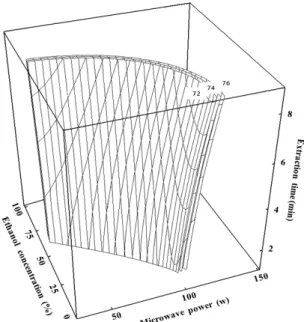
Fig. 2. Response surface for electron donating ability in Pleurotus cornucopiae extract at constant values (electron donating ability:
72-74-76%) according to ethanol concentration, extraction time, and microwave power.
율을 높일 수 있을 것으로 사료된다.
전자공여작용의 변화
각 추출물의 전자공여작용 측정 결과는 Table 1과 같았 고, Fig. 2의 4차원 반응표면분석 결과에서 보는 바와 같이 마이크로웨이브 에너지가 높을수록, 에탄올 농도 조건은 낮 을수록 전자공여작용 효과가 높은 것을 알 수 있었다. 노랑 느타리버섯의 전자공여작용에 대한 반응표면 회귀식의 R2 값은 Table 2에서 보는 바와 같이 0.87로 5% 이내에서 유의 성을 보였다. 이때 예측된 정상점은 안장점의 형태로 나타났 고, 마이크로웨이브 에너지 44.13 watts, 에탄올 농도
19.30%, 추출시간 4.21분일 때 최대값이 35.72%로 예측되 었다(Table 3). 노루궁뎅이버섯(18)의 경우 마이크로웨이 브 에너지 101.04 watts, 추출시간 1.59분의 조건에서 최대 값을 나타내는 것으로 나타났다. 이는 노랑느타리버섯은 노 루궁뎅이버섯보다 낮은 에너지와 긴 추출시간으로 추출하 였을 때 활성이 더 높은 것을 알 수 있었다. 노랑느타리버섯 의 전자공여작용의 경우 Table 4에서 보는 바와 같이 1%
내의 유의수준에서 마이크로웨이브 에너지의 영향을 받는 것으로 나타났고 에탄올 농도와 추출시간에는 큰 영향을 받 지 않는 것으로 나타났다. 만가닥버섯(19)의 경우보다 낮은
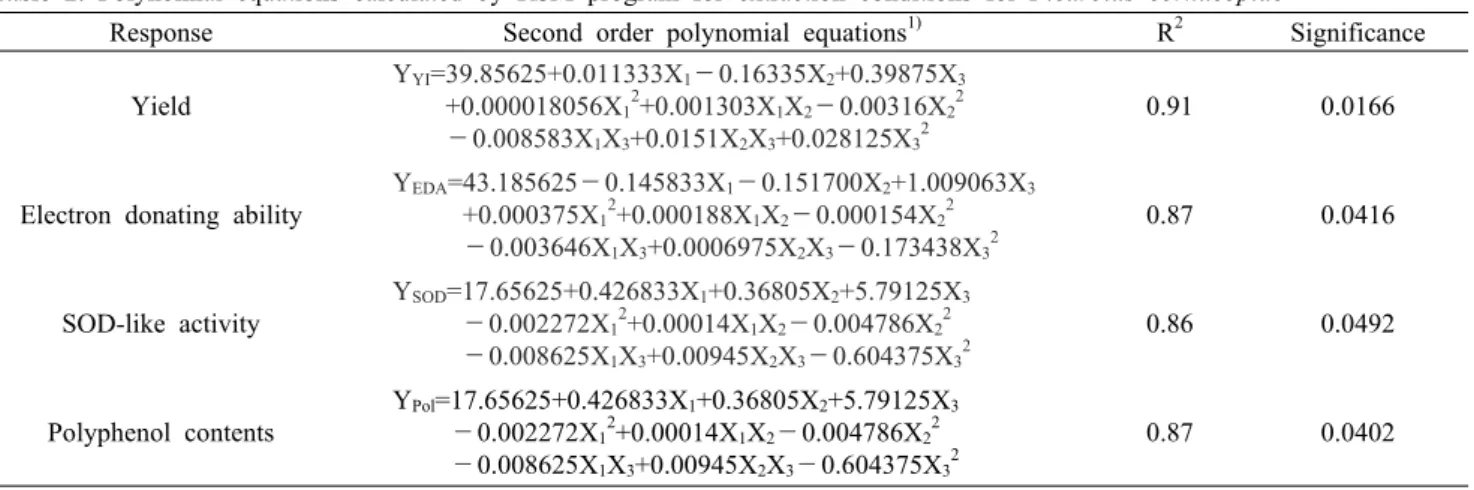
Table 2. Polynomial equations calculated by RSM program for extraction conditions for Pleurotus cornucopiae
Response Second order polynomial equations1) R2 Significance
Yield
YYI=39.85625+0.011333X1-0.16335X2+0.39875X3
+0.000018056X12+0.001303X1X2-0.00316X22
-0.008583X1X3+0.0151X2X3+0.028125X32 0.91 0.0166
Electron donating ability
YEDA=43.185625-0.145833X1-0.151700X2+1.009063X3
+0.000375X12+0.000188X1X2-0.000154X22
-0.003646X1X3+0.0006975X2X3-0.173438X32 0.87 0.0416
SOD-like activity
YSOD=17.65625+0.426833X1+0.36805X2+5.79125X3
-0.002272X12+0.00014X1X2-0.004786X22
-0.008625X1X3+0.00945X2X3-0.604375X32 0.86 0.0492
Polyphenol contents
YPol=17.65625+0.426833X1+0.36805X2+5.79125X3
-0.002272X12+0.00014X1X2-0.004786X22
-0.008625X1X3+0.00945X2X3-0.604375X32 0.87 0.0402
1)X1: microwave power (watt), X2: ethanol concentration (%), X3: extraction time (min).
Table 3. Predicted levels of extraction condition for the maximum responses of variables by the ridge analysis in Pleurotus cornucopiae
Response X11) X2 X3 Maximum Morphology
Yield
Electron donating ability SOD-like activity Polyphenol contents
62.08 44.13 114.01 50.52
12.33 19.30 65.88 23.00
6.86 4.21 1.56 2.90
40.81 35.72 34.87 31.77
Saddle point Saddle point Maximum Saddle point
1)X1: microwave power (watt), X2: ethanol concentration (%), X3: extraction time (min).
Table 4. Regression analysis for regression model of physiochemical properties in extraction condition of Pleurotus cornucopiae
Extraction conditions F-ratio
Yield Electron donating ability SOD-like activity Polyphenol contents Microwave power
Ethanol concentration Extraction time
17.36* 1.96 0.29
12.46**
0.80 0.07
0.19 0.52* 0.15
12.05**
1.24 0.25
*Significant at 10% level, **significant at 5% level.
마이크로웨이브 에너지와 에탄올 농도, 추출시간이 필요한 것으로 나타나 노랑느타리가 활성 우수한 기능성식품으로 개발하기 다소 더 용이한 것으로 판단된다.
SOD 유사 활성의 변화
SOD 유사 활성에 대한 측정값은 Table 1과 같으며, 이에 대한 회귀식은 R2 값이 0.86으로 5% 이내의 유의수준을 나 타냈다(Table 2). Table 3에서 예측된 정상점은 최대점으 로 마이크로웨이브 에너지 114.01 watts, 에탄올 농도 65.88
%, 추출시간 1.56분일 때, 34.87%로 가장 높은 값으로 측정 되었다. 추출조건이 노랑느타리버섯의 SOD 유사 활성에 미 치는 영향은 에탄올 농도의 영향을 가장 크게 받았고(P<
0.05), 다른 조건의 영향은 거의 받지 않는 것으로 나타났다 (Table 4). 또한 Fig. 3에서 보는 바와 같이 마이크로웨이브 에너지와 에탄올 농도가 높을수록 SOD 유사 활성이 높은 경향을 알 수 있었다.
총 폴리페놀 함량의 변화
추출조건에 따른 노랑느타리버섯의 총 폴리페놀 함량의
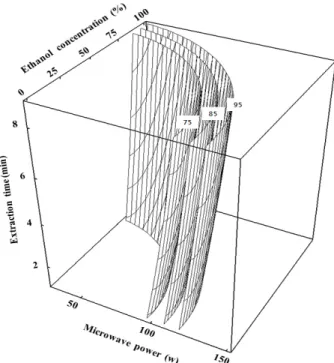
변화는 Table 1에 나타냈고, 이에 대한 반응표면분석은 Fig. 4와 같이 나타났다. Fig. 4에서 보는 바와 같이 총 폴리 페놀 함량의 변화는 마이크로웨이브 에너지는 높을수록, 에 탄올 농도는 낮을수록 함량이 높은 것을 알 수 있었다. 총 폴리페놀 함량의 회귀식의 결정계수 R2은 0.87의 다소 높은 상관관계를 보였고, 5% 이내에서의 유의성을 나타냈다 (Table 2). Table 3에서 노랑느타리버섯의 총 폴리페놀 함 량의 경우 마이크로웨이브 에너지 50.52 watts, 에탄올 농 도 23%, 추출시간 2.9분일 때, 31.77 mg/g의 최대값을 보 였고, 이때 예측된 정상점은 안장점으로 나타났다. Table 4는 총 폴리페놀 함량의 추출조건의 영향을 나타낸 것으로 마이크로웨이브 에너지의 영향을 가장 높게 받는 것으로 예 측되었고(P<0.01), 에탄올 농도와 추출시간의 영향은 받지 않는 것으로 나타났다.
한편 Kim 등(20)의 연구에서 차가버섯의 경우 추출시간, 에탄올 농도, 추출 온도 세 가지 조건에서 모두 유의적인 영향을 주는 것으로 나타났고, 특히 차가버섯의 페놀 함량이 추출 온도에 가장 큰 영향을 주는 것으로 나타나 노랑느타리 버섯과 유사함을 알 수 있었다. 노루궁뎅이버섯 에탄올 추출
Fig. 3. Response surface for superoxide anion radical scavenging activity in Pleurotus cornucopiae extract at constant values (sup- eroxide anion radical scavenging activity: 26-31-36%) according to ethanol concentration, extraction time, and microwave power.
Fig. 4. Response surface for total polyphenol contents in Pleur- otus cornucopiae extract at constant values (total polyphenol contents: 75-85-95%) according to ethanol concentration, ex- traction time, and microwave power.
Table 5. Optimum extraction condition for maximum responses of yield, electron donating ability, polyphenol content, and SOD- like activity of Pleurotus cornucopiae by superimposing their contour maps
Extraction condition Range of optimum condition Microwave power (watt)
Ethanol concentration (%) Extraction time (min)
71.48~92.84 55.01~71.66
3~9
Fig. 5. Superimposed response surface for optimization of yield (32%), electron donating ability (76%), superoxide anion radical scavenging activity (26%), and total polyphenol contents (85%) of extract from Pleurotus cornucopiae.
물의 경우 에탄올 농도가 낮을수록 페놀 함량이 증가하는 것으로 나타나 본 연구에서의 노랑느타리버섯 에탄올 추출 물과 같은 경향을 보였다(21). 점차 많은 천연식물을 활용한 항산화 활성이 우수한 기능성 소재의 식품 개발이 늘고 있는
시점에서 본 연구에서의 노랑느타리버섯의 경우 자연 유래 항산화 소재로서의 활용 잠재성이 우수한 것으로 판단된다.
최적 추출조건의 예측
마이크로웨이브 추출법을 통한 노랑느타리버섯의 최적 추출조건을 설정하기 위해 추출 수율, 전자공여작용, SOD 유사 활성, 총 폴리페놀 함량 측정 결과에 대하여 4차원 반응 표면을 superimposing 하여 중복되는 범위를 최적 추출조 건의 범위로 예측하였다. 그 결과, Fig. 5에서 보는 바와 같 이 마이크로웨이브 에너지 71.48~92.84 watts, 에탄올 농 도 55.01~71.66%, 추출시간 3~9분에서 노랑느타리버섯 의 활성이 우수할 것으로 예측되는 범위로 나타났다. 실험 결과, 노랑느타리버섯의 경우 추출시간에 따른 영향이 다소 낮은 것으로 보아 마이크로웨이브 에너지와 에탄올 농도의 최적조건에 최단시간 추출을 할 경우에도 활성이 높을 것으 로 예상된다.
요 약
노랑느타리버섯의 항산화 활성을 측정하여 효율적 추출조 건을 예측하기 위해 마이크로웨이브 에너지, 에탄올 농도, 추출시간의 요인변수를 중심합성법에 따라 설정하여 반응 표면분석을 통해 최적화 조건을 설정하였다. 노랑느타리버 섯 추출물의 수율, 전자공여작용, SOD 유사 활성, 총 폴리페 놀 함량에 대한 반응표면의 회귀식 R2 값이 각각 0.91, 0.87, 0.86 및 0.87로 분석되었고, 수율은 P<0.01, 항산화 활성이 P<0.05에서 유의적 수준을 나타냈다. 노랑느타리버섯은 요 인변수에 따라 수율, 전자공여작용, 총 폴리페놀 함량의 경 우 마이크로웨이브 에너지의 영향을 가장 많이 받았고, SOD 유사 활성의 경우 에탄올 농도에 따른 유의적 차이를 보였 다. 추출물의 각 특성을 모두 만족시키는 최적의 추출조건의 범위는 superimposing 하여 마이크로웨이브 에너지 71.48
~92.84 watts, 에탄올 농도 55.01~71.66%, 추출시간 3~9 분으로 예측되었다.
REFERENCES
1. Lim SH, Lee YH, Kang HW. 2013. Optimal extraction and characteristics of lignocellulytic enzymes from various spent mushroom composts. Korean J Mycol 41: 160-166.
2. Jang IJ. 2006. Home cultivation system of the new func- tional selenium-enriched Pleurotus cornucopiae and im- plementation of mushroom WBI data. PhD Dissertation.
Chonnam National University, Gwangju, Korea. p 1.
3. Jo EK. 2012. Physiological and antioxidant activities of sub- critical water extracts from gold oyster mushroom (Pleurotus cornucopiae Rolland var. citrinopileatus). MS Thesis.
Kyungnam University, Changwon, Korea. p 38-39.
4. Yoo BH. 2011. Production of β-glucan using mixed culture of mushroom mycelium and Trichoderma koningii. MS Thesis. Inje University, Gimhae, Korea. p 4-5.
5. Lee YH, You CH, Cha DY, Yoo YB, Min KH. 1986. Proto- plast regeneration and reversion in Pleurotus cornucopiae.
Korean J Mycol 14: 215-223.
6. Um S, Jin G, Park KW, Yu Y, Park KM. 2010. Physiological activity and nutritional composition of Pleurotus species.
Korean J Food Sci Technol 42: 90-96.
7. Choi HY, Ha KS, Jo SH, Ka EH, Chang HB, Kwon YI.
2012. Antioxidant and anti-hyperglycemic effects of a Sanghwang mushroom (Phellinus linteusau) water extract.
Korean J Food & Nutr 25: 239-245.
8. Hong SS, Jung EK, Kim AJ. 2013. Quality characteristics of yanggaeng supplemented with Sanghwang mushroom (Phellinus linteusau) mycelia. J Korean Diet Assoc 19: 253- 264.
9. Baek SJ, Kim YS, Yong HM, Chae JB, Lee SA, Bae WC, Park DW, Kim DY, Lee JW, Park SK. 2002. Antimetastatic effect of proteoglycan lsolated from the mycelium of Gano- derma lucidum IY009 in vitro and in vivo. Yakhak Hoegi 46: 11-17.
10. Chung HC, Lee JT, Kwon OJ. 2004. Bread properties utiliz- ing extracts of Ganoderma lucidum (GL). J Korean Soc Food Sci Nutr 33: 1201-1205.
11. Gontard N, Guilbert S, Cuq JL. 1992. Edible wheat gluten films: influence of the main process variables on film prop- erties using response surface methodology. J Food Sci 57:
190-196.
12. Cochran WG, Cox GM. 1957. Experimental design. 2nd ed.
John Wiley & Sons Inc., New York, NY, USA. p 335-375.
13. Box GEP, Hunter JS. 1957. Multi-factor experimental de- sign for exploring response surfaces. Annal Math Stat 28:
195-242.
14. Blois MS. 1958. Antioxidant determinations by the use of a stable free radical. Nature 181: 1199-1200.
15. Marklund S, Marklund G. 1974. Involvement of superoxide anion radical in the autoxidation of pyrogallol and a con- venient assay for superoxide dismutase. Eur J Biochem 47:
469-474.
16. Folin O, Denis W. 1912. On phosphotungstic-phosphomo- lybdic compounds as color reagents. J Biol Chem 12: 239- 249.
17. Kang BH, Lee JM, Kim YK. 2010. Optimization of hot water extraction conditions for Tricholoma matsutake by re- sponse surface methodology. J Korean Soc Food Sci Nutr 39: 1206-1212.
18. Lee KA, Jung JE, Choi YH. 2007. Optimization of micro- wave-assisted extraction process of Hericium erinaceus.
Food Eng Prog 11: 195-202.
19. Kim HK, Choi MG, Kim MO, Kim KH. 2003. Optimization of extraction conditions for Lyophyllum ulmarium by re- sponse surface methodology. J Korean Soc Food Sci Nutr 32: 574-580.
20. Kim DY, Teng H, Choi YH. 2012. Optimization of ultra- sonic-assisted extraction process for Inonotus obliquus us- ing response surface methodology. Curr Res Agric Life Sci 30: 68-75.
21. Choi MA, Park NY, Woo SM, Jeong YJ. 2003. Optimization of extraction conditions from Hericium erinaceus by re- sponse surface methodology. Korean J Food Sci Technol 35: 777-782.