- 755 -
Optimization of Extraction Conditions for Ethanol Extracts from Citrus unshiu Peel by Response Surface Methodology
Ji-Eun Jeong1, Sang-Phil Shim1, Yoo Seok Jeong2, Hee Kyoung Jung2, Young-Chan Kim3 and Joo-Heon Hong4†
1
FoodWell Co, Daegu 701-804, Republic of Korea
2
Biohealth convergence Center, Daegu Technopark, Daegu 704-801, Korea
3Korea Food Research Institute, Seongnam 463-746, Korea
4
Department of Food Science and Technology, Catholic University of Daegu, Gyeongsan 712-702, Korea
반응표면분석에 의한 진피 에탄올 추출물의 추출조건 최적화
정지은1․심상필1․정유석2․정희경2․김영찬3․홍주헌4†
1(주)푸드웰, 2(재)대구테크노파크 바이오헬스융합센터, 3한국식품연구원, 4대구가톨릭대학교 식품가공학전공
Abstract
This study was conducted to monitor the quality characteristics Citrus unshiu ethanolic extracts by a response surface methodology. In extraction conditions based on the central composite design with variations in ethanol concentration (0~100%), extraction temperature(35~95℃), and ratio of solvent to sample(20 mL/g). The maximum value of yield was 36.31% at 93.18℃, 67.13% of ethanol concentration. The extraction yield and total polyphenol content were improved with the increase of ethanol concentration than extraction temperature. Total flavonoid content was improved with the increase of extraction temperature than ethanol concentration. The coefficients of determinations(R2) were 0.8646(p<0.1) and 0.9153(p<0.05) in electron donating ability and hesperidin content, respectively. Estimated conditions for the maximized extraction including yield, total polyphenol content, total flavonoid content, electron donating ability, and hesperidin content were 55~73% in ethanol concentration, 89~95℃ in extraction temperature, and 20 mL/g in ratio of solvent to sample.
Key words:citrus unshiu peel, ethanol extract, optimization, RSM
서 론
1)
감귤류는 예로부터 한방이나 생약의 원료로 사용되고 있는 생리활성 성분이 많이 함유되어 있는 과일로서 우리나 라는 기상적, 지리적으로 감귤 재배지 중 최북단에 위치하 고 있어서 내한성이 강한 만다린계의 온주밀감이 감귤 생산 의 주종을 이루고 있다(1). 감귤류에는 flavonoid, carotenoid, coumarin, polyphenol 등의 다양한 화합물을 함유하고 있으 며, rutin 및 deosmine 등의 일반적인 flavonoid류, hesperidin, naringin 등 citrus 과일 특유의 flavonoid류, 또한 채소나 과일에서는 보고되지 않는 감귤류 고유의 tangeretin, nobietin 등의 flavonoid류가 함유되어 있다(2-3). 특히 감귤
†Corresponding author. E-mail:[email protected] Phone:82-53-850-3218, Fax:82-53-850-3218
과피인 진피에는 페놀성 화합물이 높은 농도로 존재하기 때문에 flavonoid류의 풍부한 공급원이 된다. 진피에는 carotenoid류, bio-flavonoid류, pectin 및 terpene류가 풍부하 게 함유되어 있으며, 고혈압 예방, 혈중 LDL 콜레스테롤함 량 감소 작용 및 HDL 콜레스테롤을 높이며, 순환계 질환의 예방 및 개선효과 등 다양한 생리적 작용이 보고되고 있다 (4-6). 한방에서의 진피는 위액 분비를 항진하여 소화를 돕 는다고 하며, 기관지염 등으로 인한 기침과 가래 증세를 치료하는데 사용된다. 우리나라에서는 민간요법으로 감기 에 걸렸을 때 진피를 끓여 마시기도 하였다(7).
감귤 가공품을 제조할 때 발생하는 부산물인 감귤 과피 는 진피, 귤피 등의 이름으로 한방 처방의 원료인 동시에 비타민, 유기산, 유리당 등의 영양성분 공급원으로 건강식 품의 소재로서 그 소비량도 증가하는 추세에 있다. 하지만,
감귤 가공공정에서 발생하는 과피의 이용방법이 없어서 대부분 버려지고 있는 실정으로 건강기능식품 및 화장품 등 다양한 산업분야로의 이용 방안이 요구되고 있다. 진피 에 관한 연구로는 Eun 등(8)은 감귤과육과 과피의 다양한 식이섬유와 플라보노이드 종류에 대해 연구하였으며, Lee 등(9)은 효소분해 방법을 이용하여 감귤과피의 플라보노이 드 조성 및 기능적 특성에 대해 조사하였고, Jung 등(10)은 진피에탄올 추출물을 이용하여 HIT-T15세포에 대한 산화 적 손상에 미치는 영향에 대해 연구하였다.
반응표면분석은 복수개의 독립변수들이 복합적인 작용 을 하여 한 개 또는 여러 개의 종속변수들에 영향을 줄때 그 작용의 관계를 통계적으로 분석하는 방법으로 최근에는 제품개발, 공정개발, 품질관리 등의 분야에서 널리 활용되 고 있다. Kim 등(11)은 반응표면분석을 이용하여 용매비, 에탄올농도, 추출온도에 따른 홍월적 양배추의 추출조건을 최적화 하였고, Kim 등(12)은 시료에 대한 용매비, 추출온 도와 추출시간에 따른 무화과의 추출조건 최적화를 보고하 였다.
따라서 본 연구에서는 진피를 다양한 기능성 식품소재로 활용하기 위한 기초자료로서 유용성분의 최적 추출조건을 설정하고자 하였으며, 이를 위해서 시료에 대한 용매비, 에탄올 농도 및 추출온도에 따른 유용성분의 추출특성을 반응표면분석으로 모니터링 하였다.
재료 및 방법
실험재료
진피(Citrus unshiuMarkovich)는 제주도에서 10월~11월 에 수확한 감귤 과피를 건조한 것을 대구소재 (주)옴니허브 에서 제공받아 본 실험에 사용하였으며, 시료는 분쇄기 (J-NCM, Jisico, Korea)로 분쇄한 후 표준체 No 60을 통과한 것을 -20℃ 이하의 암소에 보관하면서 추출용 시료로 사용 하였다.
추출조건의 예비설정
추출조건의 예비설정에 필요한 기초실험으로서 열수추 출과 50% 에탄올을 이용하여 시료 20 g에 대한 용매비를 10, 20, 30 mL/g로 하여 80℃, 4시간 추출하였는데 이는 대량 생산에 따른 추출, 여과 및 농축설비와 최종 제품의 생산 비용 등 경제성을 고려하기 위해 설정하였으며, 추출 후 이화학적 분석을 통해 추출조건 최적화 실험의 기본조건 으로 활용하였다.
추출조건 최적화를 위한 중심합성 실험계획
본 실험에서는 추출물의 기능적 특성을 최대로 하는 최 적 추출조건을 설정하기 위해 반응표면분석법(response
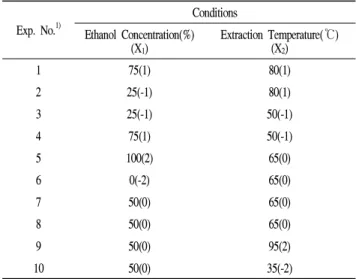
surface methodology, RSM)(13)을 사용하였다. 추출조건에 대한 실험계획은 중심합성계획(central composite design) (14)을 사용하였으며, 반응표면분석을 위해 SAS (statistical analysis system)(15)를 사용하였다. 실험계획은 Table 1과 같이 추출공정에서 중요한 변수로 고려되는 인자 즉, 시료 에 대한 에탄올 농도(0~100%, X1), 추출온도(35~95℃, X2) 를 -2, -1, 0, 1, 2의 5단계로 부호화하여 중심합성계획에 따라 Table 2와 같이 10구간으로 설정하여 추출실험을 실시 하였다. 또한 이들 요인변수에 의해 영향을 받는 종속변수 (Yn) 즉, 수율(Y1), 총 폴리페놀함량(Y2), 총 플라보노이드함 량(Y3), 전자공여능(Y4), hesperidin함량(Y5)으로 하였으며, 이들은 3회 반복 측정하여 그 평균값을 회귀분석에 사용하 였다.
Table 1. Level in extraction condition for Citrus unshiupeel based on central composite design
Xi Independent variables Coded levels
-2 -1 0 1 2
X1 Ethanol concentration (%) 0 25 50 75 100 X2 Extraction temperature (℃) 35 50 65 80 95
Table 2. Central composite design for optimization of extraction condition for Citrus unshiu peel
Exp. No.1) Conditions
Ethanol Concentration(%)
(X1) Extraction Temperature(℃) (X2)
1 75(1) 80(1)
2 25(-1) 80(1)
3 25(-1) 50(-1)
4 75(1) 50(-1)
5 100(2) 65(0)
6 0(-2) 65(0)
7 50(0) 65(0)
8 50(0) 65(0)
9 50(0) 95(2)
10 50(0) 35(-2)
1)The number of experimental conditions by central composite design.
수율 측정
수율(yield)은 추출액을 회전 감압 증발기(Rotavapor R-123, Buchi, Swizerland)로 감압 농축한 후 건조오븐 (Forced convection oven, Jeico Tech, Korea)을 이용하여 10 5℃ 상압가열건조법(16)으로 항량이 될 때까지 건조한 후 추출액 조제에 사용한 원료 건물량에 대한 고형분 수율(%, db)로 나타내었다.
총 폴리페놀함량 측정
총 폴리페놀 함량은 Folin-Denis(17)법에 따라 발효공정 단계별 채취한 시료 1 g에 20배의 증류수를 가하여 70℃에 서 30분간 추출하고 여과한 다음 추출액 0.5 mL에 2N Folin-ciocalteau reagent 0.1 mL를 첨가하고 충분히 혼합한 다음 8.4 mL의 멸균 증류수를 가하여 실온에서 3분간 반응 시킨 후 20% Na2CO3 1 mL를 첨가하고 실온에서 1시간 반응 시킨 후 spectrophotometer (Ultraspec 2100 pro, Amersham Co, Sweden)를 이용하여 725 nm에서 흡광도를 측정하였다. 이때 총 폴리페놀의 함량은 tannic acid (Sigma, St, Louis, MO, USA)를 정량하여 작성한 표준곡선으로부터 계산하였다.
총 플라보노이드함량 측정
총 플라보노이드 함량 측정은 Davis법에 따라(18) 50배 추출액 100 uL에 1 mL diethyl glycol을 혼합하여 실온에서 5분간 반응 시킨 후 1N NaOH 100 uL와 혼합하여 37℃에서 30min 간 반응 시킨 후 420 nm에서 spectrophotometer (Ultraspec 2100 pro, Amersham Co, Sweden)로 흡광도를 측정하였다. 총 플라보노이드 함량은 quercetin (Sigma, St, Louis, MO, USA)을 정량하여 작성한 표준곡선으로부터 계산하였다.
Table 3. Yield, total polyphenol, total flavonoid and hesperidin content ofCitrus unshiu peel extracts by Extract conditions Extraction conditions Ratio of solvent to sample
content (mL/g) Extracts
yield(%) Total polyphenol
contents(mg/mL) Total flavonoid
contents(mg/mL) Hesperidin contents(mg/mL) Hot water
(80℃, 4hr)
10 14.56 18.05±0.80 6.54±0.73 0.442±0.001
20 20.57 21.55±0.28 6.83±0.87 0.436±0.001
30 21.16 20.75±0.31 6.07±0.53 0.682±0.001
50% Ethanol (80℃, 4hr)
10 19.78 24.42±0.41 8.31±1.01 3.028±0.001
20 26.23 25.13±0.51 9.42±1.69 3.561±0.001
30 28.34 26.11±0.59 9.54±0.99 3.758±0.001
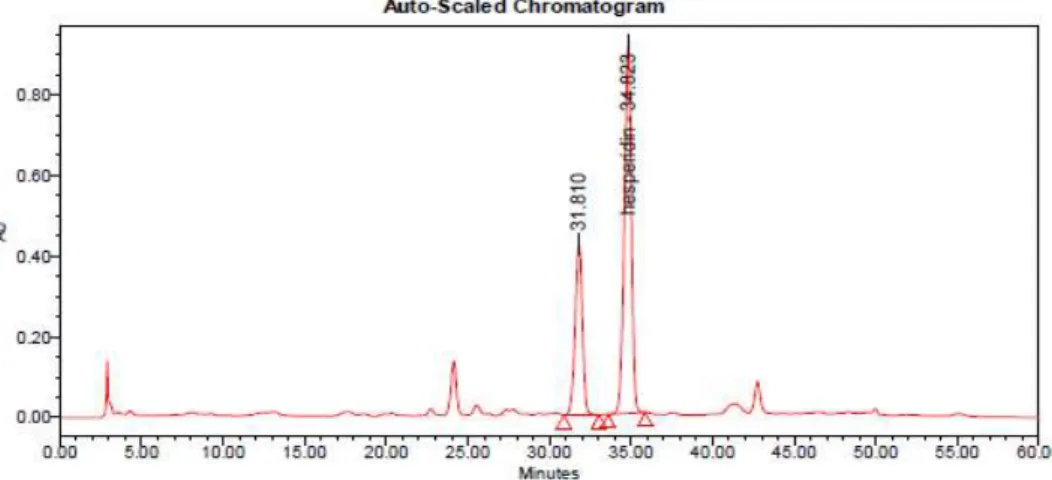
Fig. 1. HPLC separation of ethanol extract from Citrus unshiu peel.
전자공여능 측정
항산화능을 측정하기 위한 전자공여능은 1,1 diphenyl-2- picrylhydrazyl (DPPH)의 환원력을 이용하여 측정하였다 (19). 발효공정 단계별 채취한 시료 1 g에 20배의 증류수를 가하여 70℃에서 30분간 추출하고 여과한 다음 추출액 200 μL에 DPPH 용액(4×10⁻⁴ M DPPH, ethanol 100 mL에 용해) 800 μL를 가한 후 absolute ethanol을 2 mL 첨가하여 10초간 혼합 한 다음 실온에서 15분간 반응시키고 525 nm에서 흡광도를 측정하였으며, 시료를 첨가하지 않은 대조구와 흡광도 차이를 백분율로 계산하였다. 대조구로는 L-ascorbic acid를 정량하여 표준곡선을 작성하여 계산하였다.
EDA (%) =(1 - A/B) × 100 A : Absorbance of sample B : Absorbance of blank Hesperidin함량 분석
Hesperidin 분석은 Jung 등(10)의 방법에 따라 Waters 2690 liquid chromatograph (Waters Co, Milford, MA, USA) 를 이용하여 분석하였다. 이동상은 methanol (A)과 0.5%
acetic acid (B)를 사용하였으며, 0~10min 까지 A:15%, 10~
20 min까지 A:30%, 20~35 min 까지 A:40%, 35~50 min
까지 A:65% 그리고 50~60 min 까지 A:15%의 gradient 조건 으로 용출하였다. 분석 column은 sunfire C18, 5 μm(4.6 mm
× 150 mm, Waters, Co, USA)을 사용하였고, 유속 1 mL/min 로 UV 280 nm에서 검출하였다.
최적 추출조건 예측
조건별 추출물의 최적 추출조건 예측은 품질특성에 대한 contour map superimposing 했을 때 중복되는 부분의 범위에 서 최적 추출조건 범위를 설정하였다. 또한 예측된 범위에 서 임의의 중심점을 최적조건으로 예측하고, 각 회귀식에 대입하여 예측 값을 설정하였다.
결과 및 고찰
추출조건에 따른 추출물의 품질특성
에탄올 추출조건의 최적화를 위하여 추출온도와 추출시 간을 각각 80℃, 4시간으로 고정한 다음 열수추출과 50%
에탄올 추출을 시료대 용매비를 10, 20, 30 mL/g로 하여 추출특성을 확인하고 추출조건의 예비설정에 필요한 기초 실험을 실시하였다(Table 3). Table 3의 결과에 따른 예비 실험 조건을 바탕으로 중심합성계획을 실시하였다.
추출수율은 시료대 용매비가 증가할수록 증가하였으며, 50% 에탄올추출, 시료대 용매비가 30 mL/g 조건에서 28.34%로 가장 높았는데, 열수추출보다는 에탄올추출이 더 효과적이었다. 총 폴리페놀함량은 열수추출의 경우 시 료대 용매비에 따라 18.05~21.55 mg/mL 였으며, 에탄올 추출에서는 24.42~26.11 mg/mL이었고 총 플라보노이드 함량은 에탄올 추출조건이 시료대 용매비가 증가함에 따라 8.31~9.54 mg/mL로 증가하였으며, 열수추출보다 함량이
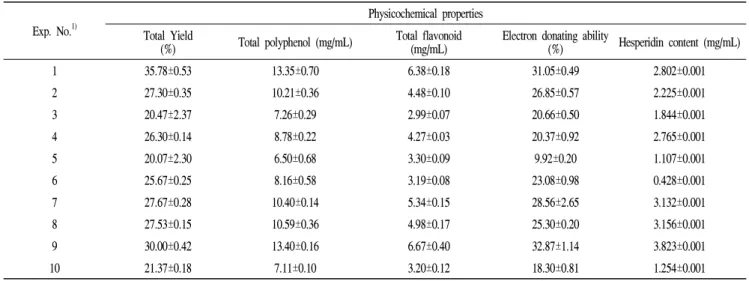
Table 4. Experimental data on yield, total polyphenol, total flavonoid, electron donating ability, and hesperidin content ofCitrus unshiu peel extracts by central composite design for response surface analysis
Exp. No.1) Physicochemical properties
Total Yield
(%) Total polyphenol (mg/mL) Total flavonoid
(mg/mL) Electron donating ability
(%) Hesperidin content (mg/mL)
1 35.78±0.53 13.35±0.70 6.38±0.18 31.05±0.49 2.802±0.001
2 27.30±0.35 10.21±0.36 4.48±0.10 26.85±0.57 2.225±0.001
3 20.47±2.37 7.26±0.29 2.99±0.07 20.66±0.50 1.844±0.001
4 26.30±0.14 8.78±0.22 4.27±0.03 20.37±0.92 2.765±0.001
5 20.07±2.30 6.50±0.68 3.30±0.09 9.92±0.20 1.107±0.001
6 25.67±0.25 8.16±0.58 3.19±0.08 23.08±0.98 0.428±0.001
7 27.67±0.28 10.40±0.14 5.34±0.15 28.56±2.65 3.132±0.001
8 27.53±0.15 10.59±0.36 4.98±0.17 25.30±0.20 3.156±0.001
9 30.00±0.42 13.40±0.16 6.67±0.40 32.87±1.14 3.823±0.001
10 21.37±0.18 7.11±0.10 3.20±0.12 18.30±0.81 1.254±0.001
1)The number of experimental conditions by central composite design
높음을 확인하였다. 진피의 유용성분인 hesperidin함량은 HPLC로 분석 하였으며(Fig. 1) 열수추출보다 에탄올 추출 이 6~8배가량 높음을 알 수 있었고 시료대 용매비가 증가 할수록 높아졌다. 따라서 에탄올을 추출용매로 설정하였으 며, 시료대 용매비는 대량 생산에 따른 추출, 여과 및 농축 설비와 생산 비용 등 경제성을 고려하여 20 mL/g로 하여 중심합성계획법에 의해 추출조건 최적화를 실시하였다.
추출공정 최적화 수율의 변화
중심합성계획에 의해 각 요인변수에 따른 반응변수들 즉, 수율(Y1), 총 폴리페놀함량(Y2), 총 플라보노이드함량 (Y3), 전자공여능(Y4) 및 hesperidin함량(Y5)에 대한 회귀식 과 반응표면분석에 의해 최적추출조건을 예측하였다. 예비 실험 결과에 따라 요인변수들 중 시료대 용매비를 20 mL/g 로 고정하여 반응표면을 나타내었다.
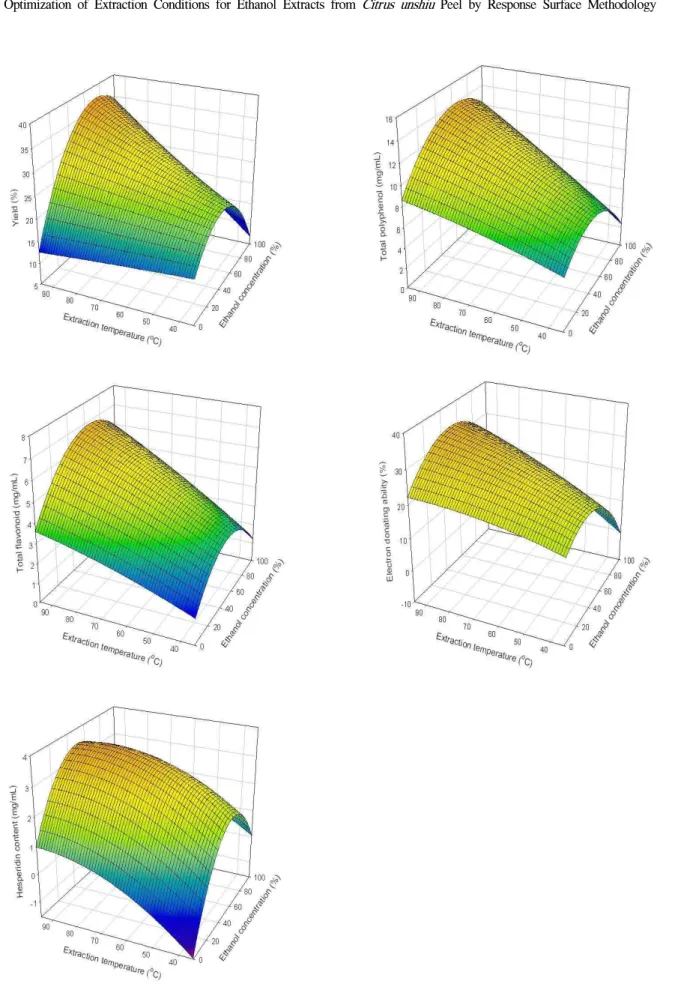
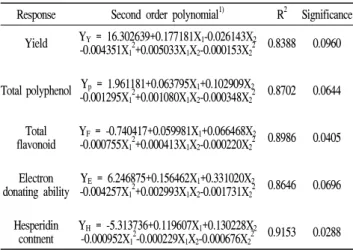
수율의 결과는 Table 4에 나타내었으며, 각각의 결과를 이용한 반응표면 회귀식은 Table 5에 나타내었다. 수율에 대한 회귀식의 R2는 0.8388이고 10%이내의 유의수준에서 유의성이 인정되었다. 10개 구간에서의 추출조건에 따른 수율의 최대값은 35.78%이었고, 각각의 추출조건에 따른 수율에 대한 반응표면 결과는 Fig. 2에 나타내었다. 즉 추출 온도의 경우 추출온도가 증가함에 따라 수율도 증가하였으 며, 에탄올 농도는 60~70%에서 최대값을 나타내었다. 추 출수율에 대해 추출 조건을 고려하여 능선분석 결과에서 에탄올농도 67.13%, 추출온도 93.18℃일 때 최대값은 36.31%로 예측되었다(Table 6). 이러한 결과는 Jo 등(20)의 산머루 유용성분의 에탄올 추출에서 추출수율은 추출온도 보다는 에탄올 농도에 많은 영향을 받으며, 에탄올 50~70%
구간에서 가장 효과적이었다는 보고와 같은 경향이었다.
Fig. 2. Response surface for the effects of extraction conditions on yield, total polyphenol, total flavonoid, electron donating ability, and hesperidin content ofCitrus unshiu peel by ethanolic extraction.
Table 5. Polynomial equations calculated by RSM program for extraction conditions of Citrus unshiu peel
Response Second order polynomial1) R2 Significance Yield YY= 16.302639+0.177181X1-0.026143X2
-0.004351X12+0.005033X1X2-0.000153X22 0.8388 0.0960 Total polyphenol Yp = 1.961181+0.063795X1+0.102909X2
-0.001295X12+0.001080X1X2-0.000348X22 0.8702 0.0644 Total
flavonoid YF= -0.740417+0.059981X1+0.066468X2
-0.000755X12+0.000413X1X2-0.000220X22 0.8986 0.0405 Electron
donating ability YE= 6.246875+0.156462X1+0.331020X2
-0.004257X12+0.002993X1X2-0.001731X22 0.8646 0.0696 Hesperidin
contnent YH= -5.313736+0.119607X1+0.130228X2
-0.000952X12-0.000229X1X2-0.000676X22 0.9153 0.0288
1)X1: ethanol concentration (%), X2: extraction temperature (℃)
Table 6. Predicted levels of optimum conditions for the maximized and minimized responses of variables by the ridge analysis of their response surface
Response
Extraction condition1) X1 X2
Estimated responses
(Max) Morphology Total yield (%) 67.13 93.18 36.31 Saddle point Total polyphenol (mg/mL) 59.47 94.46 13.86 Maximum point Total flavonoid (mg/mL) 61.01 94.26 6.80 Maximum point Electron donating ability (%) 51.45 94.99 33.48 Maximum point Hesperidin content (mg/mL) 51.48 94.98 3.47 Maximum point
1)X1: ethanol concentration (%), X2: extraction temperature (℃)
총 폴리페놀함량 및 총 플라보노이드함량의 변화 식물에 널리 분포되어 있는 페놀성 물질은 phenolic hydroxyl 그룹 때문에 단백질 또는 효소단백질, 기타 거대분 자들과 결합하는 성질, 항산화 효과, 2가 금속이온과의 결 합력을 가진다(21). 중심합성계획에 의한 진피 에탄올 추출 조건별 총 폴리페놀함량은 Table 4에서와 같이 6.50~13.40 mg/mL의 범위였으며, 결과에 대한 반응표면 회귀식의 R2 는 0.8702로 10%이내의 유의수준에서 인정되었다(Table 5). 각각의 추출조건에 따른 총 폴리페놀함량에 대한 반응 표면 결과는 Fig. 2에 나타내었다. 즉 추출온도보다는 에탄 올 농도에 많은 영향을 받음을 알 수 있었다. Park 등(22)의 메밀 새싹 에탄올 추출조건 연구에서 총 폴리페놀함량은 추출온도에 비하여 에탄올 농도가 더 큰 영향을 준다는 보고와 유사한 경향을 나타내었다. Jeong 등(23)은 에탄올 추출조건에 따른 머루의 총 폴리페놀함량 분석 결과에 따르 면 동일조건에서 물, 50% 에탄올과 100% 에탄올조건에서 추출시 50% 에탄올에서 가장 효과적이었다고 보고하였다.
감귤류에는 다양한 플라보노이드가 존재하는 것으로 알려 져 있으며, 현재까지 약 60여 종의 플라보노이드가 분리되 었고, 새로운 생리활성 물질이 계속적으로 발견되고 있다 (24). 진피 에탄올 추출조건에 따른 총 플라보노이드함량은 3.19~6.67 mg/mL의 범위였으며(Table 4), 결과에 대한 반 응표면 회귀식의 R2는 0.8986로 5%이내의 유의수준에서 인정되었다(Table 5). 진피 추출물의 총 플라보노이드 함량 의 예측된 정상점은 최대점의 형태를 나타내었으며, 추출 조건을 고려하여 능선분석 결과에서 에탄올농도 61.01%, 추출온도 94.26℃일 때 최대값은 6.80 mg/mL로 예측되었다 (Table 6). 또한 총 플라보노이드함량은 에탄올농도보다 추 출온도에 더 큰 영향을 받는 것으로 나타났다(Table 7).
Table 7. Regression analysis for regression model of physiochemical properties in extraction condition of Citrus unshiu peel
Extract condition
F-Ratio Yield Total
polypheno l
Total flavonoid
Electron donating ability
Hesperidin content Ethanol concentration 3.72 2.20* 3.82 3.91 9.93**
Extraction temperature 2.76 6.49* 7.55** 4.38* 4.51*
*Significant at 10% level ; **significant at 5% level
전자공여능의 변화
전자공여능은 활성 라디칼에 전자를 공여하고 식품 중의 지방질 산화를 억제하는 목적으로 사용되며, 인체 내에서 는 활성 라디칼에 의한 노화를 억제시키는 작용으로 이용되 고 있다(25). 라디칼 소거작용은 인체의 질병과 노화를 방지 하는데 대단히 중요한 역할을 한다. 따라서 전자공여능 측 정은 DPPH 라디칼 소거법으로 측정하며, DPPH법은 tocopherol, ascorbate, flavonoid 화합물, 방향족 아민류, Maillard형 갈변 생성물질, peptide 등의 항산화 활성을 나타 내는 생리활성 물질에 의해 환원됨으로서 짙은 자색이 발색 되는 정도에 따라 항산화 효과를 수소공여능으로 측정하는 방법으로 알려져 있다(26).
진피 에탄올 추출조건에 따른 전자공여능은 Table 4에 나타내었으며, 전자공여능 변화에 대한 반응표면은 Fig.
2에 나타내었다. 추출조건에 있어 에탄올 농도, 추출온도에 따른 전자공여능의 변화에 대한 반응표면 회귀식은 Table 5와 같으며, 전자공여능에 대한 회귀식의 R2는 0.8646로 10%이내의 유의수준에서 유의성이 인정되었다. 예측된 정 상점은 최대점의 형태로 최대값은 에탄올농도 51.45%, 추 출온도 94.99℃일 때 33.48%로 예측되었으며(Table 6), 진 피 에탄올 추출물의 추출조건에 대한 영향은 에탄올농도보 다는 추출 온도에 많은 영향을 받음을 확인하였다(Table 7). 이러한 결과는 Jeong 등(23)의 머루의 유용성분 추출조 건에서 전자공여능이 추출온도에 의해 크게 영향을 받고
있다는 보고와 같은 경향을 나타내었으며, 최대값을 나타 내는 에탄올 농도가 50~60%로 유사한 경향이었다.
Hesperidin함량의 변화
Hesperidin은 감귤류의 과피에 비교적 다량으로 함유되 어 있으며, 비타민 P라고 불리워지고 있으며, aglycone과 hesperetin 또는 methyl reiodictyol과 disaccharide, rutinose로 구성된 flavanone 배당체이다(27). Hesperidin은 항염증, 항 산화, 특정한 암세포주에 대한 항암활성을 발현하는 것으 로 알려져 있으며, Lee 등(28)은 hesperidin 및 다양한 플라보 노이드성 물질들이 인간 유방암 세포주의 증식을 억제하고 유방암의 발병과정을 지연시킬 수 있음을 보고하였다.
진피 에탄올 추출조건별 hesperidin 함량은 Table 4에서 와 같이 0.428~3.82 mg/mL의 범위였으며, 결과에 대한 반 응표면 회귀식의 R2는 0.9153로 5%이내의 유의수준에서 인정되었다(Table 5). 예측된 정상점은 최대점의 형태로, 최대값은 에탄올농도 51.48%, 추출온도 94.98℃일 때 3.47 mg/mL로 예측되었으며(Table 6), 진피 에탄올 추출물의 추 출조건에 대한 영향은 추출온도보다는 에탄올농도에 많은 영향을 받음을 알 수 있었고(Table 7) 추출온도가 증가할수 록 에탄올농도 50~60%에서 가장 함량이 높음을 확인하였 다(Fig. 2).
추출 추출조건의 예측
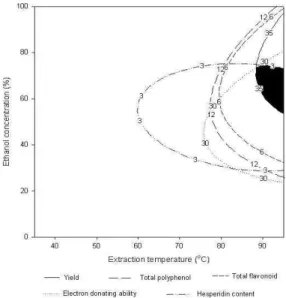
진피의 추출조건을 최적화하기 위하여 추출물의 특성인 추출물의 수율, 총 폴리페놀함량, 총 플라보노이드함량, 전 자공여능, hesperidin함량에 대해 contour map을 superimposing 하여 최적 추출조건 범위를 예측하였다. Fig. 3에서와 같이
Fig. 3. Superimposing contour map of optimized conditions for the yield, total polyphenol, total flavonoid, electron donating ability, and hesperidin content of Citrus unshiu peel as functions of extraction concentration and extraction temperature by ethanolic extraction.
반응표면이 중복된 최적 추출조건의 범위는 추출물의 품질 특성(반응변수, Y1~Y5)을 대상으로 하였을 경우 시료대 용매비를 20 mL/g로 고정하고 에탄올 농도 55~73%, 추출 온도 89~95℃이었다(Table 8).
Table 8. Optimum extraction condition for response variables yielding the optimum response by superimposing of the response surface
Extraction conditions Optimum ranges
Ethanol concentration (%) 55-73
Extraction temperature (℃) 89-95
요 약
본 실험은 반응표면분석법을 이용하여 진피 에탄올 추출 물의 이화학적 특성을 모니터링 하였다. 진피의 에탄올 추 출조건의 최적화를 위하여 예비실험 결과에 따라 요인변수 들 중 시료대 용매비를 20 mL/g로 고정하여 반응표면을 나타내었다. 추출조건에 따른 수율 및 총 폴리페놀함량의 최대값은 예측된 정상점에서 능선분석을 실시하여 본 결 과, 36.31%와 13.86 mg/mL이었다. 추출조건별 총 플라보노 이드함량은 3.19~6.67 mg/mL의 범위였으며, 결과에 대한 반응표면 회귀식의 R2는 0.8986로 5%이내의 유의수준에 서 인정되었는데 에탄올농도보다 추출온도에 더 큰 영향을 받는 것으로 나타났다. 전자공여능에 대한 회귀식의 R2는 0.8646로 10%이내의 유의수준에서 유의성이 인정되었으 며, 추출조건에 따른 hesperidin함량은 0.4282~3.823 mg/mL의 범위였으며, 추출온도보다는 에탄올농도에 많은 영향을 받음을 알 수 있었다. 진피 추출물의 특성인 수율, 총 폴리페놀함량, 총 플라보노이드함량, 전자공여능, hesperidin함량에 대해 contour map을 superimposing하여 얻 은 최적 추출조건의 범위는 시료대 용매비 20 mL/g, 에탄올 농도 55~73%, 추출온도 89~95℃로 예측되었다.
감사의 글
본 연구는 지식경제부 지역전략기획기술개발사업(과제 번호 : 70004885) 연구비지원으로 수행되었으며, 이에 감사 드립니다.
참고문헌
1. Yang HJ, Jeong SY, Choi NS, Ahn KH, Park CS, Yoon BD, Ryu YW, Ahn SC, Kim MS (2010) Optimization
of production yield for neohesperidin by response surface methodology. J Life Sci, 20, 1691-1696
2. Cha JY, Kim SY, Jeong SJ, Cho YS (1999) Effects of hesperetin and naringenin on lipid concentration in orotic acid treated mice. J Life Sci, 389-394
3. Laura B (1998) Chemistry, dietary sources, metabolism, and nutritional significance. Nutr Rev, 56, 317-333 4. Son HS, Kim HS, Kwon TB, Ju JS (1992) Isolation,
purification and hypotensive effects of bioflavonoids in citrus sinensis. J Korean Soc Food Nutr, 21, 136-142 5. Monforte MT, Trovato A, Kirjavanien S, Forestieri AM, Galati EMI, Curto RB (1995) Biological effects of hesperidin, a citrus flavonoid hypolipidemic activity on experimental hypercholesterolemia in rat. Famco, 50, 595-599
6. Son HS, Lee HS, Park YB, Bae KH, Son KH, Jeong TS, Choi MS (1999) Plasma and hepatic cholesterol and heptic activities of 3-hydroxy-3-methylgluraryl CoA reductase and acyl CoA cholesterol transferase are lower in rat fed citrus peel extract or a mixture of citrus bioflavonoids. J Nutr, 129, 1182-1185
7. Hyon JS, Kang SM, Mahinda S, Koh WJ, Yang TS, Oh MC, Oh CK, Jeon YJ, Kim SH (2010) Antioxidative activities of dried and fresh citrus peels in Jeju. Korean J Food Cookery Sci, 26, 88-94
8. Eun JB, Jung YM, Woo GJ (1996) Identification and determination of dietary fibers and flavonoids in pulp and peel of korean Tangerine (Citrus aurantium var.).
Korean J Food Sci Technol, 28, 371-377
9. Lee MH, Huh D, Jo DJ, Lee GD, Yoon SR (2007) Flavonoids components and functional properties of citrus peel hydrolysate. J Korean Soc Food Sci Nutr, 36, 1358-1364
10. Jung HK, Jeong YS, Park CD, Park CH, Hong JH (2010) Effect of the ethanol extract from citrus peels on oxidative damage in alloxan-induced HIT-T15 cell. J Korean Soc Food Sci Nutr, 39, 1102-1106
11. Kim HK, Do JR, Hong JH, Lee GD (2005) Optimization of extraction conditions for cabbage. J Korean Soc Food Sci Nutr, 34, 1625-1632
12. Kim JO, Kwon ST, Lee GD, Hong JH, Moon DH, Kim TW, Kim DI (2008) Optimization of extraction condition on fig (Ficus carica L.) by response surface methodology.
Korean J Food Preserv, 15, 66-73
13. Gontard N, Guilbert S, Cuq JL (1992) Edible wheat gluten films: Influence of the main process variables on film properties using response surface methodology. J Food
Sci, 57, 190-196
14. Lee GD, Lee JE, Kwon JH (2000) Application of response surface methodology in food industry. Food and Industry, 33, 33-45
15. SAS Institute, Inc (1990) SAS User's Guide. Statistical Analysis Systems Institute, Cary, NC, USA.
16. Official methods of analysis of the AOAC (1990) Fifteenth edition. USA. p. 1010-1011
17. Singleton VL, Rossi JA (1965) Colorimetry of total phenolics with phenolics with phosphomolybdic-phosphotungstic acid reagents. Am J Enol Viticult, 16, 144-158
18. Davis WB (1947) Determination of flavonones in citrus fruits. Anal Chem, 19, 476
19. Lee EJ, Kim JS, Kwon JH (2008) Optimization of microwave-assisted extraction conditions for total catechin and electron donating ability of grape seed extracts. Korean J Food Preserv, 15, 840-846 20. Jo IH, Kim CY, Lee TW, Lee GH, Choi YH (2010)
Optimization of extraction of effective components from Vitis coignetiae,the crimson glory vine. Korean J Food Preserv, 17, 659-666
21. Chung MJ, Paul AW, Christer H (2006) Dietary phenolic antioxidants, caffeic acid and trolox, protect rainbow trout gill cells from nitric oxide-induced apoptosis. Aquatic Toxicology, 80, 321-328 21
22. Park KJ, Lim JH, Kim BK, Jeong JW, Kim JC, Lee MH, Cho YS, Jung HY (2009) Optimization of extraction conditions to obtain functional components from buckwheat(Fagopyum esculentum M.) sprouts, using response surface methodology. Korean J Food Preserv, 16, 734-741
23. Jeong HJ, Park SB, Kim S, Kim HK (2007) Total polyphenol content and antioxidative activity of wild grape (Vitis coignetiae) extracts depending on ethanol concentrations. J Korean Soc Food Sci Nutr, 36, 1491-1496
24. Kim YD, Ko WJ, Koh KS, Jeon YJ, Kim SH (2009) Composition of flavonoids and antioxidative activity from juice of Juju citrus fruits during maturation. Korean J Nutr, 42, 278-290
25. Park NY, Lee GD, Jeong YJ, Kwon JH (1998) Optimization of extraction conditions for physicochemical properties of ethanol extracts from Chrysanthemum boreale. J Korean Soc Food Sci Nutr, 27, 585-590 26. Blois MS (1958) Antioxidant determination by the use
of a stable free radical. Nature, 26, 1199-1204
27. Cha JY, Cho YS (2001) Biofunctional activities of citrus flavonoids. J Korean Soc Agri Chem Biotechnol, 44, 122-128
28. Lee MN, Lee SY, Lee HJ, Seok JH, Lee CJ (2010)
Anti-proliferative effects of daidzein, baicalein, Hesperidin and ursolic acid on human breast cancer cells stimulated by estrogenic compounds. Yakhak Hoeji, 54, 168-173 (접수 2011년 5월 6일 수정 2011년 9월 28일 채택 2011년 9월 30일)