INTRODUCTION
Laparoscopic greater curvature plication (LGCP) is a relatively new bariatric surgery procedure. Its advantages include no
stapling or rerouting of the GI tract, minimal fistula formation, no requirement for foreign body implantation, such as a gas- tric band, and potential reversibility. The disadvantages of LGCP are technical difficulty and limited long-term follow-up data, especially with respect to weight regain. LGCP has been compared with laparoscopic sleeve gastrectomy (LSG), be- cause both procedures are relatively new and potentially have the same restrictive effects by reducing gastric volume, there- by producing similar anatomic changes and patterns of weight loss. LSG has rapidly gained popularity worldwide and, at present, accounts for around 27.8% of the global total number of metabolic/bariatric surgeries.1 In a recent study by the Ameri- can College of Surgeons’ National Surgical Quality Improve- ment Program (NSQIP), Roux-en-Y gastric bypass (RYGBP), ad- justable gastric band, and SG comprised 58.4, 28.8, and 9.3% of the procedures in 2010, which changed to 37.6, 3.1, and 58.2%
Short-Term Outcomes of Laparoscopic Greater Curvature Plication and Laparoscopic Sleeve Gastrectomy in Patients with a Body Mass Index of 30 to 35 kg/m 2
Yeon Ho Park and Seong Min Kim
Department of Surgery, Gil Medical Center, Gachon University of Medicine and Science, Incheon, Korea.
Purpose: The aim of this study was the compare the midterm outcomes of laparoscopic greater curvature plication (LGCP) and laparoscopic sleeve gastrectomy (LSG) in obese patients with a body mass index (BMI) of 30 to 35 kg/m2.
Materials and Methods: This single center, retrospective review of prospectively collected data was conducted for obese patients that underwent LGCP or LSG from March 2013 to February 2016. These two patient groups were compared in terms of demo- graphics, perioperative outcomes, weight loss [percent excess weight loss (%EWL)], comorbidity resolution, and immediate and long-term complications.
Results: A total of 149 patients were eligible for the study. Seventy-five patients underwent LGCP (group A) and 74 LSG (group B).
These two groups were matched for age, gender, and baseline BMI. Three patients in each group were readmitted for complica- tions within 30 days postoperatively. %EWL in groups A and B were 51.1±16.9 and 47.8±20.8 at 3 months (p=0.084), 71.1±20.2 and 74.5±21.8 at 6 months (p=0.165), 77.1±18.4 and 87.8±25.1 at 12 months (p=0.002), 70.5±18.5 and 83.4±28.7 at 24 months (p=0.005), and 67.3±15.3 and 78.6±31.7 at 36 months (p=0.054), respectively. Intergroup differences in resolution rates of metabolic comor- bidities between the two groups were not significant.
Conclusion: Although mean weight loss after LGCP was inferior to that after LSG, especially after six months postoperatively, it was acceptable, and LGCP had an excellent metabolic comorbidity resolution rate in patients with BMIs, ranging from 30 to 35 kg/m2. Key Words: Laparoscopic greater curvature plication, laparoscopic sleeve gastrectomy, obesity surgery, complication
pISSN: 0513-5796 · eISSN: 1976-2437
Received: February 14, 2017 Revised: March 29, 2017 Accepted: April 26, 2017
Corresponding author: Dr. Seong Min Kim, Department of Surgery, Gil Medical Center, Gachon University of Medicine and Science, 21 Namdong-daero 774beon-gil, Namdong-gu, Incheon 21565, Korea.
Tel: 82-32-460-3244, Fax: 82-32-460-3247, E-mail: [email protected]
•The authors have no financial conflicts of interest.
© Copyright: Yonsei University College of Medicine 2017
This is an Open Access article distributed under the terms of the Creative Com- mons Attribution Non-Commercial License (http://creativecommons.org/licenses/
by-nc/4.0) which permits unrestricted non-commercial use, distribution, and repro- duction in any medium, provided the original work is properly cited.
Yonsei Med J 2017 Sep;58(5):1025-1030 https://doi.org/10.3349/ymj.2017.58.5.1025
in 2014, respectively.2 Thus, we considered it would be worth- while to compare the effects of LGCP and LSG, as the latter has become the operative standard in terms of weight loss and resolution of comorbidities and complications. Previous com- parisons of the effects of these two procedures have consistent- ly suggested LGCP is inferior to LSG in terms of weight loss3-6 and the rate of complications requiring revision surgery.5,7 On the other hand, LGCP has shown more sustained weight loss and higher levels of satisfaction Class I or II obese patients.8-11 In another study, similar positive findings were reported for this patient population for LSG.12 In the present study, we evaluated the treatment outcomes of LGCP and LSG in obese patients with a body mass index (BMI) ranging from 30 to 35 kg/m2.
MATERIALS AND METHODS
This single center, retrospective study was conducted by re- viewing prospectively collected data of patients that under- went either LGCP or LSG at the Gil Medical Center (Gachon University, Incheon, South Korea) from March 2013 to Febru- ary 2016. These dates were selected in order to recruit patients within 3 years of surgery, that is, with a follow-up of at least 1 year. All study procedures were in accord with the ethical stan- dards of the institutional committee at our institution (GDIRB 2013-281) and with the 1964 Declaration of Helsinki and its lat- er amendments. The guidelines issued by the Asian Consensus Meeting on Metabolic Surgery (ACMOM 2008, Trivandrum, India) for BMI restriction using bariatric surgery (http://www.
acmoms.com/acmom_2008.html) were followed throughout.
Informed consent was obtained from all study subjects, who were specifically informed that LGCP included an experimen- tal procedure.
We have described the surgical techniques adopted for LGCP in previous studies.10,11 In brief, after gastrolysis of the greater omentum from the greater curvature of the stomach, a Bougie (36 Fr) was inserted by an anesthesiologist to guide the infold- ing procedure. Gastric infolding was performed using two lay- ers of non-absorbable sutures [inner interrupted sutures of 2-0 Ethibond® (Ethicon, Somerville, NJ, USA) and outer continuous sutures of 2-0 polypropylene (Prolene®; Ethicon, Somerville, NJ, USA) or V-LocTM (Covidien, Norwalk, CT, USA)]. The first row of sutures was started 2 cm below the gastroesophageal junc- tion and continued until 3–4 cm proximal to the pylorus. For LSG, after gastrolysis of the greater omentum from the greater curvature, a Bougie (36 or 40 Fr) was inserted to guide gastric resection, which was performed using five to seven 60 mm sta- ples. A serosal reinforcement suture was placed using 2-0 Vic- ryl® (Ethicon, Somerville, NJ, USA). Fibrin glue and a JP drain were routinely used. Patients in both groups were recommend- ed to visit at 1, 3, 6, 12, 18, and 24 months postoperatively and then annually thereafter. Ideal body weight was defined as weight corresponding to a BMI of 23 kg/m2 (the upper limit of
normal BMI for Asian populations). Information on patient perioperative BMIs, percent excess weight loss (%EWLs), and complications were collected during follow-up outpatient visits or by e-mail or telephone. The primary study endpoints were operation time, length of hospital stay, mortality, and immedi- ate and long-term postoperative complications requiring re- admission. Secondary endpoints included weight loss (%EWL) at 3, 6, 12, 24, and 36 months postoperatively and resolution of comorbidities. Statistical analysis was performed using the Statistical Package for the Social Sciences for Windows version 15.0 (SPSS Inc., Chicago, IL, USA). All reported p-values are two tailed, and significance was accepted for values of <0.05.
RESULTS
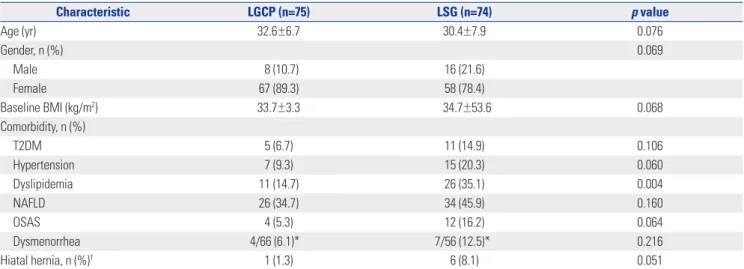
All operations were performed by a single laparoscopic sur- geon (S.M.K.) and were completed laparoscopically. 149 pa- tients were eligible, and these constituted the study cohort. The 149 study subjects were allocated to two groups, that is, 75 to group A (LGCP) and 74 to group B (LSG). Mean (±SD) ages in groups A and B were 32.6±6.7 and 30.4±7.9 years, respectively, and the number (percentages) of women were 67 (89.3%) and 58 (78.4%), respectively. Mean baseline BMIs were 33.7±3.3 and 34.7±53.6 kg/m2, respectively. Percentages of patient with a co- morbidity were not significantly different, with the exception of dyslipidemia [11 (14.7%) and 26 (35.1%), respectively, p=0.004].
However, percentages with hiatal hernia (as documented by preoperative endoscopy) were significantly different (1.3% and 8.1%, respectively, p=0.051) (Table 1).
Mean operation time was significantly longer in group A (122.1±3.2 min vs. 108.7±30.6 min, p=0.010), although mean hospital stays were not significantly different (3.2±1.5 and 2.8±
1.1 days, p=0.075). Laparoscopic cholecystectomy was concur- rently performed in 2 (2.7%) patients in group A and 1 (1.4%) patient in group B. Laparoscopic repair of hiatal hernia was concurrently performed in 4 (5.3%) patients in group A, and in 6 (8.1%) patients in group B. Laparoscopic removal of a gas- tric band was concurrently performed in 5 (6.7%) patients in group A and in 3 (4.1%) patients in group B (Table 2).
Readmission within 30 days of operation was necessary in 3 patients in both groups. In group A, 3 patients presented with gastric obstruction: two were re-hospitalized after discharge on postoperative days 5 and 7, and both responded well after conservative treatment and a tolerated liquid diet. The third patient who underwent concurrent removal of a gastric band did not improve after conservative treatment and eventually underwent plication reversal at 12 days postoperatively. In group B, 1 patient that presented with gastric obstruction (at- tributed to a staple mishap during surgery) after discharge was re-hospitalized at 5 days postoperatively and did well after conservative treatment. Another patient presented with se- vere fever and abdominal pain after discharge on postopera-
tive day 7 and was re-hospitalized. A contained proximal mi- nor leak was diagnosed, and the patient did well after conser- vative treatment. The third patient presented with frequent bilious vomiting after discharge and was re-hospitalized on postoperative day 5. A hernia was diagnosed at the 15 mm um- bilical port site by abdominal CT, and the patient underwent laparoscopic repair with Gore-Tex mesh fixation. One patient in each group was re-hospitalized after 30 days postoperatively.
The one patient in group A, did well until 8 months, but then
developed melena and syncope. Endoscopy resulted in a posi- tive test for Helicobacter pylori, but no bleeding focus was found in the plicated stomach. Transfusion of four packed RBCs was started along with Helicobacter eradication. The one patient in group B presented with frequent postprandial chest pain, es- pecially after solids. Esophageal dysmotility was diagnosed by UGI and high resolution manometry, and eventually, the pa- tient underwent conversion to RYGBP at 11 months postopera- tively; her symptom subsequently disappeared. After the first Table 1. Patient Demographic Data (n=149)
Characteristic LGCP (n=75) LSG (n=74) p value
Age (yr) 32.6±6.7 30.4±7.9 0.076
Gender, n (%) 0.069
Male 8 (10.7) 16 (21.6)
Female 67 (89.3) 58 (78.4)
Baseline BMI (kg/m2) 33.7±3.3 34.7±53.6 0.068
Comorbidity, n (%)
T2DM 5 (6.7) 11 (14.9) 0.106
Hypertension 7 (9.3) 15 (20.3) 0.060
Dyslipidemia 11 (14.7) 26 (35.1) 0.004
NAFLD 26 (34.7) 34 (45.9) 0.160
OSAS 4 (5.3) 12 (16.2) 0.064
Dysmenorrhea 4/66 (6.1)* 7/56 (12.5)* 0.216
Hiatal hernia, n (%)† 1 (1.3) 6 (8.1) 0.051
LGCP, laparoscopic greater curvature plication; LSG, laparoscopic sleeve gastrectomy; BMI, body mass index; T2DM, type 2 diabetes mellitus; NAFLD, non-alco- holic fatty liver disease; OSAS, obstructive sleep apnea syndrome.
*Number of female patients before menopause, †Documented by preoperative endoscopy.
Table 2. Perioperative Data of Patients (n=149)
LGCP (n=75) LSG (n=74) p value
Op time (min) 122.1±3.2 108.7±30.6 0.010
LOS (postop days) 3.2±1.5 2.8±1.1 0.075
Concurrent op, n (%)
Lap chol 2 (2.7) 1 (1.4) 0.568
Lap HHR 4 (5.3) 6 (8.1) 0.499
Lap GBR 5 (6.7) 3 (4.1) 0.479
LGCP, laparoscopic greater curvature plication; LSG, laparoscopic sleeve gastrectomy; Lap chol, laparoscopic cholecystectomy; Lap HHR, laparoscopic hiatal her- nia repair; Lap GBR, laparoscopic gastric band removal.
Table 3. Immediate and Long-Term Postoperative Complications Requiring Readmission (n=149)
LGCP (n=75) LSG (n=74)
<30 days
Gastric obstruction (n=3)
Gastric stenosis (n=1) Proximal leak (n=1) Trocar site hernia (n=1)
Tx Conservative Tx (n=2) Conservative Tx (n=2)
Undo plication (n=1) Mesh repair of hernia (n=1)
>30 days, <1 yr Mucosal bleeding (n=1) Esophageal dysmotility (n=1)
Tx Transfusion (n=1) Conversion to RYGBP (n=1)
>1 yr
Refractory GERD (n=1) Refractory GERD (n=2)
Tx Maintain PPI (n=1) Maintain PPI (n=1)
Conversion to RYGBP (n=1)
LGCP, laparoscopic greater curvature plication; LSG, laparoscopic sleeve gastrectomy; Tx, treatment; RYGBP, Roux-en-Y gastric bypass; GERD, gastroesophageal reflux disease; PPI, proton pump inhibitor.
postoperative year, one patient in group A and two patients in group B were re-hospitalized for persistent symptomatic gas- troesophageal reflux disease (GERD). Of these three patients, the one in group B underwent conversion to RYGBP at 15 months postoperatively (Table 3).
The mean±SD of %EWL in groups A and B at 3, 6, 12, 24, and 36 months were 51.1±16.9 (n=74) and 47.8±20.8 (n=74) (p=
0.084), 71.1±20.2 (n=74) and 74.5±21.8 (n=74) (p=0.165), 77.1±
18.4 (n=74) and 87.8±25.1 (n=74) (p=0.002), 70.5±18.5 (n=49) and 83.4±28.7 (n=49) (p=0.005), and 67.3±15.3 (n=24) and 78.6±31.7 (n=39) (p=0.054), respectively. Mean %EWLs were significant in both groups after 6 months postoperatively (Table 4, Fig. 1). Resolution rates of metabolic comorbidities in groups A and B [type 2 diabetes mellitus (T2DM): 4/5 (80%) and 9/11 (81.8%), hypertension: 4/7 (57.1%) and 11/15 (73.3%), and non- alcoholic fatty liver disease: 26/26 (100%) and 33/34 (97.1%)]
were not significantly different, except for dyslipidemia [6/11 (54.5%) and 23/26 (88.5%), respectively; p=0.022]. OSAS reso- lution rates in the two groups were 4/4 (100%) and 11/12 (91.7%), respectively (p=0.551). In all 11 patients affected, postopera- tive dysmenorrhea resolved after significant weight loss [4/4 (100%) vs. 7/7 (100%), respectively] (Table 4).
DISCUSSION
The main findings of the present study concern weight loss and the complications of LGCP and LSG performed on obese patients with BMIs ranging from 30 to 35 kg/m2. Although mean %EWL in LGCP was inferior to that of LSG, especially af- ter six months postoperatively [%EWL at 12, 24, and 36 months in groups A and B were 77.1 and 87.8% (p=0.002), 70.5 and 83.4% (p=0.005), and 67.3 and 78.6% (p=0.054), respectively], and these values were acceptable. Also, LGCP achieved an ex- cellent metabolic comorbidity resolution rate. T2DM of the five patients in LGCP group in our study were a relatively mild form of T2DM [diagnosed in preoperative evaluation (HbA1C) or controlled by oral hypoglycemic <2 years]. Therefore, the resolution rate of T2DM in LGCP in our study was relatively high, which is contrary to the previous studies showing resolu- tion of comorbidities, especially in T2DM is less favorable in LGCP. The observed %EWL inferiority was probably due to the anatomic changes typical of LGCP, as LGCP preserves more of the stomach wall after infolding the greater curvature, and this is prone to relaxation with time and results in dilatation of the plicated stomach.5-9 Few studies have investigated the effec- tiveness of LGCP in patients with BMIs in the 30 to 35 kg/m2 Table 4. Weight Loss and Changes in Comorbidities after Surgery (n=149)
LGCP (n=75) LSG (n=74) p value
%EWL
3 months 51.1±16.9 (n=74) 47.8±20.8 (n=74) 0.084
6 months 71.1±20.2 (n=74) 74.5±21.8 (n=74) 0.165
12 months 77.1±18.4 (n=74) 87.8±25.1 (n=74) 0.002
24 months 70.5±18.5 (n=49) 83.4±28.7 (n=49) 0.005
36 months 67.3±15.3 (n=24) 78.6±31.7 (n=39) 0.054
Comorbidity, n (%)
T2DM (n=16) 0.931
Remission 4/5 (80.0) 9/11 (81.8)
Improvement 1/5 (20.0) 2/11 (18.2)
Hypertension (n=22) 0.448
Remission 4/7 (57.1) 11/15 (73.3)
Improvement 3/7 (42.9) 4/15 (26.7)
Dyslipidemia (n=37) 0.022
Remission 6/11 (54.5) 23/26 (88.5)
Improvement 5/11 (45.5) 3/26 (11.5)
NAFLD (n=60) 0.378
Remission 26/26 (100) 33/34 (97.1)
Improvement 0/26 (0) 1/34 (2.9)
OSAS (n=16) 0.551
Remission 4/4 (100) 11/12 (91.7)
Improvement 0/4 (0) 1/12 (8.3)
Dysmenorrhea (n=11) -
Remission 4/4 (100) 7/7 (100)
Improvement 0/4 (0) 0/7 (0)
LGCP, laparoscopic greater curvature plication; LSG, laparoscopic sleeve gastrectomy; %EWL, percent excess weight loss; T2DM, type 2 diabetes mellitus;
NAFLD, non-alcoholic fatty liver disease; OSAS, obstructive sleep apnea syndrome.
range. Skrekas, et al.,13 in a series of 135 patients, found %EWL was significantly higher for LGCP patients with a BMI of <45 kg/m2 than for patients with a BMI of >45 kg/m2 (69.86% vs.
55.49%). Mui, et al.8 presented a series of 20 LGCP patients with BMIs of <35 and reported mean %EWL values of 76.5, 76.5, and 65.0% at 3, 6, and 12 months postoperatively. Kim, et al.10 pre- sented their findings of 64 patients with a mean BMI of 31.4 kg/m2 and reported %EWL values of 34.7, 50.8, 61.1, 82.1, and 82.9% at 1, 3, 6, 12, and 18 months, respectively. Shen, et al.9 conducted a study on 22 patients with a mean of BMI 37.0 kg/m2, and at 1, 3, 6, and 12 months postoperatively, LGCP was found to pro- duce mean %EWL values of 22.9, 38.6, 51.5, and 61.1%, respec- tively. Based on the above results and our findings, we are of the opinion LGCP should be performed in less obese patients who require less weight loss. In fact, most procedures have better weight loss in low BMI patients, including LGCP, LSG, and even bypass. Therefore, it would be more logical to choose LGCP over LSG in this group of patient unless the patient has severe comorbidities. Those who do not want gastric stapling/
resection, or to whom sleeve gastrectomy is not affordable, also can benefit from LGCP.
Regarding postoperative complications, LGCP and LSG sh- owed the same incidences of immediate and long-term com- plications in the present study. Three cases of gastric obstruc- tion (3/75, 4%) occurred among LGCP patients, and conser- vative management, including intravenous hydration and nil per os, were sufficient to correct these problems. However, one LGCP patient (1/75, 1.3%) underwent plication reversal at 12 days postoperatively. Gastric obstruction requiring revision has been constantly reported in large-scale LGCP studies, with
rates ranging from 0.4 to 7.7%.14,15 The definition of gastric ob- struction has not been defined, and no guidelines have been is- sued regarding the duration of conservative management, be- cause gastric obstruction after LGCP usually subsides in parallel with edema of the apposed gastric wall. From a technical point of view, narrowing (distortion) of His angle or incisura angula- ris should be avoided to minimize gastric obstruction. In group B, all three immediate postoperative complications, that is, gas- tric stenosis after a stapling mishap during surgery, proximal leak, and an umbilical 15-mm trocar site hernia after specimen removal, were attributed to gastric stapling and were, thus, spe- cific complications of LSG. No case of gastric prolapse during the immediate postoperative period was encountered. Howev- er, in each group, a rare complication occurred after postopera- tive 30 days. One involved delayed gastric bleeding at 8 months after LGCP, and in this case, no bleeding focus was identified endoscopically or angiographically. We speculate bleeding was caused by a small, Dieulafoy-like, mucosal lesion around non-absorbable suture material that had entered the gastric lumen during plication. Conservative management should be the priority for this complication. The second rare complication of esophageal dysmotility was diagnosed in a patient in the LSG group. This patient presented severe odynophagia after solid intake, which was corrected after conversion to gastric bypass. We postulate this phenomenon was caused by mal- function of the esophageal motor function due to a small, nar- rowed, tubular stomach after sleeve resection. This case indi- cated esophageal dysmotility as another functional complic- ation specific to gastric stapling in LSG.
The last issue concerns postoperative GERD, which was a common symptom in both groups for several months following surgery. High intraluminal pressure caused by a narrow, tube like stomach and an intact pylorus sphincter may play major roles in the development of GERD after either procedure. How- ever, the underlying mechanism of GERD appears to differ af- ter LGCP or LSG. Kim and Kim11 suggested that GER after LGCP is due to high intraluminal pressure and resulting ‘tran- sient LES insufficiency’ rather than a damaged anti-reflux me- chanism resulting from gastric resection during LSG. In our clinical experience, many patients complain of reflux symptom for several months after LGCP, but few complain of persistent symptomatic GERD. Education about eating skills and the use of proton pump inhibitors (PPIs) and antiemetics usually re- solve these problems, but in one patient in group A and in two patients in group B, postoperative PPI could not be discontin- ued during the first postoperative year. Furthermore, one pa- tient in the LSG group underwent conversion to RYGBP for symptomatic relief. Postop volvulus and adhesion may also be responsible for GERD after LSG. Gastrosplenic, gastrophren- ic, gastrocolic, and gastrohepatic ligaments hold the stomach in its anatomical position, and thus, the stomach may be prone to volvulus whenever gastric fixation is lax or the stomach is incorrectly positioned after surgical manipulation. Twisting of Fig. 1. The mean±SDs percent excess weight losses (%EWL) in groups
A and B at 3, 6, 12, 24, and 36 months postoperatively were 51.1±16.9 (n=74) and 47.8±20.8 (n=74) (p=0.084), 71.1±20.2 (n=74) and 74.5±21.8 (n=74) (p=0.165), 77.1±18.4 (n=74) and 87.8±25.1 (n=74) (p=0.002), 70.5±18.5 (n=49) and 83.4±28.7 (n=49) (p=0.005), and 67.3±15.3 (n=24) and 78.6±31.7 (n=39) (p=0.054), respectively. In both groups, the differ- ence in mean %EWL was significant after six months postoperatively.
Direction of error bar was below in group A and above in group B.
LGCP, laparoscopic greater curvature plication; LSG, laparoscopic sleeve gastrectomy.
150
100
50
00
Postop month
%EWL
Group A (LGCP) Group B (LSG)
3 6 9 12 15 18 21 24 27 30 33 36
the gastric remnant is a condition similar to organo-axial gas- tric volvulus. Due to the intentional creation of a narrow tube- like stomach, LSG may result in a twisted or spiral sleeve caused by progressive rotation of the staple line in an anterior to pos- terior plane, and this can lead to functional narrowing, de- spite a fairly normal luminal diameter.16
Several limitations of the present study warrant mentioning.
First, the study had a retrospective design and the cohort was relatively small, especially after 3 years postoperatively. Nev- ertheless, this is the first mid-term comparative study to be con- ducted on LSG and LGCP with a follow-up of up to 36 months, and despite its size, the cohort was larger than that of previous studies on similar topics. Second, the BMIs of patients en- rolled in the present study were relatively low (<40 kg/m2), be- cause, in Korea, the number of superobese and morbidly obese patients is relatively small, which appears to be why our re- sults relatively favor LGCP over LSG and why they differ from those of other comparative studies on patients with BMIs ex- ceeding 40 kg/m2. However, our observations are in line with many observational studies that concluded LGCP is maximally effective in obese patients with a lower BMI. Accordingly, our results should not be applied to the superobese or morbidly obese. Third, asymptomatic radiologic problems, such as, neofundus formation, which we regard as normal adaptation of the upper part of stomach after LGCP, were not well de- scribed in the present study. Verdi, et al.5 concluded gastric prolapse was the major cause of revision after LGCP with one revision (2.2%) for acute prolapse and 15 revisions (33.3%) for later gastric prolapse among 45 patients. We view fixation of the entire fundus using multiple plication sutures in the inner row of sutures as critical. In addition, we find non-absorbable knotless unidirectional barbed suture material (V-Loc) is best suited for the outer row of sutures, because they are not easily loosened during continuous suture reinforcement. With the exception of one patient (described in the Results), we had no long-term complaint of chronic abdominal pain or prolonged GER suggestive of ‘pathologic’ neofundus.
In conclusion, the present study shows that mean weight loss after LGCP, in patients with BMIs ranging from 30 to 35 kg/m2, is inferior to that after LSG, especially after the first six postop- erative months. Nonetheless, weight losses were still accept- able, the resolution rate of metabolic comorbidities was excel- lent, and acute and chronic complication rates were satisfactory and comparable to LSG during the first three postoperative years.
REFERENCES
1. Buchwald H, Oien DM. Metabolic/bariatric surgery worldwide 2011. Obes Surg 2013;23:427-36.
2. Khorgami Z, Shoar S, Andalib A, Aminian A, Brethauer SA, Schau- er PR. Trends in utilization of bariatric surgery, 2010-2014: sleeve gastrectomy dominates. Surg Obes Relat Dis 2017;13:774-8.
3. Shen D, Ye H, Wang Y, Ji Y, Zhan X, Zhu J, et al. Comparison of short-term outcomes between laparoscopic greater curvature pli- cation and laparoscopic sleeve gastrectomy. Surg Endosc 2013;27:
2768-74.
4. Abdelbaki TN, Sharaan M, Abdel-Baki NA, Katri K. Laparoscopic gastric greater curvature plication versus laparoscopic sleeve gas- trectomy: early outcome in 140 patients. Surg Obes Relat Dis 2014;
10:1141-6.
5. Verdi D, Prevedello L, Albanese A, Lobba A, Foletto M. Laparo- scopic gastric plication (LGCP) vs sleeve gastrectomy (LSG): a sin- gle institution experience. Obes Surg 2015;25:1653-7.
6. Chouillard E, Schoucair N, Alsabah S, Alkandari B, Montana L, De- jonghe B, et al. Laparoscopic gastric plication (LGP) as an alterna- tive to laparoscopic sleeve gastrectomy (LSG) in patients with mor- bid obesity: a preliminary, short-term, case-control study. Obes Surg 2016;26:1167-72.
7. Zerrweck C, Rodríguez JG, Aramburo E, Vizcarra R, Rodríguez JL, Solórzano A, et al. Revisional surgery following laparoscopic gas- tric plication. Obes Surg 2017;27:38-43.
8. Mui WL, Lee DW, Lam KK, Tsung BY. Laparoscopic greater curve plication in Asia: initial experience. Obes Surg 2013;23:179-83.
9. Shen D, Ye H, Wang Y, Ji Y, Zhan X, Zhu J. Laparoscopic greater cur- vature plication: surgical techniques and early outcomes of a Chi- nese experience. Surg Obes Relat Dis 2014;10:432-7.
10. Kim SB, Kim KK, Chung JW, Kim SM. Initial experiences of laparo- scopic gastric greater curvature plication in Korea-a review of 64 cases. J Laparoendosc Adv Surg Tech A 2015;25:793-9.
11. Kim SB, Kim SM. Short-term analysis of food tolerance and quality of life after laparoscopic greater curvature plication. Yonsei Med J 2016;57:430-40.
12. Hong JS, Kim WW, Han SM. Five-year results of laparoscopic sleeve gastrectomy in Korean patients with lower body mass index (30- 35 kg/m²). Obes Surg 2015;25:824-9.
13. Skrekas G, Antiochos K, Stafyla VK. Laparoscopic gastric greater curvature plication: results and complications in a series of 135 pa- tients. Obes Surg 2011;21:1657-63.
14. Abdelbaki TN, Huang CK, Ramos A, Neto MG, Talebpour M, Saber AA. Gastric plication for morbid obesity: a systematic review. Obes Surg 2012;22:1633-9.
15. Ji Y, Wang Y, Zhu J, Shen D. A systematic review of gastric plication for the treatment of obesity. Surg Obes Relat Dis 2014;10:1226-32.
16. Subhas G, Gupta A, Sabir M, Mittal VK. Gastric remnant twist in the immediate post-operative period following laparoscopic sleeve gastrectomy. World J Gastrointest Surg 2015;7:345-8.