A Comparison of Short-Term Outcomes between A Comparison of Short-Term Outcomes between
Laparoscopic and Open Liver Resection in Elderly Patients Laparoscopic and Open Liver Resection in Elderly Patients
Su Yong Lee, M.D., Ph.D., Dong-Shik Lee, M.D., Ph.D., Sung Su Yun, M.D., Ph.D., Chan Woo Cho, M.D.
Department of Surgery, Yeungnam University College of Medicine, Daegu, Korea
Purpose: The aim of this study was to compare the short-term outcomes between laparoscopic liver resection (LLR) and open liver resection (OLR) in elderly patients with hepatic tumors.
Methods: From January 2013 to December 2019, a retrospective study was conducted for a total of 143 patients with over 70 years of age, who underwent liver resection for hepatic tumors. Forty-five patients who received biliary reconstruction at the same time were excluded. According to surgical approaches, 98 patients were classified into LLR and OLR groups. All postoperative complications were classified according to the Clavien-Dindo grading system and the Comprehensive Complication Index (CCI).
Results: Incidence of the postoperative complications was not statistically different between LLR and OLR groups. The CCI was significantly lower in the LLR group, with a median of 8.556, and a median of 19.698 in the OLR group (p=0.042). The length of hospital stay in the LLR group was significantly shorter than in the OLR group (p=0.008).
Conclusion: LLR is safe and feasible as a treatment for hepatic tumor in elderly patients with potentially less postoperative complications compared to OLR.
Keywords: Hepatectomy, Laparoscopy, Laparotomy, Aged, Postoperative complications
Received August 25, 2020 Revised 1st October 18, 2020
2nd November 12, 2020 Accepted November 13, 2020 Corresponding author Chan Woo Cho
Department of Surgery, Yeungnam University College of Medicine, 170 Hyeonchung-ro, Nam-gu, Daegu 42415, Korea
Tel: +82-53-620-3580 Fax: +82-53-624-1213 E-mail: [email protected] ORCID:
https://orcid.org/0000-0002-3546-8442
This is an Open Access article distributed under the terms of the Creative Commons Attribution Non-Commercial License (http://
creativecommons.org/licenses/by-nc/4.0/) which permits unrestricted non-commercial use, distribution, and reproduction in any medium, provided the original work is properly cited.
Copyright © 2020 The Journal of Minimally Invasive Surgery. All rights reserved.
Journal of Minimally Invasive Surgery Journal of Minimally Invasive Surgery
J Minim Invasive Surg 2020;23(4):179-185
INTRODUCTION
Advancements in laparoscopic surgery have achieved a de- crease in the overall postoperative complications in many dif- ferent surgical subspecialties, including gynecology, urology, colorectal surgery, and gastric surgery.1-4 Many case series and comparative studies have also reported similar advantages in terms of postoperative morbidity, hospital length of stay, and postoperative pain in the hepatobiliary field.5-7
With the increase in life expectancy worldwide, the prevalence of neoplastic disease of the hepatobiliary system has gradually increased and the need to perform liver resections in elderly patients has increased.8 Since elderly patients are more likely to have decreased life expectancy and a greater prevalence of co-
morbidities, the decision on whether and how to perform a liver resection should be carefully made by weighing the benefits and risks of the surgery. It is currently accepted that liver resection in elderly patients can be safely performed with acceptable post- operative morbidity and mortality rates.9-12 However, the issue of whether to perform a laparoscopic liver resection (LLR) or an open liver resection (OLR) arises from considerations of the operative time, technical difficulties, and the greater prevalence of comorbidities and decreased physiologic reserve of elderly pa- tients. Although some reports have shown that LLR in the elderly is feasible, with acceptable postoperative outcomes compared to
OLR,5,7,13 more research toward improving the surgical outcomes
of elderly patients would be considered valuable. Therefore, the aim of this retrospective study was to compare the short-term
outcomes between LLR and OLR in elderly patients with hepatic tumors.
MATERIALS AND METHODS
Study design and subjects
We retrospectively analyzed the medical data from the charts and surgical records of 143 patients over 70 years of age who un- derwent elective liver resections for hepatic tumors from January 2003 to December 2019 at the Department of Hepatobiliary Sur- gery, Yeungnam University Medical Center. Forty-five patients who underwent biliary reconstruction at the same time were excluded. Finally, 98 patients were divided into the LLR and OLR groups, 48 patients in the LLR group and 50 patients in the OLR group, according to the surgical approach adopted. Patient char- acteristics, surgical procedures and outcomes, and postoperative complications were evaluated. All postoperative complications were classified according to the Clavien-Dindo grading system and the Comprehensive Complication Index (CCI). This study was reviewed and approved by the Institutional Review Board of Yeungnam University Hospital (IRB No. 2020-08-039).
Preoperative evaluation
The preoperative investigations included complete blood counts, liver function tests, the indocyanine green retention rate at 15 minutes, and routine cardiopulmonary evaluation includ- ing electrocardiogram and spirometry. Patients with a history of cardiac problems or ongoing symptoms underwent echocardiog- raphy and consultations with cardiology were conducted. Com- puted tomography or magnetic resonance imaging was routinely performed to assess the tumor characteristics. The surgical risk was assessed using criteria of the American Society of Anesthe- siologists (ASA) and liver resection was not recommended for patients with a score >3. However, surgery was performed for patients desiring surgical treatment.
Surgical procedures
The method of the procedure was decided according to the surgeon’s preference, considering the location and the size of the tumor and the surgical risk of the patient. Tumors located on the periphery in anterolateral segments (Couinaud segments 2, 3, 4b, 5, or 6) were resected using laparoscopy, mostly. Tumors in the deep central part of the liver were resected in open manners. If the concomitant surgical procedures of other departments were planned as open surgical methods, the liver resections were also held in open manners.
During the operation, central venous pressure was decreased
with fluid restriction and diuretics if needed. Parenchymal tran- section was performed with various instruments, such as the Cavitron Ultrasonic Surgical Aspirator, energy devices, and elec- trocautery. In most cases in the OLR group, the Pringle maneu- ver was performed to decrease intraoperative blood loss during liver transection. It was also performed in some cases in the LLR group by the decision of the surgeon. A closed suction drain was placed near each cut surface of the liver.
Postoperative outcomes
The postoperative complications were graded according to the Clavien-Dindo classification, and major complications were defined as those with Clavien-Dindo grade ≥III.14 Biliary leakage was defined as a bilirubin concentration in the drainage fluid
>3-fold that in serum on or after postoperative day 3.15 Post-hep- atectomy liver failure was defined according to the International Study Group of Liver Surgery criteria on postoperative day 5.16 Hemorrhage was defined as a drop in the hemoglobin level of >3 g/dL after surgery compared to the postoperative baseline level, any postoperative transfusion of packed RBC units for a fall- ing hemoglobin level, or the need for invasive reintervention.17 Ascites was defined as an abdominal drainage output of >10 mL/
kg/d after postoperative day 3.18 Postoperative delirium was di- agnosed by consulting with a psychiatrist and the patients were prescribed antipsychotic treatments by a psychiatrist.
Statistical analysis
The quantitative variables are expressed as medians (range) and the qualitative variables as frequencies (%). A Student’s t- test was used for the intergroup comparisons of quantitative variables and a chi-squared test or Fisher’s exact test was used to compare the categorical data. A p value of <0.05 was considered significant. All statistical analyses were performed using IBM SPSS version 22.0 (IBM Corp., Armonk, NY, USA).
RESULTS
Preoperative data
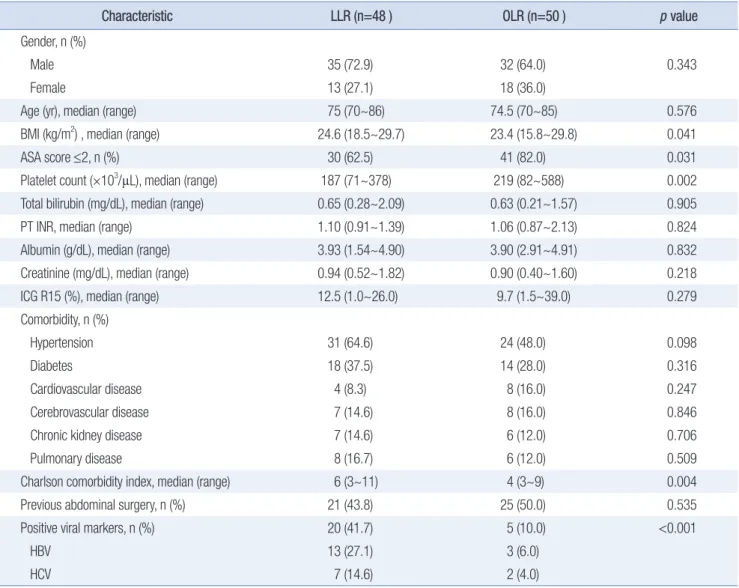
A total of 98 patients underwent hepatic resections. Forty-eight and 50 were treated with laparoscopic and open approaches, re- spectively. The baseline characteristics and preoperative labora- tory results are summarized in Table 1. There was no significant difference between the groups in terms of gender, age, history of previous abdominal surgery, and most preoperative laboratory results. The LLR group showed significantly lower platelet counts (p=0.002), ASA scores (p=0.031), a remarkably higher incidence of viral hepatitis (p<0.001), and higher body mass index (p=0.041)
and Charlson comorbidity index scores (p=0.004) than the OLR group.
Perioperative data and pathologic results
The perioperative data and pathologic results of the two groups are summarized in Table 2. There was no significant dif- ference between the groups in operative time (p=0.070), whereas the number of perioperative blood transfusions was significantly less in the LLR group (p=0.002). Synchronous surgery was fre- quently conducted in the OLR group. Anatomical resection was performed in 19 patients (39.6%) in the LLR group and 23 patients (46.0%) in the OLR group with no statistical difference (p=0.521).
Five patients (10.4%) in the LLR group were converted to open
surgery.
Regarding the pathologic outcomes, R0 resection margins were obtained in 38 patients (79.2%) in the LLR group and 40 patients (80.0%) in the OLR group with no significant difference (p=0.918). The LLR group showed significantly more liver cir- rhosis (p=0.008), and smaller tumor sizes (p=0.001) than the OLR group.
Postoperative outcomes
The data about postoperative outcomes and complications are shown in Table 3. Postoperative complications occurred in 12 patients (25.0%) in the LLR group and 21 patients (42.0%) in the OLR group with no statistical difference. Two patients (4.0%) in Table 1.
Table 1. Baseline characteristics and laboratory results Characteristic
Characteristic LLR (n=48 )LLR (n=48 ) OLR (n=50 )OLR (n=50 ) pp value value Gender, n (%)
Male 35 (72.9) 32 (64.0) 0.343
Female 13 (27.1) 18 (36.0)
Age (yr), median (range) 75 (70~86) 74.5 (70~85) 0.576
BMI (kg/m2) , median (range) 24.6 (18.5~29.7) 23.4 (15.8~29.8) 0.041
ASA score ≤2, n (%) 30 (62.5) 41 (82.0) 0.031
Platelet count (×103/µL), median (range) 187 (71~378) 219 (82~588) 0.002
Total bilirubin (mg/dL), median (range) 0.65 (0.28~2.09) 0.63 (0.21~1.57) 0.905
PT INR, median (range) 1.10 (0.91~1.39) 1.06 (0.87~2.13) 0.824
Albumin (g/dL), median (range) 3.93 (1.54~4.90) 3.90 (2.91~4.91) 0.832
Creatinine (mg/dL), median (range) 0.94 (0.52~1.82) 0.90 (0.40~1.60) 0.218
ICG R15 (%), median (range) 12.5 (1.0~26.0) 9.7 (1.5~39.0) 0.279
Comorbidity, n (%)
Hypertension 31 (64.6) 24 (48.0) 0.098
Diabetes 18 (37.5) 14 (28.0) 0.316
Cardiovascular disease 4 (8.3) 8 (16.0) 0.247
Cerebrovascular disease 7 (14.6) 8 (16.0) 0.846
Chronic kidney disease 7 (14.6) 6 (12.0) 0.706
Pulmonary disease 8 (16.7) 6 (12.0) 0.509
Charlson comorbidity index, median (range) 6 (3~11) 4 (3~9) 0.004
Previous abdominal surgery, n (%) 21 (43.8) 25 (50.0) 0.535
Positive viral markers, n (%) 20 (41.7) 5 (10.0) <0.001
HBV 13 (27.1) 3 (6.0)
HCV 7 (14.6) 2 (4.0)
LLR = laparoscopic liver resection; OLR = open liver resection; BMI = body mass index; ASA = the American Society of Anesthesiologists; PT = pro- thrombin time; INR = international normalized ratio; ICG R15 = indocyanine green retention rate at 15 minutes; HBV = hepatitis B virus; HCV = hepatitis C virus.
the OLR group died within 30 days without having a chance to be discharged, whereas there was no mortality in the LLR group.
Although the number of events in each category of postopera- tive complications was not statistically different between the groups, the CCI was significantly lower in the LLR group, with a median of 8.556, and a median of 19.698 in the OLR group (p=0.042). Most patients with C-D grade IIIa complications had bile leakage and underwent percutaneous drainage with or with- out endoscopic retrograde biliary drainage. All patients with C-D grade complications over IVa had acute kidney injury, which required hemodialysis.
The length of hospital stay in the LLR group was signifi- cantly shorter than in the OLR group (p=0.008), even though three patients had to be readmitted within 30 days after surgery.
Two of them were admitted 1 month after the surgery due to intraabdominal abscesses, and percutaneous drainage catheters were placed under fluoroscopic guidance. The other patient was hospitalized 15 days after the surgery due to mild dyspnea and diagnosed as focal pneumonia. He was discharged 3 days later with improved symptoms.
DISCUSSION
Since Reich et al.19 reported LLR in 1991, the use of LLR as a treatment for neoplastic disease has gradually increased. Many studies have reported that LLR showed improved surgical and postoperative outcomes.6,13,20-22 With these evidences, the indica- tions for LLR have been expanded to malignancies and major hepatectomies, and further studies have proven the safety and acceptable morbidity and mortality rates of LLR. Also, advance- ments in postoperative care and improvements in laparoscopic instruments have made LLR more feasible for the treatment of neoplastic liver disease.
However, a question about the feasibility of LLR in elderly patients remains unanswered. The aging process makes elderly people lose their reserve capacity gradually. This process may in- duce a greater incidence of complications and in-hospital mortal- ity, not only during the surgery but also after surgery. Pneumo- peritoneum may result in decreases in lung compliance, venous return, and the vascular perfusion of intra-abdominal organs, which can lead to postoperative cardiovascular complications and acute kidney injury.23,24
Table 2.
Table 2. Perioperative data and pathologic results Characteristic
Characteristic LLR (n=48)LLR (n=48) OLR (n=50)OLR (n=50) pp value value
Operative time (min), median (range) 150 (70~325) 180 (40~310) 0.070
Anatomical resection, n (%) 19 (39.6) 23 (46.0) 0.521
Resection type, n (%)
Major resection 6 (12.5) 20 (40.0) 0.002
Minor resection 42 (87.5) 30 (60.0)
Conversion to open surgery, n (%) 5 (10.4) - -
Perioperative blood transfusion, n (%) 5 (10.4) 19 (38.0) 0.002
Synchronous operation, n (%) 3 (6.3) 12 (24.0) 0.015
Colon 2 (4.2) 8 (16.0)
GIT, other than colon 0 (0.0) 1 (2.0)
Others 1 (2.1) 3 (6.0)
Final pathologic diagnosis, n (%)
Benign lesion of liver 4 (8.3) 6 (12.0)
Primary malignancy 35 (72.9) 26 (52.0)
Metastatic tumor 9 (18.8) 18 (36.0)
Underlying liver cirrhosis, n (%) 18 (37.5) 7 (14.0) 0.008
Number of tumors, median (range) 1 (1~3) 1 (1~4) 0.228
Maximal tumor size (cm), median (range) 22.5 (3~97) 35 (6~130) 0.001
R1 resection, n (%) 5 (10.4) 4 (8.0) 0.918
LLR = laparoscopic liver resection; OLR = open liver resection; GIT = gastrointestinal tract. Major resection was defined as the resection of 3 or more segments.
Despite the shortcomings of laparoscopy mentioned above, our study showed no difference in pulmonary and renal com- plications between the two groups. Recent LLR studies in elderly patients also reported similar results for cardiopulmonary and renal complications.5,20,25,26 The absence of large abdominal in- cisions in the LLR group, which resulted in less postoperative pain and the preservation of pulmonary function, might have counterbalanced the adverse effects of pneumoperitoneum and less blood loss might have been a counterpart of the risk of renal injury in the LLR group.27
Consistent with recent studies, our study showed the non-infe- riority, or even the superiority of LLR compared to OLR in terms of postoperative complications.5,20,25,26 Although the complication rate for each category was not significantly different, the CCI scores were significantly lower in the LLR group, indicating that
patients in the OLR group had multiple complications in each category. The explanation for the lower CCI scores might be the lower invasiveness of the LLR surgical procedure. Previous stud- ies showed that LLR required longer operation time, which was even shorter in our study, and the rate of major resection in the LLR group was lower than that in the OLR group. The length of hospital stay was significantly lower in the LLR group, which might be the result of lower CCI scores.
We designed the study period from 2003 to 2019. The study period had to be relatively long to achieve an adequate statistical power. Since the indications of LLR have been expanded over time, the large proportion of the LLR was held recently. Thus, there would be a performance bias in terms of surgical skills be- tween the two groups, which would result in a favorable outcome toward the LLR group.
Table 3.
Table 3. Postoperative outcomes and complications Characteristic
Characteristic LLR (n=48)LLR (n=48) OLR (n=50)OLR (n=50) pp value value
Hospital stay (day), median (range) 14 (6~52) 18 (8~63) 0.008
Patients with morbidity, n (%) 12 (25.0) 21 (42.0) 0.075
In-hospital mortality, n (%) 0 (0.0) 2 (4.0) 0.495
Transfer to rehabilitation center, n (%) 4 (8.3) 9 (18.0) 0.158
Readmission within 30 days, n (%) 3 (6.3) 0 (0.0) 0.114
Highest C-D grade ≥IIIa, n (%) 7 (14.6) 12 (24.0) 0.238
I 1 (2.1) 2 (4.0)
II 4 (8.3) 8 (16.0)
IIIa 3 (6.3) 6 (12.0)
IIIb 0 (0.0) 0 (0.0)
IVa 4 (8.3) 3 (6.0)
IVb 0 (0.0) 1 (2.0)
V 0 (0.0) 2 (4.0)
CCI, median (range) 8.556 (0~51.7) 19.698 (0~100) 0.042
Postoperative complications, n (%)
Superficial SSI 1 (2.1) 6 (12.0) 0.112
Deep SSI 2 (4.2) 4 (8.0) 0.678
Pneumonia 3 (6.3) 4 (8.0) 1.000
Ascites 4 (8.3) 4 (8.0) 1.000
Delirium 1 (2.1) 3 (6.0) 0.617
Bile leakage 4 (8.3) 8 (16.0) 0.247
Liver failure 1 (2.1) 5 (10.0) 0.205
Renal failure 3 (6.3) 5 (10.0) 0.715
Bleeding 4 (8.3) 10 (20.0) 0.099
LLR = laparoscopic liver resection; OLR = open liver resection; C-D grade = Clavien-Dindo grade; CCI = Comprehensive Comorbidity Index; SSI = surgi- cal site infection.
Although our center performed a complete analysis of cardio- pulmonary function and other comorbidities, many unmeasured factors, which are usually termed ‘frailty’, can affect the post- operative outcomes of elderly patients. Rockwood et al. defined frailty as a multidimensional syndrome involving the loss of reserves that gives rise to vulnerability, and established the Ca- nadian Study of Health and Aging Clinical Frailty Scale to mea- sure cognition, function, or comorbidity, and predict the risk of death.28 Since our study was designed retrospectively, the frailty of the patients was not measured.
Propensity score matching was not necessarily performed since the aim of the study was to confirm the non-inferiority of LLR compared to OLR and the factors that significantly differed be- tween each group were thought to cause better results in the OLR group. However, the pathologic data revealed that the number and size of the tumors were larger in the OLR group, which may have resulted in selection bias. Studies on the long-term oncologic outcomes of LLR are still needed. Randomized prospective trials are required to compare LLR and OLR in elderly patients.
CONCLUSION
In conclusion, we determined that LLR is safe and feasible as a treatment for neoplastic liver disease in elderly patients with potentially less postoperative complications compared to OLR.
ORCID
Su Yong Lee, https://orcid.org/0000-0002-9149-2754 Dong-Shik Lee, https://orcid.org/0000-0003-0271-3728 Sung Su Yun, https://orcid.org/0000-0002-2726-7165 Chan Woo Cho, https://orcid.org/0000-0002-3546-8442
AUTHORS’ CONTRIBUTIONS
Conceptualization: Chan Woo Cho. Formal analysis: Su Yong Lee. Methodology: Chan Woo Cho and Su Yong Lee. Writing- original draft: Su Yong Lee. Writing review and editing: Sung Su Yun, Dong-Shik Lee, and Chan Woo Cho.
CONFLICT OF INTEREST
None.
FUNDING
None.
ACKNOWLEDGMENTS
None.
REFERENCES
1) Ghezzi F, Cromi A, Ditto A, et al. Laparoscopic versus open radical hysterectomy for stage IB2-IIB cervical cancer in the setting of neo- adjuvant chemotherapy: a multi-institutional cohort study. Ann Surg Oncol 2013;20:2007-2015.
2) Gill IS, Kavoussi LR, Lane BR, et al. Comparison of 1,800 laparoscopic and open partial nephrectomies for single renal tumors. J Urol 2007;
178:41-46.
3) Huscher CG, Mingoli A, Sgarzini G, et al. Laparoscopic versus open subtotal gastrectomy for distal gastric cancer: five-year results of a randomized prospective trial. Ann Surg 2005;241:232-237.
4) van der Pas MHGM, Haglind E, Cuesta MA, et al. Laparoscopic ver- sus open surgery for rectal cancer (COLOR II): short-term outcomes of a randomised, phase 3 trial. The Lancet Oncology 2013;14:210-218.
5) Amato B, Aprea G, De Rosa D, et al. Laparoscopic hepatectomy for HCC in elderly patients: risks and feasibility. Aging Clin Exp Res 2017;29:179-183.
6) Berardi G, Van Cleven S, Fretland AA, et al. Evolution of Laparo- scopic Liver Surgery from Innovation to Implementation to Mastery:
Perioperative and Oncologic Outcomes of 2,238 Patients from 4 Eu- ropean Specialized Centers. J Am Coll Surg 2017;225:639-649.
7) Cauchy F, Fuks D, Nomi T, et al. Benefits of Laparoscopy in Elderly Patients Requiring Major Liver Resection. J Am Coll Surg 2016;222:
174-184 e110.
8) Bray F, Ferlay J, Soerjomataram I, Siegel RL, Torre LA, Jemal A.
Global cancer statistics 2018: GLOBOCAN estimates of incidence and mortality worldwide for 36 cancers in 185 countries. CA Cancer J Clin 2018;68:394-424.
9) Inoue Y, Tanaka R, Fujii K, et al. Surgical Outcome and Hepatic Re- generation after Hepatic Resection for Hepatocellular Carcinoma in Elderly Patients. Dig Surg 2019;36:289-301.
10) Nishikawa H, Kimura T, Kita R, Osaki Y. Treatment for hepatocel- lular carcinoma in elderly patients: a literature review. J Cancer 2013;
4:635-643.
11) Nozawa A, Kubo S, Takemura S, et al. Hepatic resection for hepato- cellular carcinoma in super-elderly patients aged 80 years and older in the first decade of the 21st century. Surg Today 2015;45:851-857.
12) Reddy SK, Barbas AS, Turley RS, et al. Major liver resection in elderly patients: a multi-institutional analysis. J Am Coll Surg 2011;212:787- 795.
13) Wang W, Huang Z, Guo B, Liu S, Xiao W, Liang J. Short- and long- term outcomes of laparoscopic hepatectomy in elderly patients with hepatocellular carcinoma. J BUON 2018;23:971-978.
14) Dindo D, Demartines N, Clavien PA. Classification of surgical com- plications: a new proposal with evaluation in a cohort of 6336 pa-
tients and results of a survey. Ann Surg 2004;240:205-213.
15) Koch M, Garden OJ, Padbury R, et al. Bile leakage after hepatobiliary and pancreatic surgery: a definition and grading of severity by the In- ternational Study Group of Liver Surgery. Surgery 2011;149:680-688.
16) Rahbari NN, Garden OJ, Padbury R, et al. Posthepatectomy liver failure: a definition and grading by the International Study Group of Liver Surgery (ISGLS). Surgery 2011;149:713-724.
17) Rahbari NN, Garden OJ, Padbury R, et al. Post-hepatectomy haem- orrhage: a definition and grading by the International Study Group of Liver Surgery (ISGLS). HPB (Oxford) 2011;13:528-535.
18) Ishizawa T, Hasegawa K, Kokudo N, et al. Risk factors and manage- ment of ascites after liver resection to treat hepatocellular carcinoma.
Arch Surg 2009;144:46-51.
19) Reich H, McGlynn F, DeCaprio J, Budin R. Laparoscopic excision of benign liver lesions. Obstet Gynecol 1991;78:956-958.
20) Notarnicola M, Felli E, Roselli S, et al. Laparoscopic liver resection in elderly patients: systematic review and meta-analysis. Surg Endosc 2019;33:2763-2773.
21) Spampinato MG, Arvanitakis M, Puleo F, et al. Totally laparoscopic liver resections for primary and metastatic cancer in the elderly: safe- ty, feasibility and short-term outcomes. Surg Endosc 2013;27:1881-
1886.
22) Uchida H, Iwashita Y, Watanabe K, et al. Surgical Outcomes of Lapa- roscopic Liver Resection in Elderly Patients: A Comparative Study From a Single Center. Surg Laparosc Endosc Percutan Tech 2015;25:
e109-112.
23) Demyttenaere S, Feldman LS, Fried GM. Effect of pneumoperito- neum on renal perfusion and function: a systematic review. Surg Endosc 2007;21:152-160.
24) Safran DB, Orlando R, 3rd. Physiologic effects of pneumoperito- neum. Am J Surg 1994;167:281-286.
25) Badawy A, Seo S, Toda R, et al. A Propensity Score-Based Analysis of Laparoscopic Liver Resection for Liver Malignancies in Elderly Pa- tients. J Invest Surg 2019;32:75-82.
26) Nomi T, Hirokawa F, Kaibori M, et al. Laparoscopic versus open liver resection for hepatocellular carcinoma in elderly patients: a multi- centre propensity score-based analysis. Surg Endosc 2020;34:658-666.
27) Reddy SK, Tsung A, Geller DA. Laparoscopic liver resection. World J Surg 2011;35:1478-1486.
28) Rockwood K, Song X, MacKnight C, et al. A global clinical measure of fitness and frailty in elderly people. CMAJ 2005;173:489-495.