• 검색 결과가 없습니다.

Effective and Safe Outcome of Sleeve Gastrectomy Performed by Experienced Gastric Surgeon JMBS

N/A
N/A
Protected

Academic year: 2021

Share "Effective and Safe Outcome of Sleeve Gastrectomy Performed by Experienced Gastric Surgeon JMBS"

Copied!
4
0
0

로드 중.... (전체 텍스트 보기)

전체 글

(1)

ORIGINAL ARTICLE

JMBS Journal of Metabolic and Bariatric Surgery J Metab Bariatr Surg 2015;4(1):15-18

Received: April 20, 2015, Revised: May 4, 2015, Accepted: May 8, 2015

Corresponding author: Sang-Uk Han, 206 Worldcup-ro, Yeongtong-gu, Suwon 443-749, Korea Department of Surgery, Ajou University School of Medicine

Tel: 82-31-219-5200, Fax: 82-31-219-5755, E-mail: [email protected] Copyright © 2015, The Korean Society for Metabolic and Bariatric Surgery

Effective and Safe Outcome of Sleeve Gastrectomy Performed by Experienced Gastric Surgeon

Department of Surgery, Ajou University School of Medicine, Suwon, Korea

Long-Hai Cui, Sang-Yong Son, Cheul-Su Byun, Hoon Hur, Yong-Kwan Cho, Sang-Uk Han

Purpose: Sleeve gastrectomy (SG) is an emerging approach, but there have been a surge in popularity because of its perceived technical simplicity, feasibility, and good outcomes. We describe results of a single fully experienced gastric surgeon’s short-term outcomes of laparoscopic sleeve gastrectomy (LSG) and robotic sleeve gastrectomy (RSG) for morbidly obese patients. Materials and Methods: We retrospectively reviewed 20 patients underwent LSG and RSG from July 2010 to February 2014. Results: The mean age was 36.3±10.1 years, the mean preoperative body mass index (BMI) was 37.3±5.4 kg/m

2

. Mean operative time was 124.4±36.2 min. The postoperative length of stay was 5.1±4.1 day. There was no open conversion and mortality, nor severe postoperative complication found in the LSG and RSG cases. The mean BMI decreased to 26.1±2.5 kg/m

2

at 1 year and the mean percentage excess weight loss was 69.8±24.9% at 1 year. Conclusion: Effective weight loss without complication would be achieved by sleeve gastrectomy if the procedure is performed by experienced gastric surgeon. However, further well-designed comparative studies with larger sample size are warranted to prove this preliminary result.

Key Words: Morbid obesity, Sleeve gastrectomy, Laparoscopy

INTRODUCTION

Obesity is an epidemic health-care problem worldwide [1]. Currently, bariatric surgery remains the most effective treatment for sustained weight loss in this population.

Sleeve gastrectomy (SG) is the restrictive part of the more extensive mixed restrictive and malabsorptive operation, biliopancreatic diversion/duodenal switch (BPD/DS). SG is emerging as a preferred primary weight loss procedure worldwide because of its perceived technical simplicity, feasibility, and good outcomes [2]. Recently laparoscopic sleeve gastrectomy (LSG) was proposed as a stand-alone procedure [3]. In this study, we describe results of a single

surgeon’s short-term outcomes of laparoscopic sleeve gastrectomy (LSG) and robotic sleeve gastrectomy (RSG) for morbidly obese patients.

MATERIALS AND METHODS

This study was approved by the Institutional Review Board for research using human subjects at Ajou University Hosptial (protocol registration number AJIRB-MED-MDB- 15-043).

1. Patients

Between July 2010 to February 2014, an experienced

(2)

Journal of Metabolic and Bariatric Surgery Vol. 4, No. 1, 2015

Journal of Metabolic and Bariatric Surgery

16

gastric cancer surgeon who had performed more than 1500 cases of laparoscopic gastrectomy and robotic gastrectomy, performed nineteen cases of LSG and one case of RSG for the treatment of morbid obesity. Patients were included according to the waiting list inclusion and all met the criteria for sleeve gastrectomy; BMI ≥30 kg/m

2

with comorbidities or BMI ≥35 kg/m

2

which were slightly lower than the Asian-Pacific Bariatric Surgery Group recommendation [4]. There were 20 patients (11 male and 9 female patients) with a mean age of 36.3±10.1 years (range 21-54), the mean preoperative body mass index (BMI) was 37.3±5.4 kg/m

2

(range 30.8-53.5). Before operation, all patients had been consulted to dietitian and experienced high protein diet. Patients were required to have psychological screening, routine labs, electrocardiogram, endoscopy, pulmonary function studies, and a medical evaluation. Patients were excluded if they had undergone previous bariatric surgery or other complex abdominal surgery or had poorly controlled medical or psychiatric disorders.

2. Operative procedure

Low molecular weight heparin was used to prevent deep vein thrombosis twelve hours before operation routinely.

In general anesthesia, the patient positioned to reverse-Trendelenburg position. Both operation types used a total of five trocars. The first trocar was inserted in the infraumbilical area (a 10 mm trocar in LSG and a 12 mm trocar in RSG) using the closed method and made pneumoperitoneum and intracoporeal pressure was increased up to 12 mmHg by CO

2

gas. The scope (a single - lens in LSG and a dual - lens in RSG) was inserted through this trocar. An additional four trocars were placed under direct visualization. In LSG, two 5 mm trocars were placed on the left side, and one 5 mm trocar was placed on the upper right side. A 12 mm trocar was placed on the right central side. In RSG, two 8 mm trocars were placed on the right side, and one 8 mm trocar was placed on the outer left side. A 12 mm trocar was placed on the central left side.

The great omentum was divided using Harmonic Scalpel (Ethicon EndoSurgery Inc., Cincinnati, OH, USA) from 4 cm above pyloric ring to esophago-gastric junction (EGJ). To divide posterior wall of the stomach, dissection was performed until identifying the left crus of diaphragm

muscle. A 36 Fr of bougie was inserted till duodenum to guide the plane; the stomach was resected from greater curvature to EGJ using laparoscopic stapling device. And over-sewing suture was done to cover the staple line with 3-0 Vicryl (Ethicon, Rome, Italy) or V-Loc 90 (Covidien, Mansfield, Massachusetts).

Patients with no morbidity were sent to the general ward after their operations. Unless otherwise indicated, patients were managed using a standardized postoperative clinical pathway (CP) with no nasogastric tube insertion and one closed suction drain. Patients were given sips of water on postoperative day 1 without a gastrography, a liquid diet on postoperative day 2, and a soft diet on postoperative day 3. Postoperative management was same regardless on surgical method.

All patients received nutritional advice and were instructed to follow a liquid and semiliquid diet for 2 weeks. All patients are followed up every 3 months in the outpatient clinic.

RESULTS

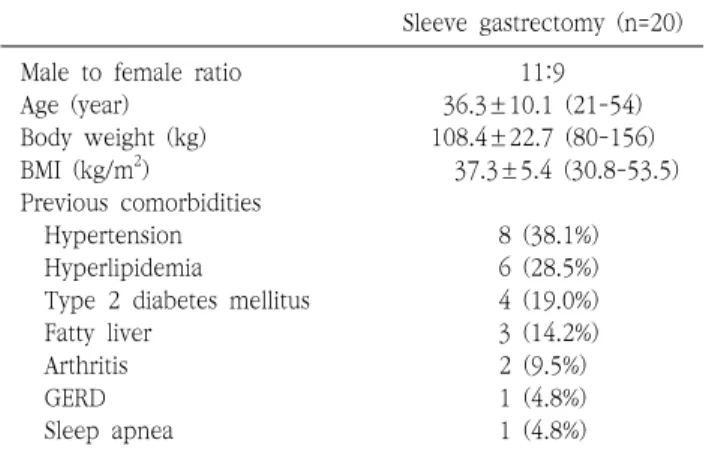
LSG and RSG was performed in 20 patients, of 11 were males 9 were females. Their mean age was 36.3±10.1 (21-54) years, and the mean BMI was 37.3±5.4 (30.8-53.5) kg/m

2

, the mean body weight was 108.4±22.7 (80-156) kg. Four patients had diabetes, eight had hypertension, six patients had hyperlipidemia, two patients had arthritis, three patients had fatty liver, one patient had gastroesophageal reflux disease (GERD), one patient had sleep apnea (Table 1).

As the Table 2 showed, the mean operating time was 124.4±36.2 min. First 10 cases’ operating time was 145.5±35.7 min, and recent 10 cases’ operating time was 97.2±15.9 min, showed statistical difference from the first 10 cases’ operating time. The postoperative length of stay was 5.1±4.1 day, first 10 cases’ length of stay was 7.3±5.6 day, and recent 10 cases’ length of stay was 3.2±1.1 day, showed statistical difference between the first 10 cases’

length of stay. There was no open conversion and mortality, nor postoperative complication such as bleeding or leakage found in the LSG and RSG cases.

Follow-up results showed that, the mean body weight at

1, 3, 6 and 12 months was 95.8±11.0 kg, 94.1±20.4 kg,

(3)

Long-Hai Cui, et al Effective and Safe Outcome of Sleeve Gastrectomy Performed by Experienced Gastric Surgeon

Journal of Metabolic and Bariatric Surgery 17

Table 1. Preoperative characteristics

Sleeve gastrectomy (n=20)

Male to female ratio 11:9

Age (year) 36.3±10.1 (21-54)

Body weight (kg) 108.4±22.7 (80-156)

BMI (kg/m

2

) 37.3±5.4 (30.8-53.5) Previous comorbidities

Hypertension 8 (38.1%)

Hyperlipidemia 6 (28.5%)

Type 2 diabetes mellitus 4 (19.0%)

Fatty liver 3 (14.2%)

Arthritis 2 (9.5%)

GERD 1 (4.8%)

Sleep apnea 1 (4.8%)

BMI = body mass index; GERD = gastroesophageal reflux disease.

Table 2. Parameters related to the operation

Sleeve gastrectomy (n=20)

Operative time (minute)* 124.4±36.2

First 10 cases 145.5±35.7

Recent 10 cases 97.2±15.9

Postoperative length of stay (day)* 5.1±4.1 (2-21)

First 10 cases 7.3±5.6 (3-21)

Recent 10 cases 3.2±1.1 (2-5)

Open conversion (%) 0

Mortality (%) 0

*P<0.05, in comparison between first and recent 10 cases’

outcomes.

Table 3. Postoperative weight loss

Preoperative 1 M 3 M 6 M 12 M

Number of patients 20 18 13 12 6

Body weight (kg) 108.4 ± 22.7 95.8 ± 11.0 94.1 ± 20.4 88.1 ± 17.6 79.2 ± 11.4

BMI (kg/m

2

) 37.3 ± 5.4 34.4 ± 5.3 31.9 ± 5.4 29.8 ± 4.8 26.1 ± 2.5

%EWL 24.4 ± 10.8 38.1 ± 18.2 51.2 ± 15.0 69.8 ± 24.9

BMI = body mass index; EWL = excess weight loss.

88.1±17.6 kg and 79.2±11.4 kg, respectively. The mean BMI was 34.4±5.3 kg/m

2

, 31.9±5.4 kg/m

2

, 29.8±4.8 kg/m

2

and 26.1±2.5 kg/m

2

, respectively. The mean %EWL was 24.4±10.8%, 38.1±18.2%, 38.1±18.2% and 69.8±24.9%, respectively (Table 3).

DISCUSSION

With the rapidly increasing rates of obesity and obesity-related metabolic disease, bariatric surgery has matured as a defined specialty with an increasing number of surgical procedures available [5]. One of the most rapidly increasing procedures being performed for morbid obesity is the LSG [6]. This procedure offers many attractive advantages to both patients and surgeons, including the relative technical simplicity and avoidance of intestinal manipulation compared with the gastric bypass. The LSG has demonstrated an overall low complication profile and short to mid - term results with weight loss and comorbidity control that are similar to other accepted bariatric procedures [7,8]. However, there have been few studies about LSG and RSG in Korea.

Some reports have shown that the incidence of staple

line dehiscence after LSG ranges from 0% to 5.5% and with overall complication rates ranging from 0% to 24% [9-14].

Leaks after LSG can result in significant morbidity [15]. In this study, there was no open conversion and mortality, nor postoperative complications found in the LSG and RSG cases. In relation to postoperative complications, staple line hemorrhage and leaks were significantly reduced when staple line reinforcement was used. A significant reduction in staple line complications may result in a shorter hospital stay [16,17].

Deitel et al. [18] reported the results of 88 surgeons who

had performed 19,605 SG procedures, observed that the

mean %EWL at 1, 2, 3, 4, and 5 years was 62.7%, 64.7%,

64.0%, 57.3%, and 60.0%, respectively. Our study also

showed that 69.8% of %EWL at postoperative 1 year, which

was similar to the results of previous studies. We used a 36

Fr bougie tube to make an enough lumen for feeding and

the staple line was sutured to prevent bleeding or leakage

[16,17]. Our philosophy is to begin 4 cm from the pylorus

thereby decreasing the antral volume while preserving its

function. It might result in permanent reduction of the

lumen size and lead to a greater percentage excess weight

(4)

Journal of Metabolic and Bariatric Surgery Vol. 4, No. 1, 2015

Journal of Metabolic and Bariatric Surgery

18

loss. The security of this procedure based on high experience of bleeding and leakage prevention and full comprehension on the optimal volume lead to a greater percentage excess weight loss because of an experienced gastric cancer surgeon who had performed.

The mean operating time was 124.4±36.2 min. First 10 cases’ operating time was 145.5±35.7 min, and recent 10 cases’ operating time was 97.2±15.9 min, showed statistical difference between the first 10 cases’ operating time. The postoperative length of stay was 5.1±4.1 day, first 10 cases’ length of stay was 7.3±5.6 day, and recent 10 cases’ length of stay was 3.2±1.1 day, showed statistical difference between the first 10 cases’ length of stay.

According to our results, surgeons performing laparoscopic bariatric surgery need to acquire the necessary skills in laparoscopic surgery and bariatric procedures, and a learning curve may be a decisive factor also in LSG and RSG. Thus, although a recent study reported that the learning curve for LSG was about 30 cases, it should be completed by around 10 cases [19].

CONCLUSION

LSG and RSG have shown promise as a primary bariatric procedure. Our data reveal that the procedure can be performed by an experienced gastric surgeon in tertiary hospital with a very low complication rate and adequate short-term weight loss. Although LSG and RSG appear to be technically less challenging, the application of correct technique is fundamental in reducing complications associated with the initial learning phase. However, further studies with larger sample size should be warranted to prove our preliminary result.

CONFLICT OF INTEREST

The authors declare that they have no conflict of interest.

REFERENCES

1. Deitel M. Overweight and obesity worldwide now estimated to

involve 1.7 billion people. Obes Surg 2003;13:329-30.

2. Buchwald H, Oien DM. Metabolic/bariatric surgery worldwide 2011. Obes Surg 2013;23:427-36.

3. Deitel M, Crosby RD, Gagner M. The First International Consensus Summit for Sleeve Gastrectomy (SG), New York City, October 25-27, 2007. Obes Surg 2008;18:487-96.

4. Heo YS, Park JM, Kim YJ, et al. Bariatric surgery versus conven- tional therapy in obese Korea patients: a multicenter retro- spective cohort study. J Korean Surg Soc 2012;83:335-42.

5. Colquitt JL, Picot J, Loveman E, Clegg AJ. Surgery for obesity.

Cochrane Database Syst Rev 2009;(2):CD003641.

6. Buchwald H, Oien DM. Metabolic/bariatric surgery worldwide 2011. Obes Surg 2013;23:427-36.

7. Braghetto I, Csendes A, Lanzarini E, Papapietro K, Cárcamo C, Molina JC. Is laparoscopic sleeve gastrectomy an acceptable pri- mary bariatric procedure in obese patients? Early and 5-year postoperative results. Surg Laparosc Endosc Percutan Tech 2012;22:479-86.

8. Chopra A, Chao E, Etkin Y, Merklinger L, Lieb J, Delany H.

Laparoscopic sleeve gastrectomy for obesity: can it be considered a definitive procedure? Surg Endosc 2012;26:831-7.

9. Lee CM, Cirangle PT, Jossart GH. Vertical gastrectomy for morbid obesity in 216 patients: report of two-year results. Surg Endosc 2007;21:1810-6.

10. Nocca D, Krawczykowsky D, Bomans B, et al. A prospective mul- ticenter study of 163 sleeve gastrectomies: results at 1 and 2 years.

Obes Surg 2008;18:560-5.

11. Lalor PF, Tucker ON, Szomstein S, Rosenthal RJ. Complications after laparoscopic sleeve gastrectomy. Surg Obes Relat Dis 2008;4:33-8.

12. Aggarwal S, Kini SU, Herron DM. Laparoscopic sleeve gas- trectomy for morbid obesity: a review. Surg Obes Relat Dis 2007;3:189-94.

13. Fuks D, Verhaeghe P, Brehant O, et al. Results of laparoscopic sleeve gastrectomy: a prospective study in 135 patients with mor- bid obesity. Surgery 2009;145:106-13.

14. Brethauer SA, Hammel JP, Schauer PR. Systematic review of sleeve gastrectomy as staging and primary bariatric procedure.

Surg Obes Relat Dis 2009;5:469-75.

15. Gagner M. Leaks after sleeve gastrectomy are associated with smaller bougies: prevention and treatment strategies. Surg Laparosc Endosc Percutan Tech 2010;20:166-9.

16. Choi YY, Bae J, Hur KY, Choi D, Kim YJ. Reinforcing the staple line during laparoscopic sleeve gastrectomy: does it have advan- tages? A meta-analysis. Obes Surg 2012;22:1206-13.

17. Karakoyun R, Gündüz U, Bülbüller N, et al. The effects of reinforce- ment methods on burst pressure in resected sleeve gastrectomy specimens. J Laparoendosc Adv Surg Tech A 2015;25:64-8.

18. Deitel M, Gagner M, Erickson AL, Crosby RD. Third International Summit: current status of sleeve gastrectomy. Surg Obes Relat Dis 2011;7:749-59.

19. Prevot F, Verhaeghe P, Pequignot A, et al. Two lessons from a 5-year follow-up study of laparoscopic sleeve gastrectomy: per- sistent, relevant weight loss and a short surgical learning curve.

Surgery 2014;155:292-9.

수치

Table  1.  Preoperative  characteristics

참조

관련 문서

The study shows that 29.5 percentage of dental hygienists have experienced the medical disputes and complaints and they are lack of recognition of

Most submerged lamp system have a fundamental fouling problem and due to the absorption of UV light by fouling materials on the quartz sleeve, germicidal power of UV

Results: 44 of 1048 patients with gastric cancer(4.1%) had synchronous and metachronous cancers. The average time interval between gastric cancer and secondary primary cancer

(Purpose) Recently early detection of gastric cancer and rate of preoperative staging are increasing due to development of endoscopy and imaging technique,

But such emotional depletion, depersonalization, and lowering of personal sense of achievements experienced due to unfair process of promotional reviews

Long-term outcomes of short dental implants supporting single crowns in posterior region: a clinical retrospective study of 5-10 years.. Osteotome sinus

Patient had laparoscopic surgery on the adnexal tumor and excised tissue was removed through Douglas pouch incision by single surgeon.. Results: The mean age

Second, sleeve, waist line, skirt length, materials, color, decoration type and location appeared to clothing cues affecting influences to overall image