Comparison of Laparoscopy-Assisted and Totally Laparoscopic Distal Gastrectomy: The Short-Term Outcome at
a Low Volume Center
Byung Seo Choi, Heung-Kwon Oh, Sei Hyeog Park, and Jong-Min Park Department of Surgery, National Medical Center, Seoul, Korea
Purpose: Laparoscopic gastrectomy has been adopted for the treatment of gastric cancer, and despite the technical difficulties, totally laparoscopic distal gastrectomy has been considered less invasive than laparoscopy-assisted distal gastrectomy. Although there have been many reports regarding the feasibility and safety of totally laparoscopic distal gastrectomy at large volume centers, few reports have been conducted at low-volume centers. The purpose of this study is to try to assess the feasibility and safety of totally laparoscopic distal gastrectomy at a low volume center through the analysis of short-term outcomes of totally laparoscopic distal gastrectomy compared with laparoscopy-assisted distal gastrectomy.
Materials and Methods: The clinical data and short-term surgical outcomes of 35 patients who had undergone laparoscopy-assisted distal gastrectomy between April 2007 and March 2010, and 37 patients who underwent totally laparoscopic distal gastrectomy be- tween April 2010 and August 2012 were retrospectively reviewed.
Results: There was no significant difference in the demographic and clinical data. However the reconstruction method and extent of lymphadenectomy showed statistically significant differences. Operation time and estimated blood loss did not show significant differ- ences. Surgical and medical complications did not show significant differences but postoperative courses including time-to-first oral in- take and postoperative hospital stay were significantly increased.
Conclusions: Our study shows that totally laparoscopic distal gastrectomy is technically feasible at a low volume center. Therefore, totally laparoscopic distal gastrectomy can be considered as one of the surgical treatment for early gastric cancer. However the possibility that totally laparoscopic distal gastrectomy may have less benefit should also be considered.
Key Words: Stomach neoplasms; Laparoscopy; Gastrectomy
Correspondence to: Jong-Min Park
Department of Surgery, National Medical Center, 245 Eulji-ro, Jung-gu, Seoul 100-799, Korea
Tel: +82-2-2260-4883, Fax: +82-2-2269-0750 E-mail: [email protected]
Received February 4, 2013 Revised March 5, 2013 Accepted March 6, 2013
Copyrights © 2013 by The Korean Gastric Cancer Association www.jgc-online.org
This is an open-access article distributed under the terms of the Creative Commons Attribution Non-Commercial License (http://creativecommons.org/
licenses/by-nc/3.0) which permits unrestricted noncommercial use, distribution, and reproduction in any medium, provided the original work is properly cited.
Introduction
Gastric cancer is still one of the most common malignan- cies in Korea1 and the incidence of early gastric cancer (EGC) has increased due to the implementation of national cancer screening program.
Since the report of Kitano et al.2 about good oncologic out- comes of laparoscopy-assisted gastrectomy (LAG), laparoscopic gastrectomy for EGC has been widely accepted and performed in Korea and Japan. Despite the technical difficulties of intracorpo- real anastomosis, totally laparoscopic distal gastrectomy (TLDG) is known to have several advantages over laparoscopy-assisted distal gastrectomy (LADG) including smaller wounds, less invasiveness, better feasibility of securing the proximal margin and shorter bowel recovery.3,4 Moreover, there have been many reports about the fea- sibility and safety of the totally laparoscopic gastrectomy.3,5-7 How- ever most of studies were conducted at large volume centers. In Korea, most patients with gastric cancer undergo surgical treatment
at large volume centers. But there still are substantial patients who should take surgical treatment at low volume centers due to their financial situation or residential region.8,9 In addition, the number of patients who want to have minimally invasive surgery has increased recently, even in these low volume centers. However, there have been few reports on the feasibility and safety of TLDG at low vol- ume centers.
Therefore, we conducted this study to assess the feasibility and safety of TLDG at low volume center through the analysis of short- term outcomes of TLDG compared with those of LADG per- formed at the same center and then compared the results at the low volume center with the published data from large volume centers.
Materials and Methods
1. Patients
We retrospectively reviewed the database of 35 patients who underwent LADG between April 2007 and March 2010, and 37 patients who underwent TLDG between April 2010 and August 2012 at the National Medical Center. All patients were thoroughly informed about the procedure and consents for surgery were ob- tained.
At our institution, indication for LADG was limited to pre-op- erative stage T1N0, T1N1 and T2N0 and as the surgeon’s experience for LADG accumulated, the indication for TLDG was extended to pre-operative stage T1~3N0~2. Patients with an ASA score 4 or more points, serosal invasion in laparoscopic view, extensive lymph node metastasis and patient suitable for endoscopic submucosal dissection (ESD) were excluded. The indication for ESD was well- differentiated mucosal lesion smaller than 2 cm without ulceration.
The disease stage was classified according to the 7th Inter- national Union Against Cancer (UICC) TNM classification. The characteristics of patients, such as age, gender, body mass index (kg/m2), history of abdominal surgery, American Society of An- esthesiologists (ASA) score, co-morbidities, and surgical outcomes (operative method, combined operation, operative time, number of used stapler, blood loss, complications, pathologic results, time- to-first flatus, time-to-first oral intake, and postoperative hospital stay) were examined.
2. Surgical procedure
Patients were placed in the supine position and the operator stood on the right side of the patient. After general anesthesia, a 10 mm trocar was inserted at the infraumbilical area and pneumoperi-
toneum was formed by insufflations of carbon dioxide. The patient was placed in the reverse trendelenburg position and four or five additional trocars were inserted. The intraperitoneal pressure was maintained at 12 to 13 mmHg. A 12 mm trocar was inserted on the right side of the umbilicus on the lateral side of the rectus abdomi- nis muscle. A 5 mm trocar was inserted in the right subcostal area on the lateral side of the rectus abdominis muscle for use by the surgeon. A 10 mm trocar was inserted in the left subcostal area on the lateral side of the rectus abdominis muscle. A 5 or 12 mm tro- car was inserted on the left side of the umbilicus on the lateral side of the rectus abdominis muscle for use by the assistant in retracting organs. A 10 mm trocar was inserted at the subxiphoid area and used for insertion of a fan-shaped liver retractor but it was some- times omitted. The EXERAⓇ Laparo-thoraco videoscope (Olym- pus, Tokyo, Japan) was used. For dissection of tissues, an ultrasonic cautery Harmonic scalpelⓇ (Ethicon Endo Surgery, Cincinnati, OH, USA) was used.
The greater omentum was divided from the mid-portion of the transverse colon toward the lower pole of the spleen. The right omentum was dissected and right gastroepiploic vessels were clipped and dissected. Then the lesser omentum was opened, and the right gastric artery was clipped and dissected. The duodenum was divided distal to the pyloric ring with a 60 mm linear stapler ECR60ⓇB (Blue cartridge, Ethicon Endo Surgery). The left gastric artery was doubly ligated with clips then transected.
1) LADG
For Billroth-I gastroduodenostomy cases, a 4~6 cm trans- verse mini-laparotomy was made in the subcostal area. For other anastomoses, a vertical 4~6 cm mini-laparotomy was made in the subxiphoid area, and an ALEXISⓇ wound retractor (2.5~6 cm;
Applied Medical, Rancho Santa Margarita, CA, USA) was installed.
For Billroth-I reconstruction, one 25 mm circular stapler CDH25Ⓡ (Ethicon Endo Surgery,) was used for gastroduodenos- tomy and distal gastrectomy was performed with two or three 60 mm linear staplers ECR60ⓇG (Gold cartridge, Ethicon Endo Sur- gery).
For Billroth-II reconstruction, gastrojejunostomy was per- formed using either one 60 mm linear stapler ECR60ⓇB or hand- sawn closure. Two or three 60 mm linear staplers ECR60ⓇG were used for artificial lesser curvature formation.
For Roux-en-Y gastrojejunostomy, the jejunum was transected 20 cm distal to the ligament of Treitz using 60 mm linear stapler ECR60ⓇB. The transected distal Roux limb was positioned in
an antecolic or retrocolic fashion and one 60 mm linear stapler ECR60ⓇB was used for gastrojejunostomy. At 20~30 cm distal from the anastomosis site, hand-sawn end-to-side jejunojejunos- tomy was performed.
2) TLDG
For Billroth-II gastrojejunostomy, one 60 mm linear stapler ECR60ⓇB was used for gastrojejunostomy and the common en- try hole was horizontally closed with one 60 mm linear stapler ECR60ⓇB. Two or three 60 mm linear staplers ECR60ⓇG were used for artificial lesser curvature formation. Reinforcement su- tures were interruptedly performed at the stapler line.
For Roux-en-Y gastrojejunostomy, the jejunum was transected 20 cm distal to the ligament of Treitz using a 60 mm linear stapler ECR60ⓇB. The transected distal Roux limb was positioned in an an- tecolic or retrocolic fashion and one 60 mm linear stapler ECR60ⓇB was used for gastrojejunostomy. At 20~30 cm distal from the anas- tomosis site, side-to-side jejunojejunostomy was performed using a 60 mm linear stapler ECR60ⓇB and common entry holes were also closed intracorporeally by using a 60 mm linear stapler ECR60Ⓡ B. Reinforcement sutures also were interruptedly performed at the stapler line.
For specimen removal, a 4~5 cm vertical mini-laparotomy was made in the infraumbilical port. The mini-laparotomy was re- tracted and protected by the ALEXISⓇ wound retractor.
3. Statistical analysis
All continuous data are presented as the mean±standard devia- tion. Statistical analyses were performed using the Wilcoxon rank sum test for continuous variables and Fisher’s exact test for cat- egorical variables. A value of P<0.05 was regarded as significant.
Statistical analyses were performed using the SAS 9.1 (SAS Institute Inc., Cary, NC, USA).
Results
1. Demographic and clinical data
In our study, LADG and TLDG were performed by a single operator. TLDG was performed after the operator got over the learning curve of the LADG.10,11 None of the procedures were con- verted to open gastrectomy and no intra-operative complications.
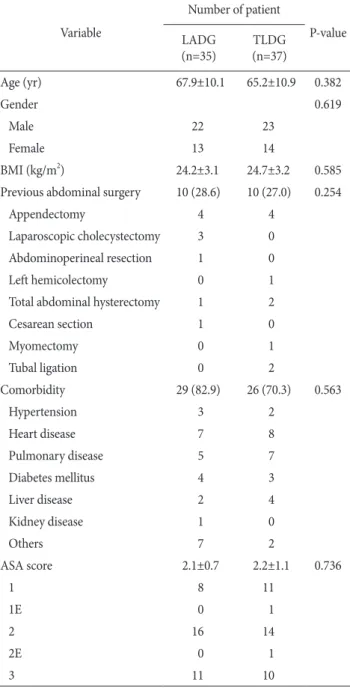
There was no significant difference in age, gender, body mass index, previous history of abdominal surgery, comorbidity or ASA score between the two groups. The characteristics of the patients are summarized in Table 1.
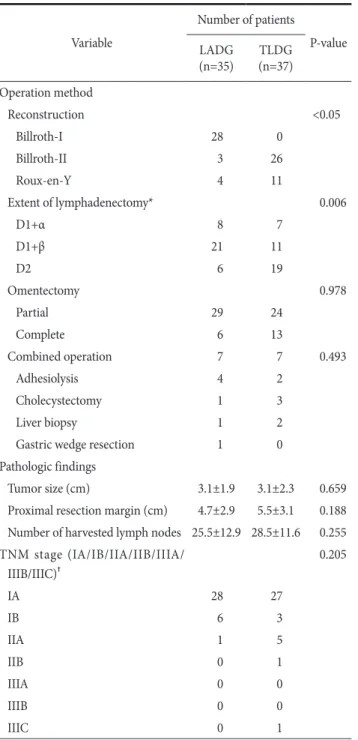
There were some differences in operation methods. Billroth-II and Roux-en-Y gastrojejunostomy after distal gastrectomy were significantly increased in the TLDG group (P<0.05). Complete omentectomy, but not statistically significant (P=0.9872) was per- formed more in the TLDG group (17.1% vs. 35.1% in the LADG and TLDG, respectively, P=0.083).
There was no significant difference in tumor size, proximal re- section margin, tumor location, depth of invasion, histology, num-
Table 1. Characteristics of patients Variable
Number of patient
P-value LADG
(n=35) TLDG
(n=37)
Age (yr) 67.9±10.1 65.2±10.9 0.382
Gender 0.619
Male 22 23
Female 13 14
BMI (kg/m2) 24.2±3.1 24.7±3.2 0.585
Previous abdominal surgery 10 (28.6) 10 (27.0) 0.254
Appendectomy 4 4
Laparoscopic cholecystectomy 3 0
Abdominoperineal resection 1 0
Left hemicolectomy 0 1
Total abdominal hysterectomy 1 2
Cesarean section 1 0
Myomectomy 0 1
Tubal ligation 0 2
Comorbidity 29 (82.9) 26 (70.3) 0.563
Hypertension 3 2
Heart disease 7 8
Pulmonary disease 5 7
Diabetes mellitus 4 3
Liver disease 2 4
Kidney disease 1 0
Others 7 2
ASA score 2.1±0.7 2.2±1.1 0.736
1 8 11
1E 0 1
2 16 14
2E 0 1
3 11 10
Values are presented as mean±standard deviation or number (%).
LADG = laparoscopy-assisted distal gastrectomy; TLDG = totally laparoscopic distal gastrectomy; BMI = body mass index; ASA = American Society of Anesthesiologists.
ber of harvested lymph nodes or TNM stage. There were 3 patients with serosal invasion (1 vs. 2 in LADG and TLDG, respectively), and serosal invasion was not detected in the operative field but di- agnosed as serosal invasion on the pathologic report. The operation method and pathologic findings are summarized in Table 2.
2. Surgical outcomes and postoperative courses There was no significant difference in operation time and es- timated blood loss between the two groups. The overall surgical and medical complication shows no significant difference. Among surgical complications, there was more leakage in the TLDG group but it was not statistically significant (1 vs. 4 in LADG and TLDG, respectively, P=0.3566). Most of the morbidities were well recov- ered with conservative treatment but one mortality case occurred in the TLDG group.
The postoperative course showed some differences. Time-to- Table 2. Operation method and pathologic findings
Variable
Number of patients
P-value LADG
(n=35) TLDG (n=37) Operation method
Reconstruction <0.05
Billroth-I 28 0
Billroth-II 3 26
Roux-en-Y 4 11
Extent of lymphadenectomy* 0.006
D1+α 8 7
D1+β 21 11
D2 6 19
Omentectomy 0.978
Partial 29 24
Complete 6 13
Combined operation 7 7 0.493
Adhesiolysis 4 2
Cholecystectomy 1 3
Liver biopsy 1 2
Gastric wedge resection 1 0
Pathologic findings
Tumor size (cm) 3.1±1.9 3.1±2.3 0.659
Proximal resection margin (cm) 4.7±2.9 5.5±3.1 0.188 Number of harvested lymph nodes 25.5±12.9 28.5±11.6 0.255 TNM stage (IA/IB/IIA/IIB/IIIA/
IIIB/IIIC)†
0.205
IA 28 27
IB 6 3
IIA 1 5
IIB 0 1
IIIA 0 0
IIIB 0 0
IIIC 0 1
Values are presented as number or mean±standard deviation. LADG = laparoscopy-assisted distal gastrectomy; TLDG = totally laparoscopic distal gastrectomy. *Extent of lymphadenectomy classified according to the Guidelines of the Japanese Gastric Cancer Association; †Stage classified by the 7th edition of the International Union Against Cancer (UICC).
Table 3. Surgical outcomes and postoperative courses Variable
Number of patients
P-value LADG
(n=35) TLDG
(n=37) Surgical outcomes
Open conversion 0 0
Operation time (min) 255.3±43.6 263.1±52.0 0.480 Blood loss (ml) 142.0±72.3 125.4±75.3 0.220
Endoscipic stapler <0.05
Circular 0.8±0.4 0
Linear 2.7±0.6 4.7±1.1
Intraoperative complications 0 0
Postoperative complications
Surgical complications 4 (11.4) 9 (24.3) 0.132
Wound infection 1 1
Intraabdominal abscess 0 1
Gastric stasis 2 0
Leakage 1 4 0.356
Intraabdominal bleeding 0 1
Pancreatitis 0 2
Medical complications 3 (8.6) 4 (10.8) 0.532
Pulmonary 2 2
Hepatic 0 1
Renal 1 0
Cerebral infarction 1 0
Mortality 0 1
Postoperative course
Time-to-first flatus (d) 2.7±0.7 3.1±0.9 0.175 Time-to-first oral intake (d) 3.1±0.5 3.5±0.9 0.011 Postoperative hospital stay (d) 9.1±3.6 14.3±9.7 <0.0001 Values are presented as mean±standard deviation or number (%).
LADG = laparoscopy-assisted distal gastrectomy; TLDG = totally laparoscopic distal gastrectomy.
first flatus was not significantly different. But time-to-first oral intake (3.1±0.5 vs. 3.5±0.9 in LADG and TLDG, respectively, P=0.0110) and postoperative hospital stay (9.1±3.6 vs. 14.3±9.7 in LADG and TLDG, respectively, P<0.0001) were significantly increased in the TLDG group. The surgical outcomes and postop- erative courses are summarized in Table 3.
Discussion
Despite the known advantage of TLDG compared with LADG, many surgeons are concerned about the technical difficulty of in- tracorporeal anastomosis, intraoperative localization of the tumor, oncologic aspects and additional costs of using many linear sta- plers.12
The safety and efficacy of LAG in the treatment of EGC have been demonstrated in many studies.13-15 Also, many authors have reported that intracorporeal anastomosis of the TLDG wound be feasible and safe.6,12 In this study, there was no significant difference in operation time, estimated blood loss, or surgical complication between LADG and TLDG. But there were four anastomosis leak- age cases and one mortality case in the TLDG group. Anastomosis leakage was more in the TLDG group but it was not statistically significant (P=0.3566). All anastomosis leakages in TLDG group were duodenal stump leakages. Two of them were well recovered with conservative treatment including gut rest with nutritional sup- port and the rest of them were managed and recovered by per- cutaneous drainage. The mortality case in the TLDG group was a 48-year-old man with alcoholic liver cirrhosis (Child-Pugh- Turcotte class B). The pre-operative TNM stage of the patient was expected to be T1N0M0 but he was not a candidate for ESD because the patient had signet-ring cell carcinoma. The patient was well informed about the risk of the surgery and an informed consent for surgery was obtained. After the operation, liver failure, renal failure and pneumonia occurred and despite the best treatment including continuous renal replacement therapy, the patient died 19 days after surgery.
EGC is not visible or palpable from outside of the stomach, which makes the localization of the tumor very difficult during TLDG.12 Of the many methods for tumor localization,4,16,17 we used preoperative endoscopic clipping if the lesion was located at the middle third of the stomach. In our study, the proximal resection margin in TLDG was not smaller than that of LADG.
The oncologic outcome, including number of retrieved lymph nodes and node station of LADG are known to be comparable with
that of open distal gastrectomy.18 In this study we could not a find significant difference in the number of harvested lymph nodes and lymph node station between the two groups. Rather, the frequency of the D2 lymph node dissection was increased in the TLDG group (17.1% vs. 35.1% in LADG and TLDG respectively, P=0.0062).
We think that this may be due to improved surgical skill during the surgeon’s learning curve period. And during the study period for TLDG, the Japanese Classification of Gastric Carcinoma (JC) and the Japanese Gastric Cancer Treatment Guideline (JGL) was revised.19 D2 lymph node dissection became more easily achieved due to lymph node station No. 14v was excluded in the revised rec- ommendation.20
After distal gastrectomy, we used linear staplers for reconstruc- tion in the TLDG. The number of stapler cartridges that were used was more in the TLDG group than in the LADG group (4.7 vs. 3.5 in TLDG and LADG respectively). In this study, as shown in other studies,7,12 the higher cost for using additional stapling was also a problem in the TLDG group.
Postoperative courses including time-to-first oral intake and postoperative hospital stay turned out to be longer in the TLDG group. The data about time-to-first oral intake did not show much difference but there were statistically significant differences after using nonparametric statistical methods (3.1±0.5 vs. 3.5±0.9 in LADG and TLDG, respectively, P=0.0110). As for the cause of the increase in postoperative hospital stay, it is estimated that there were relatively more complications in the TLDG group that pro- longed the duration of hospitalization such as leakage. In addition, an increase in the duration of hospitalization in the small number of patients have greater impact on the overall average due to the small population who were involved in this study. Furthermore, some patients with senility and much comorbidity had a longer hospital stay than expected because they showed delayed recovery from general conditions, even without the development of particu- lar complications.21
The results described above are what had been performed at a single low volume center in Korea performing an average of 31 cases of gastric cancer surgery annually. The exact meaning of low volume center is hard to define. Based on some reports about hos- pital surgical volume and surgical outcomes of gastric cancer sur- gery, in case of the Korea and Japan where the incidence of gastric cancer is higher, the hospital where less than 70 to 112 surgeries take place a year is considered a low or very low volume center.
When compared with the data of large volume centers, surgical outcomes including operation time and blood loss were acceptable.
But morbidity especially anastomosis leakage were more prevalent in our study. The ratio of anastomosis leakage in other reports ranges from 0 to 4.0%.3,6,12 The oncologic outcomes including proximal resection margin, number of harvested lymph nodes and lymph node station were comparable with the data of large vol- ume centers.3,4,6,12 The postoperative course including time-to first flatus and time-to-first oral intake also were not greatly different.
But compared with other studies, postoperative hospital stay of the TLDG group was somewhat longer. In other studies, the average postoperative hospital stay was 8.3 to 13.3 days.3,4,12 The amount of stapler cartridge usage was less than in other study. The number of cartridges used in other studies was on average 4.9 to 10.2.6,12,22
This study has some limitations. This report may have errors of retrospective studies. Reconstruction methods and frequency of D2 lymph node dissection differed between the two groups. In addi- tion, the number of total patients was too small to perform adjust- ment of covariates such as the difference of reconstruction method and extent of lymphadenectomy. And TLDG was performed after overcoming the learning curve of the LADG. Therefore, these limitations might have influenced outcomes.
Despite these limitations, our study shows that TLDG is a tech- nically feasible procedure. However there may be problems related to the increase in postoperative hospital stay, the safety issues in- cluding leakage even though they were not statistically significant and the relatively higher cost than LADG.
Therefore, TLDG can be considered as one of the surgical treat- ment for EGC if the surgeon is proficient at intracorporeal suturing and gets over the learning curve of the LADG. But the possibility that TLDG may have less benefit compared to LADG should be also considered. An additional study should be undertaken to fur- ther examine the benefit of TLDG at low volume centers.
References
1. Jung KW, Park S, Won YJ, Kong HJ, Lee JY, Park EC, et al.
Prediction of cancer incidence and mortality in Korea, 2011.
Cancer Res Treat 2011;43:12-18.
2. Kitano S, Shiraishi N, Uyama I, Sugihara K, Tanigawa N; Japa- nese Laparoscopic Surgery Study Group. A multicenter study on oncologic outcome of laparoscopic gastrectomy for early cancer in Japan. Ann Surg 2007;245:68-72.
3. Ikeda O, Sakaguchi Y, Aoki Y, Harimoto N, Taomoto J, Masuda T, et al. Advantages of totally laparoscopic distal gastrectomy over laparoscopically assisted distal gastrectomy for gastric
cancer. Surg Endosc 2009;23:2374-2379.
4. Song KY, Park CH, Kang HC, Kim JJ, Park SM, Jun KH, et al.
Is totally laparoscopic gastrectomy less invasive than laparos- copy-assisted gastrectomy?: prospective, multicenter study. J Gastrointest Surg 2008;12:1015-1021.
5. Kim KH, Kim MC, Jung GJ, Kim HH. Long-term outcomes and feasibility with laparoscopy-assisted gastrectomy for gas- tric cancer. J Gastric Cancer 2012;12:18-25.
6. Lee J, Kim D, Kim W. Comparison of laparoscopy-assisted and totally laparoscopic Billroth-II distal gastrectomy for gastric cancer. J Korean Surg Soc 2012;82:135-142.
7. Kinoshita T, Shibasaki H, Oshiro T, Ooshiro M, Okazumi S, Katoh R. Comparison of laparoscopy-assisted and total lapa- roscopic Billroth-I gastrectomy for gastric cancer: a report of short-term outcomes. Surg Endosc 2011;25:1395-1401.
8. Choi YY, Bae J, Hur KY, Choi D, Kim YJ. Reinforcing the staple line during laparoscopic sleeve gastrectomy: does it have ad- vantages? A meta-analysis. Obes Surg 2012;22:1206-1213.
9. Kim M, Park J, Kim SG, Choi S, Yoon S, Lee S. Feasibility of gastric cancer surgery at low volume hospitals. J Gastric Can- cer 2010;10:234-240.
10. Jin SH, Kim DY, Kim H, Jeong IH, Kim MW, Cho YK, et al.
Multidimensional learning curve in laparoscopy-assisted gas- trectomy for early gastric cancer. Surg Endosc 2007;21:28-33.
11. Kim MC, Jung GJ, Kim HH. Learning curve of laparoscopy- assisted distal gastrectomy with systemic lymphadenectomy for early gastric cancer. World J Gastroenterol 2005;11:7508- 7511.
12. Kim JJ, Song KY, Chin HM, Kim W, Jeon HM, Park CH, et al.
Totally laparoscopic gastrectomy with various types of intra- corporeal anastomosis using laparoscopic linear staplers: pre- liminary experience. Surg Endosc 2008;22:436-442.
13. Lee SI, Choi YS, Park DJ, Kim HH, Yang HK, Kim MC. Com- parative study of laparoscopy-assisted distal gastrectomy and open distal gastrectomy. J Am Coll Surg 2006;202:874-880.
14. Hayashi H, Ochiai T, Shimada H, Gunji Y. Prospective ran- domized study of open versus laparoscopy-assisted distal gas- trectomy with extraperigastric lymph node dissection for early gastric cancer. Surg Endosc 2005;19:1172-1176.
15. Lee JH, Han HS, Lee JH. A prospective randomized study comparing open vs laparoscopy-assisted distal gastrectomy in early gastric cancer: early results. Surg Endosc 2005;19:168- 173.
16. Kim HI, Hyung WJ, Lee CR, Lim JS, An JY, Cheong JH, et al.
Intraoperative portable abdominal radiograph for tumor local- ization: a simple and accurate method for laparoscopic gastrec- tomy. Surg Endosc 2011;25:958-963.
17. Hyung WJ, Lim JS, Cheong JH, Kim J, Choi SH, Song SY, et al.
Intraoperative tumor localization using laparoscopic ultraso- nography in laparoscopic-assisted gastrectomy. Surg Endosc 2005;19:1353-1357.
18. Song KY, Kim SN, Park CH. Laparoscopy-assisted distal gas- trectomy with D2 lymph node dissection for gastric cancer:
technical and oncologic aspects. Surg Endosc 2008;22:655-659.
19. Kwon SJ. Evaluation of the 7th UICC TNM staging system of
gastric cancer. J Gastric Cancer 2011;11:78-85.
20. Sano T, Aiko T. New Japanese classifications and treatment guidelines for gastric cancer: revision concepts and major re- vised points. Gastric Cancer 2011;14:97-100.
21. Park JM, Jin SH, Lee SR, Kim H, Jung IH, Cho YK, et al.
Complications with laparoscopically assisted gastrectomy:
multivariate analysis of 300 consecutive cases. Surg Endosc 2008;22:2133-2139.
22. Kim JJ, Kim SK, Jun KH, Kang HC, Song KY, Chin HM, et al.
Clinical usefulness of a totally laparoscopic gastrectomy. J Ko- rean Gastric Cancer Assoc 2007;7:132-138.