Roux-en-Y Gastric Bypass vs. Sleeve Gastrectomy vs.
Gastric Banding: The First Multicenter Retrospective Comparative Cohort Study in Obese Korean Patients
Sang Kuon Lee1, Yoonseok Heo2,3, Joong-Min Park4, Yong-Jin Kim5, Seong-Min Kim6, Do-Joong Park7, Sang-Moon Han8, Kyung Won Shim9, Yeon-Ji Lee10, Ja Youn Lee3, and Jin-Won Kwon11
1Department of Surgery, College of Medicine, The Catholic University of Korea, Seoul;
Departments of 2Surgery and 10Family Medicine, School of Medicine, Inha University, Incheon;
3National Evidence-based Healthcare Collaborating Agency, Seoul;
4Department of Surgery, College of Medicine, Chung-Ang University, Seoul;
5Department of Surgery, College of Medicine, Soonchunhyang University, Seoul;
6Department of Surgery, Gachon University College of Medicine, Incheon;
7Department of Surgery, Seoul National University Bundang Hospital, Seongnam;
8Department of Surgery, CHA University School of Medicine, Seoul;
9Department of Family Medicine, College of Medicine, Ewha Womans University, Seoul;
11College of Pharmacy, Kyungpook National University, Daegu, Korea.
Purpose: Bariatric surgery is relatively new in Korea, and studies comparing different bariatric procedures in Koreans are lacking.
This study aimed to compare the clinical outcomes of laparoscopic adjustable gastric banding (LAGB), Roux-en-Y gastric bypass (RYGB), and sleeve gastrectomy (SG) for treating morbidly obese Korean adults.
Materials and Methods: In this multicenter retrospective cohort study, we reviewed the medical records of 261 obese patients who underwent different bariatric procedures. Clinical outcomes were measured in terms of weight loss and resolution of co- morbidities, such as diabetes, hypertension, and dyslipidemia. Safety profiles for the procedures were also evaluated.
Results: In terms of weight loss, the three procedures showed similar results at 18 months (weight loss in 52.1% for SG, 61.0% for LAGB, and 69.2% for RYGB). Remission of diabetes, hypertension, and dyslipidemia was more frequent in patients who under- went RYGB (65.9%, 63.6%, and 100% of patients, respectively). Safety profiles were similar among groups. Early complications oc- curred in 26 patients (9.9%) and late complications in 32 (12.3%). In the LAGB group, five bands (6.9%) were removed. Among all patients, one death (1/261=0.38%) occurred in the RYGB group due to aspiration pneumonia.
Conclusion: The three bariatric procedures were comparable in regards to weight-loss outcomes; nevertheless, RYGB showed a higher rate of comorbidity resolution. Bariatric surgery is effective and relatively safe; however, due to complications, some bands had to be removed in the LAGB group and a relatively high rate of reoperations was observed in the RYGB group.
Key Words: Morbid obesity, bariatric surgery, outcomes, comparative study, Koreans Yonsei Med J 2016 Jul;57(4):956-962
http://dx.doi.org/10.3349/ymj.2016.57.4.956 pISSN: 0513-5796 · eISSN: 1976-2437
Received: August 20, 2015 Revised: December 7, 2015 Accepted: December 7, 2015
Co-corresponding authors: Dr. Yoonseok Heo, Department of Surgery, Inha University Hospital, Inha University School of Medicine, 27 Inhang-ro, Jung-gu, Incheon 22332, Korea. Tel: 82-32-890-3431, Fax: 82-32-890-3097, E-mail: [email protected] and
Dr. Ja Youn Lee, National Evidence-based Healthcare Collaborating Agency, 7F Namsan Square, 173 Toegye-ro, Jung-gu, Seoul 04554, Korea.
Tel: 82-2-2174-2890, Fax: 82-2-725-4917, E-mail: [email protected]
•The authors have no financial conflicts of interest.
© Copyright: Yonsei University College of Medicine 2016
This is an Open Access article distributed under the terms of the Creative Commons Attribution Non-Commercial License (http://creativecommons.org/licenses/by-nc/3.0) which permits unrestricted non-commercial use, distribution, and reproduction in any medium, provided the original work is properly cited.
INTRODUCTION
Obesity is a serious health problem for Western countries and a growing health concern for most countries in the Asia-Pacific region. In Korea, the prevalence of obesity in adults, defined as a body mass index (BMI) ≥25 kg/m2, has gradually increased from 29.2% in 2001 to 31.4% in 2011.1
Bariatric surgery is considered the most efficacious treatment for severe obesity in the long term. Bariatric surgery results in long-term weight-loss control, along with lifestyle improve- ments and amelioration of risk factors, within a decade after surgery.2 Furthermore, bariatric surgery is widely known to of- fer metabolic effects in patients with type II diabetes. One study demonstrated that diabetes remission, defined by blood glu- cose <110 mg/dL without diabetes medications, was 72.3% at 2 years and 30.4% at 15 years after bariatric surgery.3 Worldwide, metabolic/bariatric surgeries have more than doubled from 2003 to 2011: the most frequently performed bariatric in 2011 was the Roux-en-Y gastric bypass (RYGB), followed by sleeve gastrectomy (SG) and laparoscopic adjustable gastric banding (LAGB).4
Many bariatric surgeons prefer RYGB over SG or LAGB, be- cause the former procedure is associated with better outcomes of weight loss and resolution of comorbidities. However, RYGB is also associated with higher rates of readmission and reopera- tion/intervention;5 hence, other surgeons prefer SG or LAGB over RYGB, because these procedures have a better safety profile.
Bariatric surgery is relatively new in Korea: the first laparo- scopic bariatric procedure was performed in 2003.6 According- ly, large comparative studies are still lacking. We conducted this study to compare the clinical outcomes of RYGB vs. SG vs. LAGB in an effort to outline which procedure should be considered optimal for treating obesity and its comorbidities in obese Ko- rean adults.
MATERIALS AND METHODS
Data source and patient identification
This study applied a retrospective cohort design based on med- ical chart review. We collected data on 261 consecutive obese adults (BMI ≥30 kg/m2) who underwent LAGB, RYGB, or SG between 2008 and 2011 in the surgical departments of seven different Korean tertiary medical centers. Patients aged 17 years old or less were excluded. Patients were categorized into three groups depending on the surgical procedure: LAGB (n=72), RYGB (n=73), and SG (n=116). The ethics review boards of the National Evidence-based Healthcare Collaborating Agency and each participating hospital approved the study protocols.
Data collection
Baseline height, weight, blood pressures, and biochemical data were collected during the physical examination and laboratory
assessments performed within a few days of bariatric surgery.
Subsequent data were collected when the subjects made fol- low-up visits to the hospitals. Weight measurements at routine visits were averaged over three months to determine changes in weight at specific time points. For example, if patients mea- sured their weight twice over three months from baseline, the weight at three months was recorded as the average value of the two measurements. Information on the patients’ medical histo- ry before bariatric surgery was obtained through chart review.
To investigate complications related with bariatric surgery, de- tails of each event, onset date, and hospitalization were recorded.
Operative method
Details on each of the surgical bariatric procedures are provid- ed hereafter. Briefly, for LAGB, a four- or five-port laparoscopic approach was used, depending on the surgeon’s preference.
The pars flaccida technique was applied for creation of the ret- rogastric tunnel, and either the LAP-BAND® (Allergan, Irvine, CA, USA) or the Realize Band® (Johnson & Johnson, Neenah, WI, USA) was used. Several gastrogastric fixation sutures with nonabsorbable suture material were applied in all cases. The access port was exteriorized through a subcutaneous tunnel, and was placed by fixation to the rectus abdominis fascia. In all cases, intraoperative band filling was not performed, allowing at least four to eight weeks for capsule maturation around the band.
For RYGB, a six- or seven-port laparoscopic technique was used, and after creation of a small gastric pouch of less than 30 cc, a side-to-side gastrojejunostomy was constructed using a linear stapler. The measured Roux limb length was about 100 cm, and side-to-side jejunojejunostomy was performed using linear staplers. Potential areas for internal hernias were all su- ture-closed with nonabsorbable suture materials.
Finally, for SG, a five- or six-port laparoscopic technique was used. Omental dissection extended from about 5 cm proximal to the pylorus up to the angle of His; using a bougie with a di- ameter ranging from 36–40 French or a gastrofiberscope, sever- al linear staples were applied, and a narrow sleeve was achieved.
Suture reinforcement was performed or not, depending on the surgeon’s preference.
Clinical effectiveness
Clinical effectiveness was investigated using four parameters:
percentage of weight loss (%WL), percentage of excess weight loss (%EWL), percentage of excess BMI loss (%EBMIL), and ab- solute weight loss (AWL) from baseline. Percentage of WL was calculated by dividing changes in weight from baseline by base- line weight; %EWL was calculated by dividing weight changes from baseline by excess weight, which was obtained by sub- tracting ideal body weight from actual baseline weight. Ideal body weight was calculated as the height-adjusted weight de- pending on sex for a medium frame, according to the Metro- politan Life Insurance Company tables (1983).7 Percentage of
EBMIL was calculated by dividing BMI change from baseline by excess BMI, which was obtained by subtracting the ideal BMI (25 kg/m2) from the actual BMI. AWL from baseline was calculated by subtracting weight at a specific time point from weight at baseline.
Remission from comorbidities, including diabetes, hyperten- sion, and dyslipidemia, was investigated over time. In most cas- es, the management and follow-up of these comorbidities was usually performed by internists or primary care physicians, not by bariatric surgeons. Using the following definitions of con- comitant diseases, prevalence before and improvement after bariatric surgery were investigated objectively. Diabetes was defined as the use of antidiabetic medications, fasting blood glucose (FBG) ≥126 mg/dL, or a hemoglobin A1c (HbA1c) level
≥6.5%. Hypertension was defined as the use of antihypertensive medications, systolic blood pressure ≥140 mm Hg, or diastolic blood pressure ≥90 mm Hg. Dyslipidemia was defined as the use of cholesterol-lowering medications, total cholesterol ≥240 mg/dL, triglycerides ≥200 mg/dL, or low-density lipoprotein cholesterol ≥160 mg/dL. Remission was defined as the patient being off medication and having laboratory/measurement val- ues below the diagnostic criteria.
Safety assessment
Safety assessment was performed by collecting clinical infor- mation at two time points: within 30 days and after 30 days from bariatric surgery. Within 30 days, any occurrence of spe- cific complications was noted, including deep vein thrombosis, venous thromboembolism, tracheal reintubation, performance of interventional endoscopic procedure for control of luminal bleeding, dilatation of strictures, air reduction in a kinked gas- tric tube, tracheostomy placement, percutaneous drain place-
ment, anastomotic complication (e.g., leak, obstruction), bowel obstruction, incisional hernia, band slippage, gastric perfora- tion, port/tubing system complication, pouch dilatation, or pneumonia. After 30 days, any occurrence of gastroesophageal reflux disease, nausea/vomiting, internal hernia, gastric pro- lapse, band erosion, band removal, anastomotic stenosis, gall- bladder stone, or marginal ulcer was also recorded. If patients reported other complications, they were specified in detail.
Statistical analysis
We summarized the patient characteristics and used analysis of variance (ANOVA) for continuous variables and the chi-square test for categorical variables to investigate differences in base- line characteristics among the three groups. Changes in %WL,
%EWL, %EBMIL, and AWL were summarized at 0 (baseline), 3, 6, 9, 12, 15, and 18 months, and 95% confidence intervals were also calculated. ANOVA was used for the statistical testing of outcomes among the three groups at each time point. To re- duce data entry error, two people independently input data into the data collection forms, which were developed using Micro- soft Access software (2007). Subsequently, the accuracy of the inputted data was checked with SAS and corrected. Statistical data analysis was conducted with SAS software (9.2, SAS Insti- tute, Cary, NC, USA).
RESULTS
The characteristics of the 261 patients included in this study are presented in Table 1. The median follow-up period ranged from 6.3 to 11.6 months. BMI was similar among the three groups.
Female sex was predominant in all three groups. The mean age Table 1. Demographics
LAGB (n=72) RYGB (n=73) SG (n=116)
p value
n % n % n %
Follow up (days)
Median 347 209 189.5 0.0005
BMI (kg/m2)
Mean±SD 38.9±5.4 39.0±6.9 39.1±6.2 0.9259
30≤BMI<35 19 26.4 23 31.5 32 27.6 0.9206
35≤BMI<40 25 34.7 26 35.6 44 37.9
BMI≥40 28 38.9 24 32.9 40 34.5
Sex 0.9026
Male 17 23.6 17 23.3 30 25.9
Female 55 76.4 56 76.7 86 74.1
Age (yrs)
Mean±SD 33.6±10.3 39.1±11.1 35.0±10.4 0.0046
Concomitant disease
Hypertension 37 51.4 47 64.4 62 53.4 <0.0001
Dyslipidemia 29 40.3 40 54.8 56 48.3 0.1802
Diabetes 15 20.8 44 60.3 43 37.1 <0.0001
LAGB, laparoscopic adjustable gastric banding; RYGB, Roux-en-Y gastric bypass; SG, sleeve gastrectomy; BMI, body mass index.
was slightly higher in the RYGB group. The prevalences of hy- pertension and diabetes were higher in the RYGB group.
Weight-loss outcomes
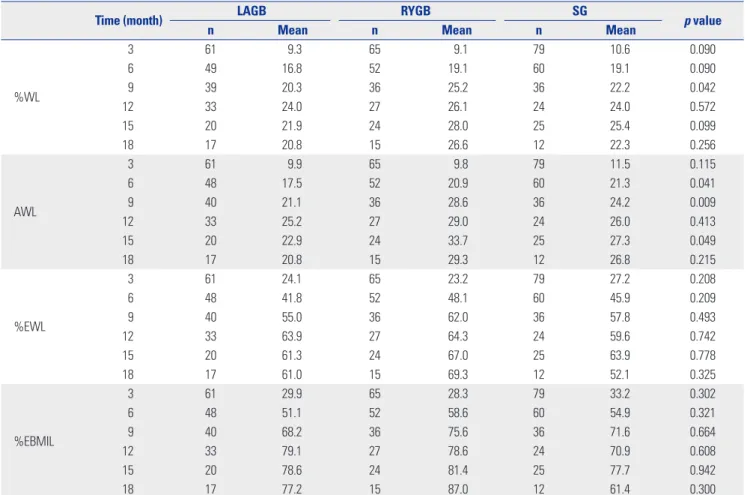
Changes in %WL, %EWL, %EBMIL, and AWL are listed in Table 2, and presented graphically in Fig. 1. Patients who underwent RYGB showed a tendency towards greater weight loss than those who underwent SG or LAGB; the difference was statisti- cally significant only at a few time points. The %WL was signifi- cant at 9 months (RYGB vs. LAGB), and AWL was significant at 6, 9, and 15 months (RYGB vs. LAGB). The mean %EWL at the last follow-up (18 months) was 52.1% for SG, 61.0% for LAGB, and 69.2% for RYGB.
Resolution of comorbidities
The prevalence of dyslipidemia was similar among the three groups before surgery. Meanwhile, diabetes and hypertension were more prevalent in the RYGB group, followed by SG. Re- mission from all concomitant diseases (diabetes, hypertension, and dyslipidemia) was more frequent in those who underwent RYGB (Table 3). While 65.9%, 63.6%, and 100% of patients showed remission from diabetes, hypertension, and dyslipid- emia, respectively, in the RYGB group, remission rates were
lower in the SG group (30.2%, 14.3%, and 73.7%) and the LAGB group (40%, 34.8%, and 66.7%). Laboratory measurements, in- cluding FBG and HbA1c, improved significantly from baseline values in the RYGB and SG groups.
Complications
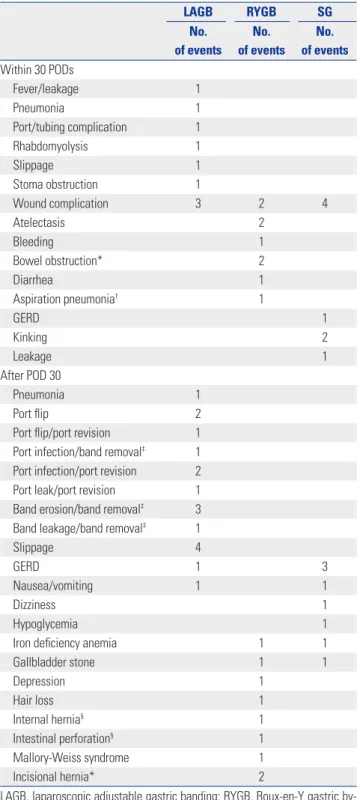
Early complications (within 30 days from surgery) occurred in 26 patients (9.9%), accounting for 12.5% of the LAGB, 12.3% of the RYGB, and 6.9% of the SG, while complications later than 30 days from surgery occurred in 32 patients (12.3%), repre- senting 22.2% of the LAGB, 12.3% of the RYGB, and 6% of the SG (Table 4). The most frequent complication within 30 days from bariatric surgery was surgical site infection, followed by pneumonia/atelectasis. One patient who had undergone RYGB underwent reoperation because of small bowel obstruction.
Other complications included leakage, bleeding, kinking of the gastric sleeve, stoma obstruction, rhabdomyolysis, band slip- page, access port complications, diarrhea, and reflux symp- toms. Complications at more than 30 days after surgery were more common in the LAGB group, although this difference was not statistically significant. Late band complications were mainly due to occurrence of port leak/revision and band ero- sion/removal. Five bands (6.9%) needed to be removed because
Table 2. Weight Change from Baseline
Time (month) LAGB RYGB SG
p value
n Mean n Mean n Mean
%WL
3 61 9.3 65 9.1 79 10.6 0.090
6 49 16.8 52 19.1 60 19.1 0.090
9 39 20.3 36 25.2 36 22.2 0.042
12 33 24.0 27 26.1 24 24.0 0.572
15 20 21.9 24 28.0 25 25.4 0.099
18 17 20.8 15 26.6 12 22.3 0.256
AWL
3 61 9.9 65 9.8 79 11.5 0.115
6 48 17.5 52 20.9 60 21.3 0.041
9 40 21.1 36 28.6 36 24.2 0.009
12 33 25.2 27 29.0 24 26.0 0.413
15 20 22.9 24 33.7 25 27.3 0.049
18 17 20.8 15 29.3 12 26.8 0.215
%EWL
3 61 24.1 65 23.2 79 27.2 0.208
6 48 41.8 52 48.1 60 45.9 0.209
9 40 55.0 36 62.0 36 57.8 0.493
12 33 63.9 27 64.3 24 59.6 0.742
15 20 61.3 24 67.0 25 63.9 0.778
18 17 61.0 15 69.3 12 52.1 0.325
%EBMIL
3 61 29.9 65 28.3 79 33.2 0.302
6 48 51.1 52 58.6 60 54.9 0.321
9 40 68.2 36 75.6 36 71.6 0.664
12 33 79.1 27 78.6 24 70.9 0.608
15 20 78.6 24 81.4 25 77.7 0.942
18 17 77.2 15 87.0 12 61.4 0.300
LAGB, laparoscopic adjustable gastric banding; RYGB, Roux-en-Y gastric bypass; SG, sleeve gastrectomy; %WL, percentage of weight loss; %EWL, percentage of excess weight loss; %EBMIL, percentage of excess body mass index loss; AWL, absolute weight loss.
of band erosion, access port infection, or band leakage. Other late complications included cholecystitis, internal hernia, intes- tinal perforation, wound dehiscence, and access port problems.
Details on complications by type of surgery are described in Ta- ble 5. Some patients had more than one complication. There was one death (1/261=0.38%) due to aspiration pneumonia within 30 days from surgery in a patient who underwent RYGB. The other groups recorded no mortality.
DISCUSSION
This is the first Korean national study in which several academ- ic institutions participated and pooled their data on bariatric surgery to compare clinical outcomes among different bariatric procedures (LAGB, RYGB, and SG). In our previous study, we showed that bariatric surgery was more effective than conven- tional medical treatment for obese patients in terms of weight- loss and improvement/resolution of comorbidities.8 In this multicenter study, our intention was to analyze the compara- tive bariatric outcomes among different weight loss procedures.
Bariatric surgery was first performed in Korea in January
2003, when the first laparoscopic SG was performed,9 followed later in the same year by laparoscopic RYGB, mini-gastric by- pass, and vertical banded gastroplasty. In 2004, the first LAGB procedure was performed. By 2009, LAGB was the most popu- lar bariatric procedure in Korea (68%), followed by RYGB (16%), SG (5.5%), and mini-gastric bypass (3%).6 This is an interesting phenomenon, since LAGB is decreasing in popularity world- wide in favor of other procedures.4 One possible reason is the less invasive nature of the LAGB procedure and the reluctance of Korean patients to undergo “major” surgery.
Many papers have compared surgical outcomes between dif- ferent bariatric procedures; however, the conclusions were not categorical and sometimes conflicted. Chapman, et al.10 com- pared LAGB with vertical banded gastroplasty and RYGB, con- cluding that LAGB was superior to the other procedures in terms of safety and weight-loss outcome, at least after 4 years of follow-up. However, a cohort study that compared RYGB with LAGB in matched patients and followed them for 3 years showed superior weight loss and comorbidity reduction in the RYGB group.11 In a multicenter study that compared RYGB with SG, RYGB was associated with greater morbidity; however, weight loss was comparable at 6, 12, and 18 months, and remission of
Fig. 1. (A) Comparison of percentage of weight loss (%WL) over an 18-month follow-up. (B) Comparison of percentage of excess weight loss (%EWL) over an 18-month follow-up. %WL, percentage of weight loss; %EWL, percentage of excess weight loss; LAGB, laparoscopic adjustable gastric banding;
RYGB, Roux-en-Y gastric bypass; SG, sleeve gastrectomy.
A
%WL
0
5
10
15
20
25
30 0 3 6 9 12 15 18 0 3 6 9 12 15 18
Month Month
p=0.09
LAGB RYGB SG p=0.09
p=0.04
p=0.57 p=0.10 p=0.26
B
%EWL
0 10 20 30 40 50 60 70 80
p=0.20
LAGB RYGB SG p=0.20
p=0.49
p=0.74 p=0.77 p=0.32
Table 3. Remission from Concomitant Diseases
LAGB (n=72) RYGB (n=73) SG (n=116)
p value
n % n % n %
Diabetes
Prevalence 15/72 20.8 44/73 60.3 43/116 37.1 <0.0001
Remission 6/15 40 29/44 65.9 13/43 30.2 0.035
Hypertension
Prevalence 38/72 52.8 49/73 67.1 62/116 53.4 0.124
Remission 8/23 34.8 28/44 63.6 4/28 14.3 0.005
Dyslipidemia
Prevalence 26/72 36.1 29/73 39.7 44/116 37.9 0.904
Remission 10/15 66.7 28/28 100 14/19 73.7 0.006
LAGB, laparoscopic adjustable gastric banding; RYGB, Roux-en-Y gastric bypass; SG, sleeve gastrectomy.
type 2 diabetes was more frequent.12 Given the increasing pop- ularity of SG over LAGB as a restrictive procedure, one interest- ing study by Chakravarty, et al.13 compared LAGB with RYGB, vertical banded gastroplasty, and SG. In this systematic review of randomized controlled trials, the authors concluded that LAGB was not the most effective bariatric procedure to reduce weight, compared with the other procedures; nevertheless, it was associated with fewer early complications, as well as a shorter operative time and shorter length of hospital stay.
In the current study, although patients who underwent RYGB showed a tendency to have greater %WL, compared with those who underwent SG and LAGB, at 6 months postoperation;
thereafter, the difference became statistically significant only at 9 months. The percentage of EWL was similar for the three pro- cedures. In terms of AWL, RYGB demonstrated better outcomes only at 6, 9, and 15 postoperative months. As this study was not prospective, this marginal difference in weight loss may have been due to the heterogeneous population group and inter-in- stitutional differences in patient management protocols. More- over, the follow-up period of only 18 months was quite short.
We may speculate that the weight-loss outcome might have been more pronounced in favor of RYGB and SG over a longer follow-up period. Indeed, a systematic review of randomized trials comparing SG, RYGB, and LAGB has shown a trend to- ward a better weight-loss outcome with RYGB (62.1–94.4%), compared to SG (49–81%) and LAGB (28.7–48%), over a follow- up period of up to 3 years.14
We demonstrated an effective resolution of comorbidities af- ter bariatric procedures. RYGB, in particular, showed signifi- cantly better outcomes than LAGB and SG in regards resolution of diabetes and dyslipidemia. These results are consistent with those from other studies that analyzed the resolution of comor- bidities after different operations.15 However, since the preva- lence of comorbidities was different among groups, it would be difficult to make a direct comparison and determine which procedure was superior in this respect.
Whereas complications from LAGB occurring more than 30 days from surgery were almost double those occurring within 30 days, the complication rates in the RYGB and SG groups were similar for both time periods. This finding is in accordance with the findings from another study, in which LAGB was asso- ciated with more long-term complications, including band ero- sion, pouch dilatation, intractable reflux symptoms, and band removals.16 However, we must take into consideration that the
LAGB group had a longer mean follow-up time, which may have influenced the increased complication rate.
In our study, one death was observed in the RYGB group. A multi-institutional study carried out by the American College of Surgeons, which compared LAGB, SG, and RYGB based on prospective longitudinal data, showed 30-day mortality rates of
Table 4. Postoperative Complication Rate
LAGB (n=72) RYGB (n=73) SG (n=116) No. of patients No. of patients No. of patients
Total 21 (29.2%) 16 (21.9%) 14 (12.1%)
Within 30 PODs 9 (12.5%) 9 (12.3%)* 8 (6.9%)
After POD 30 16 (22.2%) 9 (12.3%) 7 (6.0%)
LAGB, laparoscopic adjustable gastric banding; RYGB, Roux-en-Y gastric by- pass; SG, sleeve gastrectomy; POD, postoperative day.
*Including one death.
Table 5. Details of Surgical Complications by Type of Surgery
LAGB RYGB SG
No.
of events
No.
of events
No.
of events Within 30 PODs
Fever/leakage 1
Pneumonia 1
Port/tubing complication 1
Rhabdomyolysis 1
Slippage 1
Stoma obstruction 1
Wound complication 3 2 4
Atelectasis 2
Bleeding 1
Bowel obstruction* 2
Diarrhea 1
Aspiration pneumonia† 1
GERD 1
Kinking 2
Leakage 1
After POD 30
Pneumonia 1
Port flip 2
Port flip/port revision 1 Port infection/band removal‡ 1 Port infection/port revision 2 Port leak/port revision 1 Band erosion/band removal‡ 3 Band leakage/band removal‡ 1
Slippage 4
GERD 1 3
Nausea/vomiting 1 1
Dizziness 1
Hypoglycemia 1
Iron deficiency anemia 1 1
Gallbladder stone 1 1
Depression 1
Hair loss 1
Internal hernia§ 1
Intestinal perforation§ 1
Mallory-Weiss syndrome 1
Incisional hernia* 2
LAGB, laparoscopic adjustable gastric banding; RYGB, Roux-en-Y gastric by- pass; SG, sleeve gastrectomy; POD, postoperative day; GERD, gastroesopha- geal reflux disease.
*One patient was reoperated, †Died, ‡Band removed, §Reoperated.
0.05%, 0.11%, and 0.14%, respectively, suggesting that the surgi- cal risk of bariatric procedures is highest for RYGB, followed by SG and LAGB.5
This study had several limitations that should be taken into consideration. First, the patient population was not homoge- nous, as those who underwent RYGB had more comorbidities.
Second, the surgeons participating in this study had varying levels of bariatric surgical experience. Third, this was not a pro- spective study, but a retrospective cohort study with a limited follow-up period. Particularly, the total numbers of patients fol- lowed up was 84 (32.1%) at postoperative 12 months and 44 (16.8%) at postoperative 18 months; therefore, the statistical power of the study results is limited. Finally, there were notice- able inter-institutional differences in the management of bar- iatric patients. Nonetheless, the significance of this paper is that it is the first multi-institutional national study in which most major centers in Korea participated.
To conclude, this study demonstrates that all three bariatric procedures were comparably effective in terms of weight loss, with quite effective resolution of comorbidities. Complications were more severe in the RYGB group; however, LAGB was asso- ciated with a higher rate of late complications. Our results sug- gest that all three procedures are viable alternatives for patients whose obesity problem is not amenable to medical treatment.
A prospective randomized study would be desirable to deter- mine the relative superiorities of each of the bariatric proce- dures.
ACKNOWLEDGEMENTS
This study was completed as part of the health technology as- sessment report (Project no. NA2011-003) funded by the Na- tional Evidence-based Healthcare Collaborating Agency (NECA) in South Korea.
REFERENCES
1. Ministry of Health and Welfare. Ministry of Health and Welfare statistical year book. Seoul: Ministry of Health and Welfare; 2013.
p.10-1.
2. Sjöström L, Lindroos AK, Peltonen M, Torgerson J, Bouchard C, Carlsson B, et al. Lifestyle, diabetes, and cardiovascular risk fac- tors 10 years after bariatric surgery. N Engl J Med 2004;351:2683-93.
3. Sjöström L, Peltonen M, Jacobson P, Ahlin S, Andersson-Assars- son J, Anveden Å, et al. Association of bariatric surgery with long- term remission of type 2 diabetes and with microvascular and macrovascular complications. JAMA 2014;311:2297-304.
4. Buchwald H, Oien DM. Metabolic/bariatric surgery worldwide 2011. Obes Surg 2013;23:427-36.
5. Hutter MM, Schirmer BD, Jones DB, Ko CY, Cohen ME, Merkow RP, et al. First report from the American College of Surgeons Bariat- ric Surgery Center Network: laparoscopic sleeve gastrectomy has morbidity and effectiveness positioned between the band and the bypass. Ann Surg 2011;254:410-20.
6. Lee SK. Current status of laparoscopic metabolic/bariatric surgery in Korea. J Minim Invasive Surg 2015;18:59-62.
7. 1983 metropolitan height and weight tables. Stat Bull Metrop Life Found 1983;64:3-9.
8. Heo YS, Park JM, Kim YJ, Kim SM, Park DJ, Lee SK, et al. Bariatric surgery versus conventional therapy in obese Korea patients: a multicenter retrospective cohort study. J Korean Surg Soc 2012;83:
335-42.
9. Moon Han S, Kim WW, Oh JH. Results of laparoscopic sleeve gas- trectomy (LSG) at 1 year in morbidly obese Korean patients. Obes Surg 2005;15:1469-75.
10. Chapman AE, Kiroff G, Game P, Foster B, O’Brien P, Ham J, et al.
Laparoscopic adjustable gastric banding in the treatment of obe- sity: a systematic literature review. Surgery 2004;135:326-51.
11. Cottam DR, Atkinson J, Anderson A, Grace B, Fisher B. A case- controlled matched-pair cohort study of laparoscopic Roux-en-Y gastric bypass and Lap-Band patients in a single US center with three-year follow-up. Obes Surg 2006;16:534-40.
12. Chouillard EK, Karaa A, Elkhoury M, Greco VJ; Intercontinental Society of Natural Orifice, Endoscopic, and Laparoscopic Surgery (i-NOELS). Laparoscopic Roux-en-Y gastric bypass versus laparo- scopic sleeve gastrectomy for morbid obesity: case-control study.
Surg Obes Relat Dis 2011;7:500-5.
13. Chakravarty PD, McLaughlin E, Whittaker D, Byrne E, Cowan E, Xu K, et al. Comparison of laparoscopic adjustable gastric banding (LAGB) with other bariatric procedures; a systematic review of the randomised controlled trials. Surgeon 2012;10:172-82.
14. Trastulli S, Desiderio J, Guarino S, Cirocchi R, Scalercio V, Noya G, et al. Laparoscopic sleeve gastrectomy compared with other bar- iatric surgical procedures: a systematic review of randomized tri- als. Surg Obes Relat Dis 2013;9:816-29.
15. Campos GM, Rabl C, Roll GR, Peeva S, Prado K, Smith J, et al. Bet- ter weight loss, resolution of diabetes, and quality of life for lapa- roscopic gastric bypass vs banding: results of a 2-cohort pair- matched study. Arch Surg 2011;146:149-55.
16. Angrisani L, Cutolo PP, Formisano G, Nosso G, Vitolo G. Laparo- scopic adjustable gastric banding versus Roux-en-Y gastric by- pass: 10-year results of a prospective, randomized trial. Surg Obes Relat Dis 2013;9:405-13.