충남대학교 의과대학 호흡기내과, 의학 연구소 김주옥, 정미경, 정성수
Photodynamic Therapy(PDT) in Lung Cancer
Ju Ock Kim, M.D., Mi Kyoung Jung, M.D. Sung Soo Jung, M.D.
Department of Internal Medicine & Research Institite for Medical Science, College of Medicine, Chungnam National University, Daejeon, Korea
Address for correspondence: Ju-Ock Kim, M.D.
Department of Internal Medicine, Chungnam National University Hospital, 640 Dae-Sa-dong, Chung-gu, Taejeon, Korea.
Phone: 82-42-280-7158, Fax: 82-42-257-5753 E-mail: [email protected]
서 론
Photodynamic therapy(PDT)는 1) light-sensitive chemical(photosensitizer/drug) 2) light of an appropriate wavelength와 3) oxygen이 필요하다.
즉 PDT는 photothearpy와 photochemotherapy의 일부분에 속하는데 phototherapy는 치료 목적으로 light를 이용하는 것으로 1903년에 Niels Ryberg Finsen이 이를 이용해서 노벨 생리・의학상을 받았 다. Photochemotherapy는 light-sensitive photoche- mical과 light를 이용한다. PDT에서 light-activated chemical은 photodynamic action이 일어나기 위해서 molecular oxygen이 필요하고 이의 반대작용으로 세 포 기능에 영향을 주는 연쇄반응이 일어나 세포괴사 (necrosis)를 초래한다.
PDT는 two-phase process로서 이루어지는데, 1) First phase (presensitivation) : 암 조직에 광과민제 (photosensitizer)로 감작시키는 것으로 국소적 또는 전식적으로 광과민제를 주입하면 정상세포에 비해서 tumor tissue에 고농도로 선택적으로 축적된다. 2) Second phase(illumination) : 감작된 조직을 chemical photosensitizer의 흡수도와 일치하는 파장의 빛 (laser)에 노출시킨다. 산소의 존재하에 광과민제와 light 사이의 상호작용은 세포괴사를 일으킨다.
PDT에서 세포사멸(cell death)의 기전은 singlet
oxygen과 다른 세포독소가 방출되면서 직접적인 세 포손상과 혈관 손상 등의 여러 events로 매개된다. 최 근에는 염증과 면역반응이 관여하는 밝혀졌다.
1. 폐암 치료를 위한 기관지경하 PDT의 역할
1970년대 초에 Dougherty 등이 PDT가 동물과 인 간의 종양에 광범위하게 효과가 있다고 밝혔다. 폐암 은 PDT의 안정성과 효과를 실험한 첫 번째 종양의 하나이다. 1980년대 초에 폐암 환자가 도쿄 의과대학 에서 PDT로 처음 치료를 하였다. 이 당시의 폐암은 early stage로 수술적 제거를 거부한 환자를 포함하였 다. 환자는 bronchoscopic PDT를 한 후에 4년 뒤까지 완치상태였고 종양과 연관 없는 사건으로 사망하였 다. 이후로 전 세계적으로 천명의 폐암환자가 조기 또 는 진행성 병기에서 PDT를 시술받게 되었다.
기관지경하 PDT 방법
현재까지 폐암에서 보고된 PDT 시술의 대부분 (~98%)은 기관지내시경을 통해서 시행하였다. 이 방 법에서의 basic protocol은 다음과 같다.
1) 치료전 기관지경을 시행하여 종양의 extent와 topography를 측정한다.
2) 광과민제를 정맥에 주사하여 종양을 감작시킨다.
3) 일정시간이 지난 다음, 종양과 정상 주위 조직 간에 최적의 농도차가 나는 time interval(latent period)후에 기관지경을 통하여 종양에 적절한 파장 의 laser light를 조사한다.
4) PDT 후에 bronchial cleaning을 위해 여러 번 기
Light delivery modes Description Example Front superficial irradiation A uniform irradiance incident beam delivered to a front surface
by a microlens fiber externally. Skin PDT
Cavity superficial irradiation An isotropic source centered in a spherical cavity and delivering
light to the cavity surface. Brain tumor PDT
Cylindrical superficial irradiation A cylindrical diffuser source centered in a cylindrical lumen. Esophageal PDT Cylindrical intersitial irradiation A cylindrical diffuser source embedded in the target tissue. Solid tumor PDT Table 2. Common light delivery modes
Photosensitizer Abbreviation Gneric name Manufacturer
Approved
Polyhematoporphyrin
ether/ester Porfimer sodium Photofrin Axcan Phama, Inc
Hematoporphyrin derivatives HpD Photogem Moscow instilute of High
Chemical Technologies
Hematoporphyrin derivatives HpD Photosan SeeLab F&E GmbH
Hematoporphyrin derivatives HiPorfin Hematoporphyrin Infection Chongqing Huadin Modem Biopharmaceutics Co. Ltd.
Benzoporphyrin derivative
monoacid ring A BPD-MA, verteporfin Visudyne Novartis Pharmaceuticals
5-aminolevulinic acid ALA Levuian DUSA Pharmaceuticals, Inc.
Methyl aminolevulinate MLA Metvix PhotoCure ASA
Meta-tetrahydroxyphenylchlorin mTHPC, temoporfin Foscan Biolitec AG Mono-L-aspartyl chlorin e6 or
talaporfin sodium* NPe6, ME2906 Laserphyrin Meiji Seika Kaisha, Ltd.
Sulfonated aluminum
phthalocyanine AIPcS2-4 Photosens General Physics Institute
Tolomium chloride or Toluidine
Blue O TBO SaveDent PAD Denfotex Ltd.
Currently under clinical trial Lutetium(Ⅲ) texaphyrin or
motexafin lutetium Lutex Antrin Pharmacyclics Inc.
Tin ethyl etiopurpurin SnET2, purlytin Photrex Miravant Medical Technologies Hematoporphyrin monomethyl
ether HMME Hemporfin Fudanzhangjang
BioPharmaceutical Co., Ltd.
deuteroporphyrins DpD Duetpofin Fudanzhangjang
Bioharmaceutical Co., Ltd.
2-[1-hexyloxyethyl]-2-devinyl
pyropheophorbide-a HPPH Photochlor Roswell Park Cancer Institute
Pd-bacteriophiophorbide WST09 Tookad Negma-Lerads and Steba
Laboratories Ltd.
*Under clinical trials have different names: LS11 or Litx; PDT: photodynamic therapy.
Table 1. Regulatory status of some common PDT photosensitizers
관지경을 시행한다.
PDT에서 목표조직의 photosensitization을 위한 광 과민제와 상호작용하는 laser light의 파장을 아는 것 이 중요하다. latent period의 기간은 photosensi- tizing agent의 chemical structure와 종양세포와 정상 세포의 섭취에 따라 다르다.
대부분의 저자들은 superficial early cancer가 있는 환자에서 국소마취를 하고 flexible bronchoscope를
시행한다. 경우에 따라 전신마취를 하고 rigid bron- choscope를 하거나 ventilation을 위한 endotracheal tube를 삽입하고 이것을 통해서 fiberoptic instrument 를 삽입해서 tumor location과 illumination을 한다. 이 런 경우는 주기관지 폐쇄가 있는 환자에 용이한 시술 법이다. 이는 debridement를 하기 위한 접근이 더 쉽 고 bronchial tree cleaning을 잘 하며 complication이 발생할 때 대처할 수 있는 장점이 있다.
또한 대부분의 보고들은 bronchoscopic PDT에 초 점을 맞추고 있으나 PDT를 기관지경으로 접근할 수 없는 말초에 생긴 폐암 환자에게도 시술할 수 있다.
최근에 Okunaka 등은 peripheral lung cancer가 있었 던 소수의 환자에게 시술한 것을 보고했다. 이 기술은 국소 마취를 한 환자에서 CT imaging을 통해 direct percutaneous illumination을 하는 것이다. Moghissi 등은 흉강경을 이용하여 peripherally placed tumor에 시술할 수 있다는 것을 보고했다.
2. 광과민제(광감각제)
새로운 광과민제가 계속 나오고 있지만 오직 소수 의 광과민제만이 임상적으로 사용된다. 대부분의 의 사들은 처음에 폐암에서 PDT를 하기 위해서 hema- toporphyrin derivatives(HpD)를 사용했다. 이후에 정 제된 HpD의 변형품인 photofrin(porfimer sodium)을 사용하고 있으며 세계적으로 인정을 받은 광과민제이 다. 현재 photofrin은 모든 종양에서 널리 사용하는 광 과민제이지만 특히 폐암에서 많이 사용된다. 이것은 630nm light에서 활성화된다. 어떤 나라에서는 정제 된 다른 HpD가 시판된다. (e.g., photosan in Germany) 그러나 현재까지 미국 FDA와 European Union에서 폐암에서 사용하도록 공인된 오직 하나의 광과민제는 photofrin이다.
Meta-tetrahydroxy phenyl chlorine(Foscan 혹은 Temoporfin)도 폐암에서 PDT 시술에 사용되고 있다.
이 약품은 652nm laser light에서 활성화되고 photo- frin보다 적색파장을 더 띈다.
Prodrug 5-amino leuvulinic acid(ALA)는 광과민 제는 아니지만 protoporphyrin lX의 대사 전 물질이며 내인성 광과민제를 형성한다. 이 약품은 피부종양에 서 널리 사용되며 국소적으로 도포한다. 그러나 한 그 룹에서 소수의 환자에서 폐암의 PDT에서 5-amino levulinic acid를 주사제로 투여하여 효과가 있음을 보 고하였다.
Mono-L-aspartyl chlorin e6(NPe6)는 신물질로 Tokyo Medical University의 Kato 등이 early superficial carcinoma가 있는 41명의 환자에서 phase
ll trial을 마쳤다. 이 약품은 664-nm light에서 활성화 된다.
3. Light source and delivery system
임상적인 PDT, 특히 bronchoscopic PDT를 시작하 면서 적색파장을 이용하였다. 초반 시술은 적절한 filter가 있는 argon lamps를 이용하였고, 후에 tun- eable dye laser가 도입되었다(copper vapor dye laser pumping 640nm). 최근에는 diode laser가 특별한 파 장의 빛을 내기 위해서 개발되어 전 세계적으로 가장 많이 이용되고 있는 추세이다.
optic fiber는 모양에 따라, 치료부위에 따라 매우 다양하게 생산되고 있으며 가장 치료하기 편한 것은 diffuser type이며 laser로 100J/cm2 이면 충분하다.
4. 폐암치료에 있어서 PDT의 적응증 및 결과
수술적 절제는 환자의 전신상태(functional)와 종양 의 병기가 수술 적응증이 되고 환자가 수술에 동의한 다면 폐암 치료의 choice이다. 그러나 이런 적응증이 되는 환자는 소수이다. 폐암 환자의 20%이하에서만 수술적 절제가 가능하지만 폐암 환자의 80%에서 수 술 외의 다른 치료법이 필요하다. 이 inoperable case 는 광범위하게 두 그룹으로 나누며 advanced(group A)와 early-stage disease(group E)이다.
PDT는 두 그룹 모두에서 효과가 있다.
가) 진행병기의 폐암(group A)
기관지내 종양에 의해서 기관지가 폐쇄되면 무기 폐, 호흡곤란, 감염 및 객혈 등이 발생된다.
따라서 이런 경우의 PDT는 collateral damage를 최소화하면서 종양을 선택적으로 괴사시킴으로서 기 관지 허탈을 호전시켜서 호흡곤란을 완화시키고 tumor burden을 감소시킨다.
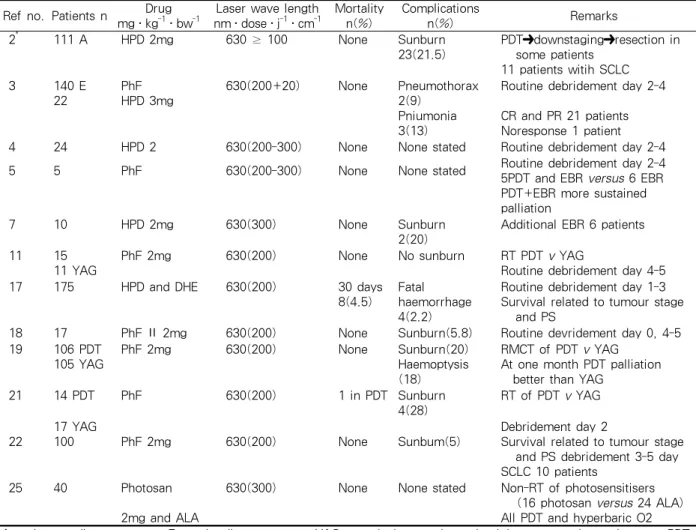
PDT로 진행병기의 폐암을 치료한 의사들은 sur- vival benefit을 위한 palliation 목적으로 시술했고 performance status가 나쁘거나 흉곽 외의 전이성 병
Ref no. Patients n Drug mg․kg-1․bw-1
Laser wave length nm․dose․j-1․cm-1
Mortality n(%)
Complications
n(%) Remarks
2* 111 A HPD 2mg 630 ≥ 100 None Sunburn
23(21.5)
PDT➜downstaging➜resection in some patients
11 patients witih SCLC
3 140 E
22
PhF HPD 3mg
630(200+20) None Pneumothorax 2(9)
Pniumonia 3(13)
Routine debridement day 2-4
CR and PR 21 patients Noresponse 1 patient
4 24 HPD 2 630(200-300) None None stated Routine debridement day 2-4
5 5 PhF 630(200-300) None None stated Routine debridement day 2-4
5PDT and EBR versus 6 EBR PDT+EBR more sustained palliation
7 10 HPD 2mg 630(300) None Sunburn
2(20)
Additional EBR 6 patients
11 15
11 YAG
PhF 2mg 630(200) None No sunburn RT PDT v YAG
Routine debridement day 4-5
17 175 HPD and DHE 630(200) 30 days
8(4.5)
Fatal haemorrhage 4(2.2)
Routine debridement day 1-3 Survival related to tumour stage
and PS
18 17 PhF Ⅱ 2mg 630(200) None Sunburn(5.8) Routine devridement day 0, 4-5 19 106 PDT
105 YAG
PhF 2mg 630(200) None Sunburn(20)
Haemoptysis (18)
RMCT of PDT v YAG At one month PDT palliation
better than YAG
21 14 PDT PhF 630(200) 1 in PDT Sunburn
4(28)
RT of PDT v YAG
22
17 YAG
100 PhF 2mg 630(200) None Sunbum(5)
Debridement day 2
Survival related to tumour stage and PS debridement 3-5 day SCLC 10 patients
25 40 Photosan
2mg and ALA
630(300) None None stated Non-RT of photosensitisers (16 photosan versus 24 ALA) All PDT and hyperbaric O2 A: advance disease cases; E: early disease cases; YAG: neodynium yttrium aluminium garnet laser therapy; PDT:
photodynamic therapy; HPD: haematoporphyrin derivative; PhF: Photofrin; DHE: dihaematoporphyrin ether; ALA:
5-aminolevulinic acid; SCLC: small-cell lung cancer; CR: complete remission; PR: partial remission; EBR: external beam radiotherapy; RT: randomised trial; RMCT: randomised multicentre trial; PS: performance status; O2 oxygen.
*article with mix of early and advanced cases.
Table 3. Photodynamic therapy (PDT) details of 12 articles (636 patients) concerned with advanced stage lung cancer
변이 있는 환자는 제외하였다.
전 세계적으로 최근에 폐암에서 시행한 PDT에 관 련된 24개의 논문(1,153환자)에서 12개의 논문(636환 자)이 진행병기의 폐암과 관련된 것이다. 결론은 다음 과 같다.
Bronchoscopic PDT는 안전하고 기관지내 병변이 있는 진행병기의 폐암에서 효과적인 치료방법이다.
이에 따른 mortality는 없다. 모든 환자에서 증상의 호 전이 있었고 전이성 병변이 없는 good performance status의 환자에서 survival benefit이 있었다. 이에 따 른 부작용은 skin photosensitivity reaction이고 빈도 는 5%-28%이며 경증이다.
나) 초기병기의 폐암(group E)
초기병기 폐암은 기관지벽에 국한된 (T1)종양이며 폐실질의 침범이 없는 경우를 의미한다.
이러한 경우에 PDT는 다른 이유로 수술적 제거를 할 수 없는 경우에 시행하게 된다. 즉
가) Cardiorespiratory insufficiency가 있거나 다른 질환이 있어서 수술 위험성이 크거나 수술 후 삶의 질 이 나쁠 경우
나) 수술적 완치를 하기에 부적당한 multifocal bronchial disease가 있는 경우
다) 환자가 수술을 거부한 경우 등으로 PDT는 완
[Ref no.] Patients/
lesions n
Drug mg․kg-1․bw-1
Laser wave length
nm․dose․j-1․cm-1 Mortality Complications n(%) Remarks
6
38/40 HPD
2-5 mg
90-375 or 54-600 None Sunbum 3 (7.7) Respiratory complication 5(13)
Haemoptysis 3 (7.8))
Procedure under GA CR 11 (29%) up to 53 m SCLC 1
8
36/39 HPD
2.5 mg
630 None None stated CR 11 (>30%)
Survived 37-109 months 16 patients
Non-Ca cause 15 patients¶
9 13/14 HPD
2.5 mg
630(200-400) None None stated CR 10 (77%)
Cancer no CR had surgery 3 patients
10 51/61 PhF Ⅱ
2 mg
630(100-200) None Sunburn 14 (28) CR 43 (84.8%) for 18 months 97% CR if tumor <1 com Tis 100% CR 70% survival≥5yrs
12 29/39 PhF
2 mg
630(100-3000) 1 pt 30 days
Anaphylatic reaction 1 Sunbrun 12 (41)
CR 19 (64%)
EBR for 10 PR→7CR 5-yr survival 56%overall Debridement frequent (everyday)
13 22/30 PhF 630(200) None None stated PDT stump recurrence 6 (23%)
Total CR 1 patients
14 30/39 PhF
2 mg
630(200) None Sunburn 4 (13) Survival 2-95 m (median 10 m) TIS 17 with 100% CR PDT→EBR 2 patient
15 12/12 PhF
2 mg
630 None None stated Tumour recurrence in stump
PDT+Brachytherapy
16 21/28 PhF
2 mg
630(200-400) None Sunburn 5 (23.7) PDT followed by surgery 10 patients
CR 11 (52%) >12m PDT alone and spared
operation 9 patients
20 102 PhF
2 mg
630(200) None Sunburn 22 (22)
Respiratory complications 20 (18-22)
CR 80 (79%) >40% 24m Median disease specific 5.7 yrs Median survival 3.5 yrs
2* 140 E
111 A
PhF 2 mg
630(100 or 200) None Sunburn 30 (21.5) CR 77 (81%) for stage Ⅰ 5-yr survival 68.4%
5-yr disease specific survival 94.8%
23 23 HPD
5 mg
630(360) None None stated CR 16 (62%)
Additional brachytherapy 3 patients
24 6E
6 YAG 17 EC
PhF
2 mg
630(200) None Fibrous scarring and stenosis after 6 months 4 (67)
Non-RT
Oncological/survival outcome not stated
E: early disease cases; A: advance disease cases; YAG: neodynium yttrium aluminium garnet laser therapy; EC: electrocautery; HPD:
haematoporphyrin derivative; PhF: photofrin; pt: patient; GA: general anaesthetic; CR: complete remission; SCLC: small cell lung cancer;
Ca: cancer; TIS: tumour situ; EBR: external beam radiotherapy; PR: partial remission; PDT: photodynamic therapy; RT: randomised trial.
*article with mix of early and advanced cases.
†patient died.
Table 4. Photodynamic therapy (PDT) details of 12 articles (517 patients) concerned with early stage lung cancer
치를 목적으로 시행하고 있다.
초기병기 폐암의 PDT효과에 대한 대규모 보고가 Tokyo-Medical University에서 있었다. 19년 동안 Kato 등이 early-stage, central-type lung cancer인 95명(116 lesions)에서 PDT를 하였고 5년 생존율은
68.4%이다. 다른 질환으로 사망한 경우를 제외하면 5 년 생존율은 94.8%로 증가한다.
Group E 환자의 문제점의 하나는 진단된 암의 extent(multifocality and the depth of infiltration)이 다. 이 문제점의 해결을 위해서 현재는 fluorescent
bronchoscopy와 bronchoscopic ultrasonography를 도입하고 있다.
a) Fluorescence bronchoscopy(AFB)
이 방법은 통상적인 white light 대신에 blue light 를 이용해서 기관지경 검사를 하는 것이다. AFB는 white light 에서는 찾을 수 없는 early- stage cancer 의 특징인 endobronchial epithelial change의 범위를 찾는데 유용하다.
b) Bronchoscopic ultrasonography
endoscopic ultrasonography imaging을 이용해서 disease의 depth와 involvement를 측정한다.
상기 두 방법은 cancer의 endobronchial treat- ment에 사용이 증가하고 있다. 최근 초기병기 폐암에 서 시행한 PDT에 관련된 12개의 article(523 patients) 을 보면 PDT는 수술 위험도가 높은 경우 (functional inoperability)에 가장 흔히 시술된다. 어떤 환자는 수 술적 절제를 받은 후에 반대 폐에 metachronous cancer가 있어서 PDT를 시술받았다. PDT를 시술받 은 환자에서 소수에서만이 localized bronchial stump recurrence가 발생했다. 초기병기 폐암에서 super- ficial carcinoma in situ가 있는 환자에서는 동시에 양 쪽 폐에서 multifocal endobronchial lesion의 가능성 이 있으므로 PDT가 유용하다.
초기병기 폐암에서 endoscopic PDT의 결과를 보 면 시술과 관련된 사망률이 없고 치명적인 합병증이 없으며 수술적 제거와 동등한 long survival을 보이고 있으며, 일본의 보고에 의하면 5년 생존율이 70%이고 다른 사망원인을 제외하면 90%이상의 survival을 보 이고 있다.
광과민제의 부작용은 skin photosensitivity (skin burn)이며 대개 경미하고 평균 10%에서 발생하며 Yorkshire Laser Center에서는 환자의 5%(3% of treatment)에서 지속되었다.
5. 기관지경하 PDT와 다른 치료방법들 사이의 관계 PDT가 폐암 치료의 중요한 도구인 것은 여러 성적
에서 보듯이 의심할 여지가 없다. Medline(Pubmed) 에서 PDT에 대해 조회했을 때 1982년부터 2004년까 지 발행된 253개의 논문을 찾을 수 있다. 이것은 폐암 에서 시행하는 전통적인 수술적 제거, 방사선치료 및 항암화학요법과는 여러 관점에서 다른, 내시경을 이 용한 치료방법(endoscopic method)이기 때문이다. 여 러 endoscopic methods가 안정성 검사를 하고 phase l trial을 마쳤다. 즉 NdYAG laser, brachytherapy 및 cryotherapy가 수년 동안 이용되었고 시험을 마쳤다.
문제는 evidence-based medicine을 위해서 기존의 endoscopic method와 효과를 비교하는 trial이 있어야 하지만, PDT와 다른 endobronchial treatment의 효과 를 비교한 randomized trial은 NdYAG laser를 제외하 고는 없다.
그러나 method간의 large-scale multicenter trial을 시행하는 것은 불가능하다. 재정적인 면이나 recruit- ment의 어려움을 포함한 여러 제약점이 있기 때문이 다. 영국에서 Medical Research Council에서 시행한 실패했던 trial을 보면 이를 알 수 있다. 이 trial은 randomized study로 external beam radiotherapy과 endobronchial treatment(PDT, YAG laser, brachy- therapy, and cryotherapy)간의 치료결과를 비교하는 것이다. randomization은 검사자에 의해 선정된 endo- broscopic method중에 하나와 external beam radio- therapy간에 이루어졌다. 3년 후에 recruitment가 너 무 적어서 이 project는 중단되었다. 이것은 환자들이 부분적으로 endobronchial therapy를 더 선호해서 external beam radiotherapy를 거부했기 때문이다. 환 자는 external beam radiotherapy가 할당되면 rando- mization을 거부했다. 또한 검사자의 협조가 부족했 다. endobronchial therapy를 비교하는 prospective controlled trial이 없기 때문에 Mathur 등이 early lung cancer에서 bronchoscopic NdYAG laser, bra- chytherapy, cryotherapy, electrocautery와 PDT에 관 련된 출판물을 재검토했다. 이 저자는 치료의 효과와 다른 측정 가능한 parameter를 분류해서 차례로 점수 를 주었다. PDT는 다른 치료기술에 비해서 가장 높은 점수(B)를 받았다. 이론적으로 PDT가 다른 method 와 비교할 때 월등하며 이것은 PDT가 종양학적으로
destructive properties가 있고 다른 endobronchial therapy보다 가장 target-orientation이 크기 때문이 다. 이것은 PDT가 광과민제와 이에 합당한 빛의 파장 간의 상호작용의 결과이기 때문이다. 그리고 photo- sensitized cancerous tissue가 빛에 의해 우선적인 목 표가 되어서 tissue necrosis가 발생하고 collateral damage를 최소화하기 때문이다.
PDT는 NdYAG laser와 같이 사용할 수 있다. 이것 은 기관지 폐쇄를 야기하는 종양을 감소시키기 위해 서 YAG laser를 이용해서 효과가 있었던 환자의 예 에서 찾아볼 수 있다. YAG laser 시술 후 PDT를 하 면 local remission까지의 기간을 길게 하고 survival benefit을 얻을 수 있다. photofrin을 이용한 PDT가 다른 치료방법들과 병합할 때 효과가 더 좋다는 것은 경험적으로 가능하다.
특별한 PDT의 금기는 아직 없는 것으로 보인다.
결 론
문헌 고찰을 해보면, 최근에 폐암치료에 있어서 기 관지경하 PDT의 역할이 더욱 명확해지고 있다. 현재, 폐암에 대한 PDT에는 오직 photofrin(porfimer sodium)만이 세계적인 권위기관들에서 인정되어 널 리 사용되고 있다. photofrin은 630nm light에 의해 활 성화된다. 그러나, 폐암의 기관지경하 PDT에 있어서 광과민제로서는 이상적이지 않다. 이상적인 광과민제 에 대한 연구는 지속되고 있다.
PDT가 폐암을 치료함에 있어서 안전하고 효과적 이라는 논의를 지지할 근거는 충분하다. 진행병기에 있어서 PDT의 역할은 특정 집단의 survival benefit 을 위한 palliation이기 때문에 PDT를 다른 치료방법 과 함께 사용할 수 있다. 초기병기에 있어서의 역할은 완치를 목적으로 하며, 이것은 성취할 수 있는 근거가 충분히 있다. COPD의 빈도가 증가하고, 고령화됨에 따라 초기병기를 갖은 폐암환자에서 PDT는 많이 사 용될 수 있다.
PDT를 폐암을 포함한 각종 암에 치료목적으로 사 용할 수 있으나 가장 큰 단점으로는 광과민제의 값이 너무 비싸다는 것이다. 따라서 보다 저렴한 광과민제
의 개발이 필수적이며 diode laser의 값도 보다 더 저 렴하게 공급되어야 할 것이다.
참 고 문 헌
1. Moghissi K, Dixon K, Thorpe JAC. A method of video-assisted thoracoscopic photodynamic therapy (VAT-PDT). Interact Cardiovasc Thoracic Surg 2003;
2:373-5.
2. Kato H. Photodynamic therapy for lung cancer: a review of 19 years experience. J Photo Chem Pho- tobiol B Biol 1998;42:96-9.
3. Balchum OJ, Doiron DR, Huth GC. PDT of endobronchial lung cancer employing the photo- dynamic action of haematoporphiria derivatives. Lasers Surg Med 1984;14:13-30.
4. Lam S, Muller NL, Miller RR, Kostashuk EC, Szasz IJ, LeRiche JC, et al. Predicting the response of obstructive endobronchial tumours to PDT. Cancer 1986;58:2298-306.
5. Lam S, Kostashuk EC, Coy EP, Laukkanen E, LeRiche JC, Mueller HA, et al. A randomised study of the safety and efficacy of photodynamic therapy using photofrin II combined with palliative radiotherapy versus palliative radiotherapy alone in patients with inoperable obstructive non-small cell bronchogenic carcinoma. Photochem Photobiol 1987;46:893-7.
6. Edell ES, Cortese DA. Bronchoscopic phototherapy with hematoporphyrin derivative for treatment of localized bronchogenic carcinoma. A 5-year experience.
Mayo Clin Proc 1987;14:62-8.
7. LoCicero J, Metzdorff M, Almgren C. Photodynamic therapy in the palliation of late stage obstructing non-small cell lung cancer. Chest 1990;98:97-100.
8. Ono R, Ikeda S, Suemasu K. Hematoporphyrin derivative photodynamic therapy in roentgenographi- cally occult carcinoma of the tracheobronchial tree.
Cancer 1992;69:1696-701.
9. Edell ES, Cortese DA. Photodynamic therapy in the management of early superficial squamous cell carci- noma as an alternative to surgical resection. Chest 1992;102:1319-22.
10. Furuse K, Fukuoka M, Kato H, Horai T, Kubota K, Kodama N, et al. A prospective phase II study on photodynamic therapy with photofrin II for centrally located early-stage lung cancer. The Japan Lung Cancer Photodynamic Therapy Study Group. J Clin Oncol 1993;11:1852-7.
11. Moghissi K, Dixon K, Parsons RJ. Controlled trial of NdYAG laser versus photodynamic therapy for advan-
ced malignant bronchial obstruction. Laser Med Sci 1993;8:269-73.
12. Imamura S, Kusunoki Y, Takifuji N, Kudo S, Matsui K, Masuda N, et al. Photodynamic therapy and/or external beam radiation therapy for roentgenologically occult lung cancer. Cancer 1994;73:1608-14.
13. Lam S. Photodynamic therapy of lung cancer. Semin Oncol 1994;21:15-9.
14. Sutedja G, Lam S, LeRiche JC, Postmus PE.
Response and pattern of failure after photodynamic therapy for intraluminal stage I lung cancer. J Bronchol 1994;1:295-8.
15. Freitag L, Korupp A, Itzigehl I, Dankwart F, Tekolf E, Reichle G, et al. Experiences with fluorescence diagnosis and photodynamic therapy in a multi- modality therapy concept of operated, recurrent bronchial carcinoma. Pneumologie 1996;50:693- 9.
16. Cortese DA, Edell ES, Kinsey JH. Photodynamic therapy for early stage squamous cell carcinoma of the lung. Mayo Clin Proc 1997;72:595-602.
17. McCaughan JS Jr, William TE. Photodynamic therapy for endobronchial malignant disease: a prospective 14 year study. J Thorac Cardiovascular Surg 1997;114:940-7.
18. Moghissi K, Dixon K, Hudson E, Stringer M, Brown S. Endoscopic laser therapy in malignant tracheo- bronchial obstruction using sequential NdYAG laser and photodynamic therapy. Thorax 1997;52:281-3.
19. Weiman TJ, Diaz-Jimenez JP, Moghissi Kl. Photo- dynamic therapy with Photofrin is effective in the palliation of obstructive endobronchial lung cancer : results of two randomised trials [abstract]. Pro- ceedings of the 34th annual meeting of the American Society of Clinical Oncology. 16-9 May 1998; Los Angeles, CA, USA.
20. Lam S, Haussinger K, Leroy M, Sutedja T, Huber RM. Photodynamic therapy (PDT) with photofrin, a treatment with curative potential for early-stage superficial lung cancer [abstract]. Proceedings of the 34th annual meeting of the American Society of Clinical Oncology, 16-9 May 1998; Los Angeles, CA, USA.
21. Diaz-Jimenez JP, Martinez-Ballarin JE, Llunell A, Farrero E, Rodriguez A, Castro MJ. Efficacy and safety of photodynamic therapy versus Nd-YAG laser resection in NSCLC with airway obstruction. Eur Respir J 1999;14:800-5.
22. Moghissi K, Dixon K, Stringer M, Freeman T, Thorpe A, Brown S. The place of bronchoscopic photodynamic therapy in advanced unresectable lung cancer:
experience in 100 cases. Eur J Cardiothorac Surg 1999;15:15-6.
23. Patelli M, Lazzari Agli L, Poletti V, Falcone F.
Photodynamic laser therapy for the treatment of early-stage bronchogenic carcinoma. Monaldi Arch Chest Dis 1999;54:315-8.
24. Van Boxem AJM, Westerga J, Wenmans BJW, Postmus PE, Sutedja G. Photodynamic Therapy, NdYAG laser and electro cautery for treating early stage intraluminal cancer: which to choose. Lung Cancer 2001;31:31-6.
25. Maier A, Tomaselli F, Matzi V, Woltsche M, Anegg U, Fell B, et al. Comparison of 5-aminolaevulinic acid and prophyrin photosensitization for photodynamic therapy of malignant bronchial stenosis: a clinical pilot study. Lasers Surg Med 2002;30:12-7.
26. Kato H, Harada M, Ichinose S, Usuda J, Tsuchida T, Okunaka T. Photodynamic therapy of lung cancer:
experience of the Tokyo Medical University. Photodiag Photodyn Therapy 2004;1:49-55.
27. Lam S, Kennedy T, Unger M, Miller YE, Gelmont D, Rusch V, et al. Localization of bronchial intraepi- thelial neoplastic lesions by fluorescence broncho- scopy. Chest 1998;113:696-702.
28. Pasic A, Vonk-Noordegraaf A, Risse EKJ. Multiple suspicious lesions detected by autofluorescence bron- choscopy predict malignant development in the bronchial mucosa in high risk patients. Lung Cancer 2003;41:295-301.
29. Herth F, Ernst A, Schulz M, Becker H. Endobron- chial ultrasonography reliably differentiates between airway infiltration and compression by tumour. Chest 2003;123:458-62.
30. Takahashi H, Sagawa M, Sato M, Sakurada A, Endo C, Ishida I, et al. A prospective evaluation of trans- bronchial ultrasonography for assessment of depth of invasion in early bronchogenic squamous cell carci- noma. Lung Cancer 2003;42:43-9.
31. Moghissi K, Bond MG, Sambrook RJ, Stephens RJ, Hopwood P, Girling DJ. Treatment of endotracheal or endobronchial obstruction by non- small cell lung cancer: lack of patients in an MRC randomised trial leaves key questions unanswered. Clin Oncol 1999;
11:179-83.
32. Mathur PN, Edell E, Sutedja T, Vergnon JM;
American College of Chest Physicians. Treatment of early stage non-small cell lung cancer. Chest 2003;
123:1765-805.
33. Dougherty TJ. An update on photodynamic therapy applications. J Clin Laser Med Surg 2002;20:3-7.
34. Dougherty TJ. Activated dye as an antitumour agent.
J Natl Cancer Inst 1974;52:1333-6.
35. Radu A, Grosjean P, Fontolliet CH. Photodynamic therapy for 101 early cancer of the upper aerodi-
gestive tract, the esophagus and the bronchi : a single-institution experience. Diagnost Therapeutic Endosc 1999;5:145-54.
36. Kato H, Furukawa K, Sato M, Okunaka T, Kusunoki Y, Kawahara M, et al. Phase II clinical study of photodynamic therapy using mono-L-aspartyl chlorin e6 and diode laser for early superficial squamous cell carcinoma of the lung. Lung Cancer 2003;42:103-11.
37. Mang TS. Lasers and light sources for PDT: past, present and future. Photodiag Photodyn Therapy 2004;1:43-8.
38. Maier A, Tomaselli F, Matzi V, Woltsche M, Anegg U, Fell B, et al. Comparison of 5-aminolevulinic acid and porphyrins photosensitisation for photodynamic therapy of malignant bronchial stenosis: a clinical pilot study.
Laser Surg Med 2002;30:12-7.
39. Dougherty TJ, Kaufman JE, Goldfarb A, Weishaupt
KR, Boyle D, Mittleman A. Photoradiation therapy for the treatment of malignant tumors. Cancer Res 1978;38:2628-35.
40. Hyata Y, Kato H, Konaka C, Ono J, Takizawa N.
Haematoporphyrin in derivative and laser photor- adiation in the treatment of lung cancer. Chest 1982;81:264-77.
41. Moghissi K, Dixon K. Is bronchoscopic photodynamic therapy a therapeutic option in lung cancer. Eur Resp J 2003;22:535-41.
42. Okunaka T, Kato H, Tsutsui H, Ishizumi T, Ichinose S, Kuroiwa Y. Photodynamic therapy for peripheral lung cancer. Lung Cancer 2004;43:77-82.
43. Moghissi K. Role of bronchoscopic photodynamic therapy in lung cancer management. Curr Opin Pulm Med 2004;10:256-60.