Brief Report
S46 Ann Dermatol
Received June 19, 2018, Revised December 14, 2018, Accepted for publication March 25, 2019
Corresponding author: You Chan Kim, Department of Dermatology, Ajou University School of Medicine, 164 WorldCup-ro, Yeongtong-gu, Suwon 16499, Korea. Tel: 82-31-219-5190, Fax: 82-31-219-5189, E-mail: [email protected]
ORCID: https://orcid.org/0000-0003-4840-594X
This is an Open Access article distributed under the terms of the Creative Commons Attribution Non-Commercial License (http://creativecommons.org/
licenses/by-nc/4.0) which permits unrestricted non-commercial use, distribution, and reproduction in any medium, provided the original work is properly cited.
Copyright © The Korean Dermatological Association and The Korean Society for Investigative Dermatology
pISSN 1013-9087ㆍeISSN 2005-3894
Ann Dermatol Vol. 31, Suppl, 2019 https://doi.org/10.5021/ad.2019.31.S.S46
BRIEF REPORT
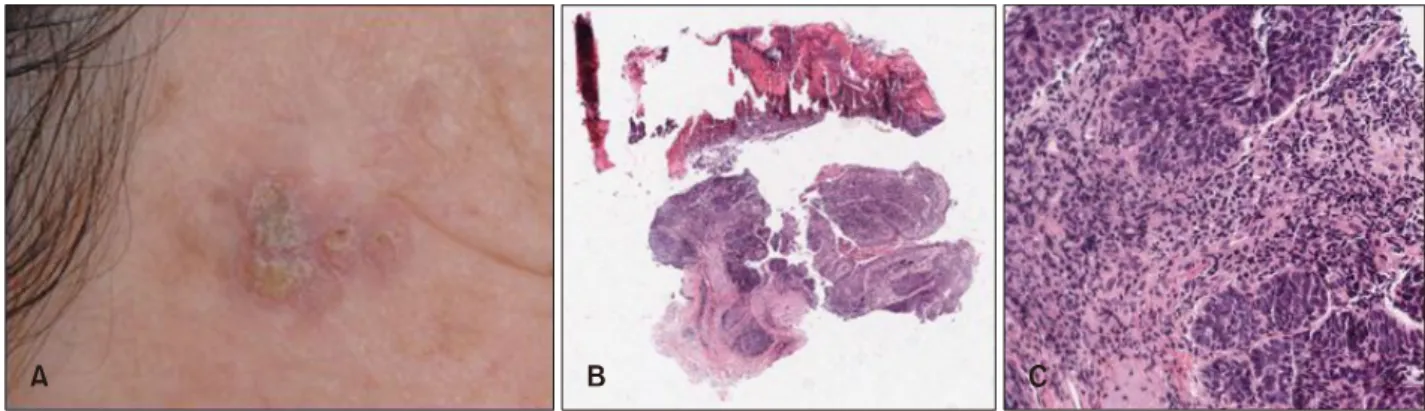
Fig. 1. Clinical and histopathologic features of squamous cell carcinoma (SCC). (A) Erythematous crusted plaque on the right temple.
(B, C) Skin biopsy specimen with serous crust and atypical keratinocytes invading the dermis, which led to the diagnosis of invasive SCC (H&E: B, original magnification; C, ×200). We received the patient’s consent form about publishing all photographic materials.
A Case of Squamous Cell Carcinoma Treated with Photodynamic Therapy with Ablative Carbon Dioxide Fractional Laser
Soo Hyun Kwon, Ji Young Yang, You Chan Kim
Department of Dermatology, Ajou University School of Medicine, Suwon, Korea
Dear Editor:
Surgical excision is the main treatment of cutaneous squ- amous cell carcinoma (SCC). However, owing to its high incidence in older age groups, some patients may not be suitable for surgery. We report a rare case of invasive SCC treated with methyl aminolevulinic acid photodynamic therapy (MAL-PDT) with ablative CO2 fractional laser.
An 83-year-old female presented with a 2-year history of an asymptomatic erythematous crusted plaque on the right temple (Fig. 1A). She had undergone laser therapy once,
without a successful outcome. Skin biopsy revealed atyp- ical keratinocytes invading the dermis. The keratinocytes were pleomorphic and hyperchromatic with atypical mi- totic figures (Fig. 1B, C). The patient refused to undergo surgery and radiotherapy; thus, she was treated with MAL-PDT with ablative CO2 fractional laser 3 times, with a 630-nm light-emitting diode at a light dose of 37 J/cm2. Ablative CO2 fractional laser (eCO2; Lutronic Inc., Seoul, Korea) was performed with 1,000 μm beam size, 30 W peak power, 60 mJ pulse energy, and 100% total density.
Brief Report
Vol. 31, Suppl, 2019 S47 Fig. 2. Clinical and histopathologic features after treatment. (A) Brownish patch on the treated area. (B, C) Skin biopsy specimen revealed no residual tumor (H&E: B, original magnification; C, ×100).
Immediately after ablative CO2 fractional laser, we applied MAL to the lesion and covered it with occlusive dressing for 2 hours, after which PDT was performed. The second and third sessions were conducted 3 and 7 weeks later, respectively. Two months after the last treatment, a brown- ish patch remained on the treated area; however, no re- sidual tumor was seen on the skin biopsy (Fig. 2). Two years after the last treatment, we found that there was no recurrence.
Generally, owing to limitations in the ability to treat deep- set disease with local treatment, PDT alone is not recom- mended for SCC lesions with a potential for regional spread1. PDT has reduced efficacy for microinvasive and nodular invasive SCC, for which 24-month clearance rates of 57% and 26%, respectively, have been reported2. In a systematic review article, after an apparently successful in- itial response of SCCs to PDT, pooled average recurrence of 26.4% (12.3% to 43.7%; 8 studies) was significantly higher than other treatments3.
PDT with ablative CO2 fractional laser is more efficacious than conventional MAL-PDT for treating microinvasive SCC lesions4. We report a rare case of invasive SCC treated with MAL-PDT with ablative CO2 fractional laser, without recurrence for 24 months after the last treatment. Ablative fractional laser facilitates the delivery and uptake of top- ical MAL deep into the skin, enhancing porphyrin syn- thesis and photodynamic activation5. The ablation fraction laser was used intentionally to drill tiny holes, so the tu- mor mass debulking effect seems to be minimal. In the case of SCC, PDT with ablative CO2 fractional laser may be particularly useful because of the deep invasion of the lesion. Among patients with SCC who are not suitable for surgery or radiotherapy, MAL-PDT with ablative CO2 frac- tional laser might be another noninvasive treatment option.
However, this type of treatment should be carefully de- cided and close follow up is necessary after treatment as
SCC is a disease that can progress to metastasis.
ACKNOWLEDGMENT
This work was supported by the GRRC program of Gyeong- gi province (GRRC AJOU2016B04, Photonics-Medical Con- vergence Technology Research Center).
CONFLICTS OF INTEREST
The authors have nothing to disclose.
ORCID
Soo Hyun Kwon, https://orcid.org/0000-0002-2336-9770 Ji Young Yang, https://orcid.org/0000-0002-2929-0908 You Chan Kim, https://orcid.org/0000-0003-4840-594X
REFERENCES
1. Zhao B, He YY. Recent advances in the prevention and treatment of skin cancer using photodynamic therapy.
Expert Rev Anticancer Ther 2010;10:1797-1809.
2. Morton C, Szeimies RM, Sidoroff A, Wennberg AM, Basset- Seguin N, Calzavara-Pinton P, et al; European Dermatology Forum. European Dermatology Forum Guidelines on topi- cal photodynamic therapy. Eur J Dermatol 2015;25:296- 311.
3. Lansbury L, Bath-Hextall F, Perkins W, Stanton W, Leonardi- Bee J. Interventions for non-metastatic squamous cell car- cinoma of the skin: systematic review and pooled analysis of observational studies. BMJ 2013;347:f6153.
4. Choi SH, Kim KH, Song KH. Effect of methyl aminolevuli- nate photodynamic therapy with and without ablative frac- tional laser treatment in patients with microinvasive squa- mous cell carcinoma: a randomized clinical trial. JAMA
Brief Report
S48 Ann Dermatol
Dermatol 2017;153:289-295.
5. Haedersdal M, Katsnelson J, Sakamoto FH, Farinelli WA, Doukas AG, Tam J, et al. Enhanced uptake and photo-
activation of topical methyl aminolevulinate after fractional CO2 laser pretreatment. Lasers Surg Med 2011;43:804-813.