Kor. J. Pharmacogn.
49(1) : 65∼ 69 (2018)
65
사상자 미백성분 Torilin의 추출조건 최적화
조양희·안종훈·송다혜·황방연·이미경*
충북대학교 약학대학
Optimization of Extraction Conditions of Torilin, a Melanogenesis Inhibitor from Torilis japonica Fruits
Yang Hee Jo, Jong Hoon Ahn, Da Hye Song, Bang Yeon Hwang, and Mi Kyeong Lee* College of Pharmacy, Chungbuk National University, Cheongju 28160, Korea
Abstract − Torilin is a major sesquiterpene of Torilis japonica (Umbelliferae) fruits and known to be a melanogenesis inhibitor.
Extraction conditions are important factor for the efficient preparation to save cost and time in economic aspects. For this rea- son, this study was conducted to optimize the extraction condition for maximal yield of torilin. For optimization, extraction fac- tors such as extraction solvent, extraction temperature and sample/solvent ratio were tested and optimized for maximum yield of torilin using response surface methodology with Box-Behnken design (BBD). The optimal condition was obtained as a EtOAc concentration in MeOH of 31.8%, an extraction temperature at 30.3oC and a sample/solvent ratio, 1000 mg/2 ml. The torilin yield under optimal conditions was found to be 9.9 mg/g dried samples, which were well-matched with the predicted value of 10.4 mg/g dried samples. These results will provide useful information about optimized extraction conditions for the development of torilin as cosmetic therapeutics to reduce skin hyperpigmentation.
Keywords − Torilin, Torilis japonica, Optimization, Response surface methodology, Melanogenesis inhibitor
사상자(Torilis japonica Decandolle)는 미나리과(Umbel- liferae)에 속하는 두해살이풀로 우리나라 전역에 자생한다.
전체에 짧은 복모가 있고 높이 30~70 cm 줄기는 곧게 선 다. 잎은 호생하며 3출엽이고 2회 호상으로 갈라지며 길이 5~10 cm로서 끝이 뾰족하고 녹색이며 소엽은 난상 피침형 이고 뾰족한 톱니가 있으며 엽병 밑 부분이 넓어져서 원줄 기를 얼싸안는다. 꽃은 6~8 월에 피고 백색이며 가지 끝과 원줄기 끝의 복산형화서에 달리고 소산경은 5~9개이며, 길 이 1~3 cm로서 6~20개의 꽃이 달린다. 열매는 4~10개씩 달 리며 난형이고 길이 2.5~3 mm로서 짧은 가시같은 털이 있 어 다른 물체에 잘 붙는다. 어린 순을 나물로 하고 열매는 약용으로 한다. 이 식물 아래 뱀이 웅크리고 있는 경우가 많 아 ‘뱀도랏’이라고도 한다. 유사종인 갯사상자·벌사상자·개 사상자의 씨도 사상자로 함께 약용한다.1)
한의약에서 열매를 말려 만든 생약을 ‘사상자’라고 부르 며 맵고 쓰며 따뜻한 성질이 있고 독은 없다고 알려져 있다.
약리효과로는 항원충작용, 성호르몬유사작용, 항암작용, 간
세포보호작용 등이 보고되어 있으며, 수렴성 소염약으로 가 려움증 등 피부질환에도 사용되고 있다.2-5) 사상자는 정유나 지방유 성분이 주로 이루어져 있으며 주성분으로 다양한 골 격의 sesquiterpene계의 화합물이 함유되어 있는 것으로 보 고되어 있다.6-10)
멜라닌은 여러 동물들의 피부나 눈 등의 조직에 존재하는 갈색 내지는 흑색 고분자 색소로서 인간의 피부색을 결정 하고 외부의 자외선으로부터 피부를 보호하는 역할을 갖는 긍정적 기능에 반해, 과도한 멜라닌 생성과 비정상적인 분 포는 기미와 주근깨를 형성하거나 노화로 인한 반점 같은 색소 침착 등 부정적인 기능도 가지고 있다.11,12) 최근 피부 착색에 대한 관심이 높아지면서 멜라닌 생성 억제를 시키기 위한 미백 소재 물질을 찾기 위해 다양한 연구가 계속하여 진행되고 있다. 사상자의 주성분은 torilin으로 guaiane 골격 의 sesquiterpene 화합물이다(Fig. 1). Torilin은 B16 세포에 서 tyrosinase의 α-MSH(α-Melanocyte Stimulating Hormone) 유발 단백질 조절하여 멜라닌 형성을 억제한다는 보고가 되 어있으며 미백활성 이외에도 항염, 항암, 항미생물 효능 등 다양한 효능이 보고되어 새로운 소재로서의 가능성이 제시
*교신저자(E-mail):[email protected] (Tel): +82-43-261-2818
되고 있다.13,14)
본 연구에서는 사상자로부터 torilin을 확보하기 위한 추 출조건에 대한 연구를 수행하였다. 반응표면분석(Response surface methodology)을 이용하여 추출조건에 torilin의 수율 에 미치는 영향을 확인하고 최적의 추출조건을 도출하고자 하였다. 반응표면분석은 통계 분석 프로그램으로 변수가 여 러 가지인 경우 유용하다. 이는 여러 변수를 동시에 분석하 고 여러 변수들의 영향을 상호 비교 분석함으로써 빠르고 합리적으로 최적의 조건을 도출할 수 있다.14-17) 이에 본 연 구에서는 본 연구에서는 반응표면분석을 이용하여 여러 추 출조건이 torilin의 추출수율에 미치는 영향을 연구하고 이 를 통계적으로 분석하여 최적의 추출조건을 제시하고자 하 였다.
재료 및 방법
실험재료 − 실험에 사용한 사상자 열매(Fruits of T.
japonica)는 2014년 5월 경북 풍기읍에서 재배된 것으로 제 천약초에서 구입하여 충북대학교 약초원에서 검증하여 사 용하였으며, 시료의 표본(CBNU201405-TJ)은 충북대학교 약학대학 약학표본실에 보관되어 있다. Torilin은 사상자의 열매로부터 분리한 후 분광학적 분석방법을 이용하여 구조 를 확인한 후 실험에 이용하였다.18)
반응표면분석 실험 계획 − 사상자로부터 torilin의 추출조 건을 최적화하기 위하여 Box-Behnken design(BBD)의 반응 표면분석을 이용하였다. 실험 추출 조건으로는 추출용매, 추 출시간 및 시료-용매 비율을 설정하여 비교하였으며 이들을 각각 독립변수로 사용하였다. 추출변수는 각각 –1, 0, 1로 코드화하였으며 각 조건이 0이 되는 중심점을 3개를 포함 하는 총 15개의 추출조건을 프로그램을 이용하여 설정하였 다. 추출조건에 다른 종속변수로는 torilin의 함량으로 선정 하고 ANOVA를 이용한 통계분석을 통하여 각 변수간의 관 계를 분석하였다.
HPLC를 이용한 Torilin의 정량 − Torilin의 정량은 Waters HPLC [Waters 515 pumps, a Waters 717 autosampler, a 996 photodiode array detector, and Waters Empower
에서 측정하였다.
Torilin의 정량은 표준품 torilin을 메탄올에 각각 0.0625, 0.125, 0.25, 0.5 및 1 mg/ml.로 희석하여 표준품 용액을 제 조한 후 검량선을 작성한 후 사용하였으며 R2=0.9911의 직 선성을 나타내었다.
사상자 시료의 추출 − 건조한 사상자 열매를 분쇄한 후 각각 2 ml의 용매로 추출하였다. 추출용매, 추출온도 및 시 료의 양은 실험조건에 맞추어 진행하였으며 추출물은 여과 후 HPLC 분석에 사용하였다.
결과 및 고찰
사상자의 Sesquiterpene은 다양한 효능이 보고되어 있으 며 특히 주성분인 torilin은 미백활성 등 다양한 효능이 보고 되어 화장품 산업 등에서 새로운 소재로 제시되고 있다.13,18) Torilin을 화장품 소재로 개발되기 위하여서는 효율적인 방 법을 통하여 이를 확보하는 것이 필요하다.
본 연구에서는 사상자로부터 torilin을 효율적으로 추출하 기 위한 추출조건을 비교하고 최적화된 추출방법을 도출하 고자 하였다. 예비실험을 통하여 추출용매, 추출온도, 시료 -용매 비율, 추출시간 등 여러 조건을 비교하였으며 이 중 torilin의 수율에 영향을 주는 것으로 나타난 추출용매, 추출 온도, 시료-용매 비율 등에 대하여 반응표면 분석을 수행하 였다. 추출조건에 따른 torilin의 함량은 HPLC를 이용하여 수행하였으며 표준품을 이용하여 사상자 추출물 당 torilin 의 함량을 정량하였다(Fig. 2).
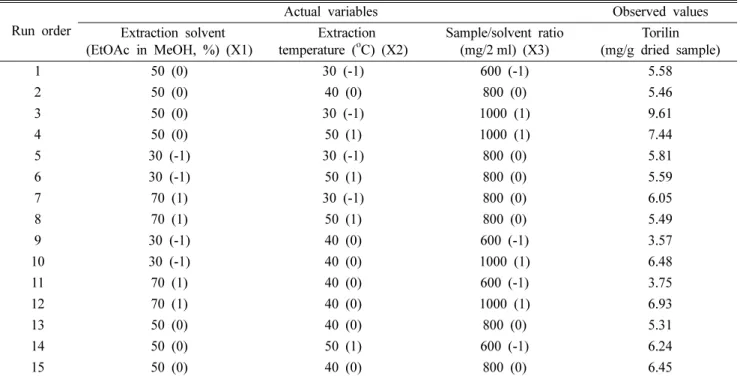
각 추출조건의 범위는 일차변수 예비실험을 통하여 추출 용매는 EtOAc와 MeOH의 혼합용매로 선정하였으며 EtOAc 의 용매 조성을 30, 50, 70%로 선정하였다. 추출온도는 30, 40, 50oC, 시료당 추출용매의 비율은 추출용매 2 ml 당 600, 800, 1000 mg으로 선정하였다. 이러한 추출조건을 바탕으로 각 조건이 코드화된 변수 0이 되는 중심점(50% EtOAc, 40oC, 800 mg 시료/2 ml 용매)을 3개를 포함하는 총 15개의 추출조건을 프로그램을 이용하여 설정하였다. 이와 같이 선 정된 추출조건으로 사상자를 추출한 후 각 시료의 torilin의 함량을 측정하였다. Table I에 보이듯이 추출수율의 차이를 나타내어 1 g의 사상자 시료당 torilin의 수율은 3.57 mg에 서 9.61 mg으로 상당한 차이를 나타내었다. 이는 추출조건 이 torilin의 수율에 큰 영향을 나타내며 최적의 수율을 위 한 추출조건의 최적화가 필요함을 시사하며 이에 최적화에 대한 연구를 수행하였다.
각 추출조건이 추출수율에 미치는 영향은 통계분석을 통 Fig. 1. Chemical structure of torilin.
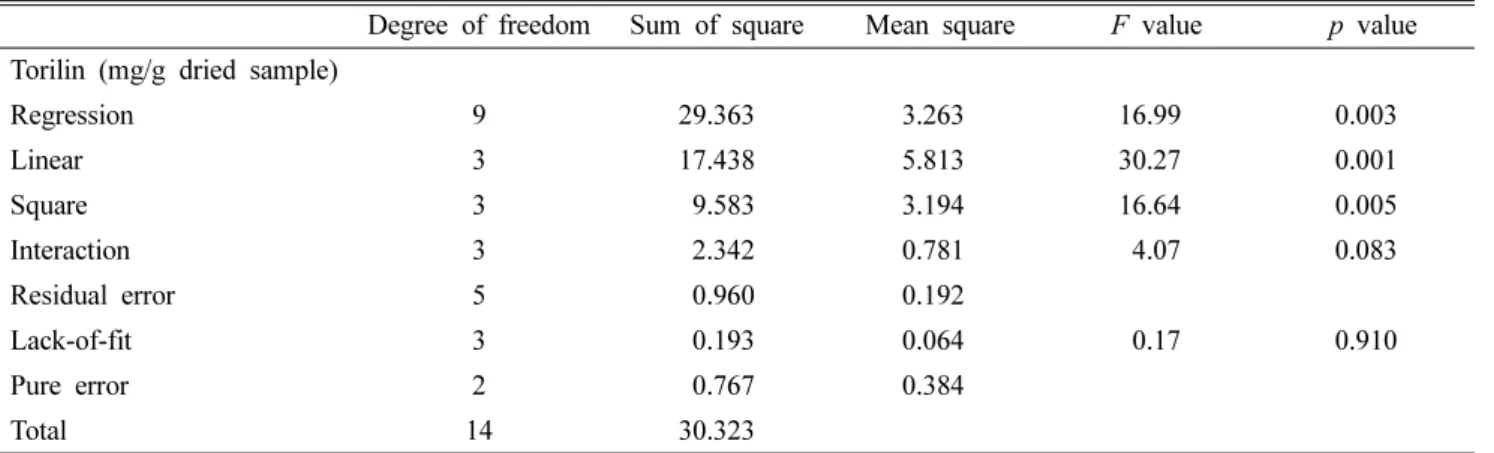
하여 살펴보았다. 각 추출조건의 계수의 유의성은 t-tests and p-values를 통하여 판단하였으며 ANOVA 분석을 통하여 torilin 수율에 대한 회귀식의 유의성을 판단하였다(Table II).
Torilin 수율에 대한 추출조건이 미치는 영향은 이차다항식 으로 다음과 같이 유도되었다.
Torilin yield (mg/g dried sample)
= 5.740+1.440X3− 1.045X12+ 1.040X22– 0.758X2X3 본 연구에서 비교한 세가지 추출조건 중 추출용매 당 시 료의 양(X3)과 추출용매(X12) 및 추출온도(X12)의 이차계수
가 유의성있는 영향을 나타내었으며 추출온도와 시료의 양 의 상호계수(X2X3)도 유의성있는 영향을 나타내었다.
이러한 회귀식의 신뢰도는 16.99의 F value와 0.003의 낮 은 p value를 통하여 적정한 것으로 판단하였으며 0.910의 lack of fit과 0.968의 R2 값도 결과의 신뢰성을 뒷받침하였 다(Table III).
Torilin의 수율에 미치는 각 추출변수의 영향은 반응표면 곡선으로 나타낼 수 있다. 세가지 추출 인자 중 추출용매는 MeOH의 양이 증가할수록 torilin의 수율이 증가하다가 다 시 감소하는 것을 확인할 수 있으며 시료의 비율이 증가할 수록 수율이 증가하는 것을 확인할 수 있다(Fig. 3).
Fig. 2. (A) HPLC chromatogram of torilin and (B) HPLC chromatogram of T. japonica fruits extract prepared from extraction con- dition of center point (X1, X2 and X3=0).
Table I. A Box-Behnken design for independent variables and their responses
Run order
Actual variables Observed values
Extraction solvent (EtOAc in MeOH, %) (X1)
Extraction temperature (oC) (X2)
Sample/solvent ratio (mg/2 ml) (X3)
Torilin (mg/g dried sample)
1 50 (0) 30 (-1) 600 (-1) 5.58
2 50 (0) 40 (0) 800 (0) 5.46
3 50 (0) 30 (-1) 1000 (1) 9.61
4 50 (0) 50 (1) 1000 (1) 7.44
5 30 (-1) 30 (-1) 800 (0) 5.81
6 30 (-1) 50 (1) 800 (0) 5.59
7 70 (1) 30 (-1) 800 (0) 6.05
8 70 (1) 50 (1) 800 (0) 5.49
9 30 (-1) 40 (0) 600 (-1) 3.57
10 30 (-1) 40 (0) 1000 (1) 6.48
11 70 (1) 40 (0) 600 (-1) 3.75
12 70 (1) 40 (0) 1000 (1) 6.93
13 50 (0) 40 (0) 800 (0) 5.31
14 50 (0) 50 (1) 600 (-1) 6.24
15 50 (0) 40 (0) 800 (0) 6.45
혼합 MeOH 2 ml로 30.0 에서 추출하는 경우 10.4 mg의 torilin을 얻을 수 있는 것으로 예측되었다. 이러한 예상치를 확인하기 위하여 제시된 조건으로 사상자를 추출하여 torilin 의 함량을 측정한 결과 9.9 mg의 torilin을 얻을 수 있었다.
이상의 결과는 최적화된 추출조건에서 예측값과 유사한 값 으로 이러한 조건으로 추출한 경우 효율적으로 torilin의 확 보가 가능함을 제시할 수 있다.
결 론
본 연구에서는 미백기능 성분 등 천연물소재로의 발굴을 위한 torilin의 추출조건 최적화에 대한 연구를 수행하였다.
Torilin (mg/g dried sample)
Intercept 5.740 0.253 22.69 <0.001 X1 0.096 0.155 0.621 0.562 X2 -0.311 0.155 -2.009 0.101 X3 1.440 0.155 9.295 <0.001 X12 -1.045 0.228 -4.583 0.006 X22 1.040 0.228 4.561 0.006 X32 0.488 0.228 2.138 0.086 X1X2 -0.085 0.219 -0.388 0.714 X1X3 0.068 0.219 0.308 0.770 X2X2 -0.758 0.219 -3.458 0.018
Table III. ANOVA for response surface regression equation
Degree of freedom Sum of square Mean square F value p value Torilin (mg/g dried sample)
Regression 9 29.363 3.263 16.99 0.003
Linear 3 17.438 5.813 30.27 0.001
Square 3 9.583 3.194 16.64 0.005
Interaction 3 2.342 0.781 4.07 0.083
Residual error 5 0.960 0.192
Lack-of-fit 3 0.193 0.064 0.17 0.910
Pure error 2 0.767 0.384
Total 14 30.323
R2=0.968, adjusted R2=0.911
Table IV. Predicted and observed values of torilin yield under optimized conditions
Extraction conditions torilin (mg/g dried sample) Extraction solvent
(EtOAc in MeOH, %)
Extraction temperature (oC)
Sample/solvent ratio
(mg/2 ml) Predicted Observed
31.8 30.0 1000.0 10.4 9.9
Fig. 3. Response surface plot analysis of extraction solvent (X1), extraction temperature (X2), and sample/solvent ratio (X3) of torilin yield.
추출용매, 추출온도 및 시료-용매 비율이 torilin의 추출수율 에 미치는 영향을 판단하고 반응표면분석을 이용하여 최적 의 추출조건을 도출하였다. 본 연구를 통하여 최적의 추출 조건으로 1000 mg의 사상자 시료를 31.8% EtOAc 혼합 MeOH 2 ml로 30.0oC에서 추출하는 경우 9.9 mg의 torilin 을 얻을 수 있었다. 이러한 추출조건을 이용하여 사상자로 부터 torilin을 효율적으로 추출 가능함을 제시하였으며 이 는 추후 torilin의 개발에 응용될 수 있을 것으로 기대된다.
사 사
본 연구는 2015년도 충북대학교 학술연구지원사업의 교 내연구비 지원에 의하여 수행되었으며 이에 감사드립니다.
인용문헌
1.배기환 (2000) 한국의 약용식물, 교학사, 서울, p 213.
2. Endale, M., Lee, W. M., Kwak, Y. S., Kim, N. M., Kim, B.
K., Kim, S. H., Cho, J., Kim, S., Park, S. C., Yun, B. S., Ko, D. and Rhee, M. (2013) Torilin ameliorates type II collagen- induced arthritis in mouse model of rheumatoid arthritis. Int.
Immunopharmacol. 16: 232-242.
3. Park, H. W., Choi, S. U., Baek, N. I., Kim, S. H., Eun, J. S., Yang, J. H. and Kim, D. K. (2006) Guaiane sesquiterpenoids from Torilis japonica and their cytotoxic effects on human cancer cell lines. Arch. Pharm. Res. 29: 131-134.
4. Choi, Y., Lee, M. K., Lim, S. Y., Sung, S. H. and Kim, Y. C.
(2009) Inhibition of inducible NO synthase, cyclooxygenase- 2 and interleukin-1β by torilin is mediated by mitogen-acti- vated protein kinases in microglial BV2 cells. Br. J. Phar- macol. 156: 933-940.
5. Youn, H. J., Lakritz, J., Rottinghaus, G. E., Seo, H. S., Kim, D. Y., Cho, M. H. and Marsh, A. E. (2004) Anti-protozoal efficacy of high performance liquid chromatography fractions of Torilis japonica and Sophora flavescens extracts on Neospora caninum and Toxoplasma gondii. Vet. Parasitol.
25: 409-414.
6. Park, W. S., Son, E. D., Nam, G. W., Kim, S. H., Noh, N. S., Lee, B. G., Jang, I. S., Kim, S. E., Lee, J. J. and Lee, C. H.
(2003) Torilin from Torilis japonica, as a new inhibitor of tes- tosterone 5 alpha-reductase. Planta Med. 69: 459-461.
7. Ryu, J. H. and Jeong, Y. S. (2001) A new guaiane type ses- quiterpene from Torilis japonica. Arch. Pharm. Res. 24: 532- 535.
8. Kitajima, J., Suzuki, N., Satoh, M., Watanabe, M. (2002) Ses- quiterpenoids of Torilis japonica fruit. Phytochemistry 59:
811-815.
9. Lee, I. K., Lee, J. H., Hwang, E. I. and Yun, B. S. (2008) New guaiane sesquiterpenes from the fruits of Torilis japonica.
Chem. Pharm. Bull. 56: 1483-1485.
10. Rigopoulos, D., Gregoriou, S., Katsambas, A. (2007) Hyper- pigmentation and melisma. J. Cosmet. Dermatol. 6: 195-202.
11. Nieuweboer-Krobotova, L. (2013) Hyperpigmentation: types, diagnostics and targeted treatment options. J. Eur. Acad. Der- matol. Venereol. S1: 2-4.
12. Prota, G. (1988) Progress in the chemistry of melanins and related metabolites. Med. Res. Rev. 8: 525-556.
13. Yun, C. Y., Kim, D., Lee, W. H., Park, Y. M., Lee, S. H., Na, M., Jahng, Y., Hwang, B. Y., Lee, M. K., Han, S. B. and Kim, Y. (2009) Torilin from Torilis japonica inhibits melanin pro- duction in alpha-melanocyte stimulating hormone-activated B16 melanoma cells. Planta Med. 75: 1505-1508.
14. Cho, W. I., Choi, J. B., Lee, K., Chung, M. S. and Pyun, Y.
R. (2008) Antimicrobial activity of torilin isolated from Tor- ilis japonica fruit against Bacillus subtilis. J. Food Sci. 73:
37-46.
15. Lee, J. W., Mo, E. J., Choi, J. E., Jo, Y. H., Jang, H., Jeong, J. Y., Jin, Q., Chung, H. N., Hwang, B. Y. and Lee, M. K.
(2016) Effect of extraction conditions of Red Ginseng on antioxidant activity, extraction yield and the contents of gin- senoside Rg1 and phenolics: Optimization using response surface methodology. J. Ginseng Res. 40: 229-236.
16. Bezerra, M. A., Santelli, R. E., Oliveira, E. P., Villar, L. S.
and Escaleira, L. A. (2008) Response surface methodology (RSM) as a tool for optimization in analytical chemistry.
Talanta 76: 965-977.
17. Kim, S. B., Jo, Y. H., Liu, Q., Ahn, J. H., Hong, I. P., Han, S. M., Hwang, B. Y. and Lee, M. K. (2015) Optimization of extraction condition of bee pollen using response surface methodology: Correlation between anti-melanogenesis, anti- oxidant activity and phenolic content. Molecules 20: 19764- 19774.
18. Song, D. H., Jo, Y. H., Ahn, J. H., Kim, S. B., Yun, C. Y., Kim, Y., Hwang, B. Y. and Lee, M. K. (2018) Sesquiterpenes from fruits of Torilis japonica with inhibitory activity on mel- anin synthesis in B16 cells. J. Nat. Med. 72: 155-160.
(2018. 1. 17 접수; 2018. 2. 23 심사; 2018. 2. 27 게재확정)