540
©The Korean Society of Food Science and Technology
유자씨에 함유된
limonin
및
nomilin
의 추출 조건 최적화
정지영·우관식1·황인국·이연리·박의석2·정헌상*
충북대학교 식품공학과, 1농촌진흥청 국립식량과학원, 2(주)미드미
Optimization of Extraction Conditions for Limonin and Nomilin
in Citron Seed
Ji Young Jeong, Koan Sik Woo1, In Guk Hwang, Youn Ri Lee, Eui Seok Park2, and Heon Sang Jeong*
Department of Food Science and Technology, Chungbuk National University
1National Institute of Crop Science, Rural Development Administration 2Metome Food Co. Ltd.
Abstract In this study, response surface methodology was employed in order to optimize the limonin and nomilin
extraction conditions from citron seed. The independent variables were extraction temperature, extraction time, and shaking velocity. The yield of limonin and nomilin increased with increased extraction temperature and time. The extraction effects on the limonin and nomilin were higher at extraction temperature (p<0.01). The predicted extraction conditions were
validated through actual experiments. The predicted conditions were as follows: 49.7oC of extraction temperature, 3.3 hr
of extraction time, and 400.6 rpm of shaking velocity for the maximum limonin contents (353.9 mg/100 g) and 50.3oC, 3.5
hr, and 399.9 rpm for the maximum nomilin contents (214.5 mg/100 g). The experimental values of limonin and nomilin contents at the predicted conditions were 338.8 and 219.5 mg/100 g, respectively. The predicted values at the optimized conditions were acceptable when compared to the experimental values.
Key words: citron seed, extraction, limonin, nomilin, response surface methodology
서 론 감귤류에속하는유자는 제주를포함해서고흥, 거창, 완도, 고 성, 장흥, 강진, 남해등남해안 일대에만자생하며, 비타민 C와 무기질이풍부하고약 4% 정도의구연산을함유하고있다(1). 유 자는액즙이풍부하고향기가좋아서산미료로써요리에사용되 거나 유자청 제조에 대부분 이용되고 있으나, 신맛으로 인하여 생식용으로는 거의이용되지않고있다. 현재국내유자는고흥 을중심으로 전남해안지역일대가 전체생산량의 약 70%를차 지하고있다(2). 그러나현재유자의이용은과육과과피만을사 용하기 때문에 국내에서 연간 1,800톤 이상발생되는 유자씨의 활용방안에대한연구가필요한실정이다. 유자씨에 포함된기능성 물질로는 bioflavonoid와 limonoid 등 이 대표적이며, bioflavonoid는 flavonoid에속하는 flavanone으로 서 hesperidin, naringin, neohesperidin, quercetin, eriocitrin, nar-irutin, nobiletin, tangeretin 등이알려져있다(3). Limonoid 화합물 은이차대사산물이며 triterpene 유도체로 주로 성숙한 과일이나 씨앗중에존재하는데 38개의 limonoid aglycone, 즉 23개의
neu-tral limonoid와 15개의 acidic limonoid가분리되었고, 최근에는 36 개의 aglycone과 20개의 glucoside 형태의 limonoid가분리되었다 (4). 이들 limonoid 화합물은 실제로 감귤류 내에서 aglycone 형 태나 glucoside 형태로 존재하는데 가장 많이 존재하는 것은 limonin과 nomilin으로 알려져 있고(5), 특히 감귤류의 씨앗은 limonoid 화합물이매우풍부하게 함유되어 있는것으로알려져 있으며, aglycone 형태가 glucoside 형태보다훨씬많은것으로보 고되고있다(6,7). Limonin은화학적으로 limonoids의일종으로단 독으로 존재하는 limonoid aglycone과 limonoid A-ring lactone의 17번 위치에 D-glucose가 β-glucosidic bond로 결합된 limonoid glucoside 형태가 있다(8). 씨에 존재하는 limonoid aglycone은 limonic acid A-ring lactone과같은 monolactone과 limonin과같은 dilactone의두종류가있다(9). Hasegawa 등(5)에따르면 limonoid aglycones는신선한 citrus seed의약 1% 정도의중량을 차지한다 고보고하였다. Limonoid 화합물은생체내의제 1차적해독물질 인 glutathion-S-transferase의활성을증가시키는것으로알려져있 으며(10), 항암효과(11,12), 혈중 cholesterol 저하효과(13), 항산화 작용(14-16) 등의생리활성효과가있다고알려져있다.
유자씨는유자전과의 14-16% 정도의 중량비율을차지하고있
으며(14), limonin과 nomilin과같은 limonoid 화합물은높은 항산 화활성과 항암활성 등의 생리활성을 가지고 있음에도 불구하고 유자청 제조시부산물로서 전량폐기되고있는실정이다. 유자씨 의 limonoid 화합물에대한연구로는 Hashinaga 등(17)의유자씨 에함유된 limonoid를분석한연구와 limonoid 화합물을분리및 정제한연구(18), HPLC로플라보노이드 및 limonoid 화합물을정 량한연구(19) 등이에대한연구가미비한실정이다. 따라서본
*Corresponding author: Heon Sang Jeong, Department of Food Sci-ence and Technology, Chungbuk National University, Cheongju, Chungcheongbuk-do 361-763, Korea
Tel: 82-43-261-2570 Fax: 82-43-271-4412
E-mail: [email protected]
Received June 6, 2008; revised August 1, 2008; accepted August 1, 2008
연구에서는유자가공품제조시부산물로생산되어폐기되고있 는유자씨를재활용하여식품소재로활용할수있는기초자료로 제공하고자산업적으로사용할수있는용매추출을이용하여유 자씨의 limonin과 nomilin에 대한 최적추출조건을 반응표면분석 을통하여 확립하고자하였다. 재료 및 방법 시료 본 실험에 사용한 유자씨는 2006년 고흥에서 수확한 유자를 과피및과육을제거한것을 (주)미드미에서제공받아이를수세 건조한후 수분함량을 평균 10±0.5%로조절하여 −20oC의냉동 고에 보관하면서 사용하였다. 유자씨는 분쇄기로 분쇄하여 18 mesh 체를통과시켜균일한 입자크기로만들어추출에 사용하 였으며, 지용성성분을 제거하기위하여 5배량의 hexane을가하 여 30분동안진탕추출하고 남은잔사를 50oC에서 감압건조하 여 hexane을완전히제거한후추출시료로사용하였다.
Limonin
및nomilin
함량 측정Limonin 및 nomilin 함량은추출시료를여과시켜 HPLC(Waters 2695, Waters, New Castle, DE, USA)로분석하였다. Limonin 및 nomilin(Sigma-Aldrich, St. Louis, MO, USA)의 표준물질을 각각 10, 20 및 30 mg/L의농도로조제하였으며, column은 X terra C18
(4.6 mm×150 mm, Agilent Technologies, Wilmington, DE, USA) 을사용하였고이동상은 acetonitrile:10 mM acetic acid(4:6, v/v)를 1 mL/min의 유속으로 흘려주었다. 검출기는 UV(210 nm)로하였 고주입량은 10µL로하였다.
추출 용매에 따른
limonin
및nomilin
함량Limonin 및 nomilin의추출에미치는추출용매의영향을살펴보 기위하여탈지된유자씨에 ethanol, methanol, acetone 및 acetoni-trile 용매를각각 10배량을첨가하여 40oC, 400rpm에서 3시간교
반추출하였으며, 추출물을여과한 후감압농축기(rotary vacuum evaporator, Eyela, Tokyo, Japan)로농축하였다. 농축물을 100 mL로 정용하여 HPLC로 limonin 및 nomilin 함량을측정하였다. 추출 용매량에 따른 추출 수율 Limonin 및 nomilin의추출에 미치는추출용매량의영향을살 펴보기위하여 위에서선정된 추출용매를 1:5(w/v)부터 5배씩증 가시켜 1:30(w/v)까지 첨가한 다음 40oC, 400 rpm에서 3시간추 출한다음여과및농축한후 100 mL로정용하여 HPLC로분석 하였다. 추출용매 농도에 따른 추출 수율 Limonin 및 nomilin의추출에 미치는에탄올농도의영향을살 펴보기위하여 에탄올농도를 95, 80, 60 및 40%로조절한다음 20배량을첨가하고 40oC, 400 rpm에서 3시간추출하였다. 추출물 은여과및농축한후 100 mL로정용하여 HPLC로분석하였다. 추출 조건 실험 설계 유자씨의 limonin 및 nomilin의최적추출조건을선정하기위하 여추출온도, 추출시간및교반속도를 3개의주요 독립변수로설 정하고중심합성계획법에따라 Table 1과같이 5단계로부호화하 여 16개의 구간으로 설계하였다. 독립변수(Xn)를 추출온도(30, 40, 50, 60, 70oC; X 1), 추출시간(1, 2, 3, 4, 5 시간; X2) 및교반 속도(200, 300, 400, 500, 600 rpm; X3)로하였으며, 종속변수(Yn) 은 limonin 및 nomilin 함량으로하였다. 통계분석
통계분석은 SAS program(SAS Institute, Cary, NC, USA)을이 용하여분석하였다. 반응모형은다중회귀분석을통해이차다 항회귀 곡선식(quadratic canonical polynomial model)으로나타내 었다. 반응표면분석에서는반응변수에대한기본 model을 second order designs에의해표현하였다. 결과 및 고찰 추출 용매에 따른
limonin
및nomilin
함량 추출용매가유자씨의 limonin 및 nomilin의추출에미치는영 향을살펴보기 위하여사용한 추출용매별추출수율은 Fig. 1과 같다. Limonin 함량은 추출용매인 methanol, ethanol, acetonitrile 및 acetone 별로 각각 241.5, 203.4, 177.5 및 199.4 mg/100 g을 나타내었으며, nomilin 함량은각각 135.9, 130.7, 117.2 및 113.4 mg/100 g을나타내었다. Woo 등(18)은 methanol, acetone, acetoni-trile 용매에따른유자과육의 limonoid 화합물의추출량은 limonin 은 methanol에의하여가장 많이추출되었으며, nomiln은 acetone 에 의하여가장 많이추출되는 것으로 보고하였다. Woo 등(19) 은유자씨를 methanol과 ethanol로추출하여 HPLC로정량한 결 과 limonin이 methanol 추출의경우 140.3 mg/100 g, ethanol 추출 의 경우 171.0 mg/100 g으로 함유되어 있는 것으로 보고하였다. Choi 등(14) 또한유자씨에서 methanol, 70% ethanol 및물로추 출하였을 경우 limonoid 화합물은 methanol 추출물의 경우 23.5 및 14.2 mg/g으로높은 함량을 보이는 것으로보고하였다. 그러 나본연구에서는 methanol 추출에서가장 높은 limonin 및nom-ilin 함량을나타내었지만, 향후식품소재 및적용가능성을 고려 하여 ethanol을추출용매로선정하였다. 최적 용매 첨가량에 따른
limonin
및nomilin
함량 Limonin 및 nomilin의추출수율에미치는용매 첨가량의영향 을살펴보기위하여추출용매로선정한 ethanol을각각 1:5, 1:10, 1:15, 1:20, 1:25 및 1:30 (w/v)으로첨가하여 추출수율을비교 하였으며, 그결과를 Fig. 2에나타내었다. Limonin 함량은용매 첨가량 1:5에서 1:20까지는 증가하다 그이후부터는 증가폭이 감소되었으며, nomilin 함량은 1:20부터 증가폭이 감소되는경향Fig. 1. Extraction yields of limonin and nomilin from citron seed with various extraction solvents. Solvent ratio per sample, 1:10 (w/ v); extraction temperature, 40oC; extraction time, 3 hr; shaking
을나타내었다. 따라서두유효성분의 추출용이성과용매사용량 에따른효율적인 면을고려해볼 때 20배의용매첨가량이 적당 하다고판단되었다. 추출 용매의 농도에 따른
limonin
및nomilin
함량 Limonin 및 nomilin의추출에미치는추출용매 농도의영향을 살펴보기위하여 ethanol 농도를 95, 80, 60 및 40%로조절한후 추출한 결과는 Fig. 3과 같다. 95% ethanol 추출 시 limonin 및 nomilin은각각 202.3 및 131.1 mg/100 g의함량을나타내었지만, 60% ethanol 추출시에는각각 279.2 및 204.2 mg/100 g으로가장 높은함량을나타내었다. Park 등(20)의연구에 의하면천연물의 에탄올추출시 에탄올농도가 수율에 큰영향을미친다고 보고 하였는데본 실험에서도 ethanol 농도에 따라많은차이를 나타 내었다. Choi 등(14) 유자씨에서 70% ethanol 추출의 경우 13.8 및 8.0 mg/g이 추출되는 것으로 보고하였으며, Woo 등(19)은 ethanol 추출의경우 171.0 mg/100 g으로함유되어있는것으로보 고하여 methanol 추출보다높은함량을보이는것으로보고하였 는데본연구에서는 60% ethanol 추출이높은함량을보여추출 용매의농도는 60%로결정하였다. 중심합성계획법에 의한limonin
및nomilin
함량 유자씨로부터 limonin 및 nomilin 추출 조건의최적화를 위하 여추출용매는 ethanol, 추출용매의 농도는 60% 그리고 용매첨가 량은 20배로결정한다음추출온도, 추출시간및교반속도를 변 수로 하여중심합성계획법으로 16구간의추출조건을설정하여추 출조건에따른 limonin 및 nomilin 함량을측정한결과를 Table 1과 Fig. 4 및 5에나타내었다. 추출조건별 limonin과 nomlin 함 량을측정한결과 limonin은 315.8-408.2 mg/100 g 범위에있었으 며, nomilin은 191.0-233.0 mg/100 g 범위로나타났다. Herman 등 (9)은 sour orange, cleopatra mandarin, nova tangerine 및 rio redFig. 2. Extraction yields of limonin and nomilin from citron seed with extraction solvent ratio per sample. Extraction solvent, 80% ethanol; extraction temperature, 40oC; extraction time, 3 hr; shaking
velocity, 400 rpm
Fig. 3. Extraction yields of limonin and nomilin from citron seed with various solvents concentrations. Solvent ratio per sample, 1:20 (w/v); extraction temperature, 40oC; extraction time, 3 hr;
shaking velocity, 400 rpm
Table 1. Experimental combinations and limonin and nomilin contents of citron seed at various extraction conditions Exp.
No
Independent variables Response variables
Extraction temp.
(oC) Extraction time(hr) Shaking(rpm) Limonin contents(mg/100 g) Nomilin contents(mg/100 g)
1 30 (-2)1) 3 (0) 400 (0) 334.2±10.5 200.1±3.60 2 40 (-1) 2 (-1) 300 (-1) 315.8±13.9 191.0±5.80 3 40 (-1) 2 (-1) 500 (+1) 336.7±0.60 199.2±6.30 4 40 (-1) 4 (+1) 300 (-1) 344.8±15.5 209.9±13.3 5 40 (-1) 4 (+1) 500 (+1) 333.8±4.50 210.3±8.00 6 50 (0) 1 (-2) 400 (0) 346.7±18.0 215.7±10.5 7 50 (0) 3 (0) 200 (-2) 354.4±18.0 219.5±2.10 8 50 (0) 3 (0) 400 (0) 361.0±13.6 219.8±10.5 9 50 (0) 3 (0) 400 (0) 361.0±13.6 219.8±10.5 10 50 (0) 3 (0) 600 (+2) 359.1±25.1 220.3±7.40 11 50 (0) 5 (+2) 400 (0) 356.9±5.60 221.2±2.70 12 60 (+1) 2 (-1) 300 (-1) 408.2±17.2 233.0±3.40 13 60 (+1) 2 (-1) 500 (+1) 386.5±14.5 215.9±15.3 14 60 (+1) 4 (+1) 300 (-1) 358.1±21.1 217.4±10.2 15 60 (+1) 4 (+1) 500 (+1) 343.5±25.8 212.0±15.4 16 70 (+2) 3 (0) 400 (0) 337.9±14.6 214.1±2.00
Results were expressed as the average of triplicate samples with mean±SD.
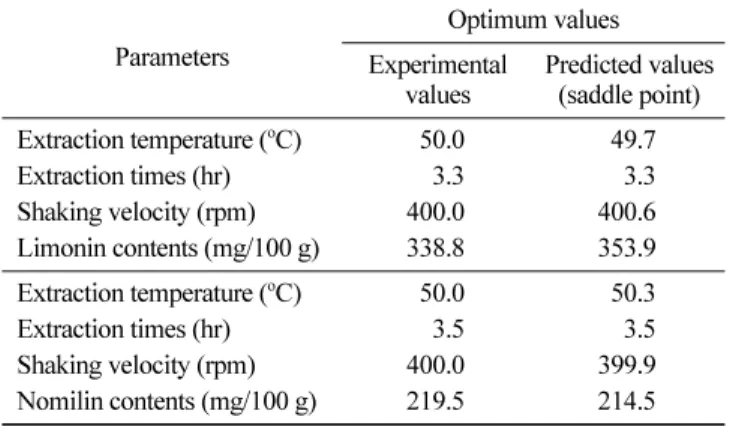
grapefruit에서 limonin의 함량이 각각 116.7, 211.9, 282.2 및 616.6 mg/100 g이포함되어있는 것으로보고하였는데 본연구에 서는 60oC, 2시간, 300 rpm 구간에서 408.2 mg/100 g으로 비교적 높은함량을함유하고있는것으로나타났다. Limonin 추출에대한통계분석결과는 Table 2 및 3에서보는 바와같이추출온도의영향이가장큰것으로나타났으며(F-value: 8.04, p<0.001), 그 다음으로 추출시간 (F-value: 3.74, p<0.01)에 의하여유의적으로 영향을받는것으로 나타났으며, 교반속도에 대해서는 유의성이 없었다. 반응표면 분석결과는 Fig. 4에서 보 는바와 같이추출온도와시간의 증가에따라 limonin 함량이증 가하는경향을 나타내었으며, 장시간 추출시에는교반속도의 증 가에따라오히려증가폭이감소되는경향을나타내었다. Nomilin 추출에대한 통계분석결과 추출온도의 영향이가장 큰것으로 나타났으며(F-value: 24.84, p<0.001), 그 다음으로 추출시간 (F-value: 6.67, p<0.001)에 의하여 유의적으로 영향을 받는 것으로 나타났으며, 교반속도에대해서는유의성이없었다. 반응표면분 석결과는 Fig. 5에서보는 바와같이단시간의추출에서는 추출 온도와속도의증가에따라 유의적으로 nomilin 함량이증가하였 으며, 추출온도 50oC 이후부터는그증가폭이감소되는경향을 나타내었다. 최적 추출 조건의 예측 유자씨의 limonin 및 nomilin의최적추출조건을결정하기위하 여 추출조건별 limonin 및 nomilin 함량에 대해 반응표면분석을 실시하고 최적추출조건을 예측하였다. 유자씨 추출물의추출 조 건에대한 통계분석결과, 반응표면에서 정상점이 모두안장점으 로나타났다. 따라서 능선분석을실시하여최적조건을산출하고 이상의예측 결과에대한모델식의신뢰성을확인하기위하여각 각의종속변수에대한최적조건범위에서추출하여예측된값들 과 비교해본 결과는 Table 4와 같다. 본 연구에서는 예측값과 limonin은유의성이있는범위에서낮게측정되었으며, nomilin은 유의성이 없는범위에서 유사한수치로측정되었다. 따라서 유자 씨 limonin의 최적 추출 조건은 추출온도 49.7oC, 추출시간 3.3 hr, 교반속도 400.6 rpm에서 353.9 mg/100 g으로 나타났으며, nom-ilin은추출온도 50.3oC, 추출시간 3.5 hr, 교반속도 399.9 rpm에서 214.5 mg/100 g으로나타났다.
Fig. 4. Response surface for the effects of extraction conditions on limonin contents of citron seed.
Fig. 5. Response surface for the effects of extraction conditions on nomilin contents of citron seed.
Table 2. Analysis of variance for limonin and nomilin contents of citron seed extracts
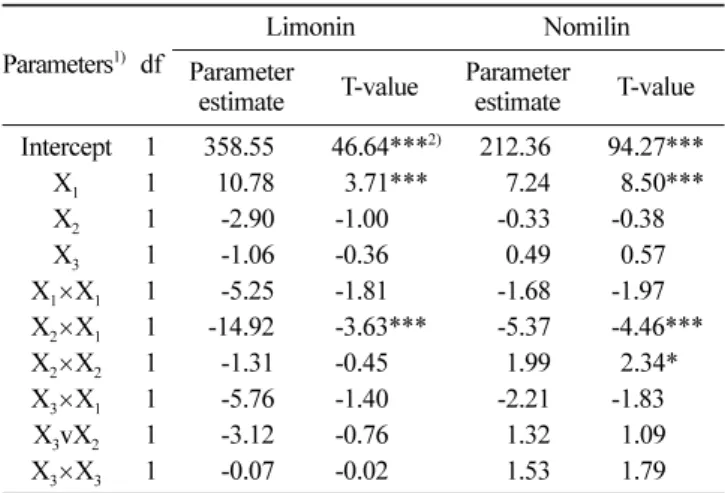
Parameters1) df Sum of squares F-value Limonin contents Extraction temperature (oC) 4 3,259 08.04***1) Extraction times (hr) 4 1,515 03.74** Shaking velocity (rpm) 4 271 00.67 Nomilin contents Extraction temperature (oC) 4 3,457 24.84*** Extraction times (hr) 4 928 06.67*** Shaking velocity (rpm) 4 282 02.02 1)**p<0.01, ***p<0.001
Table 3. Regression coefficients of the second oder polynomials for limonin and nomilin contents
Parameters1) df Limonin Nomilin
Parameter
estimate T-value Parameter estimate T-value Intercept 1 358.55 46.64***2) 212.36 94.27*** X1 1 10.78 03.71*** 7.24 08.50*** X2 1 -2.90 .-1.00 -0.33 .-0.38 X3 1 -1.06 .-0.36 0.49 00.57 X1×X1 1 -5.25 .-1.81 -1.68 .-1.97 X2×X1 1 -14.92 .-3.63*** -5.37 .-4.46*** X2×X2 1 -1.31 .-0.45 1.99 02.34* X3×X1 1 -5.76 .-1.40 -2.21 .-1.83 X3vX2 1 -3.12 .-0.76 1.32 01.09 X3×X3 1 -0.07 .-0.02 1.53 01.79 1)X
1, extraction temperature (oC); X2, extraction times (hr); X3, shaking
velocity (rpm)
요 약 유자씨의 limonin 및 nomilin에 대한최적 추출조건을 선정하 기위하여추출온도(30-70oC; X 1), 추출시간(1-5 hr; X2) 및교반속 도(200-600 rpm; X3)를독립변수로중심합성계획법에따라실험설 계한각각의 추출조건에서 limonin 및 nomilin 함량을 측정하였 다. Limonin 및 nomilin 추출조건의최적화를 위하여 추출용매 는 ethanol, 추출용매의 양은 20배그리고추출용매 농도는 60% 로선정하였다. Limonin 및 nomilin 추출에미치는추출조건의영 향은추출온도가 가장컸으며(p<0.01) 그다음으로는추출시간으 로 나타났다. 반응표면분석결과 최적 추출조건은 limonin에서는 추출온도, 추출시간 및교반속도가 각각 49.7oC, 3.3 hr 및 400.6 rpm으로나타났으며, 이때의추출량은 353.9 mg/100 g이었다. Nom-ilin은 각각 50.3oC, 3.5 hr 및 399.9 rpm이었으며, 추출량은 214.5 mg/100 g이었다. 동일조건에서의 실험값은 limonin 및 nomilin이 가각 338.8 및 219.5 mg/100 g으로 예측값과 실험값이 유사하여 최적화할수있었다. 문 헌
1. Nam HW, Hyun YH. Drying of citron juice from by-product of citron tea manufacturing. Korean J. Food Nutr. 16: 334-339 (2003)
2. Jeong JW, Lee YC, Kim JH, Kim OW. Tnahmgung B. Cooling properties and quality changes during storage of citron (Citrus junos). Korean J. Food Sci. Technol. 28: 1071-1077 (1996) 3. Bok SH, Lee SH, Park YB, Bae KH, Son KH, Jeong TS, Choi
MS. Plasma and hepatic cholesterol and hepatic activities of 3-hydroxyl-3-methyl-glutaryl-CoA reductase and acyl CoA: choles-terol transferase are lower in rats fed citrus peel extract or a mix-ture of citrus bioflavonoid. Korean J. Food Nutr. 129: 1182-1185 (1999)
4. Hasegawa S, Miyake M, Ozaki Y. Biochemistry of citrus limonoids and their anticarcinogenic activity. pp. 198-208. In: Food Phytochemicals for Cancer Prevention I. Fruit and
Vegeta-bles. Huang MT, Osawa T, Ho CT, Rosen RT (eds.), American Chemical Society Symposium Series 546, Washington DC, USA (1994)
5. Hasegawa S, Bennett RD, Verdon CP. Limonoids in citrus seeds: origin and relative concentration. J. Agr. Food Chem. 28: 922-925 (1980)
6. Ozaki Y, Fong CH, Herman Z, Maeda H, Miyake M, Ifuku Y, Hasegawa S. Limonoid glucosides in citrus seeds. Agr. Biol. Chem. Tokyo 55: 137-141 (1991)
7. Ohta H, Hasegawa S. Limonoids in pummelos (Citrus grandis
(L.) Osbeck). J. Food Sci. 60: 1284-1285 (1995)
8. Vikram A, Jayaprakasha GK, Patil BS. Simultaneous determina-tion of citrus limonoid aglycones and glucosides by high perfor-mance liquid chromatography. Anal. Chim. Acta 590: 180-186 (2007)
9. Herman Z, Fong CH, Hasegawa S. Analysis of limonoids in cit-rus seeds. pp. 361-375. In: Seed Analysis. Modern Methods of Plant Analysis. Linskens HF, Jackson JF (eds). Springer, New York, NY, USA (1992)
10. Lam LKT, Li Y, Hasegawa S. Effects of citrus limonoids on glu-tathione-S-transferase activity in mice. J. Agric. Food Chem. 37: 878 (1989)
11. Kelly C, Jewell C, O’Brien NM. The effect of dietary supplemen-tation with the citrus limonoids, limonin, and nomilin on xenobi-otic-metabolizing enzymes in the liver and small intestine of the rat. Nutr. Res. 23: 681-690 (2003)
12. Lam LKT, Zhang J, Hasegawa S. Citrus limonoid reduction of chemically induced tumorigenesis. Food Technol. 48: 104-108 (1994)
13. Kurowska EM, Borradaile N, Meade M, Spence JD, Carroll KK. Cholesterol-lowering effects of dietary citrus juice and their fla-vonoids. Studies in rats, mice and rabbits. Atherosclerosis 134: 33-37 (1997)
14. Choi I, Choi S, Nam B, Kim Y, Choi H. Contents of polyphenols and limonoids in citron (Citrus junos Sieb. ex Tanaka) seed extracts and their antioxidant properties. Food Sci. Biotechnol. 17: 373-378 (2008)
15. Giamperi L, Flaternale D, Bucchini A, Ricci D. Antioxidant activity of Citrus paradise seeds glyceric extract. Fitoterapia 75: 221-224 (2004)
16. Yoo KM, Lee KW, Park JB, Lee HJ, Hwang IK. Variation in major antioxidants and total antioxidant activity of citron (Citrus junos Sieb ex Tanaka) during maturation and between cultivars. J. Agr. Food Chem. 52: 5907-5913 (2004)
17. Hashinaga F, Herman Z, Hashegawa S. Limonoids in seeds of yuza (Citrus junos Sieb. ex Tanaka). Nippon Shokuhin Kogyo Gakk. 37: 380-382 (1990)
18. Woo KL, Ha JU, Woo DK. Quantitative determination, separation and purification of limonoid compounds from citron [Citrus junos(L.)]. The Research Institute of Engineering Technology Kyungnam University. Masan, Korea. Theses Collection 15: 363-372 (1997)
19. Woo KL, Kim JI, Kim MC, Chang DK. Determination of fla-vonoid and limonoid compounds in citron (Citrus junos Sieb. ex Tanaka) seeds by HPLC and HPLC/MS. J. Korean Soc. Food Sci. Nutr. 35: 353-358 (2006)
20. Park NJ, Kwon JH, Kim HK. Optimization of extraction condi-tions for ethanol extracts from Chrysanthemum morifolium by response surface methodology. Korean J. Food Sci. Technol. 30: 1189-1196 (1998)
Table 4. Predicted and experimental values on the response variable of optimum condition
Parameters ExperimentalOptimum values values Predicted values(saddle point) Extraction temperature (oC) 50.0 49.7 Extraction times (hr) 3.3 3.3 Shaking velocity (rpm) 400.0 400.6 Limonin contents (mg/100 g) 338.8 353.9 Extraction temperature (oC) 50.0 50.3 Extraction times (hr) 3.5 3.5 Shaking velocity (rpm) 400.0 399.9 Nomilin contents (mg/100 g) 219.5 214.5