https://doi.org/10.20307/nps.2018.24.2.103
103
Optimization of Extraction Condition of Methyl Jasmonate-treated Wild Ginseng Adventitious Root Cultures using Response Surface Methodology
Qing Liu
1, Yang Hee Jo
1, Jong Hoon Ahn
1, Seon Beom Kim
1, Kee-Yoeup Paek
2,3, Bang Yeon Hwang
1, So-Young Park
2,3, and Mi Kyeong Lee
1,*
1College of Pharmacy, Chungbuk National University, Cheongju, Chungbuk 28160, Korea
2Department of Horticultural Science, Chungbuk National University, Cheongju, Chungbuk 28644, Korea
3WellGreen Co., Cheongju, Chungbuk 28644, Korea
Abstract – The usage of wild ginseng (Panax ginseng C.A. Meyer) has been limited due to short supply and high price. Therefore, sufficient production as well as efficient extraction of mountain ginseng are required for the development as products. In this study, wild ginseng adventitious root cultures were prepared for efficient production with advantages of fast growth and stable production. Treatment of methyl jasmonate (MJ) to wild ginseng adventitious root cultures increased the extraction yield and antioxidative activity. Further investigation on effect of extraction conditions suggested the importance of ethanol concentration on antioxidative activity and extraction yield of MJ-treated wild ginseng adventitious root cultures. Optimized extraction condition of MJ- treated wild ginseng adventitious root cultures for maximum extraction yield and antioxidative activity was determined using response surface methodology with three-level-three-factor Box-Behnken design (BBD). Extraction of 1 g MJ-treated wild ginseng adventitious root culture with 30 ml of 9% ethanol at 30oC produced 310.2 mg extract with 71.0% antioxidative activity at 100µg/ml. Taken together, MJ-treated wild ginseng adventitious root culture is valuable source for wild ginseng usage and optimized extraction condition can be used for the development of functional products or folk remedies.
Keywords – Wild ginseng adventitious root cultures, Methyl jasmonate, Optimized extraction condition, Antioxidative activity, Extraction yield
Introduction
Panax ginseng C.A. Meyer (Araliaceae), commonly called ginseng, is one of the most widely used traditional herbs. Its roots have been used as a tonic to enhance immune response and consequent health and longevity for over 2000 years in Oriental countries (Tang and Eisenbrand, 2011). They also exert wide ranges of pharmacological effects including anti-cancer, anti-inflammatory, anti- diabetic, anti-fatigue and neuroprotective activities (Ru et al., 2015; Wang et al., 2016; Park et al., 2016; Patel and Rauf, 2017).
Ginseng is a perennial plant that grows slowly and has a long production cycles, 4 - 6 years. The bioactive constituents of ginseng reach desirable quality when the ginseng has matured (Chung et al., 2016; He et al., 2016).
Ginseng grows in wild environment or is cultivated on
farm. Cultivated ginseng is systematically grown on farm under the control of growth condition and harvested after 4 - 6 year cultivation. On the contrary, wild ginseng, also called mountain ginseng in Korea, grows in the wild and deep in the mountain with little sunshine and fluctuating temperature without man’s intervention. Due to the difference of environmental condition and genotypes, wild ginseng and cultivated ginseng have different composition and biological activities. The concentration of ginsenosides and amino acids in wild ginseng are much higher than those of cultivated ginseng. Wild ginseng also reported to have enhanced host defense components and biological activities (Pan et al., 2013; Sun et al., 2016).
Although wild ginseng has a great benefit, its usage has been limited because of short supply and high price.
Therefore, sufficient production is required for the develop- ment as products. As a preparation of wild ginseng, tissue culture system is considered a valuable tool to achieve rapid and stable production of excellent individual (Ruffoni et al., 2010; Murphy et al., 2014). In this study, wild ginseng adventitious root cultures were prepared for
*Author for correspondence
Prof. Mi Kyeong Lee, College of Pharmacy, Chungbuk National University, Cheongju, Chungbuk 28160, Korea.
Tel: +82-43-261-2818; E-mail: [email protected]
efficient production with advantages of fast growth and stable production with high antioxidant activity. Effect of elicitor and extraction conditions on antioxidant activity and extraction yield were also analyzed. For the develop- ment of wild ginseng as functional products, extraction procedure is indispensable. The content of active cons- tituents in extract together with their biological activity are highly affected by extraction conditions such as extraction solvent, extraction time, extraction temperature and ratio of sample/solvent. For this reason, extraction conditions was optimized for maximal antioxidant activity and extraction yield using response surface methodology (RSM) to secure efficiency in quality and economic aspects.
Experimental
Plant material − Adventitious root cultures of wild ginseng (P. ginseng) were produced from a 100-year-old wild ginseng through callus culture as we described previously (Yu et al. 2000). The root cultures were proli- ferated in a 5 L airlift balloon type bioreactor containing 4.0 L Murashige and Skoog (MS) liquid medium (3/4 strength) supplemented with 5.0 mg/L IBA, 0.1 mg/L kinetin, and 5% (w/v) sucrose for seven weeks. One week before harvest, 100 µM MJ were added to the culture as an elicitor. These roots explants were dried after collection from culture and were used for further experiments.
Optimization using response surface of methodology − A Box-Behnken design (BBD) with three variables and three levels was used to optimize the extraction conditions for maximum antioxidant activity and extraction yield of wild ginseng adventitious root cultures. Ethanol con- centration (X
1), extraction temperature (X
2) and solvent/
sample ratio (X
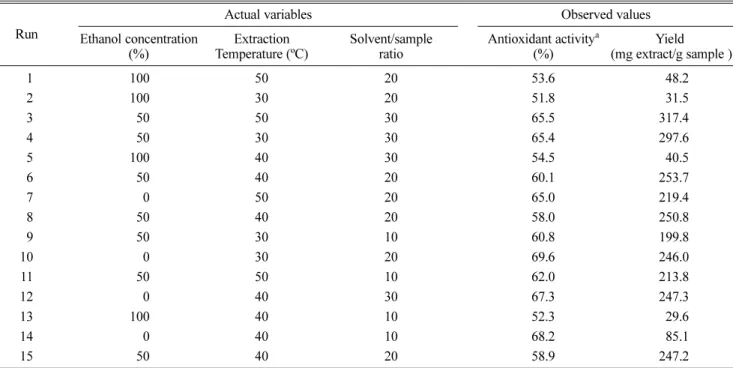
3) were chosen for independent variables, meanwhile antioxidant activity and extraction yield were as dependent responses. The variables were coded at three levels (-1, 0, and, 1) and the complete design was consisted of 15 experimental points including three replication of the center points whose variables were all coded as zero (Table 1).
Regression analysis was performed according to the experimental data. Y is the response, β
0, β
i, β
ii, β
ijare the coefficients for intercept, linearity, square and interaction, respectively and the mathematical model can be explained by the following equation
: Y =
Optimized extraction condition was derived from RSM and optimal condition was confirmed by the extraction and measurement of antioxidant activity and extraction yield.
Evaluation of antioxidant activity − The antioxidant activity was evaluated by measuring the free radical
β0 βiXi
i 1= 3
∑
βiiXi 2i 1= 3
∑
βijXiXj1 i j≤ ≤ 3
∑
+ + +
Table 1. A Box-Behnken design for extraction factors on antioxidant activity and extraction yield of wild ginseng adventitious root cultures
Run
Actual variables Observed values
Ethanol concentration (%)
Extraction Temperature (ºC)
Solvent/sample ratio
Antioxidant activitya (%)
Yield (mg extract/g sample )
1 100 50 20 53.6 48.2
2 100 30 20 51.8 31.5
3 50 50 30 65.5 317.4
4 50 30 30 65.4 297.6
5 100 40 30 54.5 40.5
6 50 40 20 60.1 253.7
7 0 50 20 65.0 219.4
8 50 40 20 58.0 250.8
9 50 30 10 60.8 199.8
10 0 30 20 69.6 246.0
11 50 50 10 62.0 213.8
12 0 40 30 67.3 247.3
13 100 40 10 52.3 29.6
14 0 40 10 68.2 85.1
15 50 40 20 58.9 247.2
a Antioxidant activity (%) was measured at 100µg/mL.
scavenging activity using 2,2-diphenyl-1-picrylhydrazyl (DPPH). Briefly, extracts prepared from different extraction conditions were mixed with freshly prepared DPPH solution. After shaking, the reaction mixtures were stand for 30 min at room temperature in dark places. The radical scavenging activity was determined by measuring the absorbance at 517 nm. The relative radical scavenging activity (%) was calculated as [1 − absorbance of solution with sample and DPPH / absorbance of solution with DPPH] × 100.
Result and Discussion
Antioxidant activity and extraction yield of MJ- untreated and MJ-treated wild ginseng adventitious root culture extract − Ginseng is traditionally used as a tea or an alcoholic beverage with ethanol for the health promoting effects. Therefore, antioxidant activity and extraction yield of wild ginseng adventitious root cultures were investigated. In plant tissue cultures, elicitors were used for enhancing the production of bioactive constituents (Kim et al., 2007; Rahimi et al., 2015). Therefore, wild ginseng adventitious root cultures were treated with methyl jasmonate (MS) as an elicitor and the antioxidant activity and extraction yield of MJ-treated wild ginseng adventitious root cultures were also analyzed. Extraction of 1 g wild ginseng adventitious root cultures with 50%
ethanol yielded 88.2 mg extract with IC
50value of 75.9 µg/mL. The amount of extract prepared from 1 g MJ- treated wild ginseng cultures was 152.4 mg with IC
50value of 38.4 µg/mL. Several elicitors have been reported
to increase secondary metabolite such as saponins and phenolic compounds in cultures of P. ginseng. Treatment of elicitors also increased the biological activity (Jeong et al., 2005; Hu et al., 2007). In our present study, HPLC chromatogram of MJ-treated wild ginseng adventitious root cultures showed similar pattern to that of MJ-untreated cultures, however, some minor additional peaks were observed, as shown in Fig. 1. In addition, MJ-treated wild ginseng adventitious root cultures produced high yield with better antioxidant activity compared to MJ-untreated samples. Therefore, MJ-treated wild ginseng adventitious root cultures were chosen for further experiment.
Effect of extraction variables on antioxidant activity and extraction yield − The content of active constituents in extract together with their biological activity are highly affected by extraction conditions (Herzi et al., 2013;
Jeong et al., 2014). Therefore, effects of extraction conditions of wild ginseng adventitious root cultures on extraction yield and antioxidant activity were analyzed.
RSM is the statistical analysis, which can figure out relationship between each factor and values with only a few point of factors. Therefore, RSM is used for the analysis of extraction conditions.
Extraction variables for RSM were selected as extraction solvent (X
1, ethanol concentration in water, 0, 50 and 100%), extraction temperature (X
2, 30, 40 and 50 ºC) and solvent/sample ratio (X
3, 10, 20 and 30) based on the preliminary study and complete with 15 experimental points was set up (Table 1).
Antioxidant activity and extraction yield of wild ginseng adventitious root cultures extracts prepared from
Fig. 1. HPLC chromatograms of MJ-untreated and MJ treated wild ginseng adventitious root cultures.
different extraction conditions were measured. As shown in Table 1, extraction yield was greatly affected depending on extraction conditions, ranging from 29.6 to 317.4 mg extract from 1 g dried sample. However, antioxidant activity
(%) was ranged from 51.8 to 69.6%, which showed good antioxidant activity in all experimental points.
Multiple regression analysis (Table 2) on the experiment data yielded the second-order polynomial regression
Table 2. Regression coefficients and their significances in the second-order polynomial regression equation for antioxidant activity and extraction yieldCoefficient Standard error t value p value
[Antioxidant activity]
Intercept X1
X2
X3
X12
X22
X32
X1X2
X1X3
X2X3
59.000 -7.238 -0.188 1.175 -0.925 1.925 2.500 1.600 0.775 -0.275
0.822 0.503 0.503 0.503 0.741 0.741 0.741 0.712 0.712 0.712
71.786 -14.380 -0.373 2.335 -1.249 2.598 3.375 2.248 1.089 -0.386
<0.001
<0.001 0.725 0.067 0.267 0.048 0.020 0.074 0.326 0.715 [Extraction yield]
Intercept X1
X2
X3
X12
X22
X32
X1X2
X1X3
X2X3
250.567 -81.000 2.988 46.813 -135.408 21.117 -14.533 10.825 -37.825 1.450
12.284 7.522 7.522 7.522 11.073 11.073 11.073 10.638 10.638 10.638
20.398 -10.768 0.397 6.223 -12.229 1.907 -1.313 1.018 -3.556 0.136
<0.001
<0.001 0.708 0.002
<0.001 0.115 0.247 0.357 0.016 0.897
Fig. 2. Response surface plots of extraction variables on [A] antioxidant activity and [B] extraction yield of wild ginseng adventitious root cultures.
equations as follows:
Antioxidant activity (%) = 59.00 – 7.24X
1− 0.19X
2– 1.18X
3– -0.93 – 1.92 – 2.50 + 1.60X
1X
2+ 0.78 X
1X
3– 0.28X
2X
3Extraction yield (%) = 250.57 – 81.00X
1+ 2.99X
2+ 46.81X
3– 135.41 + 21.12 – 14.53 + 10.83 X
1X
2– 37.83X
1X
3+ 1.45X
2X
3Among extraction variables, ethanol concentration (X
1) showed the most significant effect on antioxidant activity with p-value of <0.001 (Table 2). Extraction yield was also affected by ethanol concentration (X
1) and solvent/
sample ratio (X
3). The linear terms of ethanol con- centration (X
1) and solvent/sample ratio (X
3), the quadratic term of extraction temperature (X
12) and interaction term of ethanol concentration and solvent/sample ratio (X
1X
3) showed significant effect on extraction yield. However, extraction temperature showed relatively little effect on antioxidant activity and extraction yield of wild ginseng adventitious root cultures.
Consistent with regression coefficients and their signifi- cances, three dimensional response surface plots of antioxidant activity and extraction yield also showed the dramatic effect of ethanol concentration on extraction yield and antioxidant activity of wild ginseng adventitious root cultures (Fig. 2). On fixed temperature at 40 ºC or solvent/sample ratio as 20, antioxidant activity was im- proved as ethanol concentration reduced (Fig. 2.A). On the aspect of extraction yield, quadratic pattern of temperature and solvent/sample ratio was observed at fixed ethanol concentration (Fig. 2.B).
Taken together, antioxidant activity and extraction yield were greatly affected by ethanol concentration and solvent/
sample ratio, whereas extraction temperature exerted relatively little effect.
Optimization of extraction condition and verification − Due to the importance of extraction condition on antioxidant activity and extraction yield based on our present study, optimization for extraction condition is
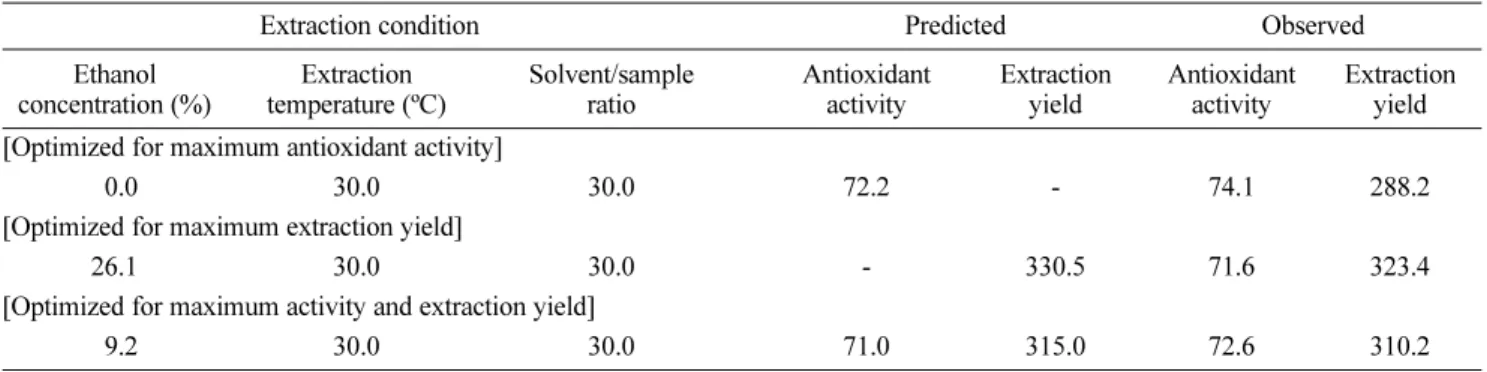
required for maximum efficacy. Therefore, optimized extraction condition for maximum antioxidant, optimized extraction condition for maximum extraction yield and optimized extraction condition for both maximum antioxi- dant and extraction yield were deduced using RSM.
Maximum antioxidant activity was expected when 1 g wild ginseng adventitious root culture was extracted by 30 mL water at 30 ºC which predicted 72.2% antioxidant activity. Extraction of 1 g sample under this extraction condition yielded 288.8 mg extract with 74.1% antioxidant activity. On the other hands, maximum extraction yield was expected when 1 g wild ginseng adventitious root culture was extracted by 30 mL of 26.1% ethanol at 30 ºC which predicted 330.5 mg extract. Extraction of 1 g sample under this extraction condition yielded 323.4 mg extract with 71.6% antioxidant activity. Extraction condition for maximum antioxidant activity and extraction yield were optimized as extraction of 1 g wild ginseng adven- titious root culture with 30 mL of 9.2% ethanol at 30 ºC which predicted 315.0 mg extract with 71.0% antioxidant activity. Extraction of 1 g sample under this extraction condition yielded 310.2 mg extract with 72.6% antioxidant activity, which was well matched with predicted values (Table 3).
Conclusion
Although the great value of wild ginseng, its usage has been limited due to its supply and subsequent high price.
In our present study, we suggested wild ginseng adven- titious root cultures as efficient production. Extract of wild ginseng adventitious root cultures showed antioxidant activity. In addition, MJ-treated sample improved antioxi- dant activity and extraction yield. Extraction conditions, especially extraction solvent and solvent/sample ratio greatly affected antioxidant activity and extraction yield of wild ginseng adventitious root cultures. Our study also provided the optimized extraction conditions for the
X12 X22 X32X12 X22 X32
Table 3. Predicted and observed values of antioxidant and extraction yield under differential optimized condition
Extraction condition Predicted Observed
Ethanol concentration (%)
Extraction temperature (ºC)
Solvent/sample ratio
Antioxidant activity
Extraction yield
Antioxidant activity
Extraction yield [Optimized for maximum antioxidant activity]
50.0 30.0 30.0 72.2 - 74.1 288.2
[Optimized for maximum extraction yield]
26.1 30.0 30.0 - 330.5 71.6 323.4
[Optimized for maximum activity and extraction yield]
59.2 30.0 30.0 71.0 315.0 72.6 310.2
maximum antioxidant activity and extraction yield of wild ginseng adventitious root cultures as extraction of 1 g wild ginseng adventitious roots with 30 mL of 9.2%
ethanol at 30 ºC which yielded 310.2 mg extract with 72.6% antioxidant activity. These results will give a strong support for economic efficiency for the preparation of wild ginseng adventitious root cultures.
Acknowledgements
This work was supported by Korea Institute of Planning and Evaluation for Technology in Food, Agriculture, Forestry and Fisheries (IPET) through Advanced Production Technology Development Program, funded by Ministry of Agriculture, Food and Rural Affairs (grant number 315013-4).
References
(1) Chung, I. M.; Lim, J. J.; Ahn, M. S.; Jeong, H. N.; An, T. J.; Kim, S.
H. J. Ginseng Res. 2016, 40, 68-75.
(2) He, J. M.; Zhang, Y. Z.; Luo, J. P.; Zhang, W. J.; Mu, Q. Nat. Prod.
Commun. 2016, 11, 739-740.
(3) Herzi, N.; Bouajila, J.; Camy, S.; Romdhane, M.; Condoret, J. S.
Food Chem. 2013, 141, 3537-3545.
(4) Hu, F. X.; Zhong, J. J. J. Biosci. Bioeng. 2007, 104, 513-516.
(5) Jeong, G. T.; Park, D. H.; Ryu, H. W.; Hwang, B.; Woo, J. C.; Kim,
D.; Kim, S. W. Appl. Biochem. Biotechnol. 2005, 124, 1147-1157.
(6) Jeong, J.Y.; Jo, Y. H.; Lee, K. Y.; Do, S. G.; Hwang, B. Y.; Lee, M.
K. Bioorg. Med. Chem. Lett. 2014, 24, 2329-2333.
(7) Kim, O. T.; Bang, K. H.; Shin, Y. S.; Lee, M. J.; Jung, S. J.; Hyun, D. Y.; Kim, Y. C.; Seong, N. S.; Cha, S. W.; Hwang, B. Plant Cell Rep.
2007, 26, 1941-1949.
(8) Murthy, H. N.; Georgiev, M. I.; Kim, Y. S.; Jeong, C. S.; Kim, S. J.;
Park, S. Y.; Paek, K. Y. Appl. Microbiol. Biotechnol. 2014, 98, 6243-6254.
(9) Pan, H. Y.; Qu, Y.; Zhang, J. K.; Kang, T. G.; Dou, D. Q. J. Ginseng Res. 2013, 37, 355-360.
(10) Park, J. G.; Son, Y. J.; Aravinthan, A.; Kim, J. H.; Cho, J. Y. J.
Ginseng Res. 2016, 40, 431-436.
(11) Patel, S.; Rauf, A. Biomed. Pharmacother. 2017, 85, 120-127.
(12) Rahimi, S.; Kim, Y. J.; Yang, D. C. Appl. Microbiol. Biotechnol.
2015, 99, 6987-6996.
(13) Ru, W.; Wang, D.; Xu, Y.; He, X.; Sun, Y. E.; Qian, L.; Zhou, X.;
Qin, Y. Drug Discov. Ther. 2015, 9, 23-32.
(14) Ruffoni, B.; Pistelli, L.; Bertoli, A.; Pistelli, L. Adv. Exp. Med. Biol.
2010, 698, 203-221.
(15) Sun, H.; Liu, F.; Sun, L.; Liu, J.; Wang, M.; Chen, X.; Xu, X.; Ma, R.; Feng, K.; Jiang, R. J. Ginseng Res. 2016, 40, 113-120.
(16) Im, D.S.; Nah, S.Y. Acta Pharmacol. Sin. 2013, 34, 1367-1373.
(17) Wang, T.; Guo, R.; Zhou, G.; Zhou, X.; Kou, Z.; Sui, F.; Li, C.;
Tang, L.; Wang, Z. J. Ethnopharmacol. 2016, 188, 234-258.
(18) Yu, K. W.; Gao, W. Y.; Son, S. H.; Paek, K. Y. In Vitro Cell. Dev.
Biol. Plant. 2000, 36, 424-428.
Received December 21, 2017 Revised February 12, 2018 Accepted February 12, 2018

![Fig. 2. Response surface plots of extraction variables on [A] antioxidant activity and [B] extraction yield of wild ginseng adventitious root cultures.](https://thumb-ap.123doks.com/thumbv2/123dokinfo/5480070.663369/4.892.73.816.186.565/response-extraction-variables-antioxidant-activity-extraction-adventitious-cultures.webp)