http://dx.doi.org/10.3938/NPSM.68.1231
Measurement and Interpretation of Undergraduate Students’ Writing about the Experiments of the Photoelectric Effect
Hunkoog Jho
∗Department of General Education, Dankook University, Cheonan 31116, Korea
Youngrae Ji
Department of Physics Education, Seoul National University, Seoul 08826, Korea (Received 18 September 2018 : revised 15 October 2018 : accepted 16 October 2018)
This study aimed at examining undergraduate students’ writing about experiments related to the photoelectric effect and giving some implications for experiment education. Thus, this study analyzed 26 students’ reports about three kinds of experiments: measuring Planck’s constant, comparing the photocurrent and the photovoltage across the intensity of light, and comparing the photocurrent and the photovoltage across the frequency of light. In the measurements, less than 25% of the students expressed the data to the correct number of significant figures even though two- thirds of the students successfully obtained the data given in the manual. In terms of interpretation, the students were not aware of the physical meanings of the detailed parts in the graphs. Even though over 50% of the students drew a line relating photocurrent to voltage, no students compared the theoretical to the empirical data or made a judgment as to whether of not the background theory really fit the experiment. The research findings showed that insufficient knowledge and skills for physics inquiry may be an obstacle in performing the experiments well.
PACS numbers: 01.40.Fk, 01.50.Pa
Keywords: Photoelectric effect, Scientific inquiry, Experiment report, Physics experiment
I. INTRODUCTION
The demarcation between classical and modern physics was made in the beginning of twentieth cen- tury. Planck introduced the action of quanta to solve the limitations of Wien’s law and equipartition theorem about the black-body radiation [1,2], and with the con- cept of quantum, Einstein explained the interesting phe- nomenon that electrons are released from the metal while specific frequency of light radiates to the metal [3]. The photoelectric effect is crucial in progression in modern physics because it fits for the quantization of light quanta and wave-particle duality of light. The phenomenon was first discovered by Hertz, and Einstein formulated the- ory of light and his ideas influenced the hypothesis of de
∗E-mail: [email protected]
Broglie [4]. Nowadays, the photoelectric effect is intro- duced in many courses for general and modern physics and undergraduate students in physics major do exper- iments to measure the photocurrent or stopping poten- tial [5–8]. As well, the experiment is used to determine Planck’s constant since Einstein first employed Planck’s concept to the emission of electrons from the metal [6,9].
The photoelectric effect can be used as a diagnostic tool to figure out students’ understanding of quantum mechanics and empirical abilities in relation to inquiry.
Students would not be able to understand the threshold frequency of light if they focused on the undulatory na- ture of light. Conversely, they would fail to understand how the frequency of light affects the electric potential.
Besides, they should recognize how energy of photons is transformed into kinetic energy of electron [10]. This in- dicates that the photoelectric effect is connected with
This is an Open Access article distributed under the terms of the Creative Commons Attribution Non-Commercial License (http://creativecommons.org/licenses/by-nc/3.0) which permits unrestricted non-commercial use, distribution, and reproduction in any medium, provided the original work is properly cited.
wave-particle duality of light, which is crucial in un- derstanding traditional interpretation of quantum me- chanics, the Copenhagen interpretation [11,12]. On the other hand, doing experiments about the photoelectric effects entails fundamental actions in physical inquiry.
First, student should derive a formula to explain the re- lation between frequency of light and stopping potential as shown Eq. (1).
KEmax= eV = hν− φ (φ : work function) (1)
They should be able to represent graphs with the ob- tained outcome and compare between experimental and theoretical data. As well, they should figure out influ- encing parameters such as work function of anode and effect of space charge [13,14], and propose more elab- orate procedures. They should distinguish observation from interpretation during the experiment, and be famil- iar with mathematical formalism to compare theoretical prediction and experimental results. The analysis of stu- dents’ reports on the phenomenon is one of the best ways to investigate how students understand the photoelectric effect and the nature of light. Thus, this study aims at in- vestigating the capabilities of undergraduate students for physics inquiry centring on measurement and interpre- tation, and examining their difficulties in understanding physical concepts related to the experiment.
II. RESEARCH METHODS
In this study, the researchers investigated 26 students attending the undergraduate for doing physical experi- ments. All of them were sophomore students consisting of 17 male and 9 female students in the department of physics education. The subject titled as “physics exper- iments and demonstration II” is compulsory for all pre- service teachers, and they should enrol the subject af- ter taking lecture-based and experiment-based subjects as follows: general physics I, II, experiment for general physics I, II, teaching for classical mechanics, and physics experiments and demonstration I. In the subject, they were supposed to do a series of experiments related to the photoelectric effect as listed: Planck’s constant, I-V with different intensity of light, and I-V with different frequency of light. A set of experiment devices made in
Pasco (AP-8209) was used for the experiments. Mercury lamp was used as a light source and the intensity of light was adjusted by the apertures with different diameters (2 mm, 4 mm, 8 mm) and the optical filter was used to adjust the frequency (365.0 nm, 404.7 nm, 435.8 nm, 546.1 nm, 577.0 nm). In experiment 1 to measure and calculate Planck’s constant, students were asked to mea- sure the stopping potential while different wavelengths of light radiated on the photodiode. In experiment 2 to measure I-V with different intensity of light, current and voltage were measured under the different apertures (2 mm, 4 mm, 8 mm) and the same wavelength (436 nm).
In experiment 3 to measure I-V with different frequencies of light, current and voltage were measured under the dif- ferent wavelengths (435.8 nm, 546.1 nm, 577.0 nm) and the same aperture (4 mm).
The three experiments they conducted in this study had different emphases. For example, the first experi- ment related to Planck’s constant helps student to cal- culate the constant and the work function of the used metal through the linear relationship between frequency of light and stopping potential, whereas the second ex- periment shows that photocurrent depends on the inten- sity of light through the saturated curve.
In order to examine students’ difficulties in the ex- perimentation related to the photoelectric effect, this study concentrated on the measurement and interpre- tation among their activities. One of overarching goals of experimentation in physics education is to improve the abilities of scientific inquiry [15,16]. Scientific inquiry im- plies a series of actions to construct scientific knowledge or to solve scientific problems, and the process can be divided into five domains: identifying problem, design- ing experiments, implementing experiments, interpreting data, and making conclusions [17]. The manual given to the student provided the experimental topics, procedures and the variables to be observed. Students were encour- aged to perform the experiments, to keep track of obser- vation results, to transform one into another data, and to interpret the results. Thus, this study concentrated on implementing experiments and interpreting data.
The assessment framework for scientific report was based on the results of Kim and others’ study [18]. They suggested evaluation criteria for each element of scien- tific inquiry. As for the measurement, they presented
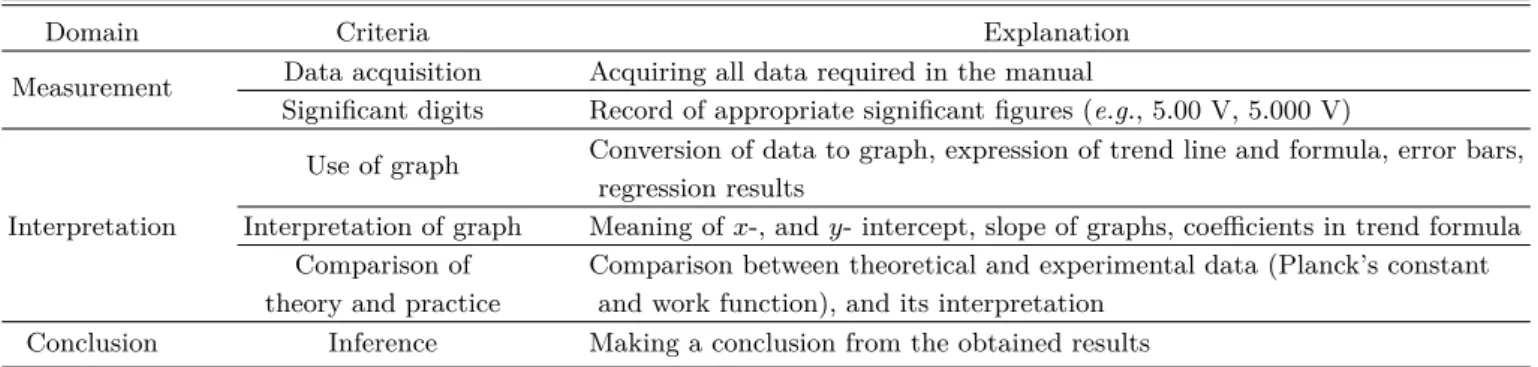
Table 1. Evaluation criteria for experimental report in the photoelectric effect.
Domain Criteria Explanation
Measurement Data acquisition Acquiring all data required in the manual
Significant digits Record of appropriate significant figures (e.g., 5.00 V, 5.000 V)
Use of graph Conversion of data to graph, expression of trend line and formula, error bars, regression results
Interpretation Interpretation of graph Meaning of x-, and y- intercept, slope of graphs, coefficients in trend formula Comparison of Comparison between theoretical and experimental data (Planck’s constant theory and practice and work function), and its interpretation
Conclusion Inference Making a conclusion from the obtained results
Table 2. Assessment result of students’ report on the photoelectric effect.
Domain Criteria Planck’s constant I-V under different intensity I-V under different f
Measurement Data acquisition 17 (65.4%) 23 (88.5%) 24 (92.3%)
Significant digits 6 (23.1%) 0 (0.0%) 0 (0.0%)
Use of graph 10 (38.5%) 21 (80.8%) 22 (84.6%)
Interpretation Interpretation of graph 6 (23.1%) 13 (50.0%) 8 (30.8%)
Comparison of theory and practice 1 (3.8%) 0 (0.0%) 0 (0.0%)
Conclusion Inference 12 (46.2%) 0 (0.0%) 0 (0.0%)
three kinds of criteria as listed: selection of experimen- tal apparatus, record of observation/measurement, and classification of the obtained data. Interpretation is com- posed of four criteria: use of symbols and diagrams, use and interpretation of graphs, qualitative explanation depending on concepts and principles, and quantitative analysis. Based on those, the study established a few of checkpoints for the better understanding of experimen- tal physics in relation to the photoelectric effect as seen in Table 1. In terms of the measurement, appropriate selection of apparatus did not have to be concerned be- cause the detailed information was already written in the manual. Instead, this study checked out if the students kept record of all data required in the manual. In re- lation to the classification of data, this study took into account whether the students could record the data fol- lowing the significant numbers. In respect to the inter- pretation, this study reflected depiction of various infor- mation on the graphs such as trend line, error bars and regression results, and understanding of the signs and symbols on the diagrams. For example, students should be able to draw a 2D plot with the measured data (fre- quency and stopping potential) in the experiment 1. As well, they should recognize the meaning of x-intercept (threshold frequency), y-intercept (work function over
electric charge), and the slope (Planck constant over elec- tric charge). Once a background theory is adopted, the obtained data is used to examine whether the experi- ment fits theoretical arguments. If any errors are found according to the comparison, the experimental design is modified and the experiments are done iteratively. In this reason, this study thought highly of comparison be- tween theory and experiment and appropriate error anal- ysis. The qualitative analysis in the interpretation was substituted for inference to make conclusions. The main goal of experiment is to build up an argument and in the educational context, the argument is linked to concep- tual understanding of physics. This study examined if the report explicitly articulates conclusions based on the experimental results in an appropriate way. The reports about the three experiments in the study followed afore- mentioned criteria and the results are shown in Table 2.
III. RESULTS
1. Experiment for Planck’s constant
This experiment was to measure the stopping potential to refrain the photovoltage evoked by photons according
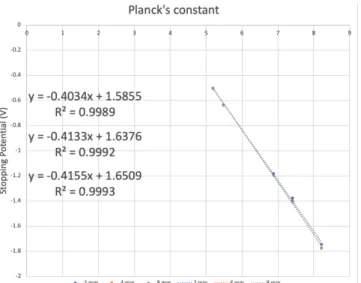
Fig. 1. (Color online) The example of students’ diagram showing the relation between frequency of light and the stopping potential.
to the different frequency and intensity of light. They were asked to measure the stopping potential evoked by five different frequencies (365.0 nm, 404.7 nm, 435.8 nm, 546.1 nm, 577.0 nm) and three different intensities. The intensity of light is differentiated by adjusting the cross- sectional area of light projected on the metal with differ- ent radii (2.0 mm, 4.0 mm, 8.0 mm).
In regard to the measurement, 17 out of 26 students examined all the experiments given to them. Measure- ment of frequency and voltage across the different condi- tions is very important because the main objective of this experiment is to obtain the linear relation between fre- quency and the potential denoted as h/e regardless with frequency and intensity of light. If they do not mea- sure according to the different intensity of light, they will not be aware that the intensity is not influential to the relation. Problematic was that only 6 students kept track of measurement results following the rule of signif- icant figures. This indicates that most of students just wrote down the numbers seen on the screen of devices, and more problematic is problematic that they might not think over the accuracy of the experiment and the error analysis. No student did the experiments repeti- tively but did only one time. Neither did they consider the error analysis nor express the deviation of data.
In terms of interpretation, we examined how well stu- dents performed the expression of data with graphs and meanings of graphs. As a result, fifteen students who
recorded the stopping potential wrongfully drew a graph with minus slope. Twenty-four students out 26 students expressed the trend line and formula and 22 explained the meaning of slop in the graph. However, over half of students (15) plotted a straight line with the decreas- ing slope (see Fig. 1). This is problematic because the stopping potential is reversely exerted on the circuit to cancel out the photovoltage. Thus, the signs need to be converted into the plus signs. Otherwise, the relation v and V would be inversely linear. It is likely that they did not distinguish the stopping potential from the pho- tovoltage. Even though 22 students obtained Planck’s constant from the slope, only 6 students derived work function from the results appropriately. Even some of students misunderstood that the y-intercept in the graph stands for the work function. In fact, the work func- tion is a value of y-intercept divided by e (1.6 × 10⁻¹⁹ C). Regarding the comparison between theoretical and experimental results, most of students only considered Planck’s constant but not work function. It is true that the outcomes of the experiment can be applied to derive Planck’s constant but more important in this experiment is to understand the wave-particle duality of light, and work function is often suggested as an example to falsify the undulatory nature of light. Despite they mentioned about Einstein’s photon theory, they did not care about work function or guess what metal was used in the exper- iment (Fig. 2). Even, they did not induce the threshold frequency which can be obtained from x-intercept of the line. The mean value of work function obtained from the experiment is 1.6 eV but the deviation between the- oretical (2.29 eV for potassium) and experimental data is huge, while the error percentage of Planck’s constant was under 5 %. This indicates that other conditions af- fect the results such as the distribution of electric field exerting on the cathode and anode, polarity of light, and effect of space charge.
While making conclusions, less than half of students (12) mentioned that the slope is consistent with the in- tensity of light. It is natural because only 17 students succeeded in obtaining all the data and even 15 students failed to draw a line of relation between frequency and potential. Although making conclusion is more impor- tant than any other process in inquiry, students tended to do the experiment as making food just following the
Fig. 2. An excerpt from students’ report and the translated text.
recipe. This result addressed that doing experiment care- lessly may impede their understanding of physics unless they understand the objective of experiment and keep the appropriate process of inquiry.
After all, the students did not seem to have enough ca- pabilities with physics inquiry. Even though the manual given to them articulated what data should be obtained explicitly, 9 out 26 students failed to satisfy the mea- surement according to the different intensity of light, and six students considered the significant figures ap- propriately. Even more, no student took into account statistical or experimental errors on doing experiment.
The inappropriate expression of the graph caused a se- ries of mistakes calculating Planck’s constant and work function. What if they measured all data required and
plotted them well, they would figure out the same slope in the diagram and reach the right conclusion. The com- parison between theory and experiment was seldom done according to the reports. If then, they would find out the reasons about the deviation of errors and improve the ex- periment. However, most of students did not make clear argument from the results. As well, it is important for students to understand the objective and the meaning of the experiment clearly. Although the equation to explain the relation between frequency of light and stopping po- tential was given to the students, they miscalculated the key variables without division of the values by e. Even, they did not much care about work function and thresh- old frequency. The experiment shows the nature of light quanta as wave-particle duality but if they only focus on
quantized energy of photons, they will miss the undula- tory nature of light. This is because the work function is determined by the frequency of light and frequency is the character of undulatory entity [19].
2. Experiment for I-V in the context of different intensity of light
The objective of this experiment is to measure the pho- tocurrent and the photovoltage and examine the relation according to the different intensity of light. The inten- sity of light was adjusted by the radius of aperture from the light source (2 mm, 4 mm, 8 mm). That is to say, the intensity of light is proportional to the square of ra- dius. The assessment result of measurement in this ex- periment was similar to the case of the first one. 23 out of 26 students satisfied measuring I and V according to the different apertures but no students succeeded in ex- pressing the data satisfying the rule of significant digits (partial satisfaction was 14 students). Neither did any- one consider the error analysis.
In respect to the interpretation, we examined whether the students performed drawing graphs and understood the meaning of graphs well. According to Eq. (1), the photovoltage depends on the frequency and the curves formed by three different intensities of light will have the same stopping potential (x-intercept). However, the intensity of light emanating from the light source caused more emission of photoelectrons and affects the pho- tocurrent. That is to say, the photocurrent is increas- ing but saturated to the specific maximum point which relies on the intensity of light. As a result, 21 students transformed the data into the graph successfully but no one derived the trend line and equation to explain the relation between I and V . Even, there was no exper- imental result showing the saturation of the photocur- rent. In fact, derivation of the equation needs under- standing of modern physics. According to the classical electrodynamics, electric force acting on the photoelec- tron is F = qE = eV /l (l: distance between anode and cathode). The work of electron by electric force is equal to the change of kinetic energy(1
2mv2–12mv20)
, and it is denoted as follows:
∫ 0 x
eV /lds = 1
2mv2−1 2mv20
(x : distance from the initial position) (2)
Hence, the velocity can be expressed as v =
√
v02+2eVm , and when we consider Eq. (1) and cur- rent density, the photocurrent is denoted as I = I0
√
1±hveV−W [20]. However, in modern physics, an elec- tron is a fermion and while considering Dirac-Fermi dis- tribution, the probability of a particle with energy E is
f (E) = 1
1 + exp(EkT−Ef)
(Ef: Fermi energy). Regarding
KEmaxof a photoelectron, the intensity of the photocur- rent is depicted as follows:
I(V ) = Imax
1 + exp((V − Vc)/V0)
(V0= kT /e , Vc = δ + φ–(h/e)v) [21] (3)
Eq. (2), which is based on classical electromagnetism, is only satisfied with the condition where the photovoltage is enough high at a very short period [22]. A couple of students stated that the photocurrent is increased loga- rithmically. However, the current is quasi-exponentially increasing at first, then is increasing like square-root shape shown in Eq. (2).
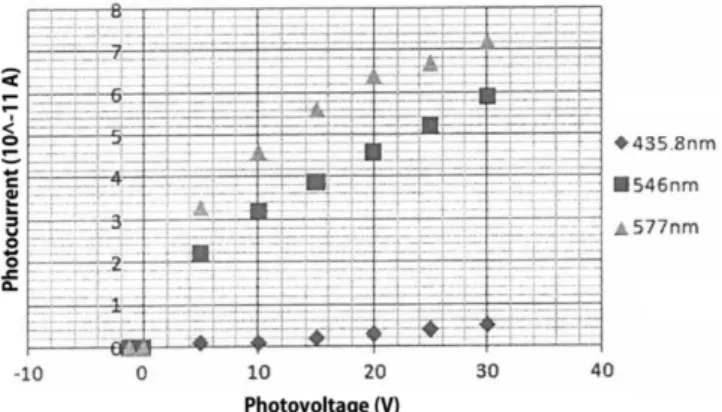
While interpreting the graph, half of students were aware that x-intercept points to the stopping poten- tial. On the contrary, only 8 students tried to exam- ine whether the maximum photocurrent is really pro- portional to the square of the radius. As long as the photocurrent does not reach the maximum value, the re- lation cannot be verified. After all, due to the insufficient data and tumbling on the derivation of the equation, all of the students did not have the expected outcome and conclusion. Fig. 3 shows the relation between photocur- rent (y-axis) and photovoltage (x-axis) across different intensity of light. Despite a couple of students dare to say that they could find out the saturation value of the pho- tocurrent, it is unclear that the photocurrent approaches the maximum value.
The analysis of students’ reports about the second experiment also revealed the students did not obtain enough data to make conclusion. Since they failed to derive an equation to relate the photocurrent and pho- tovoltage, they could not compare their results to the theoretical ones. The results of the second experiment also turned out that it is necessary to acquire funda- mental knowledge and skills for physics inquiry and to understand the goal of experiment.
Fig. 3. (Color online) An example of I-V curves accord- ing to the different intensity of light.
3. Experiment for I-V in the context of different frequency of light
This experiment intends to examine the photocurrent and photovoltage under the different wavelength (or fre- quency) of light. It is expected to have different voltages but the similar maximum current across the different fre- quencies. While assessing the measurement, we focused on the measurement of all data required and the expres- sion of significant figures. Twent-four students satisfied measuring data required in the manual whereas no one kept track of the data following the expression of signif- icant figures. The result was very similar to that in the second experiment.
Similar to the second experiment, the students mostly successfully drew a graph from the obtained data but could not derive an equation or consider error analysis.
The equation derived in the second experiment (Eq. (3)) can be applied here. If they understood the role of fre- quency in the photoelectric effect, they could figure out that the three different curves have different x-intercepts, which indicates the threshold frequency. Only 8 students were aware of the difference of x-intercepts about the three graphs, and caught up the meaning. As shown in Fig. 4, most of students did not examine whether the stopping potentials according to the different frequency of incident light are differed. Neither they did compare theoretical and experimental data nor make a successful conclusion from their measurement results.
As a consequence, basic knowledge and skills for physics inquiry was crucial in doing experiments, sim- ilar to the results of the second experiment. Although the students measured the current and voltage well, they
Fig. 4. A student’s example of I-V graph according to different frequency of light.
did not know what to see. Even, they failed to build up an equation to explain the results and could not compare theory and experiment. Moreover, they could not pro- pose any suggestion for more accurate results. Despite the significance of the frequency of incident light on the photoelectric effect, no students successfully conducted this experiment.
IV. DISCUSSIONS AND IMPLICATIONS
This study analysed students’ experiment reports about the photoelectric effect with a focus on the mea- surement and interpretation, and examined their under- standing of physical concepts in relation to the photo- electric effect. In this study, we analysed the experiment reports written by 26 undergraduate students enrolling physics experiments and demonstration, and their re- ports were comprised of three different experiments: the relation between the frequency and the potential, the re- lation between I and V according to the intensity of light, and the relation between I and V according to the fre- quency of incident light. The assessment of their reports followed the criteria presented in Table 1, and Table 2 shows the summary of the whole results about the assess- ment. The numbers in the table implies how many stu- dents performed the given actions appropriately. Here, we ruled out the students who satisfied the criteria par- tially.
The results of this study disclose several problems re- lated to experimental activities. First, the basic knowl- edge and skills for inquiry is prerequisite for the per- formance in physics inquiry. Albeit the manual for the
experiments were given to the students, some of them could not finish gathering all the data required in the manual and no one could successfully treat the data such as the significant figures and error analysis. While inter- preting data, some of them converted the data into the graph appropriately, and many of the students were not aware of the meanings of symbols and signs provided on the graph. In the second and the third experiments, no student made an appropriate argument for the results.
Moreover, many of them neglected important informa- tion such as work function and the stopping potential in the first experiment. This indicates that the students should be able to understand the objectives and values of physics experiments.
Second, conceptual understanding and mathematical formalism are crucial in doing physics inquiry. The pho- toelectric effect is based on Einstein’s quantum theory of light and the experiments in the study are connected to Eq. (1). In particular, the students should be able to understand the contents of modern physics to derive Eq. (3) from the data. The equation is based on Fermi energy in the particle physics unlike electric force acting on an electron. And, they should be able to recognize what ought to be observed in the experiment. For exam- ple, the maximum current was measured after saturation, but most of students missed the fact.
Third, the conceptual understanding is closely linked to the recognition of the objectives and values of physics experiment. In this study, the main purpose of the ex- periment was to measure Planck’s constant. However, the constant was derived from the mathematical extrap- olation to solve the black cavity radiation, and Einstein tried to explain the photoelectric effect using the con- cept of quantum and his results well matched Planck’s assumption. As a consequence, Einstein came to think about the dualism of light. For such reasons, the ex- periment encompasses many parameters as work func- tion, maximal kinetic energy and threshold frequency connected to both corpuscular and undulatory nature of light. Conversely, de Broglie brought his idea and applied it to the matter (wave-like form of matter) and this idea supported the wave-particle duality and uncer- tainty principle. We need to provide students with more opportunities to discuss the expression of formula and
semantics of various information shown in the diagrams for the better understanding of related physics.
The research finding which showed serious problems in doing physics experiment may implicate for develop- ing a guideline for physics inquiry. Even though the recent revised curriculum stresses scientific inquiry [23], student should have more opportunities to find out the problems and to do the experiment iteratively to reach the appropriate conclusion. The cook-book style man- ual is helpful to lead the right answer which is consistent with what they learned. However, such an easy way may deprive of a chance to make their own questions and to fix up their faults. To enhance their abilities for physics inquiry, there should be an elaborate framework for assessing the physics experiment report and it will be helpful to find out what process should be more improved from identification of the problems to the establishment of conclusion. Further, the experimentation in physics should include not only empirical guidelines but also his- torical and philosophical aspects of physics. This study will be a starting point to renovate experiment education in physics.
ACKNOWLEDGMENTS
This work was supported by the National Research Foundation of Korea (NRF) grant funded by the Korean Government (MSIT) (No.NRF-2017R1C1B1007561).
REFERENCES
[1] M. K. E. L. Planck, Verhandlungen Dtsch. Physik.
Ges. 2, 202 (1900).
[2] M. K. E. L. Planck, Verhandlungen Dtsch. Physik.
Ges. 2, 237 (1900)
[3] A. Einstein, Ann. Phys. 322, 132 (1905).
[4] J. G. Cramer, The Quantum Handshake: Entangle- ment, Nonlocality, and Transactions (Springer, New York, 2015).
[5] G. McClellan, E. M. Didwall and C. J. Rigby, Am.
J. Phys. 46, 832 (1978).
[6] A. K. Knudsen, Am. J. Phys. 51, 725 (1983).
[7] R. A. Powell, Am. J. Phys. 46, 1046 (1978).
[8] G. D. Earle, B. L. Copp, J. H. Klenzig and R. L.
Bishop, Am. J. Phys. 71, 766 (2003).
[9] J. D. Barnett and H. T. Stokes, Am. J. Phys. 56, 86 (1988).
[10] M. A. Asikainen and P. E. Hirvonen, Am. J. Phys.
77, 658 (2009).
[11] M. Jammer, The Conceptual Development of Quan- tum Mechanics (Tomash Publishers, Los Angeles, 1989).
[12] R. Gomatam, Philos. Sci. 74, 736 (2007).
[13] J. Rudnick and D. S. Tannhauser, Am. J. Phys. 44, 796 (1976).
[14] R. Zangara and E. Lanzara, Am. J. Phys. 61, 1114 (1993).
[15] L. van Rens, A. Pilot and J. van der Schee, J. Res.
Sci. Teach. 47, 788 (2010).
[16] L. B. Flick and N. G. Lederman, Scientific Inquiry and Nature of Science: Implications for Teaching, Learning, and Teacher Education (Springer, Dor- drecht, 2006).
[17] H. Jho, J. Res. Curr. Instr. 22, 208 (2018).
[18] M. K. Kim, H. G. Oh and J. Park, J. Korean Assoc.
Res. Sci. Educ. 16, 51 (1996).
[19] Y. Y. Cheong and J. Song, New Phys.: Sae Mulli 61, 479 (2011).
[20] H. J. Ha, S. H. Sohn and J. S. Kim, New Phys.:
Sae Mulli 65, 602 (2015).
[21] L. Changshi and L. W. Li, Optik 127, 7359 (2016).
[22] H. Jho, New Phys.: Sae Mulli 68, 869 (2018).
[23] Ministry of Education, National science curriculum, Report No. 2015-74, 2015.