646 Copyright © 2012 The Korean Society of Cardiology Korean Circulation Journal
Introduction
The incidence of stent thrombosis (ST) is relatively rare, with re- ported rates around 1-2%; however its consequences can be fatal, as most ST cases are associated with myocardial infarction or sud- den death.
1) In accordance with the Academic Research Consortium definition, ST was subdivided into early ST (0 to 30 days), late ST (31 to 360 days), and very late ST (>360 days). Acute ST was defined as occurring during the 24 hours after the intervention.
2)3) Early ST may be related to residual target lesion thrombus or dissection, stasis, st- ent underexpansion, or a combination of these.
4)
It is recommended for patients proceeding to primary percutane- ous coronary intervention (PCI) with ST-segment elevation myocar- dial infarction (STEMI) to be given supportive anticoagulant regi- mens such as unfractionated heparin (UFH).
5) However ST, during
Case Report
http://dx.doi.org/10.4070/kcj.2012.42.9.646
Print ISSN 1738-5520 • On-line ISSN 1738-5555
Acute Stent Thrombosis and Heparin Induced Thrombocytopenia in a Patient With ST-Segment Elevation Myocardial Infarction
Hong Won Shin, MD, Hyuck Jun Yoon, MD, Sang Woong Choi, MD, Han Jun Bae, MD, Ji Hyun Sohn, MD, Ho Myung Lee, MD, Hyun Ok Cho, MD, Yun Kyeong Cho, MD, Hyoung Seob Park, MD, Hyungseop Kim, MD, Chang Wook Nam, MD, Seung Ho Hur, MD, Yoon Nyun Kim, MD, and Kwon Bae Kim, MD
Division of Cardiology, Department of Internal Medicine, Dongsan Medical Center, Keimyung University College of Medicine, Daegu, Korea
Heparin is an essential drug in the treatment of acute coronary syndrome and it is used during percutaneous coronary intervention (PCI).
Heparin-induced thrombocytopenia (HIT), albeit a serious complication of heparin therapy characterized by thrombocytopenia and high risk for venous and arterial thrombosis, has rarely been previously reported during PCI. We report a case of an acute stent thrombosis due to an unusual cause, HIT during primary PCI, in a patient with acute myocardial infarction. (Korean Circ J 2012;42:646-649)
KEY WORDS: Heparin; Thrombocytopenia; Thrombosis; Myocardial infarction.
Received: January 18, 2012 Revision Received: February 1, 2012 Accepted: February 6, 2012
Correspondence: Hyuck Jun Yoon, MD, Division of Cardiology, Depart- ment of Internal Medicine, Dongsan Medical Center, Keimyung University College of Medicine, 56 Dalseong-ro, Jung-gu, Daegu 700-712, Korea Tel: 82-53-250-7448, Fax: 82-53-250-7034
• The authors have no financial conflicts of interest.
This is an Open Access article distributed under the terms of the Creative Commons Attribution Non-Commercial License (http://creativecommons.
org/licenses/by-nc/3.0) which permits unrestricted non-commercial use, distribution, and reproduction in any medium, provided the original work is properly cited.
coronary angioplasty in association with the abrupt onset of hepa- rin induced thrombocytopenia (HIT), has rarely been reported previ- ously.
6) Further, we here report a case of the acute ST due to HIT dur- ing primary PCI.
Case
A 62-year-old woman was admitted with resting chest pain for 5 hours. As a cardiovascular risk factor, she had a history of type 2 di- abetes mellitus for 5 years. The initial electrocardiogram showed ST- segment elevation in II, III, and aVF. She was given aspirin 300 mg, clopidogrel 600 mg and UFH 3600 unit loading dose, and continu- ous UFH was injected for at a maintenance rate of 12 unit/kg/hour according to American College of Cardiology/American Heart As- sociation guideline.
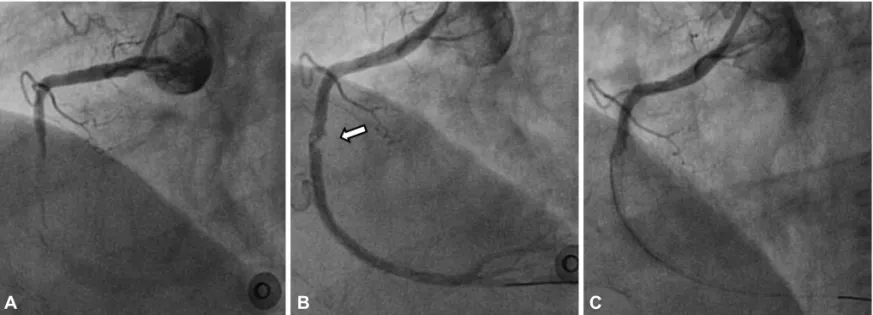
7) With the diagnosis of STEMI, she was sent to cardiac catheterization laboratory. Right coronary angiogram re- vealed total occlusion of the mid portion of the right coronary artery (RCA) with thrombus (Fig. 1A). Left coronary angiogram also showed a tight stenotic lesion in the mid portion of the left anterior descend- ing artery (LAD, 65%) and left circumflex artery (LCX, 85%). We planned primary PCI at RCA as infarct-related artery and secondary PCI on LAD and LCX. We dilated the mid RCA lesion using a 2.0×15 mm balloon. Thereafter, abundant thrombus was shown in the mid- dle to distal RCA and thrombus aspiration was performed; a 2.75×
33 mm everdimus-eluting stent (Xience Prime
TM, Abbott, Santa Clara,
CA, USA) was deployed at 10 atmospheres in the mid RCA. After
stent deployment, thrombus was shown at proximal end of the st-