Antioxidant Characteristics of Artemisis capillaris Hot-water Extract Using Response Surface Methodology
Seong-Ho Kim*
Department of Food Science and Technology, Daegu University, Gyeongbuk 712-714, Korea Received October 1, 2013 /Revised January 17, 2014 /Accepted February 7, 2014
In order to examine antioxidative characteristics of Artemisia capillaris response surface methodology was used to optimize the hot water extraction process by analyzing and monitoring the extraction condition. For total phenolic compounds content, the optimal extraction temperature, time and amount of solvent per sample were 94.50℃, 2.06 hr and 25.03 ml/g, respectively. Also, the optimal conditions for electronic donating ability were 91.82℃, 2.90 hr and 20.88 ml/g, respectively. The nitrile scavenging ability (pH 1.2) was optimized using the extraction temperature of 97.36℃, extraction time 2.75 hr and 15.19 ml/g as the amount of solvent per sample. Regression equations of total phenolic compounds content, electron donating ability and nitrile scavenging ability as dependent variable were deduced from each analyzed extraction condition. And finally, their response surfaces were su- perimposed with the optimal conditions to obtain values for each extraction process factor. The pre- dicted results through superimposing were extraction temperature 90∼95℃, extraction time 2.5∼3.5 hr and amount of solvent per sample 17~24 ml/g.
Key words : Antioxidative characteristics, Artemisia capillaris, extraction condition, response surface methodology
*Corresponding author
*Tel : +82-53-850-6536, Fax : +82-53-850-6539
*E-mail : [email protected]
This is an Open-Access article distributed under the terms of the Creative Commons Attribution Non-Commercial License (http://creativecommons.org/licenses/by-nc/3.0) which permits unrestricted non-commercial use, distribution, and reproduction in any medium, provided the original work is properly cited.
Journal of Life Science 2014 Vol. 24. No. 4. 419~427 DOI : http://dx.doi.org/10.5352/JLS.2014.24.4.419
서 론
쑥은 세계적으로 북반구에 200여종이 분포하고 우리나라 전역에서도 38여종이 봄철부터 자생하는 것으로 알려져 있다 [31]. 이러한 쑥은 독특한 향기와 맛을 가지고 있어 예로부터 식용 또는 식품첨가물로 다양한 형태의 식품으로 사용되어 왔으며, 전국 각지에 널리 분포하여 잎과 줄기의 약효가 우수 한 것으로 알려져 우리나라에서는 예로부터 식용과 한방에서 널리 사용되고 있다[17]. 그 중 인진쑥(Artemisia capillaris Thunb)은 주로 냇가의 모래땅에서 자라는 국화과(composi- tae)에 속하는 번식력이 강한 다년생 초본으로서 일명 사철쑥 또는 정경쑥이라고도 불리우며, 생약명은 인진호, 인진, 추호 등으로 알려져 있다[12]. 인진쑥에는 정유성분, caffeic acid, 방향족 oxycarbonic 및 각종 무기질과 비타민을 함유하고 있 다[4, 25]. 또한 인진쑥은 녹엽 단백질, 필수 지방산과 회분량이 많아서 영양학적 측면에서 매우 우수한 식품이며, 섬유질도 많아서 체중 조절을 위한 식품으로써 권장할만하다는 보고도 있다[1]. 인진쑥은 한방 의료에 널리 활용되어지는 약재로서
주로 소염, 해열, 이담, 이뇨 및 간질환 개선을 목적으로 많이 이용되어왔고[2, 28], 혈류개선[22], 간보호작용[7, 18], 항산화 작용[13] 등 약리효과가 있음이 보고되었다. 최근에는 인진쑥 의 약리성분뿐만 아니라 다양한 생리활성에 관한 연구가 진행 되고 있다. 특히 항산화성에 관한 연구가 많이 수행되었는데 methanol 추출액에서 항산화성이 매우 높은 성분을 분리 정제 후 chlorogenic acid, 3,5-dicaffeoylquinic acid, 3,4-di- caffeoylquinic acid 등을 분리 동정한 결과가 보고되었다[24].
또한 ethanol 추출물도 scoparone, capillarisin 등과 같은 항산 화 성분을 함유하고 있다고 한다[27]. 인진쑥 ethanol 추출물은 다른 쑥에 비해 항산화 효과가 더 크다고 알려져 있으며[17], 그 외에도 인진쑥에 대한 연구로는 지역에 따른 생육특성 및 성분함량 연구[23], 간 기능 개선[14], 항균작용[11], 항암효과 [9], 혈관 팽창작용[30] 및 당뇨증상완화[20] 등이 보고되어있 다. 본 연구에서는 건강기능식품의 원료개발에 필요한 인진쑥 열수 추출물에 관한 연구의 기초자료가 필요함에 따라서 인진 쑥의 열수추출조건에 따른 인진쑥의 항산화적 특성에 대하여 반응표면 분석법으로 최적 추출조건을 설정하였다.
재료 및 방법 실험재료
본 연구의 실험 재료인 인진쑥(Artemisia capillaris Thunb)은 경북 김천지방에서 2012년에 생산, 음건된 것을 대구약령시장 에서 구입하여 분쇄(Cemotec 1090, Tecator, Hoganas, Sweden) 후, 20 mesh체를 통과시켜 실험에 사용하였다.
Table 1. Experimental design of hot-water extraction conditions for Artemisia capillaris
Extraction conditions -2 -1 0 1 2
X1 Temperature (℃) X2 Time (hr) X3 Solvent per
sample (ml/g)
60 101
70 152
80 203
90 254
100 305 추출방법
추출조건 설정을 위한 추출물의 추출방법은 시료 10 g을 추출수기에 취하여 각각의 조건별로 가수를 한 다음 환류냉각 장치가 부착된 추출장치(EAMDS 9601, Kwang Myung Lab.
Co. Seoul, Korea)로 추출온도와 추출시간을 달리하여 추출한 후, 여과하여 추출물의 항산화 특성 측정에 사용하였다.
추출조건 최적화를 위한 실험계획
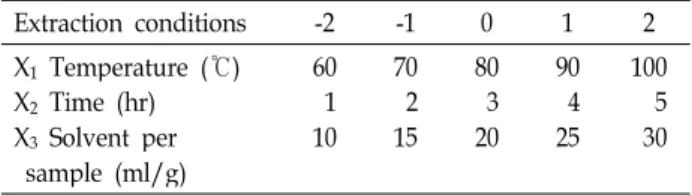
본 실험에서는 추출특성의 모니터링과 추출조건의 최적화 를 위하여 반응표면분석법(repose surface methodology, RSM)을 이용하였고[26], 추출조건에 대한 실험계획은 중심합 성계획을 실시하여 추출공정에서 중요한 독립변수(Xi)로서 추 출온도(X1), 추출시간(X2) 및 시료에 대한 용매비(X3)에 대한 실험범위를 설정하여 각각을 5단계로 부호화하였으며(Table 1), 중심합성계획에 따라 16구로 설정하여 추출실험을 하였다.
또한 이들 독립변수에 영향을 받은 종속변수(Yn)로는 총 추출 수율(Y1), 총 페놀성 화합물 함량(Y2), 전자공여능(Y3) 및 아질 산염소거능(Y4)을 측정하여 그 값을 회귀분석에 사용하였다.
또한 열수 추출에 있어서 추출조건이 인진쑥 추출물의 항산화 적 추출특성에 미치는 영향을 예측된 모델식을 바탕으로 Mathematica program을 이용하여 4차원 반응표면분석으로 해석하였다[19].
총 추출 수율 측정
각 조건별로 추출한 시료의 총 추출 수율[15]은 인진쑥 추출 물 20 ml를 미리 항량을 구한 수기에 취하여 105℃에서 증발 건조시킨 후 그 무게를 측정하였으며, 추출물 조제에 사용된 원료량(건물량)에 대한 백분율로써 추출 수율(%, total extract yield)을 나타내었다.
총 페놀성 화합물 함량 측정
추출물의 총 페놀성 화합물 함량은 Folin-Denis법[8]을 변 형하여 측정하였다. 즉, 추출물을 20배 희석한 검액 5 ml를 넣어 진탕하고 1시간 실온에서 방치하여 700 nm에서 흡광도 를 측정하였고, 대조구는 검액 대신 증류수를 넣어 동일하게 처리하였다. 이때 표준물질로는 tannic acid를 5~50 μg/ml의 농도로 조제하여 검량곡선의 작성에 사용하였다.
전자공여능 측정
시험용액의 전자공여능(electron donating ability, EDA) 시 험은 α,α-diphenyl-β-picrylhydrzyl (DPPH)를 사용한 방법으 로 측정하였다[3]. 즉, DPPH 시약 12 mg을 absolute ethanol 100 ml에 용해한 후 증류수 100 ml를 가하고 50% ethanol 용액을 blank로 하여 517 nm에서 DPPH용액의 흡광도를 약 1.0으로 조정하였다. 이 용액 4 ml를 취하여 10배 희석한 시료 용액 1 ml와 혼합한 후 상온에서 10분간 방치시킨 다음 517 nm에서 흡광도를 측정하여 시료 첨가구와 무첨가구의 흡광 도 차이를 백분율(%)로 표시하여 전자공여능으로 하였다.
EDA(%) = {1-(시료첨가시의 흡광도)/공시험의 흡광도)}
×100
갈색도 측정
추출물의 갈색도는 UV-visible spectrophotometer (Shi- madzu Co., UV-1601, Kyoto, Japan)를 사용하여 420 nm에서 측정하였다.
아질산염 소거능 측정
아질산염 소거능력은 Gray와 Dugan의 방법[6]에 준하여 측정하였다. 즉, 1 mM NaNO2용액 1 ml에 각각의 시료를 가 하고 0.1 M HCl (pH 1.2)과 구연산 완충액(pH 3.0)을 사용하여 반응용액의 pH를 각각 1.2와 3.0으로 조정한 다음 총량을 10 ml로 하였다. 이 용액을 37℃에서 1시간 반응시킨 후 각 반응 액을 1ml씩 취하여 2% acetic acid 용액 5 ml, Griess 시약(30%
초산으로 각각 조제한 1% sulfanilic acid와 1% naphthyl- amine을 1:1 비율로 하여 사용직전 혼합한 것) 0.4 ml을 가하 여 잘 혼합하였다. 이를 실온에서 15분간 방치한 후 520 nm에 서 흡광도를 측정하고 잔존하는 아질산염의 량을 계산하였다.
N(%) = {1-(A-C)/B} x100 N : 아질산염 소거율
A : 1 mM NaNO2용액에 시료를 첨가하여 1시간 방치시킨 후의 흡광도
B : NaNO2 용액의 흡광도 C : 시료자체의 흡광도
결과 및 고찰 추출물의 수율
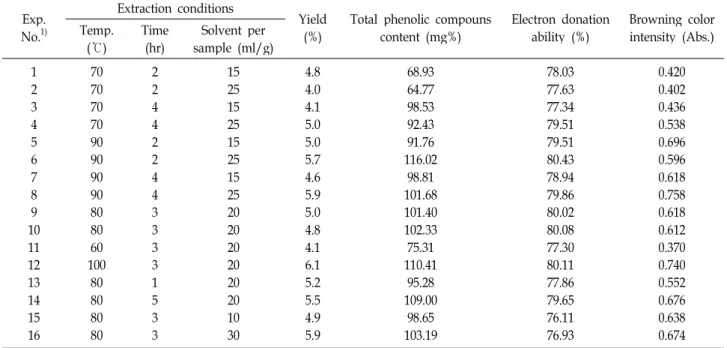
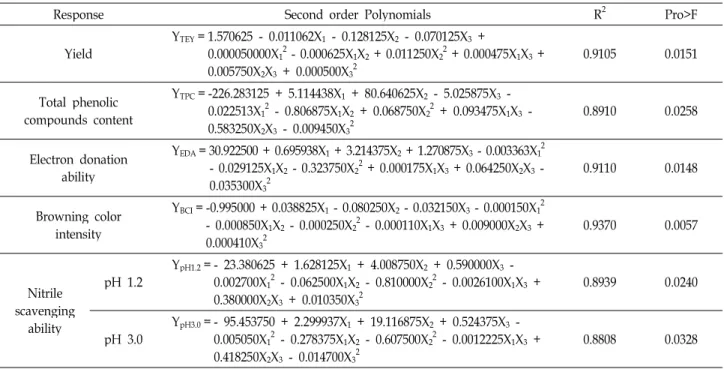
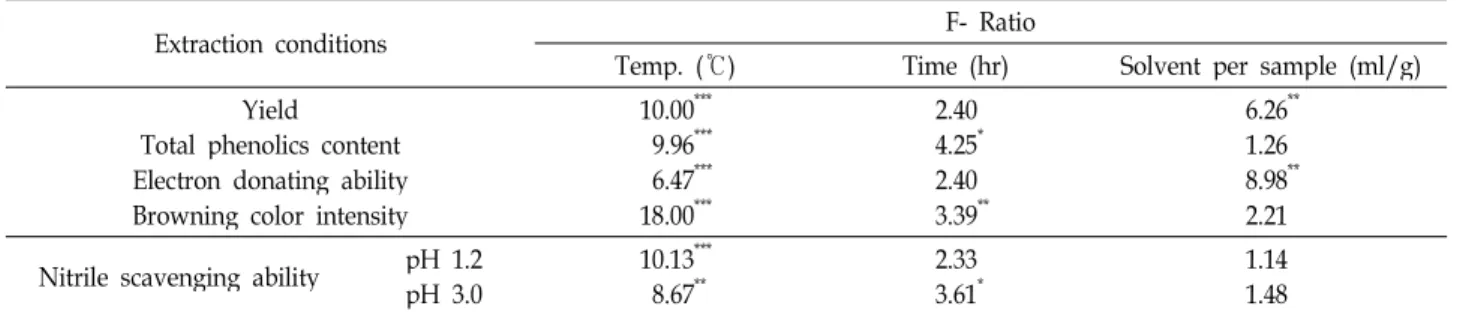
인진쑥의 추출조건에 따른 수율을 측정한 결과는 Table 2와 같이 4.0∼6.1%의 범위로 측정되었다. 이러한 결과를 이용하 여 추출조건과 수율에 대한 반응표면 회귀식을 나타낸 결과는 Table 4와 같다. 반응표면 회귀식의 R2는 0.9105로 5% 이내의 유의수준에서 인정되었다. 예측된 정상점은 안장점으로 능선 분석한 결과 최대값은 추출온도 91.51℃, 추출시간 3.73시간 및 시료에 대한 용매비 27.30 ml/g에서 수율 6.7%로 예측되었 다(Table 5). 이것은 반응표면분석법으로 예측된 값을 나타낸
Table 2. Experimental data on total phenolics content, electron donating ability and browning color intensity ofArtemisis capillaris extract under different hot-water extraction conditions based on central composite design by response surface analysis No.Exp.1)
Extraction conditions
Yield
(%) Total phenolic compouns
content (mg%) Electron donation
ability (%) Browning color intensity (Abs.) Temp.
(℃) Time
(hr) Solvent per sample (ml/g) 12
34 56 78 9 1011 1213 1415 16
7070 7070 9090 9090 80 8060 10080
8080 80
22 44 22 44 3 33 31 53 3
1525 1525 1525 1525 20 2020 2020 2010 30
4.84.0 4.15.0 5.05.7 4.65.9 5.0 4.84.1 6.15.2 5.54.9 5.9
68.93 64.77 98.53 92.43 91.76 116.02
98.81 101.68 101.40 102.33 75.31 110.41
95.28 109.00
98.65 103.19
78.03 77.63 77.34 79.51 79.51 80.43 78.94 79.86 80.02 80.08 77.30 80.11 77.86 79.65 76.11 76.93
0.420 0.402 0.436 0.538 0.696 0.596 0.618 0.758 0.618 0.612 0.370 0.740 0.552 0.676 0.638 0.674
1)The number of experimental condition by central composite design.
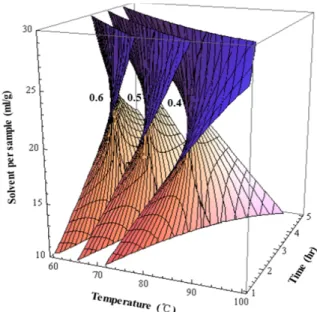
Fig. 1. Response surface for extraction yield ofArtemisia capillaris extract at constant values (4, 5, 6%) as a function of ex- traction temperature, extraction time and solvent per sample. Samples was extracted under the experimental design of hot-water extraction temperature (60~100℃), extraction time (1~5 hr) and solvent per sample (10~30 ml/g).
Table 3. Experimental data on nitrile scavenging ability (pH 1.2, pH 3.0) of Artemisis capillarisextract under different hot-water extraction conditions based on central com- posite design by response surface analysis
No.Exp.1)
Extraction conditions Nitrile scavenging ability (%) Temp.
(℃) Time
(hr) Solvent per
sample (ml/g) pH 1.2 pH 3.0 12
34 56 7 89 1011 1213 14 1516
7070 7070 9090 90 9080 8060 10080
80 8080
22 44 22 4 43 33 31 5 33
1525 1525 1525 15 2520 2020 2020 20 1030
66.37 65.33 68.21 72.79 83.04 74.80 80.40 81.74 77.43 77.98 68.98 84.27 70.87 78.06 76.78 80.70
37.84 42.10 47.64 51.11 58.01 50.67 47.52 57.70 51.88 52.76 42.61 57.99 47.46 52.32 49.23 52.47
1)The number of experimental condition by central composite design.
것으로 수율은 추출온도, 추출시간 및 시료에 대한 용매비가 증가할수록 높아지는 것으로 나타났다(Fig. 1). 또한 Table 6에
서와 같이 수율에 대한 추출조건의 영향은 추출온도에 영향을 가장 크게 받으며, 시료에 대한 용매비에도 영향을 받고 있는 것으로 나타났다.
Jung 등[9]은 추출용매는 다르나 인진쑥 MeOH추출물의 추
Table 4. Polynomial equations calculated by RSM program for extraction conditions of Artemisis capillarisextract
Response Second order Polynomials R2 Pro>F
Yield YTEY= 1.570625 - 0.011062X1 - 0.128125X2 - 0.070125X3 +
0.000050000X12- 0.000625X1X2+ 0.011250X22+ 0.000475X1X3+
0.005750X2X3 + 0.000500X32 0.9105 0.0151
Total phenolic compounds content
YTPC= -226.283125 + 5.114438X1+ 80.640625X2 - 5.025875X3 - 0.022513X12 - 0.806875X1X2 + 0.068750X22 + 0.093475X1X3 -
0.583250X2X3 - 0.009450X32 0.8910 0.0258
Electron donation ability
YEDA= 30.922500 + 0.695938X1+ 3.214375X2+ 1.270875X3- 0.003363X12
- 0.029125X1X2- 0.323750X22+ 0.000175X1X3+ 0.064250X2X3-
0.035300X32 0.9110 0.0148
Browning color intensity
YBCI= -0.995000 + 0.038825X1- 0.080250X2- 0.032150X3- 0.000150X12
- 0.000850X1X2- 0.000250X22 - 0.000110X1X3 + 0.009000X2X3+
0.000410X32 0.9370 0.0057
Nitrile scavenging
ability
pH 1.2 YpH1.2= - 23.380625 + 1.628125X1 + 4.008750X2 + 0.590000X3 - 0.002700X12 - 0.062500X1X2 - 0.810000X22- 0.0026100X1X3 +
0.380000X2X3 + 0.010350X32 0.8939 0.0240
pH 3.0 YpH3.0= - 95.453750 + 2.299937X1 + 19.116875X2 + 0.524375X3 - 0.005050X12 - 0.278375X1X2 - 0.607500X22- 0.0012225X1X3 +
0.418250X2X3 - 0.014700X32 0.8808 0.0328
출수율로 19.13%의 본 연구결과보다 높은 효율을 나타내었다.
또한 다수의 쑥 연구를 통해 알려진 쑥의 열수추출 수율과 Lee 등[16]이 보고한 사철쑥 열수 추출수율이 5∼15%라는 결 과는 본 연구와 유사하게 나타났다. 그러나 이는 시료종류, 추출용매, 추출 온도와 추출시간에 따라 변화 요인이 될 수 있으리라 판단된다.
총 페놀화합물 함량
추출조건별 추출물의 총 페놀성 화합물 함량은 Table 2에 나타내었고, 이를 회귀분석하여 본 결과 회귀식(Table 4)의 R2 는 0.8910으로 5%이내의 수준에서 유의성이 인정되었다. 인진 쑥 추출물의 총 페놀성화합물 함량의 예측된 정상점은 안장점 으로 능선분석을 실시하여 본 결과, 최대값은 124.64 mg%로 예측되었으며, 이때의 추출조건은 추출온도 94.50℃, 추출시 간 2.06시간 및 시료에 대한 용매비 25.03 ml/g이었다(Table 5). 총 페놀성화합물 함량은 추출온도에 가장 큰 영향을 받고 있었으며, 추출온도가 높아질수록 증가하는 경향을 나타내었 다(Table 6). 총 페놀성 화합물 함량의 추출특성에 따른 반응표 면을 살펴볼 때 세 변수 중 추출온도에 영향을 가장 많이 받아 추출온도가 높아질수록 함량이 증가하는 것으로 나타났다.
Seo 등[24]은 인진쑥의 ethyl acetate 추출물의 총페놀 화합 물 함량이 62.6±1.6 mg/g, acetone 추출물이 86.5±0.3 mg/g이 었고, methanol 추출물은 113.7±0.5 mg/g으로 가장 높은 함량 이었다고 보고하였다. Jung 등[9]은 인진쑥 MeOH추출물의 총페놀성 화합물이 60.07±0.89 mg/g으로 높은 함량을 가져 강한 항산화 활성을 갖는 원인이라 하였고, Choi 등[5]의 쑥의 총 페놀화합물 함량이 쑥의 종류와 수집지역에 따라서 다양한
함량값의 차이를 보였고, 최저값이 156 mg/100g, 최고값이 1,767 mg/100g으로 최대 10배 이상의 쑥 종간 편차를 나타낸 다고 보고하였다. 한편 황 등[30]은 섬애약쑥의 페놀화합물의 함량은 추출온도 60℃에서 2.30±0.21~7.02±0.22 mg/g이었고 95℃에서 3.36±0.13~9.88±0.23 mg/g으로 침출온도가 높을수 록 총 페놀화합물 함량이 증가하였다고 하였다.
전자공여능
각 조건의 추출물의 DPPH radical소거활성인 전자공여능 의 결과는 Table 2와 같으며, 이 결과를 이용하여 반응표면 회귀분석을 실시하고, 각 요인변수에 따른 반응변수 즉, 전자 공여능에 대한 회귀식은 Table 4와 같다. 추출조건별 추출물 전자공여능에 대한 회귀식의 R2는 0.9110으로 5% 이내의 유의 수준에서 유의성이 인정되었다. 추출조건에 따라 예측된 정상 점은 최대점으로 전자공여능의 최대값은 80.69%이었고, 이때 추출조건은 추출온도 91.82℃, 추출시간 2.90시간 및 시료에 대한 용매비 20.88 ml/g이었다(Table 5). 4차원 반응표면을 통 한 인진쑥 추출물의 전자공여능 변화는 추출온도가 높고 시료 에 대한 용매비가 증가할수록 높은 값을 나타냈으며, 추출시 간에는 거의 영향을 받지 않는 것으로 나타났다. 또한 추출조 건에 대한 영향은 Table 6에서와 같이 추출온도와 시료에 대한 용매비에 큰 영향을 받고 있는 것으로 나타났다. 또한 전자공 여능의 4차원 반응표면은 Fig. 3에 나타내었으며, 추출온도가 높을수록 전자공여능이 증가하는 것으로 나타났으며, 특히 시 료에 대한 용매비가 20~25 ml/g의 범위에서 높은 값을 나타내 는 것을 알 수 있었다.
Seo 등[24]은 인진쑥 ethyl acetate추출물 200 ppm의 DPPH
Table 5. Predicted levels of hot-water extraction conditions ofArtemisis capillarisextract for the maximum responses of variables by the ridge analysis
Responses X11) X22) X33) Maximum Morphology Yield
Total phenolic compunds content Electron donation ability Browning color intensity
91.51 94.50 91.82 88.52
3.73 2.06 2.90 4.22
27.30 25.03 20.88 26.60
6.7(%) 124.64(mg%)
80.69(%) 0.79(Abs)
Saddle point Saddle point Maximum Saddle point Nitrile scavenging ability pH 1.2
pH 3.0 97.36
96.87 2.75
2.05 15.19
17.50 86.32(%)
60.26(%) Saddle point Saddle point
1)Temperature (℃), 2)Time (hr), 3)Solvent per sample (ml/g)
Table 6. Regression analysis for regression model of variables in hot-water extraction condition
Extraction conditions F- Ratio
Temp. (℃) Time (hr) Solvent per sample (ml/g)
Yield
Total phenolics content Electron donating ability Browning color intensity
10.00***
9.96***
6.47***
18.00***
2.40 4.25* 2.40 3.39**
6.26**
1.268.98**
2.21 Nitrile scavenging ability pH 1.2
pH 3.0 10.13***
8.67** 2.33
3.61* 1.14
1.48
*Significant at 10% level; ** Significant at 5% level; ***Significant at 1% level.
Fig. 3. Response surface for electron donation ability ofArtemisia capillarisextract at constant values (78, 79, 80%) as a func- tion of extraction temperature, extraction time and sol- vent per sample. Samples was extracted under the ex- perimental design of hot-water extraction temperature (60~100℃), extraction time (1~5 hr) and solvent per sam- ple (10~30 ml/g). Electron donation ability was meas- ured using DPPH reagent.
Fig. 2. Response surface for total phenolic compounds content ofArtemisia capillaris extract at constant values (90, 10, 110 mg%) as a function of extraction temperature, ex- traction time and solvent per sample. Samples was ex- tracted under the experimental design of hot-water ex- traction temperature (60~100℃), extraction time (1~5 hr) and solvent per sample (10~30 ml/g). Total phenolic compound content was based on tannic acid as standard and was measured using Folin-Denis method.
소거활성은 35.2%, acetone 추출물 200 ppm은 57.1%으로 보 고하여 두 용매로 추출한 추출물은 본 실험의 물 추출물보다
소거활성 결과보다 낮게 나타났으나, methanol 추출물 200 ppm은 91.1%, methanol추출물 100 ppm에서는 90.8%의 활성
Fig. 4. Response surface for browning color intensity of Artemisia capillarisextract at constant values (Abs. 0.4, 0.5, 0.6) as a function of extraction temperature, ex- traction time and solvent per sample. Samples was ex- tracted under the experimental design of hot-water ex- traction temperature (60~100℃), extraction time (1~5 hr) and solvent per sample (10~30 ml/g). Browning color intensity was measured using spectrophotometer (OD 420nm).
으로 BHT 90.5%와 tocopherol 92.3%가 거의 같은 비슷한 수준 의 소거활성을 갖는다고 보고하여 본 실험의 물 추출물의 소 거활성값보다 높았다. Jung 등[9]은 methanol추출물의 DPPH 소거활성이 IC50 11.09±0.14 μg/ml로 높은 항산화 활성을 갖 는다고 하였다. Kang 등[10]은 쑥의 물과 70% 아세톤 추출물 의 전자공여능이 각각 47.1%, 45.8%로 보고하여 직접적인 비 교는 힘드나, 본 실험에 사용한 인진쑥의 물 추출물의 전자공 여능보다 낮은 값을 나타내었다.
갈변도의 변화
Table 2는 추출조건에 따른 갈색도의 변화를 나타내었고, 결과에 대한 반응표면 회귀식은 Table 4에 나타내었다. 갈변도 에 대한 회귀식의 R2는 0.9370이고 1% 이내에서 유의성이 인 정되었으며, 예측된 정상점은 안장점으로 능선분석을 실시하 여 본 결과 최대 흡광도 값은 0.79로 예측되었다. 이 예측값을 추출할 수 있는 조건은 추출온도 88.52℃, 추출시간 4.22시간 및 시료에 대한 용매비 26.60 ml/g으로 나타났다(Table 5). 추 출조건별 갈색도 변화의 반응표면은 Fig. 4와 같이 추출온도가 높고 추출시간이 길어질수록 갈색도가 증가하는 것으로 나타 났으며, Table 6에서도 알 수 있듯이 추출온도와 추출시간에 영향을 받고 있었으며, 시료에 대한 용매비에 대한 영향은 거 의 나타나지 않았다.
한편 섬애약쑥[29]은 상온에서 건조 전처리 시료가 60℃ 건 조시료보다 갈변도의 흡광도값이 2배 이상 이었고 숙성시간 에 따라서 갈변도는 증가하고 침출온도가 높을수록 갈변도가 증가한다고 보고하여 본 연구와 유사한 결과를 나타내었다.
아질산염 소거능의 변화
추출조건에 따른 인진쑥 추출물의 아질산염 소거능을 측정 한 결과는 Table 3과 같이 pH에 따른 영향이 크게 나타나 pH 1.2에서는 65.33∼84.27%, pH 3.0의 경우는 37.84∼58.01%의 범위로 나타났으며, pH 1.2및 pH 3.0에 따른 아질산염 소거능 에 대한 추출물의 회귀식의 R2는 각각 0.8939 및 0.8808이며, 두 조건 모두에서 5% 이내에서 유의성이 인정되었다(Table 4). 최적 예측조건은 Table 5에 나타내었고, pH 1.2의 경우 예 측된 정상점은 안장점으로 능선분석 결과 최대값이 86.32%로 예측되었고, 이때 추출조건은 추출온도 97.36℃, 추출시간 2.75시간 및 시료에 대한 용매비 15.19 ml/g이었다. pH 3.0의 경우도 예측된 정상점이 안장점으로 능선분석을 실시하여 본 결과 최대값은 60.26%로 예측되었고, 이 예측값을 추출할 수 있는 조건은 추출온도 96.87℃, 추출시간 2.05시간 및 시료에 대한 용매비 17.50 ml/g이었다. Table 6에서 보는 바와 같이 두 조건 모두에서 추출온도에 영향을 많이 받았으나 시료에 대한 용매비에는 거의 영향을 받지 않는 것을 알 수 있었다. 추출조건별 아질산염 소거능 변화의 반응표면은 Fig. 5 및 Fig.
6과 같이 추출온도가 높아질수록 아질산염 소거능은 증가하 는 것으로 나타났다.
Park과 Kim [21]의 쑥 추출물의 아질산염 소거능이 물 및 에탄올 추출물 모두에서 pH가 낮아짐에 따라 증가하여 pH 1.2에서 가장 높았다는 결과와 일치하였다.
최적추출조건 예측
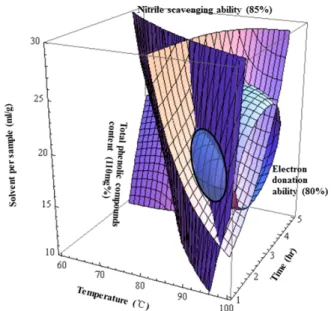
인진쑥 열수추출물의 항산화적 특성에 대한 최적 추출조건 을 설정하기 위하여 각 성분의 반응표면을 superimposing 하 여 Fig. 7에 나타내었다. 각 항목의 최적 추출조건으로 도출되 어진 최대 또는 최적값의 반응표면을 한 도면에 일치시킨 결 과 총페놀성 화합물의 함량, 전자공여능 및 아질산염 소거능 등 3항목의 최대값의 반응표면의 그림이 완전 또는 부분적으 로 적합하였고 그 일치하는 부분을 각 독립변수의 범위를 읽 어 최적 추출조건의 범위로 설정하였다. 이 반응 표면으로부 터 설정될 수 있는 최적 조건 범위는 Fig. 7의 타원형의 짙은 부분으로 인진쑥 열수추출의 최적조건을 예측한 결과, 추출온 도 90∼95℃, 추출시간 2.5∼3.5 hr 및 시료에 대한 용매비 17∼
24 ml/g의 범위로 이로부터 최적점이라 예상되는 추출 조건 은 추출온도 92.5℃, 추출시간 3.0 hr 및 시료에 대한 용매비 20.5 ml/g 를 최적추출조건으로 예측하였다.
본 연구에서는 인진쑥 열수추출물의 항산화성을 결정하는 인자로서 총페놀성 화합물의 함량, 전자공여능 및 아질산염
Fig. 7. Superimposed response surface for optimization of total phenolics compound content (110 mg%), electron dona- tion ability (80%) and nitrile scavenging ability (85% at pH 1.2) as a function of extraction temperature, time and solvent per sample.Overlapped black oval area was pre- dicted as a range of optimal extraction condition.
Fig. 5. Response surface for nitrile scavenging ability (pH 1.2) ofArtemisia capillaris extract at constant values (80, 85, 90%) as a function of extraction temperature, extraction time and solvent per sample. Samples was extracted un- der the experimental design of hot-water extraction tem- perature (60~100℃), extraction time (1~5 hr) and solvent per sample (10~30 ml/g). Nitrile scavenging ability was measured using the Gray and Dugan’s modified method.
Fig. 6. Response surface for nitrile scavenging ability (pH 3.0) ofArtemisia capillaris extract at constant values (45, 55, 65%) as a function of extraction temperature, extraction time and solvent per sample. Samples was extracted un- der the experimental design of hot-water extraction tem- perature (60~100℃), extraction time (1~5 hr) and solvent per sample (10~30 ml/g). Nitrile scavenging ability was measured using the Gray and Dugan’s modified method.
소거능 등을 반응표면분석법으로 최적추출조건을 확립하였
다. 이들 추출물이 항산화적 특성과 관련한 최적추출조건을 이용한다면 인진쑥의 가공공정에 다양한 활용이 될 수 있으리 라 생각된다.
References
1. Ahn, B. M. 2000. What is In-Jin-Sook? Artemisia caillaris, Artemisia iwayomogi andArtemisia annua. J Korean Liver6, 548-551.
2. Block, G. and Langseth, L. 1994. Anitoxidant vitamins and disease prevention. Food Technology 48, 80-89.
3. Blois, M. S. 1958. Antioxidant determination by the use of a stable free radical. Nature26, 1199-1202.
4. Cho, Y. H. and Chiang, M. H. 2002. Essential oil composi- tion and antibacterial activity ofArtemisia capillaris,Artemisia argyi, andArtemisia princeps.Korean J Intl Agric13, 313-320.
5. Choi, Y. M., Chung, B. H., Lee, J. S. and Cho, Y. G. 2006.
The antioxidant activities of Artemisia spp. collections.
Korean J Corp Sci 51, 209-214.
6. Gray, J. I. and Dugan, Jr. L. R. 1975. Inhibition of N-nitroso- amine formation in model food systems. J Food Sci 40, 981-984.
7. Han, E. K., Jin, Y. X., Yoo, Y. S., Jung, E. J., Lee, J. Y. and Chung, C. K. 2009. Effect of Artemisia capillaris and Paecilomyces japonicaon the reduction of hepatotoxicity and lipid metabolism induced by ethanol.J Korean Soc Food Sci Nutr 38, 1016-1023.
8. Isabelle, M., Lee, B. L., Ong, C. N., Liu, X. and Huang, D.
2008. Peroxyl radical scavenging capacity, polyphenolics, and lipophilic antioxidant profiles of mulberry fruits culti-
vated in southern China. J Agric Food Chem56, 9410-9416.
9. Jung, M. J., Yin, Y., Heo, S. I. and Wang, M. H. 2008.
Antioxidant and anticancer activities of extract from Artemisia capillarises. Korean J Pharmacogn 39, 194-198.
10. Kang, Y. H., Park, Y. G., Oh, S. R. and Moon, K. D. 1995.
Studies on the physiological functionality of pine needle and mugwort extracts. Korean J Food Sci Technol 27, 978-984.
11. Kim, H. T., Kim, S. W., Lim, M. K., Yeo, S. G., Jang, K.
H., Oh, T. H. and Lee, K. W. 2007. Antimicrobial effects ofArtemisia capillarisextracts on the pathogenic bacteriain vitro. J Vet Clin 24, 130-136.
12. Kim, T. J. and Jang, J. S. 1998. Korean resources plants Ⅵ., pp. 259, Seoul National University Publishing Department Corp., Seoul, Korea.
13. Kimura, Y., Okuda, H., Okuda, T., Hatano, T., Agata, I. and Arichi, S. 1985. Studies on the activities of tannins and re- lated compounds from medicinal plants and drugs. VII.
Effects of extracts of leaves of Artemisia species, and caffeic acid and chlorogenic acid on lipid metabolic injury in rats fed peroxidized oil. Chem Pharm Bull 33, 2028-2034.
14. Kiso, Y., Ogasawara, S., Hirota, K., Watanabe, N., Oshima, Y., Konno, C. and Hikino. H. 1984. Antihepatotoxic princi- ples of Artemisia capillaris buds. Planta Medica50, 81-85.
15. Kwon, J. H., Belanger, J. M. F. and Pare, J. R. J. 2003.
Optimization of microwave-assisted extraction (MAP) for ginseng components by response surface methodology. J Agric Food Soc89, 216-222.
16. Lee, K. L., Choi, G. P., Lee, H. R., Lee, G. Y., Yu, C. Y.
and Lee, H. Y. 2004. Enhanced immune activity and cytotox- icity ofArtemisia capillarisThunb extracts against human cell lines. Korean J Medicinal Crop Sci12, 36-42.
17. Lee, S. D., Park, H. H., Kim, D. W. and Bang, B. H. 2000.
Bioactive constituents and utilities ofArtemisiasp. as medic- inal herb and foodstuff. Korean J Food Nutr 13, 490-505.
18. Lim, S. S., Lee, J. H. and Kim, M. H. 1997. Effect ofArtemisia princepsvar orientalisandCircium japonicumvar Ussuriense on liver function, body lipid and bile acid of hyperlipidemic rat. Korean J Nutr 30, 797-802.
19. Martha, L. A. and James, P. B. 1992. The mathematica handbook. Compatible with mathematica version 2.0. pp.
15-511, An inprint of academic press Inc. Harcourt Brace
& Co., Boston, Massachusetts, USA.
20. Pan, J., Liu, G., Liu, H. Qiu, Z. and Chen, L. 1998. Effects ofAtemisia capillarison blood glucose and lipid in mice.J Chin Med Mat 21, 408-411.
21. Park, C. S. and Kim, M. L. 2006. Functional properties of mugwort extract and quality characteristics of noodles add- ed mugwort powder. Korean J Food Preserv 13, 161-167.
22. Park, S. H., Lim, H. Y. and Han, J. H. 2003. A study of medicinal herbs for functional foods applications (I) Nutrition / al composition and scopoletin analysis of Artemisia capillaris. J East Asian Soc Diet Life13, 552-560.
23. Rho, T. H. and Seo, G. S. 1993. Growth characteristics and chemical components in local collections of Artemisia sp.
Korean J Medicinal Crop Sci 1, 171-177.
24. Seo, H. C., Suzuki, M., Ohnishi-Kameyama, M., Oh, M. J., Kim, H. R., Kim, J. H. and Nagata, T. 2003. Extraction and identification of antioxidant components fromArtemisia ca- pillaris herba. Plant Foods Human Nutr58, 1-12.
25. Sheu, S. J., Chieh, C. L. and Weng, W. C. 2001. Capillary electrophoretic determination of the constituents of Artemisiae capillaris herba. J Chromatography911, 285-293.
26. Wanasundara , PKJPD. and Shahidi, F. 1996. Optimization of hexametaphosphate - assisted extraction of flaxseed pro- teins using response surface methodology. J Food Sci 6, 606-607.
27. Wang, H., Zou, H., Ni, J., Kong, L., Gao, S. and Guo, B.
2000. Fractionation and analysis ofArtemisia capillarisThunb by affinity chromatography with human serum albumin as stationary phase. J Chromatogr A 18, 501-510.
28. Waterfield, C. J., Turton, J. A. and Scales, M. D. 1993.
Investigations into the effects of various hepatotoxic com- pounds on urinary and liver taurine levels in rats. Arch Toxical 67, 244-254.
29. Whang, C. R., Seo, W. T., Jung, M. J. and Shim, J. H. 2013.
Antioxdant activity of theSumaeyaksuktea extracts prepared with different drying and extract conditions.Korean J Food Preserv20, 546-553.
30. Yamahara, J., Kobayashi, G., Matsuda, H., Katayama, T. and Fujimura, H. 1989. Vascular dilatory action of Artemisia capil- larisbud extracts and their active constituent. J Ethnopharmacol 26, 129-136.
31. Yook, C. S. 1997. Medicinal Plants,pp. 293-298, Jinmyung Publishing Co., Seoul, Korea.
초록:반응표면분석법을 이용한 인진쑥 열수추출물의 항산화적 특성 김성호*
(대구대학교 식품공학과)
인진쑥(Artemisia capillaris Thunbl)의 항산화적 특성을 조사하기 위하여 반응표면분석법에 의하여 열수추출특 성을 모니터링하여 최적 추출조건을 설정하였다. 총 페놀성화합물 함량에 대한 최적조건은 94.50℃, 2.06 hr 및 시료에 대한 용매비 25.03 ml/g, 전자공여능에 대한 최적조건은 91.82℃, 2.90 hr 및 20.88 ml/g으로 나타났고, 아질산염 소거능(pH 1.2)에 대한 최적조건은 97.36℃, 2.75 hr 및 15.19 ml/g등으로 각각 나타났다. 각 변수에 대한 회귀식을 도출하여 인진쑥의 총 페놀성화합물 함량, 전자공여능 및 아질산염 소거능(pH 1.2)에 대한 최적 추출조 건을 superimposing 한 결과, 추출온도 90~95℃, 추출시간 2.5~3.5 hr 및 시료에 대한 용매비 17~24 ml/g의 범위 로 각각 예측되었다.