• 검색 결과가 없습니다.

Characteristics of Eggshell Powder as Carriers of Probiotics

N/A
N/A
Protected

Academic year: 2021

Share "Characteristics of Eggshell Powder as Carriers of Probiotics"

Copied!
9
0
0

로드 중.... (전체 텍스트 보기)

전체 글

(1)

Characteristics of Eggshell Powder as Carriers of Probiotics

Woo-Do Lee

1†

, Kai-Min Niu

1†

, Jeong-Min Lim

1

, Kwon-Jung Yi

1

, Bong-Joo Lee

2

, Kang-Woong Kim

2

, Kyoung-Duck Kim

2

, Sang-Woo Hur

2

, Hyon-Sob Han

2

and Soo-Ki Kim

1

*

1

Department of Animal Science and Technology, Konkuk University, 120 Neungdong-ro, Gwangjin-gu, Seoul 05029, Korea

2

Aquafeed Research Center, National Institute of Fisheries Science, Pohang 37517, Korea Received January 8, 2018 /Revised January 16, 2018 /Accepted January 16, 2018

Eggshell (ES) is a by-product of table eggs with high content of calcium carbonate which can be used as a calcium source in feed. In this study, we have first illuminated the potential application of ES as a novel carrier for probiotics. The carriers used in the study include a SBM (Soybean meal), ESL (Eggshell powder with large particles), ESF (Eggshell powder with fine particles), and the complex carriers (SBM+ESL, SBM+ESF). The structure of carriers absorbed by L. plantarum was confirmed by SEM image. Among these carriers, the complex carrier SBM+ESF showed the highest viability of L.

plantarum with pH 7~8 during four weeks storage at room temperature. The SBM+ESF was further tested as a carrier for various probiotic strains at 4℃ or 30℃. All the probiotic strains showed high viability at 4℃ storage. However, a significant reduction of Lactobacillus cells was observed at 30℃

storage. B. lichenifomis maintained high viability whereas B. subtilis, B. amyloliquefaciens, and S. cerevisiae showed the reduction of 2 log

10

(CFU/g). These results suggest that if the ESF as a calcium source in feed was mixed with SBM, it can be used as an effective complex carrier for improving the viability of some probiotics including B. licheniformis.

Key words : Carrier, eggshell powder, probiotics, SEM, viability

*Corresponding author

*Tel : +82-2-450-3728, Fax : +82-2-458-3728

*E-mail : [email protected]

This is an Open-Access article distributed under the terms of the Creative Commons Attribution Non-Commercial License (http://creativecommons.org/licenses/by-nc/3.0) which permits unrestricted non-commercial use, distribution, and reproduction in any medium, provided the original work is properly cited.

Journal of Life Science 2018 Vol. 28. No. 1. 90~98 DOI : https://doi.org/10.5352/JLS.2018.28.1.90

Introduction

Hen eggs are popular and important food resources worldwide, since they are abundant in proteins, vitamins and minerals [1]. Due to the major demand for table eggs, 6.5×10

7

tons/year of eggs are produced worldwide [2]. As egg production increases, the eggshell (ES) waste is gen- erated massively, totaling 3-12% of the whole egg mass product [3]. The volume of ES generated worldwide has caused environmental impact concerns and potential risks for reservoirs of pathogens [4, 5]. It is critical to exploit the industrial eggshell as value added resources for practical applications. Recently, Quina et al. [6] have reviewed the application of eggshells on using as raw materials as a food additive, soil amendment, calcium source, cosmetic, catalyst, and sorbent. Eggshell contains 39% calcium components in- cluding calcium carbonate (96%), magnesium carbonate

(1%), calcium phosphate (1%) and others [7, 8]. The high calcium content of chicken eggshell powder makes it an attractive calcium source. ES has been used as dietary cal- cium source for laying hens or added in chocolate cakes [9, 10].

As the fishmeal price increase, more researchers are at- tempting to develop low fishmeal feed with plant protein sources or some others [11]. It is a promising method to maintain sustainability in aquaculture production, but some problems like the intestinal inflammation was observed [12].

Probiotics were reported to have anti-inflammation effects [13]. In previous work [14], we have characterized for Lactobacillus-fermented Artemisia annua L. including anti- oxidant and antibacterial activity and they could be used as feed additive to improve the digestibility and immunity of fish. Bacillus strains and yeast are also included in the most popular probiotics, benefits of which in health main- tenance of fish [15].

In general, the viability reduction of probiotics during

storage can directly impact on their quality. Various type

of carriers have been used to improve the viability and sta-

bility of probiotics during storage. Raspberry powder has

been evaluated as a carrier for shelf life stability of L. rham-

nosus at room temperature [16]. Different fibers such as oat,

wheat dextrin, and inulin were also used as carriers for

(2)

Table 1. Probiotics used in this study.

Stock no. Probiotics Culture

Medium

1)

Isolated

source Characteristics Reference

SK3494 Lactobacillus plantarum MRS Mugwort powder Antibacterial activity,

Lactic acid production [14]

SK1751 Lactobacillus brevis MRS Fermented leaf of

sweet potato

Antibacterial activity,

Lactic acid production This study

SK3927 Bacillus licheniformis LB Intestine of olive

flounder

Digestive enzyme

activity This study

SK4082 Bacillus subtilis LB Intestine of olive

flounder

Digestive enzyme

activity This study

SK4079 Bacillus amyloliquefaciens LB Intestine of olive flounder

Digestive enzyme

activity This study

SK3587 Saccharomyces cerevisiae YM Feces of pig Nutrients, Growth factors This study

1)

Culture Medium: MRS, deMan, Rogosa and Sharpe; LB, Luria-Bertani; YM, Yeast Malt.

L. rhamnosus and the viability of the cell with carriers de- creased slower than the cells without carriers during eight weeks storage at 37℃[17]. So far, there is no report for evaluation on eggshell powder as a probiotic carrier, al- though it has advantages for cost-effective and high level calcium content. In this study, we firstly investigated for the value-added product of eggshell powder as a probiotic carrier during the storage according to temperature changes.

Materials and Methods

Manufacture of eggshell powder

The eggshell powder used in this study was provided by Poonglim Foods Co. Ltd. Briefly, the eggshell powder with large particles (ESL) was manufactured by dehy- dration, heating (150℃), and followed by drying and smash- ing to 3-5 mm. The eggshell powder with fine particles (ESF) was manufactured by soaking in water, removing the egg- shell membrane, sterilization (100℃), and followed by dry- ing and smashing to 0.03-0.05 mm.

Determination of nutritional composition and mineral content

The crude protein, fat and ash content of ES powder were determined by the method described in A.O.A.C [18]. The calcium content was analyzed using atomic absorption spec- troscopy (flame AAS, Germany) and phosphorous content was determined spectrophotometrically by the method de- scribed in the study of Schaafsma et al. [19]

Isolation and identification of indigenous bacteria from ES powder

1 g of ESL or ESF was added into 9 ml of sterile distilled water. 100 ul of 10

-3

or 10

-4

diluted solution was spread on R2A, LB, YM and MRS agar plates. R2A, LB and MRS agar plates were incubated at 37℃ and YM plates were incubated at 30℃. The single colony was purified and iden- tified by 16S rDNA sequencing (Macrogen, Seoul, Korea).

Preparation of complex carrier with probiotics The carriers were prepared by using single source of soy- bean meal (SBM) with particle size of 0.71 mm, ESL and ESF. The complex carriers of SBM with ESL or ESF were prepared at a ratio of 5:2 mixture. All carriers were steri- lized by autoclave at 121℃ for 15 min and then dried in an oven at 60℃ overnight.

Probiotic incorporation and viability

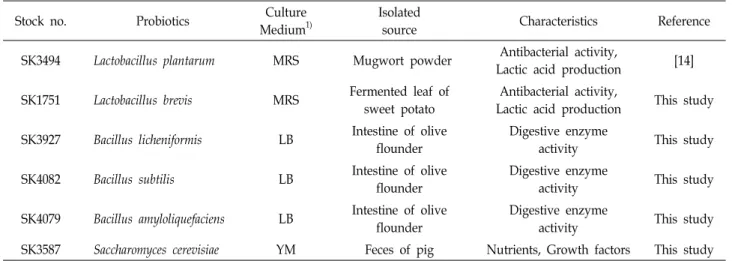
Probiotics used in the study were isolated from different sources and characterized with functional effects (Table 1).

The Lactobacillus plantarum and Lactobacillus brevis were cul-

tured in MRS for 24 hr at 37°C. Bacillus licheniformis, Bacillus

subtilis and Bacillus amyloliquefaciens were cultured in LB for

24 hr at 37°C. The Saccharomyces cerevisiae was cultured in

YM for 24 hr at 30°C. Each 50 ml of the cell was harvested

by centrifugation (5,000 g, 10 min, 4°C) and washed three

times with sterilized distilled water (DW). The cell pellets

were dissolved in 9 ml sterilized DW and mixed into each

probiotic carrier of 21 g. Then the probiotic carriers were

dried until the moisture content less than 10% in a clean

bench. The viability of probiotics in carriers was determined

(3)

Table 2. Nutritional composition of eggshell powder

Item

Eggshell, % on dry weight basis Brown color

(This study)

Brown color [10]

White color [10]

Moisture Crude protein Crude fat Ash Calcium Phosphorous

0.83 4.74 0.44 91.3 34.5 0.46

0.20 5.04 0.08 94.3 33.1 0.07

0.46 3.92 0.35 94.6 34.1 0.04

Table 3. Identification of bacteria isolated from eggshell powder Stock

no. Identification

Query Coverage

(%)

Max Identity

(%)

Isolated medium

1)

Isolated

source

2)

Characteristics Reference

SK4279 SK4280 SK4281 SK4282 SK4285 SK4288 SK4289

Bacillus licheniformis Bacillus pumilus Janibacter sp.

Bacillus subtilis Dermacoccus sp.

Lactobacillus plantarum Staphylococcus capitis

98 96 100

99 98 97 96

99 100

99 99 99 100

99

R2A R2A LB LB YM MRS

YM

ESL ESL ESL ESF ESL ESF, ESL

ESL

Probiotic Probiotic Pathogen Probiotic Deep-sea actinomycetes

Probiotic Pathogen

[21-23]

[24, 25]

[33]

[26-28]

[32]

[29-31]

[34]

1)

Culture Medium: R2A, Reasoner's 2A agar; LB, Luria-Bertani; YM, Yeast Malt; MRS, deMan, Rogosa and Sharpe.

2)
Isolated source: ESL, Eggshell powder with large particles; ESF, Eggshell powder with fine particles by CFU count method at room temperature, 4°C and 30°C

during storage. The pH was measured by a pH meter (pH/ISE Meter 735P, Istek Co., Ltd, Seoul, Korea).

Image analysis of the carriers and the immobilization of L. plantarum cells

The physical state of the prepared carriers with or with- out probiotic cells was presented by digital camera. The structure of Lactobacillus cells immobilized into different car- riers was confirmed by SEM (H 3000N; Hitachi) image. The SEM images were taken by Mushroom Research Institute of Gyeonggi-Do Agricultural Research. Briefly, the five car- riers with probiotic cells were fixed with Karnovsky’s fix- ative at 1.0×1.0 cm for 24 hr at 4°C as previously described by Lee et al. [20]. Osmic acid (1%, w/v) was added for secondary fixation and then the carriers were dehydrated in ethanol with different concentrations (50%, 70%, 85%, 95%, and 100%) for 1 hr. Afterwards, the carriers were rinsed three times using 0.05 M cacodylate buffer for 10 min. 50% and 100% isoamyl acetate solutions were added to replace the above solutions and it was dried with a crit- ical point dryer (HCP 2, Hitachi). The photos were taken after 120 sec coating using an ion sputter coater (Hitachi)

with an acceleration voltage (14.3 kV–18 kV).

Statistical analysis

IBM SPSS statistics 24 for windows (IBM, New York, US) was used for all data analysis. Data are presented as mean

± standard deviation. Significant differences were de- termined using Duncan’s multiple range test at p<0.05 level.

Results and Discussion

Nutritional composition of eggshell powder and its indigenous bacteria

The eggshell (ES) powder used in the study and reported by Ray et al. [10] showed high contents of ash and calcium as shown in Table 2. It implies that chicken eggshell powder can be utilized as an attractive calcium source in aqua- culture and animal nutrition.

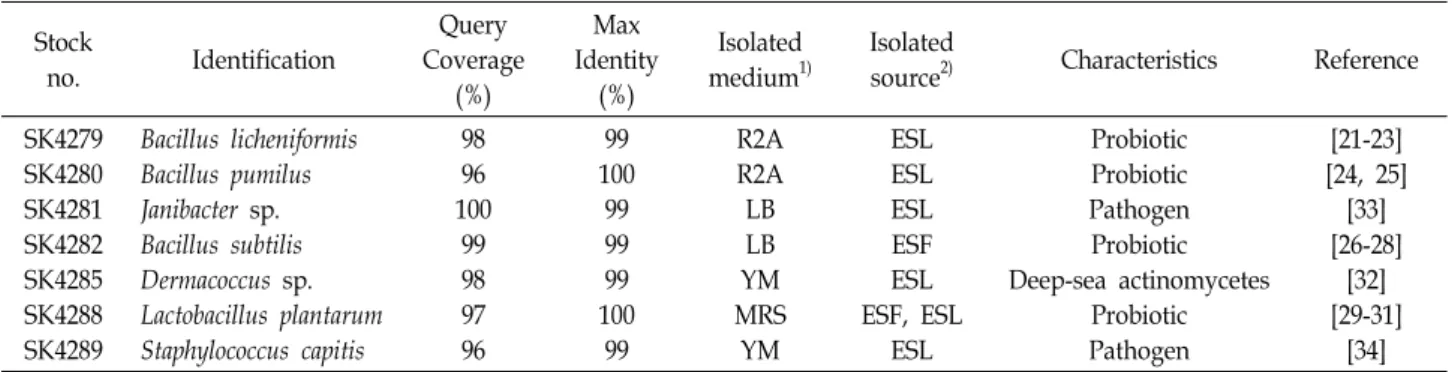
The indigenous bacteria in the ES powder were isolated and a total of eight strains were identified as shown in Table 3. Among these strains, Bacillus licheniformis [21-23], Bacillus pumilus [24, 25], Bacillus subtilis [26-28], and Lactobacillus plan- tarum [29-31] are widely used as probiotics. Dermacoccus sp.

was isolated from deep sea sediment but unknown regard- ing biological characteristics [32]. Janibacter sp. and Staphylo- coccus capitis were reported as a pathogen and an opportun- istic pathogen, respectively [33, 34]. Chaemsanit et al. [35]

reported that different species of microbes isolated from egg- shell and egg content were identified as Micrococcus, Enter- ococcus, Streptococcus, Bacillus, Corynebacterium, Staphylococcus, Acinetobacter, Neisseria, Salmonella, Proteus, Citrobacter, Escher- ichia coli, Klebsiella, Enterobacter, and Serratia.

In this study, the indigenous microbial species of egg-

shells were not divergent, especially for pathogens due to

the heating process at high temperature. It is believed that

(4)

Item Carriers with probiotics

SBM ESL ESF SBM+ESL SBM+ESF

Digital camera image

SEM (x500)

SEM (x5,000)

Fig. 1. Digital camera and SEM images of different carriers with L. plantarum. SBM, Soybean meal; ESL, Eggshell powder with large particles; ESF: Eggshell powder with fine particles. The white rows indicate L. plantarum attached on carriers.

the indigenous bacteria in ES powder come from the air-borne microorganisms along with time passing after heat processing. The presence of Lactobacillus and Bacillus strains implicates that ES powder can be used as a reservoir of probiotics. Therefore, the probiotics including Lactobacillus, Bacillus and yeast strains as shown in Table 1 were tested for their viabilities to determine the ES powder as a poten- tial source of probiotics carrier.

Image analysis for eggshell carrier and its pro- biotic adherence

L. plantarum SK3494 was primarily selected to investigate for the effect of ES carrier on the cell viability at room tem- perature (21±3℃). Soybean meal (SBM) is a common in- gredient of feed and also a general carrier of probiotics through fermentation for aqaculture and farming animals [36]. Herein SBM was used as a control carrier in the study.

The physical state, structure and the probiotic adhesion into different kind of carriers were presented by digital camera and SEM images as shown in Fig. 1. The physical states of the carriers were slightly changed to clotting state after mixing with the cell culture and drying. The micro-structure of the carriers was confirmed by images with 500 magnifica- tion. The SBM seems to be a fence composed of fibers with

a rough surface whereas ES looks like rocks with different sizes. The structure of complex carriers (SBM+ESL, SBM+

ESF) is likely that ES particles might be embedded into SBM or attached on its surface. When the adherence of probiotics was confirmed by 5,000 magnification, it was not clear to distinguish the optimal carrier of probiotics due to similar number of cell attachment.

Change of probiotic viability according to carrier type with L. plantarum during storage at room tem- perature

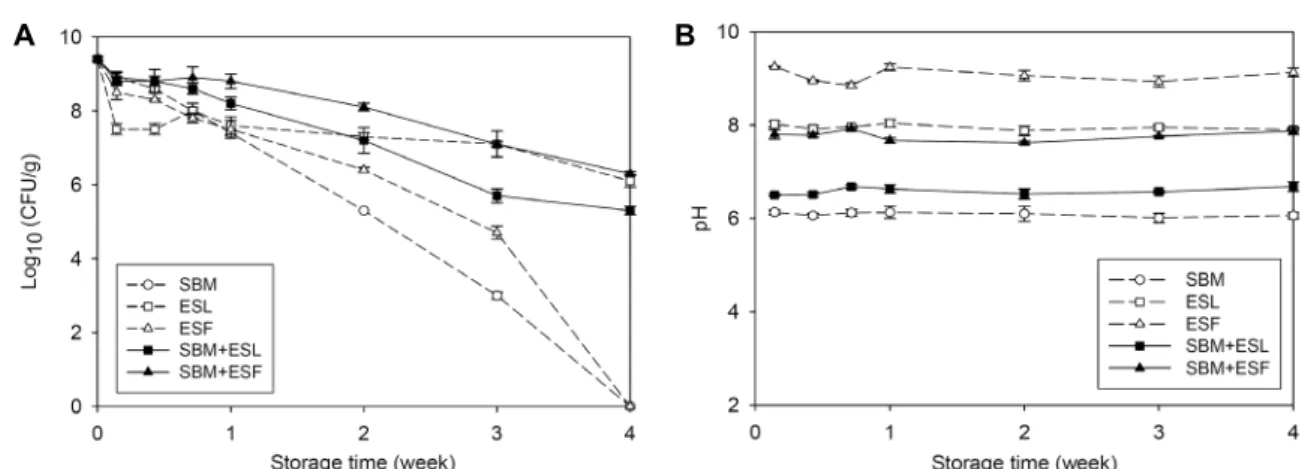
The viability of L. plantarum SK3494 was compared among different carriers during storage at room temperature. As shown in Fig. 2A, the viable cells in SBM carrier were the most quickly decreased and then followed by ESF carrier.

The ESL carrier showed quick decrease of cell viability at the initial stage and kept it constantly. The complex SBM+

ESL carrier showed better performance on probiotic via- bility compared to SBM or ESF carrier only. The SBM+ESF showed specially a good viability of L. plantarum compared to the other carriers. The pH of L. plantarum products with different carriers showed a stability with little changes (Fig.

2B). The single carrier ESF showed the highest pH above

9.0 whereas ESL or SBM+ESF was around pH 8.0. Higher

(5)

A B

C D

Fig. 3. Changes of the viability and pH on SBM+ESF complex carrier with Lactbacillus strain at the storages of 4℃ and 30℃.

(A) and (B) indicate the viability and pH change on the carrier with L. plantarum, respectively. (C) and (D) indicate the viability and pH change on the carrier with L. brevis, respectively. Data are presented as mean ± S.D. Small letters are significantly different by one-way ANOVA and Duncan’s multiple comparison test at p<0.05.

A B

Fig. 2. Changes of the viability and pH on the type of carriers with L. plantarum at the storage of room temperature. (A) Viability.

(B) pH change. The symbols: ○, SBM (Soybean meal);

, ESL (Eggshell powder with large particles); △, ESF (Eggshell powder with fine particles);

, SBM+ESL;

, SBM+ESF. Data are presented as mean ± S.D. Small letters are significantly different by one-way ANOVA and Duncan’s multiple range test at p<0.05.

pH of ESF carrier may cause less viability of the cells since more calcium carbonates were released [37]. The above re- sults indicate that ES powder has alkaline property. The complex carrier SBM+ESL and single carrier SBM showed

pH 6.5 and pH 6.0, respectively. In comparison with the

probiotic viability and pH of the probiotic products with

different carriers, SBM+ESF was determined as the optimal

carrier.

(6)

A B

C D

E F

Fig. 4. Changes of the viability and pH on SBM+ESF complex carrier with Bacillus strain at the storages of 4℃ and 30℃. (A) and (B) indicate the viability and pH change on the carrier with B. licheniformis SK3927, respectively. (C) and (D) indicate the viability and pH change on the carrier with B. subtilis SK4082, respectively. (E) and (F) indicate the viability and pH change on the carrier with B. amyloliquefaciens SK4079, respectively. Data are presented as mean ± S.D. Small letters are significantly different by one-way ANOVA and Duncan’s multiple comparison test at p<0.05.

Suitability of complex carrier SBM+ESF with various probiotics during storage at 4

o

C or 30

o

C

The optimal carrier SBM+ESF was further investigated for the viability of different probiotic strains at relatively low (4℃) or high (30℃) temperature conditions of storage.

Firstly, we tested for Lactobacillus cells as shown in Fig. 3.

The viable cell numbers of L. plantarum and L. brevis were almost no change during four weeks at 4℃ storage (Fig.

3A, Fig. 3C). However, the viable cells were quickly reduced

in both strains at 30℃ storage. The Lactobacillus cells seem

to be very sensitive to high temperature of storage com-

pared to room temperature storage as shown in Fig. 2. The

pH of the complex carrier SBM+ESF with Lactobacillus strains

showed a range of pH 7~8 (Fig. 3B, Fig. 3D). As a probiotic

carrier, it was reported for okara (by-product of soybean),

the white-yellow residue of the smashed soybeans after the

(7)

A B

Fig. 5. Changes of the viability and pH on SBM+ESF complex carrier with S. cerevisiae SK3587 at the storages of 4℃ and 30℃.

(A) Viability and (B) pH change. Data are presented as mean ± S.D. Small letters are significantly different by one-way ANOVA and Duncan’s multiple comparison test at p<0.05.

production of soymilk [38]. The shelf life of L. plantarum in okara was stabilized at 4℃ during 90 days storage. A study has reported that a significant decrease of L. plantarum TISTR2075 was observed when stored at 25℃ using malto- dextrin as the carrier [39]. The sensitivity of L. plantarum TISTR2075 was similar to our results in this study.

Secondly, we tested for the suitability of carrier SBM+ESF on Bacillus strains as shown in Fig. 4. Similar to the Lactobacillus strains, the viable cell numbers of three Bacillus strains were almost no change or a little reduction at 4℃

storage condition. However, all the Bacillus strains showed a better resistance at 30℃ compared to Lactobacillus strains.

In particular, B. licheniformis SK3927 showed a stable via- bility during four weeks storage (Fig. 4A). Bacillus can pro- duce spores under unfavorable environment to the dormant state to overcome nutrient depletion [40]. The pH of carrier SBM+ESF with Bacillus strain showed constant value around 6.5-8.0 at 4℃ and 30℃(Fig. 4B, Fig. 4D, Fig. 4F). Cho et al. reported that the initial pH 7.0 of the culture medium showed the highest growth rate of Bacillus species [41]. The pH of the SBM+ESF carrier might be favorable for the growth of Bacillus strains.

Finally, we investigated for the carrier SBM+ESF on yeast cell as shown in Fig. 5. Like other probiotic strains, S. cer- evisiae SK3587 showed a stable viability at 4℃ storage.

However, a slight reduction of cell viability was observed at 30℃ storage (Fig. 5A). It was reported that the viability of yeast cells varied slightly at the first 30 days of storage and less moisture content showed less death during pro- longed storage [42]. The pH of SBM+ESF carrier with Saccharomyces cells were similar to the carrier with other

probiotics, showing a range of 6.5-8.0 at 4℃ or 30℃ (Fig.

5B). In general, microbes has an active metabolism at opti- mal growth temperature but inactive at low temperature.

In the study, we observed that storage temperature and car- rier type are critical parameters for probiotic preservation and the viability of probiotics is species dependent.

In conclusion, the aim of this study is to exploit ES pow- der as a novel carrier to prolong the viability of probiotics during storage. ES powder mixed into soybean meal may cause a weak alkaline property with high calcium content, resulting in increased viability. The storage of Lactobacillus strains with the complex carrier SBM+ESF was recommend at 4℃. For Bacillus and yeast strains, it is better to keep at 4℃, otherwise it can cause a gradual reduction at rela- tively high temperature. It is suggested that the optimal ratio of complex SBM:ESF will be determined depending on probiotic species and their storage temperature. By fur- ther research, ES powder will be more reused as val- ue-added products including probiotics carrier in the fields of agriculture, livestiock as well as aquaculture.

Acknowledgement

This study was supported by grants from the National Institute of Fisheries Science (R2018019), Republic of Korea.

References

1. Pirvutoiu, I. and Popescu, A. 2012. Research on the major trends in the romanian eggmarket. Bull. Univ. Agric. Sci.

Vet. 69, 229-238.

(8)

2. FAO, FAOSTAT, [WWW Document], URL http://fao- stat3.fao.org/browse/Q/*/E, 2016.

3. Russ, W. and Meyer-Pittroff, R. 2004. Utilizing waste prod- ucts from the food production and processing industries.

Crit. Rev. Food Sci. Nutr. 44, 57-62.

4. Russ, W. and Schnappinger, M. 2007. Waste related to the food industry: a challengein material loops. In: Oreopoulou, V., Russ, W. (Eds.), Utilization of by-products and treat- ment of waste in the food industry. pp. 1-13. Springer Science Business Media, New York, USA.

5. Kim, H., Yum, B., Yoon, S., Song, K., Kim, J., Myeong, D., Chang, B. and Choe, N. 2016. Inactivation of Salmonella on eggshells by chlorine dioxide gas. Kor. J. Food Sci. Anim.

Resour. 36, 100-108.

6. Quina, M. J., Soares, M. A. and Quinta-Ferreira, R. 2017.

Applications of industrial eggshell as a valuable anthro- pogenic resource. Resour. Conserv. Recy. 123, 176-186.

7. Schaafsma, A., Pakan, I., Hofstede, G. J., Muskiet, F. A., Van Der Veer, E. and De Vries, P. J. 2000. Mineral, amino acid, and hormonal composition of chicken eggshell pow- der and the evaluation of its use in human nutrition. Poult.

Sci. 79, 1833-1838.

8. Oliveira, D. A., Benelli, P. and Amante, E. R. 2013. A liter- ature review on adding value to solid residues: egg shells.

J. Clean. Prod. 46, 42-47.

9. Tunç, A. E. and Cufadar, Y. 2014. Effect of calcium sources and particle size on performance and eggshell quality in laying hens. Turkish JAF Sci. Tech. 3, 205-209.

10. Ray, S., Barman, A. K., Roy, P. K. and Singh, B. K. 2017.

Chicken eggshell powder as dietary calcium source in choc- olate cakes. Pharma Innovation 6, 1-4.

11. Caruso, G. 2015. Use of plant products as candidate fish meal substitutes: an emerging issue in aquaculture pro- ductions. Fish Aquac. J. 6, 1-3.

12. Zhou, Z., Ringø, E., Olsen, R. E. and Song, S. K. 2017.

Dietary effects of soybean products on gut microbiota and immunity of aquatic animals: A review. Aquacult. Nutr. 00, 1-22.

13. Plaza-Díaz, J., Ruiz-Ojeda, F. J., Vilchez-Padial, L. M. and Gil, A. 2017. Evidence of the anti-inflammatory effects of probiotics and synbiotics in intestinal chronic diseases.

Nutrients 9, 555.

14. Lee, A. R., Niu, K. M., Kang, S. K., Han, S. G., Lee, B.

J. and Kim, S. K. 2017. Antioxidant and antibacterial activ- ities of Lactobacillus-fermented Artemisia annua L. as a poten- tial fish feed additive. J. Life Sci. 27, 652-660.

15. Hai, N. V. 2015. The use of probiotics in aquaculture. J.

Appl. Microbiol. 119, 917-935.

16. Anekella, K. and Orsat, V. 2014. Shelf life stability of lacto- bacilli encapsulated in raspberry powder: Insights into non-dairy probiotics. Int. J. Food Sci. Nutr. 65, 411-418.

17. Saarela, M., Virkajärvi, I., Nohynek, L., Vaari, A. and Mättö, J. 2006. Fibers as carriers for Lactobacillus rhamnosus during freeze-drying and storage in apple juice and chocolate- coated breakfast cereals. Int. J. Food Microbiol. 112, 171-178.

18. A.O.A.C. 2010. Official methods of analysis of association

of official chemists. 18th Ed., Washington, D.C., USA.

19. Schaafsma, A., Pakan, I., Hofstede, G. J. H., Muskiet, F.

A., Van Der Veer, E. and De Vries, P. J. F. 2000. Mineral, amino acid, and hormonal composition of chicken eggshell powder and the evaluation of its use in human nutrition.

Poult Sci. 79, 1833-1838.

20. Lee, Y. S., Lee, Y. H., Lim, S. H., Park, G. H., Choi, S.

Y., Hong, H. J. and Ko, J. A. 2013. Volatile compounds and ultrastructure of petal epidermal cells according to scent intensity in Rosa hybrida. Kor. J. Hortic. Sci. Technol.

31, 590-597.

21. Andriani, Y., Safitri, R., Rochima, E. and Fakhrudin, S. D.

2017. Characterization of Bacillus subtilis and B. licheniformis potentials as probiotic bacteria in Vanamei shrimp feed (Litopenaeus vannamei Boone, 1931). Nus. Biosci. 9, 188- 193.

22. Mitra, A., Mukhopadhyay, P. K. and Homechaudhuri, S.

2017. Probiotic effect of Bacillus licheniformis fb11 on the digestive efficiency and growth performance in juvenile Chitala chitala (Hamilton, 1822).   Proc. Zool. Soc. 2, 1-12.

23. Deng, W., Dong, X. F., Tong, J. M. and Zhang, Q. 2012.

The probiotic Bacillus licheniformis ameliorates heat stress-in- duced impairment of egg production, gut morphology, and intestinal mucosal immunity in laying hens.   Poult. Sci. 91, 575-582.

24. Yang, H. L., Xia, H. Q., Ye, Y. D., Zou, W. C. and Sun, Y. Z. 2014. Probiotic Bacillus pumilus SE5 shapes the in- testinal microbiota and mucosal immunity in grouper Epinephelus coioides. Dis. Aquat. Org. 111, 119-127.

25. Sreenivasulu, P., Suman Joshi, D. S. D., Narendra, K., Venkata Rao, G. and Krishna Satya, A. 2016. Bacillus pum- ilus as a potential probiotic for shrimp culture. Int. J. Fish Aquat. Stud. 4, 107-110.

26. Zokaeifar, H., Balcázar, J. L., Saad, C. R., Kamarudin, M.

S., Sijam, K., Arshad, A. and Nejat, N. 2012. Effects of Bacillus subtilis on the growth performance, digestive en- zymes, immune gene expression and disease resistance of white shrimp, Litopenaeus vannamei. Fish Shellfish Immunol. 33, 683-689.

27. Zuenko, V. A., Laktionov, K. S., Pravdin, I. V., Kravtsova, L. Z. and Ushakova, N. A. 2017. Effect of Bacillus subtilis in feed probiotic on the digestion of fish cultured in cages. J. Ichthyol. 57, 152-157.

28. Li, W. F., Rajput, I. R., Xu, X., Li, Y. L., Lei, J., Huang, Q. and Wang, M. Q. 2011. Effects of probiotic (Bacillus sub- tilis) on laying performance, blood biochemical properties and intestinal microflora of Shaoxing duck. Int. J. Poult.

Sci. 10, 583-589.

29. Lee, A. R., Niu, K. M., Kang, S. K., Han, S. G., Lee, B.

J. and Kim, S. K. 2017. Antioxidant and antibacterial activ- ities of Lactobacillus-fermented Artemisia annua L. as a poten- tial fish feed additive. J. Life Sci. 27, 652-660.

30. Hamdan, A. M., El Sayed, A. F. M. and Mahmoud, M.

M. 2016. Effects of a novel marine probiotic, Lactobacillus

plantarum AH 78, on growth performance and immune re-

sponse of Nile tilapia (Oreochromis niloticus). J. Appl.

(9)

초록:생균제의 부형제(운반체)로서의 난각분말의 특성

이우도

1†

․우개민

1†

․임정민

1

․이권정

1

․이봉주

2

․김강웅

2

․김경덕

2

․허상우

2

․한현섭

2

․김수기

1

*

(

1

건국대학교 동물자원과학과,

2

국립수산과학원 사료연구센터)

계란 가공 부산물인 난각(ES: Eggshell)은 탄산칼슘 함량이 높아 사료에 첨가하여 칼슘원으로 이용되고 있다.

본 연구에서는 ES를 생균제의 부형제인 운반체로서 활용 가능성을 처음으로 시도하였다. L. plantarum을 대두박 (SBM: Soybean meal), 난각조각(ESL: Eggshell powder with large particles), 난각미세분말(ESF: Eggshell powder with fine particles), 그리고 이들의 복합운반체인 SBM+ESL과 SBM+ESF에 생균제를 흡착시켜 그 부착상태를 주 사전자현미경으로 확인하였다. 이 중 복합운반체인 SBM+ESF는 상온에서 4주 동안 pH 7~8을 유지하면서 L. plan- tarum의 가장 높은 생존율을 보였다. 본 연구에 사용한 모든 생균제들은 보존기간 동안 4℃에서는 높은 생존율을 보였다. 30℃에서는 유산균수는 크게 감소하였으나, B. licheniformis는 높은 생존율을 유지하였고 B. subtilis, B.

amyloliquefaciens와 S. cerevisiae는 2 log

10

(CFU/g)정도 감소하였다. 상기 연구결과는 사료의 칼슘원으로 이용되는 난각미세분말(ESF)을 대두박과 혼합하여 사용하면 B. licheniformis를 비롯한 일부 생균제의 생존성을 향상시켜 부 형제(운반체)로도 사용할 수 있음을 밝혔다.

Microbiol. 120, 1061-1073.

31. Shen, X., Yi, D., Ni, X., Zeng, D., Jing, B., Lei, M. and Xin, J. 2014. Effects of Lactobacillus plantarum on production per- formance, immune characteristics, antioxidant status, and intestinal microflora of bursin-immunized broilers. Can. J.

Microbiol. 60, 193-202.

32. Wagner, M., Abdel-Mageed, W. M., Ebel, R., Bull, A. T., Goodfellow, M., Fiedler, H. P. and Jaspars, M. 2014.

Dermacozines h–j isolated from a deep-sea strain of Dermacoccus abyssi from Mariana Trench sediments. J. Nat.

Prod. 77, 416-420.

33. Elsayed, S. and Zhang, K. 2005. Bacteremia caused by Janibacter melonis. J. Clin. Microbiol. 43, 3537-3539.

34. Cameron, D. R., Jiang, J. H., Hassan, K. A., Elbourne, L.

D., Tuck, K. L., Paulsen, I. T. and Peleg, A. Y. 2015. Insights on virulence from the complete genome of Staphylococcus capitis.   Front. Microbiol. 6, 981-992.

35. Chaemsanit, S., Akbar, A. and Anal, A. K. 2015. Isolation of total aerobic and pathogenic bacteria from table eggs and its contents. Food Appl. Biosci. J. 3, 1-9.

36. Mukherjee, R., Chakraborty, R. and Dutta, A. 2016. Role of fermentation in improving nutritional quality of soybean meal-a review. Asian-Australas J. Anim. Sci. 29, 1523.

37. Hincke, M. T., Nys, Y., Gautron, J., Mann, K., Rodriguez-

Navarro, A. B. and McKee, M. D. 2012. The eggshell: struc- ture, composition and mineralization. Front Biosci. 17, 1266- 1280.

38. Quintana, G., Gerbino, E. and Gómez-Zavaglia, A. 2017.

Okara: A nutritionally valuable by-product able to stabilize Lactobacillus plantarum during freeze-drying, spray-drying, and storage.   Front. Microbiol. 8, 641-650.

39. Jagannath, A., Raju, P. S. and Bawa, A. S. 2010. Comparative evaluation of bacterial cellulose (nata) as a cryoprotectant and carrier support during the freeze drying process of pro- biotic lactic acid bacteria. LWT-Food Sci. Technol. 43, 1197- 1203.

40. Sadiq, F. A., Li, Y., Liu, T., Flint, S., Zhang, G., Yuan, L.

and He, G. 2016. The heat resistance and spoilage potential of aerobic mesophilic and thermophilic spore forming bac- teria isolated from Chinese milk powders. Int. J. Food Microbiol.   238, 193-201.

41. Cho, J. H., Kim, Y. B., and Kim, E. K. 2009. Optimization of culture media for Bacillus species by statistical experi- mental design methods. Kor. J. Chem. Eng. 26, 754-759.

42. Baptista, A. S., Horii, J. and Piedade, S. M. D. S. 2005. Cells

of yeasts adhered in corn grains and the storage perspective

for use as probiotic. Braz. Arch. Biol. Technol. 48, 251-257.

수치

Table  1.  Probiotics  used  in  this  study.
Table  3.  Identification  of  bacteria  isolated  from  eggshell  powder Stock no. Identification Query Coverage (%) Max Identity(%) Isolatedmedium 1) Isolated
Fig.  1.  Digital  camera  and  SEM  images  of  different  carriers  with  L.  plantarum
Fig.  3.  Changes  of  the  viability  and  pH  on  SBM+ESF  complex  carrier  with  Lactbacillus  strain  at  the  storages  of  4℃ and  30℃
+3

참조

관련 문서

It considers the energy use of the different components that are involved in the distribution and viewing of video content: data centres and content delivery networks

After first field tests, we expect electric passenger drones or eVTOL aircraft (short for electric vertical take-off and landing) to start providing commercial mobility

1 John Owen, Justification by Faith Alone, in The Works of John Owen, ed. John Bolt, trans. Scott Clark, &#34;Do This and Live: Christ's Active Obedience as the

– If very small dimension structures have L&lt; l ( the average distance between scattering events ), a large percentage of the carriers travel from the source to the

The results of this study are as follows: first, the motive of participating in senior education programs toward employment is influenced by aging;

This study the changes in structure and mechanical characteristics by the analysis on mechanical characteristics of the welding part and the post weld

The fabrication of transparent spinel using LiF as a sintering aid by hot pressing process was investigated in this study.. Spinel is widely regarded as one of the

This study aims to analyze the process and the features of corporate e-Learning as a form of informal learning. For this purpose, the concept of