Social determinants of domestic violence against
suburban women in developing countries: a systematic review
Fatemeh Abdi, PhD
1, Zohreh Mahmoodi, PhD
1, Fatemeh Afsahi, BSC
2, Negin Shaterian, BSC
3, Fatemeh Alsadat Rahnemaei, MSC
31Social Determinants of Health Research Center, Alborz University of Medical Sciences, Karaj; 2Master Student of Clinical Psychology, Department of Psychology, Tehran Medical Sciences, Islamic Azad University, Tehran; 3Student Research Committee, Nursing and Midwifery Faculty, Shahid Beheshti University of Medical Sciences, Tehran, Iran
Objective
In addition to the many social, economic, cultural, security, and environmental problems in the metropolitan areas, suburbanization has led to the growth and spread of domestic violence against women, and is still increasing.
Different social determinants can play a role in violence against suburban women, so this study was designed to investigate the social determinants of domestic violence in suburban women of developing countries.
Methods
According to PRISMA guideline, the keywords, which were determined considering MESH, were searched in Google Scholar, MEDLINE, SID, Web of Science, Pubmed, Scopus and Science Direct with the 2009 to 2019 time limit. STROBE checklist was used for evaluating quantitative studies and JBI for qualitative studies. Finally 30 high quality studies were included.
Results
The prevalence of general domestic violence among women of different ages was reported between 2.3-73.78% in the suburban regions of developing countries. The prevalence of physical, emotional and psychological violence was about 11.54-61.6% and 7.8-84.3%. The prevalence of sexual,economic and the verbal violence was about 0.8-58.8%, 13.7- 43.7% and 33.21-86.1%. The most common factors affecting violence against women were the structural factors of early marriage, the husband’s addiction to alcohol and drugs.
Conclusion
General domestic violence and its various types are prevalent in different parts of the world and the factors affecting domestic violence such as age, marriage age, low literacy, husband addiction to alcohol and drugs are all things that can be prevented by special health planning in these areas to improve women’s health and thus prevent violence against suburban women.
Keywords: Domestic violence; Suburbanization; Social determinants; Women
Received: 2020.07.22. Revised: 2020.09.01. Accepted: 2020.11.30.
Corresponding author: Fatemeh Alsadat Rahnemaei, MSC
Student Research Committee, Nursing and Midwifery Faculty, Shahid Beheshti University of Medical Sciences, 7th Floor, Bldg No. 2 SBUMS, Arabi Ave, Daneshjoo Blvd, Velenjak, Tehran, Iran
E-mail: [email protected] https://orcid.org/0000-0002-1149-8057
Articles published in Obstet Gynecol Sci are open-access, distributed under the terms of the Creative Commons Attribution Non-Commercial License (http://creativecommons.org/
licenses/by-nc/3.0/) which permits unrestricted non-commercial use, distribution, and reproduction in any medium, provided the original work is properly cited.
Copyright © 2021 Korean Society of Obstetrics and Gynecology https://doi.org/10.5468/ogs.20211
eISSN 2287-8580
Introduction
Suburbanization is a part of urban development involving the low-income, the poor, and those living in rural areas without planning, control, or adherence to urban planning rules and regulations [1]. Suburbanization is a social phenomenon that has consequences such as poverty, crime, exploitation of child labor, the weakening of the middle class, and do- mestic violence. Suburbanization can be regarded as a major disaster that entails thousands of injuries and crises. Serious social damage occurs more in suburban areas than anywhere else, including domestic violence against women and chil- dren. The World Health Organization (WHO) defines violence as the use of mental or physical force to force, threaten, or harm another person, group, or community that causes physical or psychological harm, deprivation, or death [2]. Do- mestic violence against women includes any physical, sexual, or emotional abuse imposed on women in family relation- ships [3]. Domestic violence is recognized as the most com- mon type of gender-based violence and is a particular social and health concern [4].
Violence against women is purely cultural. Despite initia- tives by national and international organizations, violence against women is on the rise worldwide [5]. In response to the lack of comparable data on the prevalence and impact of violence against women, the WHO, in collaboration with international and local partners, conducted a large study in 10 countries using representative samples from 15 studies (one rural or urban study in most countries) among 24,000 women. The results of a multi-country study on women’s health and domestic violence against women showed that between 15–71% of women aged 15–49 in a relationship experienced physical or sexual violence by a partner during their lifetime. Most studies reported an average prevalence of violence between 30–60% [6]. Other studies found that women with a history of physical or sexual violence had significantly higher health problems, greater pain, poorer health, greater anxiety, and higher suicidal thoughts than women who had not experienced violence [7]. A recent comprehensive review by the WHO acknowledged that the global prevalence of physical or sexual violence by a sexual partner is 30% among all women. The highest prevalence is in Africa, the Eastern Mediterranean, and Southeast and Eastern Asia, where approximately 37% of women experi- ence partner violence (based on a total of 185 studies from
86 countries and data from 155 studies in 81 countries has provided estimates) [8]. The results of various studies indi- cate that the following social determinants and factors are independently associated with domestic violence: low age of women, length of marriage, higher education in women, husbands’ low education, working spouses, military occu- pation, fewer children, multiple spouses, smoking spouses, aggressive spouses, chronic illness in women or their spouse, and inadequate family income [9]. According to the WHO model, the social determinants of health are socio-economic structural factors such as income, education, employment, social class, gender, race, and ethnicity; intermediate factors such as living conditions; behavioral and biological factors such as physical activity, alcohol and tobacco use; and health- related factors [10].
Is there a solution to this problem? Policies and programs based on gender empowerment analysis, attitudes, and norms that reject violence and promote gender equality as well as coordinated efforts to promote women’s activism for a non-violent life are essential principles of sustainable invest- ment in preventing violence against women [11]. In addition to the many social, economic, cultural, security, and envi- ronmental problems in metropolitan areas, suburbanization has caused the rise and spread of domestic violence against women and continues to increase. Since there has been no research on the social determinants of domestic violence in suburban women despite a considerable amount of domestic violence against suburban women, the current study aimed to investigate the social determinants of domestic violence in suburban women and suggest measures to eliminate its con- tributing factors so as to help this segment of society.
Criteria for considering studies for this review
1. Search strategy
This study was reported based on the Preferred Reporting Items for Systematic Reviews and Meta-Analyses (PRISMA) guidelines. Web of Science, MEDLINE, SID, Google Scholar, PubMed, Scopus, Science Direct, Embase were searched.
Keywords were selected using the MeSH keyboard, and the
time interval of 2009–2019 was used when searching these
databases (Table 1).
2. Inclusion and exclusion criteria
Inclusion criteria include all English and Persian studies pub- lished between 2009 and 2019 that were found in databases based on MeSH keywords; and studies that, in addition to expressing the prevalence of general domestic violence or types of domestic violence, also addressed relevant social fac- tors related to domestic violence, all in suburban areas, with married or single girls and women of different ages attend- ing the study voluntarily.
Exclusion criteria included articles in languages other than Persian and English languages, case reports, comments, let- ters; studies focusing solely on the social factors related to domestic violence without addressing their prevalence; wom- en who were aware of their rights and domestic violence, and women who did not want to cooperate.
3. Study selection
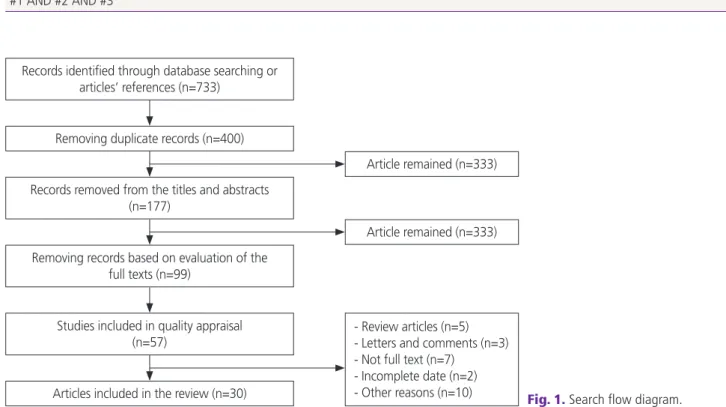
The initial search yielded 733 results. The eligibility of these papers was independently evaluated by two authors and any disagreements were resolved by consensus. In the first stage, 400 papers were excluded due to being irrelevant or dupli- cated. After reviewing the titles and abstracts of the remain- ing papers, 177 more papers were excluded. In the evalua- tion of the full texts, 42 out of the remaining 99 articles were excluded due to being ineligible. Finally, a total of 30 eligible articles were reviewed (Fig. 1).
4. Quality assessment
The STROBE statements were applied to evaluate the quality of studies. The checklist items focus on reporting how the trial was designed, analyzed, and interpreted. The STROBE Statement, an authoritative tool, consists of a 22-item check-
Fig. 1. Search flow diagram.
Records identified through database searching or articles’ references (n=733)
Records removed from the titles and abstracts (n=177)
Removing records based on evaluation of the full texts (n=99)
Studies included in quality appraisal (n=57)
Removing duplicate records (n=400)
Article remained (n=333)
Article remained (n=333)
- Review articles (n=5) - Letters and comments (n=3) - Not full text (n=7)
- Incomplete date (n=2) - Other reasons (n=10) Articles included in the review (n=30)
Table 1. Search strategy
ID Search term
#1 “Domestic Violence”[tiab] OR “Family Violence”[tiab] OR “Spousal Violence”[tiab] OR “Sexual Violence”[tiab]
OR “Physical Violence”[tiab] OR “Emotional Violence”[tiab] OR “Verbal Violence”[tiab], OR “Economical Violence”[tiab], OR “Assaultive Behavior”[tiab]
#2 ‘suburban area’ [tiab], OR ‘suburbanization’ [tiab], OR ‘Social marginalization’ [tiab] OR ‘slum’ [tiab], OR ‘informal settlement’ [tiab], OR ‘marginalization’ [taib], OR ‘Poverty Area’ [tiab],
#3 ‘woman’ [tiab], OR” women” [tiab], OR “female” [tiab]
#1 AND #2 AND #3
list. The checklist items focus on reporting or evaluating different sections of observational studies [12,13]. The JBI checklist was used for qualitative studies.
5. Data extraction
Two authors independently performed the study selection and validity assessment and resolved any disagreements by consulting a third researcher. The first author name, publica- tion year, study design, sample size, study region, age, social determinants of domestic violence, total prevalence of do- mestic violence, physical violence, emotional violence, sexual violence, economical violence, verbal violence, and quality score were extracted and entered into the analysis.
Results
After evaluation, 30 articles were selected as eligible. The types of articles were qualitative (n=3), quantitative (n=26), and mixed method (n=1). A total of 18,723 women living in the suburbs and in different age groups (13 years and older) participated in the study. The frequency of countries in which the articles were conducted is as follows: India (n=17), Ban- gladesh (n=4), Nigeria (n=2), Nepal (n=2), Uganda (n=1), Iran (n=1), South Africa (n=1), Pakistan (n=1), and Kenya (n=1).
1. Prevalence of domestic violence in suburbs
Domestic violence was perpetrated by various individuals, such as the husband, the spouse’s family, (especially the mother-in-law), other members of the wife’s family, and rela- tives. The most common perpetrator was identified as the husband. Of the 30 studies, 23 cases (Table 2) reported that the prevalence of general domestic violence among women of different ages ranged from 2.3–73.78% in suburban regions of different countries. The lowest and highest preva- lence were in India and Bangladesh, respectively.
Twenty studies also reported the prevalence of physical violence as 11.54–61.6%. The different types of physical vio- lence that were dealt with in the studies included slapping, pushing, beating, hitting, kicking, firing, pulling, twisting the hand, and throwing. Fourteen studies reported the preva- lence of emotional and psychological violence as between 7.8–84.3%.
The different types that the studies addressed included fear of the spouse, verbal disputes, the use of derogatory rheto-
ric, intimidation, lack of meeting basic needs, and insults.
Thirteen studies reported the prevalence of sexual violence as approximately 0.8–58.8%. In addition, there were ques- tions about forced sexual relations of any kind.
Three studies reported economic violence with a preva- lence ranging from 13.7–43.7%. Moreover, there were cases where the wife’s financial needs were not being met by the husband.
Four studies also exclusively focused on verbal violence, with a prevalence of 33.21–86.1%. Verbal violence also included humiliating a person alone or in front of others, threats of divorce, doubting, using abusive rhetoric to ad- dress the woman, asking for a dowry, and insulting the woman’s personality.
2. Social determinants of domestic violence in the suburbs
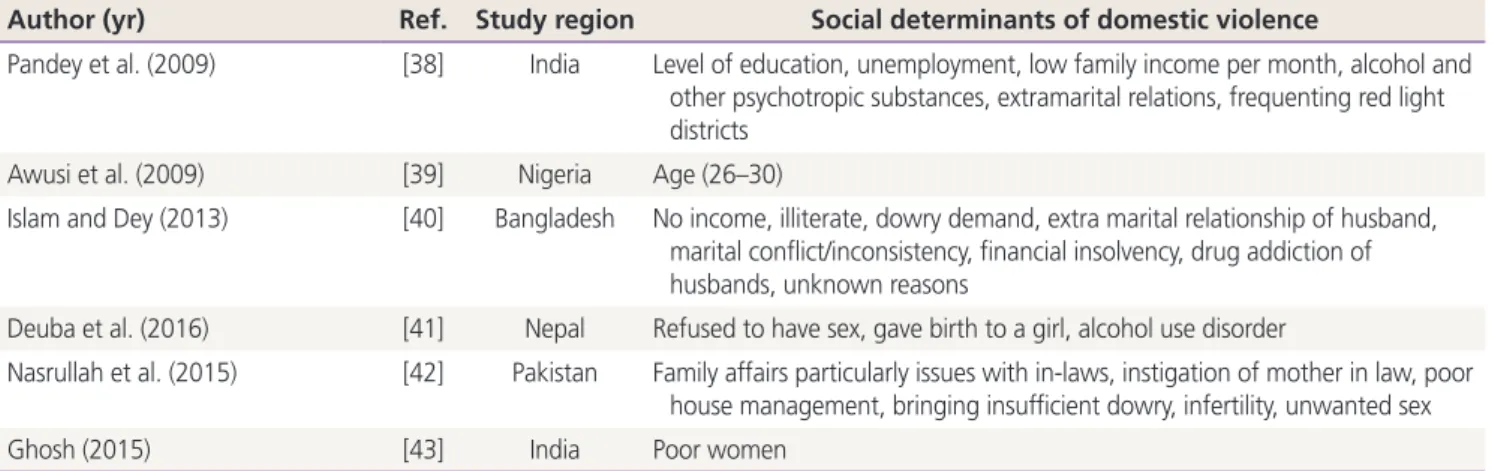
Of the 30 studies, 28 reported factors that cause domestic violence against women (Table 3). According to the WHO model, factors related to domestic violence can be divided into structural and socio-economic factors including educa- tion, employment, economic status, social class, gender, race, culture; intermediate factors including living conditions, psychological conditions, and social conditions; behavioral factors; and factors related to the health system.
3. Structural factors
These factors include low age at marriage (8 studies), low
literacy or illiteracy of woman (7 studies), not doing house-
hold chores properly (5 studies), financial issues and low
socio-economic status (5 studies), gender inequalities and
patriarchal gender norms (5 studies), not cooking properly
or not cooking according to the husband’s desire (4 stud-
ies), dowry issues such as dowry demand or low dowry
(4 studies), not being able to bear a male child (4 studies),
low level of spouse literacy (3 studies), poverty (3 studies),
working women and earning an income (3 studies), leaving
the household on any pretext without prior permission from
husband (3 studies), duration of marriage 5 years and more
(3 studies), women belonging to families with low per capita
income (2 studies), extra-marital relations by woman (2 stud-
ies), unemployed women (2 studies), number of children and
neglecting the children according to the spouse (2 studies),
neglect of children (2 studies), justifying wife beating (2 stud-
ies), instigation by mother-in-law (2 studies), affairs related
Table 2.Prevalence of domestic violence in suburban women Author (yr)Ref.Study designSample sizeRegionAge (yr) Total prevalence of domestic violence (%)
Physical (%)Emotional (%)Sexual (%)Economical (%)Verbal (%)Quality score Dasgupta et al. (2019)[14]Cross-sectional1,047India17–4529.4---21 Gibbs et al. (2018)[15]Cross-sectional680South African18–30-48.566.521.243.7-21 Chowdhury et al. (2018)[16]Cross-sectional87Bangladesh15–4957.5---21 Pal et al. (2017)[17]Cross-sectional50India15–4959.361.684.358.8--19 Mohapatra and Mistry (2017)[18]Cross-sectional100India15–4935343517--19 Khayat et al. (2017)[19]Cross-sectional400Iran15–49-18-39--20 Silverman et al. (2016)[20]Cross-sectional1,061India17–4528.4---18 Sathe and Holcambe (2016)[21]Cross-sectional115India15–4555.8328.1649.03---17 Parvin et al. (2016)[22]Cross-sectional1,566Bangladesh15–2960---21 Muthengi et al. (2016)[23]Cross-sectional452Kenya15–1925.6---20 Donta et al. (2016)[24]Cross-sectional1,136India18–392116.812.44.8--19 Swahn et al. (2015)[25]Cross-sectional313Uganda14–24-36.9----17 Dasgupta et al. (2015)[26]Cross sectional97India15–4932.9---21 Begum et al. (2015)[27]Cross sectional1,137India18–3921.216.812.44.8--20 Barman et al. (2015)[28]Cross sectional300India15–192.3---17 Hiremath and Debaje (2014)[29]Cross sectional59India15–1938.15---17 Gaikwad and Rao (2014)[30]Cross sectional548India15–4536.8626.8212.5924.64-33.2118 Shrivastava and Shrivastava (2013)[31]Cross sectional274India18–4536.953.4---86.118 Kambli et al. (2013)[32]Cross sectional105India15–4510048.57---71.417 Fawole et al. (2013)[33]Cross sectional323Nigeria18≤-16.720.80.813.7-20 Das et al. (2013)[34]Cross sectional2,139India14.911.547.81.63--21 Sinha et al. (2012)[35]Cross sectional159India15–455441.919.8---17 Sambisa et al. (2011)[36]Cross sectional5,128Bangladesh15–4935---19 Bhatta et al. (2018)[37]Cross sectional120Nepal18≤42.535.327.4---21 Pandey et al. (2009)[38]Cross sectional751India15–4517.6---17 Awusi et al. (2009)[39]Cross sectional400Nigeria15–433631-11-5817 Islam and Dey (2013)[40]Mixed method87Bangladesh14–4073.7871.1242.224.4424.45-18 Deuba et al. (2016)[41]Qualitative 20Nepal23–24-1006030--19 Nasrullah et al. (2015)[42]Qualitative19Pakistan21–34-89.568.442.1--19 Ghosh (2015)[43]Qualitative 52India20–46-53.8----16
Table 3. Social determinants of domestic violence in women living in slum
Author (yr) Ref. Study region Social determinants of domestic violence
Dasgupta et al. (2019) [14] India Not reported
Gibbs et al. (2018) [15] South African Not reported
Chowdhury et al. (2018) [16] Bangladesh Age at marriage, number of family members, wealth index
Pal et al. (2017) [17] India Women belonging to families with low per capita income, low educational background of husband, not able to bear a male child, unemployment amongst both the spouses, leave the household on any pretext without prior permission from husband, wives did not attend household activities properly Mohapatra and Mistry (2017) [18] India Alcohol addiction, illeteracy of husband, dowry related problem, not having a
male child, not cooking properly, talking with neighbors Khayat et al. (2017) [19] Iran Fear about destroying the relationship
Silverman et al. (2016) [20] India Gender inequity (nutritional deprivation, deprivation of sleep, blocking access to health care during pregnancy)
Sathe and Holcambe (2016) [21] India Not cooking properly, not attending to households, not having a male child, dowry related problem, alcoholic addiction of husbands
Parvin et al. (2016) [22] Bangladesh Injured needed health care, verbal dispute, perceived disobedience of the woman, without any particular reason
Muthengi et al. (2016) [23] Kenya Patriarchal gender norms, poverty, female employment, financial conflicts
Donta et al. (2016) [24] India Not empowered women in decision making, justifying wife beating Swahn et al. (2015) [25] Uganda Self-monitoring at night, hunger, drunkenness, sadness
Dasgupta et al. (2015) [26] India Alcohol abuse by the spouse, level of education of the spouse, per capita income and occupation of the women, argument with the spouse, spouse disliking the cooked food, neglecting the children according to the spouse, talking to unrelated male
Begum et al. (2015) [27] India Husband consumed alcohol, women who justified wife beating, married before attaining 18 years, illiterate women, marital duration was more than 5 years, women belonging to SC/ST, working, having more than one child Barman et al. (2015) [28] India Low socio-economic status (financial hardship), infidelity
Hiremath and Debaje (2014) [29] India Younger age, increases depression score, maladaptive behaviour in the adolescent population
Gaikwad and Rao (2014) [30] India Age, illiterate, lower socio-economic status, -unemployed (less than 18), duration of marriage (5–10 years), education of husband (illiterate), type of family (nuclear)
Shrivastava and Shrivastava (2013) [31] India Age, education, spousal alcoholism, duration of marriage Kambli et al. (2013) [32] India Age group 26–35 years, illiterate
Fawole et al. (2013) [33] Nigeria Lower knowledge levels, low egalitarian attitudes
Das et al. (2013) [34] India Justifiable if a woman disrespected her in-laws, argued with her husband, failed to provide good food, housework and childcare, went out without permission
Sinha et al. (2012) [35] India Alcohol addiction, multiple sex partners
Sambisa et al. (2011) [36] Bangladesh Age (19 years or less), illiterate, poor household wealth, number of children Bhatta et al. (2018) [37] Nepal Substance abuse, lack of economic stability, doing things that inlaws don’t like,
not doing household chores properly, going out without permission, talking to male friends, refusal of sex, extramarital affair of husband, lack of legal implication
to the husband’s family and doing things disfavored by the in-laws (2 studies), number of family members, husband’s unemployment, talking to neighbors, fear of losing relation- ships, not empowering women in decision-making, talking to unrelated males, and family type (nucleus).
4. Intermediate factors
The frequencies of these factors included husband’s addic- tion to alcohol and drugs (11 studies), verbal disputes and conflict with husband (4 studies), refusal of sex (3 studies), depression (2 studies), perceived disobedience, infertility, multiple sex partners, maladaptive behaviors in adolescent girls, physical trauma, disability, and inadequate household health.
5. Health-system-related factors
One study noted women’s lack of legal protections. Two studies also reported domestic violence without a reason.
Discussion
Domestic violence is a major health problem throughout the world that, although not yet well recognized, is still associ- ated with uncertainty and many taboos for women and can impact every woman regardless of her age, culture, and so- cio-economic status [44]. In this systematic study, 30 articles on domestic violence and related social determinants were studied based on the WHO model. Among domestic violence types, physical violence was the most prevalent in 20 cases,
emotional violence in 14 cases, and physical violence in 12 cases. Alhabib et al. [45] in a meta-analysis study stated that violence against women has reached epidemic proportions in many societies, and it appears that all ethnicities, nationali- ties, or socio-economic groups are affected by this phenom- enon. This finding is consistent with the study by Zakar et al. [46], who found that the highest prevalence of reported violence is related to emotional violence. A study conducted by Dolatian et al. [47] in one Iranian city found that rates of emotional violence are higher than those of physical violence:
81.2% and 40.4%, respectively, but a study conducted by Sheikhan et al. [48] found that physical violence was 34.7%
more prevalent than emotional and sexual violence. The results of a national study by Spanish researchers surveying 26,042 women who suffered violence in 2006 also found the prevalence of sexual, psychological, and physical violence against women to be 7%, 18.5%, and 18.8%, respectively [49].
In their study, Brazilian researchers reported the prevalence of physical, psychological, and sexual violence as 41.8%, 33.7%, and 14.3%, respectively, which is consistent with re- cent findings [50], but some studies attributed the difference between prevalence of physical violence with emotional and verbal violence to the greater salience of physical violence than emotional violence, the existence of respective legisla- tion, and the reluctance of some women to speak about physical violence for various reasons, such as taboos [51].
Various studies have identified several factors associated with domestic violence. In a recent study based on the WHO model, among structural determinants, economic, social,
Author (yr) Ref. Study region Social determinants of domestic violencePandey et al. (2009) [38] India Level of education, unemployment, low family income per month, alcohol and other psychotropic substances, extramarital relations, frequenting red light districts
Awusi et al. (2009) [39] Nigeria Age (26–30)
Islam and Dey (2013) [40] Bangladesh No income, illiterate, dowry demand, extra marital relationship of husband, marital conflict/inconsistency, financial insolvency, drug addiction of husbands, unknown reasons
Deuba et al. (2016) [41] Nepal Refused to have sex, gave birth to a girl, alcohol use disorder
Nasrullah et al. (2015) [42] Pakistan Family affairs particularly issues with in-laws, instigation of mother in law, poor house management, bringing insufficient dowry, infertility, unwanted sex
Ghosh (2015) [43] India Poor women
SC/ST, scheduled caste/scheduled tribe.
Table 3. Continued