Beneficial Effects of Stroke-Unit Care in Stroke Patients with Atrial Fibrillation
Hye-Yeon Choi,
1,2Joo Hyun Seo,
1Jae Hoon Yang,
1Young Dae Kim,
1Yo Han Jung,
1Han Jin Cho,
1Hyo Suk Nam,
1and Ji Hoe Heo
11Department of Neurology, Yonsei University College of Medicine, Seoul;
2Department of Neurology, Kyung Hee University College of Medicine, Kangdong Hospital, Seoul, Korea.
Received: February 9, 2012 Revised: May 8, 2012 Accepted: May 16, 2012
Corresponding author: Dr. Ji Hoe Heo, Department of Neurology,
Yonsei University College of Medicine, 50 Yonsei-ro, Seodaemun-gu, Seoul 120-752, Korea.
Tel: 82-2-2228-1605, Fax: 82-2-393-0705 E-mail: [email protected]
∙ The authors have no financial conflicts of interest.
© Copyright:
Yonsei University College of Medicine 2013 This is an Open Access article distributed under the terms of the Creative Commons Attribution Non- Commercial License (http://creativecommons.org/
licenses/by-nc/3.0) which permits unrestricted non- commercial use, distribution, and reproduction in any medium, provided the original work is properly cited.
Purpose: Continuous cardiac monitoring in a stroke unit (SU) may improve detec- tion of atrial fibrillation (AF), and SU care may improve the rate of anticoagulation by better adherence to a standardized treatment protocol in patients with AF. We in- vestigated the effects of the SU on the detection of AF and the rate of warfarin ther- apy in patients with AF. Materials and Methods: Acute stroke patients who had been admitted before or after the opening of the SU were included in our study. SU patients were monitored continuously with electrocardiography. Rates of AF and warfarin therapy were compared between patients admitted to the SU (SU group) and those admitted to the general ward (GW) prior to the opening of the SU (GW group). Results: Total 951 patients had been admitted to the GW prior to the open- ing of the SU (from January 2000 to November 2002), and 2349 patients to the SU (from January 2003 to December 2008). AF was found in 149 patients (15.7%) in the GW group and in 487 (20.7%) in the SU group. Most of AF detected during ad- mission was paroxysmal AF (84.8%). The frequency of newly detected AF was higher in the SU group than the GW group (2.5% vs. 0.7%, p=0.001). The rate of anticoagulation consideration was also higher in the SU group. Conclusion: SU care improved the detection of AF and the rate of anticoagulation consideration in acute stroke patients. Our findings support the benefits of continuous cardiac moni- toring in the SU for stroke patients.
Key Words: Acute stroke, atrial fibrillation, anticoagulation, stroke units
INTRODUCTION
Organized stroke care in a stroke unit (SU) constitutes a standardized protocol for acute evaluation and management by a coordinated, multidisciplinary stroke team.1 The essential part of the intensive SU model includes monitoring of physical and neurological status,2 and care in the SU is known to improve the outcome of stroke patients.3 However, there are several issues that are not clearly resolved yet. First, it is still unknown why care in the SU improves the outcomes of stroke patients.4 Second, there are controversies regarding the necessity of continuous cardiac mon- itoring in the SU.5,6
stay, a standard 12-lead ECG was performed immediately when AF was suspected based on ECG monitoring by con- tinuous inspection of trained nurses or physicians. In the GW, follow-up standard ECG was also performed when ar- rhythmia was detected or suspected during admission. AF was classified as paroxysmal if episodes terminated sponta- neously in less than seven days. All other types of AF were classified as persistent/permanent.
The treatment protocol was the same both before and af- ter the opening of the SU. The standard treatment protocol in acute ischemic stroke patients with AF includes oral anti- coagulation. Therefore, all patients with AF who were en- rolled in our study should have been treated with warfarin, except patients with contraindications for anticoagulation.
Whether the patient was prescribed warfarin at discharge was reviewed. If the medical records illustrated reasons of why the patient should not receive anticoagulants, the pa- tient was regarded as being considered for anticoagulation.
We investigated both rates for anticoagulation rate and anti- coagulation consideration.
Analysis
The frequencies of AF which were documented at admis- sion and during hospitalization were compared between pa- tients admitted to the SU (SU group) and those admitted to the GW prior to the opening of the SU (GW group). The an- ticoagulation rates of AF were also compared between the SU and GW groups. The SPSS for Windows (version 18.0, SPSS Inc., Chicago, IL, USA) was used for statistical analy- ses. The independent samples t-test and the Pearson χ2 test were used for comparisons between the GW group and the SU group. Significance was set at p<0.05.
RESULTS
General characteristics
Prior to the opening of the SU (from January 2000 to No- vember 2002), 951 patients with acute cerebral infarction or TIA were admitted to the neurology department, within 7 days after symptom onset. After the opening of the SU (from January 2003 to December 2008), 3016 acute stroke patients were admitted within 7 days after symptoms onset.
Of these 3016 patients, 2349 (77.9%) stayed in the SU dur- ing their hospitalization. The remaining patients were not admitted to the SU due to unavailability of bed in the SU or presentation to the hospital later than 3 days after symptom Stroke patients with atrial fibrillation (AF) have a higher
stroke recurrence rate than those without AF. This is as- sumed to be due to a high embolic risk, a low detection rate of paroxysmal AF, and/or inadequate anticoagulation with vitamin-K antagonists.7 Continuous cardiac monitoring in the SU may increase the detection of AF. In addition, better use of a standardized protocol and quality improvement ac- tivities in the SU may improve the rate of anticoagulation therapy in patients with AF. The aim of this study was to in- vestigate the effects of SU on the detection of AF that had not been recognized at admission and on the use of warfa- rin therapy in patients with AF.
MATERIALS AND METHODS
We included acute cerebral infarction or transient ischemic attack (TIA) who had been admitted to the neurology de- partment within 7 days after symptoms onset. Data were analyzed retrospectively using a stroke registry and medical records. This study was approved by the Institutional Re- view Board of Severance Hospital, Yonsei University Health System.
Admission criteria and monitoring in the SU
Admission to the SU required adherence with the written admission criteria,8 including stroke within three days after symptom onset, recurrent TIA, thrombolytic treatment, pro- gressive stroke, impending brain herniation, and scheduled or performed cerebral digital subtraction angiography or ce- rebral artery angioplasty/stent. Among them, patients with acute cerebral infarction or TIA who had been admitted within 7 days after symptoms onset were included.
In all SU patients, electrocardiography (ECG), pulse rate, respiration rate, and oxygen saturation were continuously monitored. Blood pressure and body temperature were mon- itored on an hourly basis. Patient neurological status was monitored using the National Institute of Health Stroke Scale (NIHSS). After stabilization of neurological symptoms, the patients were transferred to the general ward (GW) or dis- charged according to the predetermined discharge criteria of the SU.8
Diagnosis of atrial fibrillation and anticoagulation rate All patients took standard 12-lead ECG at admission. The patient’s previous history of AF and results of the standard 12-lead ECG at admission were reviewed. During the SU
the SU group (83.1%)] (p=0.583).
Anticoagulation rate
The rate of warfarin therapy was higher in the SU group (82.5%) than in the GW group (73.8%) (p=0.019). The rate of consideration for anticoagulation was also higher in the SU group than in the GW group (Table 2). The most com- mon reason that stroke survivors did not receive anticoagula- tion treatment despite consideration was intracerebral hemor- rhage and large hemorrhagic transformation (Table 3).
DISCUSSION
The benefit of SU care is well-known, and the effects are long-lasting.9 However, the precise reason of why SU care improves patient outcome is not yet clear.4 In this study, de- tection of AF and the rate of anticoagulation in stroke pa- tients with AF increased after the opening of the SU, con- tributing to improved long-term outcome due to better prevention of recurrent strokes.
Although the SU care is one treatment supported by the highest level of evidence, models are not uniform among hospitals and countries. Common stroke-model compo- onset. The mean duration of hospitalization was 10.4±9.0
days in the GW group, and 9.6±9.3 days in the SU group (stayed for 4.9±2.5 days in the SU). There was no signifi- cant difference in the duration of hospitalization between the GW group and SU group (p=0.073).
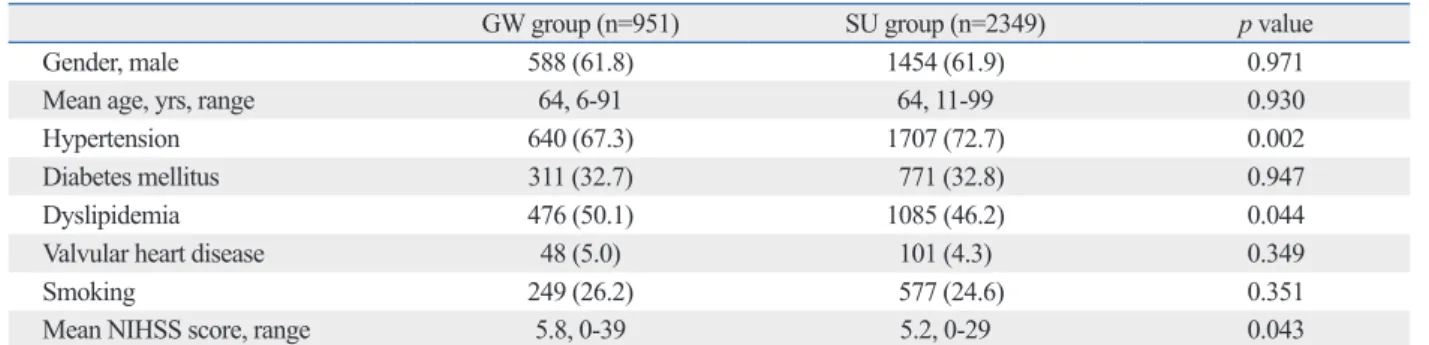
Hypertension was more common in the SU group than in the GW group. Dyslipidemia was more common and the baseline NIHSS score was higher in the GW group than in the SU group. The remaining demographics, including clas- sic risk factors for stroke, were not different between the groups (Table 1).
Frequency and detection of atrial fibrillation
AF was observed in 149 patients (15.7%) in the GW group and in 487 patients (20.7%) in the SU group (p=0.001). The frequency of AF documented at admission was higher in the SU group than in the GW group (Table 2). AF was newly de- tected during hospitalization in 7 patients (0.7%) in the GW group and in 59 patients in the SU group (2.5%, p=0.001) (Table 2).
Most AF detected during admission was paroxysmal AF (56 of 66 newly detected AF, 84.8%), and there was no dif- ference in the types of AF between the two groups [parox- ysmal AF, 7 of 7 in the GW group (100%) vs. 49 of 59 in Table 1. General Patient Characteristics
GW group (n=951) SU group (n=2349) p value
Gender, male 588 (61.8) 1454 (61.9) 0.971
Mean age, yrs, range 64, 6-91 64, 11-99 0.930
Hypertension 640 (67.3) 1707 (72.7) 0.002
Diabetes mellitus 311 (32.7) 771 (32.8) 0.947
Dyslipidemia 476 (50.1) 1085 (46.2) 0.044
Valvular heart disease 48 (5.0) 101 (4.3) 0.349
Smoking 249 (26.2) 577 (24.6) 0.351
Mean NIHSS score, range 5.8, 0-39 5.2, 0-29 0.043
SU, stroke unit; GW, general ward; NIHSS, National Institutes of Health Stroke Scale.
The numbers in parentheses are percentages.
Table 2. The Frequencies of Atrial Fibrillation and the Anticoagulation Rates in Patients Who Were Admitted to General Ward or Stroke Unit
GW group (n=951) SU group (n=2349) p value
Atrial fibrillation
Upon admission 142 (14.9) 428 (18.2) 0.024
After admission 7 (0.7) 59 (2.5) 0.001
Total 149 (15.7) 487 (20.7) 0.001
Anticoagulation
Treatment 110 (73.8) 402 (82.5) 0.019
Consideration 134 (89.9) 470 (96.5) 0.001
GW, general ward; SU, stroke unit.
The numbers in parentheses are percentages.
the increased frequency of AF during ECG monitoring in the SU was due to improved detection of paroxysmal AF.
Although Holter monitoring for 24 hours or for a few days may be performed in stroke patients who are not admitted to the SU but in the GW, routine implementation of those evaluation in stroke patients in the GW is not easy in clini- cal practice. In this regard, continuous ECG monitoring in the SU during acute stage of infarction is more practical.
Continuous ECG monitoring in the SU may have addition- al benefits of real time detection of other cardiac disease, including acute myocardial infarction as well as AF.
There are several limitations in this study. First, we did not use automatic system to detect paroxysmal AF in SU. If automatic detect system was available, detection rate of AF might be higher than that in this study. Second, the SU group included about 78% of acute stroke patients who were ad- mitted during the study period while the GW group includ- ed all acute stroke patients. Some of patients who were not admitted to the SU were due to presentation to a hospital later than 3 days after symptom onset. This might affect the results of comparison between the groups, although it might be a little. Third, hypertension was more common in the SU group. The higher frequency of AF upon admission in the SU group may partly be due to the higher frequency of hypertension in this group. Nevertheless, our findings dem- onstrated that detection of AF and the rate of anticoagulant use in stroke patients with AF increased after the opening of a SU. Stroke-unit care may contribute to improved long- term outcomes due to better prevention of recurrent stroke in patients with AF. Our findings support the benefit of con- tinuous cardiac monitoring in the SU.
ACKNOWLEDGEMENTS
The authors would like to thank our biostatistician, Hye Sun Lee, M.S., for her assistance in our statistical analyses.
This work was supported by a grant from the Korea Health 21 R&D Project, Ministry of Health & Welfare, Republic of Korea (A102065).
REFERENCES
1. Stroke Unit Trialists’ Collaboration. Organised inpatient (stroke unit) care for stroke. Cochrane Database Syst Rev 2007:CD000197.
2. Treib J, Grauer MT, Woessner R, Morgenthaler M. Treatment of stroke on an intensive stroke unit: a novel concept. Intensive Care
nents include multidisciplinary team care, evidence-based management protocol and early rehabilitation.10 However, controversies exist regarding the necessity of continuous monitoring of vital signs, including ECG.2,5,8 Our findings suggest that continuous ECG monitoring in SU is helpful for improved detection of AF.
Although current clinical guidelines recommend antico- agulation therapy as a standard preventive strategy for sec- ondary prevention in stroke patients with AF, compliance with such guidelines is reportedly not satisfactory.7,11,12 In the present study, anticoagulation rate was higher in the SU group than the GW group, despite of same treatment proto- col between the two groups. The increased rate of anticoag- ulation consideration in the SU group suggested that care in SUs improved compliance with treatment protocols, which supports the usefulness of SU care.
In our study, about 85% of newly detected AF was the paroxysmal type. Anticoagulation is required for patients with paroxysmal AF as well as those with persistent or per- manent AF, because the incidences of ischemic stroke are similar between those types of AF.13 Although AF is easily diagnosed using routine ECG at admission, paroxysmal AF may not appear on an isolated ECG recording.14 Almost 30% of newly detected AF cases were reported as paroxys- mal AF in patients with acute ischemic stroke.15 Detection of a paroxysmal AF may improve as the duration of ECG monitoring increases.16 ECG recording for 24 hours in- creases the detection of previously unrecognized AF in up to 2% of stroke patients.17 Our findings demonstrated that Table 3. Reasons That Patients Received No Anticoagulation Despite Consideration
Reason Bleeding
Intracerebral hemorrhage/large hemorrhagic
transformation 18
Gastro-intestinal bleeding 5
Subdural hemorrhage 2
Hematoma in the femoral puncture site after
angiography 1
Hematuria 1
Retroperitoneal bleeding 1
Large infarction that might require
decompressive craniectomy 9
Patient or caregiver refusal 3
Poor compliance 4
Death 33
Others* 15
*Newly developed anemia without evidence of bleeding, previous intrace- rebral hemorrhage or physician’s discretion.
11. McBride D, Brüggenjürgen B, Roll S, Willich SN. Anticoagula- tion treatment for the reduction of stroke in atrial fibrillation: a co- hort study to examine the gap between guidelines and routine medical practice. J Thromb Thrombolysis 2007;24:65-72.
12. Glazer NL, Dublin S, Smith NL, French B, Jackson LA, Hracho- vec JB, et al. Newly detected atrial fibrillation and compliance with antithrombotic guidelines. Arch Intern Med 2007;167:246-52.
13. Friberg L, Hammar N, Rosenqvist M. Stroke in paroxysmal atrial fibrillation: report from the Stockholm Cohort of Atrial Fibrilla- tion. Eur Heart J 2010;31:967-75.
14. Liao J, Khalid Z, Scallan C, Morillo C, O’Donnell M. Noninva- sive cardiac monitoring for detecting paroxysmal atrial fibrillation or flutter after acute ischemic stroke: a systematic review. Stroke 2007;38:2935-40.
15. Lin HJ, Wolf PA, Benjamin EJ, Belanger AJ, D’Agostino RB.
Newly diagnosed atrial fibrillation and acute stroke. The Framing- ham Study. Stroke 1995;26:1527-30.
16. Roche F, Gaspoz JM, Da Costa A, Isaaz K, Duverney D, Pichot V, et al. Frequent and prolonged asymptomatic episodes of paroxys- mal atrial fibrillation revealed by automatic long-term event re- corders in patients with a negative 24-hour Holter. Pacing Clin Electrophysiol 2002;25:1587-93.
17. Francis DA, Heron JR, Clarke M. Ambulatory electrocardio- graphic monitoring in patients with transient focal cerebral isch- aemia. J Neurol Neurosurg Psychiatry 1984;47:256-9.
Med 2000;26:1598-611.
3. Rudd AG, Hoffman A, Irwin P, Lowe D, Pearson MG. Stroke unit care and outcome: results from the 2001 National Sentinel Audit of Stroke (England, Wales, and Northern Ireland). Stroke 2005;36:
103-6.
4. Donnan GA, Fisher M, Macleod M, Davis SM. Stroke. Lancet 2008;371:1612-23.
5. Davis SM, Donnan GA. Stroke unit design: high tech versus low tech. Stroke 2004;35:1021.
6. Steiner T. Stroke unit design: intensive monitoring should be a routine procedure. Stroke 2004;35:1018-9.
7. Waldo AL, Becker RC, Tapson VF, Colgan KJ; NABOR Steering Committee. Hospitalized patients with atrial fibrillation and a high risk of stroke are not being provided with adequate anticoagula- tion. J Am Coll Cardiol 2005;46:1729-36.
8. Choi HY, Cho HJ, Kim SH, Han SW, Nam HS, Lee JY, et al. Or- ganization and operation of stroke unit. Korean J Stroke 2006;8:
171-8.
9. Fuentes B, Díez-Tejedor E, Ortega-Casarrubios MA, Martínez P, Lara M, Frank A. Consistency of the benefits of stroke units over years of operation: an 8-year effectiveness analysis. Cerebrovasc Dis 2006;21:173-9.
10. Kwan J, Hand P, Dennis M, Sandercock P. Effects of introducing an integrated care pathway in an acute stroke unit. Age Ageing 2004;33:362-7.