Korean J Clin Pharm, Vol. 26, No. 3, 2016
207 Original Article
Official Journal of
Korean College of Clinical Pharmacy Available online at http://www.kccp.or.kr pISSN: 1226-6051
비판막성 심방세동 환자의 뇌졸중 예방에서 dabigatran과 rivaroxaban의 임상적용의 현황
박유경1,2#·강지은3#·김승준4·라현오5·이정연2,3*
1서울성모병원약제부, 2이화여자대학교임상보건과학대학원, 3이화여자대학교약학대학생명약학부, 4알바니약학대학, 5가톨릭대학교의과대학 (2016년 4월 28일접수·2016년 8월 14일수정·2016년 8월 16일승인)
Practice Preferences on Dabigatran and Rivaroxaban for Stroke Prevention in Patients with Non-valvular Atrial Fibrillation
You Kyung Park1,2#, Ji Eun Kang3#, Seong Joon Kim4, Hyen O La5, and Sandy Jeong Rhie2,3*
1Department of Pharmacy, Seoul St. Mary's Hospital, Seoul 06591, Republic of Korea
2Graduate School of Clinical Health Sciences, Ewha Womans University, Seoul 03760, Republic of Korea
3College of Pharmacy & Division of Life and Pharmaceutical Sciences, Ewha Womans University, Seoul 03760, Republic of Korea
4Albany College of Pharmacy and Health Sciences, Albany, NY 12208, USA,
5Department of Pharmacology, School of Medicine, The Catholic University of Korea, Seoul 06591, Republic of Korea (Received April 28, 2016·Revised August 14, 2016·Accepted August 16, 2016)
INTRODUCTION
Atrial fibrillation (AF) is associated with a high risk of thromboembolism and stroke. Stroke imposes a severe and growing burden on individuals and society, with the incidence
of stroke continuing to rise as the population ages.1) As a leading risk factor for stroke, AF can be effectively prevented by anticoagulants, which would shorten patient’s recovery time.2,3) Nonetheless, researches on management of AF reported that risk-control initiatives are weakly implemented ABSTRACT
Objective: Prescription rate of dabigatran and rivaroxaban, which are the direct oral anticoagulants (DOAC), has increased. We have analyzed the prescription trend and medication use of dabigatran and rivaroxaban in patients with non-valvular atrial fibrillation (NVAF). Methods: It was retrospectively studied from September 2012 to April 2014 using the electronic medical records and the progress notes. Patients with NVAF (n=424) were evaluated on the medication use, prescribing preferences, adverse drug reactions (ADRs) and the availability of prescription reimbursement of dabigatran (n=210) and rivaroxaban (n=214). Results:
Dabigatran was prescribed higher than rivaroxaban (23.3% versus 7.5%, p<0.001) in the neurology department, but rivaroxaban was prescribed higher compared to dabigatran in the cardiology department (87.4% versus 74.3%, p<0.001). Dabigatran was prescribed more than rivaroxaban in high risk patients with CHADS2 score ≥ 3 (44.3% versus 31.3%, p=0.006). Dabigatran patients seemed to have more ADRs than patients with rivaroxaban (25.2% versus 11.2%, p<0.001), but no serious thrombotic events and bleeding were found. Only 35.6% (n=151) were eligible for prescription reimbursement by the National Health Insurance (NHI). Bridging therapy (86, 31.5%) and direct-current cardioversion (57, 20.2%) were main reasons of ineligibility for reimbursement. Conclusion: Prescription preferences were present in choosing either dabigatran or rivaroxaban for patients with NVAF. Inpatient protocols and procedures considering patient-factors in NVAF need to be developed.
KEY WORDS: Dabigatran, rivaroxaban, non-valvular atrial fibrillation, stroke prevention
*Correspondence to: Sandy Jeong Rhie, College of Pharmacy & Division of Life and Pharmaceutical Sciences and Graduate School of Clini- cal Health Sciences, Ewha Womans University, 52 ewhayeodae-gil, Seodaemun-gu, Seoul 03760, Republic of Korea
Tel: +82-2-3372-3023, Fax: +82-2-3372-2850 E-mail: [email protected]
#The first two authors contributed equally to this work.
with only 30% of patients.1,4)
Dabigatran, which is the direct thrombin inhibitor, was first released into the market as a direct oral anticoagulant (DOAC) to prevent stroke for patients with non-valvular atrial fibrillation (NVAF) with an expectation to remedy defects of warfarin.
Dabigatran was studied in 18,113 non-valvular atrial fibrillation (NVAF) patients (average CHADS2 score: 2.1), who have at least one risk factor of stroke, and it was evaluated compared to warfarin group in the large scale of RE-LY trial.5-7) Another DOAC, rivaroxaban, was approved with the same indication later by ROCKET AF study performed with 14,264 NVAF patients (average CHADS2 score: 3.48).8,9) Each medication’s precautions and safety related to bleeding were evaluated by comparing them with warfarin.5-12) DOACs have benefits of being dosed without requiring regular monitoring, fast onset, less drug/food interactions, and non-inferior or better safety profiles for prevention and treatment of stroke or systemic embolism. The usage of DOACs had increased even more in Korea since 2013 with the reimbursement by National Health Insurance (NHI). However, there have been problems to make the transition of these medications into a clinical practice due to several factors. They include the inability to check medication compliance by plasma concentration, the uncertainty of dose adjustment in certain populations (eg, renal impairments, obesity, and age greater than 75), the absence of specific antidotes, and the higher costs compared to warfarin.
In this study, the appropriateness of DOAC usages, prescribing preferences, and safety of dabigatran and rivaroxaban were investigated for patient with NVAF in a real clinical setting.
METHODS
Patients and setting
Patients 18 years and older who were admitted and diagnosed with NVAF confirmed by electrocardiography were analyzed in this study. All the patients in this study received either dabigatran or rivaroxaban for stroke prevention between September 2012 and April 2014 at a university hospital.
Patients’ baseline characteristics were collected through electronic medical record (EMR) with age of starting DOAC, gender, height, weight, CHADS2 score, serum creatinine (SCr), and blood pressure. Medical history, concomitant medications, previous use of antithrombotics, any direct current cardioversion (DCCV), or radiofrequency catheter ablations were also assessed.
Drug use and prescribing preferences
Patients were stratified into low (CHADS2 scores 0-1), moderate (CHADS2 scores 2), and high (CHADS2 scores≥ 3) risk. Indications, dosage, duration of treatment, and prescribing departments were evaluated in this study. Dosage was evaluated based on patient’s age, renal function using Cockcroft and Gault formulation, and Ideal body weight (IBW) unless total body weight (TBW) was less than 20% of IBW. Adjusted body weight (ABW) was applied if actual weight was more than 120% of IBW.
Compliance
Medication possession ratio (MPR) was used to measure the compliance of dabigatran and rivaroxaban. The number of patients and reasons for non-compliance, late refill, switching to alternatives, and temporary holdings were also analyzed.
However, the short term use of bridging therapy was not included in the compliance analysis.
Adverse drug reactions
The events of stroke, transient ischemic attack, systemic thrombosis, and any bleeding were reviewed by EMR and daily progress note. Major bleeding was defined as at least 2 g/dL reduction in hemoglobin, transfusion with minimum 2 units of blood or frozen fresh plasma, or finding of major organ or microvascular bleeding (intraocular compartment syndrome, intracranial, intra-spinal, intraocular, intramuscular, retroperitoneal, intraarticular or pericardial bleeding), the bleeding with hypotension requiring intravenous vasopressor, and the bleeding requiring surgical intervention, emergency visits, or hospitalizations.13,14) The study also reviewed chemistry panel, complete blood count (CBC), and CT scan.
Prescription reimbursement
Reimbursement of dabigatran and rivaroxaban in patients with NVAF was allowed if there were 40% or more failure of INR adjustment, hypersensitivity, or contraindication to warfarin by Health Insurance Review & Assessment Service (HIRA) in Korea. The reasons and the number of prescriptions not eligible for reimbursements were also evaluated.
Statistical analysis
Patients’ baseline characteristics were analyzed by independent- sample t-test and chi-square test. Comparison between the two groups was done with chi-square test and fisher’s exact test.
IBM SPSS version 22.0 (SPSS Inc., Chicago, IL, USA) program was utilized for data analysis, and it was considered to be statistically significant if p value was lower than 0.05.
RESULTS
Patients’ demographics and characteristics
Among the total of 424 patients, 210 patients were administered with dabigatran and 214 were on rivaroxaban.
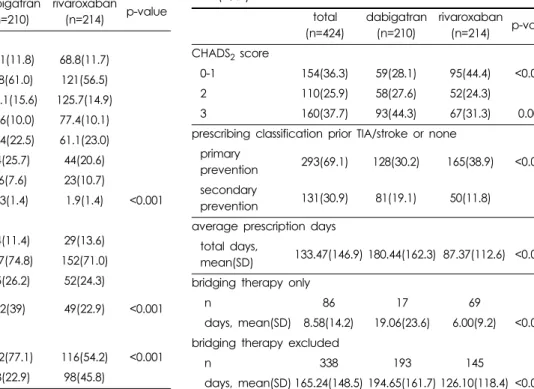
There were no statistically significant differences between the two groups in age, gender, renal function, or concomitant drugs. The average CHADS2 score was significantly higher in dabigatran group (2.3 versus 1.9, p<0.001). History of stroke and transient ischemic attack was higher in dabigatran group compared to rivaroxaban group (p<0.001). The number of patients, who had been on warfarin, was significantly higher in dabigatran group compared to rivaroxaban group (162;
77.1% versus 116; 54.2%, p<0.001) (Table 1).
Drug use evaluation and prescription preferences
Cardiology and neurology were the major departments prescribing both medications (343; 81.0%, 65; 15.3%, respectively). Other prescribing departments were generalsurgery, emergency room, neurosurgery, and rehabilitation.
While rivaroxaban was prescribed more than dabigatran in cardiology (187; 87.4% versus 156; 74.3%, p<0.001), dabigatran was prescribed more in neurology (49; 23.3% versus 16;
7.5%, p<0.001) for the secondary prevention of stroke in patients with non-valvular atrial fibrillation.
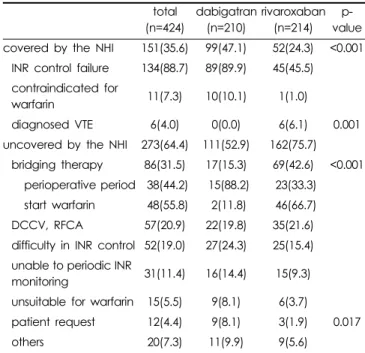
In low risk patients, who had CHADS2 score 0 to 1, prescription rate of rivaroxaban was higher compared to that of dabigatran (44.4% versus 28.1%, p<0.001). However, dabigatran showed higher prescription rate than that of rivaroxaban in high risk patients with CHADS2 score≥ 3 (44.3% versus 31.3%, p=0.006).
Rivaroxaban was used significantly for primary prevention of stroke when compared to dabigatran (38.9% vs. 30.2%, p<0.001) (Table 2). The dosage of dabigatran was appropriate in 83% (165/199) of patients excluding 11 patients whose creatinine clearances (CrCL) were unable to be defined. The average treatment duration was significantly longer with dabigatran than rivaroxaban (180.4 days versus 87.4 days, p<0.001). This is because dabigatran was used for the secondary prevention of stroke rather than short term indications, such as bridging therapy. In bridging therapy, rivaroxaban was prescribed more often than dabigatran (69;
Table 1. Baseline characteristics of patients.
dabigatran (n=210)
rivaroxaban
(n=214) p-value demographics and risk scores
age, y, mean(SD) 70.1(11.8) 68.8(11.7) male gender, n(%) 128(61.0) 121(56.5) SBP, mean(SD) 126.1(15.6) 125.7(14.9) DBP, mean(SD) 78.6(10.0) 77.4(10.1) CrCl (ml/min),mean(SD) 58.4(22.5) 61.1(23.0)
drinker, n(%) 54(25.7) 44(20.6)
smoker, n(%) 16(7.6) 23(10.7)
CHADS2 score, mean(SD) 2.3(1.4) 1.9(1.4) <0.001 comorbidities, n(%)
congestive heart failure 24(11.4) 29(13.6)
hypertension 157(74.8) 152(71.0)
diabetes mellitus 55(26.2) 52(24.3) prior transient ischemic
attack /stroke 82(39) 49(22.9) <0.001
prior VKA history, n(%)
VKA-experienced 162(77.1) 116(54.2) <0.001
VKA-naïve 48(22.9) 98(45.8)
abbreviations: SBP, systolic blood pressure; DBP, diastolic blood pres- sure; CrCl, creatinine clearance; VKA, vitamin K antagonist(warfarin)
Table 2. Prescription preferences of dabigatran and rivaroxa- ban (n, %).
total (n=424)
dabigatran (n=210)
rivaroxaban (n=214) p-value CHADS2 score
0-1 154(36.3) 59(28.1) 95(44.4) <0.001
2 110(25.9) 58(27.6) 52(24.3)
3 160(37.7) 93(44.3) 67(31.3) 0.006
prescribing classification prior TIA/stroke or none primary
prevention 293(69.1) 128(30.2) 165(38.9) <0.001 secondary
prevention 131(30.9) 81(19.1) 50(11.8) average prescription days
total days,
mean(SD) 133.47(146.9) 180.44(162.3) 87.37(112.6) <0.001 bridging therapy only
n 86 17 69
days, mean(SD) 8.58(14.2) 19.06(23.6) 6.00(9.2) <0.001 bridging therapy excluded
n 338 193 145
days, mean(SD) 165.24(148.5) 194.65(161.7) 126.10(118.4) <0.001 abbreviations: TIA, transient ischemic attack.
42.6% versus 17; 15.3%, p<0.001) (Table 2).
Rivaroxaban group showed significantly higher compliance rate than dabigatran group. Among the patients, 12 patients (5.7%) in dabigatran group and 3 patients (1.4%) in rivaroxaban group (p=0.016) did not request a prescription because they still had some medications left from missed doses.
Adverse drug reactions
None of the patients have experienced stroke, transient ischemic attack, or systemic embolism during the study period.
The incidence of adverse drug reactions (ADRs) was significantly higher with dabigatran than rivaroxaban (52;
24.8% versus 24; 11.2%, p<0.001). Gastrointestinal (GI) upset (23; 11.0%) and GI bleeding (11; 5.2%) were the most common ADRs of dabigatran. Discontinuation of treatment due
to ADRs was significantly higher in dabigatran group compared to rivaroxaban group (37; 17.6% versus 11; 5.1%, p<0.001). Ten cases of emergency room (ER) visits, hospital admission and the extension of hospitalization (4.8%) due to ADR were reported in dabigatran group, while rivaroxaban had two ER visits or hospital admissions events (0.9%) (p=0.017).
Prescription reimbursement
In both dabigatran and rivaroxaban groups, 151 (35.6%) out of 424 prescriptions were eligible for the reimbursement from NHI.
Ninety-nine cases (47.1%) of dabigatran prescription were covered by NHI, but only 52 cases (24.3%) of rivaroxaban prescription were eligible for reimbursement (p<0.001). Most of the approved cases included the failure of INR adjustment (134;
88.7%) and contraindication to warfarin (11; 7.3%). Unapproved cases included bridging therapies (86; 31.5%), directly current cardioversion or radiofrequency catheter ablation (57; 20.9%), INR fluctuation without meeting the NHI criteria (52; 19.0%), noncompliance with regular INR monitoring (31; 11.4%), and recent bleeding (15; 5.5%) (Table 4).
DISCUSSION
This study shows the trends of prescribing pattern and use Table 3. Adverse drug reactions reported during the study
period. n (%).
total (n=424)
dabigatran (n=210)
rivaroxaban (n=214) p-value
ADRs 77(18.2) 52(25.2) 24(11.2) <0.001
GI trouble 25(5.9) 23(11.0) 2(0.9) <0.001
GI bleeding 14(3.3) 11(5.2) 3(1.4) 0.027
epistaxis 6(1.4) 2(1.0) 4(1.9)
weakness 4(0.9) 3(1.4) 1(0.5)
bruise 4(0.9) 2(1.0) 2(0.9)
gum bleeding 3(0.7) 1(1.0) 2(0.9)
edema 3(0.7) 1(0.5) 2(0.9)
skin rash 2(0.5) 1(0.5) 1(0.5)
hematuria 2(0.5) - 2(0.9)
dizziness 2(0.5) 1(0.5) 1(0.5)
diarrhea 2(0.5) 1(0.5) 1(0.5)
coughing 1(0.2) 1(0.5) -
hemoptysis 1(0.2) 1(0.5) -
GI ulcer 1(0.2) 1(0.5) -
tingling sensation 1(0.2) - 1(0.5)
headache 1(0.2) - 1(0.5)
etc.a 5(1.2) 4(1.9) 1(0.5)
discontinuation due
to ADR 48(11.3) 37b(17.6) 11(5.1) <0.001 ER visits or hospital
admissions due to ADR
12(2.8) 10c(4.8) 2d(0.9) 0.017
abbreviations: ADR, adverse drug reactions; GI, gastrointestinal; ER, emergency room
ared eyes, weight loss, palpitation, temporal behaviral changes. b17 dyspepsia, 9 GI bleeding, 9 espistaxis and bruise. c7 GI bleeding, 1 diz- ziness, 1 weakness, 1 intrapulmonary hemorrhage. d 1 expistasis, 1 gum bleed.
Table 4. Prescriptions based on NHI coverage (n, %).
total (n=424)
dabigatran (n=210)
rivaroxaban (n=214)
p- value covered by the NHI 151(35.6) 99(47.1) 52(24.3) <0.001
INR control failure 134(88.7) 89(89.9) 45(45.5) contraindicated for
warfarin 11(7.3) 10(10.1) 1(1.0)
diagnosed VTE 6(4.0) 0(0.0) 6(6.1) 0.001
uncovered by the NHI 273(64.4) 111(52.9) 162(75.7) bridging therapy 86(31.5) 17(15.3) 69(42.6) <0.001
perioperative period 38(44.2) 15(88.2) 23(33.3) start warfarin 48(55.8) 2(11.8) 46(66.7) DCCV, RFCA 57(20.9) 22(19.8) 35(21.6) difficulty in INR control 52(19.0) 27(24.3) 25(15.4) unable to periodic INR
monitoring 31(11.4) 16(14.4) 15(9.3) unsuitable for warfarin 15(5.5) 9(8.1) 6(3.7)
patient request 12(4.4) 9(8.1) 3(1.9) 0.017
others 20(7.3) 11(9.9) 9(5.6)
abbreviations: NHI, National Health Insurance; VTE, venous throm- boembolism; DCCV, direct current cardioversion; RFCA, radiofre- quency catheter ablation.
of both dabigatran and rivaroxaban for NVAF patients in a real-world setting. Dabigatran and rivaroxaban are the first two medications approved to be used in NVAF patients for the prevention of systemic thromboembolism and stroke. They are leading the paradigm shift of anticoagulation therapy in modern days. The use of dabigatran and rivaroxaban is expected to increase, but the cost and adverse drug reactions are still putting the limit on their use.11) Compliance seemed to be another issue for clinical outcomes since the assay method is not well developed yet.
In this study, dabigatran or rivaroxaban seemed to be selected based on the clinical experience of healthcare providers and their preferences. In addition, dabigatran was found to be prescribed in patients who had higher CHADS2 scores. These findings have several assumptions. First, there had not been a head-to-head comparative clinical trial between dabigatran and rivaroxaban. Also, since dabigatran had been introduced clinically longer than rivaroxaban, doctors would have been comfortable with prescribing dabigatran over rivaroxaban. Dabigatran and rivaroxaban were eligible to be reimbursed for the secondary prevention of stroke and for the substitution of warfarin in patients who were unable to use it.
However, this study has found that about 64.4% of patients were on either dabigatran or rivaroxaban for perioperative use, DCCV or RFCA cardioversion, as an alternative to warfarin due to uncontrolled INR. It is postulated due to the major merit of DOACs with a simple dosing not requiring a regular monitoring because of the wider therapeutic index, faster onset of action, shorter half-life, and better safety issues compared to warfarin.14)
Dabigatran had significantly lower compliance than rivaroxaban. It may be due to the fact that dabigatran was dosed twice daily but rivaroxaban was dosed once a day.
DOACs are proved to be effective in reducing the risk of stroke in AF with the assumption of good compliance.
However, in the clinical settings where no regular laboratory monitoring is needed, a poor medication compliance is common, which may impact the clinical outcomes for the patient. Thus, DOAC could impose the same risk as with warfarin or other injectable anticoagulants. To improve compliance, healthcare professionals should consider patient’s preference on the choice of medications and direction to use as well as the patient’s knowledge of medications. Any personal barriers to medication adherence have to be assessed to provide information and advice on taking medication safely
if patients need it.
GI upset and bleeding were higher in patients with dabigatran 150 mg bid than patients with rivaroxaban. In the pivotal phase 3 trials with dabigatran, the overall safety profile was favorable to dabigatran compared to warfarin, except for a relative increase in dyspepsia-like symptoms and (at the higher dabigatran dose) GI bleeding events.15) In 2014, U.S.
Food and Drug Administration has announced the safety caution through MedWatch regarding the GI bleeding from dabigatran.16) According to the American Academy of Neurology (AAN) 2014 guideline, DOACs are recommended in patients, who have high risk of bleeding in cranium due to anticoagulation therapies or who are not able to regularly receive checkup on INR due to mobility impairment.17) As far as we understand, head-to-head trials to compare dabigatran and rivaroxaban or with other DOACs are not available, yet.
Therefore, large scales of post-marketing surveillance are also needed.
This study had some limitations. It was a retrospective study at a single medical center for patients with NVAF, and rivaroxaban was introduced in a short period of time than dabigatran. However, this study provided the early stage of DOAC usage and the areas that needed improvement in medication use. Each newly introduced oral anticoagulants needs further investigation for their risk factors, effects of short and long term use, safety profile, and patient’s experience or follow-up after usage.18)
CONCLUSION
Dabigatran showed higher prescription rate in high CHADS2 score group and it is used more for secondary prevention of stroke compared to rivaroxaban. There were more adverse effects of dyspepsia and GI bleeding in dabigatran compared to rivaroxaban. Rivaroxaban was found to be used for bridging therapy in NVAF patients and its compliance rate has shown to be higher compared to dabigatran.
FUNDING
No funding sources for this study.
CONFLICT OF INTEREST
No conflicts of interest have been declared.
ACKNOWLEDGEMENT
We thank the Department of Pharmacy at Seoul St. Mary’s hospital for supporting us in performing this study.
REFERENCES
1. Roger VL, Go AS, Lloyd-Jones DM, et al. Heart disease and stroke sta- tistics--2012 update: a report from the American Heart Association.
American Heart Association Statistics Committee and Stroke Statistics Subcommittee. Circ 2012;125(1):e2-e220.
2. Aguilar MI, Hart R. Oral anticoagulants for preventing stroke in patients with non-valvular atrial fibrillation and no previous history of stroke or transient ischemic attacks. Cochrane Data System Rev 2005;
3: Art. No. CD001927.
3. Hart RG, Pearce LA, Aguilar MI. Meta-analysis: antithrombotic ther- apy to prevent stroke in patients who have nonvalvular atrial fibrilla- tion. Ann Intern Med 2007;146(12):857-67.
4. Shin HW, Kim YN, Bae HJ, et al. Trends in oral anticoagulation ther- apy among Korean patients with atrial fibrillation: The KORean Atrial Fibrillation Investigation. Korean Circ J 2012;42(2):113-7.
5. Ezekowitz MD, Connolly SJ, Parekh A, et al. Rationale and design of RE-LY: randomized evaluation of long-term anticoagulant therapy, warfarin, compared with dabigatran. Am Heart J 2009;157:805-10.
6. Connolly SJ, Ezekowitz MD, Yusuf S, et al. Dabigatran versus war- farin in patients with atrial fibrillation. N Engl J Med 2009;361:1139- 51.
7. Connolly SJ, Ezekowitz MD, Yusuf S, et al. Newly identified events in the RE-LY® trial. N Engl J Med 2010;363(19):1875-6.
8. ROCKET AF Study Investigators. Rivaroxaban— once daily, oral, direct factor Xa inhibition compared with vitamin K antagonism for prevention of stroke and Embolism Trial in Atrial Fibrillation: rationale
and design of the ROCKET AF study. Am Heart J 2010;159(3):340-7.
9. Patel MR, Mahaffey KW, Garg J, et al. Rivaroxaban versus warfarin in nonvalvular atrial fibrillation. N Engl J Med 2011;365(10):883-91.
10. Lopes RD, Alexander JH, Al-Khatib SM, et al. Apixaban for reduction in stroke and other Thromboembolic events in atrial fibrillation (ARIS- TOTLE) trial: design and rationale. Am Heart J 2010;159:331-9.
11. Granger CB, Alexander JH, McMurray JJ, et al. Apixaban versus war- farin in patients with atrial fibrillation. N Engl J Med 2011;365(11):
981-92.
12. Giugliano RP, Ruff CT, Braunwald E, et al. Edoxaban versus warfarin in patients with atrial fibrillation. N Engl J Med 2013;369(22):2093- 104.
13. Wong KS, Hu DY, Oomman A, et al. Rivaroxaban for stroke preven- tion in East Asian patients from the ROCKET AF trial. Stroke 2014;
45(6):1739-47.
14. Mismetti P, Laporte S. Rivaroxaban: clinical pharmacology. Ann Fr Anesth Reanim 2008; 27(Suppl3):516-21.
15. Bytzer P, Connolly SJ, Yang S, et al. Analysis of upper gastrointestinal adverse events among patients given dabigatran in the RE-LY trial.
Clin Gastroenterol Hepatol 2013;11(3):246–52.e5.
16. U.S. Food and Drug Administration. Pradaxa (dabigatran): drug safety communication - lower risk for stroke and death, but higher risk for GI bleeding compared to warfarin. page last Updated: 05/13/2014. Avail- able from http://www.fda.gov/Safety/MedWatch/SafetyInformati on/
SafetyAlertsforHumanMedicalProducts/ucm397179.htm. Accessed August 26, 2016.
17. Culebras A, Messé SR, Chaturvedi et al. Summary of evidence-based guideline update: prevention of stroke in nonvalvular atrial fibrillation:
report of the Guideline Development Subcommittee of the American Academy of Neurology. Neurology 2014;82(8):716-24.
18. Mohanty BD, Looser PM, Gokanapudy LR, et al. Controversies regarding the new oral anticoagulants for stroke prevention in patients with atrial fibrillation. Vasc Med 2014;19(3):190-204.