CASE REPORT
고칼슘혈증이 동반된 급성 췌장염에서 진단된 다발성 골수종 환자
조익현, 백창렬
가톨릭대학교 의과대학 성빈센트병원 소화기내과
Acute Pancreatitis with Hypercalcemia as Initial Manifestation of Multiple Myeloma
Ik Hyun Jo and Chang-Nyol Paik
Devision of Gastroenterology, Department of Internal Medicine, St. Vincent’s Hospital, College of Medicine, The Catholic University of Korea, Suwon, Korea
A case of acute pancreatitis associated with hypercalcemia resulting from a newly diagnosed multiple myeloma is reported. There have been several prior reports of hypercalcemia-induced pancreatitis in patients with multiple myeloma, but very few showed the following two aspects: pancreatitis as the first manifestation of hematologic malignancy and recovery after serum calcium levels fell into normal range. When clinicians encounter a patient with hypercalcemic status and acute pancreatitis without any known etiology of pancreatitis, multiple myeloma as a root cause of pancreatitis should be considered. (Korean J Gastroenterol 2020;75:220-224)
Key Words: Pancreatitis; Hypercalcemia; Multiple myeloma
Received December 6, 2019. Revised January 6, 2020. Accepted January 22, 2020.
CC This is an open access article distributed under the terms of the Creative Commons Attribution Non-Commercial License (http://creativecommons.org/licenses/
by-nc/4.0) which permits unrestricted non-commercial use, distribution, and reproduction in any medium, provided the original work is properly cited.
Copyright © 2020. Korean Society of Gastroenterology.
교신저자: 백창렬, 16247, 수원시 팔달구 중부대로 93, 가톨릭대학교 의과대학 성빈센트병원 소화기내과
Correspondence to: Chang-Nyol Paik, Division of Gastroenterology, Department of Internal Medicine, St. Vincent’s Hospital, College of Medicine, The Catholic University of Korea, 93 Jungbu-daero, Paldal-gu, Suwon 16247, Korea. Tel: +82-31-249-7135, Fax: +82-31-253-8898, E-mail: [email protected], ORCID:
https://orcid.org/0000-0002-3470-6904 Financial support: None. Conflict of interest: None.
INTRODUCTION
Although gallstones and chronic alcohol consumption are the most common causes of acute pancreatitis,1 more than one-third of all acute pancreatitis cases are classified as idiopathic. However, before making a final diagnosis, other less frequent etiologies such as autoimmunity, hyper- triglyceridemia, medications, or hypercalcemia should be ruled out.1,2 Hypercalcemia could induce acute pancreatitis, but only a few cases have been reported as hypercalcemic pancreatitis caused by multiple myeloma itself. Here, we re- port a case of acute pancreatitis in an elderly male, which was induced by hypercalcemia as an initial presentation of multiple myeloma.
CASE REPORT
A 76-year-old man was referred to our institute with diffuse abdominal pain. He had a medical history of hypertension and benign prostate hyperplasia for 20 years. He had not taken any other medication that could cause acute pancreatitis.
Moreover, he did not have a history of pancreatitis. He was an ex-smoker who had smoked 30 pack-years and a current drinker consuming about 50 g of alcohol per week.
Pain started 2 weeks ago and had worsened over the past 3 days. At the time of his visit, vital signs were stable, and decreased bowel sound with combined mild tenderness was observed in the periumbilical and epigastric areas. Laboratory findings revealed a white blood cell count of 14,760/mm3
Fig. 1. Computed tomography scan of abdomen (non-enhanced).
Mild edematous pancreatic parenchymal change with peri- pancreatic haziness.
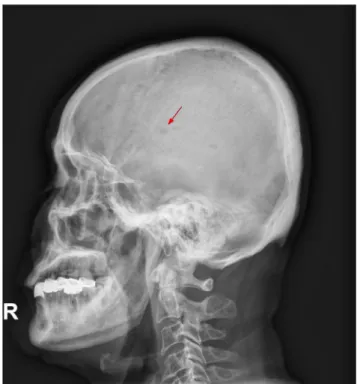
Fig. 2. Skull X-ray image (lateral view). Multiple punched-out osteolytic lesions are scattered in numerous sizes (red arrow).
segmented neutrophils content of 75.4%, and hemoglobin count of 9.6 g/dL. BUN and serum creatinine levels were ele- vated (45.9 mg/dL and 5.0 mg/dL, respectively). Mild hypona- tremia and hypokalemia were identified (131.6 mEq/L of so- dium and 3.3 mEq/L of potassium). In the liver function tests, serum AST, ALT, total bilirubin, ALP, and GGT were within normal limits (AST 20 U/L, ALT 11 U/L, total bilirubin 0.49 mg/dL, ALP 64 U/L, and GGT 21 U/L). Serum CRP was elevated (10.41 mg/dL, reference value: 0-0.3 mg/dL). Serum trigly- ceride level was within normal range (67 mg/dL). Autoimmune markers showed a negative fluorescent ANA and IgG4 level of 47.2 mg/L (reference value: 30-2,010 mg/L). Tumor marker levels for CEA and CA 19-9 were normal (1.74 mg/mL and 23.6 U/mL, respectively). The total protein and serum albumin levels were 8.6 g/dL and 2.3 g/dL, respectively, indicating a reversal of the albumin/globulin ratio (0.36). The calcium level was 12.8 mg/dL (as corrected calcium: 14.2 mg/dL) while the phosphorus level was 4.1 mg/dL. Serum amylase and lipase levels were 186 mg/dL (reference value: 22-80 mg/dL) and 259.3 U/L (reference value: less than 60.0 U/L), respectively. The intact parathyroid hormone value decreased to 2.5 pg/mL (reference value: 15-53 pg/mL) while the 25-OH vitamin D level was normal at 34.12 ng/mL (reference value for sufficiency: 32.01-100.00 ng/mL).
Abdomen CT showed a mild edematous pancreatic paren- chymal change with peripancreatic haziness, which is compat- ible with acute interstitial edematous pancreatitis (Fig. 1).
There was no evidence of gallstone or biliary tract dilatation in the CT images, so we excluded gallstone pancreatitis. The skull X-ray image demonstrated multifocal punched-out osteo- lytic lesions (Fig. 2).
We carried out protein electrophoresis with immunofixation of both serum and urine, and bone marrow biopsy was plan- ned concurrently. We found an myeloma protein in the gamma region in the electrophoresis (Fig. 3A) and monoclonal bands corresponding to IgG and κ lanes in the immunofixation (Fig. 3B), which led us to a diagnosis of monoclonal gammopathy.
Bone marrow specimens showed that 60% of all nucleated elements were plasma cell-originated (Fig. 4A) with CD138 expression in the immunohistochemical stain (Fig. 4B) and κ clonality in the in situ hybridization stain. As patients showed 60% plasma cellularity and all hypercalcemia, renal in- sufficiency, anemia, and bone lesions, our final diagnosis was acute pancreatitis due to hypercalcemia, attributed to multiple
myeloma, based on diagnostic criteria provided by the International Myeloma Working Group. For the treatment of pancreatitis, the patient fasted for a few days and then under- went fluid supplementation and intravenous nafamostat me- sylate infusion. Hemodialysis was carried out due to worsened dyspnea and progressive renal failure, and serum calcium lev-
Fig. 3. (A) Serum electrophoresis showing an myeloma protein in the gamma region (black arrow). (B) Serum immunofixation demonstrates monoclonal bands on IgG and κ lanes, which is evidence of monoclonal gammopathy (IgG, κ type). ELP, electrophoresis; Ig, immunoglobulin;
κ, kappa; L, lambda.
A B
Fig. 4. (A) Microscopic finding of bone marrow shows that about 60% of nucleated elements are plasma cells, which are oval-shaped with a round eccentric nucleus and abundant basophilic cytoplasm (Giemsa stain, ×200). (B) Discrete plasma cell mass displaced normal marrow tissue, expressing CD138 on the immunohistochemical stain (CD138, ×100).
el started to decrease over 4 weeks, along with gradually nor- malized serum amylase and lipase levels and improvement of abdominal symptoms (Fig. 5). After clinical stabilization, the patient started chemotherapy with a lenalidomide-dex- amethasone regimen for multiple myeloma, the root cause of acute pancreatitis.
DISCUSSION
In our report, we describe a case of acute pancreatitis ac- companied with abdominal pain. The patient was initially ac- companied by hypercalcemia, albumin/globulin ratio in- version, and anemia, which led to a diagnosis of multiple myeloma. Other causes of pancreatitis such as gallstones, alcohol consumption, and hypertriglyceridemia were excluded
A B
Fig. 5. Changes in serum calcium and amylase level during hospitalization. After hemodialysis, serum amylase levels decreased, as calcium levels had been normalized.
through history taking, CT images, and laboratory data. The normalization of serum calcium levels during treatment re- sulted in clinical improvements of concurrent pancreatitis.
This is a rare case in which pancreatitis was the first manifes- tation of myeloma and was relieved by the correction of hypercalcemia.
Acute pancreatitis is a disease caused by inflammatory re- action of the pancreas parenchyma, and it has been asso- ciated with various predisposing factors. According to system- atic reviews, its incidence and impact on society has been growing over the last several decades.3 Nowadays, acute pan- creatitis is one of the most frequent gastrointestinal diseases requiring hospitalization in the United States.4 Hypercalcemia can cause acute pancreatitis, with a reported prevalence of 1.5-8%,5 but is mostly related to hyperparathyroidism.
However, rare cases are caused by secondary hypercalcemia due to malignant disease and so on. The mechanism of pan- creatitis attack is thought to be characterized by the shutting down of the pancreatic canaliculi with calcium deposits and by elevation of intracellular trypsinogen enzymatic activity in the pancreas acini.6 Although hypercalcemia-induced pan- creatitis is mainly associated with elevated parathyroid hor- mone activity due to parathyroid adenoma or carcinoma, para- neoplastic syndromes accompanied by various metastatic cancers, or even milk-alkali syndrome, cases connected with
multiple myeloma are uncommon.
Renal failure, anemia, osteolytic lesions, and hypercalcemia are frequently encountered clinical manifestations of multiple myeloma. As for hypercalcemia, about 21% of newly diagnosed symptomatic myeloma patients show elevated serum calcium levels.7 The mechanism of hypercalcemia in multiple myeloma is complex. Various cytokines produced by myeloma cells induce osteoclast actions, and the total amount of calcium in serum can be elevated as a consequence.8 Multiple myeloma is diag- nosed as manifestation of myeloma caused by hypercalcemia, but pancreatitis develops during treatment of multiple myeloma.9 The literature also has reported myeloma in younger patients with pancreatitis, but the progress and therapeutic results related to pancreatitis after management of hyper- calcemia itself have not been reported.10,11
In summary, we report a rare case of acute pancreatitis secondary to hypercalcemia in patients who came to the clinic for abdominal pain and were diagnosed with multiple myeloma.
The association between pancreatitis and plasma cell-pro- liferating disorders may be easy to be overlooked due to its rarity. Thus, alertness for diagnosis will be needed when deal- ing with pancreatitis without a common cause. Clinicians should keep in mind that acute pancreatitis caused by hyper- calcemia is one of the initial by-products of multiple myeloma progression.
REFERENCES
1. Nesvaderani M, Eslick GD, Vagg D, Faraj S, Cox MR.
Epidemiology, aetiology and outcomes of acute pancreatitis: a retrospective cohort study. Int J Surg 2015;23:68-74.
2. Frey CF, Zhou H, Harvey DJ, White RH. The incidence and case-fa- tality rates of acute biliary, alcoholic, and idiopathic pancreatitis in California, 1994-2001. Pancreas 2006;33:336-344.
3. Yadav D, Lowenfels AB. The epidemiology of pancreatitis and pancreatic cancer. Gastroenterology 2013;144:1252-1261.
4. Peery AF, Dellon ES, Lund J, et al. Burden of gastrointestinal dis- ease in the United States: 2012 update. Gastroenterology 2012;143:1179-1187.e3.
5. Tun-Abraham ME, Obregón-Guerrero G, Romero-Espinoza L, Valencia-Jiménez J. Acute pancreatitis associated with hypercal- caemia. Cir Cir 2015;83:227-231.
6. Frick TW, Fernández-del Castillo C, Bimmler D, Warshaw AL.
Elevated calcium and activation of trypsinogen in rat pancreatic acini. Gut 1997;41:339-343.
7. Kastritis E, Katodritou E, Pouli A, et al. Frequency and prognostic significance of hypercalcemia in patients with multiple myeloma:
an analysis of the database of the Greek Myeloma Study Group.
Blood 2011;118:5083.
8. Oyajobi BO. Multiple myeloma/hypercalcemia. Arthritis Res Ther 2007;9 Suppl 1:S4.
9. Lee KH, Lee JS, Kim SH. Acute pancreatitis in a case of multiple myeloma with hypercalcemia. Korean J Intern Med 1989;4:
178-180.
10. McIntosh J, Lauer J, Gunatilake R, Knudtson E. Multiple myeloma presenting as hypercalcemic pancreatitis during pregnancy.
Obstet Gynecol 2014;124(2 Pt 2 Suppl 1):461-463.
11. Mishra SB, Azim A, Mukherjee A. Multiple myeloma presenting as acute pancreatitis. Am J Emerg Med 2017;35:1385.e1- 1385.e2.