Cutibacterium acnes (formerly Propionibacterium acnes) is an anaerobic, Gram-positive rod and that is a normal flora of human skin and mucosal surface as well as an opportunistic pathogen related to acnes vulgaris, sarcoidosis, brain abscess, endocarditis, periodontitis, and endodontic infections. C. acnes KCOM 1861 (= ChDC B594) was isolated from a human jaw osteomyelitis lesion. Here, we present the complete genome sequence of C. acnes KCOM 1861.
Keywords: Cutibacterium acnes, human, jaw osteomyelitis
Cutibacterium acnes (formerly Propionibacterium acnes) is an anaerobic, Gram-positive rod that forms part of normal microbiota on oral cavity, skin, external ear canal, large intestine, and conjunctiva (McDowell et al., 2013; Niazi et al., 2016;
Scholz and Kilian, 2016; Aubin et al., 2017). It has been reported that C. acnes was identified as an opportunistic pathogen related to acnes vulgaris (Leyden, 2001), sarcoidosis
(Eishi et al., 2002), brain abscess (Mathisen et al., 1984), endocarditis (Gunthard et al., 1994), periodontitis (Handal et al., 2004), and endodontic infections (Lee et al., 2005; Niazi et al., 2016). C. acnes KCOM 1861 (= ChDC B594) was isolated from a human jaw osteomyelitis lesion. In this report, we present the complete genome sequence of C. acnes KCOM 1861.
The C. acnes KCOM 1861 was grown at 37°C on tryptic soy broth (TSB, Difco) medium supplemented with 0.5% yeast extract, 0.05% cysteine HCl-H
2O, 0.5 mg/ml of hemin, 2 μg/ml of vitamin K
1, and 5% sheep blood in anaerobic atmosphere (10% H
2, 5% CO
2, and 85% N
2). The bacterial genomic DNAs were prepared using a G-spin
TMGenomic DNA Extraction kit (iNtRON Co.) according to the manufacturer’s instructions. The DNA concentrations were determined by UV-spectrophotometry (Ultrospec 2000, Pharmacia Biotech.) at wavelengths of 260 nm and 280 nm.
The genomic DNA of C. acnes KCOM 1861 was sequenced by the Illumina Hiseq 2,000 platform. De novo assembly was performed by ALLPATHS-LG (Gnerre et al., 2011) which
Korean Journal of Microbiology (2017) Vol. 53, No. 2, pp. 126-128 pISSN 0440-2413
DOI https://doi.org/10.7845/kjm.2017.7016 eISSN 2383-9902
Copyright ⓒ 2017, The Microbiological Society of Korea
Note (Genome Announcement)
Complete genome sequence of Cutibacterium acnes KCOM 1861 isolated from a human jaw osteomyelitis lesion
Soon-Nang Park
1†, Hanseong Roh
2†, Yun Kyong Lim
1, and Joong-Ki Kook
1,3*
1
Korean Collection for Oral Microbiology and Department of Oral Biochemistry, School of Dentistry, Chosun University, Gwangju 61452, Republic of Korea
2
Macrogen Inc., Seoul 08511, Republic of Korea
3
Oral Biology Research Institute, Chosun University, Gwangju 61452, Republic of Korea
사람 악골 골수염에서 분리된 Cutibacterium acnes KCOM 1861의 유전체 염기서열 해독
박순낭
1†・ 노한성
2†・ 임윤경
1・ 국중기
1,3*
1
조선대학교 치과대학 구강생화학교실 및 한국구강미생물자원은행,
2마크로젠,
3조선대학교 구강생물학연구소
(Received April 10, 2017; Accepted April 11, 2017)
†
These authors contributed equally to this work.
*For correspondence. E-mail: [email protected]
Tel.: +82-62-230-6877; Fax: +82-62-224-3706
Genome sequence of C. acnes KCOM 1861 ∙ 127
Korean Journal of Microbiology, Vol. 53, No. 2 produced one circular large scaffold and 4 tiny scaffolds. All 27
gaps among the scaffolds were filled by GapCloser (Luo et al., 2012; http://sourceforge.net/projects/soapdenovo2/files/GapCloser).
And we confirmed that the 4 tiny scaffolds were placed at gaps on the largest scaffold by dot plot analysis. Finally, the assembly was polished by iCORN2 (Otto et al., 2010). Genome annotation was conducted by the NCBI Prokaryotic Genome Annotation Pipeline (PGAP) (https://www.ncbi.nlm.nih.gov/
genome/annotation_prok/).
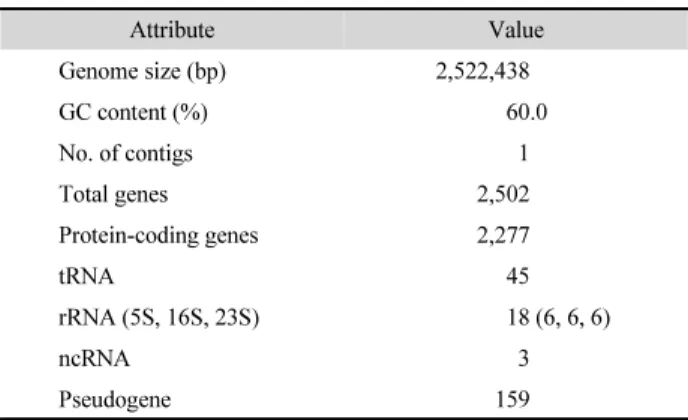
The complete genome of C. acnes KCOM 1861 is 2,522,438 bp in length and has a G+C content of 60% (Table 1). A total of 2,436 protein-coding sequences (CDSs), 18 rRNAs, and 45 tRNAs were annotated (Table 1). The genome sequence contained virulence factors such as beta-lactamase, macrolide export ATP-binding/permease protein MacB, ATP-dependent zinc metalloprotease FtsH, zinc metalloprotease Rip1, vancomycin high temperature exclusion protein, multiple antibiotic resistance protein MarR, cephalosporin-C deacetylase, outer membrane porin F precursor, hemolysin C, antitoxin/MT0933, antitoxin YqcF, diphtheria toxin repressor, and Christie-Atkins-Much- Petersen (CAMP) factor (Cfa). The complete genome included genes responsible for the biosynthesis of biofilm, such as gly- cosyltransferase Gtf1, glycosyltransferase EpsJ, and biofilm regulatory protein A precursor. The genome contained oxidative stress-response genes such as superoxide dismutase, thiol peroxidase, thioredoxin-2, thoredoxin reductase, and catalase.
The genome also contained bacterial type II secretion system protein F domain protein, the nine two-component systems, one unmatched DNA-binding response regulator, and one unmatched sensor histidine kinase. This complete genome is
informative for comparative genome analysis of C. acnes.
Nucleotide sequence accession number
This whole genome sequence was deposited in GenBank under accession number NZ_CP012647.
적 요
Cutibacterium acnes (이전 학명 = Propionibacterium acnes) 은 혐기성, 그람 양성 간균으로 사람 피부 및 점막조직 표면의 정상 세균총에 해당할 뿐만 아니라 여드름, 유육종증, 뇌종양, 심내막염, 전립선암, 치주질환 및 치수감염질환과도 연관성 이 있는 것으로 보고되고 있다. C. acnes KCOM 1861 (= ChDC B594) 균주가 사람 악골 골수염 병소에서 분리되었으며 그 유 전체 염기서열을 해독하여 보고한다.
Acknowledgements
This research was supported by the Bio & Medical Technology Development Program of the National Research Foundation (NRF) funded by the Ministry of Science, ICT &
Future Planning (NRF-2013M3A9B8013860). The Cutibacterium acnes KCOM 1861 strain was deposited in the Korean Collection for Oral Microbiology.
References