GENOME REPORT
Complete genome sequence
of Clostridium perfringens CBA7123 isolated
from a faecal sample from Korea
Yeon Bee Kim
1, Joon Yong Kim
1, Hye Seon Song
1, Changsu Lee
1, Joseph Kwon
2, Jisu Kang
3,4, Jin‑Kyu Rhee
5,
Myeong Seon Jeong
6, Young‑Do Nam
3,4†and Seong Woon Roh
1*†Abstract
Background: Clostridium perfringens is an opportunistic human pathogen that causes necrotic enteritis, mild diar‑ rhea, clostridial myonecrosis or gas gangrene, sepsis, etc. In this study, we aim to determine the pathogenesis of this bacterium at the genomic level. The genome of strain CBA7123 was sequenced, and a comparative genomic analysis between strain CBA7123 and four other related C. perfringens strains was performed.
Results: The genome of strain CBA7123 consisted of one circular chromosome and one plasmid that were 3,088,370 and 46,640 bp long with 28.5 and 27.1 mol% G+C content, respectively. The genomic DNA was predicted to contain 2798 open reading frames (ORFs), 10 rRNA genes, and 94 tRNA genes. The genomic comparison analysis between the five strains revealed the distinctive virulence properties of strain CBA7123 by highlighting certain strain‑specific genes. Conclusions: In this study, the C. perfringens CBA7123 genome was sequenced and compared with other C. per-fringens genomes. Among the various genes sequenced, the detection of antimicrobial resistance genes and those encoding various virulence factors may extend the understanding of the pathogenesis of C. perfringens strains. Keywords: Clostridium perfringens, Complete genome sequence, Comparative genomic analysis, Pathogenesis, Antimicrobial resistant, Virulence factor
© The Author(s) 2017. This article is distributed under the terms of the Creative Commons Attribution 4.0 International License (http://creativecommons.org/licenses/by/4.0/), which permits unrestricted use, distribution, and reproduction in any medium, provided you give appropriate credit to the original author(s) and the source, provide a link to the Creative Commons license, and indicate if changes were made. The Creative Commons Public Domain Dedication waiver (http://creativecommons.org/ publicdomain/zero/1.0/) applies to the data made available in this article, unless otherwise stated.
Background
Clostridium perfringens is a Gram-positive,
spore-form-ing, strict anaerobic, rod-shaped bacterium belonging to the phylum Firmicutes [1–3]. This bacterium inhab-its diverse environments such as soil, sewage, and ani-mal intestines [4]. Although C. perfringens does not invade healthy cells, it acts as a pathogen by produc-ing various enzymes and toxins and is also considered a common cause of food poisoning worldwide [5]. C.
per-fringens toxins, mainly comprising α, β, ε, and ι
extracel-lular toxins, are indicators for classifying its strains as A to E toxinotypes [6–8]. The type A of C. perfringens is the most commonly found toxinotype that possesses only
α toxin-encoding gene, plc. Strains with α-toxin genes can cause necrotic enteritis, mild diarrhea, clostridial myonecrosis or gas gangrene, sepsis, and food poison-ing in humans as well as various enterotoxemic diseases in livestock [7, 9, 10]. In this study, we aim to elucidate the pathogenesis of this species through its genome, spe-cifically the virulence-related genes. The genome of C.
perfringens CBA7123 was completely sequenced and
ana-lyzed using bioinformatics. Additionally, genomic data that were compared between strain CBA7123 and four other C. perfringens strains would illustrate the virulence mechanisms of these bacteria.
Methods
Isolation and DNA extraction of C. perfringens CBA7123 Clostridium perfringens CBA7123 (=KCCM 43242) was
isolated from the feces of a 73-year-old man, and a pure culture was obtained using serial dilution. The colony
Open Access
*Correspondence: [email protected]
†Young‑Do Nam and Seong Woon Roh contributed equally to this work 1 Microbiology and Functionality Research Group, World Institute
of Kimchi, Gwangju 61755, Republic of Korea
was cultured anaerobically in ATCC medium no. 2840, modified Eggerth–Gagnon medium (10 g peptone, 4 g Na2HPO4·2H2O, 2 g porcine gastric mucin, 50 ml sheep
blood, and 15 g agar per liter) at 37 °C for 24 h. The total genomic DNA of strain CBA7123 was extracted using QuickGene DNA tissue kit S (Kurabo, Japan) and the G-spin total DNA extraction kit (iNtRON Biotechnology, Korea). The purity, quality, and quantity of genomic DNA were measured using Agilent 2100 Bioanalyzer (Agilent Technologies, USA) as described the manufacturer’s instruction.
Library preparation and genome sequencing
Detailed genome sequencing was performed as described previously [11]. Briefly, the genomic DNA of strain CBA7123 was sheared according to the PacBio 20-kb Template Preparation using BluePippin Size-Selection System protocol, and SMRTbell library was prepared using P6-C4 chemistry (Pacific Biosciences, USA). The sequences were obtained using PacBio RS II system (Pacific Biosciences) as following an instruction of the manufacturer. The 150,292 reads were generated with 7090 bp of average read length by the PacBio RS II system from one SMRT cell.
Genome assembly and annotation
De novo assembly of the genome sequence was performed using Hierarchical Genome Assembly Process (HGAP) version 2 software, with default parameters supported by PacBio SMRT Analysis ver. 2.3.0 [12]. rRNA and tRNA of the assembled sequence were identified using RNAmmer 1.2 and tRNAscan-SE 1.21, respectively. Genes were predicted using Glimmer3 of Rapid Annotation using Subsystem Technology (RAST) server (http://rast.nmpdr.org), and functional gene annotations were performed using the SEED, Clusters of Orthologous Groups (COG, http://www.ncbi.nlm.nih.gov/COG), and Kyoto Encyclopedia of Genes and Genomes (KEGG,
http://www.genome.jp/kegg/) databases. PathogenFinder 1.1 [13] and ResFinder 2.1 [14] were used to estimate the pathogenicity and antimicrobial resistance genes, respectively. The virulence factors were searched using the Basic Local Alignment Search Tool (BLAST) in the virulence factors of pathogenic bacteria database [15] with default parameters and predicted with zero e-value. Comparative genomic analysis
The C. perfringens strains for comparative genomic analy-sis were selected using Microbial Nucleotide BLAST in the NCBI complete genome database. The four strains with BLAST total scores over 5.5e+06 were selected: strains FORC 003, JP55, FORC 025, and JP838. To com-pare the genomic structures between strain CBA7123 and
these four strains, the progressive alignment algorithm in MAUVE multiple genome alignment software 2.4.0 was used [16]. The OrthoANI algorithm was used to analyze genomic relatedness between strain CBA7123 and other
C. perfringens species. OrthoANI percentages were
calcu-lated and a phylogenetic tree was constructed, as described by Lee et al. [17]. Orthologs between strain CBA7123 and the reference strains were predicted and mapped using the reciprocal best hit method in UBLAST [18]. Pan-genome orthologous groups (POGs) were estimated using the EzBioCloud Comparative Genomics Database (http:// cg.ezbiocloud.net/) [19], and their presence was calculated using the Jaccard coefficient. UPGMA clustering was then used to show clustering between strain CBA7123 and the reference strains as a dendrogram, based on the presence or absence of gene content. The intersections and differ-ences of POG sets of the different strains were visualized as a Venn diagram, using the jvenn program [20].
Quality assurance
The single colony of strain CBA7123 was transferred more than three times to obtain a pure culture and confirmed using a variable pressure field emission scanning electron microscope (Chuncheon Center, Korea Basic Science Institute, Korea) (Additional file 1: Figure S1) and a PCR-sequencing approach targeting 16S rRNA gene as described by Min et al. [21].
Results and discussion
General features
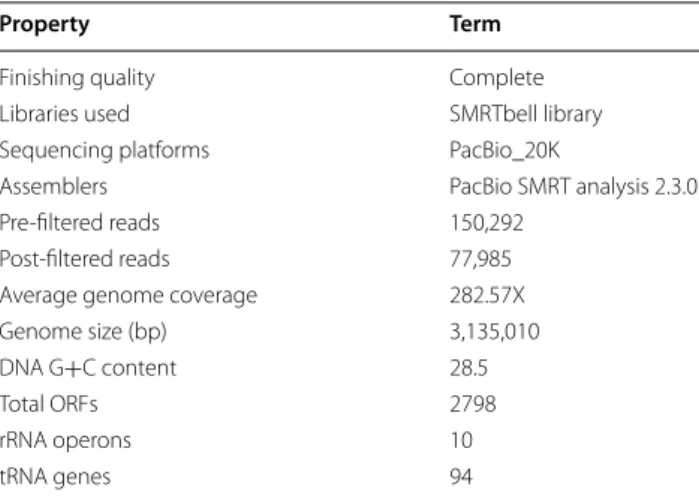
The genome of strain CBA7123 comprised two circular contigs that were 3,088,370 and 46,640 bp long with 28.5 and 27.1 mol% G+C content, respectively. Each contig matched to a chromosome and plasmid by the BLAST analysis with GenBank genome database. 2798 open reading frames (ORFs), 10 rRNA (10 5S rRNA, 10 16S rRNA, 10 23S rRNA) operons, and 94 tRNA genes were present. Among the various COG categories, G (carbohydrate transport and metabolism; 205 ORFs), E (amino acid transport and metabolism; 168 ORFs), J (translation, ribosomal structure, and biogenesis; 163 ORFs), K (transcription; 149 ORFs), and L (replication, recombination, and repair; 147 ORFs) made up the largest proportion (≥6% of the total COGs classifications). Detailed genome features are summarized in Table 1, and numbers of COG functional categories are shown in Table 2.
Comparative genomic analysis of strain CBA7123 with other C. perfringens strains
In the comparison of genomic structures between strain CBA7123 and strains FORC 003, JP55, FORC 025, and JP838, locally collinear blocks indicated high
homology (Additional file 1: Figure S2). OrthoANI val-ues between strain CBA7123 and each of strains FORC 003, JP55, FORC 025, and JP838 were 96.2, 96.2, 96.3, and 95.8, respectively. Although the phylogenetic tree constructed based on these OrthoANI values did not obviously indicate that strain CBA7123 was clustered with the other C. perfringens strains (Fig. 1a), all of the OrthoANI values were over 95%, which is the cut-off for
species demarcation [17]. A POG comparison showed that the five strains shared 2392 POGs; however, 152 POGs were exclusive to strain CBA7123 (Fig. 2). Of the 152 POGs, some POGs encoded for antibiotic resist-ance and antiviral defense functions: two kinds of multidrug export MepA proteins, CRISPR-associated endonuclease Cas1 and Cas2, 5′ to 3′ exodeoxyribonu-clease. The dendrogram created based on the presence of POGs indicated that strain CBA7123 was clustered with strains JP55, FORC 003, and FORC 025 (Fig. 1b). These results revealed that strain CBA7123 is closely related to C. perfringens, but different from other C.
perfringens strains.
Pathogenesis, virulence factors, and antimicrobial resistance genes
Strain CBA7123 was determined to be a human patho-gen with 0.77 probability, using Pathopatho-genFinder 1.1. The 13 proteins except for conserved hypothetical proteins and hypothetical proteins were matched with patho-genic organisms belonging to class Clostridia (Table 3). The genome contained tetracycline-resistance genes: two
tetA(P) genes, one each in the chromosome and
plas-mid; and one tetB(P) gene in the plasmid. Strain FORC 003 genome also contained the same tetracycline-resist-ance genes, whereas strain JP838 genome only contained
tetA(P). No antimicrobial resistance genes were detected
in the other two strains. The key virulence factors of strain CBA7123 were predicted to be exo-alpha-sialidase (nanI), sialidase (nanH), collagenase (colA, kappa-toxin), perfringolysin O (pfoA, theta-toxin), phospholipase C (plc, alpha-toxin), and alpha-clostripain (cloSI) with 96, 95, 98, 98 and 96% identity, respectively, in the chro-mosome and all of which were also present in the four reference strains. Sialidase hydrolyzes the α-linkage of terminal sialic acid residues from mammalian cell sur-face to generate free sialic acid, which is important car-bon and energy source for colonization and growth of bacterial pathogen in the intestines [22]. Perfringolysin O and phospholipase C are soluble toxin and phospho-lipid cleaving enzyme leading to host cell lysis, respec-tively, and these two enzymes have synergistic effects in
Clostridium perfringens-mediated gas gangrene [23, 24]. Collagenase and alpha-clostripain are not major determi-nant of virulence in clostridial myonecrosis, but it could be assumed that the two proteins have effects on C.
per-fringens-mediated disease [25, 26]. Strain CBA7123 could be classified as toxinotype A, based on the presence of the α-toxin gene (plc). Identification of tetracycline-resistance genes and various other virulence factors may help future research into reducing the pathogenesis of C.
perfringens in humans and contribute to faster treatment
response. Table 1 General features of the Clostridium perfringens
CBA7123 genome
Property Term
Finishing quality Complete
Libraries used SMRTbell library Sequencing platforms PacBio_20K
Assemblers PacBio SMRT analysis 2.3.0 Pre‑filtered reads 150,292
Post‑filtered reads 77,985 Average genome coverage 282.57X
Genome size (bp) 3,135,010
DNA G+C content 28.5
Total ORFs 2798
rRNA operons 10
tRNA genes 94
Table 2 Number of general COG-associated functional genes
Code Value % age Description
J 163 6.65 Translation, ribosomal structure and biogenesis K 149 6.08 Transcription
L 147 6.00 Replication, recombination and repair D 27 1.10 Cell cycle control, cell division, chromosome
partitioning
O 71 2.90 Posttranslational modification, protein turnover, chaperones
M 139 5.67 Cell wall/membrane/envelope biogenesis N 4 0.16 Cell motility
P 125 2.10 Inorganic ion transport and metabolism T 96 3.92 Signal transduction mechanisms C 137 5.59 Energy production and conversion G 205 8.37 Carbohydrate transport and metabolism E 168 6.86 Amino acid transport and metabolism F 77 3.14 Nucleotide transport and metabolism H 83 3.39 Coenzyme transport and metabolism I 54 2.20 Lipid transport and metabolism
Q 18 0.73 Secondary metabolites biosynthesis, transport and catabolism
R 0 0.00 General function prediction only S 787 32.12 Function unknown
Clostridium perfringens CBA7123 Clostridium perfringens JP838 Clostridium perfringens JP55 Clostridium perfringens FORC 003 Clostridium perfringens FORC 025
Clostridium perfringens JP838 Clostridium perfringens CBA7123 Clostridium perfringens JP55 Clostridium perfringens FORC 003 Clostridium perfringens FORC 025
a
b
Fig. 1 Phylogenetic tree depicting the relationship between Clostridium perfringens CBA7123 and four reference strains: FORC 003, FORC 025,
JP55, and JP838, constructed based on a OrthoANI values using the orthologous average nucleotide identity tool and b gene content (presence or absence) using Jaccard coefficients and UPGMA clustering
152 123 263 770 165 8 20 53 2 21 24 20 ? 20 41 4 9 13 7 5 6 21 39 40 42 63 27 13 9 123 2,392 C. perfringens CBA7123 C. perfringens FORC 003 C. perfringens JP55 C. perfringens JP838 C. perfringens FORC 025
Fig. 2 Venn diagram based on POGs indicating the orthologous groups among five Clostridium perfringens strains. Number of Venn diagrams repre‑
Future directions
The genome information of strain CBA7123 can improve the understanding of C. perfringens, and the information of its antimicrobial resistance and virulence factors can contribute to the development of methods for preventing
C. perfringens-related food poisoning. Future research
studies should investigate the pathogenesis mechanism in detail as well as the specific roles of each virulence factor.
Abbreviations
BLAST: Basic Local Alignment Search Tool; COGs: Clusters of Orthologous Groups; HGAP: Hierarchical Genome Assembly Process; KEGG: Kyoto Encyclopedia of Genes and Genomes; ORFs: open reading frames; POGs: pan‑genome orthologous groups; RAST: Rapid Annotation using Subsystem Technology.
Authors’ contributions
SWR and YDN designed and coordinated all the experiments. HSS performed the microbiology experiments. YBK, JYK, and SWR performed the bioinformatic analysis and wrote the manuscript. CL, JK, JK, JKR, and MSJ checked and edited the manuscript. All authors read and approved the final manuscript.
Author details
1 Microbiology and Functionality Research Group, World Institute of Kimchi,
Gwangju 61755, Republic of Korea. 2 Biological Disaster Analysis Group, Korea
Basic Science Institute, Daejeon 34133, Republic of Korea. 3 Gut Microbiome
Research Group, Korea Food Research Institute, Seongnam 13539, Republic of Korea. 4 University of Science and Technology, Daejeon 34113, Republic
of Korea. 5 Department of Food Science and Engineering, Ewha Womans Additional file
Additional file 1: Figure S1. A photomicrograph of Clostridium per-fringens strain CBA7123 using Variable Pressure Field Emission Scanning Electron Microscope (VP‑FE‑SEM). Figure S2. Comparison of genomic structure between Clostridium perfringens CBA7123 and strains FORC 003, FORC 025, JP55, and JP838, using a progressive alignment algorithm in Mauve. The locally collinear blocks with identical colors represent highly homologous regions. The genomes were figured based on scale of the genome of strain CBA7123.
University, Seoul 03760, Republic of Korea. 6 Chuncheon Center, Korea Basic
Science Institute, Gangneung, Gangwon‑do 24341, Republic of Korea. Acknowledgements
Not applicable. Competing interests
The authors declare that they have no competing interests. Availability of data and materials
This complete genome project has been deposited at DDBJ under the accession numbers AP017630–AP017631.
Ethics approval and consent to participate
The study protocol was approved by the institutional review board of the Theragen ETEX Bio Institute (700062‑20160804‑JR‑005‑02).
Funding
This research was supported by the Korea Food Research Institute (E0170602‑ 01), the World Institute of Kimchi funded by the Ministry of Science, ICT and Future Planning, Republic of Korea (KE1702‑2), the Center for Analytical Research of Disaster Science of the Korea Basic Science Institute (C37703), and the Basic Science Research Program through the National Research Foundation of Korea (NRF) funded by the Ministry of Education, Science, and Technology (2015R1D1A1A09061039).
Publisher’s Note
Springer Nature remains neutral with regard to jurisdictional claims in published maps and institutional affiliations.
Received: 13 March 2017 Accepted: 25 May 2017
References
1. Minton NP, Ehsaan M, Humphreys CM, Little GT, Baker J, Henstra AM, et al. A roadmap for gene system development in Clostridium. Anaerobe. 2016;41:104–12.
2. Shimizu T, Ohtani K, Hirakawa H, Ohshima K, Yamashita A, Shiba T, et al. Complete genome sequence of Clostridium perfringens, an anaerobic flesh‑eater. Proc Natl Acad Sci USA. 2002;99:996–1001.
3. Wong YM, Juan JC, Gan HM, Austin CM. Draft genome sequence of Clostridium perfringens strain JJC, a highly efficient hydrogen producer isolated from landfill leachate sludge. Genome Announc. 2014;2:e00064. Table 3 Pathogenesis-related proteins matched to the genus Clostridium
Matched protein function Matched organisms Protein ID
Acetyltransferase GNAT family Clostridium perfringens ATCC 13124 ABG84563 Conserved hypothetical protein Clostridium perfringens str. 13 BAB81124
Creatininase Clostridium perfringens ATCC 13124 ABS84729
DedA family protein Clostridium perfringens ATCC 13124 ABG84228
FemAB family protein Clostridium perfringens SM101 ABG87847
Iron‑sulfur cluster‑binding protein Clostridium perfringens SM101 ABG85421
Oxidoreductase, FAD‑binding Clostridium perfringens SM101 ABG85949
PTS system, mannose/fructose/sorbose family, IIC component Clostridium perfringens ATCC 13124 ABG82202
Putative csfB protein Clostridium perfringens SM101 ABG87739
Putative membrane protein Clostridium perfringens ATCC 13124 ABG83481
Transcriptional regulator, PadR family Clostridium perfringens ATCC 13124 ABG82435 Transcriptional regulator, PadR family Clostridium perfringens SM101 ABG85373
• We accept pre-submission inquiries
• Our selector tool helps you to find the most relevant journal
• We provide round the clock customer support
• Convenient online submission
• Thorough peer review
• Inclusion in PubMed and all major indexing services
• Maximum visibility for your research Submit your manuscript at
www.biomedcentral.com/submit
Submit your next manuscript to BioMed Central
and we will help you at every step:
4. Johansson A, Aspan A, Bagge E, Baverud V, Engstrom BE, Johansson KE. Genetic diversity of Clostridium perfringens type A isolates from animals, food poisoning outbreaks and sludge. BMC Microbiol. 2006;6:47. 5. Gross TP, Kamara LB, Hatheway CL, Powers P, Libonati JP, Harmon SM,
Israel E. Clostridium perfringens food poisoning: use of serotyping in an outbreak setting. J Clin Microbiol. 1989;27:660–3.
6. Hassan KA, Elbourne LD, Tetu SG, Melville SB, Rood JI, Paulsen IT. Genomic analyses of Clostridium perfringens isolates from five toxinotypes. Res Microbiol. 2015;166:255–63.
7. Petit L, Gibert M, Popoff MR. Clostridium perfringens: toxinotype and genotype. Trends Microbiol. 1999;7:104–10.
8. Rood JI, Cole ST. Molecular genetics and pathogenesis of Clostridium perfringens. Microbiol Rev. 1991;55:621–48.
9. Brynestad S, Granum PE. Clostridium perfringens and foodborne infec‑ tions. Int J Food Microbiol. 2002;74:195–202.
10. Hashiba M, Tomino A, Takenaka N, Hattori T, Kano H, Tsuda M, Takeyama N. Clostridium Perfringens Infection in a Febrile Patient with Severe Hemo‑ lytic Anemia. Am J Case Rep. 2016;17:219–23.
11. Kim JY, Song HS, Kim YB, Kwon J, Choi JS, Cho YJ, et al. Genome sequence of a commensal bacterium, Enterococcus faecalis CBA7120, isolated from a Korean fecal sample. Gut Pathog. 2016;8:62.
12. Chin CS, Alexander DH, Marks P, Klammer AA, Drake J, Heiner C, et al. Nonhybrid, finished microbial genome assemblies from long‑read SMRT sequencing data. Nat Methods. 2013;10:563–9.
13. Cosentino S, Voldby Larsen M, Moller Aarestrup F, Lund O. Pathogen‑ Finder–distinguishing friend from foe using bacterial whole genome sequence data. PLoS ONE. 2013;8:e77302.
14. Zankari E, Hasman H, Cosentino S, Vestergaard M, Rasmussen S, Lund O, et al. Identification of acquired antimicrobial resistance genes. J Antimi‑ crob Chemother. 2012;67:2640–4.
15. Chen L, Yang J, Yu J, Yao Z, Sun L, Shen Y, Jin Q. VFDB: a reference database for bacterial virulence factors. Nucleic Acids Res. 2005;33:D325–8. 16. Darling AC, Mau B, Blattner FR, Perna NT. Mauve: multiple alignment
of conserved genomic sequence with rearrangements. Genome Res. 2004;14:1394–403.
17. Lee I, Kim YO, Park SC, Chun J. OrthoANI: an improved algorithm and soft‑ ware for calculating average nucleotide identity. Int J Syst Evol Microbiol. 2015;66:1100–3.
18. Ward N, Moreno‑Hagelsieb G. Quickly finding orthologs as reciprocal best hits with BLAT, LAST, and UBLAST: how much do we miss? PLoS ONE. 2014;9:e101850.
19. Yoon SH, Ha SM, Kwon S, Lim J, Kim Y, Seo H, Chun J. Introducing EzBio‑ Cloud: a taxonomically united database of 16S rRNA and whole genome assemblies. Int J Syst Evolut Microbiol. 2016. (In press).
20. Bardou P, Mariette J, Escudie F, Djemiel C, Klopp C. jvenn: an interactive Venn diagram viewer. BMC Bioinform. 2014;15:293.
21. Min UG, Kim SJ, Hong H, Kim SG, Gwak JH, Jung MY, et al. Calculibacil-lus koreensis gen. nov., sp. nov., an anaerobic Fe(III)‑reducing bacterium isolated from sediment of mine tailings. J Microbiol. 2016;54:413–9. 22. Li J, Uzal FA, McClane BA. Clostridium perfringens Sialidases: potential contrib‑
utors to intestinal pathogenesis and therapeutic targets. Toxins. 2016;8:341. 23. Awad MM, Ellemor DM, Boyd RL, Emmins JJ, Rood JI. Synergistic effects of
alpha‑toxin and perfringolysin O in Clostridium perfringens‑mediated gas gangrene. Infect Immun. 2001;69:7904–10.
24. Dang TX, Hotze EM, Rouiller I, Tweten RK, Wilson‑Kubalek EM. Prepore to pore transition of a cholesterol‑dependent cytolysin visualized by electron microscopy. J Struct Biol. 2005;150:100–8.
25. Awad MM, Ellemor DM, Bryant AE, Matsushita O, Boyd RL, Stevens DL, et al. Construction and virulence testing of a collagenase mutant of Clostridium perfringens. Microb Pathog. 2000;28:107–17.
26. Chakravorty A, Awad MM, Hiscox TJ, Cheung JK, Carter GP, Choo JM, et al. The cysteine protease alpha‑clostripain is not essential for the patho‑ genesis of Clostridium perfringens‑mediated myonecrosis. PLoS ONE. 2011;6:e22762.