Fusobacterium animalis (formerly Fusobacterium nucleatum subsp. animalis) is a Gram-negative, anaerobic, and filament- shaped bacterium. F. animalis may be a part of normal flora and a periodontopathogen of human oral cavity. F. animalis KCOM 1280 (= ChDC F318) was isolated from a human periodontitis lesion. In this report, we present the draft genome sequence of F. animalis KCOM 1280.
Keywords: Fusobacterium animalis, human, periodontitis
Fusobacterium nucleatum subsp. animalis was classified as one of four or five subspecies of Fusobacterium nucleatum by DNA-DNA hybridization (DDH) and electrophoretic patterns of glutamate dehydrogenase and 2-oxoglutarate reductase (Gharbia and Shah, 1990, 1992). Recently, F. nucleatum subsp.
animalis was reclassified as Fusobacterium animalis based on the average nucleotide identity and genome-to-genome distance analyses (Kook et al., 2017). F. animalis is a Gram-negative,
anaerobic, and filament-shaped bacterium (Gharbia and Shah, 1990). F. animalis may be a commensal species of human oral cavity. F. animalis KCOM 1280 (= ChDC F318) was isolated from a human periodontitis lesion. In this report, we present the draft genome sequence of F. animalis KCOM 1280.
The F. animalis KCOM 1280 was grown on brain heart infusion (BHI, Difco Laboratories) medium supplemented with 0.5% yeast extract, 0.05% cysteine HCl-H
2O, 0.5 mg/ml of hemin, 2 µg/ml of vitamin K
1, and 5% sheep blood in an anaerobic chamber (Model Bactron I, Sheldon Manufacturing Inc.) maintaining with a gas mixture of 10% H
2, 5% CO
2, and 85% N
2(Park et al., 2013). The bacterial genomic DNA was prepared as described previously and DNA concentration was determined by the Epoch ™ Microplate Spectrophotometer (BioTek Instruments Inc.) at wavelengths of 260 and 280 nm (Cho et al., 2015).
The genomic DNA of F. animalis KCOM 1280 was sequenced using the Illumina Hiseq 2000 platform by Macrogen Inc. The library of 5 kb mate-pair was sequenced which reached cove- rage of 2,056×. The de novo assembly was performed by ALLPATHS-LG (Gnerre et al., 2011) and SSPACE (Boetzer
Korean Journal of Microbiology (2018) Vol. 54, No. 2, pp. 146-148 pISSN 0440-2413
DOI https://doi.org/10.7845/kjm.2018.7097 eISSN 2383-9902
Copyright ⓒ 2018, The Microbiological Society of Korea
Draft genome sequence of Fusobacterium animalis KCOM 1280 isolated from a human subgingival plaque of periodontitis lesion
Soon-Nang Park
1†, Yun Kyong Lim
1†, Ja Young Shin
2, Hanseong Roh
2, and Joong-Ki Kook
1,3*
1
Korean Collection for Oral Microbiology and Department of Oral Biochemistry, School of Dentistry, Chosun University, Gwangju 61452, Republic of Korea
2
Macrogen Inc., Seoul 08511, Republic of Korea
3
Oral Biology Research Institute, Chosun University, Gwangju 61452, Republic of Korea
사람 치주염 병소의 치은연하지면세균막에서 분리된 Fusobacterium animalis KCOM 1280의 유전체 염기서열 해독
박순낭
1†・ 임윤경
1†・ 신자영
2・ 노한성
2・ 국중기
1,3*
1
조선대학교 치과대학 구강생화학교실 및 한국구강미생물자원은행,
2마크로젠,
3조선대학교 구강생물학연구소
(Received December 12, 2017; Accepted February 6, 2018)
†
These authors contributed equally to this work.
*For correspondence. E-mail: [email protected];
Tel.: +82-62-230-6877; Fax: +82-62-224-3706
Genome sequence of F. animalis KCOM 1280 ∙ 147
Korean Journal of Microbiology, Vol. 54, No. 2 and Pirovano, 2014). All gaps among the scaffolds were filled
by GapCloser (Luo et al., 2012; http://sourceforge.net/projects/
soapdenovo2/files/GapCloser). And we confirmed the scaffolds were placed at gaps on the largest scaffold by dot plot analysis.
Finally, the assembly was polished by iCORN2 (Otto et al., 2010). Genome annotation was conducted by the NCBI Prok- aryotic Genome Annotation Pipeline (PGAP) (https://www.
ncbi.nlm.nih.gov/ genome/annotation_prok/).
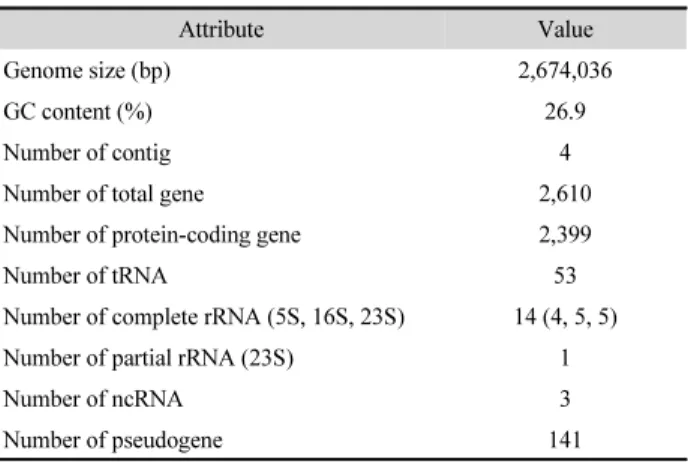
The complete genome of F. animalis KCOM 1280 was 2,674,036 bp in length and had a G + C content of 26.9% (Table 1). A total of 2,399 protein-coding sequences (CDSs), 14 rRNAs, and 53 tRNAs were annotated (Table 1). The genome sequence contained virulence factors such as haemagglutinin, hemolysin transporter protein ShlB, hemolysin A, protease 3 precursor, FtsH protease regulator HflK, metalloprotease LoiP/YpwA, ATP-dependent zinc metalloprotease FtsH, protease HtpX, protease 4, papain family cysteine protease, putative protease YhbU precursor, metalloprotease LoiP precursor, putative metalloprotease YpwA, sialic acid-binding periplasmic protein SiaP precursor, sialic acid TRAP transporter permease protein SiaT, outer membrane porin F, multidrug resistance protein MexA/MdtC/MdtK/NorM, multidrug export ATP-binding/permease protein, multidrug export protein MepA, multidrug-efflux transporter 1 regulator, putative multidrug export ATP-binding/permease protein, ma- crolide export protein MacA, macrolide export ATP-binding/
permease protein MacB, antitoxin ChpS/YwqK/YefM/RelB/
MazE, toxin YoeB, toxin zeta, plasmid encoded toxin Txe, outer membrane porin F precursor, and transport protein TonB.
The genome contained phage genes such as phage portal protein, phage capsid family protein, phage tail sheath protein,
phage-like element PBSX protein XkdM, phage-related minor tail protein, putative prophage phiRv2 integrase, phage tail protein (Tail_P2_I), phage P2 GpU, phage late control gene D protein (GPD), phage tail tube protein FII, phage major capsid protein E, phage terminase large subunit (GpA), N-terminal phage replisome organiser (Phage_rep_org_N), and SPBc2 prophage- derived glycosyltransferase SunS. The complete genome encodes proteins for the biofilm formation, autoinducer-2 (AI-2) modi- fying protein LsrG, autoinducer 2 sensor kinase/phosphatase LuxQ, and glycosyltransferase family 28 C-terminal domain. It also contained type II secretion system protein D/E/F, type IV secretion system protein virB4/virB9/ virB10/virB11/PtlG, preprotein translocase subunit YajC, and protein translocase subunit SecA/SecD/SecE/ SecY.
The genome also contained the oxidative stress-response genes such as anaerobic nitric oxide reductase flavorubredoxin, anaerobic sulfite reductase subunit A/B/C, thioredoxin reductase, glutaredoxin, peptide methionine sulfoxide reductase MsrB, thiol-disulfide oxidoreductase ResA, nitroreductase A, pyruvate- flavodoxin oxidoreductase, rubrerythrin (conferring superoxide dismutase-like activity), and NADH oxidase. The genome contained the three two-component systems (PdtaS/PdtaR, YpdA/YpdB, and YehU/putative response regulatory protein).
The F. animalis KCOM 1280 strain was deposited in the Korean Collection for Oral Microbiology.
Nucleotide sequence accession number
This whole Genome sequence has been deposited at DDBJ/
ENA/GenBank under the accession NJGJ00000000. The version described in this paper is version NJGJ01000000.
적 요
Fusobacterium animalis (예전에 Fusobacterium nucleatum subsp. animalis으로 알려짐)는 그람 음성이면서, 혐기성 및 선 형의 세균이다. F. animalis는 사람 구강 내 정상 세균총의 하나 이며 치주질환원인균이라 여겨지고 있다. F. animalis KCOM 1280 (= ChDC F318) 균주는 사람 치주질환 병소에서 분리되 었다. 본 논문에서 F. animalis KCOM 1280 균주 유전체 염기 서열을 해독하여 보고하고자 한다.
Table 1. Genome features of Fusobacterium animalis KCOM 1280
Attribute Value
Genome size (bp) 2,674,036
GC content (%) 26.9
Number of contig 4
Number of total gene 2,610
Number of protein-coding gene 2,399
Number of tRNA 53
Number of complete rRNA (5S, 16S, 23S) 14 (4, 5, 5)
Number of partial rRNA (23S) 1
Number of ncRNA 3
Number of pseudogene 141
148 ∙ Park et al.
미생물학회지 제54권 제2호
Acknowledgements
This research was supported by Basic Science Research Program through the National Research Foundation of Korea (NRF) funded by the Ministry of Science and ICT (2017R1 A2B4004894).
References