Korean Journal of Microbiology (2019) Vol. 55, No. 1, pp. 77-79 pISSN 0440-2413
DOI https://doi.org/10.7845/kjm.2019.8095 eISSN 2383-9902
Copyright ⓒ 2019, The Microbiological Society of Korea
Genome sequence of Veillonella atypica KHUD-V1 isolated from a human subgingival dental plaque of periodontitis lesion
Jae-Hyung Lee
1,2,3†, Seung-Yun Shin
4†, Han Lee
1, Seok Bin Yang
1, Eun-Young Jang
5, Jae-In Ryu
6, Jin-Yong Lee
1* , and Ji-Hoi Moon
1,2*
1
Department of Maxillofacial Biomedical Engineering, School of Dentistry,
2Department of Life and Nanopharmaceutical
Sciences,
3Kyung Hee Medical Science Institute,
4Department of Periodontology, School of Dentistry,
5Department of Dentistry, Graduate School,
6Department of Preventive Dentistry, School of Dentistry, Kyung Hee University, Seoul 02447, Republic of Korea
사람 치주염 병소의 치은 연하 치태에서 분리된 Veillonella atypica KHUD-V1의 유전체 염기서열 해독
이재형
1,2,3†・ 신승윤
4†・ 이 한
1・ 양석빈
1・ 장은영
5・ 류재인
6・ 이진용
1* ・ 문지회
1,2*
1
경희대학교 치과대학 악안면생체공학교실,
2경희대학교 나노의약생명과학과,
3경희의과학연구소,
4경희대학교 치과대학 치주과학교실,
5
경희대학교 대학원 치의학과,
6경희대학교 치과대학 예방치과학교실
(Received November 26, 2018; Revised January 10, 2019; Accepted January 22, 2019)
†
These authors contributed equally to this work.
*For correspondence. (J.Y. Lee) E-mail: [email protected];
Tel.: +82-2-961-9544; Fax: +82-2-962-0598 / (J.H. Moon) E-mail: [email protected];
Tel.: +82-2-961-0795; Fax: +82-2-962-0598
Here we report the genome sequence of Veillonella atypica strain KHUD-V1 isolated from subgingival dental plaque of Korean chronic periodontitis patients. Unlike other V. atypica strains, KHUD-V1 carries two prophage regions and prophage remnants, as well as several genes homologous to prophage- associated virulence factors, such as virulence-associated protein E, a Clp protease, and a toxin-antitoxin system. The isolate and its genome sequence obtained here will aid to understand the diversity of the genome architecture of Veillonella within an evolutionary framework and the role of prophages that contribute to the genetic diversity as well as the virulence of V. atypica.
Keywords: Veillonella atypicau, genome, periodontitis, prophage
Anaerobic, Gram-negative cocci Veillonella species are a part of the normal microflora of the oral cavity, gastrointestinal
and urogenital tracts in humans (Pei et al., 2004; Keijser et al., 2008; van den Bogert et al., 2011). However, they can participate in mixed-species infections and have been isolated from patients with skin, dental, and respiratory infections. Rarely, Veillonella can cause serious infections like meningitis, endocarditis, and osteomyelitis (Saladi et al., 2017).
Bacteriophages are viruses that infect bacteria. Once the bacteriophage genome is integrated into the host cell genome, it is called a prophage. Prophages play an intricate role in the evolution of bacterial genome, contribute to the genetic diversity even within the same species, and act as regulators of the microbiota composition (Roodt et al., 2012; Lugli et al., 2016).
Prophages are also known to be closely related to the adaptation of existing pathogens to new hosts and the emergence of new pathogens or epidemic clones.
So far, very little is known about the occurrence and genetic
variability of prophages within the Veillonella. Here, we report
a genome sequence of V. atypica strain KHUD-V1 isolated
from subgingival dental plaque of Korean chronic periodontitis
78 ∙ Lee et al.
미생물학회지 제55권 제1호
Fig. 1. Prophages present in Veillonella atypica KHUD-V1. Location of the prophages on the host chromosome and characterization of the genes were imaged using PHASTER.
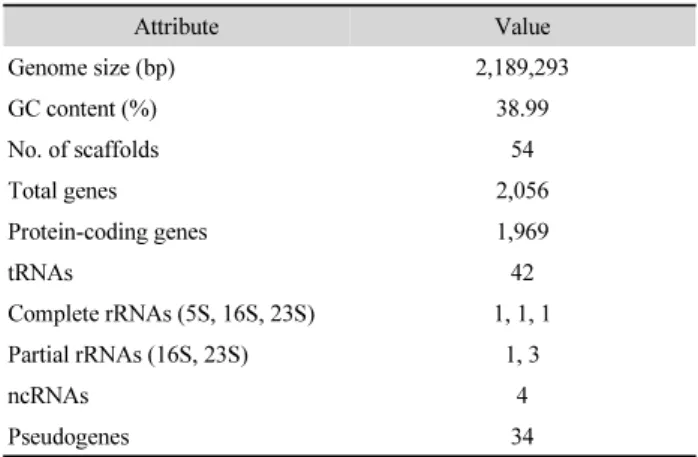
Table 1. Genome features of Veillonella atypica KHUD-V1
Attribute Value
Genome size (bp) 2,189,293
GC content (%) 38.99
No. of scaffolds 54
Total genes 2,056
Protein-coding genes 1,969
tRNAs 42
Complete rRNAs (5S, 16S, 23S) 1, 1, 1
Partial rRNAs (16S, 23S) 1, 3
ncRNAs 4
Pseudogenes 34
patients. Interestingly, the genome of this strain contains two prophage regions, which are not found in the currently registered V. atypica genomes. Several virulence factors that may be associated with the prophages were also found. V. atypica strain KHUD-V1 has been deposited in the Korean Collection for Type Cultures (KCTC) for future reference and research.
The new clinical isolate and its genome sequence obtained here will aid to understand the diversity of the genome architecture of Veillonella within an evolutionary framework, and the role of prophages that contribute to the genetic diversity as well as the virulence of V. atypica.
The bacterial genomic DNA was extracted, and the sequencing library was constructed following the paired-end sequencing on the Illumina Hi-Seq X platform. In total, 15,818,696 paired-
end read pairs (2 × 151 bp) were obtained. After filtering out
low quality raw reads, SPAdes (version 3.12.0) (Bankevich et
Genome sequence of V. atypica ∙ 79
Korean Journal of Microbiology, Vol. 55, No. 1 al., 2012) with default parameters was used to construct the
genome, creating 54 scaffolds (> 500-bp length). Gene annotation of the genome was performed by the NCBI Prokaryotic Genome Annotation Pipeline (Tatusova et al., 2016). The genome of V. atypica KHUD-V1 was found to contain 2,189,293 bp with a G+C content of 38.99% (Table 1). A total of 1,969 protein- coding genes, 7 rRNAs, and 42 tRNAs were annotated (Table 1). Two clustered regularly interspaced short palindromic repeats (CRISPRs) arrays were also identified.
Pan genome analysis was performed using the currently registered V. atypica genomes in NCBI GenBank by Pan Genome Analysis Pipeline (PGAP) tools (Zhao et al., 2012).
PHASTER (PHAge Search Tool Enhanced Release) (Arndt et al., 2016) was used to identify and annotate prophage sequence regions (Fig. 1). We identified 247 KHUD-V1 strain-specific genes, including two prophage regions and prophage remnants, as well as several genes homologous to prophage-associated virulence factors, such as virulence associated protein E, a Clp protease, and a toxin-antitoxin system.
Nucleotide sequence accession number
This Whole Genome Shotgun sequencing project for V. atypica KHUD-V1 is available at GenBank under the accession no.
QXZZ00000000. The version described in this paper is Version QXZZ01000000.
적 요
본 논문에서는 한국인 만성 치주염 환자의 치은연하치태에 서 분리된 Veillonella atypica KHUD-V1의 유전체 서열을 보 고한다. 다른 V. atypica 균주와 달리, KHUD-V1에서는 프로 파지 및 이와 관련된 것으로 추정되는 여러 병독성 인자가 확 인되었다. V. atypica KHUD-V1 균주 및 이 균주의 유전체 서 열정보는 Veillonella의 유전체 다양성을 진화론적 관점에서 이해하고, V. atypica의 병독성 및 유전적 다양성에 기여하는 프로파지의 역할을 연구하는데 유용할 것이다.
Acknowledgements
This research was supported by the National Research Foundation of Korea (NRF) funded by the Ministry of Science &
ICT (NRF-2016R1D1A1B03932450, NRF-2018R1A2B6002173, and NRF-2017M3A9B6062027).
References