Korean Journal of Microbiology (2017) Vol. 53, No. 3, pp. 219-221 pISSN 0440-2413
DOI https://doi.org/10.7845/kjm.2017.7052 eISSN 2383-9902
Copyright ⓒ 2017, The Microbiological Society of Korea
Note (Genome Announcement)
Complete genome sequence of Fusobacterium nucleatum KCOM 1323 isolated from a human subgingival plaque of periodontitis lesion
Soon-Nang Park
1†, Yun Kyong Lim
1†, Ja Young Shin
2, Hanseong Roh
2, and Joong-Ki Kook
1,3*
1
Korean Collection for Oral Microbiology and Department of Oral Biochemistry, School of Dentistry, Chosun University, Gwangju 61452, Republic of Korea
2
Macrogen Inc., Seoul 08511, Republic of Korea
3
Oral Biology Research Institute, Chosun University, Gwangju 61452, Republic of Korea
사람 치주질환병소의 치은연하지면세균막에서 분리된
Fusobacterium nucleatum KCOM 1323의 유전체 염기서열 해독
박순낭
1†・ 임윤경
1†・ 신자영
2・ 노한성
2・ 국중기
1,3*
1
조선대학교 치과대학 구강생화학교실 및 한국구강미생물자원은행,
2마크로젠,
3조선대학교 구강생물학연구소
(Received August 8, 2017; Accepted August 10, 2017)
†
These authors contributed equally to this work.
*For correspondence. E-mail: [email protected];
Tel.: +82-62-230-6877; Fax: +82-62-224-3706
Fusobacterium nucleatum is a Gram-negative, obligately anaerobic and rod- or filament-shaped bacterium. F. nucleatum is part of oral microflora and is a causative agent of periodontitis as well as is associated with a wide spectrum of systemic diseases of human. F. nucleatum KCOM 1323 (=
ChDC F317) was isolated from a human subgingival plaque of periodontitis lesion. Here, we present the complete genome sequence of F. nucleatum KCOM 1323.
Keywords: Fusobacterium nucleatum, periodontitis
Fusobacterium nucleatum Gram-negative, obligately anaerobic and rod- or filament-shaped bacterium (Strauss et al., 2008). F.
nucleatum is part of oral microflora and is a causative agent of periodontitis as well as is associated with preterm birth, colorectal cancer, inflammatory bowel disease, respiratory tract infections, cardiovascular disease, rheumatoid arthritis, and Alzheimer’s disease (Haffajee and Socransky, 1994; Han, 2015).
F. nucleatum KCOM 1323 (= ChDC F317) was isolated from a human subgingival plaque of periodontitis lesion. In this report, we present the complete genome sequence of F. nucleatum KCOM 1323.
The F. nucleatum KCOM 1323 was grown in brain heart infusion (BHI, Difco Laboratories) medium supplemented with 0.5% yeast extract, 0.05% cysteine HCl-H
2O, 0.5 mg/ml of hemin, 2 μg/ml of vitamin K
1, and 5% sheep blood in an anaerobic chamber (Model Bactron I) was maintained using a gas mixture of 10% H
2, 5% CO
2, and 85% N
2(Park et al., 2013). The bacterial genomic DNA was prepared as described previously and DNA concentration was determined by the Epoch™ Microplate Spectrophotometer (BioTek Instruments Inc.) at wavelengths of 260 and 280 nm (Cho et al., 2015).
The genomic DNA of F. nucleatum KCOM 1323 was
sequenced using the Illumina Hiseq 2000 platform by Macrogen
Inc.. The library of 5 kb mate-pair was sequenced which reached
coverage of 1,769X. The de novo assembly was performed by
SPAdes (version: 3.8.2) (Bankevich et al., 2012) and AlignGraph
(Bao et al., 2014). All gaps among the scaffolds were filled by
220 ∙ Park et al.
미생물학회지 제53권 제3호
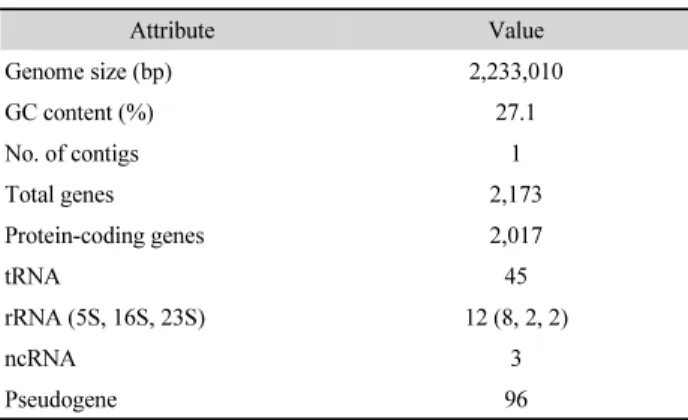
Table 1. Genome features of Fusobacterium nucleatum KCOM 1323
Attribute Value
Genome size (bp) 2,233,010
GC content (%) 27.1
No. of contigs 1
Total genes 2,173
Protein-coding genes 2,017
tRNA 45
rRNA (5S, 16S, 23S) 12 (8, 2, 2)
ncRNA 3
Pseudogene 96
GapCloser (Luo et al., 2012; http://sourceforge.net/projects/
soapdenovo2/files/GapCloser). And we confirmed the scaffolds were placed at gaps on the largest scaffold by dot plot analysis.
Finally, the assembly was polished by iCORN2 (Otto et al., 2010).
Genome annotation was conducted by the NCBI Prokaryotic Genome Annotation Pipeline (PGAP) (https://www.ncbi.nlm.
nih.gov/genome/annotation_prok/).
The complete genome of F. nucleatum KCOM 1323 is 2,233,010 bp in length and has a G + C content of 27.1% (Table 1). A total of 2,017 protein-coding sequences (CDSs), 12 rRNAs, and 45 tRNAs were annotated (Table 1). The genome sequence contained virulence factors such as hemolysin A, hemolysin transporter protein ShlB, butyrate fermentation- related genes, papain family cysteine protease, serine protease, metalloprotease LoiP, zinc metalloprotease, Carbapenem- hydrolyzing beta-lactamase Sme-1, sialic acid-binding periplasmic protein SiaP, sialic acid TRAP transporter permease protein SiaT, multidrug resistance protein MexA/MdtK/MdtC/NorM, Multidrug export protein MepA, putative multidrug export ATP-binding/permease protein, macrolide export ATP-binding/
permease protein MacB, outer membrane porin F, and transport protein TonB. The genome contained phage portal protein, phage tail sheath protein, phage-like element PBSX protein XkdM, phage-related minor tail protein, SPBc2 prophage-derived glycosyltransferase SunS, and oxidative stress-response genes such as, glutathione peroxidase homolog BsaA, nitric oxide reductase NADPH-dependent FMN reductase, light-independent protochlorophyllide reductase subunit B, thioredoxin reductase, nitroreductase A, peptide methionine sulfoxide reductase MsrA/
MsrB, glutaredoxin, and putative oxidoreductase. The complete
genome encodes for involving the biofilm formation, toxin- antitoxin biofilm protein TabA, fibronectin-binding protein A, and autoinducer-2 (AI-2) modifying protein LsrG. It also contained type II secretion system protein D/E/F/G, protein translocase subunit SecA/SecD/SecE/SecY, preprotein translocase subunit YajC, the three two-component systems (PdtaS/PdtaR, YpdA/YpdB, and YehR/putative response regulatory protein), and seven unmatched response regulatory proteins (MgsR, PmpR, TenI, GabR, ZraR, PhlP, and RecX).
The genome also contained the oxidative stress-response genes such as glutathione peroxidase, glutaredoxin, NADH oxidase, and rubrerythrin (confers superoxide dismutase-like activity). The genome contained the four two-component systems and one unmatched sensor histidine kinase. The Fusobacterium nucleatum KCOM 1323 strain was deposited in the Korean Collection for Oral Microbiology.
Nucleotide sequence accession number
This whole genome sequence was deposited in GenBank under accession number CP022122.
적 요
Fusobacterium nucleatum는 그람 음성이면서, 절대 혐기성 및 막대 또는 가는 섬유 모양의 세균이다. F. nucleatum는 사람 의 구강 내 정상세균총의 하나이고, 치주질환의 원인인자이면 서 다양한 전신질환과도 연관성이 있다. F. nucleatum KCOM 1323 (= ChDC F317) 균주가 사람 치주질환 병소의 치은연하 치면세균막에서 분리되었다. F. nucleatum KCOM 1323 균주 유전체 염기서열을 해독하여 보고한다.
Acknowledgements
This research was supported by Basic Science Research
Program through the National Research Foundation of Korea
(NRF) funded by the Ministry of Science and ICT (2017R1A
2B4004894).
Genome sequence of Fusobacterium nucleatum KCOM 1323 ∙ 221
Korean Journal of Microbiology, Vol. 53, No. 3
References