Korean Journal of Microbiology (2019) Vol. 55, No. 1, pp. 64-66 pISSN 0440-2413
DOI https://doi.org/10.7845/kjm.2019.8089 eISSN 2383-9902
Copyright ⓒ 2019, The Microbiological Society of Korea
Complete genome sequence of Cutibacterium acnes KCOM 1315 isolated from a human jaw osteomyelitis lesion
Soon-Nang Park
1†, Jeong-Hwan Park
2†, Yun Kyong Lim
1, Ja Young Shin
3, Hanseong Roh
3, and Joong-Ki Kook
1*
1
Korean Collection for Oral Microbiology and Department of Oral Biochemistry, School of Dentistry, Chosun University, Gwangju 61452, Republic of Korea
2
School of Dentistry, Chosun University, Gwangju 61452, Republic of Korea
3
Macrogen Inc., Seoul 08511, Republic of Korea
사람 악골골수염 병소에서 분리된 Cutibacterium acnes KCOM 1315의 유전체 염기서열 완전 해독
박순낭
1†・ 박정환
2†・ 임윤경
1・ 신자영
3・ 노한성
3・ 국중기
1*
1
조선대학교 치과대학 구강생화학교실 및 한국구강미생물자원은행,
2조선대학교 치과대학 치의학과,
3마크로젠
(Received November 21, 2018; Revised December 19, 2018; Accepted December 20, 2018)
†
These authors contributed equally to this work.
*For correspondence. E-mail: [email protected];
Tel.: +82-62-230-6877; Fax: +82-62-224-3706
Cutibacterium acnes is a member of normal flora of human skin, conjunctiva, intestinal tract, the external auditory canal as well as oral cavity. It has been identified as an opportunistic pathogen related to acne vulagris, endocarditis infections, sarcoidosis, brain abscess, periodontitis, and osteomyelitis of the humerus. C. acnes KCOM 1315 (= ChDC KB81) was isolated from a human jaw osteomyelitis lesion. Here, we present the complete genome sequence of C. acnes KCOM 1315.
Keywords: Cutibacterium acnes, human, jaw osteomyelitis
Cutibacterium acnes is Gram-positive, anaerobic, aerotolerant, diphtheroid, and rod-shaped bacterium. C. acnes is a member of normal flora of human skin, conjunctiva, intestinal tract, the external auditory canal as well as oral cavity (McDowell et al., 2013; Scholz and Kilian, 2016; Aubin et al., 2017). It has been reported that C. acnes was identified as an opportunistic pathogen related to acne vulgaris (Leyden, 2001), endodontic
infections (Niazi et al., 2016), endocarditis (Günthard et al., 1994), sarcoidosis (Zhou et al., 2013), periodontitis (Narita et al., 2016), brain abscess (Zaffiri et al., 2013), and osteomyelitis of the humerus (Sainani et al., 2015). C. acnes KCOM 1315 (=
ChDC KB81) was isolated from a human jaw osteomyelitis lesion. In this report, we present the complete genome sequence of C. acnes KCOM 1315.
The C. acnes KCOM 1315 was grown on tryptic soy agar (TSA; BD Difco Laboratories) supplemented with 5% sheep blood in an anaerobic chamber (Model Bactron I) maintained using a gas mixture of 10% H
2, 5% CO
2, and 85% N
2. The bacterial genomic DNA was prepared as previously described (Cho et al., 2015).
The genomic DNA of C. acnes KCOM 1315 was sequenced using PacBio RSII SMRT sequencing platform using a 20 kb SMRTbell template library and Illumina HiSeq 2500 by Macrogen Inc. Approximately 1,509 Mb (589 ×) with 181,833 filtered subreads (mean subreads length 8,302 bp) were generated and assembled into a single contig by HGAP (version: 3.0, default setting) in PacBio’s SMRT portal (http://www.pacb.com/
products-and-services/analytical-software/smrt-analysis). The
Genome sequence of C. acnes KCOM 1315 ∙ 65
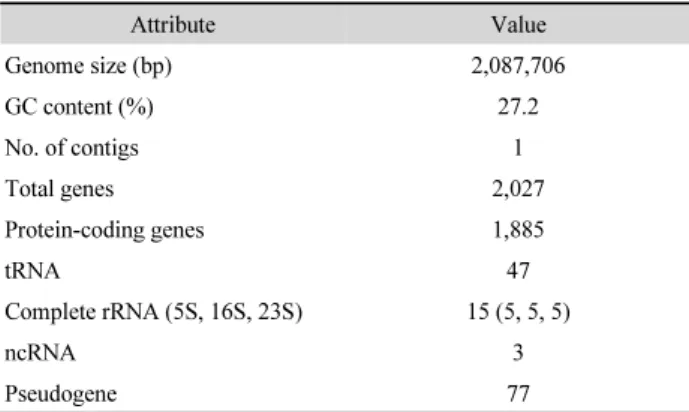
Korean Journal of Microbiology, Vol. 55, No. 1 Table 1. Genome features of Cutibacterium acnes KCOM 1315
Attribute Value
Genome size (bp) 2,087,706
GC content (%) 27.2
No. of contigs 1
Total genes 2,027
Protein-coding genes 1,885
tRNA 47
Complete rRNA (5S, 16S, 23S) 15 (5, 5, 5)
ncRNA 3
Pseudogene 77
Fig. 1. Circular map of genome of Cutibacterium acnes KCOM 1315. Marked characteristics are shown from outside to the center; CDS on forward strand, CDS on reverse strand, tRNA, rRNA, GC content, and GC skew.
initial assembly was polished by Pilon (version: 1.21) with 13,154,086 paired-end reads (518 ×, trimmed by trimmomatic 0.36) from Illumina Hiseq 2500 (https://github.com/broadinstitute/
pilon/wiki) (Walker et al., 2014). The pilon fixed 33 INDELs
and most of errors were A/T insertions or G/C deletions. Genome annotation was conducted by the NCBI Prokaryotic Genome Annotation Pipeline (PGAP) (https://www.ncbi.nlm.nih.gov/
genome/annotation_prok/) (Tatusova et al., 2016).
The complete genome of C. acnes KCOM 1315 was 2,560,301 bp in length and had a G+C content of 60.0%. A total of 2,368 protein-coding sequences (CDSs), 9 rRNAs, and 47 tRNAs were annotated (Table 1 and Fig. 1).
The genome sequence contained antibiotic-resistance-related
genes; macrolide export ATP-binding/permease protein MacB,
multiple antibiotic resistance protein MarR/MdtG, metallo-
beta-lactamase type 2, multidrug resistance protein Stp, putative
multidrug resistance ABC transporter ATP-binding/permease
protein YheI, putative multidrug-efflux transporter, and multidrug
efflux protein YfmO. It contained several protease genes; ATP-
dependent zinc metalloprotease FtsH, tricorn protease, zinc
66 ∙ Park et al.
미생물학회지 제55권 제1호
metalloprotease Rip1, Lon protease, extracellular basic protease, rhomboid protease AarA, putative zinc protease, periplasmic serine endoprotease DegP, serine protease, and protease Hflk.
The genome encoded for involving the biofilm formation, putative glycosyltransferase EpsJ and biofilm regulatory protein A. The genome contained the oxidative stress-response genes such as superoxide dismutase (Mn/Fe), thioredoxin-2, catalase, thioredoxin reductase, and thiol-disulfide oxidoreductase ResA.
The genome also contained the two-component systems (MtrB/
MtrA and VraR/LiaS). Hemolysin C, diphtheria toxin repressor, hemolysin C, antitoxin YqcF, and putative antitoxin VapB12, putative sialic acid transporter and outer membrane porin F were founded in the genome sequence.
The C. acnes KCOM 1315 strain was deposited into the Korean Collection for Oral Microbiology.
Nucleotide sequence accession number
This Whole Genome Shotgun project has been deposited at DDBJ/ENA/GenBank under the accession CP031442. The version described in this paper is version CP031442.1.
적 요
Cutibacterium acnes는 사람의 피부, 결막, 장관, 외이도 및 구강의 정상 세균 총의 하나이다. 이 세균 종은 여드름, 심내막 염 감염, 유육종증, 뇌 농양, 치주염 및 골수염과 관련된 기회감 염성병원균으로 확인되었다. C. acnes KCOM 1315 (= ChDC KB81)는 사람 악골골수염 병소로부터 분리되었다. 여기에서 C. acnes KCOM 1315 균주 완전 유전체 염기서열을 해독하여 보고한다.
Acknowledgements
This research was supported by the National Research Foundation of Korea (NRF) grant funded by the Korea government (MSIT) (No. 2018R1A2B5002239).
References