Janibacter indicus TT2 was isolated from the human ear skin for its ability to degrade t-octylphenol polyethoxylates (Triton X-100). Herein, we report the whole-genome sequence and gene annotations of J. indicus TT2. This strain possessed one circular chromosome comprising 3,663,756 bp, with the G + C content of 71.0%, encoding 3,452 protein-coding genes, two ribosomal RNA operon copies, and forty-nine tRNA genes.
In addition, we found that strain TT2 had dehydratase and hydroxylase genes in its genome that might be responsible for removal of the ethylene oxide units and oxygenation of the t-octylphenol moiety of Triton X-100, respectively.
Keywords: Janibacter indicus, skin bacteria, t-octylphenol polyethoxylates, Triton X-100
The genus Janibacter belongs to phylum Actinobacteria that are Gram-positive bacteria with high G + C contents in their DNA. Currently, the genus Janibacter consists of twelve valid species and other unclassified strains in the NCBI taxonomy database. The type strain J. indicus (CGMCC 1.12511
T= LMG 27493
T) was isolated from the hydrothermal sediment of the Indian Ocean (Zhang et al., 2014). In the database, two genome sequence information of J. indicus is currently available from strains LMG 27493 and YFY001. The latter strain is described
at NCBI BioSample database and has been isolated from a patient from Jiangxi province, China. Furthermore, J. indicus LMG 27493
Tis the only strain characterized and described in the current literature, indicating the ecological roles and the biochemical pathways of this species have not been much explored.
Triton X-100 is a chemical mixture composed of t-octylphenol polyethoxylates. The average number of the ethylene oxide units (-CH
2CH
2-O-) in Triton X-100 is 9.5. Triton X-100 is a nonionic detergent used widely in laboratories for cell lysis or membrane permeabilization. When exposed to environments, some microbial degradation intermediates of Triton X-100 were found to be recalcitrant and have shown endocrine disruptor activities (Nguyen et al., 2016). During the screening of skin bacteria that can catabolize Triton X-100, one strain TT2 was isolated from the skin behind the ear of a male college student by swab sampling and showed degradation of Triton X-100.
The strain TT2 is available from the Korean Collection for Type Cultures (South Korea) as KCTC 49498. This strain was aerobically grown on Luria Bertani (LB) medium at 28°C.
Colony PCR of strain TT2 with the universal 16S rRNA primers, 27F and 1492R (Frank et al., 2008), and nucleotide sequencing showed 100% sequence identities to the type strain, J. indicus LMG 27493
T. Ethical approval for subject sampling was granted
Korean Journal of Microbiology (2020) Vol. 56, No. 4, pp. 413-415 pISSN 0440-2413
DOI https://doi.org/10.7845/kjm.2020.0109 eISSN 2383-9902
Copyright ⓒ 2020, The Microbiological Society of Korea
Complete genome sequence of Janibacter indicus TT2, isolated from the human ear skin
Jargal Jambaldorj , Munkhtsatsral Ganzorig , and Kyoung Lee*
Department of Bio Health Science, Changwon National University, Changwon 51140, Republic of Korea
사람의 귀 피부에서 분리한 Janibacter indicus TT2의 유전체 서열 분석
잠발도르 자르갈 ・ 간조리그 뭉크사츠랄 ・ 이경*
국립창원대학교 생명보건학부
(Received October 29, 2020; Revised November 24, 2020; Accepted November 27, 2020)
*For correspondence. E-mail: [email protected];
Tel.: +82-55-213-3486; Fax: +82-55-213-3480
414 ∙ Jambaldorj et al.
미생물학회지 제56권 제4호
by the Changwon National University ethics committee.
To study the genetic backgrounds for the catabolism of Triton X-100 and skin adaptation by strain TT2, the whole genome sequencing has been carried out. For DNA extraction, cells were cultured in a flask on LB broth overnight at 28°C for 48 h with aeration of 140 rpm. Total genomic DNA was purified using the phenol extraction method (Ausubel et al., 1990). For genomic DNA sequencing, the DNA library was prepared using SMRTbell templates with an insert size of 20 kb as previously described (Lee et al., 2020). The Pacific Biosciences RSII platform was utilized for library sequencing at DNA Link Co.
The raw reads were filtered in single-molecule real-time (SMRT) Portal (version 2.3.0) using RS_Subreads protocol with SFilter v1 parameters. De novo assembly of the genome was carried out using Hierarchical Genome Assembly Process (RS_HGAP3_
Assembly) pipeline with SMRTanalysis 2.3.0 p4 software. The final contigs were generated using pre-assembled 27,097 reads with 265.8 Mbp and 17,613 of N50 value (a minimum size of 1 kb). After assembly, contigs were subjected to a final polishing step to ensure the accuracy of the genome sequence using Pilon v1.23 with default values (Walker et al., 2014). Bioinformatics programs such as NUCmer 3.1 and MUMmer 3.5 (Kurtz et al., 2004) were used to identify overlapped sequences of both ends for manual genome closure. Gene predictions and annotations were provided by NCBI using the NCBI Prokaryotic Genome Annotation Pipeline 4.13 using the best-placed reference protein set (GeneMarkS-2) (Tatusova et al., 2016). The highest BLAST average nucleotide identity (ANIb) value between TT2 and type strains of other bacteria in the NCBI database was sought using the JSpeciesWS server (Richter et al., 2016). The SEED subsystem via the Rapid Annotations using Subsystems Tech- nology (RAST) server was used for the functional categorization of the predicted proteins and comparison of homologous proteins between J. indicus genomes (Aziz et al., 2008). In silico digital DNA-DNA hybridization (dDDH) was used to calculate genome- to-genome distances using the Type (Strain) Genome Server (TYGS) (Meier-Kolthoff and Göker, 2019).
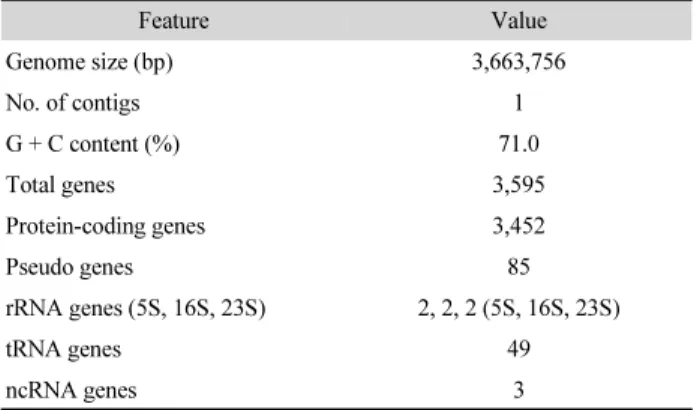
The final genome assembly has an average coverage of 169.0- fold and consists of one circular chromosome of 3,663,756 bp (71.0% G + C content). The chromosome contains 3,452 protein- coding sequences (CDSs), two copies of rRNA genes (5S, 16S, and 23S), and 49 coding regions of tRNAs (Table 1). Strain TT2
shared the highest ANIb value with the type strain J. indicus LMG 27493
T(GenBank accession number GCA_900176385.1), showing 96.47% with a coverage of 80.55%. In addition, the dDDH value between the two genomes was calculated to be 75.7% (formula d
4). The ANIb and dDDH values are above the suggested cutoff points of 95% and 70%, respectively, for the delineation of new bacterial species (Richter et al., 2016). Thus, these results confirmed that strain TT2 belongs to the species of J. indicus but with differences to the type strain LMG 27493
Tat the strain level.
The genome of strain TT2 contained an array of genes coding for catabolism of phenolic compounds initiated by multicom- ponent phenol hydroxylase and extradiol catechol dioxygenase as a proposed pathway in Pseudomonas alkylphenolica KL28 (Jeong et al., 2003). Besides, the strain TT2 possessed genes encoding propanediol dehydratase/reactivase, which are not present in the genomes of the other two strains LMG 27493
Tand YFY001, isolated from different niches. These enzymes catalyze the dehydration of 1,2-propanediol, 1,2-ethanediol and glycerol to the corresponding deoxy aldehydes (Daniel et al., 1998). Further investigation is necessary to determine the involvement of these enzymes for the catabolism of Triton X-100 by J. indicus TT2. The possible involvement of the glyoxylate cycle in the catabolism of the ethoxylate formed by exoscission of Triton X-100 has been proposed in human skin-derived Moraxella osloensis strains (Lim et al., 2018). On the contrary, the related isocitrate lyase (aceA) and malate synthase (glcB) genes were not identified in the genome of TT2 strain. Currently, the biochemical mechanisms on the removal of the ethylene oxide and t-octylphenol moieties of Triton
Table 1. General features of J. indicus TT2
Feature Value
Genome size (bp) 3,663,756
No. of contigs 1
G + C content (%) 71.0
Total genes 3,595
Protein-coding genes 3,452
Pseudo genes 85
rRNA genes (5S, 16S, 23S) 2, 2, 2 (5S, 16S, 23S)
tRNA genes 49
ncRNA genes 3
Genome sequence of Janibacter indicus TT2 ∙ 415
Korean Journal of Microbiology, Vol. 56, No. 4 X-100, a mixture of varying molecular weights, by bacteria
have not been recognized in detail.
Nucleotide sequence accession number
The genome sequence of the J. indicus TT2 strain was deposited in GenBank under the accession number CP062789.
Raw sequencing data have been deposited in the SRA under the accession number SRR12720097.
적 요
Janibacter indicus TT2는 사람의 귀 피부에서 분리되었으 며, t-octylphenol polyethoxylates (Triton X-100)를 분해하는 능력이 있다. 본 연구에서는 J. indicus TT2의 전장 게놈 서열 과 유전자 주석 분석을 수행하였으며, 이 균주는 G + C 함량이 71.0 %인 3,663,756-bp 크기의 원형 염색체를 보유하고 있었 다. 염색체는 3,452개의 단백질 코딩 유전자, 2개의 리보솜 RNA 오페론 및 49개의 tRNA 유전자를 포함하고 있었다. TT2 균주의 유전체는 Triton X-100에 존재하는 ethylene oxide 단 위의 탈수와 페놀기의 산화를 촉매 할 것으로 추정되는 효소 를 암호하고 있는 것을 확인하였다.
Acknowledgments
This research was supported by Changwon National University in 2019~2020.
References