ARTICLE
Received: September 19, 2018 Revised: September 22, 2018 Accepted: September 26, 2018
*Corresponding author : Sejong Oh
Division of Animal Science, Chonnam National University, Gwangju, Korea Tel : +82-62-530-2116
Fax : +82-62-530-2129 E-mail : [email protected]
Copyright © 2018 Korean Society of Milk Science and Biotechnology.
This is an Open Access article distributed under the terms of the Creative Commons Attribution Non-Commercial License (http://
creativecommons.org/ licenses/by-nc/3.0) which permits unrestricted non-commercial use, distribution, and reproduction in any medium, provided the original work is properly cited.
ORCID Bomee Lee 0000-0003-1954-5046 Hae-Chang Yi 0000-0001-7042-2629 Yong-II Moon 0000-0001-5903-2160 Sejong Oh 0000-0002-5870-3038
Kefir 배양용 기능성 복합 Starter 개발
이봄이1․이해창1․문용일2․오세종3
1㈜삼익유가공, 2우석대학교 동물자원식품학과, 3전남대학교 동물자원학부
Development of a Functional Mixed-Starter Culture for Kefir Fermentation
Bomee Lee1, Hae-Chang Yi1, Yong-II Moon2, and Sejong Oh3
1Samik Dairy & Food Co. Ltd., 453 Yeoksam-ro, Seoul, Korea
2Dept. of Animal Source Food, Wooseok University, Wanju, Korea
3Division of Animal Science, Chonnam National University, Gwangju, Korea
Abstract
Kefir, which originates in the Caucasian mountains, is a cultured milk beverage produced by a combination of acidic and alcoholic fermentation. Kefir products are commonly used as food vehicles to deliver health-promoting materials including kefran and lactic acid bacteria to consumers. The aim of this study was to develop a freeze-dried starter culture without yeast and assess the suitability of kefir-like dairy products for the growth of lactic acid bacteria and the acidification of milk.
Pasteurized whole milk (SNF 8.5%) stored at 25℃ was aseptically inoculated with starter cultures (0.002% w/v); it was kept at 25℃ until the pH attained a value of 4.6. Ten grams of the kefir-like product sample was diluted with 90 mL of 0.15% peptone water diluent in a milk dilution bottle, followed by uniform mixing for 1 min. Viable cells of
Lactobacillus
species were enumerated on modified-MRS agar (pH 5.2), with incubation at 37℃ for 48 h. Viable cells ofLactococcus
species were enumerated on M17-lactose agar, with incu- bation at 32℃ for 48 h.The pH attained a value of 4.6 after fermentation for 9 h 30 min (Starter 1), 9 h 45 min (Starter 2), and 12 h (Starter 3). The viable cell count of
Lactobacillus
sp. andLactococcus
sp. was initially 105∼106 CFU/g; it increased significantly to 109 CFU/g after 12 h of incubation. During the storage of the kefir-like products at 4℃ for 1 4 days, the total viable cell numbers were unchanged, but the pH decreased slightly. The consistency of the kefir products increased gradually during the storage. The organoleptic properties of the kefir products fermented using the new starter culture are more desirable than those of commercial kefir. These results suggest that the newly developed starter culture without yeast could be suitable for kefir fermentation.Keywords
kefir, starter culture, probiotics, fermentation
서 론
요구르트와 Kefir는 코카서스 산맥의 Elbrus 산에서 시작되었는데, 남쪽 지역은 요구르트, 북쪽지역
은 Kefir의 탄생지로 알려져 있다(Fig. 1). 여러 종류의 미생물이 적당한 온도의 우유에 옮겨졌고,
인간은 이것을 발견했던 것으로 Elbrus 산의 남쪽 경사면에서는 40∼45℃의 고온을 선호하는 미생
물이 터키 유목민의 우유통에 우연히 전달되어 우유발효가 되었고, 터키인들은 이를 "Yogurut"라고
불렀다. Yogurut는 11세기에 들어와서 현재의 이름인 요구르트(yoghurt)로 바뀌었다(Bylund,
2003). Kefir는 25∼28℃에서 잘 자라는 미생물에 의해 Elbrus 산 북쪽 경사면에서 만들어졌는데,
(A) (B)
Fig. 1. The region where Kefir and Yogurt was first made (Bylund, 2003); A, and a Kefir product in Korea; B.
Kefir라는 이름은 터키 언어에서 파생된 것이다. 이름의 첫 번째 음절인 kef는 터키어로 즐겁다는 것을 의미하는데, Kefir는 yoghurt와 다른 유형의 독특한 미생물을 함유하고 있다. 요구르트와 다르 게 Lactococcus 속 유산균과 CO
2를 생산하는 헤테로발효 유산균 및 효모가 바로 Kefir와 요구르트 와 다른 점이다. 특히, 효모는 알코올을 생성할 수 있기 때문에 Kefir에 존재하는 최대 알코올 함량은 약 0.8% 정도로 알려져 있다.
Kefir grain은 점성이 있는 노란색 혹은 유백색의 비정형 형태이다(Guzel-Seydim 등, 2000). 발효 유 제조에 사용되는 종균(단독 혹은 혼합 유산균)을 통상적으로 스타터로 부르지만, Kefir의 경우에는 Kefir grains으로 부르고 있다. Kefir grain은 효모, lactic acid bacteria, acetic acid bacteria 및 mycelial fungi 등으로 구성되어 있다. 우리나라의 김치가 지역별 사용재료별 다양한 미생물 분 포를 나타나는 것과 같이 Kefir도 지역별, 국가별 각기 다양한 미생물 분포를 보인다. Kefir grain에 서 가장 많은 비율을 차지하는 미생물은 Lactobacillus 속 유산균으로 전체 미생물의 65∼80% 정도 를 보인다(Wouters 등, 2002). 나머지 미생물 분포는 lactococci 와 yeasts 등이 차지하고 있다.
Kefir에서 분리되는 유산균으로는 Lactobacillus acidophilus, Lactobacillus brevis, Lacto- bacillus casei, Lactobacillus fermentum, Lactobacillus helveticus, Lactobacillus kefiri, Lactobacillus parakefiri, Lactococcus lactis 및 Leuconostoc mesenteroides 등을 들 수 있다 (Kandler와 Kunath, 1983; Fujisawa 등, 1988; Pintado 등, 1996; Cogan 등, 1997; Takizawa 등, 1998; Micheli 등, 1999; Assadi 등, 2000; Witthuhn 등, 2004).
Kefir에서 분리되는 효모로는 Kluyveromyces marxianus, Torula kefir, Saccharomyces exiguus 및 Candida lambica가 대표적이다(Kwak 등, 1996; Pintado 등, 1996; Garrote 등, 1997; Wyder와 Puhan, 1997; Wyder 등, 1999; Assadi 등, 2000; Witthuhn 등, 2004; ). 또한, 초산을 생산하는 Acetobacter aceti와 A. rasens, 곰팡이 종류인 Geotrichum candidum 등도 분리되었음이 보고되었다(Pintado 등, 1996).
전통방법으로 생산하는 Kefir는 종균의 안정적 확보 및 각 미생물의 함유량을 제어할 수가 없어
Kefir starter에 함유되는 미생물 종류에 따라 제품의 안정성(stability) 및 안전성(safety)에
많은 영향을 미친다.
국내에서는 티벳 버섯이라는 이름으로 잘못 알려져 있는데, Kefir의 역사적 고찰이나, 다른 문헌에 근거해서도 티벳 버섯이라는 명칭은 그 유래를 찾을 수가 없다. 아마도 일본이나 국내의 광신적인 Kefir 신봉자들이 만든 것으로 추정되는데, 이는 김치를 김치로 부르지 않고 엉뚱한 다른 이름을 지어서 부르는 것과 같은 것으로 참으로 우스꽝스러운 일이 아닐 수 없다.
Kefir의 세계 최대의 소비국으로 러시아는 전체 발효유 중 약 70%를 차지하고 있는데, 요구르트와는 달리 독특한 맛과 건강 효능 때문에 많이 음용하고 있다. 일본에서는 Kefir의 우수한 효능 때문에 최근 학계나 생산업계의 관심이 증대되고 있다. 최근 Kefir가 미국 타임지가 선정한 ‘행복감을 주는 식품’ 중 하나로 국내에 그 소식이 소개되면서 관심이 높아졌는데, 국내에서는 2017년 10월에 매일 유업에서 발효유로 12종의 유산균이 함유되어 12시간 배양하여 제조한 Kefir12 라는 제품을 처음으 로 출시하였다(Fig. 2). 일본의 메이지 유업에서 Kefir Yogurt Drink, Minami Nihon에서 Kefir Yogurt, Kansai Runa에서 Kefir, Ohayo에서 Kefier 등이 발매되었고, 그 외에 Kefir 발효물을 첨가한 Kefir 응용제품이 5∼6종 출시되었다.
본 연구는 효모를 함유하지 않은 유산구균과 유산간균으로 구성된 스타터를 개발하기 위하여 Kefir 배양시 생균수 변화 및 Kefir 제조 특성에 대한 기초자료를 얻고자 수행하였다.
재료 및 방법
1. Kefir의 제조
살균된 우유에 제조된 스타터를 0.02%(w/w)를 접종하여 25℃에서 정치 배양하면서 Kefir를 제조하 였다. 판매 중인 상업용 스타터는 2%를 접종하였다. 배양액의 pH가 4.5에 이르면 배양을 종료시켰으 며, 바로 냉각하여 Kefir를 완성하였다.
2. 유산균수 평가
유산균수의 측정은 pH를 5.2로 조정한 MRS-lactose 배지에 Kefir 시료를 도말하여 37℃에서 48시 간 동안 혐기성 배양기에서 배양한 후 집락을 계수하였다.
Lactococcus 균수의 측정은 M17-lactose 배지에서 30℃에서 24시간 혐기적 조건에서 배양한 후 집락을 평가하였다.
3. Kefir 스타터의 저장중 생균수 변화
제조된 스타터는 산소투과가 거의 없는 알루미늄코팅 비닐에 진공포장하여 저장시료로 사용하였다.
Fig. 2. Developed-starter culture in this study.
제조된 스타터는 —20℃와 5℃에서 각각 저장한 다음 12주 동안 저장하면서 생균수를 평가하였다.
4. pH 및 적정 산도의 측정
pH는 pH meter(FEP20; Mettler Toledo; Greifensee, Switzerland)를 사용하여 측정하였으며, 적정산도는 시료 9 g을 적정하는데 소요되는 0.1N NaOH의 mL 수로 환산하였다.
결과 및 고찰
1. Kefir Starter의 저장 안정성 평가
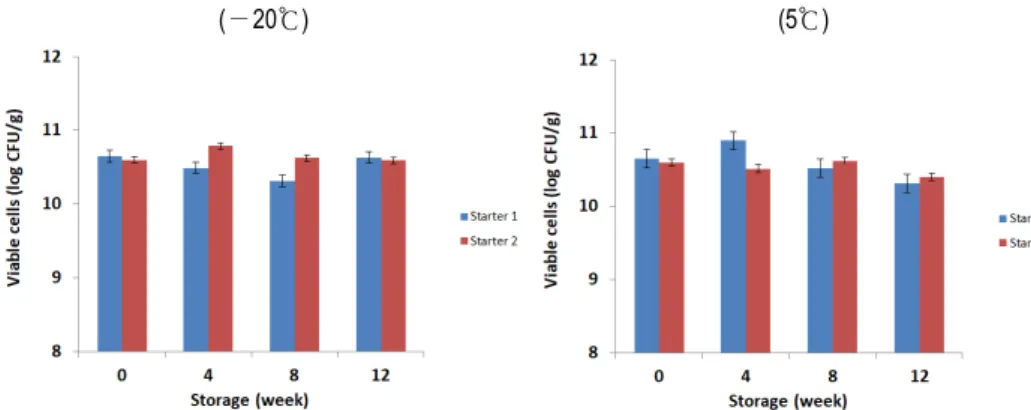
제조된 스타터(Fig. 2)를 —20℃와 5℃에서 각각 저장하면서 생균수를 평가한 결과는 Fig. 3에서 보는 바와 같다. 냉동보관의 경우, 스타터 초기 균수의 10
10CFU/g를 4개월간 유지하는 것으로 나타 났으며, 냉장 보관의 경우 2∼6×10
10CFU/g의 생균수를 유지하는 것으로 나타났다.
Yeast가 첨가되지 않아 original Kefir 논란이 있지만, yeast는 다른 우유제품과 발효유 제품에서 제품 변질(탄산가스에 의한 용기 팽창)의 주된 원인 미생물로 공정상 반드시 제어되어야 한다. 따라서 본 개발 starter에는 타 유제품에 영향을 줄 수 있는 yeast를 첨가하지 않고, 유산구균과 유산간균 만으로 조성을 완성하였다. Table 1은 본 연구에서 개발한 Kefir starter의 specification을 나타낸 것이다. 개발 starter는 유산균 12 species를 함유하며, L. acidophilus의 경우 2종이 함유되어 있 어 실제적으로 총 13종류로 구성되었다. 본 연구에서는 동일 유산균주들을 사용하여 각 유산균 혼합 비율을 다르게 하여 Starter 1, 2, 및 3을 완성하였다.
2. Kefir 제품의 배양중 특성
제조 후 총 생균수는 스타터 의 경우 4.5×10
10CFU/g이었으며, 장기간동안 다소간의 증감이 있었으 나, 이것은 측정오차로 파악되었다. 냉동저장 12주 후 4.3×10
10CFU/g, 냉장 저장 12주 후에는 2.1×10
10CFU/g로 나타났다.
본 연구에서 완성한 스타터 2의 경우에는 제조 직후 생균수는 3.97×10
10CFU/g이었으며, 냉동저장 12주 후 3.89×10
10CFU/g, 냉장 저장 12주 후에는 2.52×10
10CFU/g로 초기균수를 유지하는 것으로 나타났다.
3. Kefir의 제조
살균된 우유에 제조된 스타터를 0.02%(w/w)를 접종하여 25℃에서 정치 배양한 결과, pH에 4.5에
(—20℃) (5℃)
Fig. 3. Changes of viable cells of Kefir starter during storage.
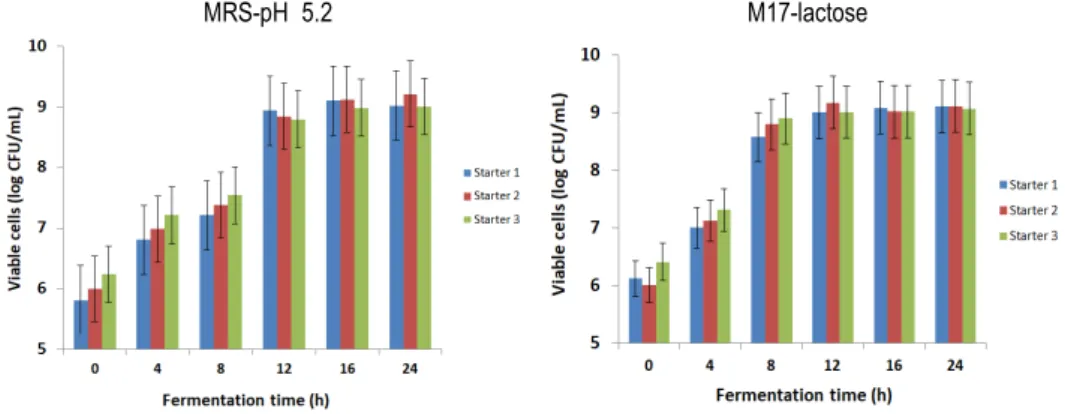
도달하는 시간은 스타터 1의 경우 9시간 30분, 스타터 2의 경우 9시간 45분이 걸렸다. 그러나 판매 중인 상업용 스타터는 12시간이 소요되었다. Kefir를 배양하면서 생균수를 평가한 결과는 Fig. 4 에 보는 바와 같다. 0.02%(w/w) 접종시 초기 생균수는 약 10
5∼10
6CFU/mL 정도로 나타났다.
Lactobacillus의 총균수는 배양 12시간이 지나야 약 10
8∼10
9CFU/mL에 이르렀으며, Lacto- coccus 속 유산균의 생균수는 배양 8시간에 약 10
8∼10
9CFU/mL에 도달하는 것으로 확인되었다.
따라서 Kefir 제품의 생산을 위한 적정 배양시간은 8시간 정도로 생각되었다.
4. Kefir 배양 중 pH의 변화
발효유의 경우, 기호성이 가장 좋은 pH는 당류를 첨가하지 않은 경우 pH 4.5∼4.8 정도이고, 당류를 첨가하는 경우 pH 4.2∼4.3 정도이다. Fig. 5에서 나타난 바와 같이, 배양 4시간에 pH 5.1∼5 정도 로 저하되었으며, 배양 12시간에는 pH 4.3∼4.2 정도까지 저하되었다. 스타터 1과 스타터 2는 Kefir 배양 8시간에 pH 4.7 정도로 나타나, 적정배양시간은 8∼9시간 정도로 생각되었다.
그러나 산업적 생산시에는 배양탱크에서 이송하는 시간이 있으므로 배양 8시간 이내에 배양을 종료 하는 것이 적절한 것으로 생각된다.
요구르트의 경우, Streptococcus thermophilus와 Lactobacillus delbrueckii ssp. bulgaricus의 Table 1. The sheet of Kefir starter specification
Product characteristics Specifications
Description
․ Powder appearing off-white to light brown in color and composed of lyophilized lactic acid bacteria standardized with food grade carbohydrate carriers.
․ Blend of selected strains for the manufacture of Kefir Composition
․ Bifidobacterium longum, Lactobacillus casei, Lactobacillus plantarum, Lactobacillus acidophilus, Lactobacillus bulgaricus, Lactobacillus fermentum, Lactobacillus reuteri, Streptococcus thermophilus, Lactococcus lactis ssp. lactis, Lactococcus lactis ssp. cremoris, Lactococcus lactis ssp. lactis biovar diacethylactis, L. acidophilus KCNU, L. brevis BMB6, lactose, and maltodextrin
Manufacturing methods
․ Individual cultures are grown in sterilized media under specific conditions, then concentrated, lyophilized, and standardized.
․ Final powder product is tested and aseptically packaged into sealed containers.
Recommended dosage ․ 100 units of starter culture to treat 2,000 L of milk.
Directions
․ Milk used must be free of residual antibiotics.
․ Sanitize hands and outside of bottle prior to inoculation or rehydration.
․ Directly inoculate vat when bottom is completely covered with milk and agitator is on.
․ If inoculating a full vat, culture must be rehydrated in a separate, sanitized container of warm milk for 20 minutes.
Activity
․ Activity is measured by acid development.
․ Acidification time to reach a TA>0.45 in rehydrated skim milk powder and glucose medium with 0.0037%
inoculation and 10% NFMS at 32℃ is less than 8 hours.
Microbiological specifications
Lactic acid bacteria > 1x10¹⁰ CFU/g
Yeasts/molds <10 /g
Coliforms (<10 /g) Negative by test
Listeria (25 g) Negative by test
Salmonella (40 g) Negative by test Staph. aureus (<1 /g) Negative by test Packaging
․ Sealed in polyethylene plastic bottles.
․ Standard size: 100 U (2,000 L).
․ Custom packaging is available upon request.
Product storage
․ 18 months shelf life is expected when stored below —20℃.
․ 4 months shelf life is expected when stored at 4℃.
․ Transportation with dry ice is recommended to maintain temperature below —5℃.
MRS-pH 5.2 M17-lactose