• 검색 결과가 없습니다.

Effectiveness and Safety of Korean Medicine for Trigeminal Neuralgia: A Case Report

N/A
N/A
Protected

Academic year: 2021

Share "Effectiveness and Safety of Korean Medicine for Trigeminal Neuralgia: A Case Report"

Copied!
8
0
0

로드 중.... (전체 텍스트 보기)

전체 글

(1)

Effectiveness and Safety of Korean Medicine for Trigeminal Neuralgia: A Case Report

Ji Min Bae

1

, Dae Hun Kim

1

, Byung Ryul Lee

2

and Gi Young Yang

2,*

1

Department of Acupuncture & Moxibustion, Pusan National University Korean Medicine Hospital

2

Department of Clinical Medicine, Pusan National University School of Korean Medicine

[Abstract]

Objectives : ThisstudyaimstoreporttheeffectivenessandsafetyofKoreanmedicinewith threadembeddingacupunctureinthetreatmentoftrigeminalneuralgia(TN).

Methods : A73-year-oldmanwhohadsufferedfromseverefacialpainforoneyearandwho hadhadahealthytoothextractedduetothepainisreported.Hecouldnoteatorsleepdue totheseverepain.Acupuncture,threadembeddingacupuncture,cupping,herbalsteam,and herbalmedicineswereusedforthetreatment.NumericRatingScale(NRS)andadverseevents werecheckeddaily,andotheroutcomes(BaselineEvaluation,VisualAnalogueScale[VAS], ShortFormHealthSurvey36-BodilyPain[SF-36BP],andPatientGlobalAssessment[PGA]) weremeasuredathospitaladmissionanddischarge.Duringthefollow-upexaminations,his painwasevaluatedroughly,withoutusinganyformalmeasurements,onthebasisofaglobal assessment.

Results : Allmeasuredparameters,includingpain,qualityoflife,andpatientsatisfactionwere notedtohaveimprovedatthetimeofdischargecomparedtoadmission:VASfrom10to1.5, NRSfrom7–8to1–2,andSF-36BPfrom0to22.5,andthepatient’sglobalassessmentwas somewhatimproved.Hedidnottakeanyanalgesicsafterdischargeandnotedonlymildad- verseevents,likepainwheretheacupunctureandthreadembeddingacupunctureneedles wereinserted.Hispainreliefwasmaintainedfor6months.

Conclusion : Koreanmedicinewiththreadembeddingacupuncturemightbeasafeandeffective treatmentforTN.Inthefuture,largersamplesizesandhighqualityrandomizedclinicaltrials arewarrantedtoconfirmitsefficacyandsafety.

※ ThisworkwassupportedbyclinicalresearchgrantfromPusanNationalUniversityHospitalin 2016.

✱ Correspondingauthor:20Geumo-ro,Mulgeum-eup,Yangsan,Gyeongnam50612,Republicof Korea

Tel:+82-55-360-5963 E-mail:[email protected] Key words :

Koreanmedicine;

ThreadEmbedding acupuncture;

Trigeminalneuralgia

Received : 2017. 01. 24.

Revised : 2017. 02. 02.

Accepted : 2017. 02. 03.

On-line : 2017. 02. 20.

ThisisanOpen-AccessarticledistributedunderthetermsoftheCreativeCommonsAttributionNon-CommercialLicense(http://creativecommons.org/licenses/by- nc/3.0)whichpermitsunrestrictednon-commercialuse,distribution,andreproductioninanymedium,providedtheoriginalworkisproperlycited.

TheAcupuncture istheJournalofKoreanAcupuncture&MoxibustionMedicineSociety.(http://www.TheAcupuncture.org)

Copyright2017KAMMS.KoreanAcupuncture&MoxibustionMedicineSociety.Allrightsreserved.

(2)

Ⅰ. Introduction

Trigeminal neuralgia (TN) is characterized by re- current unilateral brief electric shock-like pains.

It is limited to one or more divisions of the trigem- inal nerve and is triggered by innocuous stimuli

1)

.

The annual incidence rate of TN is 4 to 13 per 100,000 and this condition gradually becomes more common with increasing age; most cases present after the age of 50 years

2,3)

. Almost all (80~90%) cases are caused by vascular compression of the trigeminal nerve at its entry into the pons. Other causes include meningioma, epidermoid and other cysts, saccular aneurysms, and arteriovenous malformations

2,4,5)

.

The diagnosis of TN is based on its characteristic clinical features (primarily paroxysms of pain in the trigeminal nerve), but it is difficult to distin- guish from dental pain. Classic TN pain is inter- mittent and sharp, whereas dental pain is continuous and dull.

Carbamazepine is considered the gold standard for the initial medical treatment of TN

6)

. Several other drugs have shown some evidence of effec- tiveness as well, including oxcarbazepine, baclofen, lamotrigine, and pimozide

7)

. If patients are not re- sponsive to these medical therapies, surgery can be considered. Surgical treatments can be divided into 2 categories: ablative procedures that include microvascular decompression and non-ablative procedures that include radiofrequency thermoco- agulation, chemical (glycerol) injections, balloon compression, stereotactic radiosurgery, and pe- ripheral neurectomy and nerve blocking

7)

.

Acupuncture trials for TN were retrieved from 5 Korean web databases, the Research Information Sharing Service (RISS), Korean studies Information Service System (KISS), Oriental Medi- cine Advanced Searching Integrated System (OASIS), Korea Institute of Science and Technology Information (KISTI), and National Dig- ital Science Library (NDSL). We found no studies similar to ours, which used thread embedding

acupuncture. Here, we report this approach using the data from the medical records of Pusan National University (Korean Medicine Hospital).

Ⅱ. Case study

1.Patient

Lee O.O., 73 years

2.Symptoms

1) The chief complaint was pain over the left lower face.

2) Other symptoms were insomnia and anorexia (secondary to pain)

3.Onset

May 2014

4.Patient’s Past Medical History

1) Cerebral infarction in 2012 for which he un- derwent a vascular surgery; he has been on medication since then.

2) Dementia diagnosed in 2014; he has been on medication since then.

3) Periodontitis was diagnosed in 2010 at the Pusan National University (Dental Hospital);

thereafter, he was on medication for 6 to 7 months.

5.Family History

None

(3)

6.Present Medication

NEUROCEPT 5 mg (Donepezil hydrochloride), 1 Tablet hora somni (nootropic and neuro- tonic)

ALBIS 300 mg, 1 Tablet (Sucralfate hydrate, potassium bismuth citrate and ranitidine hy- drochloride) quaque die (other antiulcerant) BONALING-A 50 mg, 1 Tablet (Dimenhydri- nate) quaque die (antiemetic)

CRESTOR 10 mg, 1 Tablet (Rosuvastatin cal- cium) quaque die (antilipidemic agent) NEUROMED 800 mg, 1 Tablet (Oxiracetam) quaque die (nootropics and neurotonics) PLAVITOR 97.875 mg, 1 Tablet (Clopidogrel hydrogen sulfate) quaque die (antithrombotic antiplatelet agent)

PLETAAL 50 mg, 1 Tablet (Cilostazol) quaque die (antithrombotic antiplatelet agent)

7.Present History

1) May 2014: The patient experienced idiopathic pain over the left lower face. He went to a local hospital and was diagnosed with TN. De- spite taking medication prescribed, the pain was not relieved.

2) July–August 2014: After making a rough guess that the pain might be due to a dental problem, he got his tooth extracted at a dental hospital to get relief from the pain;

however, there was no improvement.

3) December 2014: The patient visited the Pusan National University (Dental Hospital), but was unable to understand the reason for his pain and diagnosis.

4) May 2015: The patient visited the Pusan Na- tional University (Korean Medicine Hospital) for the treatment of his facial pain.

8.Examination 1)Baselineevaluation

The patient was asked to grade his pain intensity at presentation as severe, moderate, mild, or none.

His self-evaluated pain intensity at admission was moderate.

2)ShortFormHealthSurvey36-Bodily Pain(SF-36BP)

The SF-36 BP measures the state of bodily pain and disability over the past 4 weeks. It consists of 2 sections, and each scale is transformed into a 0–

100 scale. The mean of the 2 values indicates the patient’s degree of discomfort. (A higher score in- dicates a lower level of disability). Physical function and bodily pain are graded using this quality of life questionnaire.

3)VisualAnalogueScale(VAS)

The VAS is a graphically represented continuous scale that is 10 cm in length. Pain intensity grading ranges from 0 (no pain) to 10 (the worst pain imag- inable), and the patients mark a point on the line that represents their perceived pain. The VAS is determined by measuring it from the starting point of 0 to the marked point. Upon admission, the pa- tient-reported VAS was 10.

4)NumericRatingScale(NRS)

Using the NRS, the patient-reported pain is ver- bally assessed by using a scale ranging from 0 to 10 (0 = no pain, 10 = the worst pain imaginable). As it is more convenient for evaluating the pain intensity compared to the VAS, we evaluated the patient using the NRS scale daily. On hospitaliza- tion, his NRS was 7–8.

9.Intervention

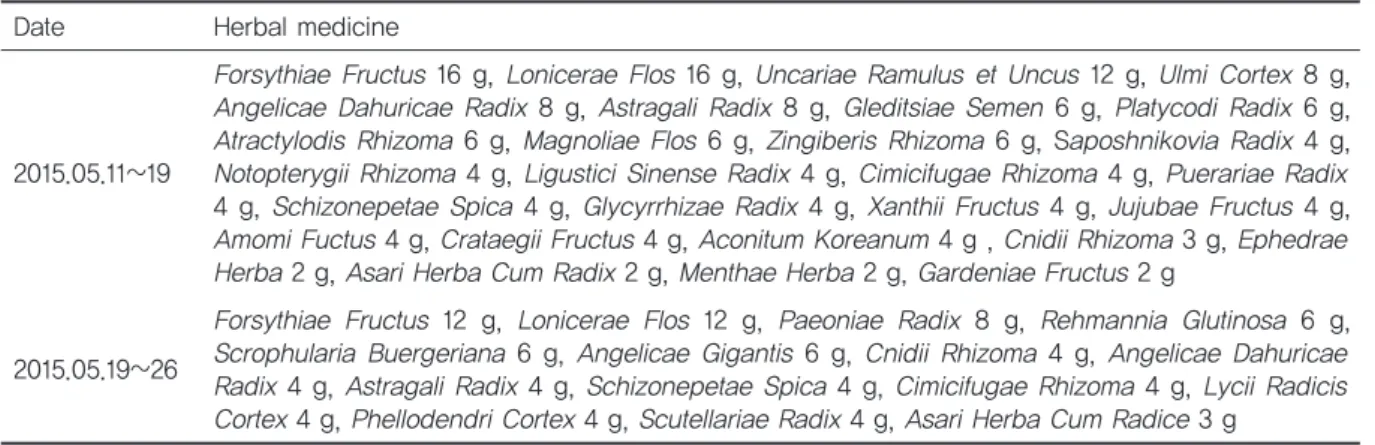
1) Acupuncture (Table 1) 2) Herbal Medicine (Table 2)

2015.05.11~19 ‘Gagamwiryeongtang’ was pre-

(4)

Table 1. StandardsforReportingInterventioninClinicalTrialsofAcupuncture(STRICTA) 1. Acupuncture rationale

1a) Style of acupuncture Classic acupuncture theory and Master Dong’s acupuncture theory 1b) Reasoning for treatment provided Based on historical context and literature sources (e.g., The

Textbook of Acupuncture and Moxibustion Medicine)

1c) Extent to which treatment was varied Semi-fixed formula; individualized acupuncture regimen according to the patient’s symptoms and conditions

2. Details of needling

2a) Number of needle insertions per subject per session

10 ~ 15 points; practitioner adjusted the number of needle insertions according to patient’s symptoms and conditions

2b) Names of points: ST4, ST6, TE17, LI2, LI3, LI4, LR3, LR2, and Ashi-point 2c) Depth of insertion 30 ~ 90 mm (according to the expected tissue depth on

acupuncture points) 2d) Response sought Subjective De-qi sensation

2e) Needle stimulation Manual stimulation of rotation, lifting and thrusting 2f) Needle retention time 0 ~ 20 minutes

2g) Needle type Dong-bang stainless steel disposable acupuncture needle 0.40 × 60 mm, 4090 mm, 40 x 135 mm, 50×60 mm, 3. Treatment regimen

3a) Number of treatment sessions 31 3b) Frequency and duration of treatment

sessions Twice daily until discharge (excluding the admission day) 4. Other components of treatment

4a) Details of other interventions

administered to the acupuncture group Dry-cupping, herbal steam therapy on face, herbal decoction, and thread embedding acupuncture

5. Practitioner background 5a) Description of participating

acupuncturists Two Korean medicine doctors.

1) Resident trainee in acupuncture and moxibustion medicine with 3 years of experience

2) Specialist of acupuncture and moxibustion medicine with more than 10 years of experience

6. Control or comparator interventions No control intervention

Table 2. HerbalMedicineTreatment

Date Herbal medicine

2015.05.11~19

Forsythiae Fructus 16 g, Lonicerae Flos 16 g, Uncariae Ramulus et Uncus 12 g, Ulmi Cortex 8 g, Angelicae Dahuricae Radix 8 g, Astragali Radix 8 g, Gleditsiae Semen 6 g, Platycodi Radix 6 g, Atractylodis Rhizoma 6 g, Magnoliae Flos 6 g, Zingiberis Rhizoma 6 g, Saposhnikovia Radix 4 g, Notopterygii Rhizoma 4 g, Ligustici Sinense Radix 4 g, Cimicifugae Rhizoma 4 g, Puerariae Radix 4 g, Schizonepetae Spica 4 g, Glycyrrhizae Radix 4 g, Xanthii Fructus 4 g, Jujubae Fructus 4 g, Amomi Fuctus 4 g, Crataegii Fructus 4 g, Aconitum Koreanum 4 g , Cnidii Rhizoma 3 g, Ephedrae Herba 2 g, Asari Herba Cum Radix 2 g, Menthae Herba 2 g, Gardeniae Fructus 2 g

2015.05.19~26

Forsythiae Fructus 12 g, Lonicerae Flos 12 g, Paeoniae Radix 8 g, Rehmannia Glutinosa 6 g,

Scrophularia Buergeriana 6 g, Angelicae Gigantis 6 g, Cnidii Rhizoma 4 g, Angelicae Dahuricae

Radix 4 g, Astragali Radix 4 g, Schizonepetae Spica 4 g, Cimicifugae Rhizoma 4 g, Lycii Radicis

Cortex 4 g, Phellodendri Cortex 4 g, Scutellariae Radix 4 g, Asari Herba Cum Radice 3 g

(5)

scribed 3 times a day, 2 hours after meal.

2015.05.19~26 ‘Chieunyangbang’ was pre- scribed 3 times a day, 2 hours after meal.

Additionally, sometimes, he was administered

‘Uhwang cheongsimwon’ to relieve the pain.

3) Herbal Steam: Steam was applied to the face for 20 minutes twice daily. The steam con- sisted of Agastachis herba, Artemisiae Vul- garidis Folium, and Menthae Herba.

4) Cupping: Ten cups were placed on the upper back for 5 minutes, 1 or 2 times per day, for 7 days. This was repeated a total of 10 times.

5) Thread embedding Acupuncture

August 26, September 16, and December 30, 2014: We performed thread embedding acupuncture 3 times, (29 G × 25 mm), and 10 thread embedding acupunctures were per- formed each time. Three thread embedding acupuncture needles were inserted in the frontal region, 3 in the zygomatic region, and 4 in the corner of his lip.

10.Treatment Period

May 11~26, 2015: Inpatient treatment May 27, 2015~January 13, 2016: Outpatient follow up treatment

11.Results (Table 3)

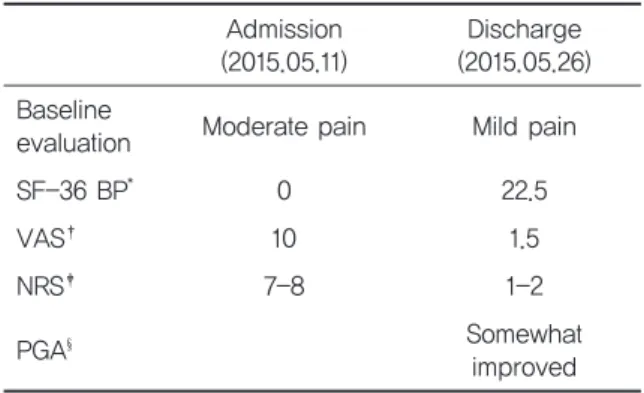
We assessed the patient’s NRS and adverse events daily, and other outcomes were measured at admission and discharge. His daily NRS showed fluctuations, but was never worse than at the time of hospitalization. After 15 days of treatment, all outcomes were better than at the initial admission.

1) Baseline Evaluation 2) SF-36 BP

3) VAS 4) NRS (Fig. 1)

5) Patient Global Assessment (PGA)

The patient’s assessment of recovery after

treatment was evaluated at discharge. Re- sponse options included very much improved, somewhat improved, no change, somewhat worsened, and very much worsened. His re- sponse was “somewhat improved”, and he had experienced a pain reduction of 70–80% as a result of the treatment.

6) Adverse Events

There were some adverse events, such as bleeding, pain, and bruising where the acupuncture or thread embedding acupunc- ture needles were inserted, but these were mild and transient events.

Table 3. ChangesinOutcomesafterTreatment Admission

(2015.05.11) Discharge (2015.05.26) Baseline

evaluation Moderate pain Mild pain

SF-36 BP

*

0 22.5

VAS

10 1.5

NRS

7-8 1-2

PGA

§

Somewhat

improved

*: Short Form Health Survey 36-Bodily Pain.

†: Visual Analogue Scale.

‡: Numeric Rating Scale.

§: Patient Global Assessment.

Fig.1.DailyNRSEvaluation

* If patient reported his pain intensity as 7-8, it is regarded as

7.5 in this graph.

(6)

7) Follow Up

From May 27, 2015 through January 13, 2016, the patient continued to receive treatment (for a period of 35 weeks). He was adminis- tered weekly treatment; thus, he had a total of 35 sessions. Thread embedding acupuncture was performed 3 times in all, on August 26, September 16, and November 30, 2015. The patient reported that he was almost pain-free from October 17, 2015.

Ⅲ. Discussion

In the past six years, the number of patients vis- iting hospitals in Korea has exceeded 42,000 annu- ally, and medical care benefit costs had increased to 5.5 billion won in 2015

8)

. There is a growing need for appropriate treatment.

The prognosis of TN is variable because it is the intensity of pain that causes patients to seek treat- ment. Recurrence is common, and a single episode of pain may vary from 1 day to 4 years. Severe pain reduces a patient’s quality of life.

Carbamazepine is the first-line treatment for classical TN. Based on 2 placebo-controlled studies that evaluated the use of carbamazepine in TN, a Cochrane systematic review concluded that carba- mazepine is probably effective in some people with chronic neuropathic pain, including TN. However, in 4 studies, 65% (113/173) participants experienced at least 1 adverse event in the carbamazepine group, compared to only 27% (47/173) in the placebo group

6)

. The adverse events included giddi- ness, unsteadiness, drowsiness, dizziness, blood dyscrasias, cutaneous problems, interference with other drugs, impaired mental and motor function in older people, skin rash, renal dysfunction, in- crease in liver transaminases, hyponatremia, ataxia, nausea, and cardiac arrhythmia

9)

.

A Cochrane systematic review reported that all neurosurgical interventions produced variable

pain relief, but their efficacy could not be confirmed because of the poor quality of the 11 in- cluded trials. Further, many of them resulted in several adverse events, including paresthesia or reduced sensation, reduced corneal reflexes, corneal keratitis, masseter dysfunction, cere- brospinal fluid leak, a transient rise in blood pres- sure and others

10)

.

Concerning non-antiepileptic drugs, only low quality evidence is available regarding their efficacy in the treatment of TN, and there are sev- eral side effects. For example, 83.3% of pimozide users experienced at least 1 adverse event, such as physical and mental impairment, hand tremors, memory impairment, involuntary movements dur- ing sleep, and slight manifestations of Parkinson’s disease.

There were no studies on microvascular decom- pression; observational data suggested that this treatment modality provided the longest-lasting pain relief.

There is little evidence to help aid comparative decision-making efforts regarding the best surgical procedure for treating TN. Well-designed studies are urgently needed to facilitate the same.

Acupuncture is broadly used for the relief of low back pain, neck pain, knee pain, headaches, and so on. The mechanism of analgesia is unclear, but it is assumed that it 1) harmonizes energy flow (Qi) and stimulates the body’s natural healing mecha- nisms;

11)

2) allows for a variable combination of local effects; 3) induces the release of β-endorphins, endomorphins, and enkephalin, and brings about heightened levels of serotonin and dopamine in the blood and brain;

12)

4) releases immune-modulators to induce the release of adrenaline and nor-adren- aline; and 5) promotes pain sensory inhibition at the spinal cord level.

Thread embedding acupuncture is a technique

that provides longer stimulation to the acupoints

than standard acupuncture. It acts as a foreign

substance in the body that causes mechanical and

biochemical effects, and results in aseptic inflam-

mation. Persistent stimulation from the embedded

(7)

acupuncture boosts the body’s self-defense mech- anisms and helps it become self-sustaining. It is known to be effective in the treatment of various chronic pains and functional diseases and has re- cently found application in facial palsy treatment, plastic surgery, obesity treatments, and a muscu- loskeletal disease treatment

11)

.

In Korean medicine, we treat TN by addressing acupoints such as Hagwan (ST7), Hapgok (LI4), Chanjuk (BL2), Hyeopgeo (ST6), Taeyang (EX- HN15), and Sabaek (ST2). In particular, the third branch of trigeminal nerve pain is treated with Hyeopgeo (ST6), Hagwan (ST7), Daeyeong (ST5), and Seungjang (CV24)

13)

.

A systematic review of acupuncture for TN sug- gested that it has an efficacy rate similar to that of carbamazepine, but with fewer adverse events;

however, these results should be interpreted cau- tiously because the methodological quality of the reviewed studies were low

14)

. Further, chuna com- bined with acupuncture has shown favorable re- sults for TN compared to carbamazepine in a systematic review conducted in 2016, but this re- view also included studies with a high risk of bias.

This study has the following limitations:

1) Only 1 case, a retrospective one, was consid- ered; hence, the findings cannot be general- ized.

2) We have an incomplete outcome assessment;

we measured the patient’s outcomes using VAS, NRS, SF-36 BP, and PGA, but the pain frequency and duration should also have been measured. Further, in this study, the patient’s 24-hour mean pain intensity was measured using VAS, although the maximum pain, 24-hour mean pain, and minimum pain could have been measured separately. A Cochrane review considered complete pain re- lief without medication one year after ran- domization and pain intensity reduction of 30%, 50%, or greater as the primary outcomes.

3) The outcome was incomplete. At follow-up, no outcome measurements were used.

4) Several interventions were performed:

acupuncture, cupping, herbal steam, herbal medicine, and thread embedding acupuncture were used. For this reason, it is unclear as to which intervention was the most effective.

Despite the above limitations, this case report also has several strengths:

1) We saw a rapid treatment effect; the patient had been suffering from severe pain for 1 year and had lost both his appetite and ability to sleep due to the pain. He even got his tooth extracted due to the pain, but experienced no relief. After one session of Korean medicine treatment, his pain intensity reduced by 50%, and his sleeping time increased from 2–3 hours to 6 hours. After 14 days of treatment, his pain, based on VAS, decreased from 10 to 1.5, with minimal adverse events like pain at the sites of acupuncture needle insertion. He has not taken any analgesics after being dis- charged.

2) Long-term follow-up was performed. The patient’s hospitalization was for 15 days, but we continued his treatment and observation for 8 months. His pain intensity and adverse events were checked at every visit. During his treatment, pain levels were fluctuating.

Sometimes his pain increased for no reason, or due to the cold, but the pain intensity was the worst when he first checked into the hos- pital. Sometimes after getting discharged, he even felt no pain.

3) The report about thread embedding acupunc- ture for the treatment of TN is the first of its kind in Korea. There have been several reports about Korean medicine and TN, but none of them focused on thread embedding acupuncture. We used thread embedding acupuncture for this patient’s treatment and found it to be effective and safe; hence, we decided to report it.

Based on these results, we can suggest that Ko-

rean medicine with thread embedding acupuncture

(8)

may be an effective and safe treatment modality for TN; however, this is just a case report. A ran- domized controlled trial is the gold standard for evaluating an intervention’s true efficacy. There is no evidence to assess the effectiveness and safety of Korean medicine, and no evidence of its true economic costs. In the future, larger sample sizes and high quality randomized clinical trials are needed to confirm the effectiveness and safety of Korean medicine for TN. Future studies should re- port their methods in detail and use clear inclusion criteria, allocation concealment, randomization, double-blinded assessments, and adequate out- come measurements.

Ⅳ. References

1. Societ Headache Classification Committee of the International Headache. The International Classification of Headache Disorders, 3rd edi- tion (beta version). Cephalalgia. 2013;33(9):

629-808.

2. Katusic S., Williams D. B., Beard C. M., Bergstralh E. J., Kurland L. T. Epidemiology and clinical features of idiopathic trigeminal neuralgia and glossopharyngeal neuralgia:

similarities and differences, Rochester, Min- nesota, 1945-1984. Neuroepidemiology 1991;

10(5-6):276-81.

3. MacDonald B. K., Cockerell O. C., Sander J. W., Shorvon S. D. The incidence and lifetime prevalence of neurological disorders in a prospective community-based study in the UK.

Brain. 2000;123(Pt 4):665-76.

4. Bowsher D. Trigeminal neuralgia: an anatomi- cally oriented review. Clin Anat. 1997;10(6):

409-15.

5. Hamlyn P. J. Neurovascular relationships in the posterior cranial fossa, with special refer- ence to trigeminal neuralgia. 2. Neurovascular compression of the trigeminal nerve in cadav- eric controls and patients with trigeminal neu- ralgia: quantification and influence of method.

Clin Anat. 1997;10(6):380-8.

6. Wiffen P. J., Derry S., Moore R. A., Kalso E. A.

Carbamazepine for chronic neuropathic pain and fibromyalgia in adults. Cochrane Database Syst Rev. 2014;(4):CD005451.

7. Zakrzewska J. M., Linskey M. E. Trigeminal neuralgia. BMJ Clin Evid. 2014;10:1207.

8. Healthcare Bigdata Hub. Morbidity statistics 2010-2015[Internet]. Geneva: Sevice Health Insurance Review ans Assessment.; c2000- 2017. [cited 2016 December 30]. available from:

http://opendata.hira.or.kr

9. Oomens M. A., Forouzanfar T. Pharmaceutical Management of Trigeminal Neuralgia in the Elderly. Drugs Aging. 2015;32(9):717-26.

10. Zakrzewska J. M., Akram H. Neurosurgical in- terventions for the treatment of classical trigeminal neuralgia. Cochrane Database Syst Rev. 2011;(9):CD007312.

11. Society Korean Acupuncture and Moxibustion Medicine. Acupuncture Medicine. Seoul:

Hanmi Medical Science. 2016:15-7,181-4.

12. Han J. S. Acupuncture and endorphins. Neu- rosci Lett. 2004;361(1-3):258-61.

13. Lyu ES, Lee H, Lee BR. The Literature Study on Medical treatments with acupuncture for

“ Trigeminal neuralgia”. J Daejeon Oriental Med. 2001;10(1):259-68.

14. Liu H., Li H., Xu M., Chung K. F., Zhang S. P.

A systematic review on acupuncture for trigeminal neuralgia. Altern Ther Health Med.

2010;16(6):30-5.

수치

Table 2. HerbalMedicineTreatment
Table 3. ChangesinOutcomesafterTreatment Admission

참조

관련 문서

③ → He thinks that his parents still treat him like a child and want to know everything about him.. ④ → He wants to say to his parents

A high school teacher wanted to develop a test in order to assess his students’ English reading ability. He developed the test based on the following procedures:.. ∙ Step

In his remarks, Ambassador Park expressed his deep gratitude to Norwegian Korean War veterans for helping Korea in overcoming the crisis of war as well as achieving the

 “As the passionate lover and the divine, he approached God with the passion he had formerly shown to women: he addresses Christ with the fierceness of a lover”.

And then, he makes his characters who live death-in-life in Dublin experience some severe paralysis and he, at the same time, emphasizes a spiritual

He joyfully used techniques to enlarge the possibility of the instrumental representation with old master's works and his ability as a composer was

When he had thought his works with specific christian character, Minjung Theology substituted for western theology In Korean Churches.. Extremely Korean

Comparison of pain scale between the conventional and 2-step needle insertion technique according to the injection area ··· 11... The combination of pain scale and