Impacts of Depression, Somatization, and Jaw Disability on Graded Chronic Pain in TMD Patients
Cheul Kim,
1D.D.S.,M.S.D., Eun-Seop Shin,
2D.D.S.,Ph.D. Jin-Woo Chung,
2D.D.S.,Ph.D.
Department of Oral Medicine and Diagnosis, College of Dentistry, Kangnung National University
1Department of Oral Medicine and Oral Diagnosis, College of Dentistry, Seoul National University
2The aim of this study was to investigate the impact of depression, somatization, and jaw disability on graded chronic pain of TMD using Research Diagnostic Criteria for Temporomandibular Disorders (RDC/TMD).
Ninety-three patients (17 men and 76 women, mean±SD age of 30.1±12.5 years) diagnosed with TMD based on RDC/TMD axis I criteria were administered RDC/TMD axis II history questionnaire. The relationships between depression, somatization, jaw disability, and each parameters of graded chronic pain (e.g. pain intensity, pain days, disability score, disability days, graded chronic pain scale) were analyzed by multiple regression analysis. The obtained results were as follows:
1. Among 93 TMD patients, the prevalence of low disability group of graded chronic pain scale was 42.0% and high disability group of graded chronic pain scale was 51.5%.
2. Depression did not show any significant influences on pain intensity, pain days, disability score, disability days, and graded chronic pain scale.
3. Somatization showed a significant effect on pain intensity (p<0.01), disability days (p<0.01), and graded chronic pain scale (p<0.01) except for both pain days and disability score.
4. Jaw disability also showed a significant effect on pain intensity (P<0.001), disability days (p<0.01), and graded chronic pain scale (P<0.001) except for both pain days and disability score.
Somatization and jaw disability may closely relate to the pain intensity and degree of disability that TMD patients perceive. Therefore, comprehensive understanding of psychological profile and improvement of functional limitation of jaw movements in the patient should be considered to obtain an excellent outcome of chronic TMD management.
Key words : Temporomanidibular disorders, RDC for TMD, Psychological profile, Graded chronic pain scale
1)
Ⅰ. INTODUCTION
Temporomandibular disorders (TMD) are chara-
Corresponding author: Prof. Jin-Woo Chung
Department of Oral Medicine and Oral Diagnosis College of Dentistry, Seoul National University Yunkeun-Dong 28, Chongro-Ku, Seoul 110-749, KOREA E-mail: [email protected]
received: 2005-05-12 accepted: 2005-07-23
cterized by orofacial pain, tenderness of the masticatory muscles and temporomandibular joint (TMJ), restricted range of jaw movements, and variable joint sounds
1). In numerous contributing factors which related to TMD, some of these may initiate and lead to the onset of the symptoms, some are perpetuating and lead to continuation of the symptoms, and some are resultant as a product of having the illness
2).
Among these contributing factors the role of
psychosocial factors in the cause, perpetuation, and
prognosis of the TMD has been widely discussed.
TMD has long been suspected of being greatly influenced by behavioral and psychosocial factors
3-7). Orofacial pain involving TMD may be influenced by varied psychologic conditions, furthermore psychologic factors directly affect physical status sometimes
8-12).
The importance of psychosocial issues was recently highlighted in the development of the RDC/TMD which involves axis I which assesses the clinical TMD conditions as well as axis II which evaluate the pain-related disability and psychological status
13).
This two-axes approach enables physical diagnosis to be coordinated with operationalized assessment of psychological distress and psychosocial dysfunction associated with chronic TMD and orofacial disability.
The purpose of this study was to investigate the impact of depression, somatization, and jaw disability on graded chronic pain scale of TMD patients comprising symptom variables (e.g. pain intensity, pain days, disability score, disability days) based on RDC/TMD which provides a comprehensive assessment of potential role of psychosocial factors in chronic pain patients.
Ⅱ. MATERIALS AND METHODS 1. Subjects
Ninety-three patients with temporomandibular disorder (TMD) who had visited the Department of Oral Medicine, Seoul National University Dental Hospital were evaluated. The subjects consisted of
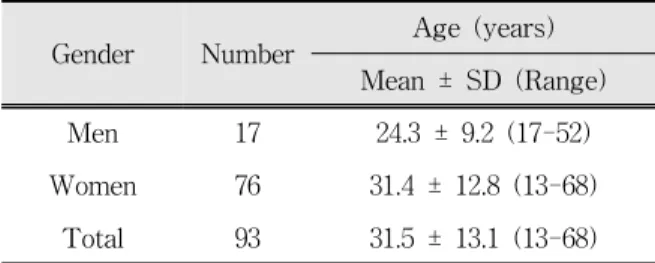
Gender Number Age (years)
Mean ± SD (Range)
Men 17 24.3 ± 9.2 (17-52)
Women 76 31.4 ± 12.8 (13-68)
Total 93 31.5 ± 13.1 (13-68)
Table 1. Demographic feature of the subjects
17 men (24.3±9.2 years) and 76 women (31.4±12.8 years) whose mean±SD ages is 30.1±12.5 years (Table 1). The diagnoses of TMD were based on the RDC/TMD axis I criteria
13).
2. RDC/TMD axis II questionnaire
RDC/TMD axis II history questionnaire was administered to each subject before treatment
13). The original English version of the RDC/TMD axis II history questionnaire was first translated into Korean by the authors. This translation was then evaluated and revised by several faculty members in the Department of Oral Medicine and Oral Diagnosis, Seoul National University. A native English speaker who was fluent in Korean then translated the draft Korean version back into English. The backward translated English version was compared with the original English version to confirm that the questions had been properly translated, and the final Korean version was completed.
The parameters of psychological profiles including depression and somatization, jaw disability, pain intensity, pain days, disability score, disability days, and graded, chronic, pain scale were analyzed.
Method of assessing depression and somatization was derived from Symptom Checklist-90-Revision (SCL-90-R). Participants responded to 13 items of depression parameter and 7 items of additional parameter of SCL-90-R, and then resultant raw mean score was regarded as depression scale.
Somatization scale was also obtained by raw mean score from the responses to 12 items of non-specific physical symptoms of SCL-90-R.
Jaw disability scale was gained from the ratio of positively responded item number to 12 items of jaw disability checklist based on items commonly used in clinical TMD research.
The history questionnaire includes three
questions to grade pain intensity: one for the actual
pain, one for maximal pain in the last 6 months, and
one for average pain in the last 6 months. The
response options for each of three items were based on the ordinal rating of 0 to 10 scale. To obtain the final score, we multiplied average of the responses to the each item by 10. Therefore pain intensity is 0 to 100 score derived from above three questions.
The score of pain days was obtained from the number of days that each subject had pain in facial area.
Disability score is 0 to 100 score derived from three questions that assess a degree of interference in daily activities, social activities, and work activities. The method of calculating disability score is same as grading pain intensity. The score of disability days was obtained from the number of days that each subject has been kept from usual activities related with work, school, or housework due to the facial pain.
Graded chronic pain scale was classified to five stages (0=no pain; I=low intensity-low disability;
II=high intensity-low disability; III=high intensity- high disability-moderatly limiting; IV=high intensity-high disability-severely limiting) according to the severity of chronic pain symptoms derived from the pain intensity and disability point which is summed by adding disability score point to disability days score point. Grade I and II are defined as low disability group, and grade III and IV are defined as high disability group.
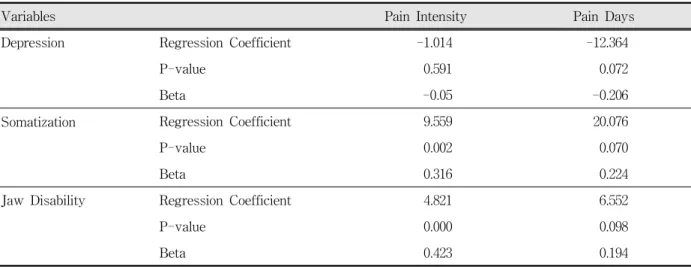
Variables Pain Intensity Pain Days
Depression Regression Coefficient -1.014 -12.364
P-value 0.591 0.072
Beta -0.05 -0.206
Somatization Regression Coefficient 9.559 20.076
P-value 0.002 0.070
Beta 0.316 0.224
Jaw Disability Regression Coefficient 4.821 6.552
P-value 0.000 0.098
Beta 0.423 0.194
Table 2. Multiple regression analysis of impact of depression, somatization, and jaw disability on pain intensity and pain days.
3. Statistical analyses
Statistical analysis was performed to evaluate the strength of the relationship between depression, somatization, jaw disability and each parameters of graded chronic pain by using multiple multivariate regression analysis.
Multiple multivariate linear regression analyses were used to describe depression, somatization, or jaw disability to predict whether the respondents reported any impact on pain intensity, pain days, disability score, disability days, and graded chronic pain scale. For each variable in equation, the following statistics were calculated: regression coefficient, standardized coefficient and P-value.
Ⅲ. RESULTS
Table 2 shows the impact of depression, somatization, and jaw disability on pain intensity and pain days from multiple regression analyses.
Depression did not show any significantly influence on both pain intensity and pain days. However, both somatization (beta=0.316, p=0.002) and jaw disability (beta=0.423, p=0.000) had a significant effect on pain intensity.
Table 3 shows the impact of depression,
somatization, and jaw disability on disability score
Variables Disability Score Disability Days
Depression Regression Coefficient 1.160 -4.195
P-value 0.227 0.388
Beta 0.143 -0.087
Somatization Regression Coefficient -1.000 25.916
P-value 0.519 0.001
Beta -0.082 0.356
Jaw Disability Regression Coefficient 0.416 8.563
P-value 0.454 0.003
Beta 0.090 0.312
Table 3. Multiple regression analysis of impact of depression, somatization, and jaw disability on disability score and disability days.
GCP scale Number (%)
Grade 0 6 (6.5)
Low disability
Grade I 26 (28.0)
Grade II 13 (14.0)
High disability
Grade III 22 (23.6)
Grade IV 26 (27.9)
Table 4. Distribution of graded chronic pain (GCP) scale in TMD patients.
and disability days. Depression did not significantly influence on either disability score or disability days. On the other hand, both somatization (beta=0.356, p=0.001) and jaw disability (beta=0.312, p=0.003) showed significant effects on disability days.
Table 4 shows distribution of graded chronic pain scale in ninety-three TMD patients. Among 93 TMD patients, six patients were graded as 0 (6.5%). The prevalence of low disability group (grade I and II) of graded chronic pain scale was 42.0% and high disability group (grade III and IV) of graded chronic pain scale was 51.5%.
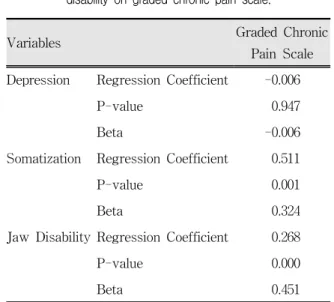
Variables Graded Chronic
Pain Scale Depression Regression Coefficient -0.006
P-value 0.947
Beta -0.006
Somatization Regression Coefficient 0.511
P-value 0.001
Beta 0.324
Jaw Disability Regression Coefficient 0.268
P-value 0.000
Beta 0.451
Table 5. Multiple regression analysis of impact of depression, somatization, and jaw disability on graded chronic pain scale.
Table 5 shows the impact of depression, somatization, and jaw disability on graded chronic pain scale from multiple regression analyses.
Somatization (beta=0.324, p=0.001) and jaw disability (beta=0.451, p=0.000) showed strong impacts on graded chronic pain scale. Depression did not show any significant effect on graded chronic pain scale.
Ⅳ. DISCUSSION
In management of TMD similar to other chronic pain, it is essential that the clinicians understand the emotional and psychological components of the patients pain because it has been extensively documented in patients with chronic pain that maladaptive behavioral, psychosocial factors, and stress may affect the perceived physical symptoms
14,15). The most important, almost universal, feature of TMD is that chronic and persistent orofacial pain is the overwhelming reason which patients seek TMD treatment. According to many reports, TMD patients showed characteristic psychometric profiles representing relatively high values of anxiety, somatization, and depression.
Although there are controversies over whether the psychological factor is a cause or a result of the disorders, several studies reported strong relationship between psychological factors and chronic pain
3,4,6,8,11).
In this study we evaluated the clinical TMD conditions, pain-related disability and psychological status in TMD patients according to the guideline of research diagnostic criteria for temporoman- dibular disorders (RDC/TMD). Several diagnostic systems have been available to classify TMD patients based on pathophysiologic findings and psychosocial findings respectively or on both aspects. But most of them have critical shortcomings that they evaluate patients on the basis of either pathophysiologic findings or psychosocial findings and lack clearly specified criteria for assessment of the clinical signs and symptoms.
In 1992, Dworkin et al. developed novel diagnostic criteria, named research diagnostic criteria for temporomandibular disorders (RDC/TMD) to complement of above mentioned deficits
13). A set of RDC/TMD allows standardization and replication of research in the most common forms of TMD. This classification system is divided into two axes. Axis I involves assessment on the physical diagnosis based on pathophysiology. This is coordinated with
an assessment of TMD-related parafunctional behaviors, psychologic distress, and psychosocial dysfunction on axis II using history questionnaire.
In particular, detailed examination specifications are provided to allow clinical data associated with each RDC/TMD criterion to be gathered through standardized TMD clinical examination and interview methods. Several reports have shown the reliability and validity of RDC/TMD
16-21,25).
The RDC/TMD axis I classifies the most common forms of TMD into three mutually exclusive diagnostic categories and allows multiple diagnoses across diagnostic categories to be made for a given patient. The RDC/TMD diagnostic groups are as follows; i) myofascial pain, ii) disc displacements, iii) arthralgia, arthritis, and arthrosis. On the other hand RDC/TMD axis II assesses and classifies the global severity of the pain condition in terms of pain intensity, pain-related disability, depression, and nonspecific physical symptoms (somatization)
13). In the present study we investigated the impact of depression, somatization, and jaw disability on graded chronic pain in RDC/TMD axis II parameters.
Our results indicated that the degree of somatization and jaw disability was significantly associated with pain intensity, disability days, and graded chronic pain scale except for pain days and disability score.
On the other hand, depression did not have a significant influence on pain intensity, pain days, disability score, disability days, and graded chronic pain scale at all.
Our results coincided with the study of Yap et al.
which reported mean scores of limitations related to mandibular functioning corresponded to the graded chronic pain severity
22).
Somatization is a term which has been used to describe a chronic condition characterized by multiple somatic complaints that are not due to any apparent organic illness and a range of behaviors:
reporting numerous physical symptoms, frequent
utilization of health care, and persistence in seeking
a physical or biomedical explanation for and
treatment of symptoms
23).
Somatization scores have been found to be elevated in chronic pain patients, and McCreary et al. found that somatization was a significant predictor of poorer response to treatment for TMD patients
9,12,24).
Our findings were consistent with those of previous studies which have demonstrated that somatization relates to the extent of self-reported pain
3,6,9,12). In other words, the report of distress from bodily physical symptoms strongly connected with report of more severe pain intensity and disability complaints.
One possible interpretation of the results of the present study is that most TMD patients were somatically focused or sensitized because of a higher intensity or more severe pain condition, thus they showed an increased graded chronic pain scale arose from pain intensity and pain related disability On the other hand, our results were different from other studies that reported characteristic psychometric profile representing relatively higher values of anxiety, somatization, and depression. It was not shown that depression makes a significant impact on graded chronic pain in the present study.
We conjectured that the reason why depression did not have significant effect on graded chronic pain was the relatively short duration that most enrolled subjects in our study suffered from TMD related orofacial pain and disability.
That is to say, it showed that 26 of 93 patients (28%) have pain days more than 180 days and only 10 of 93 patients (11%) have disability days more than 180 days.
Although influence of depression was not significant on pain intensity and pain-related disability in the present study, its potential importance should not overlook in the management of chronic TMD patients.
Because specifically physical discomfort such as non-specific physical symptom and limitation of jaw function have strong influence on subjective perception of pain, we have to focus on the importance of physical findings from TMD patients
as well as management of pain.
The results of this study underline the importance of assessing the psychological distress and functional limitation of jaw movements that is associated with chronic TMD patients.
In summary, comprehensive understanding of psychological profile and improvement of functional limitation of jaw movements in the patient should be considered to lead an excellent outcome of chronic TMD management.
Ⅴ. CONCLUSIONS
The purpose of this study was to investigate the impact of depression, somatization, and jaw disability on graded chronic pain of TMD based on Research Diagnostic Criteria for Temporoman- dibular Disorders (RDC/TMD) which provides a comprehensive assessment of potential role of psychosocial factors in chronic pain patients.
Ninety-three patients (17 men and 76 women, mean
±SD age of 30.1±12.5 years) diagnosed with TMD based on RDC/TMD axis I criteria were administered RDC/TMD axis II history questionnaire. The relationships between depression, somatization, jaw disability, and each parameters of graded chronic pain (e.g. pain intensity, pain days, disability score, disability days, graded chronic pain scale) were analyzed by multiple regression analysis. The obtained results were as follows:
1. Among 93 TMD patients, the prevalence of low disability group of graded chronic pain scale was 42.0% and high disability group of graded chronic pain scale was 51.5%.
2. Depression did not show any significant influences on pain intensity, pain days, disability score, disability days, and graded chronic pain scale.
3. Somatization showed a significant effect on pain intensity (p<0.01), disability days (p<0.01), and graded chronic pain scale (p<0.01) except for both pain days and disability score.
4. Jaw disability also showed a significant effect on
pain intensity (P<0.001), disability days (p<0.01),
and graded chronic pain scale (P<0.001) except for both pain days and disability score.
Comprehensive understanding of psychological profile and improvement of functional limitation of jaw movements in the patient should be considered to obtain an excellent outcome of chronic TMD management.
REFERENCES
1. McNeill C. Temporomandibular disorders, Guidelines for Classification, Assessment, and Management. The American Academy of Orofacial Pain, Chicago, Quintessence Publishing Co. 1994
2. Fricton JR, Kroening RJ, Hathaway KM. TMJ and craniofacial pain: Diagnosis and Management. 1st ed., St. Louis, Tokyo 1988, Ishiyaku EuroAmerica, Inc., pp. 27-37
3. Lee YO, Lee SW. A study of the emotional characteristics of temporomandibular disorder patients using SCL-90-R. J Craniomandib Disord Facial Oral Pain 1989;3:25-34
4. Schulte JK, Anderson GC, Hathaway MK, Will TE.
Psychometric profiles and related pain characteristics of temporomandibular disorder patients. J Orofac Pain 1993;7:247-253
5. Butterworth JC, Deardorff WW. Psychometric profiles of craniomandibular pain patients: Identifying specific subgroups. J Craniomand Pract 1987;5:225-232 6. Dahlstrom L. Psychometrics in temporomandibular
disorders: An overview. Acta Odontol Scand 1993;51:339-352
7. Yap AU, Chua EK, Hoe JK. Clinical TMD, pain- related disability and psychological status of TMD patients. J Oral Rehabil 2002;29:374-380
8. Gale EN, Dixon DC. A simplified psychologic questio- nnaire as a treatment planning aid for patients with temporomandibular joint disorders. J Prosthet Dent 1989;61:235-238
9. Suvinen TI, Reade PC. Temporomandibular disorders:
A critical review of the nature of pain and its assessment. J Orofac Pain 1995;9:317-339
10. Cimino R, Michelotti A, Stradi R, Farinaro C.
Comparison of clinical and psychologic features of fibromyalgia and masticatory myofascial pain. J Orofac Pain 1998;12:35-41
11. Rollman GB, Gillespie JM. The role of psychosocial
factors in temporomandibular disorders. Curr Rev Pain 2000;4(1):71-81
12. Lindroth JE, Schmidt JE, Carlson CR. A comparison between masticatory uscle pain patients and intracapsular pain patients on behavioral and psychosocial domains. J Orofac Pain 2002;16:277-283 13. Dworkin SF, LeResche L. Research diagnostic criteria for temporomandibular disorders: Review, criteria, examinations and specifications, critique. J Craniomandib Disord Facial Oral Pain 1992;6:301-355 14. Macfarlane TV, Blinkhorn AS, Davies RM, Kincey J, Worthington HV. Oro-facial pain in the community:
prevalence and associated impact. Community Dent Oral Epidemiol. 2002;30:52-60
15. Seok H, Son BK, Ha YR, Ryu HH, Moon JH. Clinical influence of emotional depression on chronic low back pain. J Korean Acad Rehabil Med 2003;27:568-574 16. Dworkin SF, Sherman J, Mancl L, Ohrbach R,
LeResche L, Truelove E. Reliability, validity, and clinical utility of the Research Diagnostic Criteria for Temporomandibular Disorders Axis II scales:
Depression, Non-specific physical symptoms, and Graded chronic pain. J Orofac Pain 2002;
16(3):207-220.
17. Manfredini D, Segu M, Bertacci A, Binotti G, Bosco M. Diagnosis of temporomandibular disorders according to RDC/TMD axis I findings, A multicenter Italian study. Minerva Stomatol.
2004;53:429-438
18. List T, Dworkin SF. Comparing TMD diagnoses and clinical findings at Swedish and US TMD centers using research diagnostic criteria for tempor- omandibular disorders. J Orofac Pain 1996;10:240-253 19. Wahlund K, List T, Dworkin SF. Temporomandibular disorders in children and adolescents: Reliability of a questionnaire, clinical examination, and diagnosis. J Orofac Pain 1998;12:42-51
20. Rantala MA, Ahlberg J, Suvinen TI, Savolainen A, Kononen M. Symptoms, signs, and clinical diagnoses according to the research diagnostic criteria temporomandibular disorders among Finnish multiprofessional media personnel. J Orofac Pain 2003;17(4):311-316
21. Dworkin SF, Huggins KH, Wilson L, Mancl L, Turner J, Massoth D, LeResche L, and Truelove E. A randomized clinical trial using Research Diagnostic Criteria for Temporomandibular Disorders-Axis II to target clinic cases for tailored self-care TMD treatment program. J Orofac Pain 2002;16(1):48-63.
22. Yap AU, Chua EK, Hoe JK. Clinical TMD, pain- related disability and psychological status of TMD patients. J Oral Rehabil. 2002;29(4):374-380
23. Wilson L, Dworkin SF, Whitney C, LeResche L.
Somatization and pain dispersion in chronic temporomandibular disorder pain. Pain 1994:57:55-61 24. Mccreary CP, Clark GT, Oakley ME, Flack V.
Predicting response to treatment for temporoman
국문요약
우울, 신체화, 턱기능장애가 측두하악장애 환자의 만성통증척도에 미치는 영향
강릉대학교 치과대학 구강내과진단학교실
1, 서울대학교 치과대학 구강내과진단학교실
2김 철
1․신은섭
2․정진우
2측두하악장애 연구진단기준 (Research Diagnostic Criteria for Temporomandibular Disorders; RDC/TMD)을 이용하여 측두하악장애 환자들에서 심리학적 상태 및 턱기능장애의 정도가 통증의 정도 및 지속기간, 통증과 관련된 일상생활 장애의 정도 및 기간, 만성통증척도에 미치는 영향 등을 알아보기 위하여 RDC/TMD axis I criteria에 따라 측두하악장애로 진단받은 평균연령 30.1±12.5 세인 93 명의 환자들(남성 17명, 여성 76명)을 대상 으로 RDC/TMD axis II 병력 설문지를 작성하게 한 뒤, 우울증점수, 신체화장애점수, 턱기능장애점수와 만성통 증척도의 통증 강도, 통증 지속기간, 통증과 연관된 장애 점수, 통증과 연관된 장애의 기간 및 만성통증척도 사이 의 연관성을 분석하여 다음과 같은 결론을 얻었다.
1. 93명의 측두하악장애 환자들에서 만성통증척도의 경도의 장애를 보이는 군 (low disability group, grade I and II)은 42.0% 이었으며, 심도의 장애를 보이는 군 (high disability group, grade III and IV)은 51.5% 이었다.
2. 우울증점수는 통증 강도, 통증 지속기간, 통증과 연관된 장애 점수, 통증과 연관된 장애의 기간, 만성통증척도 모두에 통계적으로 유의한 영향을 미치지 않았다.
3. 신체화장애점수는 통증 강도 (p<0.01), 통증과 연관된 장애의 기간 (p<0.01), 만성통증척도 (p<0.01)에 유의한 영향을 미쳤으나, 통증 지속기간이나 통증과 연관된 장애 점수에는 통계적으로 유의한 영향을 미치지 않았다.
4. 턱기능장애점수는 통증 강도 (p<0.001), 통증과 연관된 장애의 기간 (p<0.01), 만성통증척도 (p<0.001)에 유의 한 영향을 미쳤으나, 통증 지속기간이나 통증과 연관된 장애 점수에는 통계적으로 유의한 영향을 미치지 않았 다.
측두하악장애환자에서 신체화장애와 턱기능장애는 환자가 느끼는 통증의 강도 및 장애의 정도와 밀접하게 관 련되어 나타날 수 있으며, 환자가 호소하는 정서적 스트레스에 대한 포괄적인 이해와 기능장애에 대한 적절한 관리가 측두하악장애 환자의 성공적인 치료에 매우 중요하리라 생각된다.
주제어 : 측두하악장애, 측두하악장애 연구진단기준, 심리학적 상태, 만성통증척도
dibular disorders. J Craniomandib Disord Facial Oral Pain. 1992;6:161-170
25. Schmitter M, Kress B, Rammelsberg P. Temporo- mandibular joint pathosis in patients with myofascial pain: a comparative analysis of magnetic resonance imaging and a clinical examination based on a specific set of criteria. Oral Surg Oral Med Oral Pathol Oral Radiol Endod. 2004;97:318-324