• 검색 결과가 없습니다.

Surgical Treatment of Sternoclavicular Joint Dislocation Using a T-plate

N/A
N/A
Protected

Academic year: 2021

Share "Surgical Treatment of Sternoclavicular Joint Dislocation Using a T-plate"

Copied!
3
0
0

로드 중.... (전체 텍스트 보기)

전체 글

(1)

ISSN: 2233-601X (Print) ISSN: 2093-6516 (Online)

− 221 −

Department of Thoracic and Cardiovascular Surgery, Konyang University College of Medicine

Received: September 1, 2015, Revised: October 15, 2015, Accepted: October 15, 2015, Published online: June 5, 2016

Corresponding author: Young Jin Kim, Department of Thoracic and Cardiovascular Surgery, Konyang University Hospital, 158 Gwanjeodong-ro, Seo-gu, Daejeon 35365, Korea

(Tel) 82-42-600-9150 (Fax) 82-42-600-6657 (E-mail) [email protected]

Wan Jin Hwang, Department of Thoracic and Cardiovascular Surgery, Konyang University Hospital, 158 Gwanjeodong-ro, Seo-gu, Daejeon 35365, Korea

(Tel) 82-42-600-9150 (Fax) 82-42-600-6657 (E-mail) [email protected]

C

The Korean Society for Thoracic and Cardiovascular Surgery. 2016. All right reserved.

CC
This is an open access article distributed under the terms of the Creative Commons Attribution Non-Commercial License (http://creative- commons.org/licenses/by-nc/4.0) which permits unrestricted non-commercial use, distribution, and reproduction in any medium, provided the original work is properly cited.

Surgical Treatment of Sternoclavicular Joint Dislocation Using a T-plate

Wan Jin Hwang, M.D., Yeiwon Lee, M.D., Yoo Sang Yoon, M.D., Young Jin Kim, M.D., Han Young Ryu, M.D.

A 22-year-old man was hospitalized with a sternoclavicular joint (SCJ) dislocation caused by a traffic accident.

Surgical reduction and fixation of the SCJ were performed using a T-plate. SCJ dislocation is rare, accounting for less than 1% of all dislocations, and is usually treated conservatively, although severe cases may require surgery.

Surgery typically involves joint reduction and fixation using an autologous tendon graft, but this has disadvantages such as the requirement for additional surgery to obtain autologous tissue and an extended operative time. To overcome these issues, here, we performed a simple SCJ reduction and fixation using a T-plate and achieved good results.

Key words: 1. Sternum 2. T-plate

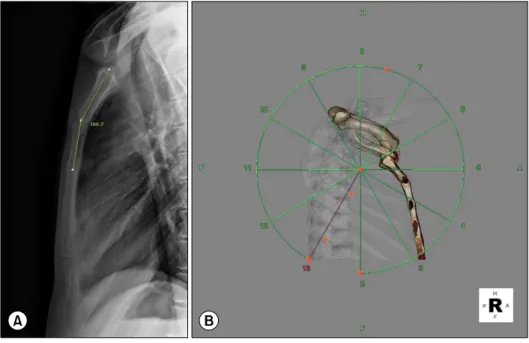
A 22-year-old man was hospitalized with anterior thoracic wall pain that occurred after he became caught between two automobiles during work. His vital signs were good at the time of hospitalization, and there were no specific physical findings on either arm except for impaired movement. A sim- ple thoracic radiograph showed no signs of thoracic wall or clavicle fracture but confirmed a dislocation of the manu- brioclavicular junction (Fig. 1). No organ injury was observed on a three-dimensional chest computed tomography scan, but a hematoma near the sternoclavicular joint (SCJ) and posteri- or dislocation of the manubrium were noted (Fig. 1). The pa- tient chose surgical treatment because he had persistent severe pain in his arms and was unable to elevate them completely.

Surgery was performed in a supine position. After exposing

the sternum with a midline vertical incision from the sternal notch to a point 2 cm inferior to the Louis angle, an SCJ manual reduction was performed; while hyperextension of the Louis angle was maintained, T-plate fixation of the manu- brium and sternal body was performed and the operation was completed (Fig. 2). After surgery, at the time of discharge, the patient was advised to use slings on both arms to main- tain SCJ stabilization. Outpatient examination 6 months after the surgery revealed that the patient was pain free and showed normal bilateral movement of the arms (Fig. 3).

SCJ dislocation is rare, accounting for less than 1% of all dislocations, and the majority of cases reportedly occur due to traffic accidents [1]. They can be divided into anterior and posterior dislocations, the latter of which is much rarer, and

Korean J Thorac Cardiovasc Surg 2016;49:221-223 How to Do It

http://dx.doi.org/10.5090/kjtcs.2016.49.3.221

(2)

Wan Jin Hwang, et al

− 222 −

Fig. 1. Dislocated sternoclavicular joint on lateral view. (A) Angle of Louis 160’ and (B) reconstruction view on computed tomography.

Fig. 2. (A) Dislocation of SCJ and clavicle head (*) at intraoperation.

(B) Reduction SCJ & fixation of Louis angle with T-plate. SCJ, ster- noclavicular joint.

can be accompanied by fatal structural injury [1,2]. Anterior dislocation is usually treated conservatively; however, surgical treatment can be considered for recurrent or severe dis- locations [1-3]. Surgical treatment usually involves joint re- duction using an autologous tendon graft and stable fixation [1-3], but it is also possible to secure unstable joint fixation using other suture materials [4].

SCJ stabilization using an autologous tendon is a larg-

er-scale surgical procedure that requires extended operative time, and obtaining the tendon graft carries a risk of injury to other organs. Moreover, during surgery, there is a high risk of injury to the large vessels that run close to the SCJ [5].

The present surgical method reduces the risk of large ves-

sel or organ injury during graft tissue harvesting and de-

creases the surgical time. However, our study findings are

limited because this was the first time that we attempted the

(3)

T-plate for Sternoclavicular Joint Dislocation

− 223 − Fig. 3. Lateral view of postoperation (angle of Louis 170’).

procedure, and no long-term follow-up was performed nor were comparisons with other surgical or conservative treat- ments made.

CONFLICT OF INTEREST

No potential conflict of interest relevant to this article was reported.

REFERENCES

1. Guan JJ, Wolf BR. Reconstruction for anterior sternocla- vicular joint dislocation and instability. J Shoulder Elbow Surg 2013;22:775-81.

2. Singer G, Ferlic P, Kraus T, Eberl R. Reconstruction of the sternoclavicular joint in active patients with the figure- of-eight technique using hamstrings. J Shoulder Elbow Surg 2013;22:64-9.

3. Bak K, Fogh K. Reconstruction of the chronic anterior un- stable sternoclavicular joint using a tendon autograft: me- dium-term to long-term follow-up results. J Shoulder Elbow Surg 2014;23:245-50.

4. Janson JT, Rossouw GJ. A new technique for repair of a dislocated sternoclavicular joint using a sternal tension cable system. Ann Thorac Surg 2013;95:e53-5.

5. Ponce BA, Kundukulam JA, Pflugner R, et al. Sternoclavicu-

lar joint surgery: how far does danger lurk below? J

Shoulder Elbow Surg 2013;22:993-9.

수치

Fig. 1. Dislocated sternoclavicular  joint on lateral view. (A) Angle of  Louis 160’ and (B) reconstruction  view on computed tomography.

참조

관련 문서

- PVN이 50% 이상 지분 보유 : Petrovietnam Drilling & Well Services Joint Stock Corporation(PV Drilling), Petrovietnam Technical Service Joint

Conclusion : The treatment using facet joint block with lumbar surgical operation seems to have short term clinical effects, however can't prevent

Three-Dimensional heat conduction analysis on dissimilar joint by TIG Assisted FSW (TAFSW) is carried out using an analytical model to determine the thermal histories

Joint Expert Committee on Food Additives(JECFA) JECFA Joint Meeting on Pesticide Residues(JMPR) JMPR High Production Volume Screening Information Data. Set(HPV

1) It could be lengthened defected columella without additional surgical procedure. 2) It could be avoided a complication as like meganostril and delaying

Effect of pain control and improve function of knee joint applied to osteoarthritis by carbon surface-heating... Diagram of

The torque analysis was performed acting on the joint of robot by modeling the kinematics and dynamics of the robot.. Load torque of the joint

3,4 Therefore, to date, studies have been conducted to examine the absorbable fixation plate manufactured using polymer and a fixation screw that can