Vo1. 21, No. 2, November, 2012
※통신저자: 안 희 창
서울시 성동구 왕십리로 17 한양대학교병원 성형외과
Tel: 02-2290-8560, Fax: 02-2295-7671 , E-mail: [email protected]
유둔-유륜 복합체 보존 유방절제술 및 즉시 유방 재건술 후 종양학적 미용학적 결과
한양대학교 의과대학 성형외과학교실, 외과학교실*
박찬우∙안희창∙김연환∙정민성*
─
─ Abstract ──
Oncological and Aesthetic Outcomes of Nipple-Areolar Complex(NAC) Sparing Mastectomy and Immediate Breast Reconstruction
Chan Woo Park, M.D., Hee Chang Ahn, M.D., PhD., Youn Hwan Kim, M.D., PhD., Min Sung Jung, M.D., PhD. *
Department of Plastic and Reconstructive Surgery, School of Medicine, Hanyang University, Seoul, Korea Department of Surgery, School of Medicine, Hanyang University, Seoul, Korea*
Background: Women receiving mastectomy usually prefer a single-stage surgical procedure without the need for additional surgery. Hence, nipple sparing mastectomy was introduced, and the follow-up data on the aesthetic outcome and recurrence of breast cancer were investigated in this study.
Materials and Methods: The study subjects comprised 22 patients who received nipple-sparing mas- tectomy and immediate breast reconstruction using the free transverse abdominal rectus abdominis myocutaneous flap between June of 2007 and June of 2012. The patients’aesthetic outcomes were mea- sured with 2 methods for the objective result: Breast size measurements and breast volume calculation both at preoperative phase and postoperative 1 years phase. Also, the patients’satisfaction was evaluated at postoperative 1 year with the self-assessment questionnaire. Follow up check for assessing cancer recurrence was performed for an average period of postoperative 1063 days.
Results: First, in objective aesthetic outcome, there were no significant differences between the preop- erative and postoperative results on both the breast size and the volume. Second, the patient satisfaction analysis scores were graded as very good in 15 patients (68.2%), and as good in 6 patient (27.3%). Most of the patients were very satisfied with our surgery method. Last, there was no local or distant recurrence in these 22 patients during the follow-up period.
Conclusion: In this study, the nipple-sparing mastectomy achieved satisfactory results for the breast scar and shape with a single-stage surgical procedure, and the cancer recurrence rate was not significantly different from that of the conventional mastectomy. Besides, the nipple-sparing mastectomy is more cost- effective than the conventional mastectomy since it reduces the need for additional procedures. However, we think that it is necessary to determine the long-term outcomes about the recurrence rate.
Key Words: Breast Neoplasms, Nipples, Mastectomy, Neoplasm Recurrence, Local
INTRODUCTION
As more advanced breast cancer screening pro- grams, various neo-adjuvant and adjuvant treat- ments are being developed and the need for a paradigm shift in breast cancer surgery has been increased with the evolution of breast cancer surgery, and its progression to a more minimally invasive and cosmetically acceptable method1 .As the proportion of women diagnosed with early breast cancer has increased due to the advanced screening methods, a less invasive surgery can be performed for the radical treatment of breast cancer2.
Moreover, women requiring mastectomy usual- ly prefer a single-stage surgical procedure which does not require additional surgery for the nipple areola complex(NAC) reconstruction.
Therefore, the demand for a less invasive and cosmetically superior surgical procedure is rapid- ly increasing in Korea as well as worldwide1.
As the demand for a surgical procedure with improved aesthetic outcome is increasing, nipple sparing mastectomy(NSM) is gaining worldwide popularity due to the cosmetically satisfying out- come.
NSM provides the optimal aesthetic outcome in breast cancer treatment due to some advantages3-4: First, this surgical procedure allows for the preservation of the natural shape, size, sensa- tion and symmetry of the nipple areola complex compared with the contra-lateral or normal breast without additional surgery. Second, breast secondary touch operation is usually per- formed 6 months after the final breast recon- struction, and tattooing is commenced 3 to 6 months after nipple reconstruction whereas in the NSM, there is no need for a secondary surgery, if an aesthetically satisfying result is achieved in a single-stage surgical procedure and it is also cost-efficient4. Third, a thicker flap and more breast tissue are preserved in NSM, and since there is more blood supply to the nip- ple and breast tissue, it will be associated with a
lower incidence of flap loss and necrosis5.
But, as the surgical procedure is becoming less invasive, the risk of ongoing recurrence and incomplete resection of the remnant tumor is increasing. This means that, the minimally invasive surgical procedure is likely to be an incomplete operation for local and distant recur- rences6,7.
Therefore, when performing breast cancer surgery, it is necessary to consider both the aes- thetic and oncological aspects in order to achieve the best aesthetic results, and to perform an oncologic safe surgical procedure. However, since mastectomy can cause breast disfigurement and deformity, the minimally invasive mastectomy alone cannot achieve optimal aesthetic result.
Therefore, by performing minimally invasive mastectomy concomitantly with breast recon- struction surgery, we can greatly reduce the physical and psychological trauma in the patients and produce an optimal aesthetic result without impairing the oncologic outcome.
Hence in this article, we report our experience of a less invasive and single-stage surgery, NSM and immediate breast reconstruction with mus- cle-sparing free transverse abdominal rectus abdominis muscle(TRAM) flap. In addition, we also report the follow-up data on the aesthetic and oncologic outcomes of this surgical proce- dure.
MATERIALS AND METHODS
From January of 2007 to June of 2012, data of 34 patients who underwent NSM and immediate breast reconstruction with muscle-sparing free TRAM flap were analyzed retrospectively
Out of 34 patients, a total of 22 patients met the inclusion criteria and included in this study (Table 1-1) because other 12 patients had vascu- lo-occlusive disease, rheumatic disease or history of irradiation and some of them were lost in the follow-up process or had less than 1 year follow- up period. A few of them had history of other
underlying abdominal wall diseases or had gone through surgeries such as cesarean section, abdominoplasty, etc before breast cancer surgery and they were also excluded (Table 1-2).
Mastectomies were performed by a senior gen- eral surgeon. The surgical indications were decided limited by the Department of General Surgery to the as follows.
1. Tumor had to be at least >3 cm away from the nipple-areolar complex.
2. There were no clinically positive lymph nodes.
3. There were negative intraoperative frozen sections of the tissue obtained from the nip- ple-areolar complex around the involved breast.
All breast reconstruction procedures were per- formed by a single plastic surgeon affiliated to the Department of Plastic Surgery using muscle- sparing free TRAM flap only. Except for the TRAM flap procedure, any additional procedures which could change the breast volume such as artificial breast prosthesis application, reduction mammoplasty were not performed.
The authors retrospectively evaluated the data of 22 patients who underwent NSM and immedi- Table 1-1. Characteristics of 22 patients receiving nipple sparing mastectomy and immediate breast reconstruction with free TRAM flap and satisfying inclusion criteria
Case Age(yr) BMI Follow-Up(days) Previous breast Cancer Other combined
operation history Position medical problems
1 38 27.5 599 No Left No
2 62 28 1355 No Right No
3 60 32.1 581 No Right No
4 41 30.5 1625 No Left No
5 42 28.4 722 No Right No
6 46 29.3 2045 No Right No
7 34 30 888 No Left No
8 43 26 812 No Left No
9 38 23.5 1236 No Left No
10 44 25.5 1525 No Left No
11 36 22.7 1162 No Right No
12 65 29.5 769 No Bilateral No
13 45 30.1 499 No Left No
14 51 27.4 1543 No Left No
15 37 29 680 No Left No
16 37 25.5 1312 No Right No
17 36 25.7 757 No Right No
18 45 23.5 662 No Right No
19 40 27 1444 No Right No
20 37 29.3 1402 No Left No
21 56 30.5 1367 No Left No
22 35 26 401 No Right No
Average 44 27.3 1063
Table 1-2. Exclusion criteria
Complication Vasculo-occlusive disease Rheumatic disease Hhistory of irradiation Follow up loss
Less than 1 year follow up period Abdominal wall disease
History of abdominal wall surgery
ate breast reconstruction with muscle-sparing free TRAM flap particularly in terms of aesthetic result, patient’s aesthetic satisfaction, oncologic safety and complications
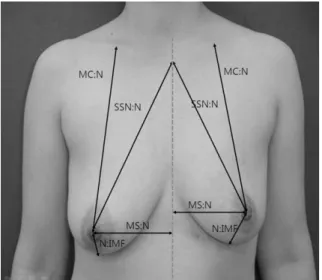
First, aesthetic outcome was measured with 2 methods for the objective result: Breast size measurements by using 4 parameters and breast volume calculation (Fig.1).
Breast size was assessed with physical exami- nation and clinical photographs by the plastic surgeon which compared the reconstructed breasts with the contra-lateral unaffected breasts at a minimum period of 12 months after the initial breast reconstruction surgery.
For the objective comparative breast size analysis, we have used 4 breast size parameters.
: Mid-clavicle to nipple distance, supra-sternal notch to nipple distance, nipple to infra-mam- mary fold(IMF) distance and mid-sternum to nipple distance measured before the surgery and 1 year after the surgery each.
It is helpful to measure the preoperative breast volume because carving flaps similar to contra- lateral breast is critical procedure. So, other than breast size measurements, we also have calculated breast volume preoperatively and postoperatively. Breast volume measurement was performed by the plaster casting method and it Fig. 1. For Objective comparative analysis about aesthetic
oucome, we have measured 4 breast size parame- ters. : Mid-clavicle to nipple distance, suprasternal notch to nipple distance, nipple to inframammary fold(IMF) distance, mid-sternum to nipple dis- tance preoperatively, postoperatively and follow up period.
Fig. 2. Breast volume measurement was performed by the plaster casting method.
can be summarized as follows (Fig.2).
We applied the plaster to 4 anatomical points - infraclavicle, anterior axilla, inframammary fold, mid-sternum - the combination of which formed patients’ breast-shaped mold. Then we poured water into the mold. After that, we could indirectly measure patients’breast volume through measured water volume (Fig.2).
Generally, as free TRAM flap has the muscle component, there are some volume reduction in reconstructed breast and anatomical landmarks’
position change due to muscle atrophy in postop- erative 1 year. Therefore, we have compared the result of preoperative parameter measurements with that of postoperative 1 year.
Second, the patients’satisfaction was evaluat-
ed at postoperative 1 year with the self-assess- ment questionnaire. It was designed by incorpo- rating multiple subjective questions to evaluate the patients’aesthetic satisfaction. The overall score of the self satisfaction analysis was grad- ed in 10 subjects. The investigated items includ- ed breast contour and volume, NAC position (malposition, degree of rotation), symmetry, color (degree of discoloration), size, shape (degree of distortion), projection, degree of scar formation (size, shape), and need for additional revision surgery.
The scores were classified into 6 grades as fol- lows: 0, very bad; 1, bad; 2, fair; 3, good; 4, very good; 5, excellent. After summing up the scores of the 10 subjects, the cumulative score
Table 2. Preoperative absolute aesthetic outcome analysis
Case MC to N Diff SSN to N Diff N to IMF Diff MS to N Diff Breast
d(Affected/ d(Affected/ d(Affected/ d(Affected/ volume
Contralateral) Contralateral) Contralateral) Contralateral) (Affected side)
1 20.0/20.4 -0.4 21.0/21.0 0 7.5/7.2 0.3 9.0/9.0 0 393
2 21.4/20.8 0.6 22.0/21.5 0.5 8.5/8.2 0.3 10.5/10.3 0.2 488
3 18.5/18.2 0.3 19.0/18.8 0.2 6.8/6.8 0 8.6/8.8 -0.2 194
4 22.0/22.0 0 21.5/21.8 -0.3 8.2/8.5 -0.3 10.7/10.5 0.2 486
5 20.5/20.2 0.3 20.8/20.4 0.4 7.2/6.7 0.5 9.3/9.0 0.3 453
6 21.0/21.0 0 21.0/21.0 0 7.0/7.0 0 9.6/10.0 -0.4 522
7 22.3/22.0 0.3 23.0/23.3 -0.3 7.8/8.0 -0.2 11.5/11.0 0.5 802
8 19.8/19.4 0.4 19.5/19.1 0.4 7.0/6.5 0.5 8.8/9.0 -0.2 398
9 20.3/20.7 -0.4 20.5/20.5 0 6.8/7.3 -0.5 9.5/9.5 0 433
10 19.0/19.5 -0.5 19.3/19.0 0.3 6.9/7.2 -0.3 9.0/8.5 0.5 396
11 20.0/20.0 0 20.4/20.0 0.4 7.3/7.3 0 9.2/9.5 -0.3 411
12 19.0/18.8 0.2 19.0/19.0 0 7.0/7.0 0 9.3/9.3 0 288
13 21.0/20.7 0.3 21.2/21.0 0.2 7.5/7.1 0.4 9.6/9.3 0.3 437
14 21.0/21.0 0 21.3/21.0 0.3 7.3/7.5 -0.2 8.5/8.5 0 443
15 20.0/20.0 0 20.5/20.5 0 7.0/7.0 0 9.3/9.0 0.3 429
16 20.0/19.5 0.5 20.3/20.0 0.3 7.1/6.9 0.2 10.2/10.0 0.2 464
17 19.0/19.0 0 19.7/19.5 0.2 6.8/6.8 0 9.0/9.0 0 398
18 21.0/20.5 0.5 21.3/21.0 0.3 7.3/7.1 0.2 10.1/10.1 0 534
19 20.0/20.0 0 20.5/20.0 0.5 7.4/7.7 -0.3 9.5/9.8 -0.3 529
20 19.0/19.5 -0.5 19.0/19.5 -0.5 6.8/6.5 0.3 9.1/9.0 0.1 418
21 21.0/20.7 0.3 21.4/21.0 0.4 7.2/7.2 0 10.6/10.5 0.1 534
22 21.6/22.0 -0.4 21.0/21.3 -0.3 8.0/8.3 -0.3 10.3/10.3 0 569
Average 20.3/20.3 0.07 20.6/20.5 0.14 7.3/7.3 0.03 9.6/9.5 0.06 455.4
*MC(Midclevicle), N(Nipple), IMF(Inframammary fold), SSN(Suprasternal notch), MS(Midsternum), d(Distance)
*Diff: Difference between affected side data & contralateral side data
*Breast volume measurement was performed by casting method.
was reassessed using the overall scores as fol- lows: a score of 0 to 24 was regarded as aesthet- ically poor; a score of 25 to 34 as aesthetically bad; a score of 35 to 39 as aesthetically fair; a score of 40 to 44 as aesthetically good; a score of 45 to 49 as aesthetically very good; a score of 50 as aesthetically superior.
Third, the assessment of oncologic safety and complications was done through regular outpa- tient monitoring with radiologic imaging study and clinical examination about local and sys- temic recurrence and newly developed cancer.
RESULTS
The age of the patients ranged from 34 to 65 years with the mean age of 44 years.
The median follow-up period was 1063 days
(range; 401-2045 days).
All 22 patients had unilateral breast cancer.
Twelve of them had a left breast cancer and ten of them had a right breast cancer. All of them underwent unilateral breast reconstruction surgery concomitantly with nipple sparing mas- tectomy and none of them had positive lymph node and received postoperative radiation therapy.
The objective breast size measurement of the affected breasts before the surgery are as fol- lows.
The mean length of mid-clavicle to nipple on affected breast was 20.3 cm (range: 18.5 to 22.3 cm). The mean length of supra-sternal notch to nipple on affected breast was 20.6cm (range:
19.0 to 23.0 cm). The mean length of nipple to inframammary fold(IMF) on affected breast was 7.3 cm (range: 6.8 to 8.5 cm). The mean length
Table 3. Comparative aesthetic outcome analysis of affected breast
Case D of MC to N d D of SSN to N d D of N to IMF d D of MS to N d D of Breast volume (ml)
1 0.2 0.3 0.1 -0.2 34
2 0.2 0.2 0.1 -0.2 23
3 -0.2 -0.3 0 0 -23
4 0.5 0.5 0.3 0.2 46
5 0 0 0 0.2 21
6 0.2 0.3 0.2 -0.3 29
7 0.5 0.5 0.3 0 36
8 -0.5 -0.3 0.2 0.2 -26
9 0.3 0.5 0.3 0 26
10 -0.2 0.3 0.2 0 -18
11 0.3 0.2 0 0 29
12 -0.2 -0.2 -0.3 -0.1 -25
13 -0.5 -0.5 -0.5 -0.3 -48
14 0 0 0 0.2 -21
15 0 0.3 0.2 0 31
16 0.3 0.3 0.4 0.2 38
17 0.3 0.2 0.2 0 18
18 0.5 0.6 0.5 0.4 52
19 0 0.3 0.4 0.4 36
20 0.4 0.4 0.3 0.3 33
21 -0.2 0.4 0.3 0.3 16
22 0.2 0.5 0.3 -0.3 28
Average 0.1 0.2 0.16 0.05 15.23
*D(Difference postoperative 1 year result - preoperative result), MC(Midclevicle), N(Nipple), IMF(Inframammary fold), SSN(Suprasternal notch), MS(Midsternum), d(Distance)
of mid-sternum to nipple on affected breast was 9.6 cm (range 8.5 to 11.5 cm). There were no significant differences of breast sizes between the affected breasts and the unaffected breasts (Table 2).
Comparative objective analysis of the affected breast size measurement before and after the surgery are as follows. The mean length of mid- clavicle to nipple on affected breast was 0.1 cm.
The mean length of suprasternal notch to nipple on affected breast was 0.2 cm. The mean length of nipple to inframammary fold (IMF) on affect- ed breast was 0.16 cm. The mean length of mid- sternum to nipple on affected breast was 0.05 cm. There were no significant differences of breast sizes between the preoperative and post- operative results (Table 3).
Preoperative mean breast volume was calculat- ed to be 455.4 (194~802) ml by the plaster cast- ing method. Comparative objective analysis of breast volume calculation before and after the surgery are 15.25 ml(range: -48 to 52). There were no significant differences of breast volume between the preoperative and postoperative results (Table 3).
Second, the overall score of the patient satis- faction analysis was graded as very good in 15 patients (68.2%), and as good in 6 patient (27.3%). This indicates that, most of the patients were very satisfied with our surgery method (Table 4). Regarding the nipple-areolar complex position, symmetry, color, size, and shape, almost all patients agreed that the projec- tion of the nipple-areolar complex was well Table 4. Patient satisfaction analysis
NAC NAC NAC NAC NAC NAC Scar Need fo
Case Contour Volume
Position symmetry color size shape projection Formation Additional Overall score operation
1 5 5 4 5 5 5 5 4 3 5 46 (Very good)
2 4 4 5 4 5 5 5 4 3 4 43 (Good)
3 5 5 5 5 5 5 5 4 3 4 46 (Very good)
4 5 4 4 5 5 5 5 3 3 5 44 (Very good)
5 5 5 4 5 5 5 5 4 4 4 46 (Very good)
6 4 5 4 4 4 5 5 5 5 5 46 (Very good)
7 4 4 4 4 5 4 4 4 2 2 37 (Fair)
8 5 5 5 5 4 5 5 4 4 4 46 (Very good)
9 4 5 5 4 5 5 5 4 4 4 45 (Very good)
10 4 5 5 5 5 5 5 5 3 4 46 (Very good)
11 5 4 5 5 4 4 4 4 4 4 43 (Good)
12 3 4 5 5 5 5 5 5 3 4 44 (Good)
13 5 5 4 5 5 5 5 4 4 5 47 (Very good)
14 4 4 4 4 5 4 4 5 3 5 42 (Good)
15 5 5 5 4 5 5 5 5 5 4 48 (Very good)
16 5 4 5 5 5 4 5 4 4 5 46 (Very good)
17 4 4 4 4 4 5 5 5 3 5 43 (Good)
18 4 5 4 5 4 4 4 4 4 5 43 (Good)
19 5 4 5 5 5 5 5 5 4 4 47 (Very good)
20 4 5 4 4 5 5 5 5 4 4 45 (Very good)
21 5 4 5 5 4 5 5 4 3 4 45 (Very good)
22 5 5 5 5 4 5 5 3 4 5 46 (Very good)
Average 4.5 4.55 4.55 4.64 4.68 4.77 4.82 4.27 3.59 4.32
*The score was classified into the 6 grades as follows: 0 is considered as very bad; 1, bad; 2, fair; 3, good; 4, very good; 5, excellent.
*After summing up the scores of the 10 subjects, the cumulative score was reassessed using the overall scores as follows: a score of 0 to 24 was regarded as aesthetically poor; a score of 25 to 34 as aesthetically bad; a score of 35 to 39 as aesthetically fair; a score of 40 to 44 as aesthetically good; a score of 45 to 49 as aesthetically very good; a score of 50 as aesthetically superior.
maintained, the natural shape and color of the nipple-areolar complex were preserved, and the nipple-areolar complex was located in a suitable position (Fig. 3, 4). There was no patient on whom additional nipple and areola reconstruction surgery was performed for aesthetic reasons.
There was no local or distant breast cancer recurrence in these 22 patients during the 1063 days mean follow-up period(range: 101 to 2045 days)
However, there were two patients (9.1%) who underwent an additional surgery for the resolu- tion of fat necrosis and partial flap necrosis. The complication was resolved with wound revision without progression of inflammation (Table 5).
Also, three patients (13.65%) developed minor wound complications such as delayed healing at the flap site or donor site wound dehiscence but they were resolved with conservative treatment (Table 5).
DISCUSSION
Compared with the other breast cancer surg- eries, nipple sparing mastectomy has been demonstrated to successfully achieve an excellent aesthetic outcome. However, there are several questions such as “Minimal cancer resection can be the cause of higher recurrence rates of breast cancer?” which need to be addressed7. Several Fig. 3. (A) 41-years-old woman had Nipple preserving mastectomy and immediate left breast reconstruction with free
TRAM flap, Anterior view at postoperative 1 year. (B) After Nipple preserving mastectomy and immediate breast reconstruction with free TRAM flap, Lateral view at postoperative 1 year. Overall satisfaction score was 44.
A
B
studies have demonstrated that local recurrence rate was not increased after nipple sparing mas- tectomy compared with skin-sparing mastectomy (SSM), modified radical mastectomy (MRM), and radical mastectomy (RM) in breast cancer8.
Gerber B. et al. also reported that nipple spar- ing mastectomy did not increase the recurrence risk, and was an oncologically safe technique compared to the other breast cancer surgeries9,10.
There are some additional procedures for reducing the recurrence rate after nipple sparing mastectomy more effectively. Since the distance between the tumor and the NAC could be relat- ed to occult tumor involvement in the NAC, it is important to calculate the distance between the tumor and the NAC, so as to further minimize the risk of tumor recurrence11,12. Since assessing Table 5. Number of postoperative complications after immedi-
ate breast reconstruction with free TRAM flap
Complication No. (%)
Major flap complications 2/22(9.1%)
Hematoma 0/22(0%)
Seroma 0/22(0%)
Fat necrosis 1/22(4.55%)
Partial flap necrosis 1/22(4.55%)
Total flap necrosis 0/22(0%)
Minor flap complications 3/22(13.65%) Donor-site complications 0/22(0%)
Total 5/22(22.75%)
*Minor flap complications were defined as complications which could be treated by conservative treatment.
*Major flap complications were defined as complications which could be treated by surgical treatment.
*Abdominal bulging, abdominal herniation, donor site fat necrosis, and delayed wound healind were defined in Donor site complications.
Fig. 4. (A) 38 years old woman underwent Nipple preserving mastectomy and immediate breast reconstruction with free TRAM flap, Anterior view at postoperative 1 year. (B) 38 years old woman, Lateral view at postoperative 1 year. Overall satisfaction score was 46.
A
B
the tumor margins including the base of the NAC intraoperatively is important for predicting the presence of occult tumor involvement in the NAC, it could help predict whether tumor recur- rence occurs and further minimize the recur- rence risk3,12.
There are definite surgical indications for nip- ple sparing mastectomy. The tumor should be located at least 3 centimeters or more from the nipple-areolar complex. There should be no clini- cally positive lymph nodes in the axilla. The intraoperative frozen section of the tissue obtained from around the nipple-areolar complex should be negative. Since the blood supply near the nipple-areolar complex can be compromised when the incision is made near the NAC, inci- sion and dissection should be performed at least 3 cm away from the NAC13.
In general, advanced breast cancer is treated with radical resection whereas early breast cancer is treated with minimal resection such as in nipple sparing mastectomy although there is no strict rule for the range of resection.
Interestingly, nipple sparing mastectomy could be associated with a low recurrence rate using strict patient selection and tumor margin evalu- ation14.
Therefore, if nipple sparing mastectomy is per- formed in selected patients with great care, it could be considered as a relatively safe procedure with an excellent aesthetic outcome and can be successfully used in early-stage breast cancer.
The ideal breast reconstruction technique can be decided based on the requirements of natural contour of the reconstructed breast, its symme- try to the contra-lateral breast, and the patient’
s needs15. Also, it is important to select the most appropriate breast reconstruction technique in each condition.
There are a lot of breast reconstruction tech- niques after breast cancer surgery, including prosthetic procedures, techniques using autolo- gous tissue, and combination techniques using the autologous tissue and the implant. After
considering several factors such as the size of the opposite breast, the plans for altering the opposite breast, the exact nature of the mastec- tomy defect, the pathologic stage of breast can- cer, the history of irradiation, the general health of the patient, the availability of donor tissue, and the patient’s expectations, the sur- geons have to select the most suitable technique for breast reconstruction16.
Development of the material for tissue expander breast reconstruction surgery, the use of autologous tissue, and the advances in micro- scopic techniques have brought about a signifi- cant improvement in the functional and aesthet- ic results of breast reconstruction surgery17. Many studies have demonstrated that immediate breast reconstruction for women with early breast cancer was more effective in increasing the survival rate of patients and detection rate of recurrence18.
Generally, due to the infection resistance and aesthetically natural contour, techniques using autologous tissue are more preferred for breast reconstruction surgery than techniques using breast implant or tissue expander. Another com- plication related to the use of breast prosthesis is migration of the expander or implant through the axilla into the back.
Since there are various available surgical tech- niques using the autologous tissue, such as pedi- cled TRAM flap, LD flap, free TRAM flap and free DIEP flap, the problem of choosing the most suitable tissue for breast reconstruction surgery still remains unanswered19.
First, pedicled TRAM flap can be the most attractive option, since the use of TRAM flap can help surgeons to avoid the complications related to the use of prosthesis. However, there certainly are some patients who have suffered from major abdominal donor site complications.
Abdominal wall complications using TRAM flap including direct hernia, abdominal wall weakness and seroma are preventable complica- tions if a careful fascial closure is performed19.
Second, in pedicled TRAM flap, flap complica- tions include total or partial flap necrosis, or more commonly, fat necrosis. However, since the commonly used dominant pedicle has a high- er perfusion pressure in free flap techniques, the frequency of flap necrosis or fat necrosis can be reduced dramatically, compared with that using pedicled TRAM flap20.
So, in cases in which a large amount of tissue is needed, like in breast cancer surgery, or in cases of some vascular problems, a bipedicled TRAM flap or free TRAM flap or LD flap or free DIEP flap should be considered to reduce the risk of flap loss and necrosis. Most cases of flap loss do not occur in split-thickness grafts.
But there are some cases of partial flap loss in which debridement and additional reconstruction surgery are needed21,22.
Besides, the use of pedicled TRAM flap is associated with an aesthetic problem such as anterior chest wall bulging.
The latissimus dorsi flap can be another option, since the latissimus dorsi flap is a stable flap that has excellent and abundant blood cir- culation and is rarely associated with significant flap loss and necrosis22.
But, in LD flap reconstruction, there remains a possibility of donor site complications like limi- tation of shoulder mobility, shoulder weakness and winging of the scapula. Also, latissimus dorsi myocutaneous flap does not provide enough soft tissue for breast reconstruction. Therefore, tissue expander, breast implants are usually used to do breast reconstruction. Also, aesthetic problems in the donor site are found in breast reconstruction using LD flap such as malposition of the nipple-areolar complex, loss of natural breast contour22.
The deep inferior epigastric artery perforator (DIEP) flap provides an enhanced circulation but is difficult to harvest compared with free TRAM flap23.
Therefore, free flap technique such as free TRAM flap, free DIEP flap can be the possible
options for breast reconstruction since this proce- dure has some advantages such as the less use of muscle, and better blood supply.
In conclusion, free TRAM flap can be applied to the patients with a larger breast and the patients with a previous history of irradiation after receiving a free flap23.
Moreover, among the other available autolo- gous tissue flap techniques, the natural contour and shape of the breast can be more easily achieved with the free TRAM flap and it pro- duces aesthetically superior results. With suit- able flap insetting and shaping, breast projection can be increased, the location of the inframam- mary fold can be adjusted to the ideal site and the desired shape can be obtained by additional flap trimming23.
As a result, free TRAM flap can provide many benefits in selected patients; it can provide an aesthetically superior breast reconstruction, both in terms of contour and projection; it can simul- taneously provide the patients with the benefits of an abdominoplasty; and it demonstrates a superior flap survival rate. As per the experi- ence of one of the surgeon’s at our hospital regarding various breast reconstruction tech- niques, free TRAM flap showed a higher sur- vival rate, lower complication rate, and better aesthetic result compared with the other recon- struction techniques.
But, in order to choose a free TRAM flap for breast reconstruction, a skillful microanastomosis technique and a positive frame of mind are required for free flap survival. Therefore, in this study, the authors selected a free TRAM flap for breast reconstruction. Nipple sparing mastectomy and immediate breast reconstruction with muscle-sparing free TRAM flap is not only aesthetically satisfying and but it is also onco- logically safe, and therefore it should be consid- ered as a surgical treatment option in women who need to undergo breast cancer surgery and reconstruction.
In summary, there are several advantages of
the above mentioned surgical procedure.
First, only a single-stage reconstructive surgery is needed to be performed. There is no need for additional surgery to reconstruct the nipple-areolar complex. Thus, this surgical pro- cedure can reduce the hospital costs and the financial burden on patients, and it can be con- sidered as an excellent cost-effective surgical procedure.
Second, due to minimized scar formation and better cosmesis, the need for secondary or revi- sion surgery is less likely.
The other advantage of immediate breast reconstruction is the preservation of important landmarks, such as inframammary fold, nipple- areolar complex, and the native unaffected breast. Thus the preservation of important land- marks allows the reconstructed breast to assume a more natural and symmetrical shape once the breast volume is restored.
Even though a long-term follow-up in a large number of cases of early stage breast cancer was not conducted, we can report that nipple sparing mastectomy and immediate breast reconstruction with free TRAM flap can be the single-stage breast reconstructive surgery with a high level of patient satisfaction in terms of aesthetic and oncologic outcomes.
REFERENCES
1) Holloway CM, Easson A, Escallon J, Leong WL, Quan ML, Reedjik M, Wright FC, McCready DR. Technology as a force for improved diagnosis and treatment of breast disease. Can J Surg. 2010; 53: 268-77.
2) Ory M, Smith M, Hochhalter A, Stevens A, Wernicke M.
C-c3-03: indicators of lifetime and annual mammography screening in the brazos valley. Clin Med Res. 2010; 8:
193-4.
3) Babiera G, Simmons R. Nipple-areolar complex-sparing mastectomy: feasibility, patient selection, and technique.
Ann Surg Oncol. 2010; 17(Suppl 3): 245-8.
4) Yueh JH, Houlihan MJ, Slavin SA, Lee BT, Pories SE, Morris DJ. Nipple-sparing mastectomy: evaluation of patient satisfaction, aesthetic results, and sensation. Ann
Plast Surg. 2009; 62: 586-90.
5) Denewer A, Farouk O. Can nipple-sparing mastectomy and immediate breast reconstruction with modified extended latissimus dorsi muscular flap improve the cos- metic and functional outcome among patients with breast carcinoma? World J Surg. 2007; 31: 1169-77.
6) Slavin SA, Schnitt SJ, Duda RB, Houlihan MJ, Koufman CN, Morris DJ, Troyan SL, Goldwyn RM. Skin-sparing mastectomy and immediate reconstruction: oncologic risks and aesthetic results in patients with early-stage breast cancer. Plast Reconstr Surg. 1998; 102: 49-62.
7) Petit JY, Veronesi U, Rey P, Rotmensz N, Botteri E, Rietjens M, Garusi C, De Lorenzi F, Martella S, Bosco R, Manconi A, Luini A, Galimberti V, Veronesi P, Ivaldi GB, Orecchia R. Nipple-sparing mastectomy: risk of nip- ple-areolar recurrences in a series of 579 cases. Breast Cancer Res Treat. 2009; 114: 97-101.
8) Boukerrou M, Dahan Saal J, Laurent T, Barau G, Clough K. Nipple sparing mastectomy: an update. Gynecol Obstet Fertil. 2010; 38: 600-6.
9) Gerber B, Krause A, Dieterich M, Kundt G, Reimer T.
The oncological safety of skin sparing mastectomy with conservation of the nipple-areola complex and autologous reconstruction: an extended follow-up study. Ann Surg.
2009; 249: 461-8.
10) Gerber B, Krause A, Reimer T, Muller H, Kuchenmeister I, Makovitzky J, Kundt G, Friese K. Skin-sparing mastec- tomy with conservation of the nipple-areola complex and autologous reconstruction is an oncologically safe proce- dure. Ann Surg. 2003; 238: 120-7.
11) Pirozzi PR, Rossetti C, Carelli I, Ruiz CA, Pompei LM, Piato S. Clinical and morphological factors predictive of occult involvement of the nipple-areola complex in mas- tectomy specimens. Eur J Obstet Gynecol Reprod Biol.
2010; 148: 177-81.
12) Wang SY, Peng DF, Cai ZG, Zhang RZ, Yao TJ, Zhang H, Yang M, Dong HM. Clinicopathologic analysis of the nipple-areolar complex occult involvement in early stage breast carcinoma. Zhonghua Zhong Liu Za Zhi. 2008; 30:
203-6.
13) Medina-Franco H, Vasconez LO, Fix RJ, Heslin MJ, Beenken SW, Bland KI, Urist MM. Factors associated with local recurrence after skin-sparing mastectomy and immediate breast reconstruction for invasive breast can- cer.Ann Surg. 2002; 235: 814-9.
14) Gupta A, Borgen PI. Total Skin Sparing (Nipple Sparing) Mastectomy: What is the Evidence? Surg Oncol Clin N Am. 2010; 19: 555-66.
15) Denford S, Harcourt D, Rubin L, Pusic A. Understanding normality: a qualitative analysis of breast cancer patients concepts of normality after mastectomy and reconstructive surgery. Psychooncology. 2010; 20: 5 53-8.
16) Marín-Gutzke M, Sánchez-Olaso A. Reconstructive surgery in young women with breast cancer. Breast Cancer Res Treat. 2010; 123(Suppl 1): 67-74.
17) Ulrik AF, Matzen S. J. Studies of injection ports of perma- nent expandable breast implants. Plast Reconstr Aesthet Surg. 2010; 63: 327-31.
18) Lim W, Ko BS, Kim HJ, Lee JW, Eom JS, Son BH, Lee TJ, Ahn SH. Oncological safety of skin sparing mastecto- my followed by immediate reconstruction for locally advanced breast cancer. J Surg Oncol. 2010; 102: 39-42.
19) Atherton DD, Hills AJ, Moradi P, Muirhead N, Wood SH.
The economic viability of breast reconstruction in the UK:
Comparison of a single surgeon’s experience of implant;
LD; TRAM and DIEP based reconstructions in 274
patients. J Plast Reconstr Aesthet Surg. 2010; 64: 710-5.
20) Grotting JC, Beckenstein MS, Arkoulakis NS. The art and science of autologous breast reconstruction. Breast J.
2003; 9: 350-60.
21) Bassiouny MM, Maamoun SI, El-Shazly Sel-D, Youssef OZ. TRAM flap for immediate post mastectomy recon- struction: comparison between pedicled and free transfer. J Egypt Natl Canc Inst. 2005; 17: 231-8.
22) Selber JC, Fosnot J, Nelson J, Goldstein J, Bergey M, Sonnad S, Serletti JM. A prospective study comparing the functional impact of SIEA, DIEP, and muscle-sparing free TRAM flaps on the abdominal wall: Part II. Bilateral reconstruction. Plast Reconstr Surg. 2010; 126: 1438-53.
23) Grotting JC, Urist MM, Maddox WA, Vasconez LO.
Conventional TRAM flap versus free microsurgical TRAM flap for immediate breast reconstruction. Plast Reconstr Surg. 1989 May; 83(5): 828-41