INTRODUCTION
Recently, nipple-sparing mastectomy (NSM) has received increased attention for the treatment of early-stage breast cancer patients. Several studies have demonstrated that NSM can produce satisfactory oncological outcomes when it is performed in select patients.1-6 In addition, NSM provides superior aesthetic outcomes by preserving the whole skin envelope, including the nipple-areolar complex (NAC), and facilitates the reconstruction of more symmetric and natural breasts.7-9
Necrotic complications including necrosis of the NAC region or the mastectomy flap remain a major problem in NSM. These complications can delay and disturb oncological treatment10 and produce less satisfactory aesthetic outcomes,11-13 eventually obviating the main advantage of NSM.
The reported prevalence of necrotic complications ranges from 0.0% to 41.2%.6,14-19 With careful patient selection and technical advances, the rate of necrotic complications have been reduced, but remains still relatively high, compared with that of other mastectomy procedures. Although some factors have been reported to influence the development of
Necrotic Complications in Nipple-Sparing Mastectomy Followed by Immediate Breast Reconstruction:
Systematic Review with Pooled Analysis
Kyeong-Tae Lee, Goo-Hyun Mun*
Department of Plastic Surgery, Samsung Medical Center, Sungkyunkwan University School of Medicine, Seoul, Korea
CC This is an open-access article distributed under the terms of the Creative Commons Attribution Non-Commercial License (http://creativecommons.org/licenses/by-nc/3.0) which permits unrestricted noncommercial use, distribution, and reproduction in any medium, provided the original work is properly cited.
Copyright © 2014 by the Korean Society for Microsurgery. All Rights Reserved.
Received October 27, 2014 Accepted October 29, 2014
*Correspondence to: Goo-Hyun Mun Department of Plastic Surgery, Samsung Medical Center, Sungkyunkwan University School of Medicine, 81 Irwon-ro, Gangnam-gu, Seoul 135-710, Korea Tel: +82-2-3410-2233
Fax: +82-2-3410-0036 E-mail: [email protected]
Financial support: None.
Conflict of interest: None.
This study provides a systematic review of the literature on nipple-sparing mastectomy and necrotic complications in order to estimate the prevalence of necrotic complications and to investigate their significant predictors. A literature search was conducted using the MEDLINE and Ovid databases. A pooled analysis was performed for calculation of the prevalence of nipple-areolar complex (NAC) necrosis, mastectomy flap necrosis, and overall necrotic complications and to evaluate the relationships between necrotic complications and potential risk factors. A total of 44 papers were analyzed. The prevalence of overall necrotic complications was 13.7%, including 7.5% for NAC necrosis and 7.8% for mastectomy flap necrosis. Types of incisions showed significant association with the rates of NAC necrosis and mastectomy flap necrosis. Incisions involving the NAC showed a significantly higher rate of NAC necrosis than those not involving it. The prevalence of NAC necrosis was higher in the autologous tissue reconstruction group than in the prosthesis group. Active smoking and diathermy dissection were significant predictors of both NAC necrosis and mastectomy flap necrosis. The findings of this review suggest that there are several predictors of necrotic complications in nipple-sparing mastectomy. Appropriate patient selection, careful operative planning, and surgical technique refinements may reduce the risk of necrotic complications.
Key Words: Mastectomy, Postoperative complication, Necrosis
ARMS
Archives of Reconstructive Microsurgery http://dx.doi.org/10.15596/ARMS.2014.23.2.51necrotic complications, including the type of incision,8,19,20 the reconstruction method,19,21,22 age,20,23 and smoking,7 there is no general consensus as to which factors are important and the debate is ongoing. These differences in reported outcomes and the resulting debate over risk factors can be attributed to differences in patient demographics, operative techniques (e.g., the choice of incision placement, reconstruction methods, and dissection tools), and different skill levels and experience of surgeons. In this regard, a systematic literature review should provide a more comprehensive overview of necrotic complications in NSM cases.
Several studies have provided systematic reviews of NSM4,24 but focused mainly on its oncological aspects, paying little attention to necrotic complications. Although there was one recent review comparing the prevalence of postoperative complications after NSM procedures, including nipple necrosis, based on the type of mastectomy incision and the reconstruction method,25 it evaluated only two risk factors for these complications and ignored the necrotic complications that developed in the areola and the mastectomy skin flap, which can also present serious challenges.23,26,27 The present systematic review estimates the overall prevalence of each necrotic complication in the NAC and the mastectomy flap and identifies the relationships between the development of necrotic complications and their potential risk factors.
PATIENTS AND METHODS
Literature review
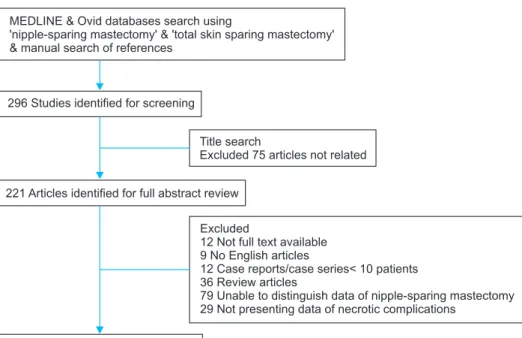
A literature search of the Medline and Ovid database was conducted in November 2013 by using the search terms ‘nipple- sparing mastectomy’ and ‘total skin-sparing mastectomy’ as keywords. A manual search was also conducted for additional papers relevant to the topic. A total of 296 papers were obtained through this search. After excluding the articles that were not related to surgical outcomes of NSM in title review, 221 abstracts were reviewed. Basically, all papers presenting the prevalence of necrotic complications in NSM procedures were included, regardless of their publication types and languages.
Then, following studies were excluded by predefined exclusion criteria; systematic reviews and meta-analyses, case reports and series with fewer than 10 cases, studies in languages other than English, studies not concerning NSM procedures, and studies lacking extractable data on necrotic complications of NSM because it was hard to distinguish NSM outcomes from those of other mastectomy procedures. Not only total necrosis requiring surgical intervention but also partial necrosis that could be healed only by conservative treatment was regarded as a necrotic complication. Two authors independently identified the relevant studies for inclusion and extracted data related to the outcomes.
Disagreements were resolved by consensus discussion between authors. Based on these criteria, 203 papers were excluded,
Fig. 1. Study attrition diagram.
MEDLINE & Ovid databases search using
'nipple-sparing mastectomy' & 'total skin sparing mastectomy'
& manual search of references
296 Studies identified for screening
Title search
Excluded 75 articles not related
221 Articles identified for full abstract review
44 Articles systematically analyzed
Excluded
12 Not full text available 9 No English articles
12 Case reports/case series< 10 patients 36 Review articles
79 Unable to distinguish data of nipple-sparing mastectomy 29 Not presenting data of necrotic complications
eventually yielding 44 for the final analysis (Fig. 1).
Data extraction and analysis
Full-text reviews were conducted for all 44 papers. The
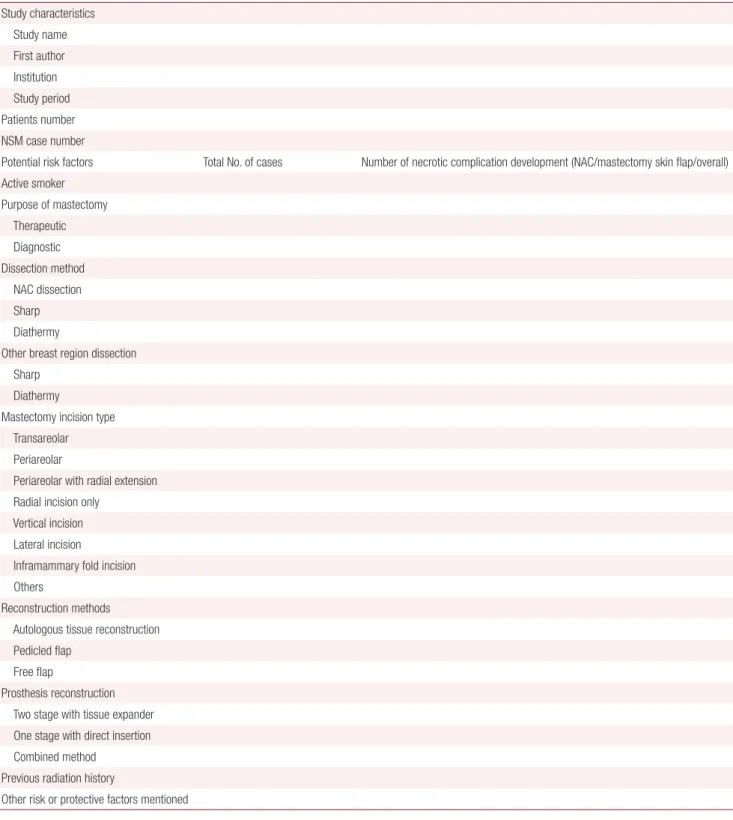
following data were extracted using a standardized data extraction form (Table 1): study characteristics including the first author, the publication year, the study institution, the number of patients, the number of NSM procedures, the
Table 1.Data extraction form Study characteristics Study name First author Institution Study period Patients number NSM case number
Potential risk factors Total No. of cases Number of necrotic complication development (NAC/mastectomy skin flap/overall) Active smoker
Purpose of mastectomy Therapeutic Diagnostic Dissection method NAC dissection Sharp Diathermy
Other breast region dissection Sharp
Diathermy
Mastectomy incision type Transareolar Periareolar
Periareolar with radial extension Radial incision only
Vertical incision Lateral incision
Inframammary fold incision Others
Reconstruction methods Autologous tissue reconstruction Pedicled flap
Free flap
Prosthesis reconstruction Two stage with tissue expander One stage with direct insertion Combined method
Previous radiation history
Other risk or protective factors mentioned NAC: nipple-areolar complex.
number of NAC necrosis cases, mastectomy flap necrosis and overall complications, the type of incision, the NAC involvement of incisions, the type of reconstruction, the dissection method for mastectomy, the purpose of NSM procedures (therapeutic or prophylactic), and the patient history of irradiation. Necrotic complications were classified into two categories, namely NAC necrosis and mastectomy flap necrosis, and were analyzed separately. Necrosis of the nipple or areolar region was regarded as NAC necrosis. Necrosis of other breast skin envelopes was regarded as mastectomy flap necrosis.
Not all data were available in every paper. In the calculation of the prevalence of overall necrotic complications, papers that demonstrated the prevalence of only NAC or mastectomy skin flap necrosis but did not present the rate of overall necrotic complications were excluded. Those papers presenting only overall necrotic complication rates were also excluded in analyzing the prevalence of each necrotic complication.
When more than one paper was reported from the same institution with overlapping data collection periods, they were regarded as the same cohort. To evaluate the prevalence of necrotic complications, papers with the largest number of cases were chosen. In the analysis of risk factors, those papers demonstrating data on these factors were included regardless of the number of cases.
A pooled analysis of the prevalence of necrotic complications was conducted. The number of cases with necrotic complications was calculated in the presence and absence of risk factors. A chi-square test was conducted and p<0.05 was considered significant. PASW Statistics ver. 18.0 (IBM Co., Armonk, NY, USA) was used for the statistical analysis.
RESULTS
Overall prevalence of necrotic complications Forty-four articles1-3,7-9,14-16,18,20-23,28-57
were included in the calculation of the prevalence of necrotic complications, representing a total of 6,722 NSM cases in 5,432 patients (Table 2). The prevalence of NAC necrosis was described in 38 arti cles,1,3,7-9,14-16,20,22,23,28-31,33-57
that of mastectomy flap necrosis in 29 articles,3,7-9,14,15,18,20,22,23,29,31-33,35,37,38,40-42,45-48,52-54,56,57 and that of overall necrotic complications in 18.2,7,8,15,18,20-23,29,31,33,35,37,38,45,52,57
NAC necrosis developed in 445 out of 5,965 cases (7.5%), and mastectomy flap necrosis in 239 out of 3,049 (7.8%). The
overall necrotic complications prevalence was 13.7% (222 out of 1,620 cases).
Incision type
Twenty-five papers8,9,14,18,20-22,29-35,38,39,41,42,45,47,48,51,53,56,57
representing 2,570 NSM cases described the prevalence of necrotic complications by incision type. Here, 15 different incisions were used and could be classified into eight categories:
transareolar incisions, periareolar incisions, periareolar incisions with a radial extension, radial incisions only, vertical incisions, lateral incisions, inframammary fold incisions, and others. The effect of incision type on the development of NAC necrosis was demonstrated in 22 papers.8,9,14,18,22,30-35,38,39,41,42,45,47,48,51,53,56,57
NAC necrosis developed most frequently in transareolar incisions (81.8%), followed by periareolar incisions (38.3%), inframammary fold incisions (13.8%), periareolar incisions with a radial extension (13.4%), radial incisions only (11.0%), lateral incisions (5.6%), and vertical incisions (3.9%), and differences were significant (p<0.001) (Table 3). An additional analysis of 20 of the papers was conducted with classifying all incision types into two groups based on whether they involved NAC regions or not, regardless of the incision su btype.8,9,14,18,30,32-35,38,39,41,42,45,47,48,51,53,56,57
Cases with incisions involving the NAC showed significantly higher rates of NAC necrosis than those with incisions not involving this region (23.6% vs. 10.6%, p<0.001) (Table 4).
Seventeen papers8,9,14,18,22,32,33,37,38,40,42,45,47,48,53,56,57
representing 1,008 cases described the prevalence of mastectomy flap necrosis depending on the type of incision. Transareolar incisions had the highest prevalence of mastectomy flap necrosis (36.4%), followed by periareolar incisions with a radial extension, radial incisions only, lateral, inframammary incisions, vertical incisions, and periareolar incisions. In contrast to its relationship with NAC necrosis, surgeries that included an incision with NAC involvement did not show asignificantly higher rate of mastectomy flap necrosis than surgeries without NAC involvement (7.7% vs. 5.6%, p=0.261).
Overall necrotic complications were described in 11 papers, including 733 cases.8,18,20-22,29,33,35,38,45,57
No significant differences were observed across the incision types. Furthermore, NAC involvement in incisions had no effect on the development of overall necrotic complications.
Table 2. Characteristics of 44 included studies Study (year)DesignNo. of patientsNo. of casesMean age (yr)Active smoker (%)Type of incision usedType of reconstructionNecrotic complication rate (%) OverallNAC necrosisMastectomy flap necrosis Sufi et al.57 (2000)Retrospective121240N/ALateralCombined16.78.38.3 Margulies et al.56 (2005)Retrospective31504625.8IMF, othersProsthesisN/A14.02.0 Caruso et al.55 (2006)Prospective505142N/ARadial, IMF, othersProsthesisN/A2.0N/A Komorowski et al.23 (2006)Retrospective383844.5N/APeriareolar, lateral, othersProsthesis15.813.22.6 Sacchini et al.54 (2006)Retrospective12319245N/APeriareolar with radial extension, transareolar, IMF, othersProsthesis, autologousN/A11.59.9 Denewer and Farouk53 (2007)Retrospective414141.5N/APeriareolar with radial extensionAutologousN/A2.47.3 Crowe et al.34 (2008)Prospective11014943N/ARadialProsthesis, autologousN/A1.3N/A Regolo et al.51 (2008)Retrospective7010242.3N/APeriareolar, lateralProsthesisN/A20.6N/A Sookhan et al.52 (2008)Retrospective18184411.1IMF, periareolarProsthesis11.111.10.0 Stolier et al.18 (2008)Prospective588248.60.0Vertical, radialProsthesis, autologous2.40.02.4 Wijayanayagam et al.32 (2008)Prospective436443.711.6Periareolar, transareolar, IMF, radialProsthesis, autologous, combinedN/A2.017.2 Garwood et al.21 (2009)Prospective115170447.0IMF, radial, lateral, transareolar, periareolar, othersProsthesis, autologous19.410.612.9 Paepke et al.50 (2009)Prospective9696N/AN/APeriareolar, IMF, lateral, othersProsthesis, autologousN/A28.1N/A Petit et al.36 (2009)Prospective9761,00146N/AOthersProsthesis, autologousN/A9.0N/A Yueh et al.14 (2009)Prospective101744N/AIMFProsthesis, autologousN/A41.211.8 Colwell et al.38 (2010)Retrospective814430.0IMFProsthesis7.10.07.1 Kim et al.49 (2010)Prospective11511541.5N/APeriareolar with radial extension, radial AutologousN/A22.6N/A Radovanovic et al.35 (2010)Prospective20521447N/ARadialProsthesis7.52.36.5 Salgarello et al.48 (2010)Retrospective334245.89.1Periareolar, periareolar with radial extension, radial, othersProsthesisN/A9.52.4 Boneti et al.47 (2011)RetrospectiveN/A28151.23.6Periareolar, IMF, othersProsthesisN/A0.74.6 de Alcantara et al.2 (2011)Retrospective200353440.0Periareolar, lateralProsthesis, autologous19.50.3N/A Harness et al.37 (2011)Retrospective436048.79.3IMF, radial, othersProsthesis15.015.00.0 Jensen et al.1 (2011)Prospective99149515.1Periareolar, radial, IMFProsthesis, autologousN/A5.4N/A Rawlani et al.33 (2011)Retrospective203744.4N/APeriareolar, lateral, IMFProsthesis24.324.30.0 Spear et al.46 (2011)Retrospective1011624314.9Lateral, IMF, vertical, periareolarProsthesis, autologousN/A7.01.9
Table 2. Continued Study (year)DesignNo. of patientsNo. of casesMean age (yr)Active smoker (%)Type of incision usedType of reconstructionNecrotic complication rate (%) OverallNAC necrosisMastectomy flap necrosis Algaithy et al.20 (2012)Prospective45504226.7Periareolar, radialProsthesis26.024.014.0 Folli et al.39 (2012)Non-concurrent cohort115115N/A0.0RadialProsthesisN/A40.0N/A Moyer et al.41 (2012)Retrospective264042.9N/APeriareolar with radial extension, radial, vertical, IMFProsthesis, autologousN/A37.52.5 Peled et al.9 (2012)Prospective42865746.91.6IMF, periareolar, radial, lateral, transareolar, othersProsthesis, autologousN/A3.511.9 Schneider et al.43 (2012)Retrospective193447.40.0Vertical, radialAutologousN/A2.9N/A Wagner et al.40 (2012)Prospective335445.424.2LateralProsthesis, autologousN/A29.69.3 Warren Peled et al.3 (2012)Prospective16026046.5N/AIMF, periareolar, radial, lateralProsthesisN/A1.26.2 Yang et al.42 (2012)Prospective929243.2N/ARadialAutologousN/A13.09.8 Alperovich et al.15 (2013)Retrospective81346.612.5OthersProsthesis, autologous, combined0.00.00.0 Blechman et al.8 (2013)Retrospective2955460.0IMFProsthesis5.55.53.6 Gould et al.30 (2013)Retrospective731134730.1Periareolar, radial, vertical, lateral, IMFProsthesis, autologous, combinedN/A20.4N/A Lee et al.22 (2013)Retrospective12513040.61.6RadialProsthesis, autologous16.211.58.5 Levine et al.31 (2013)Retrospective84134N/A0.0Vertical, lateral, IMFAutologous3.70.03.7 Munhoz et al.29 (2013)Retrospective15815851.419.6Periareolar, IMFProsthesis7.65.12.5 Rulli et al.28 (2013)Retrospective607350N/APeriareolar with radial extension, radialProsthesisN/A5.5N/A Sakurai et al.16 (2013)Retrospective78878851N/APeriareolar with radial extension, IMFProsthesisN/A0.0N/A Stolier and Levine44 (2013)Retrospective231340N/A0.0Vertical, lateral, IMFProsthesis, autologousN/A2.6N/A Tanna et al.7 (2013)Retrospective518547.80.0Vertical, radial, IMF, othersAutologous20.012.912.9 Vaughn et al.45 (2013)Retrospective1121430.0IMFProsthesis9.50.09.5 NAC: nipple-areolar complex, N/A: not applicable, IMF: inframammary fold.
Reconstruction methods
Twenty-nine papers7-9,14,15,18,20-23,30,31,33,35,37-39,42,43,45,47-49,52-57
representing 2,765 cases demonstrated the prevalence of necrotic complications depending on reconstruction method used. The relationship between NAC necrosis and reconstruction method was analyzed for 2,641 cases from 28 papers.7-9,14,15,18,20,22,23,30,31,33,35,37-39,42,43,45,47-49,52-57
The NAC necrosis rate was significantly different between three reconstruction
groups, namely the autologous reconstruction group, the prosthesis reconstruction group, and the combined-method group (p=0.020) (Table 5). In a separate comparison between just the autologous reconstruction group and the prosthesis reconstruction group, excluding the combined-method group, a significant difference was observed and autologous reconstruction showed a significantly higher rate of NAC necrosis than did prosthesis reconstruction (p=0.019).
Table 3. Incision types as a predictor of necrotic complications
Incision type Nipple-areolar complex Mastectomy flap Overall
Total cases Necrosis cases Total cases Necrosis cases Total cases Necrosis cases
Total 1,507 180 (11.9) 961 65 (6.8) 733 80 (10.9)
Transareolar 11 9 (81.8) 11 4 (36.4)
Periareolar 81 31 (38.3) 49 1 (2.0) 92 14 (15.2)
Periareolar with radial extension 112 15 (13.4) 45 4 (8.9) 39 4 (10.3)
Radial incision only 857 94 (11.0) 500 38 (7.6) 390 43 (11.0)
Vertical 128 5 (3.9) 54 2 (3.7) 51 2 (3.9)
Lateral 198 11 (5.6) 135 8 (5.9) 67 5 (7.5)
Inframammary fold 109 15 (13.8) 147 8 (5.4) 35 3 (8.6)
Others 11 0 (0.0) 20 0 (0.0) 59 9 (15.3)
p-value <0.001 0.004 0.369
Values are presented as number or number (%).
Table 4. Association between incision with NAC involvement and necrotic complications
Incision type NAC Mastectomy flap Overall
Total cases Necrosis cases Total cases Necrosis cases Total cases Necrosis cases
Total 1,220 168 (13.8) 878 53 (6.0) 398 44 (11.1)
Incision with NAC involvement 301 71 (23.6) 194 15 (7.7) 185 24 (13.0)
Incision without NAC involvement 919 97 (10.6) 684 38 (5.6) 213 20 (9.4)
p-value <0.001 0.261 0.256
Values are presented as number or number (%).
NAC: nipple-areolar complex.
Table 5. Reconstruction method as a predictor of necrotic complications
Reconstruction methods Nipple-areolar complex Mastectomy flap Overall
Total cases Necrosis cases Total cases Necrosis cases Total cases Necrosis cases
Total 2,641 233 (8.8) 2,110 146 (6.9) 1,051 139 (13.2)
Autologous tissue reconstruction 644 71 (11.0) 491 43 (8.8) 354 53 (15.0)
Prosthesis reconstruction 1,982 159 (8.0) 1,600 102 (6.4) 678 84 (12.4)
Combined method 15 3 (20.0) 19 1 (5.3) 19 2 (10.5)
p-value 0.020 0.183 0.478
Values are presented as number or number (%).
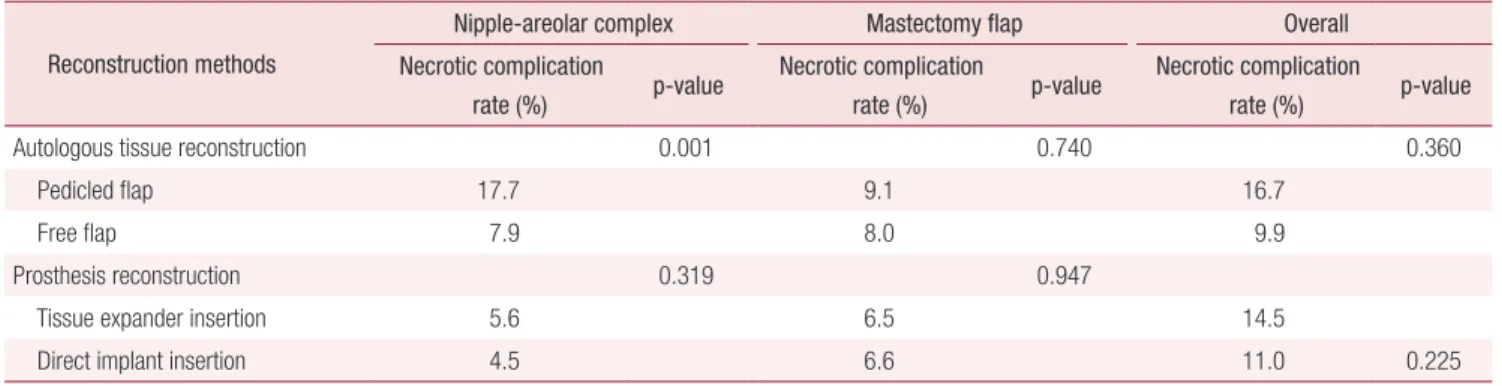
In the subgroup analysis for the prosthesis reconstruction group, two methods (two-stage reconstruction with a tissue expander and one-stage reconstruction with the direct insertion of an implant) demonstrated similar NAC necrosis rates (p=0.319). In the subgroup analysis within the autologous group, cases of free flaps showed significantly lower rates of NAC necrosis than those of pedicled flaps (p=0.001) (Table 6).
Mastectomy flap necrosis with different reconstruction methods was described in 23 papers.7-9,14,15,20,22,23,31-33,35,37,38,42,45,47,48,52-54,56,57
No significant differences were observed between the three types of reconstruction methods. In the analysis after excluding cases of the combined method, mastectomy flap necrosis in the autologous tissue group was higher than that in the prosthesis group with marginal significance (8.8% vs. 6.4%, p=0.069). In terms of overall necrotic complications, 1,051 cases from 15 pa pers7,8,15,20-23,31,33,35,37,38,45,52,57 were analyzed, but no significant differences were found between the three groups. No subgroup analysis for each reconstruction method group showed any significant differences between the groups, either in the prevalence of mastectomy flap necrosis or overall necrotic complications.
Active smoking
Eighteen papers7,8,15,18,20-22,30-32,37,38,43,45-47,52,56
representing 1,536
cases demonstrated the prevalence of necrotic complications by smoking status. The prevalence of NAC necrosis was described in 14 papers7,8,15,18,22,30-32,38,43,45-47,56
and was significantly higher in active smokers (28.6%) than in non-active ones (6.0%) (p<0.001). In the analysis of mastectomy flap necrosis from 12 papers,7,15,18,22,31,32,37,38,45,47,52,56 active smokers also showed a significantly higher rate of mastectomy flap necrosis than did non-active ones (16.1% vs. 5.4%, p=0.012). Overall necrotic complications depending on active smoking were computed in 672 cases found in nine papers,7,8,15,20-22,31,38,45 and similar results were found (Table 7).
Mastectomy dissection methods
A total of 16 papers8,9,14,15,18,32,37-39,45-47,49,51,52,56 representing 1,595 cases described the prevalence of necrotic complications depending on dissection methods, which were classified into two groups: sharp and diathermy dissection groups. Cases in which sharp dissection was mainly used and the use of electrocautery was limited only to vessel cauterization were assigned to the sharp dissection group. The prevalence of NAC necrosis in the diathermy dissection group was significantly higher than that in the sharp dissection group (20.8% vs.
7.9%, p<0.001). The prevalence of mastectomy flap necrosis
Table 6. Subgroup analysis in each reconstruction method group Reconstruction methods
Nipple-areolar complex Mastectomy flap Overall
Necrotic complication
rate (%) p-value Necrotic complication
rate (%) p-value Necrotic complication
rate (%) p-value
Autologous tissue reconstruction 0.001 0.740 0.360
Pedicled flap 17.7 9.1 16.7
Free flap 7.9 8.0 9.9
Prosthesis reconstruction 0.319 0.947
Tissue expander insertion 5.6 6.5 14.5
Direct implant insertion 4.5 6.6 11.0 0.225
Table 7. Active smoking as a predictor of necrotic complications
Smoking status Nipple-areolar complex Mastectomy flap Overall
Total cases Necrosis cases Total cases Necrosis cases Total cases Necrosis cases
Total 1,180 85 (7.2) 868 50 (5.8) 672 95 (14.1)
Active smoker 63 18 (28.6) 31 5 (16.1) 23 13 (56.5)
Non-active smoker 1,117 67 (6.0) 837 45 (5.4) 649 82 (12.6)
p-value <0.001 0.012 <0.001
Values are presented as number or number (%).
described in 813 cases from 12 papers8,14,15,18,32,37,38,45-47,52,56
was also significantly higher in the diathermy dissection group than in the sharp dissection group (7.6% vs. 3.4%, p=0.011).
Four papers8,15,37,52 described overall necrotic complications depending on dissection methods, and a higher prevalence was shown in the diathermy dissection group, although it was not significant (Table 8).
Mastectomy purpose
Sixteen papers8,15,20,30,33,36-38,42,45,46,48,49,52,53,55 representing 1,916 NSM cases described the prevalence of necrotic complications with respect to the purpose of mastectomy, including therapeutic or prophylactic purposes. The prevalence of NAC necrosis for therapeutic purposes was 9.9%, similar to that for prophylactic purposes (8.8%). By contrast, the
prevalence of mastectomy flap necrosis computed from eight papers15,33,37,38,42,46,52,53 was significantly different between the groups, and surgeries performed for therapeutic purposes showed a higher rate of complications than when performed for prophylactic purposes (5.3% vs. 1.2%, p=0.026). The prevalence of overall necrotic complications depending on mastectomy purposes was mentioned in four papers,8,15,20,38 and there was no significant difference between the groups (Table 9).
Breast irradiation history Ten papers1,21,22,31,33,38,40,45,56,57
representing 771 NSM procedures were included in our review of breast irradiation.
The prevalence of NAC necrosis in the cases of prior radiation was 18.8%, which was significantly higher than that in the cases of no prior irradiation (6.6%, p=0.010). However, the
Table 9. Association between purpose of mastectomy and necrotic complications
Purpose of mastectomy Nipple-areolar complex Mastectomy flap Overall
Total cases Necrosis cases Total cases Necrosis cases Total cases Necrosis cases
Total 1,751 171 (9.8) 437 16 (3.7) 132 17 (12.9)
Therapeutic purpose 1,502 149 (9.9) 266 14 (5.3) 71 10 (14.1)
Prophylactic purpose 249 22 (8.8) 171 2 (1.2) 61 7 (11.5)
p-value 0.593 0.026 0.655
Values are presented as number or number (%).
Table 8. Dissection method of mastectomy as a predictor of necrotic complications
Dissection methods Nipple-areolar complex Mastectomy flap Overall
Total cases Necrosis cases Total cases Necrosis cases Total cases Necrosis cases
Total 1,595 151 (9.5) 813 37 (4.6) 146 14 (9.6)
Sharp dissection 1,398 110 (7.9) 588 20 (3.4) 128 12 (9.4)
Diathermy dissection 197 41 (20.8) 225 17 (7.6) 18 2 (11.1)
p-value <0.001 0.011 0.815
Values are presented as number or number (%).
Table 10. Prior radiation history as a predictor of necrotic complications
Preoperative radiotherapy Nipple-areolar complex Mastectomy flap Overall
Total cases Necrosis cases Total cases Necrosis cases Total cases Necrosis cases
Total 547 40 (7.3) 417 23 (5.5) 483 70 (14.5)
With prior radiation history 32 6 (18.8) 11 0 (0.0) 26 10 (38.5)
Without prior radiation history 515 34 (6.6) 406 23 (5.7) 457 60 (13.1)
p-value 0.010 0.417 <0.001
Values are presented as number or number (%).
prevalence of mastectomy flap necrosis was not significantly different between the two groups. In terms of overall necrotic complications, five papers21,22,31,33,57
were analyzed, and the prior irradiation group had a significantly higher rate of overall necrotic complications than did the group with no prior irradiation (38.5% vs. 13.1%, p<0.001) (Table 10).
DISCUSSION
This systematic review documented a computed prevalence of overall necrotic complications of 13.7%, including 7.5%
for the prevalence of NAC necrosis and 7.8% for that of mastectomy flap necrosis. Although this study included partial necrosis events that could be healed with conservative management, the fact that some sort of necrotic complication developed in every 7.5 NSM case is noteworthy and indicates a need to reduce this rate. In addition, some patients and operation-related factors were significantly related to the development of necrotic complications after NSM procedures.
This finding suggests that the avoidance or reduction of risk factors could reduce the risk of necrotic complications.
The type of mastectomy incision was significantly related to the development of necrotic complications, especially NAC necrosis, which is consistent with the findings of several other studies.33,41 Noteworthy is that the cases where incisions involving the NAC regions showed a significantly higher rate of NAC necrosis than those not involving these regions across all incision subtypes. Previous studies have provided similar findings that incisions involving more than a third20 or 30%
of the NAC21 are significantly related to the development of NAC necrosis. In NSM, the perfusion of the mastectomy flap relies only on the subdermal plexus from adjacent vessels.58 The perfusion of NAC regions placed furthest away from the vascular source becomes most vulnerable to ischemia.
Therefore, it can be assumed that placement of the incision along the areolar margin or crossing the NAC can seriously interrupt blood supply through the subdermal plexus to NAC regions, eventually increasing the risk of necrosis.
The rate of mastectomy flap necrosis was not significantly associated with whether incisions involved the NAC region or not. As a matter of fact, although the rate of mastectomy flap necrosis was significantly different among the eight different incision groups (p=0.004), the significant difference did
not remain in the further analysis after excluding 11 cases of transareolar incisions (p=0.481). Considering that mastectomy flap after NSM is a random flap perfused by subdermal plexus, the length and size of incision that can break down subdermal plexus, rather than location of incision, may be more important to perfusion of mastectomy flap. Actually, periareolar incision allows only a small size of skin break down, leading to a relatively low rate of necrosis (2.0%). However, a periareolar incision with radial extension, which elongated the total length of incision, showed the second largest rate of mastectomy flap necrosis (8.9%). Thus, if possible, shorter incision may be recommendable for reducing the risk of mastectomy flap necrosis.
The literature is not conclusive about whether reconstruction methods are actually associated with the development of necrotic complications and which reconstructive methods are better for reducing those risks. Some studies have demonstrated a significant relationship between reconstruction methods and necrotic complications, reporting a significantly lower prevalence of necrotic complications with autologous reconstruction.19,22 In contrast, another study demonstrated that autologous tissue reconstruction was an independent risk factor for necrotic complications.21 In the present review, cases of autologous tissue reconstruction showed higher prevalence of all types of necrotic complications. Generally, autologous tissue reconstruction methods are more often chosen for the reconstruction of large ptotic breasts or in obese patients.59 Although some studies have reported successful outcomes and low complication rates after performing NSM for large ptotic breasts,43 it is generally considered that necrotic complications can develop more frequently in large and ptotic breasts.46,60,61 In addition, several studies have demonstrated a relationship between obesity and complications such as wound problems after breast surgery.62-64 Although potential detrimental effects associated with those characteristics were not evaluated in this review because of a lack of data, they might have contributed to the high prevalence of necrotic complications in autologous tissue reconstruction. In this regard, further prospective well- designed studies would be helpful to increase the validity of these findings.
Interestingly, cases of pedicled flaps showed a significantly higher prevalence of NAC necrosis than that of free flaps.
In general, breast reconstruction procedures using pedicled
flaps require some additional undermining beneath the breast envelope to acquire a window for flap transposition. It is likely that this wider dissection may result in some disturbance of the perfusion in the mastectomy flap, leading to a high prevalence of necrosis.
The relationship between active smoking and the develop- ment of necrotic complications has been reported in several studies,7,20,21 which is consistent with the results of the present study. The adverse effect of smoking on micro- and macro- circulation is well known.4,65,66 The mastectomy flap after NSM in active smokers may be more vulnerable to ischemia than that in non-active smokers. Given that NSM showed higher prevalence of necrotic complications than other mastectomy procedures, patients should cease smoking before surgery to reduce the risk of necrotic complications.
In the present review, diathermy dissection showed almost twice the prevalence of NAC necrosis and mastectomy flap necrosis in comparison to sharp dissection. Electrocautery can easily cause collateral thermal damage to dermal vessels and adjacent tissue, disturbing the mastectomy flap perfusion.21 To reduce the risk of necrotic complications, sharp dissection with the limited use of electrocautery would be beneficial, as also recommended by previous research.21,43
The debate over the relationship between the purpose of mastectomy and the development of necrotic complications continues. Although therapeutic NSM showed higher prevalence for all types of necrotic complications, the differences between the groups were relatively small and were significant only in mastectomy flap necrosis. Actually, for some therapeutic purposes, taking additional tissue for a safety margin clearance would be necessary depending on the size and location of the tumor, and therefore higher rates of necrosis would be expected for the therapeutic group. Unexpectedly, however, no significant difference was observed in this review, which is consistent with the findings of previous studies.8,46 This lack of significance suggests that therapeutic NSM is also safe, even from necrotic complications, as long as it is performed in selected patients such as those with small tumors or tumors far removed from the breast skin.
Previous studies of potential effects of prior irradiation history on necrotic complications have produced mixed results,1,21 and a similar phenomenon was observed in this review. It is well known that wound healing can be impaired in irradiated tissue
because of the inhibition of fibroblast function67 and increase in microvascular disease,68 which can increase the rate of necrotic complications. In this review, the prevalence of NAC necrosis and overall necrotic complications were significantly higher in irradiated cases, while that of mastectomy flap necrosis was not. This mixed result may be explained by a lack of concrete data on prior irradiation, including the period of time between radiation and subsequent NSM and the dose of radiation, and the small number of cases included in this analysis. Future research should consider a larger cohort for clearer conclusions.
Despite the strengths of this review including a large number of cases and analysis of multiple risk factors for necrotic complications, there are some limitations. A majority of the studies included were retrospective and observational, and it was difficult to exclude all confounding biases. Most studies did not present specific data for each subgroup, such as reconstruction methods used in each incision group. Therefore, a subgroup or multiple logistic regression analysis for evaluating independent effects of each risk factor could not be conducted.
The effects of other potential risk factors for necrotic complications, including the thickness of mastectomy skin flap and different levels of experience among surgeons, could not be analyzed because of a lack of data. Additionally, it may not be straight forward to assess publication bias by statistical tests in this design of pooled analysis. In spite of our thorough efforts for including all relevant studies using two large databases, slight possibility of publication bias could not be excluded totally in the present review.
CONCLUSIONS
The development of necrotic complications in NSM patients, including NAC necrosis and mastectomy flap necrosis, may be influenced by patient characteristics like smoking status or prior irradiation history and operation-related factors such as the type of mastectomy incision, the reconstruction method, the dissection method, and the purpose of the mastectomy.
Although randomized prospective studies or their systematic reviews are required for definitive conclusions, the results of the present review provide helpful insights for patient counseling and preoperative planning to minimize the risk of necrotic complications in NSM followed by immediate breast reconstruction.
REFERENCES
1. Jensen JA, Orringer JS, Giuliano AE. Nipple-sparing mastectomy in 99 patients with a mean follow-up of 5 years. Ann Surg Oncol 2011;18:1665-70.
2. de Alcantara Filho P, Capko D, Barry JM, Morrow M, Pusic A, Sacchini VS. Nipple-sparing mastectomy for breast cancer and risk-reducing surgery: the Memorial Sloan-Kettering Cancer Center experience. Ann Surg Oncol 2011;18:3117-22.
3. Warren Peled A, Foster RD, Stover AC, Itakura K, Ewing CA, Alvarado M, et al. Outcomes after total skin-sparing mastectomy and immediate reconstruction in 657 breasts. Ann Surg Oncol 2012;19:3402-9.
4. Mallon P, Feron JG, Couturaud B, Fitoussi A, Lemasurier P, Guihard T, et al. The role of nipple-sparing mastectomy in breast cancer: a comprehensive review of the literature. Plast Reconstr Surg 2013;131:969-84.
5. Voltura AM, Tsangaris TN, Rosson GD, Jacobs LK, Flores JI, Singh NK, et al. Nipple-sparing mastectomy: critical assessment of 51 procedures and implications for selection criteria. Ann Surg Oncol 2008;15:3396-401.
6. Gerber B, Krause A, Dieterich M, Kundt G, Reimer T. The oncological safety of skin sparing mastectomy with conservation of the nipple-areola complex and autologous reconstruction: an extended follow-up study. Ann Surg 2009;249:461-8.
7. Tanna N, Broer PN, Weichman KE, Alperovich M, Ahn CY, Allen RJ Sr, et al. Microsurgical breast reconstruction for nipple- sparing mastectomy. Plast Reconstr Surg 2013;131:139e-47e.
8. Blechman KM, Karp NS, Levovitz C, Guth AA, Axelrod DM, Shapiro RL, et al. The lateral inframammary fold incision for nipple-sparing mastectomy: outcomes from over 50 immediate implant-based breast reconstructions. Breast J 2013;19:31-40.
9. Peled AW, Foster RD, Garwood ER, Moore DH, Ewing CA, Alvarado M, et al. The effects of acellular dermal matrix in expander-implant breast reconstruction after total skin-sparing mastectomy: results of a prospective practice improvement study. Plast Reconstr Surg 2012;129:901e-8e.
10. Hudson DA. Factors determining shape and symmetry in immediate breast reconstruction. Ann Plast Surg 2004;52:15-21.
11. Meretoja TJ, von Smitten KA, Kuokkanen HO, Suominen SH, Jahkola TA. Complications of skin-sparing mastectomy followed by immediate breast reconstruction: a prospective randomized study comparing high-frequency radiosurgery with conventional diathermy. Ann Plast Surg 2008;60:24-8.
12. Platt AJ, Mohan D, Baguley P. The effect of body mass index and wound irrigation on outcome after bilateral breast reduction.
Ann Plast Surg 2003;51:552-5.
13. Dao TN, Verheyden CN. TRAM flaps: a reconstructive option after bilateral nipple-sparing total mastectomy. Plast Reconstr Surg 2005;116:986-92.
14. Yueh JH, Houlihan MJ, Slavin SA, Lee BT, Pories SE, Morris DJ.
Nipple-sparing mastectomy: evaluation of patient satisfaction,
aesthetic results, and sensation. Ann Plast Surg 2009;62:586-90.
15. Alperovich M, Tanna N, Samra F, Blechman KM, Shapiro RL, Guth AA, et al. Nipple-sparing mastectomy in patients with a history of reduction mammaplasty or mastopexy: how safe is it?
Plast Reconstr Surg 2013;131:962-7.
16. Sakurai T, Zhang N, Suzuma T, Umemura T, Yoshimura G, Sakurai T, et al. Long-term follow-up of nipple-sparing mastec- tomy without radiotherapy: a single center study at a Japanese institution. Med Oncol 2013;30:481.
17. Rusby JE, Gui GP. Nipple-sparing mastectomy in women with large or ptotic breasts. J Plast Reconstr Aesthet Surg 2010;63:
e754-5.
18. Stolier AJ, Sullivan SK, Dellacroce FJ. Technical considerations in nipple-sparing mastectomy: 82 consecutive cases without necrosis. Ann Surg Oncol 2008;15:1341-7.
19. Lohsiriwat V, Rotmensz N, Botteri E, Intra M, Veronesi P, Martella S, et al. Do clinicopathological features of the cancer patient relate with nipple areolar complex necrosis in nipple- sparing mastectomy? Ann Surg Oncol 2013;20:990-6.
20. Algaithy ZK, Petit JY, Lohsiriwat V, Maisonneuve P, Rey PC, Baros N, et al. Nipple sparing mastectomy: can we predict the factors predisposing to necrosis? Eur J Surg Oncol 2012;38:125- 9.
21. Garwood ER, Moore D, Ewing C, Hwang ES, Alvarado M, Foster RD, et al. Total skin-sparing mastectomy: complications and local recurrence rates in 2 cohorts of patients. Ann Surg 2009;249:26-32.
22. Lee KT, Pyon JK, Bang SI, Lee JE, Nam SJ, Mun GH. Does the reconstruction method influence development of mastectomy flap complications in nipple-sparing mastectomy? J Plast Reconstr Aesthet Surg 2013;66:1543-50.
23. Komorowski AL, Zanini V, Regolo L, Carolei A, Wysocki WM, Costa A. Necrotic complications after nipple- and areola-sparing mastectomy. World J Surg 2006;30:1410-3.
24. Piper M, Peled AW, Foster RD, Moore DH, Esserman LJ. Total skin-sparing mastectomy: a systematic review of oncologic outcomes and postoperative complications. Ann Plast Surg 2013 [Epub ahead of print].
25. Endara M, Chen D, Verma K, Nahabedian MY, Spear SL.
Breast reconstruction following nipple-sparing mastectomy: a systematic review of the literature with pooled analysis. Plast Reconstr Surg 2013;132:1043-54.
26. Davies K, Allan L, Roblin P, Ross D, Farhadi J. Factors affecting post-operative complications following skin sparing mastectomy with immediate breast reconstruction. Breast 2011;20:21-5.
27. Patel KM, Hill LM, Gatti ME, Nahabedian MY. Management of massive mastectomy skin flap necrosis following autologous breast reconstruction. Ann Plast Surg 2012;69:139-44.
28. Rulli A, Caracappa D, Barberini F, Boselli C, Cirocchi R, Castellani E, et al. Oncologic reliability of nipple-sparing mastectomy for selected patients with breast cancer. In Vivo 2013;27:387-94.
29. Munhoz AM, Aldrighi CM, Montag E, Arruda EG, Aldrighi JM, Gemperli R, et al. Clinical outcomes following nipple-areola- sparing mastectomy with immediate implant-based breast reconstruction: a 12-year experience with an analysis of patient and breast-related factors for complications. Breast Cancer Res Treat 2013;140:545-55.
30. Gould DJ, Hunt KK, Liu J, Kuerer HM, Crosby MA, Babiera G, et al. Impact of surgical techniques, biomaterials, and patient variables on rate of nipple necrosis after nipple-sparing mastectomy. Plast Reconstr Surg 2013;132:330e-8e.
31. Levine SM, Snider C, Gerald G, Tanna N, Broer PN, Stolier A, et al. Buried flap reconstruction after nipple-sparing mastectomy:
advancing toward single-stage breast reconstruction. Plast Reconstr Surg 2013;132:489e-97e.
32. Wijayanayagam A, Kumar AS, Foster RD, Esserman LJ.
Optimizing the total skin-sparing mastectomy. Arch Surg 2008;143:38-45; discussion 45.
33. Rawlani V, Fiuk J, Johnson SA, Buck DW 2nd, Hirsch E, Hansen N, et al. The effect of incision choice on outcomes of nipple-sparing mastectomy reconstruction. Can J Plast Surg 2011;19:129-33.
34. Crowe JP, Patrick RJ, Yetman RJ, Djohan R. Nipple-sparing mastectomy update: one hundred forty-nine procedures and clinical outcomes. Arch Surg 2008;143:1106-10; discussion 1110.
35. Radovanovic Z, Radovanovic D, Golubovic A, Ivkovic-Kapicl T, Bokorov B, Mandic A. Early complications after nipple-sparing mastectomy and immediate breast reconstruction with silicone prosthesis: results of 214 procedures. Scand J Surg 2010;99:115- 8.
36. Petit JY, Veronesi U, Orecchia R, Rey P, Martella S, Didier F, et al. Nipple sparing mastectomy with nipple areola intraoperative radiotherapy: one thousand and one cases of a five years experience at the European institute of oncology of Milan (EIO).
Breast Cancer Res Treat 2009;117:333-8.
37. Harness JK, Vetter TS, Salibian AH. Areola and nipple-areola- sparing mastectomy for breast cancer treatment and risk reduction: report of an initial experience in a community hospital setting. Ann Surg Oncol 2011;18:917-22.
38. Colwell AS, Gadd M, Smith BL, Austen WG Jr. An inferolateral approach to nipple-sparing mastectomy: optimizing mastectomy and reconstruction. Ann Plast Surg 2010;65:140-3.
39. Folli S, Curcio A, Buggi F, Mingozzi M, Lelli D, Barbieri C, et al.
Improved sub-areolar breast tissue removal in nipple-sparing mastectomy using hydrodissection. Breast 2012;21:190-3.
40. Wagner JL, Fearmonti R, Hunt KK, Hwang RF, Meric-Bernstam F, Kuerer HM, et al. Prospective evaluation of the nipple-areola complex sparing mastectomy for risk reduction and for early- stage breast cancer. Ann Surg Oncol 2012;19:1137-44.
41. Moyer HR, Ghazi B, Daniel JR, Gasgarth R, Carlson GW.
Nipple-sparing mastectomy: technical aspects and aesthetic outcomes. Ann Plast Surg 2012;68:446-50.
42. Yang SJ, Eom JS, Lee TJ, Ahn SH, Son BH. Recipient vessel
selection in immediate breast reconstruction with free abdominal tissue transfer after nipple-sparing mastectomy. Arch Plast Surg 2012;39:216-21.
43. Schneider LF, Chen CM, Stolier AJ, Shapiro RL, Ahn CY, Allen RJ. Nipple-sparing mastectomy and immediate free-flap reconstruction in the large ptotic breast. Ann Plast Surg 2012;69:
425-8.
44. Stolier AJ, Levine EA. Reducing the risk of nipple necrosis:
technical observations in 340 nipple-sparing mastectomies.
Breast J 2013;19:173-9.
45. Vaughn CJ, Peled AW, Esserman LJ, Foster RD. Feasibility of performing total skin-sparing mastectomy in patients with prior circumareolar mastopexy or reduction mammoplasty incisions.
Ann Plast Surg 2013 [Epub ahead of print].
46. Spear SL, Willey SC, Feldman ED, Cocilovo C, Sidawy M, Al- Attar A, et al. Nipple-sparing mastectomy for prophylactic and therapeutic indications. Plast Reconstr Surg 2011;128:1005-14.
47. Boneti C, Yuen J, Santiago C, Diaz Z, Robertson Y, Korourian S, et al. Oncologic safety of nipple skin-sparing or total skin- sparing mastectomies with immediate reconstruction. J Am Coll Surg 2011;212:686-93; discussion 693-5.
48. Salgarello M, Visconti G, Barone-Adesi L. Nipple-sparing mastectomy with immediate implant reconstruction: cosmetic outcomes and technical refinements. Plast Reconstr Surg 2010;
126:1460-71.
49. Kim HJ, Park EH, Lim WS, Seo JY, Koh BS, Lee TJ, et al. Nipple areola skin-sparing mastectomy with immediate transverse rectus abdominis musculocutaneous flap reconstruction is an oncologically safe procedure: a single center study. Ann Surg 2010;251:493-8.
50. Paepke S, Schmid R, Fleckner S, Paepke D, Niemeyer M, Schmalfeldt B, et al. Subcutaneous mastectomy with conserv- ation of the nipple-areola skin: broadening the indications. Ann Surg 2009;250:288-92.
51. Regolo L, Ballardini B, Gallarotti E, Scoccia E, Zanini V.
Nipple sparing mastectomy: an innovative skin incision for an alternative approach. Breast 2008;17:8-11.
52. Sookhan N, Boughey JC, Walsh MF, Degnim AC. Nipple- sparing mastectomy: initial experience at a tertiary center. Am J Surg 2008;196:575-7.
53. Denewer A, Farouk O. Can nipple-sparing mastectomy and immediate breast reconstruction with modified extended latissimus dorsi muscular flap improve the cosmetic and functional outcome among patients with breast carcinoma?
World J Surg 2007;31:1169-77.
54. Sacchini V, Pinotti JA, Barros AC, Luini A, Pluchinotta A, Pinotti M, et al. Nipple-sparing mastectomy for breast cancer and risk reduction: oncologic or technical problem? J Am Coll Surg 2006;203:704-14.
55. Caruso F, Ferrara M, Castiglione G, Trombetta G, De Meo L, Catanuto G, et al. Nipple sparing subcutaneous mastectomy:
sixty-six months follow-up. Eur J Surg Oncol 2006;32:937-40.
56. Margulies AG, Hochberg J, Kepple J, Henry-Tillman RS, Westbrook K, Klimberg VS. Total skin-sparing mastectomy without preservation of the nipple-areola complex. Am J Surg 2005;190:907-12.
57. Sufi PA, Gittos M, Collier DS. Envelope mastectomy with immediate reconstruction (EMIR). Eur J Surg Oncol 2000;26:
367-70.
58. Moyer HR, Losken A. Predicting mastectomy skin flap necrosis with indocyanine green angiography: the gray area defined.
Plast Reconstr Surg 2012;129:1043-8.
59. Garvey PB, Villa MT, Rozanski AT, Liu J, Robb GL, Beahm EK.
The advantages of free abdominal-based flaps over implants for breast reconstruction in obese patients. Plast Reconstr Surg 2012;130:991-1000.
60. Spear SL, Hannan CM, Willey SC, Cocilovo C. Nipple-sparing mastectomy. Plast Reconstr Surg 2009;123:1665-73.
61. Verheyden CN. Nipple-sparing total mastectomy of large breasts: the role of tissue expansion. Plast Reconstr Surg 1998;101:1494-500; discussion 1501-2.
62. Fischer JP, Cleveland EC, Nelson JA, Kovach SJ, Serletti JM, Wu LC, et al. Breast reconstruction in the morbidly obese patient:
assessment of 30-day complications using the 2005 to 2010
National Surgical Quality Improvement Program data sets. Plast Reconstr Surg 2013;132:750-61.
63. Gust MJ, Smetona JT, Persing JS, Hanwright PJ, Fine NA, Kim JY. The impact of body mass index on reduction mammaplasty:
a multicenter analysis of 2492 patients. Aesthet Surg J 2013;33:
1140-7.
64. Fischer JP, Wes AM, Tuggle CT 3rd, Serletti JM, Wu LC.
Risk analysis of early implant loss after immediate breast reconstruction: a review of 14,585 patients. J Am Coll Surg 2013;
217:983-90.
65. Reus WF, Robson MC, Zachary L, Heggers JP. Acute effects of tobacco smoking on blood flow in the cutaneous micro- circulation. Br J Plast Surg 1984;37:213-5.
66. Yanbaeva DG, Dentener MA, Creutzberg EC, Wesseling G, Wouters EF. Systemic effects of smoking. Chest 2007;131:1557- 66.
67. Fajardo LF. Morphologic patterns of radiation injury. Front Radiat Ther Oncol 1989;23:75-84.
68. Prionas SD, Kowalski J, Fajardo LF, Kaplan I, Kwan HH, Allison AC. Effects of X irradiation on angiogenesis. Radiat Res 1990;124:43-9.