126
INTRODUCTION
In comparison to Western countries, the overall incidence of breast cancer is relatively low in Korea.(1) Since 2001, however, it has been the number one cancer to strike women in this country.(2) Although twenty-five to thirty percent of breast cancer patients have undergone breast conserving surgery in Korea, yet many patients still undergo a mastectomy as the curative operation. Unlike Western countries, women who are 30∼40 years of age show a high rate of breast cancer in Korea.
Considering this fact, a great deal of attention is being given to immediate breast reconstruction after a mastectomy. To reduce the drawbacks of the conventional mastectomy, the skin sparing mastectomy (SSM) was first reported in literature by Toth or Lappert in 1991 with their approved method of preserving as much breast skin as possible.(3) In 1996, doctors in Korea began using this procedure with the author’s approval, yet few hospitals are currently using this method on a regular basis.(4) In most cases of SSM, preserving the overlying skin and inframammary fold and displaying a small scar with the removal of all the breast tissue, nipple-areola complex, previous
Skin-sparing Mastectomy with Immediate Breast Reconstruction for the Treatment of Advanced Breast Cancer
1Department of Surgery, University of Ulsan, College of Medicine, Asan Medical Center,
2Department of Surgery, University of Hanyang, College of Medicine, Hanyang University Hospital,
3Department of Plastic and Reconstruction Surgery, University of Ulsan, College of Medicine, Asan Medical Center
Ui Kang Hwang1, Ho Sung Yoon2, Beom Seok Kwak1 Byeong-Ho Son1, Sei Hyun Ahn1 and Taik Jong Lee3
Purpose: This study was performed to show the several clinical variables before and after the surgery that need to be considered for patient selection and whether there is an increased possibility of recurrence after surgery and whether this possibility can be reduced when adjuvant treatment is applied.
Methods: The outcome of SSM with immediate breast reconstruction, using follow-up data of cases performed at Asan Medical Center between September, 1996 and December, 2002, were retrospectively assessed and path- ologically advanced breast cancer patients (stage III) were analyzed separately.
Results: 191 patients had undergone SSM with immediate reconstruction during the study period. The percentage of cases stage III was 15.2% (29 cases). Among these patients, 6 (20.7%) were suspected of being in the early stages of breast cancer prior to the surgery. The mean age of the advanced breast cancer patients was 37 years.
Immediate breast reconstruction consisted of a pedicled TRAM flap (n=24), a insertion of tissue expander (n=4) or direct implant (n=1). Radiotherapy was performed in 16 patients (53.3%) and chemotherapy was conducted without delay in all case. With a median length of follow-up of 36.1 months for 22 patients, who under went the operation until December, 2001, local recurrence was 4.5% (1/22) with successful local treatment, and distant metastasis was 13.7% (3/22). There was no difference in the disease free survival compared to that of the non-reconstruction group (P=0.093).
Conclusion: SSM with immediate reconstruction seems safe and effective for patients with advanced breast cancer. However an accurate preoperative assessment of the extent of the disease and discussion for the planning of treatment between surgeon and patient is required.
(Journal of Korean Breast Cancer Society 2004;7:126- 131)
ꠏꠏꠏꠏꠏꠏꠏꠏꠏꠏꠏꠏꠏꠏꠏꠏꠏꠏꠏꠏꠏꠏꠏꠏꠏꠏꠏꠏꠏꠏꠏꠏꠏꠏꠏꠏꠏꠏꠏꠏꠏꠏꠏꠏꠏꠏꠏꠏꠏꠏꠏꠏꠏ Key Words: Skin-Sparing mastectomy, Advanced breast
cancer, Immediate reconstruction
Correspondence: Ho-Sung Yoon, Department of Surgery, University of Hanyang, College of Medicine, Hanyang University Hospital, 17 Haengdang-dong, Sungdong-gu, Seoul 133-792, Korea. Tel: 2-2290-8452, Fax: 2-2281-0224, E-mail: yoonhs@
hanyang.ac.kr
Received: 28 January, 2004 Accepted: 28 May, 2004
incision scar, tumor involved skin, skin sparing mastectomy show good cosmetic results (Fig. 1). By sparing skin that does not involve any tumor, the cosmetic results will indeed be good after breast reconstruction. However, because the danger of local recurrence rises with the conserved skin and because the possibility of complications rises due to the relatively complex surgery, oncologists are hesitant to employ it. The guidelines in this country for selecting patients for mastectomy with immediate breast reconstruction used to vary widely, however there has recently been a consensus that patients with stage 0 and stage 1 breast cancer are the most appropriate candidates.
A recently published series demonstrates the safety and effectiveness of SSM with immediate reconstruction for the treatment of such early breast cancer. However, it has been considered contraindicated for patients with more advanced cancer in many hospitals. In cases when the cancer is identified as being in an early stage in preoperative assessments but the final pathological report shows locally advanced breast cancer, or when the patient has a strong desire for breast reconstruction even after the detection of advanced breast cancer, this modality application is considered as inevitable. With such patients the decision has to be made carefully. Using our experience, this study was performed to show, first, the several clinical variables before and after the surgery that need to be considered for patient selection and to determine the extent of the disease
in preoperative assessment, and second, whether there is an increased possibility of recurrence after surgery using follow-up data and whether this possibility can be reduced when adjuvant treatment is applied.
METHODS
We retrospectively assessed the results of SSM with immediate breast reconstruction performed at the Asan Medical Center in Korea between September, 1996 and December, 2002. Out of 191 patients, twenty-nine patients with clinically advanced breast cancer (stage III, AJCC staging, 6th edition) were analyzed separately. For all patients, a modified radical mastectomy that focused on sparing as much skin as possible was performed. Immediate recon- struction following the mastectomy was performed by using the TRAM (transverse rectus abdominis mycotaneous) flap, insertion of a tissue expander, the insertion of direct implants.
Medical records, breast sheets and pathologic results were collected and each patient’s clinical characteristics, preop- erative assessment of the cancer stage and postoperative clinical results were discussed and researched retrospectively.
The delay, modification, use or non-use of any chemotherapy or radiotherapy as adjuvant treatment were also considered and analyzed. In addition, we compared the disease-free Fig. 1. Pre and Postoperative view of patient underwent SSM with immediate reconstruction with a transeverse rectus abdominis myocutaneous
(TRAM) falp. (A) preoperative view, (B, C) postoperative view.
survival rates of the reconstruction and non-reconstruction groups within the same stage. Analysis of recurrence and the disease-free survival rate was compared for 22 patients who had undergone surgery until 2001 December. These patients (follow-up duration: 16.5 to 49.1 months, median follow-up period: 36.1 months) were the focus of the study, and the control group consisted of 114 stage III patients who had not undergone immediate reconstructive surgery and were selected randomly with same follow-up period. The statistical analyses of the survival rates were performed using the Kaplan-Meier and log-rank tests of SPSS version 10.0.
RESULTS
1) Clinical characteristics for all patients
191 patients underwent SSM with immediate reconstruction during the study period. The age of the patients ranged from 25 to 66 years, with an average of 39 years old. Of the total group, 17.3% (33 cases) were found to be in stage 0, 32.5%
(62 cases) were in stage I, and the rest were in the later stages of the disease, meaning that roughly half of the patients underwent the SSM with immediate breast recon- struction in the early stages of breast cancer. The percentage of cases in stage II was 33.2% (63 cases) and that for stage III was 15.2% (29 cases) (Table 1).
2) Preoperative assessment of extent of disease and its results
All of the patient underwent immediate reconstruction after surgery with expression the desire. Among these patients, 6
(20.7%) were suspected of being in the early stages of breast cancer prior to the surgery. Their preoperative mammograms and breast ultrasounds did not indicate axillary lymph node involvement and physical examination showed the patients to have focal microcalcification or a relatively small lump.
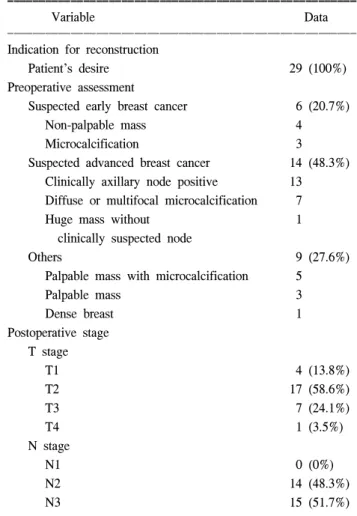
Preoperative assessments indicated that 14 patients (48.3%) were in relatively advanced stages of the cancer. These patients showed profound clinical characteristics such as axillary lymph node involvement, and larger tumor sizes with or without diffuse microcalcification. These patients were at first not considered for breast reconstruction during treatment planning, but after considering the patient’s young age and after discussing the option with the patient, each one decided to undergo breast reconstruction. Postoperatively, the final pathologic findings showed IIIA in 13 cases (44.8%), IIIB in 1 case (3.4%), IIIC in 15 cases (51.8%) and in terms of T
Table 1. Skin-Sparing Mastectomy with immediate breast recon- struction in AMC (1996∼2002)
ꠚꠚꠚꠚꠚꠚꠚꠚꠚꠚꠚꠚꠚꠚꠚꠚꠚꠚꠚꠚꠚꠚꠚꠚꠚꠚꠚꠚꠚꠚꠚꠚꠚꠚꠚꠚꠚꠚꠚꠚꠚꠚꠚꠚꠚꠚꠚꠚꠚꠚꠚꠚꠚꠚꠚ
Variable Data
ꠏꠏꠏꠏꠏꠏꠏꠏꠏꠏꠏꠏꠏꠏꠏꠏꠏꠏꠏꠏꠏꠏꠏꠏꠏꠏꠏꠏꠏꠏꠏꠏꠏꠏꠏꠏꠏꠏꠏꠏꠏꠏꠏꠏꠏꠏꠏꠏꠏꠏꠏꠏꠏꠏꠏ Patient number 191 cases
Age, range (mean) 25∼66 (39) Stage*
0 33 (17.3%)
I 62 (32.5%)
IIA 47 (24.6%)
IIB 16 (8.4%)
IIIA 13 (6.8%)
IIIB 1 (0.5%)
IIIC 15 (7.9%)
Other 4 (2.1%)
ꠏꠏꠏꠏꠏꠏꠏꠏꠏꠏꠏꠏꠏꠏꠏꠏꠏꠏꠏꠏꠏꠏꠏꠏꠏꠏꠏꠏꠏꠏꠏꠏꠏꠏꠏꠏꠏꠏꠏꠏꠏꠏꠏꠏꠏꠏꠏꠏꠏꠏꠏꠏꠏꠏꠏ
*AJCC staging, 6th edition.
Table 2. Preoperative assessment of extent of disease and its staging for advanced breast cancer patients r under- going skin-sparing mastectomy with immediate recon- struction
ꠚꠚꠚꠚꠚꠚꠚꠚꠚꠚꠚꠚꠚꠚꠚꠚꠚꠚꠚꠚꠚꠚꠚꠚꠚꠚꠚꠚꠚꠚꠚꠚꠚꠚꠚꠚꠚꠚꠚꠚꠚꠚꠚꠚꠚꠚꠚꠚꠚꠚꠚꠚꠚꠚꠚ
Variable Data
ꠏꠏꠏꠏꠏꠏꠏꠏꠏꠏꠏꠏꠏꠏꠏꠏꠏꠏꠏꠏꠏꠏꠏꠏꠏꠏꠏꠏꠏꠏꠏꠏꠏꠏꠏꠏꠏꠏꠏꠏꠏꠏꠏꠏꠏꠏꠏꠏꠏꠏꠏꠏꠏꠏꠏ Indication for reconstruction
Patient’s desire 29 (100%)
Preoperative assessment
Suspected early breast cancer 6 (20.7%)
Non-palpable mass 4
Microcalcification 3
Suspected advanced breast cancer 14 (48.3%) Clinically axillary node positive 13 Diffuse or multifocal microcalcification 7
Huge mass without 1
clinically suspected node
Others 9 (27.6%)
Palpable mass with microcalcification 5
Palpable mass 3
Dense breast 1
Postoperative stage T stage
T1 4 (13.8%)
T2 17 (58.6%)
T3 7 (24.1%)
T4 1 (3.5%)
N stage
N1 0 (0%)
N2 14 (48.3%)
N3 15 (51.7%)
ꠏꠏꠏꠏꠏꠏꠏꠏꠏꠏꠏꠏꠏꠏꠏꠏꠏꠏꠏꠏꠏꠏꠏꠏꠏꠏꠏꠏꠏꠏꠏꠏꠏꠏꠏꠏꠏꠏꠏꠏꠏꠏꠏꠏꠏꠏꠏꠏꠏꠏꠏꠏꠏꠏꠏ
staging, T1 in 4 cases (13.8%), T2 in 17 cases (58.6%), T3 in 7 cases (24.1%), and T4 in 1 case. Thus, the percentage of patients with lesions above T3, on which cancer cells could technically remain after the skin sparing mastectomy was 62.1%. Pathologic examinations were performed to confirm the absence of residual cancer cells in the skin margins. N staging assessment found that there were no N1 lesions, N2 lesions in 14 cases (48.3%), and N3 lesions in 15 cases (51.7%). Since nodal status was the most important factor in determining the stage of the disease in this study, all of these cases were determined to be stage III or higher because N2 or N3 lesions were found in all patients. We were able to successfully remove all involved lymph nodes through conventional dissections during modified radical mastectomy (Table 2).
3) Management and outcome result of patients
The mean age of the patients who underwent immediate reconstruction was 36 years old, which was younger than the overall mean age of 39 for patients who had undergone skin
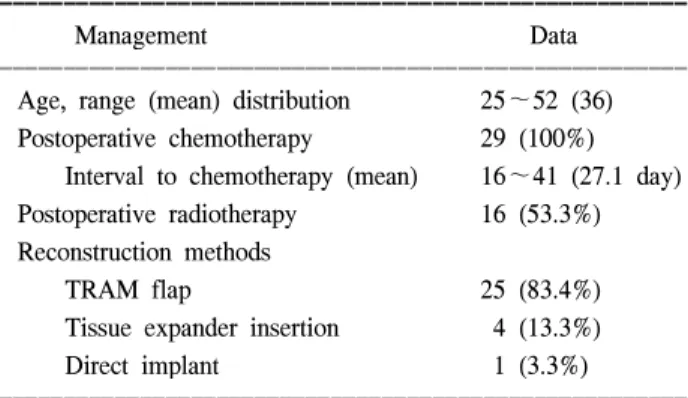
sparing mastectomy. TRAM (transverses rectus abdominis myocutaneus) with the use of pedicles was the most common reconstruction method with 24 cases, tissue expander insertions were used in 4 cases, and a direct implant insertion was used in one case. Radiotherapy was performed in 16 patients (53.3%) and chemotherapy was conducted without delay in all cases without any specific complications. The mean time of beginning of chemotherapy was 27 days following surgery and most patients began within fourth weeks. In all cases, there was no need to delay the adjuvant treatment due to postoperative complications (Table 3).
Twenty two patients who had undergone surgery until 2001 December received follow-up examinations for a median duration of 36.1 months (16.5∼49.1 months). Local recur- rence occurred in only one case during this period. This patient had a recurrent nodule on the skin of the reconstructed breast which was detected 16 months after surgery. This patient has recently developed bone and lung metastasis. Distant metastasis of cancer without local recurrence occurred in 3 cases, two of which had metastastic lesions on the bone, lung and/or liver, and the cancer reoccurred in the contralateral axillary lymph node of the other patient (Table 4). There was no difference in the disease free survival rates of the group that underwent im- mediate reconstruction and the group that did not (P=0.093) (Fig. 2).
DISCUSSION
Starting recently in Korea, patients in the early stages of breast cancer have been undergoing breast conservation surgery in order to minimize the psychological and socio- Table 3. Management of patients advanced breast cancer under-
going skin-sparing mastectomy with immediate recon- struction (stage III, n= 29)
ꠚꠚꠚꠚꠚꠚꠚꠚꠚꠚꠚꠚꠚꠚꠚꠚꠚꠚꠚꠚꠚꠚꠚꠚꠚꠚꠚꠚꠚꠚꠚꠚꠚꠚꠚꠚꠚꠚꠚꠚꠚꠚꠚꠚꠚꠚꠚꠚꠚꠚꠚꠚꠚꠚꠚ
Management Data
ꠏꠏꠏꠏꠏꠏꠏꠏꠏꠏꠏꠏꠏꠏꠏꠏꠏꠏꠏꠏꠏꠏꠏꠏꠏꠏꠏꠏꠏꠏꠏꠏꠏꠏꠏꠏꠏꠏꠏꠏꠏꠏꠏꠏꠏꠏꠏꠏꠏꠏꠏꠏꠏꠏꠏ Age, range (mean) distribution 25∼52 (36) Postoperative chemotherapy 29 (100%)
Interval to chemotherapy (mean) 16∼41 (27.1 day) Postoperative radiotherapy 16 (53.3%) Reconstruction methods
TRAM flap 25 (83.4%)
Tissue expander insertion 4 (13.3%)
Direct implant 1 (3.3%)
ꠏꠏꠏꠏꠏꠏꠏꠏꠏꠏꠏꠏꠏꠏꠏꠏꠏꠏꠏꠏꠏꠏꠏꠏꠏꠏꠏꠏꠏꠏꠏꠏꠏꠏꠏꠏꠏꠏꠏꠏꠏꠏꠏꠏꠏꠏꠏꠏꠏꠏꠏꠏꠏꠏꠏ
Table 4. Outcome for patients with advanced breast cancer undergoing skin-sparing mastectomy with immediate reconstruction (stage III, n= 22)
ꠚꠚꠚꠚꠚꠚꠚꠚꠚꠚꠚꠚꠚꠚꠚꠚꠚꠚꠚꠚꠚꠚꠚꠚꠚꠚꠚꠚꠚꠚꠚꠚꠚꠚꠚꠚꠚꠚꠚꠚꠚꠚꠚꠚꠚꠚꠚꠚꠚꠚꠚꠚꠚꠚꠚ
Variable Data
ꠏꠏꠏꠏꠏꠏꠏꠏꠏꠏꠏꠏꠏꠏꠏꠏꠏꠏꠏꠏꠏꠏꠏꠏꠏꠏꠏꠏꠏꠏꠏꠏꠏꠏꠏꠏꠏꠏꠏꠏꠏꠏꠏꠏꠏꠏꠏꠏꠏꠏꠏꠏꠏꠏꠏ Median follow-up months (range) 36.1 (16.5∼49.1) Local recurrence
Chest wall* 1 (4.5%)
Distant metastasis 3 (13.7%)
Total 4 (18.2%)
ꠏꠏꠏꠏꠏꠏꠏꠏꠏꠏꠏꠏꠏꠏꠏꠏꠏꠏꠏꠏꠏꠏꠏꠏꠏꠏꠏꠏꠏꠏꠏꠏꠏꠏꠏꠏꠏꠏꠏꠏꠏꠏꠏꠏꠏꠏꠏꠏꠏꠏꠏꠏꠏꠏꠏ
*Disease free interval: 16 months/This case was combined distant metastasis recently.
Fig. 2. Disease free survival of SSM and no-SSM group on advanced cancer patients.
logical problems associated with the loss of a breast.
However, when conservation surgery cannot be utilized, the patient must undergo a mastectomy. In such cases, immediate breast reconstruction can be performed to compensate for the loss of a breast and, in Korea where the proportion of young breast cancer patients is high, the application of this surgical modality is expected to increase. There is no different in the rate of incidence and detection of local recurrences between SSM with immediate breast reconstruction and conventional mastectomy in many studies,(5,6) so it has become accepted as a viable surgical alternative for breast cancer in the early stages due to its excellent cosmetic results compared to any other form of breast reconstructive surgery.(7,8) However, SSM is not advised for clinically advanced breast cancer due to several reasons. One of the most important reasons is that the preserved skin tissue could be infiltrated with the cancer, increasing the chance of local recurrence.(9) Some recent reports have indicated that the rate of local recurrence is actually not that high.(10∼12) Calrson and Slavin, et al.(8,13) reported that local recurrence rates of all patients, including those in the early stages were 2% to 4.8% in their study. The local recurrence rate in this study was 4.5% and the distant recurrence rate was 13.7%andsimilar results were shown in Robert s report, in which 25 clinically advanced breast cancer patients above stage IIB (AJCC staging 5th edition), with a 4.0% rate of local recurrence and 16% of distant. These results showed better than those in other reports.(10) In cases where the tumor is large and axillary lymph node metastasis of the primary tumor has occurred, the chances of local recurrence and systemic recurrence are high.
In these cases, it is essential that chemotherapy, radiation ther- apy, hormonal therapy be administered following surgery.(11) These are considered to be the ideal adjuvant methods of treatment for advanced breast cancer which can clearly de- crease the risks of local recurrence and increase the patients’
chances of survival.(14) However, patients who must undergo these adjuvant treatment methods must be cautious in their decision to reconstruct the breast. SSM with immediate breast reconstruction is not advised for patients with clinically advanced breast cancer for several reasons, including concerns regarding the increased risk of local recurrence, possible effects to the patient’s survival, and concerns that prolonged recovery from an extensive surgery would result in delays in postoperative chemotherapy.(15) Because the effects of breast reconstruction on the oncological aspects of adjuvant radiotherapy have become a matter of concern, the safety of such treatment is becoming the main issue of this matter.
And in fact, the application of radiotherapy following breast reconstruction has come under scrutiny. Buchholz et al.(16) have raised two serious issues involving adjuvant radiotherapy following immediate breast reconstruction. First, the cosmetic results might deteriorate after radiation due to contracture.
Secondly, the simulation for radiotherapy is considered to be rather difficult, resulting in a decrease in the total dosage of radiation due to the reconstructed breast. In our study, 16 patients (53.3%) who underwent radiotherapy after surgery are still satisfied with the cosmetic results of their operation.
The rates of local recurrence or other parameters between the radiation group and non-radiation group could not be compared because the number of patients was so small, however this is an issue for further consideration.
CONCLUSION
In Korea, a relatively high number of SSM with immediate breast reconstruction procedures are conducted for the treatment of breast cancer. Through the analysis of data from this institute, SSM with immediate reconstruction seemed to be safe and effective for patients with clinically advanced breast cancer. However, continued accurate preoperative assessments of the extent of the disease and proper discussion and treatment planning between the surgeon and patient are needed.
REFERENCES
1) National Cancer for Health Statistics. SEER cancer statistic review (1973∼1998), 2001.
2) Ministary of Health and Welfare, Republic of Korea. Annual Report of the Central Cancer Resistry in Korea 2003 (2001.
1.∼2002. 2.)
3) Toth BA, Lappert P. Modified skin incisions for mastectomy:
The need for plastic surgical input in preoperative planning.
Plast Reconstr Surg 1991;87:1048-53.
4) Ahn SH, Yoon HS, Han SH, Lee TJ. Skin sparing mastectomy with circumareolar incision and immediate reconstruction in breast cancer. J Korean Surg Soc 1998;55(6 supp):951-8.
5) Ho CM, Mak CK, Lau Y, Cheung WY, Hung WK. Skin involvement in invasive breast carcinoma: Safety of skin- sparing mastectomy. Ann Surg Oncol 2003;10:102-7.
6) Watier E, Leveque J, Pioud R, Pailheret JP, Grall JY. Imme- diate breast reconstruction with deepidermalized transverse rectus abdominis musculocutaneous flap after skin sparing mastectomy. Eur J Obstet Gynecol Reproduct Biol 1999;
84:17-21.
7) Carlson GW, Losken A, Moore B, Thornton J, Elliott M,
Bolitho G, et al. Results of immediate breast reconstruction after skin-sparing mastectomy. Ann Plast Surg 2001;46:222-8.
8) Slavin SA, Schnitt SJ, Duda RB, Houlihan MJ, Koufman CN, Troyan SL, et al. Skin-sparing mastectomy and immediate reconstruction: Oncologic risks and aesthetic results in patients with early stage breast cancer. Plast Reconst Surg 1998;102:
49-62.
9) Simmons RM. Skin-sparing mastectomies. Am J Surg 2000;
180:290-3.
10) Foster RD, Esserman LJ, Anthony JP, Hwang ES, Do H.
Skin-sparing mastectomy and immediate breast reconstruction:
A prospective cohort study for the treatment of advanced stages of breast carcinoma. Ann Surg Oncol 2002;9:462-6.
11) Hortobagyi GN. Overview of new treatment for breast cancer.
Breast Cancer Res Treat 1992;21:3-13.
12) Kroll SS, Khoo A, Singletary SE, Ames FC, Wang BG, Reece GP, et al. Local recurrence risk after skin-sparing and conventional mastectomy: A 6-year follow-up. Plast Reconst
Surg 1999;104:421-5.
13) Carlson GW, Bostwick J 3rd, Styblo TM, Moore B, Murray DR, Wood WC. Skin-sparing mastectomy: oncologic and reconstructive considerations. Ann Surg 1997;225:570-8.
14) Kuerer HM, Newman LA, Smith TL, Ames FC, Hunt KK, Dhingra K, et al. Clinical course of breast cancer patients with complete pathologic primary tumor and axillary lymph node response to doxorubicin-based neoadjuvant chemotherapy. J Clini Oncol 1999;17:460-9.
15) Newman LA, Kuerer HM, Hunt KK, Ames FC, Ross MI, Theriault R, et al. Feasibility of immediate breast recon- struction for locally advanced breast cancer. Ann Surg Oncol 1999;6:671-5.
16) Buchholz TA, Kronowitz SJ, Kuerer HM. Immediate breast reconstruction after skin-sparing mastectomy for the treatment of advanced breast cancer: Radiation oncology considerations.
Ann Surg Oncol 2002;9:820-1.