ABSTRACT
Parkinson's disease (PD) is the second most common neurodegenerative disorder. Although its major manifestation is motor symptoms, resulting from the loss of dopaminergic neurons in the substantia nigra, psychiatric symptoms, such as depression, anxiety, hallucination, delusion, apathy and anhedonia, impulsive and compulsive behaviors, and cognitive
dysfunction, may also manifest in most patients with PD. Given that the quality of life — and the need for institutionalization — is so highly dependent on the psychiatric well-being of patients with PD, psychiatric symptoms are of high clinical significance. We reviewed the prevalence, risk factors, pathophysiology, and treatment of psychiatric symptoms to get a better understanding of PD for improved management.
Keywords: Parkinson's Disease; Psychiatry; Depression; Psychosis; Impulse Control Disorder;
Dementia
INTRODUCTION
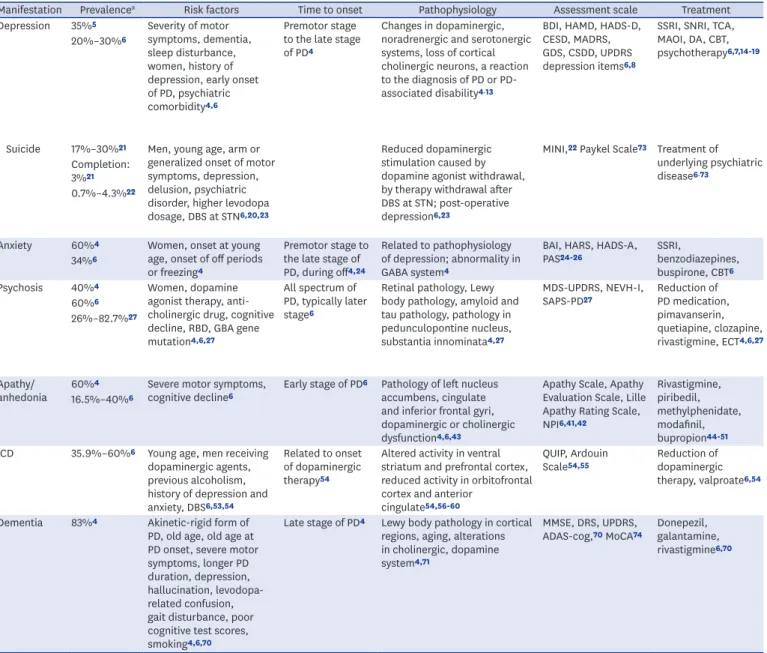
Parkinson's disease (PD) is the second most common neurodegenerative disorder, accounting for 0.5%–5% of the population older than 65 years.1 The prevalence has been shown to increase with age. Motor symptoms, such as bradykinesia, rigidity, tremor, and gait disturbance, resulting from the loss of dopaminergic neurons in the substantia nigra, are the main symptoms of PD. However, the clinical importance of nonmotor symptoms, including hyposmia, rapid eye movement sleep behavior disorder, constipation, and psychiatric symptoms, is being realized. Psychiatric symptoms, such as depression, anxiety, hallucination, delusion, apathy and anhedonia, impulsive and compulsive behaviors, and cognitive dysfunction, appears to be manifesting in most PD patients (Fig. 1).2 Given that the quality of life — and the need for institutionalization — is so highly dependent on the psychiatric well-being of PD patients, psychiatric symptoms are of high clinical significance.3,4 Here, we reviewed the prevalence, risk factors, pathophysiology, and treatment of psychiatric symptoms in PD patients (Table 1).
Review Article
Received: Aug 31, 2018 Accepted: Oct 11, 2018 Address for Correspondence:
Jong-Min Kim, MD, PhD
Department of Neurology, Seoul National University Bundang Hospital, Seoul National University College of Medicine, 82 Gumi-ro, 173-beon-gil, Bundang-gu, Seongnam 13620, Republic of Korea.
E-mail: [email protected]
© 2018 The Korean Academy of Medical Sciences.
This is an Open Access article distributed under the terms of the Creative Commons Attribution Non-Commercial License (https://
creativecommons.org/licenses/by-nc/4.0/) which permits unrestricted non-commercial use, distribution, and reproduction in any medium, provided the original work is properly cited.
ORCID iDs Ji Won Han
https://orcid.org/0000-0003-2418-4257 Yebin D. Ahn
https://orcid.org/0000-0001-9566-5555 Won-Seok Kim
https://orcid.org/0000-0002-1199-5707 Cheol Min Shin
https://orcid.org/0000-0003-2265-9845 Seong Jin Jeong
https://orcid.org/0000-0002-3580-1452 Yoo Sung Song
https://orcid.org/0000-0001-7985-1358
Ji Won Han ,1 Yebin D. Ahn ,1 Won-Seok Kim ,2 Cheol Min Shin ,3
Seong Jin Jeong ,4 Yoo Sung Song ,5 Yun Jung Bae ,6 and Jong-Min Kim 7
1Department of Neuropsychiatry, Seoul National University Bundang Hospital, Seongnam, Korea
2Department of Rehabilitation Medicine, Seoul National University Bundang Hospital, Seongnam, Korea
3Department of Internal Medicine, Seoul National University Bundang Hospital, Seongnam, Korea
4Department of Urology, Seoul National University Bundang Hospital, Seongnam, Korea
5Department of Nuclear Medicine, Seoul National University Bundang Hospital, Seongnam, Korea
6Department of Radiology, Seoul National University Bundang Hospital, Seongnam, Korea
7 Department of Neurology, Seoul National University College of Medicine, Seoul National University Bundang Hospital, Seongnam, Korea
Psychiatric Manifestation in Patients with Parkinson's Disease
Medicine General &
Social Medicine
DEPRESSION
The prevalence of depression in PD patients is 20%–35%,5,6 and the 1-year incidence of minor depression is 18%.7 The prevalence and incidence of depression in PD patients are varied depending on the diagnostic criteria. Depression can manifest anytime, from the premotor stage to the late stages of the disease.4 Depression in PD patients generally involves apathy, anhedonia, somatic, and neurovegetative symptoms, such as fatigue, concentration difficulty, insomnia, etc.; therefore, it may be challenging to identify clinical depression in PD patients.8 Depressive symptoms can be assessed using general depression scales, such as Beck Depression Inventory, Hamilton Depression Rating Scale, Hospital Anxiety and Depression Scale-depression subscale, Centre for Epidemiologic Studies Depression Scale, Montgomery–Asberg Depression Rating Scale, Geriatric Depression Scale, Cornell Scale for Depression in Dementia, and Unified Parkinson's Disease Rating Scale (UPDRS) depression item.6,8 Risk factors of depression are women, severity of motor symptoms, occurrence of Yun Jung Bae
https://orcid.org/0000-0002-1779-4949 Jong-Min Kim
https://orcid.org/0000-0001-5723-3997 Disclosure
The authors have no potential conflicts of interest to disclose.
Author Contributions
Conceptualization: Han JW, Kim WS, Shin CM, Jeong SJ, Song YS, Bae YJ, Kim JM. Data curation: Han JW, Ahn YD. Methodology: Han JW, Ahn YD, Kim JM. Writing - original draft:
Han JW, Ahn YD, Kim JM. Writing - review &
editing: Han JW, Kim WS, Shin CM, Jeong SJ, Song YS, Bae YJ, Kim JM.
PD
Depression
• Around 35% in PD
• Changes in dopaminergic, noradrenergic, and serotonergic systems
• Psychological reaction to the diagnosis of PD or PD-associated disability
• Be cautious to suicide Anxiety
• Up to 60% in PD
• Risk of underdiagnosis
• Premotor phase
• Presented dominantly during off periods such as ‘episodic anxiety’
Psychosis
• Dominantly visual hallucination, delusion
• Related to DLBD, PDD
• Difficult to identify de novo PD psychosis or drug-induced psychosis or combined forms of psychosis
• Reducing the dose of anti-parkinsonian medication, atypical antipsychotics
PDD• More than 80% of PD, later form of PD
• Mixed cortical and subcortical dementia
• Frontal executive dysfunction and visuospatial dysfunction
• Risk factors: akinetic-rigid form of PD, advanced age, longer duration of symptoms of PD, depression, hallucination, early occurrence of levodopa-related psychosis, smoking
ICD• Up to 60%
• Compulsive gambling, buying, sexual behavior, creativity, and eating
• Related to onset of dopaminergic therapy
• Dose reduction or discontinuation of dopamine agorist
Apathy/anhedonia
• Up to 40% in PD, early stage of PD
• Marked loss of motivation (apathy)
• Loss of interest (anhedonia)
• Be associated with severe motor symptoms and cognitive decline
• Dopaminergic depletion in nigrostriatal pathway, dopamine withdrawal
Fig. 1. Diagram of psychiatric manifestations in PD. Nonmotor symptoms in PD include various psychiatric symptoms, such as depression, anxiety, psychosis, apathy/anhedonia, ICD, and dementia. These psychiatric symptoms contribute to impaired quality of life for patients and families and are considered risk factors for nursing home placement.
PD = Parkinson's disease, ICD = impulse control disorder, DLBD = diffuse Lewy body disease, PDD = Parkinson's disease dementia.
motor complications or fluctuations, dosage of dopaminergic medication, cognitive decline and dementia, psychotic episodes, anxiety, and sleep disturbance.4,6
Depressive symptoms in PD patients can manifest across a wide range of severity, chronicity and etiology, including major depression, dysthymia, minor depression, subsyndromal
Table 1. Summary of psychiatric manifestations in PD
Manifestation Prevalencea Risk factors Time to onset Pathophysiology Assessment scale Treatment
Depression 35%5 Severity of motor symptoms, dementia, sleep disturbance, women, history of depression, early onset of PD, psychiatric comorbidity4,6
Premotor stage to the late stage of PD4
Changes in dopaminergic, noradrenergic and serotonergic systems, loss of cortical cholinergic neurons, a reaction to the diagnosis of PD or PD- associated disability4,13
BDI, HAMD, HADS-D, CESD, MADRS, GDS, CSDD, UPDRS depression items6,8
SSRI, SNRI, TCA, MAOI, DA, CBT, psychotherapy6,7,14-19 20%–30%6
Suicide 17%–30%21 Men, young age, arm or generalized onset of motor symptoms, depression, delusion, psychiatric disorder, higher levodopa dosage, DBS at STN6,20,23
Reduced dopaminergic stimulation caused by dopamine agonist withdrawal, by therapy withdrawal after DBS at STN; post-operative depression6,23
MINI,22 Paykel Scale73 Treatment of underlying psychiatric disease6,73
Completion:
3%21 0.7%–4.3%22
Anxiety 60%4 Women, onset at young age, onset of off periods or freezing4
Premotor stage to the late stage of PD, during off4,24
Related to pathophysiology of depression; abnormality in GABA system4
BAI, HARS, HADS-A,
PAS24-26 SSRI,
benzodiazepines, buspirone, CBT6 34%6
Psychosis 40%4 Women, dopamine agonist therapy, anti- cholinergic drug, cognitive decline, RBD, GBA gene mutation4,6,27
All spectrum of PD, typically later stage6
Retinal pathology, Lewy body pathology, amyloid and tau pathology, pathology in pedunculopontine nucleus, substantia innominata4,27
MDS-UPDRS, NEVH-I,
SAPS-PD27 Reduction of PD medication, pimavanserin, quetiapine, clozapine, rivastigmine, ECT4,6,27 60%6
26%–82.7%27
Apathy/
anhedonia 60%4 Severe motor symptoms,
cognitive decline6 Early stage of PD6 Pathology of left nucleus accumbens, cingulate and inferior frontal gyri, dopaminergic or cholinergic dysfunction4,6,43
Apathy Scale, Apathy Evaluation Scale, Lille Apathy Rating Scale, NPI6,41,42
Rivastigmine, piribedil, methylphenidate, modafinil, bupropion44-51 16.5%–40%6
ICD 35.9%–60%6 Young age, men receiving dopaminergic agents, previous alcoholism, history of depression and anxiety, DBS6,53,54
Related to onset of dopaminergic therapy54
Altered activity in ventral striatum and prefrontal cortex, reduced activity in orbitofrontal cortex and anterior
cingulate54,56-60
QUIP, Ardouin
Scale54,55 Reduction of dopaminergic therapy, valproate6,54
Dementia 83%4 Akinetic-rigid form of PD, old age, old age at PD onset, severe motor symptoms, longer PD duration, depression, hallucination, levodopa- related confusion, gait disturbance, poor cognitive test scores, smoking4,6,70
Late stage of PD4 Lewy body pathology in cortical regions, aging, alterations in cholinergic, dopamine system4,71
MMSE, DRS, UPDRS,
ADAS-cog,70 MoCA74 Donepezil, galantamine, rivastigmine6,70
PD = Parkinson's disease, BDI = Beck depression inventory, HAMD = Hamilton depression rating scale, HADS-D = hospital anxiety and depression scale- depression subscale, CESD = center for epidemiologic studies depression scale, MADRS = Montgomery–Asberg depression rating scale, GDS = geriatric depression scale, CSDD = Cornell scale for depression in dementia, MDS-UPDRS = Movement disorder society-unified Parkinson's disease rating scale, SSRI
= selective serotonin reuptake inhibitors, SNRI = serotonin–norepinephrine reuptake inhibitors, TCA = tricyclic antidepressants, MAOI = monoamine oxidase B inhibitor, DA = dopamine agonists, CBT = cognitive behavioral therapy, DBS = deep brain stimulation, STN = subthalamic nucleus, MINI = mini-international neuropsychiatric interview suicidality module, RBD = rapid eye movement sleep behavior disorder, GBA = glucocerebrosidase, GABA = gamma-aminobutyric acid, BAI = Beck anxiety inventory, HARS = Hamilton anxiety rating scale, HADS-A = hospital anxiety and depression scale-anxiety subscale, PAS = Parkinson anxiety scale, NEVH-I = north-east visual hallucinations interview, SAPS-PD = scale for the assessment of positive symptoms in Parkinson's disease, ECT = electroconvulsive therapy, NPI = neuropsychiatric inventory, QUIP = questionnaire for impulsive-compulsive disorders in Parkinson's disease, ICD = impulse control disorder, MMSE = mini-mental state examination, DRS = dementia rating scale, ADAS-cog = Alzheimer's disease assessment scale-cognitive subscale, MoCA = Montreal cognitive assessment.
aAmong the patients with Parkinson's disease.
depression or depressive disorder due to PD, and adjustment disorders (Fig. 2).9,10 According to the provisional diagnostic criteria for depression in PD patients and the Diagnostic and Statistical Manual of Mental Disorders (5th Edition), the criteria for diagnosing major depression are as follows: persistent and pervasively depressed moods, loss of interest and pleasure with other cognitive and somatic symptoms. Dysthymia is defined as a persistent chronic depressive disorder, lasting more than two years. The depressive symptoms in minor depression involve fewer symptoms and less impairment than major depression.
Subsyndromal depression can be diagnosed for depressive symptoms that do not meet the criteria for major depression, dysthymia, or minor depression with respect to severity and symptom duration; the depressive symptoms are of short duration or are not ‘present most of the day, nearly every day.’ For example, depressive symptoms that arise only during the off phase of motor fluctuation in PD can be classified as subsyndromal depression. Depressive disorder due to PD refers to depressive symptoms which could have direct pathophysiological relevance to PD, regardless of symptom severity; it can manifest a depressive episode responsive to dopamine replacement therapy or major depressive-like episodes, even with mixed features of manic or hypomanic episodes. Adjustment disorders are a reactive depression, such as grief and demoralization, to the diagnosis of PD. A systemic review reported that the weighted prevalence of major depressive disorder was 17% of PD patients,
Depression in PD DSM-5
Diagnostic criteria for depression in PD by NINDS/NIMH work group
Depressive disorder due to PD
Minor depression (DSM-IV-TR) Major
depression
Dysthymia Adjustment
disorder
Subsyndromal depression
Fig. 2. Diagnostic nomenclature of depression in PD. The Diagnostic and Statistical Manual of Mental Disorders (5th Edition) by American Psychiatric Association classifies depression according to its etiology and symptom severity. The provisional diagnostic criteria for depression in Parkinson's disease proposed by the NINDS/NIMH Work Group classifies depression according to the presence or absence of symptoms and severity.
PD = Parkinson's disease, DSM-IV-TR = a text revision of diagnostic and statistical manual of mental disorders (4th edition), DSM-5 = diagnostic and statistical manual of mental disorders (5th edition).
that of dysthymia was 13%, and that of minor depression was 22%.11 In the depression in PD, symptoms as irritability and dysphoria are more frequent than in the major depression not related to PD, while guilt, self-blame, and suicide attempts are less usual.12
Changes in dopaminergic, noradrenergic, and serotonergic systems are known to be the main pathophysiology of depression in PD patients. Reduction in dopamine transporter at the striatum and limbic brain regions, decrease in forebrain serotonin innervation, reduction in dopaminergic and noradrenergic innervation in the locus coeruleus, thalamus, and limbic brain regions, as well as an increase in neuronal loss and gliosis in locus coeruleus are evidences for changes in neurotransmitter systems related to depression. The loss of cortical cholinergic neurons also involves depression. Psychological reactions to the diagnosis of PD or PD-associated disability also play a role in triggering depression.4,13
Selective serotonin reuptake inhibitors have a satisfying efficacy for depression in PD (Table 2). They show outstanding efficacy, not only in depression, but also in daily living and motor function.14,15 Serotonin–norepinephrine reuptake inhibitors are the safest Table 2. Systematic review and meta-analysis of treatment of depression in PD
Intervention type Author (yr) Type of
analysis No. of
studies Drug by class Comparison
group SMD or
effect size Statistical heterogeneity (Q)
Pharmacological Mills et al. (2018)15 Network
meta-analysis 20 SSRI Placebo 0.49 3.23
(df = 3, P = 0.357)
TCA Placebo 0.77
MAOI Placebo −1.27
MAOI SSRI −0.78
MAOI SNRI −0.90
Zhuo et al. (2017)14 Network
meta-analysis 45 (8,890
subjects) SSRI Placebo 1.56
SNRI Placebo 1.55
TCA Placebo 1.50
DA Placebo 0.56
SSRI DA 0.99
SSRI MAOI 1.18
TCA DA 0.94
TCA MAOI 1.12
Starkstein et al. (2017)7 Systemic review 19 Citalopram Placebo Effective Paroxetine Placebo Controversial
Desipramine Placebo Effective
Venlafaxine SSRI Effective
Bomasang-Layno et al.
(2015)19 Systemic review
(meta-analysis) 20 (14) SSRI/SNRI Placebo 0.45
Citalopram Placebo 0.84
Paroxetine Placebo 0.73
Troeung et al. (2013)17 Meta-analysis 9 TCA Placebo 1.36
Omega-3 Placebo 0.92
Citalopram Placebo 0.99
Paroxetine Placebo 0.78
Venlafaxine Placebo 0.59
Behavior and other
intervention Starkstein et al. (2017)7 Systemic review 19 CBT Placebo Effective
Xie et al. (2015)18 Network
meta-analysis 12 CBT Control −1.45 Tau2 = 0.68, Z = 5.23
(df = 9, P < 0.00001) Psychodynamic
therapy CBT −2.20 Tau2 = 1.33, Z = 4.11
(df = 5, P < 0.00001) Bomasang-Layno et al.
(2015)19 Systemic review
(meta-analysis) 20 (14) CBT, group
psychodrama Control 0.87
Troeung et al. (2013)17 Meta-analysis 9 CBT Control 1.57
rTMS Starkstein et al. (2017)7 Systemic review 19 rTMS Controversial
PD = Parkinson's disease, SMD = standardized mean difference, SSRI = selective serotonin reuptake inhibitors (citalopram, fluoxetine, paroxetine, sertraline, etc.), TCA = tricyclic antidepressants (amitriptyline, clomipramine, desipramine, nortriptyline, trazodone, etc.), MAOI = monoamine oxidase B inhibitors (lazabemide, rasagiline, safinamide, selegiline, etc.), SNRI = serotonin–norepinephrine reuptake inhibitors (duloxetine, venlafaxine etc.), DA = dopamine agonists (pergolide, piribedil, pramipexole, ropinirole, rotigotine, etc.), CBT = cognitive behavioral therapy, rTMS = repetitive transcranial magnetic stimulation.
medication with high efficacy for depression; however, improvements in motor symptoms remain poor.14 Tricyclic antidepressants are also good for improving depression.16 Many previous studies have focused on selective serotonin reuptake inhibitors as the first line of treatment for depression in PD patients; however, monoamine oxidase B inhibitors may also be considered as therapeutic alternatives for depression in PD, showing a higher standardized mean difference than selective serotonin reuptake inhibitors or tricyclic antidepressants.15 As shown previously, monoamine oxidase B inhibitors and dopamine agonists tend to have better performance than serotonin–norepinephrine reuptake inhibitors or tricyclic antidepressants in motor symptoms in PD.6,14-16 Cognitive behavioral therapy and psychotherapy can also improve depression by improving the executive function.7,17-19 Nonetheless, further studies are needed to determine whether repetitive transcranial magnetic stimulation works for depression in PD.7
Suicide
The prevalence of suicidal ideation is approximately 17%–30% among those with PD, which is two times higher than the general population.20,21 The completion rate of suicidal attempt has been reported to be between 0.7% and 4.3%.22 Risk factors of suicide are men, upper extremity or generalized onset of motor symptoms, depression, delusion or any comorbid psychiatric disorder, higher levodopa dosage, and deep brain stimulation (DBS) at the subthalamic nucleus.6,20,23 Among patients treated with DBS, suicidal behavior appears to be associated with postoperative depression and/or altered impulse regulation. A large international multicenter study reported that the prevalence of suicides occurring in the first postoperative year (263/100,000/year, 0.26%) were higher than the age-, gender- and country-adjusted World Health Organization suicide rates (standardized mortality ratio, 12.63–15.64; P < 0.001) and remained elevated at the fourth postoperative year (38/100,000/
year, 0.04%) (standardized mortality ratio, 1.81–2.31; P < 0.05).23 One recent study compared 10 PD patients with complete suicide and randomly selected 30 PD patients who died from natural causes.21 PD patients with complete suicide were younger and had less comorbidities, better cognition, lower UPDRS motor scores, lower Hoehn and Yahr stage, and higher use of entacapone than their counterparts.
The pathogenesis of suicidal ideation has been shown to be hypo-dopaminergic syndrome caused by dopamine agonist withdrawal, which is associated with depression, anxiety, apathy, and anhedonia, resulting in suicide attempts.6,23 After DBS at subthalamic nucleus, reduced dopaminergic stimulation after drug dose reduction may be related to suicide.
Treatment of suicide ideation is targeting the underlying suicide-related psychiatric
symptoms, such as depression or anxiety.6,23 Proper management of motor fluctuation is also important to prevent suicide for relatively young, cognitively well-functioning patients with few comorbidities.21 Preoperative assessment, including psychosocial assessments, focusing on the potential suicidal risks before DBS at subthalamic nucleus is recommended as a preventive measure.6,23
ANXIETY
Anxiety appears to be underrecognized and undertreated in PD patients due to diagnostic imprecision, symptom overlap with motor and cognitive features of PD, complexity of diagnosis, healthcare access and resources, as well as under-reporting of symptoms by patients and caregivers.24 Anxiety symptoms are commonly accompanied by depression;
they can be also presented as generalized anxiety with somatic symptoms, anxiety attacks, agoraphobia, and social avoidance. Anxiety and depression are the strongest predictors of poor quality of life. They can occur prior to the onset of motor symptoms to the late stages of PD.4 It can be presented dominantly during off periods as ‘episodic anxiety,’ but does not always correspond with motor fluctuation.24
The prevalence of anxiety in PD patients was shown to be as high as 60%, a frequency greater than that found in community dwelling age-matched controls.4,6,24 Risk factors of anxiety are women, onset at young age, and onset of off periods or freezing.4 Psychosocial factors are related to fear of being unable to function or being embarrassed due to the exhibition of motor symptoms, and biological factors are related to the brain and chemical pathways linked with depression in PD patients, such as abnormal gamma-aminobutyric acid function.4 Degeneration of subcortical nuclei and ascending dopamine, as well as norepinephrine and serotonin pathways within the frontal–basal ganglia circuits may be responsible for symptoms of anxiety.13
Screening using anxiety assessment scales, such as Beck Anxiety Inventory, can improve diagnostic accuracy for anxiety.25 Hamilton Anxiety Rating Scale and Hospital Anxiety and Depression Scale-anxiety subscale can be used to detect anxiety in PD patients; however, they do not show satisfactory validity due to the heterogeneity of anxiety disturbances in PD.24 Parkinson Anxiety Scale – a 12-item observer- or patient-rated scale with three subscales for persistent, episodic anxiety, and avoidance behavior – is easy and brief to administer, offering better clinimetric properties than the existing anxiety rating scales.26
Pharmacological treatments are mainly selective serotonin reuptake inhibitors, benzodiazepines, and buspirone. Nonpharmacological intervention, such as cognitive behavioral therapy, can be a treatment option.6 Because the pattern of anxiety or mood fluctuations can be heterogeneous, adjustment of antiparkinsonian medications to minimize motor fluctuations can be beneficial.24
PSYCHOSIS
Psychosis as early PD symptoms manifests as passage hallucination (peripheral visual field), illusion, and formed hallucinations. Hallucination is most often presented as visual hallucination of people, animal or inanimate objects. In the early stages, patients are nearly aware of hallucination with preserved insight. In the advanced stages, psychosis manifests as non-visual hallucination and delusions, as well as visual hallucination.6 The contents of delusions are guilt, grandiosity, reference, religious idea, persecution, jealousy, and theft.
Delusional misidentification syndrome, such as Capgras delusion, can also be presented.27 The criterion for being considered as having dementia with parkinsonism, such as diffuse Lewy body disease and Parkinson's disease dementia is recurrent visual hallucinations that are typically well formed and detailed. The diagnostic criteria of PD psychosis are summarized in Table 3.28
The prevalence of visual hallucination ranges from 22% to 38%, and that of auditory hallucination ranges from 0% to 22%.4,6,27 The overall prevalence of psychosis ranges from 26% to 82.7%. The assessment scales are the Movement Disorder Society-Unified Parkinson's Disease Rating Scale, North-East Visual Hallucinations Interview, and Scale
for the Assessment of Positive Symptoms in Parkinson's disease.27 Risk factors are women, dopamine agonist therapy, anti-cholinergic drug, cognitive decline, presence of rapid eye movement sleep behavior disorder symptoms, and glucocerebrosidase gene mutations.4,6,27 Psychosis increases the risk of dementia, and cognitive decline is one of the risk factors for psychosis in PD and vice versa.
Decrease in retinal dopamine concentration, thinning of retinal ganglion cell layer in the dominant eye, Lewy body in amygdala and parahippocampal gyrus, high level of amyloid and tau pathology in frontal, parietal, and hippocampal areas are well-established underlying pathophysiologic mechanisms of psychosis in PD patients.4,27 Brainstem atrophy in pedunculopontine nucleus and substantia innominata are known to be associated with psychosis in PD patients.27
It is difficult to discriminate between de novo PD psychosis, drug-induced psychosis, and combined forms of psychosis. About 30% of patients treated with chronic dopaminergic therapy have drug-induced psychosis. A reduction in PD medication is often the first option to treat psychosis in PD.4,6,27 If PD psychosis does not improve by reducing the dose of PD medication, atypical antipsychotics are often considered. A neuroimaging study showed that PD patients with visual hallucinations have elevated serotonin 2A (5-HT2A) receptor binding density in the visual processing areas.29 Therefore, 5-HT2A receptor inverse agonist is considered for treating psychotic symptoms in PD patients. Pimavanserin, a neocortical 5-HT2A receptor inverse agonist, may be a potential therapeutic medication targeting PD psychosis,27,30 which received approval by the Food and Drug Administration in 2016 (Table 4). Compared to the placebo, pimavanserin showed no significant differences in the discontinuation rates due to all causes, adverse effects, and death. Moreover, the incidence of at least one adverse event and serious adverse events were similar between the two groups.
The pimavanserin group showed a lower incidence of orthostatic hypotension than the placebo group, suggesting an additional benefit with respect to the management of common nonmotor symptoms in PD patients.30,31 Quetiapine, a 5-HT2A blocker with low affinity for dopamine D2 receptors and minimal motor side effects, is the most commonly used antipsychotic in PD psychosis.32,33 Although double-blind, randomized, placebo-controlled trials of quetiapine have failed to demonstrate the efficacy in PD psychosis, open-label, rater- blinded studies showed significant improvement. Quetiapine may be useful in mild cases.
Clozapine has been regarded to have minimal motor side effects, like quetiapine; it did not Table 3. Diagnosis of PD psychosis
Criteria Details
Characteristic symptoms
Presence of at least one of the symptoms Illusions
False sense of presence Hallucinations Delusions
Primary diagnosis UK PD brain bank criteria for clinical diagnosis of PD Chronology of the onset of symptoms of psychosis The symptoms occur after the onset of PD
Duration Recurrent or continuous for ≥ 1 month
Exclusion of other causes Dementia with Lewy bodies
Psychiatric disorders such as schizophrenia, schizoaffective disorder, delusional disorder, or mood disorder with psychotic features
Delirium Modified from Ravina et al.28
PD = Parkinson's disease.
show significant effect on the UPDRS motor scores and showed the lowest attrition among the antipsychotics.34 Clozapine was recommended by National Institute for Health and Care Excellence (NICE) in the United Kingdom;35 however, it requires close blood monitoring given the risk of dose-independent leukopenia/neutropenia, since 3% of patients treated with clozapine have experienced leukopenia/neutropenia requiring withdrawal.31 Psychosis with cognitive impairment can be treated by cholinesterase inhibitor, such as rivastigmine.
Electroconvulsive therapy is also one of the treatment options for psychosis. Patients usually receive 5 to 12 sessions, and the effects persist for 5 to 30 weeks. Table 5 summarizes a general approach to the management of PD psychosis.
Table 4. Systematic review and meta-analysis of treatment of psychosis in PD Intervention type Author (yr) Type of analysis No. of
studies Drug by
class Comparison
group SMD or
effect size Statistical heterogeneity (Q)
Pharmacological Yasue et al. (2016)30 Systemic review
and meta-analysis 4 Pimavanserin Placebo −2.26 Tau2 = 0.78
Jethwa and Onalaja
(2015)31 Network
meta-analysis 9 Clozapine Placebo −1.10 Tau2 = 0.00
Pimavanserin Placebo Effective Frieling et al. (2007)34 Network
meta-analysis 7 Clozapine Placebo −1.10 Chi2 = 0.08
PD = Parkinson's disease, SMD = standardized mean difference.
Table 5. A recommended stepwise approach to the management of PD psychosis
Steps Details
Step 1
A search for possible triggers Infections, electrolyte imbalance or metabolic disturbances, stroke, tumors Ruling out of medical causes of delirium
Step 2
Reduce or stop non-parkinsonian drugs that could cause psychosis Review of medications
Discontinue any nonessential centrally acting medications Choice of medications with low risk of worsening mental status Step 3
Reduce or stop adjunctive anti-parkinsonian drugs in the following
order: Adjustment of anti-parkinsonian medications as motor function will tolerate
Anticholinergics Careful consideration of the drug's benefits for motor function and risks for psychosis Monoamine oxidase B inhibitors Adjustment of dopamine agonists and levodopa dosage: Caution for the
development of dopamine agonist withdrawal syndrome and neuroleptic malignant syndrome, respectively
Amantadine Dopamine agonists COMT inhibitors Levodopa Step 4
Antipsychotics If psychotic symptoms persist, antipsychotics could be carefully added.
Quetiapine Clozapine Pimavanserin Cholinesterase inhibitor
Rivastigmine Electroconvulsive therapy
Patient and caregiver counseling for psychosis
Environmental modifications and behavioral interventions Avoidance of low light situations
Correction of visual problems
Modified from Martinez-Ramirez et al.32 and Schneider et al.33 PD = Parkinson's disease, COMT = catechol-O-methyltransferase.
APATHY AND ANHEDONIA
Apathy, defined as a marked loss of motivation not attributable to emotional distress, intellectual impairment, or diminished level of consciousness, is seen throughout the spectrum of neurocognitive disorders.36,37 Anhedonia refers to the impaired ability to experience pleasure — in other words, loss of interest — and it is one of the two core symptoms when diagnosing depressive disorder (the other symptom is ‘depressed mood’).
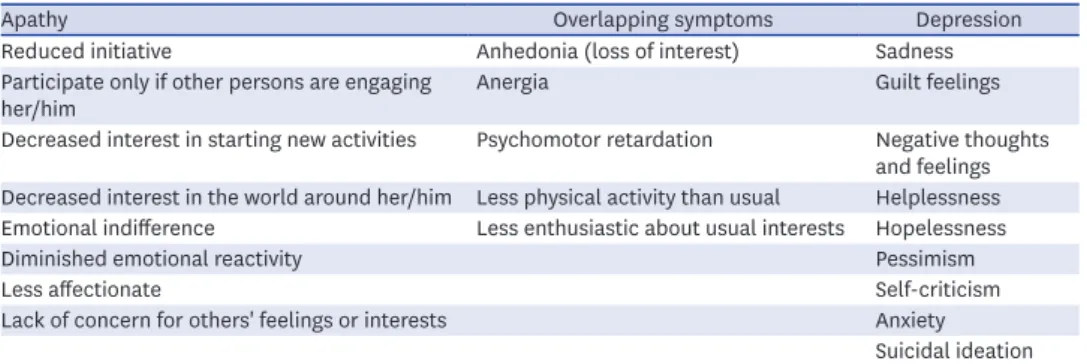
Although apathy and anhedonia are often confused with depression, they differ in terms of the mechanisms, therapeutic approaches, and prognoses occurring in PD patients.38 Some symptoms are more specific to apathy; hence, their presence or absence may help separate apathy from depression (Table 6).39
The prevalence of apathy in PD is between 16.5% and 40%; it can manifest in the early stage of the disease.6 Although apathy is usually associated with fatigue and anhedonia, about half of the patients with apathy do not suffer from concomitant depression or cognitive impairment. Therefore, apathy could be regarded as a separate clinical entity in PD patients.
Apathy among treatment-naïve patients with early-stage PD was shown to be associated with more severe motor symptoms, worse cognitive status, and low quality of life.6,40 Apathy can be evaluated by using the Lille Apathy Rating Scale41 and the apathy section of Neuropsychiatric Inventory.42 Lille Apathy Rating Scale has four dimensions for evaluating apathy: curiosity, action initiation, emotion, and self-awareness.
Risk factors are severe motor symptoms and cognitive decline.6 Apathy that is associated with the severity of motor symptoms suggests that apathy may be caused by dopamine depletion in the nigrostriatal pathway.43 Apathy in patients with post-DBS showed a relationship with dopaminergic therapy withdrawal. Atrophy of the left nucleus accumbens and reduction on gray matter density in cingulate gyrus and inferior frontal gyrus are suggested as the pathophysiological mechanisms.4,6
Pharmacological treatments are rivastigmine44 and piribedil,45 a dopamine agonist, whose dosage of up to 300 mg per day led to 34.7% reduction in apathy scores at 12 weeks.
Anticholinergics, antidepressants, and nonpharmacological treatment strategies, such as cognitive training and exercise, have been suggested.6 Methylphenidate, modafinil, and stimulating antidepressants, including bupropion, can be used to treat apathy syndrome.46 Methylphenidate and modafinil were not fully investigated to prove efficacy on apathy in
Table 6. Clinical differentiation between apathy and depression
Apathy Overlapping symptoms Depression
Reduced initiative Anhedonia (loss of interest) Sadness
Participate only if other persons are engaging
her/him Anergia Guilt feelings
Decreased interest in starting new activities Psychomotor retardation Negative thoughts and feelings Decreased interest in the world around her/him Less physical activity than usual Helplessness Emotional indifference Less enthusiastic about usual interests Hopelessness
Diminished emotional reactivity Pessimism
Less affectionate Self-criticism
Lack of concern for others' feelings or interests Anxiety
Suicidal ideation Modified from Pagonabarraga et al.39
PD patients. They may be effective in treating fatigue or PD-related sleep problems, such as excessive daytime sleepiness.47,48 Bupropion, one of the norepinephrine–dopamine reuptake inhibitors, was not shown to be effective in treating apathy by clinical trials; however, expert opinion suggested its potential efficacy.49 Since cases of bupropion-related parkinsonism or dystonia have been reported, caution is needed when using bupropion.50,51
IMPULSE CONTROL DISORDER
The reported prevalence of impulse control disorder (ICD) varied from 35.9% to 60%.6 Recent longitudinal studies that followed-up PD patients for 5 years reported that the 5-year cumulative incidence of ICD was about 46%.52 Symptoms were revealed as compulsive gambling, buying, sexual behavior, creativity, and eating. ICD is one of the main reasons for referral to the psychiatric department since it can lead to serious financial, legal, or psychosocial consequences.52 Risk factors are young age, dopaminergic therapy especially in men, previous alcoholism, history of depression and anxiety, ICD symptom prior to PD onset, and DBS.6,53,54 The PD-specific assessment scales for ICD are Questionnaire for Impulsive-compulsive disorders in PD (QUIP)54 and Ardouin Scale.55
The relation to dopaminergic therapy is a clue to suggest the relationship between ICD and dopamine replacement therapy.54 Regulation of reward responsiveness and motivational drives may be affected by dopamine replacement therapy. There seems to be difference in brain function between patients with both PD and ICD and those with PD but not ICD at baseline and during risk-taking tasks, especially, in the ventral striatum and prefrontal cortex.56 Hyperactivity in the ventral striatum among PD patient with ICD symptoms, such as pathological gambling, was suggested by some positron emission tomography (PET) studies, which showed greater dopamine release and greater dopamine D2-like receptor availability in the ventral striatum among PD patients with pathological gambling than those without during a gambling task and in response to general rewarding cues during levodopa challenge.57 In contrast, hypoactivity in the ventral striatum was suggested by some functional magnetic resonance imaging studies, which reported that PD patients with ICD showed lower activity in the ventral striatum compared with PD patients without ICD during risk-taking tasks.58,59 Another PET research suggested lower activity in impulse control and response inhibition areas, such as the lateral orbitofrontal cortex and rostral cingulate, following the dopamine agonist administration in PD patients with pathological gambling than in PD patients without pathological gambling.60 Relatively reduced activity was also shown in the orbitofrontal cortex and anterior cingulate in PD patients with ICD during a risk-taking task.59 Castrioto et al.61 suggested that ICD and apathy, like levodopa-induced dyskinesia and parkinsonian bradykinesia, lie at the opposite ends of the spectrum of dopaminergic stimulation. They proposed that pulsatile dopamine replacement therapy may induce sensitization of the limbic ventral striatum, leading to a shift from apathy to ICD.
Dose reduction or discontinuation of dopamine agonist is one of the treatment options.6 There is limited evidence with respect to valproate and zonisamide.54 Although DBS indirectly benefits ICD by allowing a reduction in the use of dopamine agonist, it may also increase ICD behaviors.62-65
DEMENTIA
The prevalence of Parkinson's disease dementia (PDD) is as high as 83%.4 PD patients has 5–6 folds increase in the risk of dementia compared with healthy controls. The prevalence increases with age and duration of PD; therefore, PDD is a more progressed form of PD.4 Dementia in PD manifests as mixed subcortical and cortical features of dementia. Subcortical features include slowness of thought (bradyphrenia), impaired working memory, executive dysfunction, and visuospatial constructional deficits. Cortical features are comprised of memory impairment and language dysfunction. PDD is shown to be associated with many comorbid behavioral symptoms, including depression (58%), anxiety (49%), hallucination (44%), apathy (54%), disinhibition, and irritability.66 Memory decline is usually not the first symptom; therefore, the diagnosis of PDD tends to be delayed. Frontal executive dysfunction and visuoconstructive disability may initially appear. Administration of the comprehensive neuropsychological battery is necessary for early detection of cognitive decline in PD.
Clinical diagnostic criteria for probable and possible PDD were proposed for the diagnosis of dementia associated with PD by the Movement Disorder Society Task Force for PDD in 2007 (Table 7).67 Because the spectrum of cognitive dysfunction ranges from mild cognitive impairment (MCI) to PDD, the MDS PD-MCI criteria were also developed.68 The Diagnostic and Statistical Manual of Mental Disorders (5th Edition) provided the diagnostic criteria for major neurocognitive disorder due to PD (corresponding to PDD) and mild neurocognitive disorder due to PD (corresponding to PD-MCI).10 The term, PDD, should be used to describe dementia that occurs in the context of well-established PD, and 1-year rule between the onset of dementia and parkinsonism (i.e., motor symptoms precede the onset of dementia by at least one year) has been applied to distinguish dementia with Lewy bodies (less than 1-year) from PDD (more than 1-year).69
Risk factors of PDD are akinetic-rigid form of PD, advanced age, older age at onset of PD, severe motor symptoms, longer duration of symptoms of PD, depression, hallucination, early occurrence of levodopa-related confusion or psychosis, severe gait and postural reflex disturbances, poor cognitive test scores, and smoking.4,6,70
Dementia can be developed due to Lewy body pathology in posterior cortical regions (notably parietal and temporal) that correspond to Braak's stages of 5 and 6 for PD.71 Aging process, reduction in cortical cholinergic markers, and the loss of dopamine transporter in striatum/
inferior frontal gyrus also contribute to the dementing process in PD.4 Cholinesterase inhibitors (donepezil, galantamine, rivastigmine) are pharmacological treatments.6,70
CONCLUSION
Identification, assessment, treatment, and management of psychiatric symptoms in PD may require comprehensive and multidisciplinary approach based on the Bio-Psycho-Social model.72 Treatment should be tailored to the needs of individual patient based on their unique etiology or pathophysiology of each psychiatric symptom, ranging from pharmacological or nonpharmacological treatment to the psychological and socioenvironmental interventions.
Psychiatric symptoms of PD can be improved if they are identified at the right time and properly treated. It is important to pay close attention to the psychiatric symptoms and to
educate the family about the potential symptoms, especially for high-risk patients, prior to symptom onset. Further studies are necessary to better understand the neurobiological mechanism of each symptom and to develop more appropriate pharmacological and nonpharmacological treatments.
REFERENCES
1. Tanner CM, Goldman SM. Epidemiology of Parkinson's disease. Neurol Clin 1996;14(2):317-35.
PUBMED | CROSSREF
2. Aarsland D, Larsen JP, Lim NG, Janvin C, Karlsen K, Tandberg E, et al. Range of neuropsychiatric disturbances in patients with Parkinson's disease. J Neurol Neurosurg Psychiatry 1999;67(4):492-6.
PUBMED | CROSSREF
3. Chaudhuri KR, Healy DG, Schapira AH; National Institute for Clinical Excellence. Non-motor symptoms of Parkinson's disease: diagnosis and management. Lancet Neurol 2006;5(3):235-45.
PUBMED | CROSSREF Table 7. Diagnosis of PDD
Characteristics Details
Features of PDD
Core features Diagnosis of PD according to UK Parkinson's Disease Brain Bank Criteria for Clinical Diagnosis of Parkinson's Disease
A dementia syndrome, developing within the context of established PD Impairment in more than one cognitive domain
Representing a decline from premorbid level Deficits severe enough to impair daily life Associated clinical features Cognitive features: impaired
Attention Executive functions Visuo-spatial functions Memory
Language Behavioral features
Apathy
Depression, anxiety Hallucinations Delusions
Excessive daytime sleepiness Features which do not exclude PDD, but make the
diagnosis uncertain Co-existence of any other abnormality which may by itself cause cognitive impairment Time interval between the development of motor and cognitive symptoms not known Features suggesting other conditions or diseases as
cause of mental impairment, which, when present make it impossible to reliably diagnose PDD
Acute confusion due to systemic diseases or abnormalities, drug intoxication Major Depression
Features compatible with probable vascular dementia criteria Criteria for the diagnosis of probable and possible PDD
Probable PDD Core features: both
Associated clinical features
Impairment in at least two of the four core cognitive domains At least one behavioral symptom
None of the group III features present None of the group IV features present
Possible PDD Core features: both
Associated clinical features
Impairment in one or more core cognitive domains Behavioral symptoms may or may not be present OR
One or more of the group III features present None of the group IV features present Modified from Emre et al.67
PDD = Parkinson's disease dementia.
4. Schapira AH, Chaudhuri KR, Jenner P. Non-motor features of Parkinson disease. Nat Rev Neurosci 2017;18(7):435-50.
PUBMED | CROSSREF
5. Reijnders JS, Ehrt U, Weber WE, Aarsland D, Leentjens AF. A systematic review of prevalence studies of depression in Parkinson's disease. Mov Disord 2008;23(2):183-9.
PUBMED | CROSSREF
6. Aarsland D, Kramberger MG. Neuropsychiatric symptoms in Parkinson's disease. J Parkinsons Dis 2015;5(3):659-67.
PUBMED | CROSSREF
7. Starkstein SE, Brockman S. Management of depression in Parkinson's disease a systemic review. Mov Disord 2017;4(4):470-7.
CROSSREF
8. Torbey E, Pachana NA, Dissanayaka NN. Depression rating scales in Parkinson's disease: a critical review updating recent literature. J Affect Disord 2015;184:216-24.
PUBMED | CROSSREF
9. Marsh L, McDonald WM, Cummings J, Ravina B; NINDS/NIMH Work Group on Depression and Parkinson's Disease. Provisional diagnostic criteria for depression in Parkinson's disease: report of an NINDS/NIMH Work Group. Mov Disord 2006;21(2):148-58.
PUBMED | CROSSREF
10. American Psychiatric Association. Diagnostic and Statistical Manual of Mental Disorders. 5th ed. Arlington, VA:
American Psychiatric Association; 2013.
11. Reijnders JS, Ehrt U, Weber WE, Aarsland D, Leentjens AF. A systematic review of prevalence studies of depression in Parkinson's disease. Mov Disord 2008;23(2):183-9.
PUBMED | CROSSREF
12. Burn DJ. Beyond the iron mask: towards better recognition and treatment of depression associated with Parkinson's disease. Mov Disord 2002;17(3):445-54.
PUBMED | CROSSREF
13. Remy P, Doder M, Lees A, Turjanski N, Brooks D. Depression in Parkinson's disease: loss of dopamine and noradrenaline innervation in the limbic system. Brain 2005;128(Pt 6):1314-22.
PUBMED | CROSSREF
14. Zhuo C, Xue R, Luo L, Ji F, Tian H, Qu H, et al. Efficacy of antidepressive medication for depression in Parkinson disease: a network meta-analysis. Medicine (Baltimore) 2017;96(22):e6698.
PUBMED | CROSSREF
15. Mills KA, Greene MC, Dezube R, Goodson C, Karmarkar T, Pontone GM. Efficacy and tolerability of antidepressants in Parkinson's disease: a systematic review and network meta-analysis. Int J Geriatr Psychiatry 2018;33(4):642-51.
PUBMED | CROSSREF
16. Menza M, Dobkin RD, Marin H, Mark MH, Gara M, Buyske S, et al. A controlled trial of antidepressants in patients with Parkinson disease and depression. Neurology 2009;72(10):886-92.
PUBMED | CROSSREF
17. Troeung L, Egan SJ, Gasson N. A meta-analysis of randomised placebo-controlled treatment trials for depression and anxiety in Parkinson's disease. PLoS One 2013;8(11):e79510.
PUBMED | CROSSREF
18. Xie CL, Wang XD, Chen J, Lin HZ, Chen YH, Pan JL, et al. A systematic review and meta-analysis of cognitive behavioral and psychodynamic therapy for depression in Parkinson's disease patients. Neurol Sci 2015;36(6):833-43.
PUBMED | CROSSREF
19. Bomasang-Layno E, Fadlon I, Murray AN, Himelhoch S. Antidepressive treatments for Parkinson's disease: a systematic review and meta-analysis. Parkinsonism Relat Disord 2015;21(8):833-42.
PUBMED | CROSSREF
20. Lee T, Lee HB, Ahn MH, Kim J, Kim MS, Chung SJ, et al. Increased suicide risk and clinical correlates of suicide among patients with Parkinson's disease. Parkinsonism Relat Disord 2016;32:102-7.
PUBMED | CROSSREF
21. RN WL, Masoon MA, Acharyya S, NG HL, Tay KY, Au WL, et al. Suicide in Parkinson's disease. Mov Disord Clin Pract 2018;5(2):177-82.
CROSSREF
22. Kostić VS, Pekmezović T, Tomić A, Jecmenica-Lukić M, Stojković T, Spica V, et al. Suicide and suicidal ideation in Parkinson's disease. J Neurol Sci 2010;289(1-2):40-3.
PUBMED | CROSSREF
23. Voon V, Krack P, Lang AE, Lozano AM, Dujardin K, Schüpbach M, et al. A multicentre study on suicide outcomes following subthalamic stimulation for Parkinson's disease. Brain 2008;131(Pt 10):2720-8.
PUBMED | CROSSREF
24. Chen JJ, Marsh L. Anxiety in Parkinson's disease: identification and management. Ther Adv Neurol Disorder 2014;7(1):52-9.
PUBMED | CROSSREF
25. Shulman LM, Taback RL, Rabinstein AA, Weiner WJ. Non-recognition of depression and other non- motor symptoms in Parkinson's disease. Parkinsonism Relat Disord 2002;8(3):193-7.
PUBMED | CROSSREF
26. Leentjens AF, Dujardin K, Pontone GM, Starkstein SE, Weintraub D, Martinez-Martin P. The Parkinson Anxiety Scale (PAS): development and validation of a new anxiety scale. Mov Disord 2014;29(8):1035-43.
PUBMED | CROSSREF
27. Ffytche DH, Creese B, Politis M, Chaudhuri KR, Weintraub D, Ballard C, et al. The psychosis spectrum in Parkinson disease. Nat Rev Neurol 2017;13(2):81-95.
PUBMED | CROSSREF
28. Ravina B, Marder K, Fernandez HH, Friedman JH, McDonald W, Murphy D, et al. Diagnostic criteria for psychosis in Parkinson's disease: report of an NINDS, NIMH work group. Mov Disord 2007;22(8):1061-8.
PUBMED | CROSSREF
29. Ballanger B, Strafella AP, van Eimeren T, Zurowski M, Rusjan PM, Houle S, et al. Serotonin 2A receptors and visual hallucinations in Parkinson disease. Arch Neurol 2010;67(4):416-21.
PUBMED | CROSSREF
30. Yasue I, Matsunaga S, Kishi T, Fujita K, Iwata N. Serotonin 2A receptor inverse agonist as a treatment for Parkinson's disease psychosis: a systematic review and meta-analysis of serotonin 2A receptor negative modulators. J Alzheimers Dis 2016;50(3):733-40.
PUBMED | CROSSREF
31. Jethwa KD, Onalaja OA. Antipsychotics for the management of psychosis in Parkinson's disease:
systematic review and meta-analysis. BJPsych Open 2015;1(1):27-33.
PUBMED | CROSSREF
32. Martinez-Ramirez D, Okun MS, Jaffee MS. Parkinson's disease psychosis: therapy tips and the importance of communication between neurologists and psychiatrists. Neurodegener Dis Manag 2016;6(4):319-30.
PUBMED | CROSSREF
33. Schneider RB, Iourinets J, Richard IH. Parkinson's disease psychosis: presentation, diagnosis and management. Neurodegener Dis Manag 2017;7(6):365-76.
PUBMED | CROSSREF
34. Frieling H, Hillemacher T, Ziegenbein M, Neundörfer B, Bleich S. Treating dopamimetic psychosis in Parkinson's disease: structured review and meta-analysis. Eur Neuropsychopharmacol 2007;17(3):165-71.
PUBMED | CROSSREF
35. National Institute for Health and Care Excellence. Parkinson's Disease: Diagnosis and Management in Primary and Secondary Care (Clinical Guideline CG35). London: National Institute for Health and Care Excellence; 2006.
36. Marin RS. Apathy: a neuropsychiatric syndrome. J Neuropsychiatry Clin Neurosci 1991;3(3):243-54.
PUBMED | CROSSREF
37. Lanctôt KL, Agüera-Ortiz L, Brodaty H, Francis PT, Geda YE, Ismail Z, et al. Apathy associated with neurocognitive disorders: recent progress and future directions. Alzheimers Dement 2017;13(1):84-100.
PUBMED | CROSSREF
38. Kaji Y, Hirata K. Apathy and anhedonia in Parkinson's disease. ISRN Neurol 2011;2011:219427.
PUBMED | CROSSREF
39. Pagonabarraga J, Kulisevsky J, Strafella AP, Krack P. Apathy in Parkinson's disease: clinical features, neural substrates, diagnosis, and treatment. Lancet Neurol 2015;14(5):518-31.
PUBMED | CROSSREF
40. Drijgers RL, Dujardin K, Reijnders JS, Defebvre L, Leentjens AF. Validation of diagnostic criteria for apathy in Parkinson's disease. Parkinsonism Relat Disord 2010;16(10):656-60.
PUBMED | CROSSREF
41. Sockeel P, Dujardin K, Devos D, Denève C, Destée A, Defebvre L. The Lille apathy rating scale (LARS), a new instrument for detecting and quantifying apathy: validation in Parkinson's disease. J Neurol Neurosurg Psychiatry 2006;77(5):579-84.
PUBMED | CROSSREF
42. Cummings JL, Mega M, Gray K, Rosenberg-Thompson S, Carusi DA, Gornbein J. The neuropsychiatric inventory: comprehensive assessment of psychopathology in dementia. Neurology 1994;44(12):2308-14.
PUBMED | CROSSREF