909 https://doi.org/10.9713/kcer.2018.56.6.909
PISSN 0304-128X, EISSN 2233-9558
A Computational Study on the Adsorption Characteristics of Hydrocarbons (Propylene, n-Butane and Toluene) by uing Cation-exchanged ZSM-5 Zeolites
Hyun Chul Lee, Kyung Min Kim, Sung Il Choi, Yong Ha Kim, Hee Chul Woo and Yong Sun Won† Department of Chemical Engineering, Pukyong National University, 45, Yongso-ro, Nam-gu, Busan, 48513, Korea
(Received 6 September 2018; Received in revised form 16 October 2018; accepted 30 October 2018)
Abstract − A hydrocarbon trap (HT) plays an important role of controlling vehicle emissions in the so-called cold emission period by holding hydrocarbons until three way catalysts (TWCs) are thermally activated. In this study, we have investigated the adsorption characteristics of cation (H, La, K, and Ag)-exchanged ZSM-5 zeolites for hydrocar- bons (propylene, n-butane, and toluene) by DFT (density functional theory)-based computational chemistry. Cation exchange is to improve the hydrothermal stability of zeolites and their adsorption capacity, thereby rendering cation- exchanged zeolites promising materials for HT. The idea of cluster approximation makes the calculation of adsorption energies superbly efficient in computation. The results showed that Ag-exchanged ZSM-5 would be the best for the adsorption of all three adsorbates, without often encountered Ag oxidation in experiments. Besides, the hydrothermal stability of La-exchanged ZSM-5 was confirmed from the change of geometrical parameters by cation exchange, and it showed good adsorption capacity for propylene and toluene. Hydrogen-exchanged ZSM-5 was also good for hydrogen adsorption, but had poor hydrothermal stability.
Key words: ZSM-5, Cation Exchange, Hydrocarbon Trap (HT), Density Functional Theory, Cluster Approximation
1. Introduction
Hydrocarbons from vehicle emissions are considered to be one of the primary reasons for air pollution such as ozone destruction, acid rain, and photochemical smog [1,2]. In particular, volatile organic compounds (VOCs), including benzene, formaldehyde, xylene, and styrene, pose a major threat to the environment. VOCs generally have a high vapor pressure and obnoxious odor, producing ozone in the presence of nitrogen oxide (NOx) or having a direct malicious effect on humans. As countermeasures, limits on hydrocarbon emis- sions are gradually elevated worldwide, and there are extensive stud- ies to remove hydrocarbons in exhaust gas. For example, Tier 1 (EPA emission standards) is applied for light-duty vehicles prior to 2004 models by < 0.30 g/mile, and 2008 models comply with rein- forced Tier 2 bin 8 regulations by < 0.17 g/mile [3]. Domestically, EURO 6 (EURO regulations) are adopted to control hydrocarbon emissions from vehicles by < 0.13 g/kWh in 2015 [3].
Technically, hydrocarbon emissions from vehicles are controlled via emission gas consecration system, composed of three-way cata- lysts (TWCs) and hydrocarbon trap (HC trap). TWCs convert hydro- carbons and NOx in the emission gas into water (H2O), nitrogen (N2), and carbon dioxide (CO2), but requiring a certain high activa- tion temperature of 200-220 °C for their proper performance [4,5].
HC traps thus have to perform the role of preventing hydrocarbon
emissions until catalysts are activated. In fact, 70~80% of total hydro- carbons are emitted from vehicles during this so-called cold-emis- sion period [4,5].
Zeolites, which are generally used for HC traps, can be expressed as microporous aluminosilicates comprised of silica (SiO2) and alu- mina (Al2O3). Between the two, Al2O3 plays a major role of adsorb- ing hydrocarbons [6]. However, engines produce a large amount of water in the exhaust gas at an instantaneous high temperature of 800- 900 °C after sufficient running. This condition causes dealumination, which is detrimental to the performance of HC traps (i.e., hydrocar- bon adsorption) [7]. To avoid dealumination, zeolites with a high SiO2/Al2O3 ratio can be used, but adsorption sites will be lost inevi- tably. Zeolites with exchanged cations such as lanthanum (La) and iron (Fe) are thus used because of their hydrothermal stability [7,8].
La cation exchange is known to improve the performance of the hydrocarbon adsorption as well as to provide zeolites hydrothermal stability [7]. Meanwhile, alkali metal and Ag cation exchanges are also effective for the adsorption of aromatic hydrocarbons and olefins, respectively [9-11]. In addition, zeolites with hydrogen as cation are known to have more Brønsted acidic sites than others and thus are advantageous for hydrocarbon adsorption [12,13]. Cations also deter- mine the characteristics of zeolites (acidic or basic), and acidic zeolites are favorable for hydrocarbon adsorption. These acidic characteris- tics are expressed by Lewis or Brønsted acids, and then zeolites with Brønsted acid are more efficient for the strong adsorption of hydro- carbons [12,13].
In this study, we investigated the adsorption characteristics of cat- ion-exchanged zeolites for hydrocarbons using a computational approach based on density functional theory (DFT). ZSM-5 was selected as
†To whom correspondence should be addressed.
E-mail: [email protected]
This is an Open-Access article distributed under the terms of the Creative Com- mons Attribution Non-Commercial License (http://creativecommons.org/licenses/by- nc/3.0) which permits unrestricted non-commercial use, distribution, and reproduc- tion in any medium, provided the original work is properly cited.
910 Hyun Chul Lee, Kyung Min Kim, Sung Il Choi, Yong Ha Kim, Hee Chul Woo and Yong Sun Won
adsorbent, while propylene, n-butane, and toluene were selected as adsorbates. ZSM-5 is a representative zeolite of MFI-type of zeo- lites. Cations such as La, potassium (K), silver (Ag), and hydrogen were then exchanged into ZSM-5 to provide hydrothermal stability.
The structures for calculations were all built based on the cluster approximation (cheap in computation). Finally, geometrical changes were checked out to confirm the hydrothermal stability of cation- exchanged ZSM-5 zeolites and the adsorption energies of hydrocar- bons on them were calculated for comparison.
2. DFT Calculations with Cluster Approximation
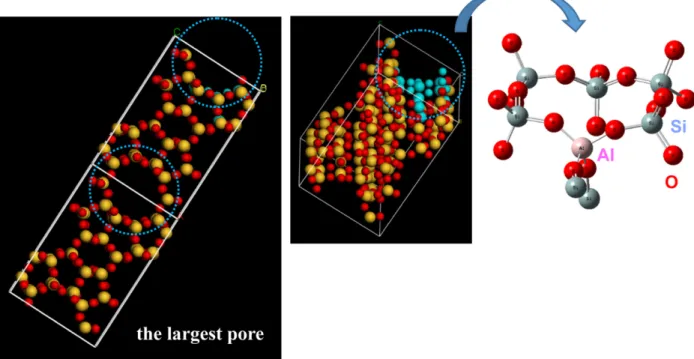
DFT calculations were performed using the Gaussian 09 program with the B3LYP model chemistry and a split basis set (6-31G(d) for non-metal atoms and LanL2DZ for metal atoms). To save computa- tional capacity, a highly symmetric cluster was extracted from the three-dimensional ZSM-5 structure as shown in Fig. 1 [14,15]. It represents the largest pore available for hydrocarbon adsorption.
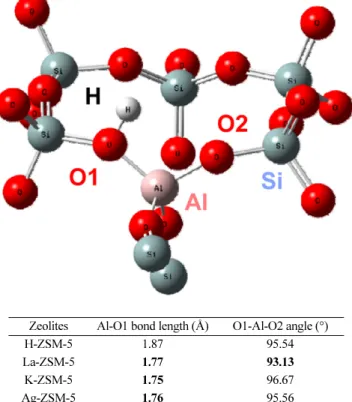
Then, cation-exchanged clusters are geometrically optimized to have local minima in potential energy surface (PES) with unpaired elec- trons treated by hydrogen termination [16], as shown in Fig. 2. They are denoted H-ZSM-5, La-ZSM-5, K-ZSM-5, and Ag-ZSM-5 with respect to the kind of exchanged cations, and terminal hydrogens for unpaired electrons are not shown in figures for simplicity. Mean- while, La is exchanged into ZSM-5 zeolites with a form of La(OH)2
(Fig. 2) [15].
3. Results and discussion
The structural (or hydrothermal) stability of cation-exchanged ZSM-5 zeolites was evaluated by comparing geometrical parameters among
geometrically optimized structures (Fig. 2). Fig. 3 summarizes the calculated bond length and bond angle between aluminum (Al) and neighboring oxygens (O1 and O2), depending on the exchanged cat- ion. In particular, La-ZSM-5 has a much contracted Al-O1 bond length and O1-Al-O2 angle. It means that La cations increase the ste- ric hindrance to prevent polar water molecules from attacking Si-O- Al bonds, thereby providing the ZSM-5 structure with hydrothermal stability [17].
The binding energy (i.e., adsorption energy) is simply calculated by the following equation, and the procedure is visualized for the tol- uene adsorption on H-ZSM-5 (having hydrogen as cation) in Fig. 4, as an example.
ΔEbinding = E (adsorbate + zeolite cluster) – E (zeolite cluster)
– E (adsorbate) (1)
The adsorption complex, H-ZSM-5 cluster, and toluene were geo- metrically optimized to have their own local minima in PES, respec- tively. Technically, basis set superposition errors (BSSEs) have to be considered to obtain energy values more correctly, but are neglected in this study because they are mostly cancelled out in energy com- parison. The cluster approximation used in this study is limited to emulating the hydrocarbon adsorption into 3-dimensional zeolite structures exactly since the cluster is considered to be a sort of large gas molecule in the calculation. Therefore, the calculated energies are of relative importance; they are useful for comparison. Table 1 summarizes the calculated adsorption energies.
At first glance, Ag-ZSM-5 has the highest adsorption energy for propylene and toluene, and is also fairly good for n-butane adsorp- tion. However, Ag often exists in the form of oxide in zeolites treated at high temperatures, and the actual experimental performance (not shown here) of Ag-ZSM-5 was considerably degraded. Anyhow,
Fig. 1. The largest pore of the 3-dimenstional ZSM-5 structure (left) and the extracted highly symmetric cluster representing the largest pore (right).
calculations suggest that Ag cation exchange is the most effective in terms of hydrocarbon adsorption if not accompanied by oxidation. It is then noted that adsorption energies are relatively small for n- butane regardless of the kind of cation-exchanged ZSM-5 zeolites, meaning that n-butane adsorption occurs through loose binding with insignificant energy (< 5 kcal/mol) because of the inherent chemical stability of alkanes. Aside from Ag-ZSM-5, H-ZSM-5 becomes the best in terms of hydrocarbon adsorption in general, while K-ZSM-5 shows its unusual capability for toluene adsorption. However, con- sidering the hydrothermal stability assessed in Fig. 3, La-ZSM-5 will be the best choice to hold aromatics such as toluene and olefins until the main TWCs are thermally activated, while being robust to the dealumination of ZSM-5 zeolites by water vapor from engines.
In fact, computational results had a fairly good agreement with experimental ones (not shown here) except for Ag-ZSM-5. Finally, Fig. 5 shows the adsorption complexes of propylene and toluene on H-ZSM-5 and La-ZSM-5 zeolites. As described by the dotted circle and arrow in Fig. 5(a) and 5(c), exchanged cations (H and La) are very close to the center of the double bond in propylene, while cations are almost in the line of the normal vector of the phenyl group in toluene (see the dotted circle and arrow in Fig. 5(b) and 5(d)). Unlike alkanes such as n-butane, the presence of ppπ orbital in propylene and tolu- ene contributes to the interaction of adsorbates and exchanged cations.
Fig. 2. Geometrically optimized cation-exchanged clusters; (a) H-ZSM-5, (b) La-ZSM-5, (c) K-ZSM-5, and (d) Ag-ZSM-5.
Fig. 3. Geometrical parameters of cation-exchanged zeolites based on geometrically optimized cluster structures.
Zeolites Al-O1 bond length (Å) O1-Al-O2 angle (°)
H-ZSM-5 1.87 95.54
La-ZSM-5 1.77 93.13
K-ZSM-5 1.75 96.67
Ag-ZSM-5 1.76 95.56
912 Hyun Chul Lee, Kyung Min Kim, Sung Il Choi, Yong Ha Kim, Hee Chul Woo and Yong Sun Won
4. Conclusions
A DFT-based computational approach was used to investigate the adsorption characteristics of cation (H, La, K, Ag)-exchanged ZSM- 5 zeolites for hydrocarbons (propylene, n-butane, toluene). To make the calculation efficient, a highly symmetric cluster representing the largest pore was cleaved out of the three-dimensional ZSM-5 struc- Table 1. Comparison of calculated adsorption energies between adsorbates
and cation-exchanged zeolites. The energies are in the unit of kcal/mol
Propylene n-butane Toluene
H-ZSM-5 -11.75 kcal/mol -4.26 -7.01
La-ZSM-5 -9.85 -1.83 -6.13
K-ZSM-5 -4.76 -2.33 -7.97
Ag-ZSM-5 -20.3 -3.87 -13.26
Fig. 4. The binding energy calculation for the toluene adsorption on H-ZSM-5. Gray and white balls in toluene denote carbons and hydro- gens, respectively.
Fig. 5. Geometrically optimized molecular structures of adsorption complexes; (a) propylene on H-ZSM-5, (b) toluene on H-ZSM-5, (c) pro- pylene on La-ZSM-5, and (d) toluene on La-ZSM-5. Gray and white balls denote carbons and hydrogens, respectively.
ture, and the so-called cluster approximation was employed. The change of geometrical parameters was calculated first with respect to the kind of cations, confirming that the bond between Al and neigh- boring oxygens was reinforced the most by La exchange to improve the hydrothermal stability of La-exchanged ZSM-5. Then, the calcu- lations of adsorption energies indicated that Ag-exchanged ZSM-5 was superior to others for the adsorption of all three hydrocarbons.
La- and H-exchanged ZSM-5 also had decent adsorption capacities for propylene and toluene, but H-exchanged ZSM-5 showed poor hydrothermal stability.
Acknowledgments
This work was supported by the Pukyong National University Research Abroad Fund in 2016 (C-D-2016-0848).
References
1. Sanz, O., Delgado, J. J., Navarro, P., Arzamendi, G., Gandia, L.
M. and Montes, M., “VOCs Combustion Catalysed by Platinum Supported on Manganese Octahedral Molecular Sieves,” Appl.
Catal. B: Environ., 110, 231-237(2011).
2. Maupin, I., Mijoin, J., Barbier Jr., J., Bion, N., Belin T. and Mag- noux, P., “Improved Oxygen Storage Capacity on CeO2/zeolite Hybrid Catalysts. Application to VOCs Catalytic Combustion,”
Catal. Today, 176, 103-109(2011).
3. http://www.compass.or.kr (Compliance in Advance and Support- ing Sytem).
4. Higashiyama, K., Nagayama T., Nagano, M. and Nakagawa, S.,
“A Catalyzed Hydrocarbon Trap Using Metal-impregnated Zeolite for SULEV System,” J. Fuels Lubricants, 112, 499-505(2003).
5. Noda, N., Takahashi, A. and Mizuno, H., “In-line Hydrocarbon (HC) Adsorber System for Reducing Cold Start Emissions,” Society of Automotive Engineers, Technical paper, 2000-01-0892(2000).
6. Seo, G., “First Step of Zeolites,” Chonnam University (2005).
7. Li, H., Shen, B., Wang, X. and Shen, S., “Thermal and Hydro- thermal Stability of La-Modified ETS-10 and its Cracking Abil-
ity,” Catal. Lett., 99, 165-169(2005).
8. Johannis, A. Z. P., Gerhard, D. P., Jeroen, A. B. and Saskia, B.,
“Hydrothermal Stability of Fe-ZSM-5 and Fe-BEA Prepared by Wet Ion-exchange for N2O Decomposition,” Appl. Catal. B: Envi- ron., 71, 16-22(2007).
9. Liu, X., Jordan, K. L., Dmitrii, A. A. and Robert, J. F., “FT-IR Spectroscopic Studies of Hydrocarbon Trapping in Ag+-ZSM-5 for Gasoline Engines under Cold-start Conditions,” Appl. Catal.
B: Environ., 35, 125-136(2001).
10. He, X., Huang X., Wang, Z. and Yan, Y., “The role of Silver Species on the Hydrothermal Stability of Zeolite Catalysts,” Micro. Meso.
Mater., 142, 398-403(2011).
11. Inés, T., Silvia, I., Pedro, P., Carlos, T., Joaquı´n, C. And Jesús, S., “Preparation and Characterization of Titanosilicate Ag-ETS- 10 for Propylene and Propane Adsorption,” J. Phys. Chem. C, 111, 4702-4709(2007).
12. C. Busco, A. barbaglia, M. broyer, V. Bolis, G. M. F. and Ugliengo, P., “Charaterisation of Lewis and Brøested Acidic Sites in H-MFI and H-BEA Zeolites; a Thermodynamic and ab Initio Study,”
Thermochemica Acta, 418, 3-9(2004).
13. Ivanov, A. V., Graham, G. W. and Shelef, M., “Adsorption of Hydro- carbons by ZSM-5 Zeolites with Different SiO2/Al2O3 Ratios: a Combined FTIR and Gravimetric Study,” Appl. Catal. B: Environ., 21, 243-258(1999).
14. Zheng, A., Liu, S.-B. and Deng, F., “Chemoselectivity During Propene Hydrogenation Reaction over H-ZSM-5 Zeolite: Insights from Theoretical Calculations,” Macro. Micro. Mater., 121, 158- 165(2009).
15. Jiang, S., Huang, S., Qin, L., Tu, W., Zhu, J., Tian, H. and Wang, P., “Density Functional Theory Study of Relevant Properties of Lanthanum Species and 1-butane Activation over Lanthanum Modified Zeolite,” J. Mol. Sci.: THEOCHEM, 962, 1-6(2010).
16. Won, Y. S., Lee, J., Kim, C. S. and Park, S. S., “Computational Study of Adsorption, Diffusion, and Dissociation of Precursor Species on the GaN (0001) Surface during GaN MOCVD,” Surf. Sci., 603, L31-L34(2009).
17. Li, Y., Liu, H., Zhu, J., He, P., Wang P. and Tian, H., “DFT Study on the Accomodation and Role of La Species in ZSM-5 Zeolite,”
Micro. Macro. Mater., 142, 621-628(2011).