734 http://dx.doi.org/10.9713/kcer.2016.54.6.734
PISSN 0304-128X, EISSN 2233-9558
총 설
Review on the Determination of Frumkin, Langmuir, and Temkin Adsorption Isotherms at Electrode/Solution Interfaces Using the Phase-Shift Method and Correlation Constants
Jinyoung Chun and Jang H. Chun*,†
Department of Chemical Engineering, Pohang University of Science and Technology, 77, Cheongam-ro, Nam-gu, Pohang, Gyeongbuk, 37673, Korea
*President, Kwangwoon University, 20, Gwangun-ro, Nowon-gu, Seoul, 01897, Korea (Received 1 September 2016; accepted 27 September 2016)
Abstract − This review article described the electrochemical Frumkin, Langmuir, and Temkin adsorption isotherms of over-potentially deposited hydrogen (OPD H) and deuterium (OPD D) for the cathodic H2 and D2 evolution reactions (HER, DER) at Pt, Ir, Pt-Ir alloy, Pd, Au, and Re/normal (H2O) and heavy water (D2O) solution interfaces. The Frum- kin, Langmuir, and Temkin adsorption isotherms of intermediates (OPD H, OPD D, etc.) for sequential reactions (HER, DER, etc.) at electrode/solution interfaces are determined using the phase-shift method and correlation constants, which have been suggested and developed by Chun et al. The basic procedure of the phase-shift method, the Frumkin, Lang- muir, and Temkin adsorption isotherms of OPD H and OPD D and related electrode kinetic and thermodynamic param- eters, i.e., the fractional surface coverage (0 ≤ θ ≤ 1) vs. potential (E) behavior (θ vs. E), equilibrium constant (K), interaction parameter (g), standard Gibbs energy (∆Gθ○) of adsorption, and rate (r) of change of ∆Gθ○ with θ (0 ≤ θ ≤ 1), at the interfaces are briefly interpreted and summarized. The phase-shift method and correlation constants are useful and effective techniques to determine the Frumkin, Langmuir, and Temkin adsorption isotherms and related electrode kinetic and thermodynamic parameters (θ vs. E, K, g, ∆Gθ○, r) at electrode/solution interfaces.
Key words: Phase-shift method and correlation constants, Frumkin, Langmuir, Temkin adsorption isotherms, Over- Potentially deposited hydrogen and deuterium, Noble metal alloy electrodes
1. Introduction
Many experimental methods have been developed and used to study the adsorption of hydrogen for the cathodic H2 evolution reac- tion (HER) at noble metal and alloy/aqueous solution interfaces [1- 7]. The cathodic HER is one of the most extensively studied topics in electrochemistry, electrocatalysis, hydrogen technologies, and fuel cells, etc. It is well known that under-potentially deposited hydrogen (UPD H) and over-potentially deposited hydrogen (OPD H) occupy different surface adsorption sites and act as two distinguishable elec- troadsorbed H species, and that only OPD H can contribute to the cathodic HER [2-7]. However, there is not much reliable data on the Frumkin, Langmuir, and Temkin adsorption isotherms of OPD H for the cathodic HER and related electrode kinetic and thermodynamic parameters, i.e., the fractional surface coverage (0 ≤ θ ≤ 1) vs. potential (E) behavior (θ vs. E), equilibrium constant (K), interaction parame- ter (g), standard Gibbs energy (∆Gθ○) of adsorption, and rate (r) of change of ∆Gθ○ with θ (0 ≤ θ ≤ 1). Furthermore, there is not much reli- able data on the Frumkin, Langmuir, and Temkin adsorption isotherms of over-potentially deposited deuterium (OPD D) for the cathodic D2
evolution reaction (DER) and related electrode kinetic and thermo- dynamic parameters. Similarly, there is not much reliable data on the Frumkin, Langmuir, and Temkin adsorption isotherms of hydroxide (OH) and deuteroxide (OD) for the anodic O2 evolution reaction (OER) and related electrode kinetic and thermodynamic parameters.
Because, to the authors’ knowledge, K and g for the Frumkin adsorp- tion isotherms of intermediates cannot be experimentally and readily determined using conventional methods [1-7]. Also, a quantitative relationship between the Temkin and Frumkin or Langmuir adsorp- tion isotherms of intermediates has not been developed or reported to study the cathodic HER and DER or the anodic OER. Thus, there is a technological need for a useful, effective, and reliable method to determine the Frumkin, Langmuir, and Temkin adsorption isotherms of intermediates (OPD H, OPD D, OH, OD, etc.) for the sequential reactions (HER, DER, OER, etc.) and related electrode kinetic and thermodynamic parameters at the interfaces.
Although the Frumkin and Langmuir adsorption isotherms may be regarded as classical models and theories, it is preferable to con- sider the Frumkin and Langmuir adsorption isotherms for OPD H and OPD D rather than electrode kinetics and thermodynamics equa- tions for OPD H and OPD D because these adsorption isotherms are associated more directly with the atomic mechanism of OPD H and OPD D. To determine the Frumkin, Langmuir, and Temkin adsorption isotherms, the phase-shift method and correlation constants have been originally suggested and developed on the basis of relevant experi- mental results and physical phenomena rather than mathematical
†To whom correspondence should be addressed.
E-mail: [email protected]
‡This article is dedicated to Prof. Choon Han on the occasion of his retirement from Kwangwoon University.
This is an Open-Access article distributed under the terms of the Creative Com- mons Attribution Non-Commercial License (http://creativecommons.org/licenses/by- nc/3.0) which permits unrestricted non-commercial use, distribution, and reproduc- tion in any medium, provided the original work is properly cited.
ior rather than by their nature. For example, the wave-particle duality of light and electrons, i.e., their wave and particle behaviors, is well known in science and has been applied in engineering. At first glance, it seems that there is no linear relationship between the (−ϕ vs. E) behavior for fo and the (θ vs. E) behavior at the interfaces.
Thus, tedious experimental techniques and procedures [9-13] have been used to verify the validity and correctness of the phase-shift method. A new method must be rigorously tested, especially when it is unique, but only with pure logic and objectivity and through scien- tific procedures. However, the objections to the phase-shift method do not fulfill these criteria (see Text and Supporting Information in Ref. 18). The comments and replies on the phase-shift method are briefly summarized elsewhere [18-20]. In recent, the validity of the phase-shift method has been qualitatively analyzed and verified by Garcia et al. [22].
In this review article, we supplement and summarize the Frumkin, Langmuir, and Temkin adsorption isotherms of OPD H and OPD D and related electrode kinetic and thermodynamic parameters (θ vs.
E, K, g, ∆Gθ○, r) at noble metal (Pt, Ir, Pd, Au, Re) and alloy (Pt-Ir)/
normal (H2O) and heavy water (D2O) solution interfaces [9-21].
2. Theoretical and Experimental Backgrounds of the Phase-Shift Method
2-1. The equivalent circuit for the adsorption and sequential reactions
The equivalent circuit for the adsorption of OPD H and OPD D for the cathodic HER and DER at the Pt, Ir, Pt-Ir alloy, Pd, Au, and Re/
H2O and D2O solution interfaces can be expressed as shown in Fig.
1a [18-20,23-25]. In Fig. 1a, RS is the real solution resistance; RF is the real resistance due to the faradaic resistance (Rφ) for the dis- charge step and superposition of various effects; RP is the real resis- tance due to the faradaic resistance (RR) for the recombination step and superposition of various effects; CP is the real capacitance due to the adsorption pseudocapacitance (Cφ) for the discharge step and super- position of various effects; and CD is the real double-layer capaci- tance. Correspondingly, neither RF nor CP is constant; both RF and CP depend on E and θ and can be measured. Note that both Rφ and Cφ also depend on E and θ but cannot be measured.
The numerical derivation of Cφ from the Frumkin and Langmuir
adsorption isotherms is described elsewhere, and Rφ depends on Cφ [23-25]. They attain maximum values at θ ≈ 0.5 and intermediate E, decrease symmetrically with E at other values of θ, and approach minimum values or 0 at θ ≈ 0 and low E and θ ≈ 1 and high E. This behavior is well known in interfacial electrochemistry, electrode kinetics, and EIS. The unique feature and combination of Rφ and Cφ vs. E, i.e., −ϕ and θ vs. E, imply that the normalized rate of change of
−ϕ with respect to E, i.e., Δ(−ϕ)/ΔE, corresponds to that of θ with respect to E, i.e., Δθ/ΔE, and vice versa (see Footnotes c and d in Table 1). This is a typical characteristic of the Gaussian profiles of Δ(−ϕ)/ΔE and Δθ/ΔE, i.e., the Frumkin and Langmuir adsorption isotherms. Note that ϕ depends on both E and frequency (f ) but θ depends on only E [25]. The linear relationship between the Gauss- ian profiles of Δ(−ϕ)/ΔE and Δθ/ΔE most clearly appears at the spec- ified intermediate frequency. We refer to it as the optimum intermediate frequency (fo). The value of fo is experimentally and graphically evaluated on the basis of Δ(−ϕ)/ΔE and Δθ/ΔE for intermediate and other frequencies (see Fig. 9).
2-2. The frequency response of the equivalent circuit for the adsorption
The frequency responses of the equivalent circuit for all f that is shown in Fig. 1a are essential for understanding the unique feature and combination of (RS, RF) and (CP, CD) vs. E for fo, i.e., the linear relationship between the (−ϕ vs. E) behavior for fo and the (θ vs. E) behavior. At low frequencies, the equivalent circuit for all f can be expressed as a series circuit of RS, RF, and RP. At high frequencies, the equivalent circuit for all f can be expressed as a series circuit of RS and CD. Both the low and high frequency responses are meaning- Fig. 1. (a) Experimentally proposed equivalent circuit for the phase-
shift method. (b) Simplified equivalent circuits for interme- diate frequency responses.
less for studying the adsorption of OPD H and OPD D. Note that RF and CP include Rφ and Cφ, i.e., the adsorption of OPD H and OPD D, respectively. At intermediate frequencies, one finds regions in which the equivalent circuit for all f behaves as a series circuit of RS, RF, and CP or a series and parallel circuit of RS, CP, and CD, as shown in Fig.
1b. However, the simplified equivalent circuit shown in Fig. 1b does not represent the change of the cathodic HER and DER themselves but only the intermediate-frequency response.
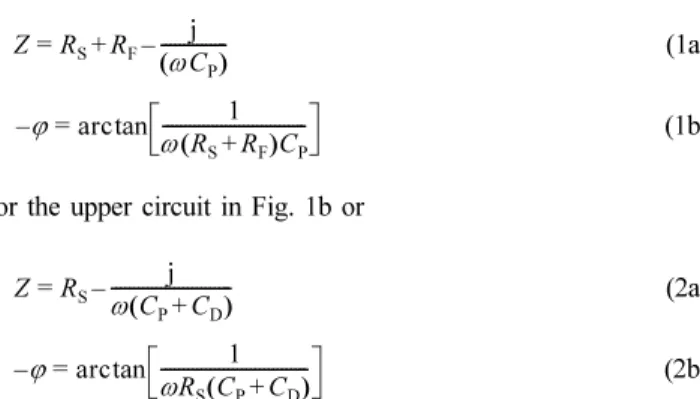
At intermediate frequencies, the impedance (Z) and lagged phase- shift (−ϕ) are given by [16-20,23,25]
(1a)
(1b)
for the upper circuit in Fig. 1b or
(2a)
(2b)
for the lower circuit in Fig. 1b, where j is the imaginary unit (i.e., j2 = −1) and ω is the angular frequency, defined as ω = 2πf, where f is the frequency. Under these conditions,
and (3)
In the previous papers [9-15], only Eq. (1) was used with a foot- note stating that CP practically includes CD (see Table 1 in Ref. 12, Tables 1 and 2 in Ref. 13, etc.). Both Eqs. (1) and (2) show that the effect of RP on −ϕ for intermediate frequencies is negligible. These aspects are completely overlooked, confused, and misunderstood in the comments on the phase-shift method [18-20]. Correspondingly, all of the simulations on the phase-shift method using Eq. (1), which appears in the comments (CP does not include CD), are basically invalid and incorrect. All of the analyses of the effect of RP on
−ϕ for intermediate frequencies are meaningless (see Supporting Information in Ref. 18).
The following limitations and conditions of the equivalent circuit elements for fo are summarized on the basis of the experimental data in the previous papers [9-20]. Neither RS nor CD is constant. At θ ≈ 0, RS > RF and CD > CP, or vice versa, and so forth. For a wide range of θ (i.e., 0.2 < θ < 0.8), RF >> RS or RF > RS and CP >> CD or CP > CD, and so forth. At θ ≈ 1, RS > RF or RS < RF and CP >> CD. The mea- sured ϕ for fo depends on E and θ. In contrast to numerical simulations, the limitations and conditions for Eq. (1) or (2) are not considered for the phase-shift method because all of the measured values of −ϕ for intermediate frequencies include (RS, RF) and (CP, CD). Correspond- ingly, the measured −ϕ for fo is valid and correct regardless of the applicability of Eq. (1) or (2). Both the measured values of −ϕ at fo and the calculated values of −ϕ at fo using Eq. (1) or (2) are exactly the same (see Supporting Information in Ref. 18). The unique fea- ture and combination of (RS, RF) and (CP, CD) vs. E for fo are equiva- lent to those of Rφ and Cφ vs. E for fo, i.e., −ϕ and θ vs. E for fo, due to the reciprocal property of RF and CP, which include Rφ and Cφ. It sug- gests that only the polar form of the equivalent circuit impedance, i.e., −ϕ described in Eq. (1b) or (2b), is useful and effective for studying the linear relationship between the −ϕ (90° ≥ −ϕ ≥ 0°) vs. E behavior at fo and the θ (0 ≤ θ ≤ 1) vs. E behavior. The linear relationship between the Gaussian profiles of Δ(−ϕ)/ΔE and Δθ/E for fo implies that only one Frumkin or Langmuir adsorption isotherm is deter- mined on the basis of the relevant experimental results (see Figs. 2, 7 to 9). The shape and location of the (θ vs. E) profile for fo correspond to g and K for the Frumkin or Langmuir adsorption isotherm (see Figs. 7b, 8, and 10c). These aspects are the essential nature of the phase-shift method for determining the Frumkin and Langmuir adsorption isotherms.
3. Basic Procedure and Description of the Phase-Shift Method
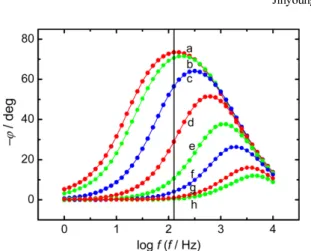
3-1. The phase-shift curves (−ϕ vs. log f) for different potentials Figure 2 compares the phase-shift curves (−ϕ vs. log f) for differ-
Z RS RF j
ω CP
( )
--- – +
=
ϕ
– arc 1
ω R( S+RF)CP
--- tan
=
Z RS j
ω C( P+CD) --- –
=
ϕ
– arc 1
ωRS(CP+CD) --- tan
=
RP 1
ωCP
( )
---
» RP»RS+RF
Table 1. Measured values of the phase shift (−ϕ) for fo = 1.259 Hz, the fractional surface coverage (θ) of OPD H and OPD D, and the normalized rates of change of −ϕ and θ vs. E [Δ(−ϕ)/ΔE, Δθ/ΔE] at the Pt-Ir alloy/0.1 M LiOH (H2O + D2O) solution interface
E/V vs. SHEa −ϕ/deg θ b Δ(−ϕ)/ΔEc Δθ/ΔEd
−0.659 84.7 ~ 0 ~ 0 ~ 0
−0.684 84.0 0.00830 0.08304 0.08304
−0.709 79.4 0.06287 0.54567 0.54567
−0.734 60.8 0.28351 2.20641 2.20641
−0.759 26.6 0.68921 4.05694 4.05694
−0.784 7.7 0.91340 2.24199 2.24199
−0.809 2.6 0.97390 0.60498 0.60498
−0.834 1.3 0.98932 0.15421 0.15421
−0.859 0.7 0.99644 0.07117 0.07117
−0.884 0.6 0.99763 0.01186 0.01186
−0.909 0.4 ~ 1 0.02372 0.02372
aSHE (standard hydrogen electrode). b0 ≤ θ ≤ 1. c{[(neighbor phase shift difference)/(total phase shift difference)]/[(neighbor potential difference)/(total potential difference)]}. d{[(neighbor fractional surface coverage difference)/(total fractional surface coverage difference)]/[(neighbor potential difference)/
(total potential difference)]}
ent E at the Pt-Ir alloy/0.1 M LiOH (H2O + D2O) solution interface [20]. The intermediate frequency of 1.259 Hz, shown as a vertical solid line on the (−ϕ vs. log f ) plot in Fig. 2, can be set as fo for (−ϕ vs. E) and (θ vs. E) profiles. All E in Table 1 and Figs. 2~19 are given on the standard hydrogen electrode (SHE) scale. The following qual- itative interpretation is valid and effective for studying the linear relationship between Δ(−ϕ)/ΔΕ and Δθ/ΔE for fo at noble metal and alloy/solution interfaces [8-21].
At the maximum −ϕ shown in curve a of Fig. 2, it appears that the adsorption of OPD H and OPD D and superposition of various effects are minimized; i.e., θ ≈ 0 and E is low. At the maximum −ϕ, when θ ≈ 0 and E is low, both Δ(−ϕ)/ΔE and Δθ/ΔE for fo are mini- mized because (Rφ and Cφ vs. E) approach minimum values or 0. At the minimum −ϕ shown in curve k of Fig. 2, it appears that the adsorption of OPD H and OPD D and superposition of various effects are maximized or almost saturated; i.e., θ ≈ 1 and E is high. At the minimum −ϕ, when θ ≈1 and E is high, both Δ(−ϕ)/ΔE and Δθ/ΔE for fo are also minimized because (Rφ and Cφ vs. E) approach mini- mum values or 0. At the medium −ϕ between curves d and e in Fig. 2, it appears that both Δ(−ϕ)/ΔE and Δθ/ΔE for fo are maximized because (Rφ and Cφ vs. E) approach maximum values at θ ≈ 0.5 and intermediate E. At other values of ϕ in Fig. 2, both Δ(−ϕ)/ΔE and Δθ/
ΔE for fo decrease symmetrically with E because (Rφ and Cφ vs. E) decrease symmetrically with E at other values of θ (see Table 1 and Fig. 9b). Therefore, one can obtain the linear relationship between the Gaussian profiles of Δ(−ϕ)/ΔE and Δθ/ΔE for fo on the basis of the relevant phase-shift curves (−ϕ vs. log f ) for different E. Simi- larly, Figs. 3, 4, 5, and 6 show the phase-shift curves (−ϕ vs. log f ) for different E at the Pt-Ir [19], Ir [16], Pd [12], and Au [10] inter- faces, respectively.
Note that −ϕ depends on both E and f but θ depends on only E.
This is the reason why a single equation for (−ϕ vs. θ) as functions of
E and f is necessary. However, the phase-shift method has been experimentally proposed and verified on the basis of the phase-shift curves (−ϕ vs. log f ) at different E (see Figs. 2 to 6). The electrochemi- cal impedance data, i.e., (−ϕ vs. log f ) and (−ϕ vs. E), were measured and interpreted by using the frequency response analyzer and EIS. In practice, the cyclic, differential pulse, and linear sweep voltamme- tries are not necessary for the phase-shift method itself [10-12].
3-2. The phase-shift (−ϕ vs. E) and fractional surface coverage (θ vs. E) profiles
The procedure and description of the phase-shift method for deter- mining the Frumkin adsorption isotherm of OPD H and OPD D at the Pt-Ir alloy/0.1 M LiOH (H2O + D2O) solution interface are sum- marized in Table 1 [20].
Fig. 2. Comparison of the phase-shift curves (−ϕ vs. log f) for different potentials (E) at the Pt-Ir alloy/0.1 M LiOH (H2O + D2O) solu- tion interface [20]. Measured values: ●. Vertical solid line:
1.259 Hz; single sine wave; scan frequency range, (104 to 0.1) Hz; ac amplitude, 5 mV. Dc potentials: (a) −0.659 V, (b) − 0.684 V, (c) −0.709 V, (d) −0.734 V, (e) −0.759 V, (f) −0.784 V, (g)
−0.809 V, (h) −0.834 V, (i) −0.859 V, (j) −0.884 V, and (k) −0.909 V (all vs. SHE).
Fig. 3. Comparison of the phase-shift curves (−ϕ vs. log f ) for different potentials (E) at the Pt-Ir alloy/0.5 M H2SO4 aqueous solution interface [19]. Measured values: ●. Vertical solid line: 25.12 Hz;
single sine wave; scan frequency range, (104 to 1) Hz; ac ampli- tude, 5 mV. Dc potentials: (a) 0.061 V, (b) 0.041 V, (c) 0.021 V, (d) 0.001 V, (e) −0.019 V, (f) −0.039 V, (g) −0.059 V, (h) −0.079 V, (i) −0.099 V, (j) −0.119 V, and (k) −0.139 V (all vs. SHE).
Fig. 4. Comparison of the phase-shift curves (−ϕ vs. log f ) for dif- ferent potentials (E) at the Ir/0.1 M KOH aqueous solution interface [16]. Measured value: ●. Vertical solid line: 1.259 Hz; single sine wave; scan frequency range, (104 to 0.5) Hz;
ac amplitude, 5 mV. Dc potential: (a) −0.659 V, (b) −0.684 V, (c)
−0.709 V, (d) −0.734 V, (e) −0.759 V, (f) −0.784 V, (g) −0.809 V, (h) −0.834 V, (i) −0.859 V, (j) −0.884 V, and (k) −0.909 V (all vs.
SHE).
The values of −ϕ and θ as a function of E at fo = 1.259 Hz shown in Fig. 7 [20] are illustrated on the basis of the experimental results summarized in Table 1. The values of −ϕ and θ as a function of E at f
= 0.1 Hz, 10 Hz, and 100 Hz shown in Fig. 7 are also illustrated through the same procedure summarized in Table 1. However, note that the differences between the (−ϕ vs. E) profile at fo = 1.259 Hz and the (−ϕ vs. E) profiles at f = 0.1 Hz, 10 Hz, and 100 Hz shown in Fig. 7a do not represent the measurement error but only the frequency response. In practice, the (θ vs. E) profiles at f = 0.1 Hz, 10 Hz, and 100 Hz shown in Fig. 7b should be exactly the same as the (θ vs. E) profile at fo = 1.259 Hz. Because, as stated above, θ depends on only E and this unique feature most clearly appears at fo. In Table 1, the fitted range of θ does not influence the determination of the Frumkin adsorption isotherm of OPD H and OPD D. Because, as shown in Fig. 8 [20], only one Frumkin adsorption isotherm (θ vs. E) is deter-
mined regardless of the fitted range of θ over the same potential range.
The normalized rates of change of −ϕ and θ with respect to E, i.e., Δ(−ϕ)/ΔE and Δθ/ΔE, for four different frequencies at the Pt-Ir alloy/
0.1 M LiOH (H2O + D2O) solution interface are shown in Fig. 9 [20]. The Gaussian profile shown in Fig. 9b is illustrated on the basis of Δ(−ϕ)/ΔE and Δθ/ΔE data for fo = 1.259 Hz summarized in Table 1.
The Gaussian profiles of Δ(−ϕ)/ΔE and Δθ/ΔE at f = 0.1 Hz, 10 Hz, Fig. 5. Comparison of the phase-shift curves (−ϕ vs. log f ) for dif-
ferent potentials (E) at the Pd/0.5 M H2SO4 aqueous solu- tion interface [adapted from Ref. 12]. Measured value: ●.
Vertical solid line: 125.9 Hz; single sine wave; scan frequency range, (104 to 1) Hz; ac amplitude, 5 mV. Dc potential: (a) 0.066 V, (b) 0.016 V, (c) −0.034 V, (d) −0.084 V, (e) −0.134 V, (f)
−0.184 V, (g) −0.259 V, and (h) −0.309 V (all vs. SHE).
Fig. 6. Comparison of the phase-shift curves (−ϕ vs. log f ) for dif- ferent potentials (E) at the Au/0.5 M H2SO4 aqueous solu- tion interface [adapted from Ref. 10]. Measured value: ●.
Vertical solid line: 100 Hz; single sine wave; scan frequency range, (104 to 1) Hz; ac amplitude, 5 mV. Dc potential: (a)
−0.009 V, (b) −0.059 V, (c) −0.109 V, (d) −0.159 V, (e) −0.209 V, (f) −0.259 V, and (g) −0.309 V (all vs. SHE).
Fig. 7. Comparison of (a) the phase-shift profiles (−ϕ vs. E) and (b) the fractional surface coverage profiles (θ vs. E) for four dif- ferent frequencies at the Pt-Ir alloy/0.1 M LiOH (H2O + D2O) solution interface [20]. Experimental data: ●, 0.1 Hz;
■, 1.259 Hz; ◄, 10 Hz; ○, 100 Hz. The optimum interme- diate frequency (fo) is 1.259 Hz.
Fig. 8. Evaluation of the fitted range of θ at the Pt-Ir alloy/0.1 M LiOH (H2O + D2O) solution interface [adapted from Ref.
20]. Experimental data: ■ (0 ≤ θ ≤ 1). Fitted data: ●
,
0 ≤ θ0.9; ○
,
0.1 ≤ θ ≤ 1; ◄, 0.2 ≤ θ ≤ 0.8. The solid curve (0 ≤ θ≤ 1) shows the Frumkin adsorption isotherm calculated using Eq. (4) for g = −2.2 with Ko = 5.3 × 10⁻⁵ mol-1, i.e., K = 5.3 × 10⁻⁵ exp(2.2θ) mol-1.
and 100 Hz are shown in Figs. 9a, c, and d, respectively. Finally, one can conclude that the (θ vs. E) and Δθ/ΔE profiles at fo = 1.259 Hz shown in Figs. 7b and 9b, respectively, are applicable to the determi- nation of the Frumkin adsorption isotherm of OPD H and OPD D at the interface (see Fig. 10).
4. Electrochemical Frumkin, Langmuir, and Temkin Adsorption Isotherms
4-1. The Frumkin and Langmuir adsorption isotherms The derivation and interpretation of the practical forms of the elec- trochemical Frumkin, Langmuir, and Temkin adsorption isotherms are described elsewhere [1,2,26]. The Frumkin adsorption isotherm assumes that the surface is inhomogeneous or that the lateral interaction effect is not negligible. It is well known that the Langmuir adsorp- tion isotherm is a special case of the Frumkin adsorption isotherm.
The Langmuir adsorption isotherm can be derived from the Frumkin adsorption isotherm by setting the interaction parameter (g) to be zero, i.e., g = 0. The Frumkin adsorption isotherm (θ vs. E) can be expressed as follows [26]
(4)
(5)
K = Ko exp(−gθ) (6)
where θ (0 ≤ θ ≤ 1) is the fractional surface coverage, g is the interaction parameter for the Frumkin adsorption isotherm, Ko is the equilibrium constant at g = 0, C+ is the concentration of ions (H+, D+, H+ + D+, etc.) in the bulk solution, E is the applied
θ 1–θ
--- exp g( ) Kθ = oC+exp(–EF/RT)
g r
RT---
=
Fig. 9. Comparison of the normalized rates of change of −ϕ and θwith respect to E, i.e., Δ(−ϕ)/ΔE and Δθ/ΔE, for four different frequencies at the Pt-Ir alloy/0.1 M LiOH (H2O + D2O) solution interface [20]. Solid curves show the fitted Gaussian profiles. Experimental data:○, Δ(−ϕ)/ΔE;
●, Δθ/ΔE. (a) 0.1 Hz, (b) 1.259 Hz, (c) 10 Hz, and (d) 100 Hz. The optimum intermediate frequency ( fo) is 1.259 Hz.
Fig. 10. Comparison of the five fitted data for the Frumkin adsorption isotherms at the Pt-Ir alloy/0.1 M LiOH (H2O + D2O) solu- tion interface [adapted from Ref. 20]. Experimental data: ■.
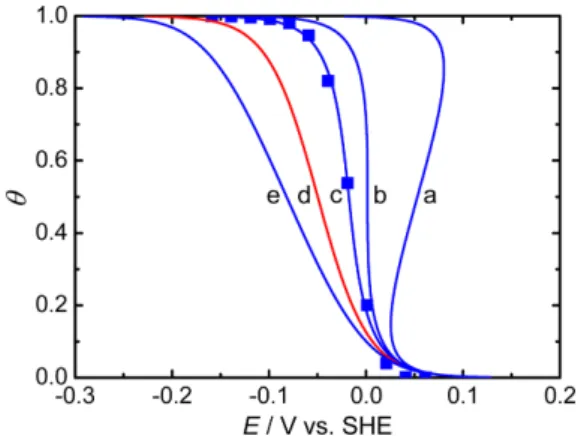
Solid curves show the Frumkin adsorption isotherms (θ vs. E) calculated using Eq. (4) for (a) g = −8, (b) g = −4, (c) g = −2.2, (d) g = 0, i.e., the Langmuir adsorption isotherm, and (e) g = 2.4 with Ko = 5.3 × 10⁻⁵ mol-1. Dashed lines show the hysteresis loop of two-dimensional phase formation.
potential, F is Faraday’s constant, R is the gas constant, T is the absolute temperature, r is the rate of change of the standard Gibbs energy (∆Gθ○) of adsorption with θ (0 ≤ θ ≤ 1), and K is the equi- librium constant. Note that when g = 0 in Eqs. (4) to (6), the Langmuir adsorption isotherm is obtained. For the Langmuir adsorption iso- therm, when g = 0, the inhomogeneous and lateral interaction effects are assumed to be negligible.
Figure 10 shows the determination of the Frumkin adsorption iso- therm of OPD H and OPD D using Eq. (4) at the Pt-Ir alloy/0.1 M LiOH (H2O + D2O) solution interface [20]. Curves a, b, c, d, and e show the five numerically calculated Frumkin adsorption isotherms corresponding to g = −8, −4, −2.2, 0, and 2.4, respectively, for Ko = 5.3 × 10⁻⁵ mol−1. The curve c shows that the Frumkin adsorption iso- therm, K = 5.3 × 10⁻⁵ exp(2.2θ) mol−1, is applicable to the adsorp- tion of OPD H and OPD D, and Eq. (5) gives r = −5.5 kJ mol−1. The Frumkin adsorption isotherm implies that the lateral interaction between OPD H and OPD D species is not negligible. In other words, the Langmuir adsorption isotherm for g = 0, i.e., K = 5.3 × 10⁻⁵ mol−1, is not applicable to the adsorption of OPD H and OPD D at the inter- face (see Fig. 10d).
Figures 11, 12, and 13 also show the determination of the Frumkin adsorption isotherms of OPD H using Eq. (4) at the Pt [14], Ir [14], and Pd [12] interfaces, respectively. Similarly, Fig. 14 shows the determination of the Langmuir adsorption isotherm of OPD H using Eq. (4) for g = 0 at the Au interface [10]. As stated above, the Lang- muir adsorption isotherm implies that the lateral interaction between OPD H species is negligible.
4-2. The Temkin adsorption isotherm
At intermediate values of θ, i.e., 0.2 < θ < 0.8, the pre-exponential term, [θ/(1 − θ)], varies little with θ in comparison with the variation of the exponential term, exp(gθ). Under these approximate conditions, the Temkin adsorption isotherm can be simply derived from the Frum- kin adsorption isotherm. The Temkin adsorption isotherm (θ vs. E)
Fig. 11. Comparison of the five fitted Frumkin adsorption isotherms at the Pt/0.5 M H2SO4 aqueous solution interface [adapted from Ref. 14]. Experimental data: ■ . Solid curves show the Frumkin adsorption isotherms (θ vs. E) calculated using Eq. (4) for (a) g = −8, (b) g = −4, (c) g = −2.5, (d) g = 0, i.e., the Langmuir adsorption isotherm, and (e) g = 2.5 with Ko = 3.5 × 10⁻⁵ mol-1.
Fig. 12. Comparison of the five fitted Frumkin adsorption isotherms at the Ir/0.5 M H2SO4 aqueous solution interface [adapted from Ref. 14]. Experimental data: ■ . Solid curves show the Frumkin adsorption isotherms (θ vs. E) calculated using Eq. (4) for (a) g = −8, (b) g = −4, (c) g = −2.4, (d) g = 0, i.e., the Langmuir adsorption isotherm, and (e) g = 2.4 with Ko = 2.7
× 10-5 mol-1.
Fig. 13. Comparison of the five fitted Frumkin adsorption isotherms at the Pd/0.5 M H2SO4 aqueous solution interface [adapted from Ref. 12]. Experimental data: ■. Solid curves show the Frumkin adsorption isotherms (θ vs. E) calculated using Eq. (4) for (a) g = −8, (b) g = −4, (c) g = 0, i.e., the Langmuir adsorption isotherm, (d) g = 1.6, and (e) g = 6.4 with Ko= 3.3
× 10-5 mol-1.
Fig. 14. Comparison of the five fitted Langmuir adsorption iso- therms at the Au/0.5 M H2SO4 aqueous solution interface [adapted from Ref. 10]. Experimental data: ■ . Solid curves show the Langmuir adsorption isotherms (θ vs. E) calcu- lated using Eq. (4) for g = 0. (a) K = 2.3 × 10⁻⁴ mol-1, (b) K = 2.3 × 10⁻⁵ mol-1, (c) K = 2.3 × 10⁻⁶ mol-1, (d) K = 2.3 × 10⁻⁷ mol-1, and (e) K = 2.3 × 10⁻⁸ mol-1.
can be expressed as follows [26].
exp(gθ) = KoC+ exp(−EF/RT) (7)
The physical meaning of g in the Temkin adsorption isotherm is significantly different from that in the Frumkin adsorption isotherm.
Note that g in Eq. (7) is practically determined by the slope of exper- imental data for 0.2 < θ < 0.8 (see Figs. 15 to 19). The evaluation of the applicability of the Frumkin and Temkin adsorption isotherms over the same potential range is described elsewhere [16,20].
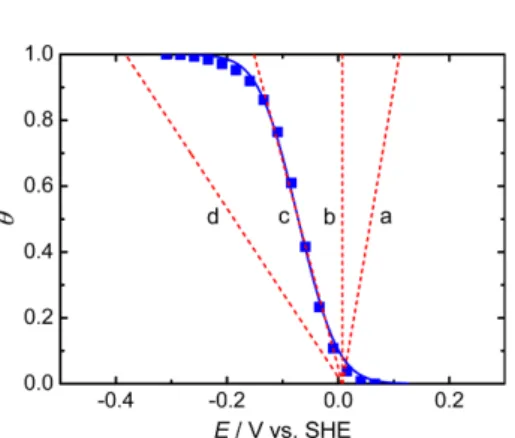
Figure 15 shows the determination of the Temkin adsorption iso- therm corresponding to the Frumkin adsorption isotherm shown in curve c of Fig. 10. The dashed line labeled c in Fig. 15 shows that the numerically calculated Temkin adsorption isotherm of OPD H and OPD D using Eq. (7) is K = 5.3 × 10⁻⁴ exp(−2.4θ) mol−1, and Eq. (5) gives r = 6.0 kJ mol−1.
Figures 16, 17, and 18 also show the determination of the Temkin adsorption isotherms corresponding to the Frumkin adsorption iso- therms shown in Figs. 11c, 12c, and 13d, respectively. Similarly, Fig. 19 shows the determination of the Temkin adsorption isotherm corre- sponding to the Langmuir adsorption isotherm shown in Fig. 14c.
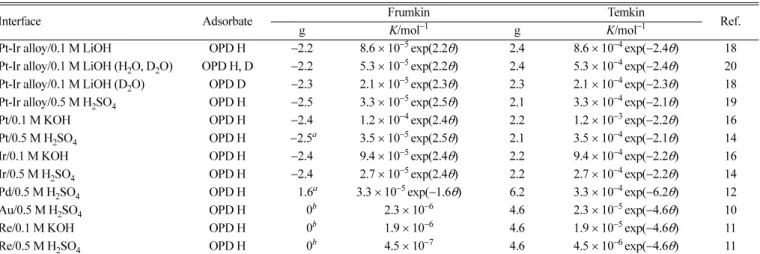
The g and K for the Frumkin and Temkin adsorption isotherms of OPD H and OPD D at the noble metal and alloy/H2O and D2O solu- tion interfaces are summarized in Table 2.
4-3. The correlation constants between the Temkin and Frumkin or Langmuir adsorption isotherms
For 0.2 < θ < 0.8, all the Langmuir adsorption isotherms are paral- lel to each other (see Fig. 14). Correspondingly, all the slopes of the Langmuir adsorption isotherms, i.e., all g for the Temkin adsorption isotherms, are the same regardless of the values of K. As summa- rized in Table 2, we have experimentally found that the values of g for the Temkin adsorption isotherms are approximately 4.6 greater
than those for the Langmuir adsorption isotherms (see Fig. 19). Sim- ilarly, the values of g for the Temkin adsorption isotherms are approximately 4.6 greater than those for the Frumkin adsorption iso- therms (see Figs. 15 to 18). Because the Frumkin adsorption isotherm is determined on the basis of the Langmuir adsorption isotherm (see Figs. 10 to 13). In addition, we have experimentally found that Ko for the Temkin adsorption isotherm is approximately 10 times greater than Ko for the correlated Frumkin or Langmuir adsorption isotherm (see Figs. 15 to 19 and Table 2). The values of g and Ko for the Tem- kin adsorption isotherm are approximately 4.6 and 10 times greater than those for the correlated Frumkin or Langmuir adsorption iso- therm, respectively. These factors (ca. 4.6 and 10) can be taken as correlation constants between the Temkin and Frumkin or Langmuir adsorption isotherms.
tion isotherms at the Pt-Ir alloy/0.1 M LiOH (H2O + D2O) solution interface [adapted from Ref. 20]. Experimental data: ■ . The solid curve shows the Frumkin adsorption iso- therm, i.e., K = 5.3 × 10⁻⁵ exp(2.2θ) mol-1. Dashed lines show the Temkin adsorption isotherms (θ vs. E) calculated using Eq. (7) and the correlation constants for (a) g = −4, (b) g = 0, (c) g = 2.4, and (d) g = 8.5 with Ko = 5.3 × 10⁻⁴ mol-1. Note that the Temkin adsorption isotherm, i.e., K = 5.3 × 10⁻⁴ exp(−2.4θ) mol-1, is valid and effective only at 0.2 < θ < 0.8.
2 4
face [adapted from Ref. 14]. Experimental data: ■. The solid curve shows the Frumkin adsorption isotherm, i.e., K = 3.5 × 10⁻⁵ exp(2.5θ) mol−1. Dashed lines show the Temkin adsorp- tion isotherms (θ vs. E) calculated using Eq. (7) and the correla- tion constants for (a) g = −4, (b) g = 0, (c) g = 2.1, and (d) g = 8.5 with Ko = 3.5 × 10⁻⁴ mol−1. Note that the Temkin adsorption isotherm, i.e., K = 3.5 × 10⁻⁴ exp(−2.1θ) mol-1, is valid and effective only at 0.2 < θ < 0.8.
Fig. 17. Comparison of the Frumkin and four fitted Temkin adsorp- tion isotherms at the Ir/0.5 M H2SO4 aqueous solution inter- face [adapted from Ref. 14]. Experimental data: ■. The solid curve shows the Frumkin adsorption isotherm, i.e., K = 2.7 × 10⁻⁵ exp(2.4θ) mol−1. Dashed lines show the Temkin adsorp- tion isotherms (θ vs. E) calculated using Eq. (7) and the cor- relation constants for (a) g = −4, (b) g = 0, (c) g = 2.2, and (d) g = 8.5 with Ko= 2.7× 10⁻⁴ mol-1. Note that the Temkin adsorp- tion isotherm, i.e., K = 2.7 × 10⁻⁴ exp(−2.2θ) mol-1, is valid and effective only at 0.2 < θ < 0.8.
Finally, one can conclude that the Temkin adsorption isotherm correlating with the Frumkin or Langmuir adsorption isotherm, and vice versa, is readily determined using the correlation constants. The two different adsorption isotherms, i.e., the Temkin and Frumkin or Langmuir adsorption isotherms, appear to fit the same data regard- less of their adsorption conditions. This is a unique feature between the Temkin and Frumkin or Langmuir adsorption isotherms.
4-4. Applicability of the Langmuir and Temkin adsorption isotherms
The applicability of the Langmuir adsorption isotherm of OPD H and OPD D at the Pt-Ir alloy/0.1 M LiOH (H2O + D2O) solution interface is described elsewhere [20]. As shown in Figs. 10d, 11d,
12d, and 13c, the Langmuir adsorption isotherm is not applicable to the adsorption of OPD H and OPD D or OPD H at the interface. At extreme values of θ, i.e., θ ≈ 0 and 1, the Langmuir adsorption iso- therm is often applicable to the adsorption of intermediates. However, the validity and correctness of the Langmuir adsorption isotherm are unclear and limited even at θ ≈ 0 and 1. As stated in the introduction, the values of g and Ko for the Frumkin adsorption isotherm are not experimentally and readily determined using other conventional methods, so the Langmuir adsorption isotherm is often used even though it has the critical limitation and applicability. To solve these problems, the phase-shift method has been originally developed [8].
In addition, the correlation constants between the Temkin and Frum- kin or Langmuir adsorption isotherms have been experimentally and consistently found [12-20].
As shown in Figs. 15c, 16c, 17c, 18c, and 19c, the Temkin adsorp- tion isotherm is valid and effective only at 0.2 < θ < 0.8. For 0.2 < θ <
0.8, note that the short potential range (ca. 28~37 mV) is difficult to observe in the Temkin adsorption isotherm correlating with the Frumkin or Langmuir adsorption isotherm. At other values of θ, i.e., 0 ≤ θ < 0.2 and 0.8 < θ ≤ 1, only the Frumkin adsorption isotherm is valid and effective. Finally, one can conclude that the Frumkin adsorption isotherm is more useful, effective, and reliable than the Langmuir and Temkin adsorption isotherms.
5. Standard Gibbs Energy of Adsorption
Under the Frumkin adsorption conditions, the relationship between the equilibrium constant (K) and the standard Gibbs energy of adsorp- tion (∆G○) is [26].
2.3RT log K = −∆Gθ○ (8)
For the Pt-Ir alloy/0.1 M LiOH (H2O + D2O) solution interface, use of Eqs. (6) and (8) shows that ∆Gθ○ of OPD H and OPD D is in the range (24.4 ≥ ∆Gθ○≥ 18.9) kJ mol−1 for K = 5.3 × 10⁻⁵ exp(2.2θ) mol−1 and 0 ≤ θ ≤ 1. This result implies an increase in the absolute value of ∆Gθ○, i.e., |∆Gθ○|, of OPD H and OPD D with θ (0 ≤ θ ≤ 1). Note that ∆Gθ○ is a negative number, i.e., ∆Gθ○ < 0 [27]. Table 3 shows ∆Gθ○ of OPD H and OPD D at the noble metal and alloy/H2O and D2O solution interfaces.
6. Interaction Parameters for the Frumkin and Temkin Adsorption Isotherms
6-1. The negative value of the interaction parameter for the Frumkin adsorption isotherm
For the Pt, Ir, and Pt-Ir alloy interfaces [15,16,18-20], the negative values of g shown in Table 2 imply the lateral attractive (g < 0) inter- action between OPD H and OPD D species, which leads to an increase in |∆Gθ○| of OPD H and OPD D with θ (0 ≤ θ ≤ 1) (see Table 3).
This is a unique feature of OPD H and OPD D species at the inter- faces.
Fig. 18. Comparison of the Frumkin and four fitted Temkin adsorp- tion isotherms at the Pd/0.5 M H2SO4 aqueous solution interface [adapted from Ref. 12]. Experimental data: ■. The solid curve shows the Frumkin adsorption isotherm, i.e., K = 3.3 × 10⁻⁵ exp(−1.6θ) mol−1. Dashed lines show the Temkin adsorption isotherms (θ vs. E) calculated using Eq. (7) and the correlation constants for (a) g = −4, (b) g = 0, (c) g = 6.2, and (d) g = 15.2 with Ko = 3.3 × 10⁻⁴ mol-1. Note that the Temkin adsorption isotherm, i.e., K = 3.3 × 10⁻⁴ exp(−6.2θ) mol-1, is valid and effective only at 0.2 < θ < 0.8.
Fig. 19. Comparison of the Langmuir and four fitted Temkin adsorp- tion isotherms at the Au/0.5 M H2SO4 aqueous solution interface [adapted from Ref. 10]. Experimental data: ■. The solid curve shows the Langmuir adsorption isotherm, i.e., K
= 2.3 × 10⁻⁶ mol-1. Dashed lines show the Temkin adsorp- tion isotherms (θ vs. E) calculated using Eq. (7) and the cor- relation constants for (a) g = −4, (b) g = 0, (c) g = 4.6, and (d) g = 13.8 with Ko = 2.3 × 10⁻⁵ mol-1. Note that the Temkin adsorption isotherm, i.e., K = 2.3 × 10⁻⁵ exp(−4.6θ) mol-1, is valid and effective only at 0.2 < θ < 0.8.
The dashed lines of Fig. 10a show that the lateral attractive (g < 0) interaction between OPD H and OPD D species may lead to a two- dimensional phase formation. Taking into account the critical value of g, i.e., g = −4 (see Fig. 10b), for the electrochemical case [27], the values of g, i.e., g > −4 (see Fig. 10c), shown in Table 2 are reasonable.
For more negative values, i.e., g < −4 (see Fig. 10a), the hysteresis loop of two-dimensional phase formation will be observed. Note that g = −4 corresponds to r = −9.9 kJ mol−1 with θ (0 ≤ θ ≤ 1) (see Eq. (5)).
The negative values of g for the Frumkin adsorption isotherms at the Pt, Ir, and Pt-Ir alloy interfaces are qualitatively and quantitatively interpreted elsewhere [15,16,18,20].
6-2. The positive value of the interaction parameter for the Frumkin adsorption isotherm
For the Pd interface [12], the positive value of g shown in Table 2 implies the lateral repulsive (g > 0) interaction between OPD H spe- cies, which leads to a decrease in |∆Gθ○| of OPD H with θ (0 ≤ θ ≤ 1) (see Table 3). The lateral repulsive (g > 0) interaction between OPD
H species at the Pd interface is distinctly different from the lateral attractive (g < 0) interaction between OPD H and OPD D species at the Pt, Ir, and Pt-Ir alloy interfaces. Note that the Pd belongs to the same Pt group metal.
For the Au and Re interfaces [10,11], the lateral interaction between OPD H species is negligible, i.e., g = 0 or g ≈ 0. As previously described, this implies that the Langmuir adsorption isotherm is applicable to the adsorption of OPD H at the interfaces (see Fig. 14).
6-3. The positive value of the interaction parameter for the Temkin adsorption isotherm
Table 2 also shows that all g for the Temkin adsorption isotherms of OPD H and OPD D at the same interfaces are positive values. In other words, all the lateral interactions between OPD H and OPD D species are repulsive. It is not true except the Pd interface. As previ- ously described, the physical meaning of g in the Temkin adsorption isotherm is significantly different from that in the Frumkin adsorp- tion isotherm regardless of their mathematical approximations. This
Au/0.5 M H2SO4 OPD H 0b 2.3 × 10⁻⁶ 4.6 2.3 × 10⁻⁵ exp(−4.6θ) 10
Re/0.1 M KOH OPD H 0b 1.9 × 10⁻⁶ 4.6 1.9 × 10⁻⁵ exp(−4.6θ) 11
Re/0.5 M H2SO4 OPD H 0b 4.5 × 10⁻⁷ 4.6 4.5 × 10⁻⁶ exp(−4.6θ) 11
aAdapted for this work. bLangmuir adsorption isotherm. Note that the values of g and Ko for the Temkin adsorption isotherm are approximately 4.6 and 10 times greater than those for the correlated Frumkin or Langmuir adsorption isotherm, respectively. All the Temkin adsorption isotherms are valid and effective only at 0.2 < θ < 0.8
Table 3. Comparison of the standard Gibbs (∆Gθ○) energies of adsorption and the rates (r) of change of ∆Gθ○with θ (0 ≤ θ ≤ 1) for the Frumkin adsorption isotherms of OPD H and OPD D at the noble metal and alloy/normal (H2O) and heavy water (D2O) solution interfaces
Interface Adsorbate ∆Gθ○/kJ mol−1 r/kJ mol−1 Ref.
Pt-Ir alloy/0.1 M LiOH OPD H 23.2 ≥ ∆Gθ○≥ 17.7 −5.5 18
Pt-Ir alloy/0.1 M LiOH (H2O, D2O) OPD H, D 24.4 ≥ ∆Gθ○≥ 18.9 −5.5 20
Pt-Ir alloy/0.1 M LiOH (D2O) OPD D 26.7 ≥ ∆Gθ○≥ 21.0 −5.7 18
Pt-Ir alloy/0.5 M H2SO4 OPD H 25.6 ≥ ∆Gθ○≥ 19.4 −6.2 19
Pt/0.1 M KOH OPD H 22.4 ≥ ∆Gθ○≥ 16.5 −6.0 16
Pt/0.5 M H2SO4 OPD H 25.4 ≥ ∆Gθ○≥ 19.2a −6.2a 14
Ir/0.1 M KOH OPD H 23.0 ≥ ∆Gθ○≥ 17.1 −6.0 16
Ir/0.5 M H2SO4 OPD H 26.1 ≥ ∆Gθ○≥ 20.1 −6.0 14
Pd/0.5 M H2SO4 OPD H 25.6 ≤ ∆Gθ○≤ 29.5a 4.0a 12
Au/0.5 M H2SO4 OPD H 32.2b 0b 10
Re/0.1 M KOH OPD H 32.6b 0b 11
Re/0.5 M H2SO4 OPD H 36.2b 0b 11
aAdapted for this work. bLangmuir adsorption isotherm
is the critical limitation of the Temkin adsorption isotherm of OPD H and OPD D at the Pt group metal and alloy interfaces.
7. Summary
The Frumkin, Langmuir, and Temkin adsorption isotherms (θ vs.
E) cannot be experimentally and readily determined using conven- tional methods. At present, the phase-shift method and correlation constants seem to be the most accurate, useful, and effective tech- niques for determining the Frumkin, Langmuir, and Temkin adsorp- tion isotherms of intermediates (OPD H, OPD D, OH, etc.) for the sequential reactions (HER, DER, OER, etc.) and related electrode kinetic and thermodynamic parameters (θ vs. E, K, g, ∆Gθ○, r) at electrode/normal (H2O) and heavy water (D2O) solution interfaces.
For the Pt, Ir, and Pt-Ir alloy interfaces, the lateral attractive (g < 0) interaction between OPD H and OPD D species is determined. In contrast to the Pt, Ir, and Pt-Ir alloy interfaces, the lateral repulsive (g
> 0) interaction between OPD H species is determined at the Pd inter- face. For the Au and Re interfaces, the lateral interaction between OPD H species is negligible (g = 0 or g ≈ 0).
For 0.2 < θ < 0.8, the Temkin adsorption isotherm correlating with the Frumkin or Langmuir adsorption isotherm, and vice versa, is readily determined using the correlation constants. The Temkin and Frum- kin or Langmuir adsorption isotherms appear to fit the same data regardless of their adsorption conditions. This implies that the Frum- kin adsorption isotherm is the most useful, suitable, and correct for studying the adsorption processes of intermediates for the sequential reactions at the interfaces.
Finally, we expect that reliable simulations with a single equation for (−ϕ vs. θ) as functions of E and f or relevant experimental data for the phase-shift method and correlation constants will be obtained and interpreted using other conventional methods. We also expect that this review article should support and encourage the investiga- tors in the fields of interfacial electrochemistry, electrode kinetics, hydrogen technology, EIS, and fuel cells.
Acknowledgments
Figures 1, 3, and 4 and the section on theoretical and experimental backgrounds of the phase-shift method were reprinted with permis- sion from the Journal of Chemical & Engineering Data 55, 2363- 2372, 5598-5607 (2010) and 56, 251-258 (2011). Copyright 2010 and 2011, the American Chemical Society (ACS). Figures 2, 7, 9 and Table 1 were appeared in the Developments in Electrochemistry (InTech, 2012). Figures 5, 11-13, 16-18 were reprinted and adapted with permission from the International Journal of Hydrogen Energy 32, 1982-1990 (2007) and 33, 4962-4965 (2008). Figures 6, 14, and 19 were reprinted and adapted with permission from the Journal of the Electrochemical Society 150, E207-217 (2003). Copyright 2003, The Electrochemical Society (ECS). The authors wish to thank the ACS, the InTech, the International Association for Hydrogen Energy
(IAHE), and the ECS.
References
1. Gileadi, E., Kirowa-Eisner, E. and Penciner, J., “Interfacial elec- trochemistry,” Addison-Wesley: Reading, MA, 1975.
2. Bockris, JO’M. and Khan, S. U. M., “Surface electrochemis- try,” Plenum Press: New York, 1993.
3. Conway, B. E. and Jerkiewicz, G., Eds., “Electrochemistry and materials science of cathodic hydrogen absorption and adsorption,”
Electrochemical Society Proceedings, Vol. 94-21; The Electro- chemical Society: Pennington, NJ, 1995.
4. Jerkiewicz, G. and Marcus, P., Eds., “Electrochemical surface science and hydrogen adsorption and absorption,” Electrochemi- cal Society Proceedings, Vol. 97-16; The Electrochemical Soci- ety: Pennington, NJ, 1997.
5. Jerkiewicz, G., “Hydrogen sorption at/in electrodes,” Prog. Surf.
Sci., 57, 137-186(1998).
6. Jerkiewicz, G., Feliu, J. M. and Popov, B. N., Eds., “Hydrogen at surface and interfaces,” Electrochemical Society Proceedings, Vol. 2000-16; The Electrochemical Society: Pennington, NJ, 2000.
7. Jerkiewicz, G., “Electrochemical hydrogen adsorption and absorp- tion. Part 1: Under-potential deposition of hydrogen,” Electrocatal., 1, 179-199(2010).
8. Chun, J. H., “Methods for estimating adsorption isotherms in electrochemical systems,” U.S. Patent 6,613,218(2003).
9. Chun, J. H. and Ra, K. H., “The phase-shift method for the Frumkin adsorption isotherms at the Pd/H2SO4 and KOH solution interfaces,” J. Electrochem. Soc., 145, 3794-3798(1998).
10. Chun, J. H., Ra, K. H. and Kim, N. Y., “Langmuir adsorption isotherms of over-potentially deposited hydrogen at poly-Au and Rh/H2SO4 aqueous electrolyte interfaces; Qualitative analysis using the phase-shift method,” J. Electrochem. Soc., 150, E207- 217(2003).
11. Chun, J. H., Jeon, S. K., Ra, K. H. and Chun, J. Y., “The phase- shift method for determining Langmuir adsorption isotherms of over-potentially deposited hydrogen for the cathodic H2 evolu- tion reaction at poly-Re/aqueous electrolyte interfaces,” Int. J.
Hydrogen Energy, 30, 485-499(2005).
12. Chun, J. H., Jeon, S. K. and Chun, J. Y., “The phase-shift method and correlation constants for determining adsorption isotherms of hydrogen at a palladium electrode interface,” Int. J. Hydrogen Energy, 32, 1982-1990(2007).
13. Chun, J. H., Kim, N. Y. and Chun, J. Y., “Determination of adsorp- tion isotherms of hydrogen and hydroxide at Pt-Ir alloy electrode interfaces using the phase-shift method and correlation con- stants,” Int. J. Hydrogen Energy, 33, 762-774(2008).
14. Chun, J. Y. and Chun, J. H., “Correction and supplement to the determination of the optimum intermediate frequency for the phase-shift method [Chun et al., Int. J. Hydrogen Energy 30 (2005) 247-259, 1423-1436],” Int. J. Hydrogen Energy, 33, 4962-4965 (2008).
15. Chun, J. Y. and Chun, J. H., “A negative value of the interaction parameter for over-potentially deposited hydrogen at Pt, Ir, and Pt-Ir alloy electrode interfaces,” Electrochem. Commun., 11, 744- 747(2009).
16. Chun, J., Lee, J. and Chun, J. H., “Determination of adsorption
adsorption isotherms of over-potentially deposited hydrogen on a Pt-Ir alloy in H2SO4 aqueous solution using the phase-shift method and correlation constants,” J. Chem. Eng. Data, 56, 251- 258(2011).
20. Chun, J. and Chun, J. H., In “Developments in electrochemis- try,” Chun, J. H. ed., InTech, Rijeka, 2012, Ch. 1, pp. 3-27 (http://
www.intechopen.com/books/developments-in-electrochemistry).
ory,” Electrochim. Acta, 32, 1703-1712(1987).
25. Gileadi, E., “Electrode Kinetics,” VCH: New York, 1993, pp.
293-296.
26. Gileadi, E., “Electrode Kinetics,” VCH: New York, 1993, pp.
261-271.
27. Gileadi, E., “Electrode Kinetics,” VCH: New York, 1993, pp.
303-305.
![Fig. 4. Comparison of the phase-shift curves (−ϕ vs. log f ) for dif- dif-ferent potentials (E) at the Ir/0.1 M KOH aqueous solution interface [16]](https://thumb-ap.123doks.com/thumbv2/123dokinfo/5405263.218992/4.892.476.809.377.728/comparison-phase-curves-ferent-potentials-aqueous-solution-interface.webp)
![Fig. 9. Comparison of the normalized rates of change of −ϕ and θ with respect to E, i.e., Δ(−ϕ)/ΔE and Δθ/ΔE, for four different frequencies at the Pt-Ir alloy/0.1 M LiOH (H 2 O + D 2 O) solution interface [20]](https://thumb-ap.123doks.com/thumbv2/123dokinfo/5405263.218992/6.892.152.742.126.580/comparison-normalized-change-respect-different-frequencies-solution-interface.webp)